
Published: October 2025 | Last updated: May 2026 | Editorial review and quality control: Martina N.
What does primary syphilis look like, and when should I test?
Primary syphilis usually shows up as a single firm, painless sore called a chancre, most often 2 to 4 weeks after exposure. Blood antibody tests are most reliable 6 to 12 weeks after exposure. A negative result before week 3 should be repeated at the 6 to 12 week mark to rule infection out.
A small firm bump shows up where you weren't expecting one, and it behaves oddly: no pain, no itch, just a slight firmness under the skin that feels different from the usual pimple. Three weeks later it is gone on its own. For most people that bump turns out to be exactly what they assumed: an ingrown hair, a friction sore, a folliculitis spot, a cold sore about to surface. For a small but meaningful number of people, it was the first and only obvious sign of primary syphilis, an infection that gets harder to treat the longer it sits unnoticed.
This guide is for the second group, and for everyone who isn't sure which group they belong to. We'll walk through what a primary syphilis chancre actually looks like, how the infection passes between bodies (including through oral sex alone), why a painless sore that disappears on its own is not the same thing as the infection clearing, when antibody-based blood testing becomes reliable after a possible exposure, and what to do if your result comes back positive. No moralizing, no scare scripts, just the timing math and the visual clues you need to make a calm decision.
Key Takeaways
- A primary syphilis chancre is typically painless, single, and firm; it lasts 3 to 6 weeks and heals on its own even though the bacteria are still spreading internally.
- Antibody-based syphilis blood tests are most reliable 6 to 12 weeks after exposure; a negative result before week 3 does not mean you are uninfected.
What a Primary Syphilis Chancre Looks Like
Syphilis is caused by a corkscrew-shaped bacterium called Treponema pallidum. It enters the body through tiny breaks in skin or through a mucous membrane during oral, vaginal, or anal sex, and it can also pass through skin-to-skin contact with an existing sore. After an incubation period that runs about 10 to 90 days with a median of 21 to 25 days according to the StatPearls clinical overview, the body produces a single localized lesion at the entry point. That lesion is called a chancre, and it has a fairly specific look once you know what to compare it against.
A textbook primary chancre is round or oval, has smooth raised edges, feels firm and rubbery when you press around it, and has a clean center that may look pink, glossy, or slightly ulcerated. It is almost always painless. It is almost always single (one sore, not a cluster). It tends to sit on the skin or mucosa exactly where contact happened: the vulva, vaginal walls, cervix, penis, foreskin, scrotum, anus, rectum, lips, tongue, or back of the throat. The CDC describes the sore as firm, round, and painless, and notes it is easy to miss entirely (CDC: About Syphilis). Regional lymph nodes near the sore (groin, neck) can be slightly swollen but are usually not tender.
That painlessness is why the chancre gets missed so often. People expect an STI sore to hurt, itch, or look angry. A primary chancre does none of those things. It just sits there for three to six weeks and then heals without treatment, leaving the impression that whatever it was is over. The bacteria, by that point, have already moved into the lymphatic system and bloodstream and are setting up for the secondary stage. The usual look-alikes behave differently: a cold sore from herpes simplex shows up as a cluster of small fluid-filled blisters on a red base that tingle, then crust over within a week; a canker sore lives inside the mouth on soft mucosa with a white-yellow base ringed by a thin red halo and stings against acidic food. Neither has the firm, painless, single-ulcer character of a chancre.
Why a Painless Sore Doesn't Mean You're Safe
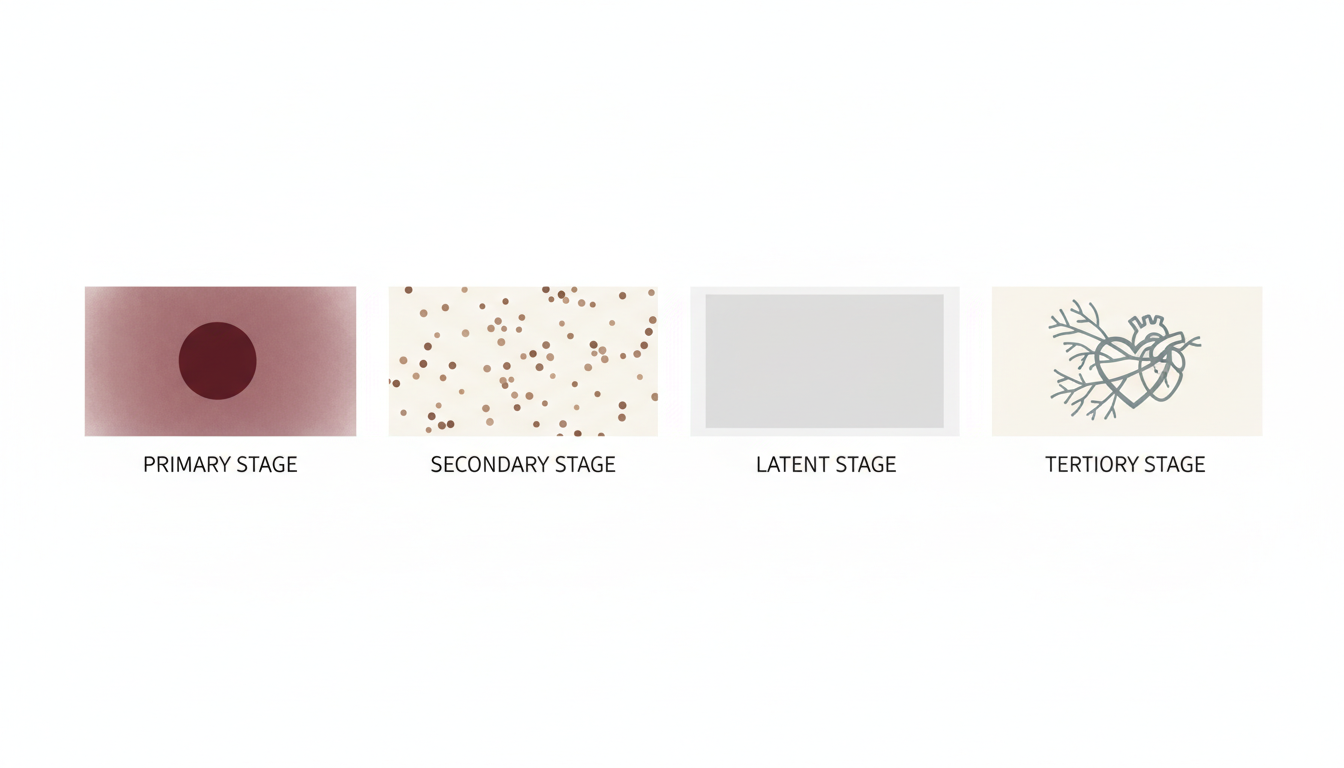
The hardest concept to internalize about primary syphilis is that the sore healing is not your immune system winning. The chancre disappears because the bacteria have moved on, not because they've been cleared. Untreated, primary syphilis progresses to a secondary stage that typically appears 2 to 8 weeks after the disappearance of the primary chancre, according to the StatPearls clinical overview.
Secondary syphilis is where the infection becomes systemic. Common features include a non-itchy reddish-brown rash that often shows up on the palms of the hands and the soles of the feet, a pattern the NHS describes as one of the more recognizable signs because other rashes rarely behave that way, along with patchy hair loss, mucous patches in the mouth and on the genitals, swollen lymph nodes throughout the body, low-grade fever, sore throat, and fatigue. Those varied, easily-mistaken presentations are why syphilis earned the old nickname "the great imitator." These symptoms also resolve on their own in weeks to months, and the infection then enters a latent stage where the person has no symptoms at all but blood tests still detect antibodies. Latent syphilis can sit quietly for years.
If still untreated, between 25 and 40 percent of people with untreated syphilis may eventually develop tertiary disease, though it can take 20 or 30 years to become clinically apparent, per the StatPearls clinical overview. Tertiary syphilis can damage the heart and large blood vessels, the brain and spinal cord (neurosyphilis), the eyes (ocular syphilis), and the inner ear, and some of that damage is permanent. The good news is the entire progression is preventable. Treatment with a single intramuscular dose of long-acting benzathine penicillin G cures primary, secondary, and early latent syphilis, according to the CDC's primary and secondary syphilis treatment guidelines.
If a chancre healed weeks or months ago and any of these now appear, treat them as a single picture rather than separate problems: a non-itchy reddish-brown rash on the palms or soles, patchy hair loss along the scalp or beard, smooth gray-white patches in the mouth or on the genitals, broadly swollen lymph nodes, low-grade fever, sore throat, or unusual fatigue. Most resolve on their own, and that is not a sign the infection has cleared.
How the Infection Spreads, Including Through Oral Sex
Syphilis passes through skin-to-skin or mucous-membrane contact with an active sore. That includes vaginal sex, anal sex, and oral sex in either direction. No penetration, no ejaculation, and no exchange of fluid is required for transmission. A chancre on a partner's lip, tongue, throat, penis, vulva, or anus can transfer the bacterium during contact, and the giving partner is just as exposed as the receiving partner (CDC: About Syphilis).
Oral transmission is the route most people underestimate. The sore on a partner can sit inside the mouth or on the back of the throat where neither of you sees it, and the chancre itself does not warn the person who has it. Without pain, an unfamiliar bump in the mouth gets brushed off as a bite, a coffee burn, or a stress canker, and the infected person stays unaware that they are passing the bacterium on. The same logic applies to chancres inside a foreskin, on a cervix, or just inside the anus: visible to a clinician with the right angle, easy to miss in a self-check.
This is why exposure history matters more than partner type when you're deciding whether to test. A regular partner you trust can be an unknowing carrier from an earlier contact. A one-time encounter you took safer-sex precautions for can still transmit syphilis if there was a sore outside the barrier's coverage.
Condoms and dental dams reduce transmission risk, but only for the area they cover. A chancre at the corner of a partner's mouth, at the base of the shaft, on the scrotum, or just outside the labia sits outside the protected zone.
When to Test for Syphilis After Exposure: The Timing Math
Syphilis testing is not about looking for the bacteria directly. Standard screening tests look for antibodies your immune system produces in response to Treponema pallidum, and your body needs time to make those antibodies in detectable quantities. Test too early and the antibodies haven't ramped up yet; the test reads negative even though you are infected. Test after the chancre has already healed, and blood antibody testing still works fine. The window where you risk a false negative is roughly the first three weeks after exposure, which is why a private option like an at-home syphilis test is most informative once you're past that early window.
Two test families are used: treponemal tests (which detect antibodies specific to T. pallidum) and non-treponemal tests like RPR and VDRL (which detect a less specific antibody that rises and falls with disease activity). Modern clinic algorithms combine both. At-home rapid kits are typically treponemal lateral-flow immunoassays based on a fingerstick blood sample. The window-period math below applies to both technologies because antibody production is the rate-limiting step.
| Time since exposure | What's happening internally | What testing can tell you |
|---|---|---|
| 0 to 10 days | Bacteria multiplying at the entry site; immune system has not yet produced detectable antibodies | Testing is generally not useful. A negative result this early carries almost no reassurance. |
| 10 to 21 days | Chancre may appear; antibody production just beginning | Blood antibody tests often still negative. If a sore is visible, a clinic can swab it for direct detection. |
| 3 to 6 weeks | Antibodies reaching detectable levels in most people | Reasonable first testing window. Negative results at 3 weeks should still be confirmed at 6 to 12 weeks. |
| 6 to 12 weeks | Antibody response fully developed in nearly all infected people | Most reliable testing window. A negative test here is meaningfully reassuring. |
| Beyond 12 weeks | Primary chancre long healed; secondary stage may be developing or infection may be latent | Antibody tests remain accurate. Useful if symptoms have appeared or a partner was diagnosed. |
Should You Test Right Now?
Most people who land on a page like this fall into one of three situations, and the right next step is different for each. Use the quick guide below to find where you are, then read on for how to choose a test format.
Do You Need a Syphilis Test Today?
Do you have a painless, firm sore on your lip, mouth, or genitals right now?
Yes: Test now and book a clinic visit regardless of the home result. A clinician can swab an active sore for direct detection, which works even before antibodies appear in the blood.
Was your possible exposure less than 3 weeks ago, with no sore?
Yes: Testing now can ease your mind, but antibodies may not have developed yet. Plan a follow-up test at 6 weeks and again at 12 weeks to close the window before treating yourself as cleared.
Was your possible exposure more than 12 weeks ago, with no symptoms?
Yes: A negative treponemal antibody test now is reasonable evidence you were not infected from that event.
No: If it has been between 3 and 12 weeks, test now for a baseline and retest at the 12-week mark to be sure.
Guidance only, not a diagnosis. A clinician can advise based on your specific situation.
Choosing a Test: At-Home, Mail-In, or Clinic
Where you test matters less than when you test, but the format does affect privacy, cost, and what kinds of follow-up you can layer on. Here's how the three common options compare for someone who suspects a recent exposure or noticed a possible chancre. For routine screening and for people who are not symptomatic, an at-home rapid test is often the most practical starting point; for an active sore, pregnancy, or any sign the infection has moved past the primary stage, a clinic is the better tool.
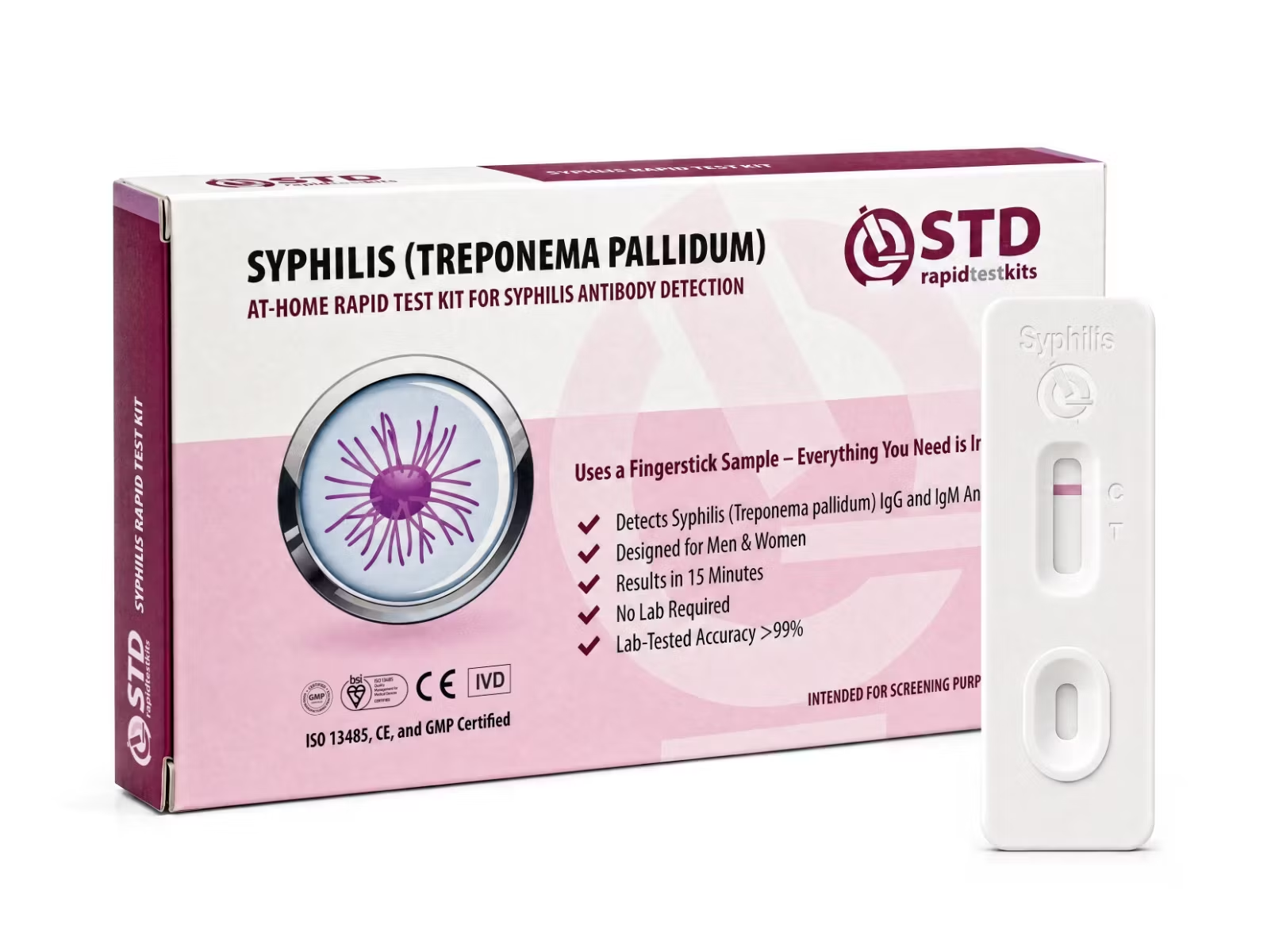
An at-home rapid fingerstick test gives a result in 15 to 20 minutes. A drop of blood from a finger is applied to a lateral-flow cassette that detects treponemal antibodies. The kit is the same kind of chemistry public-health programs have used for syphilis screening in lower-resource settings for years. It carries a flat upfront price with no clinic visit, no copay, no separate lab fee, and no insurance paperwork, and it ships in unmarked packaging.
A mail-in lab kit collects a dried blood spot or small vial and ships it back to a lab that runs the standard treponemal plus non-treponemal panel. Results take 2 to 5 days from when the lab receives the sample. The advantage over a rapid kit is that the lab can run a confirmatory test on the same sample if the screening is positive.
An in-clinic visit gets you a venous blood draw, the full treponemal and non-treponemal algorithm, a swab of any visible sore for direct detection if appropriate, treatment on site if positive, and partner-services support. The trade-offs are scheduling, cost if you're uninsured, and the social friction of walking into a sexual-health clinic if you live somewhere small.
For a typical reader who isn't symptomatic but had a possible exposure 6 or more weeks ago and wants a private answer fast, an at-home rapid test is a sensible first move. If the result is positive, or if a chancre is currently present, follow up with a clinic for confirmation and treatment.
A note on our perspective: this article is published by stdrapidtestkits.com, which sells the at-home rapid syphilis test described below. We recommend products based on fit for the reader's concern, not commercial benefit, and we say so plainly when a clinic visit or a different test is the better tool.
At-Home vs Mail-In vs Clinic Syphilis Testing
| Feature | At-home rapid fingerstick | Mail-in lab kit | In-clinic blood draw |
|---|---|---|---|
| Result time | 15 to 20 minutes | 2 to 5 days after lab receives sample | Same day to a few days |
| Confirmatory test on same sample | No (positive needs lab follow-up) | Yes (lab runs treponemal + non-treponemal) | Yes (full algorithm on one draw) |
| Privacy | High (unmarked packaging) | High (unmarked shipping) | Moderate (clinic visit on record) |
| Cost shape | Flat upfront price, no insurance needed | Flat kit price plus lab processing | Visit, lab, and possible copay; varies by insurance |
| Treatment on site | No | No | Yes (penicillin shot if positive) |
An at-home rapid test trades same-sample confirmation for speed, privacy, and a flat price; a positive result from any home or mail-in test should be confirmed at a clinic.
Syphilis Isn't a Niche-Population Disease Anymore
The public image of syphilis as something that only affects specific populations has not matched the data for years. Recent record-high case totals across the U.S. show sharp increases in cisgender women of reproductive age and a corresponding rise in congenital syphilis (newborns infected in the womb), per CDC STI surveillance data. Men who have sex with men still account for a substantial share of cases in urban areas, but the disease is no longer concentrated in any one group.
Congenital syphilis cases in the United States reached the highest single-year total since 1994 in recent surveillance, according to the CDC's congenital syphilis page. Globally, the World Health Organization estimates millions of new adult syphilis infections each year and has flagged the trend as a public-health concern across multiple regions (WHO Syphilis fact sheet). For a person looking at a sore on their lip, assumptions about who gets syphilis are a poor filter for whether to test.
If you've been hesitant to test because syphilis doesn't fit the picture you have of who gets it, the surveillance data says reset that assumption. Cases are rising in heterosexual women, in pregnant people, in newborns, and across age groups outside the populations most commonly associated with STI screening.
What Happens If You Skip Testing
The question that drives most syphilis-curious readers to this kind of article is some version of "the sore went away, am I fine?" The honest answer is that you can't know without testing, because primary syphilis is the only stage with an obvious external sign and that sign disappears on its own. After the chancre heals, syphilis becomes a blood-test-only diagnosis until a secondary rash appears (which not everyone notices) or until much later when complications begin.
The progression from primary to tertiary syphilis is well-characterized but not deterministic. Plenty of untreated people pass through latent syphilis and never develop tertiary disease. The trouble is that no one can tell in advance which group they'll be in, and the people who do progress lose function (cardiovascular, neurological, sensory) that no later treatment can fully restore. Catching syphilis at the primary or early latent stage means a single penicillin injection and a follow-up blood test at 6 and 12 months. Catching it after years of latency means treatment that may take longer, plus the small but real chance of irreversible damage already underway.
None of this is meant to alarm someone who had a fleeting bump and is otherwise healthy. Most cases resolve uneventfully with timely testing and a single dose of penicillin if needed.
If Your Test Comes Back Positive (Including a Faint Line)
One detail worth knowing up front: a lateral-flow rapid test reads a faint line the same way it reads a strong line, as a positive ("reactive") result. The intensity of the line correlates loosely with antibody concentration, but any visible test line within the timer window is reactive, not a maybe. If you see any line at all in the test area, treat the result as positive and follow up.
A positive syphilis result at the primary or secondary stage is one of the most treatable findings in adult infectious disease. The standard regimen is benzathine penicillin G 2.4 million units IM in a single dose, with clinical and serologic evaluation at 6 and 12 months after treatment, per the CDC's primary and secondary syphilis treatment guidelines. For people with a true penicillin allergy, doxycycline by mouth for 14 days is an alternative for early stages, though desensitization to penicillin is preferred when possible because of efficacy. One safety note before that appointment: do not try to self-treat with leftover antibiotics. Partial or wrong-drug courses can lower the antibody signal without curing the infection, which makes confirmatory testing harder to interpret and leaves the bacteria active in the body. Pregnant people with syphilis should always be treated with penicillin (with desensitization if allergic) because doxycycline is unsafe in pregnancy and untreated maternal syphilis causes congenital syphilis in the baby.
After treatment, providers schedule follow-up non-treponemal blood tests (RPR or VDRL) at 6 and 12 months to confirm the antibody titer is dropping. A four-fold drop is the standard marker of successful treatment. The treponemal antibody test will likely stay positive for life, which is why retesting after re-exposure relies on changes in the non-treponemal titer or on direct testing of any new sore.
Two practical notes. First, you can be reinfected. Successful treatment does not produce immunity, and a fresh exposure starts the clock over. Second, in the 24 hours after the first penicillin shot, some people develop a flu-like reaction (fever, headache, muscle aches, mild rash) called a Jarisch-Herxheimer reaction. It's caused by dying bacteria and resolves on its own; it isn't an allergy and doesn't mean treatment is failing.
Confirm with a lab test if you used a rapid kit. Schedule treatment promptly (most clinics can do same-day or next-day for early-stage syphilis). Notify recent partners, ideally going back at least three months for primary syphilis (longer for later stages). Plan follow-up bloodwork at 6 and 12 months. Hold off on sex until two weeks after your treatment shot.
How to Tell Partners Without Making It Weird
Partner notification is the part most people dread, and it's also the part with the most room for kindness. The reason it matters is straightforward: someone you've been sexually involved with may also be infected and may not yet know, and treating them prevents them from passing the infection further (including back to you). Many clinics and public-health departments offer anonymous partner-notification services that contact people on your behalf without naming you, which is genuinely useful when the relationship is awkward, ended badly, or you don't have current contact information.
If you're notifying someone yourself, brevity beats explanation. A message like "Hey, I just got tested and found out I have syphilis. I'm getting treated. I wanted you to know so you can get tested and treated too if needed. Happy to answer questions." covers everything that matters. You don't owe a backstory, a timeline reconstruction, or an apology. Bacteria carry no record of how they got from body to body.
The CDC's general guidance is to notify partners going back at least three months for primary syphilis, six months for secondary, and one year for early latent. If that timeline feels unmanageable, your local sexual-health clinic can help you think it through and offer the anonymous-notification option for partners you'd rather not contact directly.
Without treatment, syphilis can spread to the brain, nervous system, eyes, and ears. Penicillin is the recommended treatment at all stages.
Retesting and Long-Term Follow-Up
For someone who tested in the early window (before 6 weeks) and got a negative result, retesting at 6 to 12 weeks is the right move. The first test was a baseline; the second is the one that actually rules out infection. Many clinicians recommend an interim test at 6 weeks plus a final test at 12 weeks for added reassurance, especially if the suspected exposure was high-risk.
For someone who tested positive and was treated, follow-up non-treponemal titers at 6 and 12 months confirm the treatment worked. For someone with ongoing exposure risk (multiple partners, partners with unknown status, condomless sex), routine screening every 3 to 6 months is what major sexual-health bodies recommend, and that's true regardless of past results. If you're considering or already on PrEP for HIV, syphilis screening is part of the standard lab panel at every PrEP visit. If you're pregnant, syphilis screening at the first prenatal visit is universal in U.S. and U.K. care; many guidelines now recommend a second test in the third trimester for areas with rising syphilis rates.
One last note on combination kits. If your concern after a possible exposure is broader than just syphilis, an integrated panel can be more efficient than testing each infection separately, and our combined at-home STI test kits cover several infections from one purchase. The window-period math is different for each (HIV antigen-antibody tests reach reliable accuracy at 45 days; chlamydia and gonorrhea swabs are useful from about 14 days; syphilis as discussed above), so read the kit instructions for the timing that applies to each component.
What to Do Next, by Situation
Wherever you land in this picture, the next step is concrete. Find the line below that matches your situation and follow it.
Your Next Move After a Sore or a Result
Do you have a painless, firm sore on your lip, mouth, or genitals right now?
Yes: Book a clinic visit today regardless of any home-test result. A clinician can swab an active sore for direct detection, which works even before antibodies appear in your blood.
Did a home rapid test show any visible line in the result area?
Yes: Treat it as positive. Book a clinic for a confirmatory lab panel and, if confirmed, a single penicillin injection. Hold off on sex until treatment is complete, and notify partners going back at least three months for primary syphilis.
Were you recently treated for syphilis?
Yes: Schedule follow-up non-treponemal blood titers at 6 and 12 months to confirm the infection cleared, and plan routine rescreening if you have ongoing exposure risk.
No: If your exposure was 3 to 12 weeks ago with no sore, test now for a baseline and retest at the 12-week mark before treating yourself as cleared.
Practical next steps only. A clinician confirms and treats; this is how to get there.
Frequently asked questions
- Can a syphilis sore really be painless?
- Yes, and that's the textbook presentation. Primary chancres are usually painless, single, firm to the touch, and don't itch. People often mistake them for an ingrown hair, a friction sore, or a small cyst because nothing about them demands attention. Lack of pain is one of the features that distinguishes a chancre from a herpes outbreak (which is typically painful and clustered) or a routine pimple (which is usually tender).
- How fast do syphilis symptoms show up after exposure?
- Per the StatPearls clinical overview, the incubation period is about 10 to 90 days with a median of 21 to 25 days. Most people who develop a primary chancre see it somewhere between week 2 and week 4 post-exposure. The sore then lasts 3 to 6 weeks before healing on its own. If you're tracking timing for a specific exposure, week 3 to week 6 is when a chancre is most likely to be visible.
- How do I tell a syphilis chancre apart from a herpes sore?
- The character is opposite. A chancre is single, painless, firm to the touch, with a clean rolled border. A herpes outbreak is a cluster of small painful blisters on a red base that break and crust over within a week. Painful clusters point to herpes; painless single ulcers point to syphilis. Neither rule is absolute, which is why testing is what closes the question.
- Can syphilis really spread through oral sex alone?
- Yes. A chancre on a partner's lip, tongue, gums, tonsils, or back of the throat can pass the bacterium during oral contact, and a chancre on the giving partner's genitals can pass it to the receiver's mouth. No penetration or fluid exchange is required. Oral chancres are easy to miss because they may look like a canker sore or get blamed on a bitten cheek. Condoms and dental dams reduce risk but only protect the area they cover.
- If the bump healed on its own, am I in the clear?
- No. The disappearing sore is a sign of progression, not clearance. Once the bacteria move from the entry site into the bloodstream and lymphatic system, the visible sore resolves on its own while the infection stays active. A blood test is the only way to know your current status, since untreated syphilis can reach the secondary stage within a couple of months of the chancre fading.
- How is syphilis treated?
- Primary, secondary, and early latent syphilis are cured with a single intramuscular injection of benzathine penicillin G, 2.4 million units, per the CDC's treatment guidelines. People with a documented penicillin allergy may receive doxycycline by mouth for 14 days as an alternative for early stages, outside of pregnancy. Pregnant people who are allergic should be desensitized and treated with penicillin rather than switched to another drug. After treatment, clinicians recheck blood titers at 6 and 12 months to confirm the infection cleared.
- Is a faint line on a rapid test still a positive result?
- Yes, treat any visible band as reactive. Unlike tests where line darkness carries clinical meaning, a syphilis lateral-flow strip gives a binary read: line present or absent. Even a barely visible band that appears within the timer window counts as positive. The next step is a clinic appointment for a quantitative lab test that can measure the actual antibody titer and serve as a baseline for tracking treatment response later.
- When should I retest if my first home test was negative?
- If your first test was inside the 3-week window, retest at 6 weeks and again at 12 weeks. Those two checkpoints close the antibody-window gap for most people, since seroconversion typically completes within 12 weeks of exposure. A negative result at 12 weeks in someone with no symptoms is meaningfully reassuring.
- How accurate are at-home rapid syphilis tests?
- Modern lateral-flow rapid treponemal tests perform well once the antibody response has developed, which is why they are most reliable 6 to 12 weeks after exposure. Published evaluations of rapid treponemal tests generally report sensitivity in the mid-to-high 90s and specificity above 99 percent when the test is used inside its validated window; the product page lists the specific figures for the kit we sell. These are screening tests rather than confirmatory diagnostics, so a positive result should be followed up with a clinic-based lab test that runs both a treponemal and non-treponemal assay. The biggest source of error with home tests is timing: a negative result before week 3 carries very little weight.
- U.S. National Library of Medicine, StatPearls. Syphilis: clinical overview covering incubation period (10 to 90 days, median 21 to 25), primary chancre presentation, secondary stage timing 2 to 8 weeks after chancre disappearance, and 25 to 40 percent progression to tertiary disease.
- U.S. Centers for Disease Control and Prevention. Sexually Transmitted Infections Treatment Guidelines, Primary and Secondary Syphilis: dosing of benzathine penicillin G 2.4 million units IM, doxycycline alternative, penicillin desensitization in pregnancy, and follow-up serology at 6 and 12 months.
- U.S. Centers for Disease Control and Prevention. About Syphilis: stages of infection, the firm, round, painless chancre, transmission routes (including oral sex), and screening guidance.
- U.S. Centers for Disease Control and Prevention. About Congenital Syphilis: recent annual case counts and prevention guidance for syphilis in pregnancy.
- U.S. Centers for Disease Control and Prevention. STI Statistics: surveillance data showing recent record-high syphilis case totals in the U.S. across multiple demographic groups.
- World Health Organization. Syphilis fact sheet: global epidemiology, transmission routes, and stage-by-stage clinical features.
- U.K. National Health Service. Syphilis: chancre presentation, secondary rash on palms and soles, and U.K. testing and treatment pathway.
