How Soon Should You Get Tested After Unprotected Sex?
You can buy a test today and run it tonight, but that does not mean today's result tells the truth about an exposure that happened yesterday. STI tests need time to detect an infection. This guide breaks down the window period for HIV, chlamydia, gonorrhea, herpes, syphilis, and hepatitis, explains which test works earliest, and shows when to retest before you trust a negative.




- Different STIs have different window periods. The day-after panic test rarely catches anything because the body has not yet produced a detectable signal.
- Plan two tests, not one: an early baseline at the right interval for each infection, plus a confirmation at 90 days (or 6 months for hepatitis) before you treat yourself as cleared.
Published: October 2025 | Last updated: April 2026 | Editorial review and quality control: Martina N.
The first 24 hours after a risky encounter are the worst kind of waiting. You want answers immediately. The problem is that no STI test can give a true answer that early. Most rapid tests work by detecting either the body's immune response or a specific organism in a sample, and both of those signals take days to weeks to build up to a level a test strip can read. Testing the day after sex usually returns a clean result for the wrong reason: the infection might be there, but your body has not yet produced enough of the marker that the test is calibrated to detect.
This guide walks through the actual window periods for each common STI, explains why those windows exist, lists which test works earliest for each, and gives you a retest schedule you can plan around. The goal is one calm two-step plan, not a panic-driven test that you cannot trust.
How soon should you get tested for STIs after unprotected sex?
Most rapid STI tests need a window period before they can detect a new infection. The earliest reliable windows are: 5 to 7 days for chlamydia and gonorrhea swabs, 10 to 14 days for an HIV RNA test at a clinic, 18 to 45 days for a clinic fourth-generation HIV antibody/antigen combo (which catches the p24 antigen earlier than antibody alone), 23 to 90 days for a home rapid antibody-only HIV test, 3 to 6 weeks for syphilis, 4 to 6 weeks for HSV-2 antibodies, and 4 to 10 weeks for hepatitis B (HBsAg). A negative result inside the window can be a false negative, so the standard plan after a single high-risk exposure is an early test plus a confirmatory retest at 90 days for HIV, syphilis, and bacterial infections, and at 6 months for hepatitis B and C.
Key Takeaways
- Different STIs have different window periods. The day-after panic test rarely catches anything because the body has not yet produced a detectable signal.
- Plan two tests, not one: an early baseline at the right interval for each infection, plus a confirmation at 90 days (or 6 months for hepatitis) before you treat yourself as cleared.
Why testing right after sex usually misses an early infection
Most sexually transmitted infections take time to become detectable. The reason has nothing to do with how aggressive the infection is and everything to do with how rapid tests work. Antibody tests look for the body's immune response, which takes weeks to develop. Antigen tests look for viral or bacterial proteins that need to reach a measurable concentration. Even bacterial swabs that detect the organism directly need enough cells in the sample to register a positive line. None of those signals exist on day one.
The biology is simple. After exposure, an infectious organism establishes itself in the genital tract or the bloodstream. The immune system starts producing antibodies. Those antibodies build up over days to weeks. Tests are calibrated to read a threshold concentration, so until the immune response crosses that line, the test reads negative even when the infection is present. Doctors call the gap between exposure and detectable result the window period.
Testing too early is one of the most common reasons people end up with a false negative result, then unknowingly transmit the infection to a partner before symptoms force them back for a second test.
Different test technologies look for different signals, and each takes its own time to become detectable in a fresh infection:
- Direct organism detection (NAAT, swab antigen): needs a measurable bacterial or viral load at the sample site. Days to about a week for chlamydia and gonorrhea.
- Viral RNA (HIV PCR): needs the virus to replicate to detectable levels in blood. About 10 days.
- Antigen plus antibody combo (HIV 4th-gen): picks up p24 antigen first, antibodies second. About 18 days in clinic chemistry.
- Antibody only (HIV rapid, syphilis, herpes, hepatitis): needs the immune system to seroconvert. Three weeks to several months.
What the window period actually means
The window period is the interval between exposure and the moment a test can reliably detect the infection. It is not a single number for all infections or all tests. Two factors set the window: the biology of the infection (how fast it replicates, how strongly the immune system reacts) and the type of test (looking for the organism directly, looking for an antibody response, or looking for both).
This is why an HIV RNA test can detect virus around 10 days after exposure while an antibody-only test for the same virus might not flip positive for a month. Both are valid tests. They are looking for different signals at different stages of infection. The same logic applies across the board. Chlamydia tests pick up the bacteria quickly because the organism is present at the site of infection within days. Herpes antibody tests need the slowest immune response of any common STI, because the virus is small, local, and slow to provoke a measurable systemic antibody load.
A single negative result inside the window period is not a final answer; it is a snapshot of where your immune system stood on test day.
Window periods for the most common STIs
The table below summarizes the earliest reliable testing window for each common STI by test type, plus the recommended retest point most clinicians use to consider a result final. The timing reflects current guidance from the U.S. Centers for Disease Control and Prevention (CDC STI Treatment Guidelines) and the World Health Organization (WHO STI fact sheet). Note that two different HIV rows below cover the home rapid antibody-only test versus the clinic fourth-generation antibody/antigen combo, which are not the same chemistry and have different earliest-reliable windows.
| Infection | Earliest reliable test | Test type | Final clearance window |
|---|---|---|---|
| HIV | 10 to 14 days | RNA (PCR) test, clinic only | Retest at 45 to 90 days with antibody/antigen |
| HIV | 18 to 45 days | Clinic 4th-generation antibody/antigen combo | 90 days for full clearance |
| HIV | 23 to 90 days | Home rapid antibody-only lateral-flow | 90 days for confirmation |
| Chlamydia | 5 to 7 days | Lab NAAT or rapid swab (home) | 2 weeks if symptoms persist; 3 months after treatment |
| Gonorrhea | 5 to 7 days | Lab NAAT or rapid swab (home) | 2 weeks if symptoms persist; 3 months after treatment |
| Syphilis | 3 to 6 weeks | Treponemal antibody (lab or rapid) | 3 months for confirmation |
| HSV-2 | 4 to 6 weeks | IgG antibody (lab or rapid) | 12 weeks for most; 16 weeks as conservative outer bound |
| Hepatitis B | 4 to 10 weeks | HBsAg (lab or rapid) | 6 months for confirmation |
| Hepatitis C | 8 to 11 weeks (avg) | Antibody (lab or rapid); RNA earlier | 6 months for confirmation |
Two notes that change how you read the table
The window numbers above assume a single isolated exposure tested with the named technology. Two real-world conditions can shift how you should read them: rapid lateral-flow chemistry behaves differently from lab chemistry at low organism loads, and people with ongoing exposures need to anchor the clock to the most recent encounter rather than the first one.
Read the table with these two caveats
- Home rapid lateral-flow tests use the same sample type as their lab counterparts, but lab chemistry (NAAT for bacteria, fourth-generation antigen/antibody for HIV) is more sensitive at low concentrations. Treat a reactive home result as worth confirming at a clinic, and a non-reactive result inside the window period as worth repeating at the clearance interval.
- If you have ongoing exposures, restart the testing clock from the most recent encounter, not the first one. People in open or non-monogamous relationships should plan for routine quarterly screening rather than a single post-exposure test.
When STI symptoms typically start (and why symptoms are not a substitute for testing)
Symptoms can show up before a test turns positive, weeks after, or never at all. Most chlamydia and gonorrhea infections in women cause no symptoms (CDC chlamydia overview), which is why the CDC recommends routine screening even when nothing feels wrong. The symptom timelines below are typical ranges based on CDC clinical guidance. Use them as orientation, not as a reason to skip testing.
| Infection | Typical symptom onset | Common early signs |
|---|---|---|
| Chlamydia | 1 to 3 weeks (often silent) | Burning urination, abnormal discharge, pelvic discomfort |
| Gonorrhea | 2 to 7 days | Yellow or green discharge, painful urination, testicular pain |
| HSV-2 first outbreak | 4 to 12 days | Tingling, painful blisters, regional pain |
| Syphilis (primary) | 10 to 90 days (avg 21) | Painless ulcer (chancre) at exposure site |
| HIV (acute infection) | 2 to 4 weeks | Fever, fatigue, sore throat, rash, swollen glands |
| Hepatitis B / C | Weeks to months (often silent) | Fatigue, abdominal pain, dark urine, jaundice |
Why symptoms are unreliable
The takeaway from the timelines above is uncomfortable: symptoms cannot be trusted as an all-clear signal. Many infections stay silent for years, which is how chlamydia damages fertility before it is caught and how HIV is most commonly transmitted by people who do not know they carry it. Hepatitis C is so consistently asymptomatic that the CDC estimates roughly 40% of adults living with chronic infection in the United States are unaware of their status (CDC hepatitis C overview), which is why universal one-time hepatitis C screening is now recommended for every adult at least once.
If you have symptoms, do not wait for the window period to close. Test now. Many infections, including chlamydia, gonorrhea, and syphilis, are easily curable with a short course of antibiotics, and earlier treatment limits onward transmission. If you do not have symptoms but had a defined high-risk exposure, follow the window-period schedule rather than assuming the absence of symptoms means absence of infection.
Roughly 70% of women with chlamydia have no symptoms; up to 50% of men with gonorrhea report none either. HSV-2 sheds asymptomatically between outbreaks, which is how most genital herpes is transmitted. The CDC's universal one-time hepatitis C screen for every adult is built on the same principle: a meaningful share of infections will never produce a symptom that prompts a test.
Choosing the right type of test
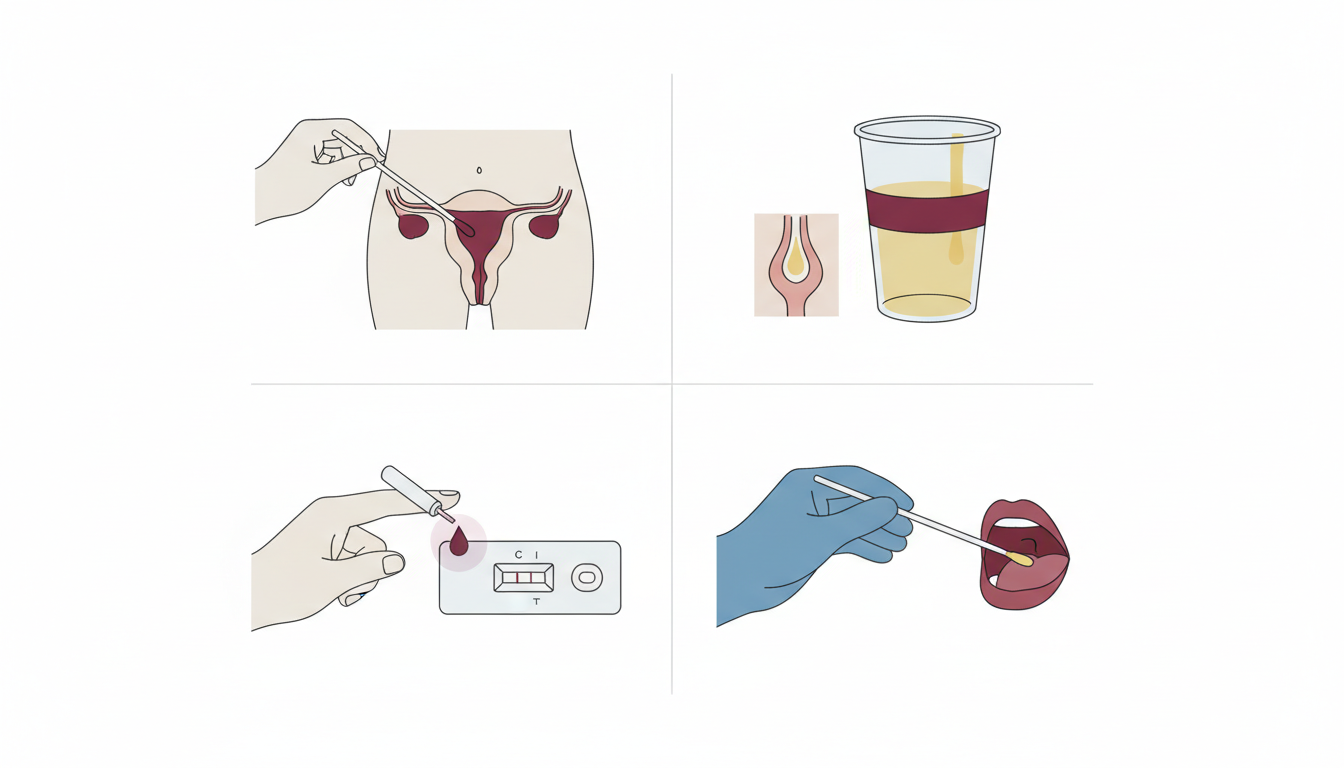
Not every STI uses the same kind of sample. The right test for a given exposure depends on the infection, the anatomy involved, and how recent the encounter was. Four sample types cover almost everything:
Self-collected swab. Used for chlamydia, gonorrhea, trichomoniasis (women only), and HPV (women only). The swab samples cells directly from the genital tract. At-home rapid swab tests use lateral-flow chemistry to detect bacterial antigens; lab tests use NAAT to amplify the organism's DNA, which is why labs detect lower bacterial loads. Both work from day 5 to 7 post-exposure, but the at-home rapid is most reliable with a higher bacterial load (around day 7 to 14, or whenever symptoms appear).
Urine sample. Used in clinics for chlamydia and gonorrhea NAAT. Urine catches genital infections. It does not catch throat or rectal infections, which are common after oral or anal exposure and frequently asymptomatic.
Fingerstick blood. Used for HIV, syphilis, hepatitis B, hepatitis C, and HSV-1/HSV-2 antibodies. The body's immune response or the viral load circulating systemically is what these tests measure. Blood tests have the longest window periods (weeks for some, months for others) because they depend on the immune system finishing its first round of antibody production. At-home rapid blood tests are lateral-flow strips that read antibody presence at threshold concentrations.
Provider-collected throat or rectal swab. If the exposure included oral or anal sex and you are concerned about pharyngeal or rectal chlamydia or gonorrhea, the test for those sites is a clinic-administered swab. We do not sell a rectal or pharyngeal home swab, and we will not pretend that a genital swab covers a throat exposure. For known oral or anal exposure to a positive partner, see a clinic for the right swab site.
At-home rapid test versus clinic test
Both routes work. They differ in speed, sensitivity, and cost. The right choice depends on how soon you need an answer, whether you have symptoms, and how confident you need the final result to be.
At-home rapid tests are lateral-flow cassettes. Sample on the strip, wait 15 minutes, read a control line and a result line. They are fastest, private, and require no clinic visit. The trade-off: lateral-flow chemistry is less sensitive than lab NAAT at low organism loads. A reactive result is meaningful and worth confirming. A non-reactive result inside the window period needs a follow-up at the full clearance window.
Clinic-based screening uses NAAT for bacterial infections, fourth-generation antigen/antibody combo for HIV, and treponemal-plus-non-treponemal pairing for syphilis. The chemistry is more sensitive at lower analyte concentrations, and the result is usually documented in a medical record. The trade-off: it takes 1 to 5 days for results, requires an appointment, and may include a co-pay or out-of-pocket cost depending on insurance.
Mail-in lab kits sit between the two. You collect a sample at home, mail it to a partner laboratory, and get NAAT-grade results in 3 to 5 days. They combine the privacy of home collection with lab sensitivity, but they are slower than rapid tests and slower than walking into a same-day clinic.
A single negative test taken 90 or more days after your last exposure is reliable for HIV, syphilis, and HSV-2 antibodies (the slowest of the major STIs to seroconvert). For chlamydia and gonorrhea, a routine screen at the same point catches the vast majority of asymptomatic infections. If your last exposure was inside an established monogamous relationship and neither partner is symptomatic, you are likely in the population that does not need an urgent retest. Routine annual screening (or quarterly if you have multiple partners) is enough.
What to test for after a specific exposure
The right test panel depends on what kind of contact happened and what your partner's status is. The CDC's general post-exposure screening recommendation includes the four most common bacterial and viral infections plus HIV. Beyond that baseline, add tests based on specific risk factors:
- Vaginal or anal sex (any partner status): chlamydia, gonorrhea, syphilis, HIV, HSV-2 (if symptomatic).
- Oral sex with a known-positive partner: add a pharyngeal swab at a clinic for the matching infection. Home swab kits do not cover throat sites.
- Partner has HIV, hepatitis B, or hepatitis C: add the relevant blood panel and consider PEP (post-exposure prophylaxis) for HIV within 72 hours. PEP is a clinic-only intervention.
- Condom failure or unknown partner status: full panel. The 8-in-1 combination panel covers the eight most common STIs in one kit.
- Sexual assault: go to an emergency department or a sexual-assault response clinic. Forensic collection, prophylactic antibiotics, PEP, and emergency contraception are all time-sensitive interventions that home kits cannot provide.
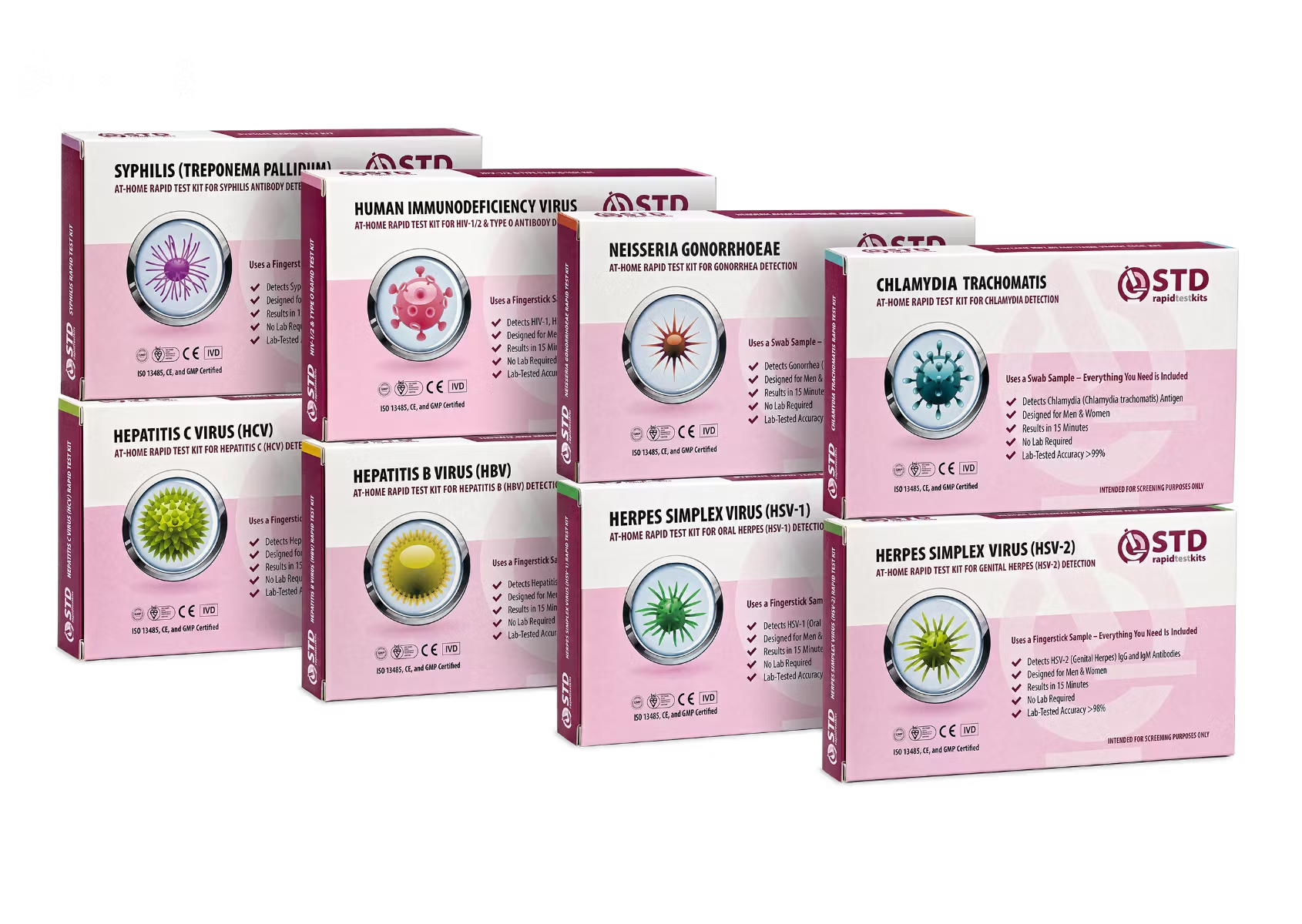
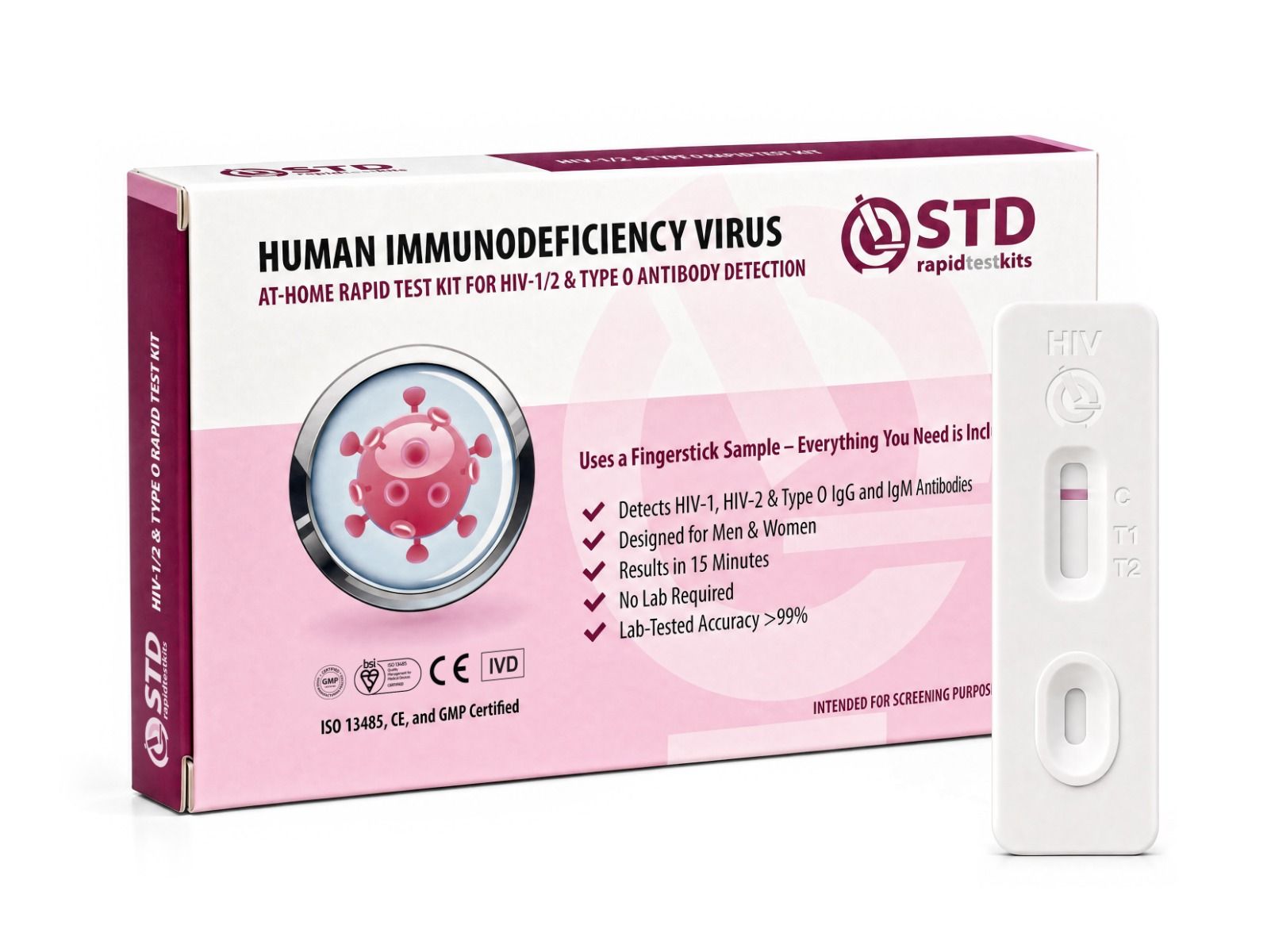
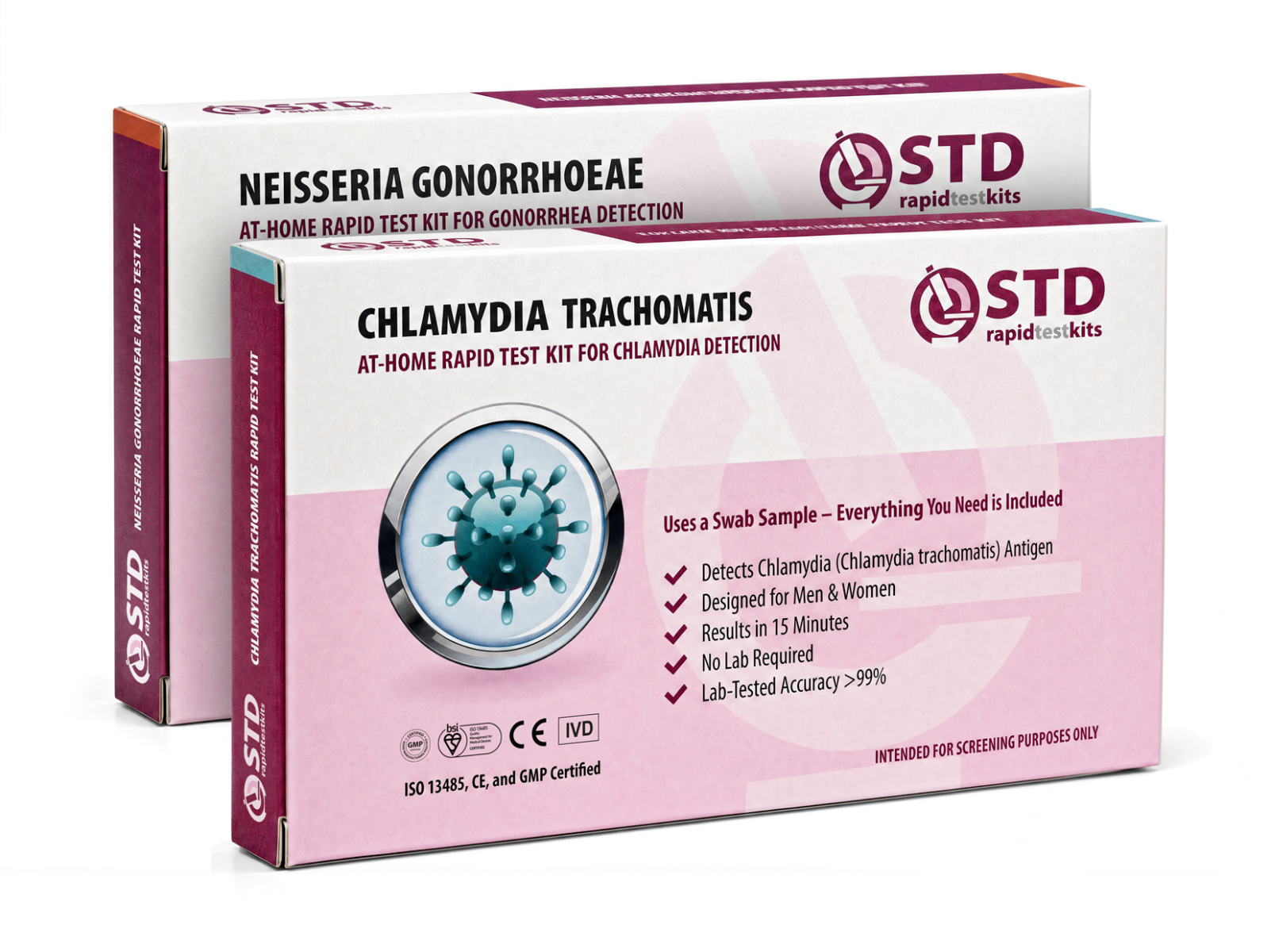
The kits below are sold by stdrapidtestkits.com. They are lateral-flow rapid tests, not lab NAAT, so a reactive home result is always worth confirming at a clinic and a non-reactive result inside the window is worth repeating at the clearance interval.
When to retest after a negative early result
The retest plan below is the version most clinicians follow for an asymptomatic adult after a single high-risk exposure. If you have symptoms, do not wait, test now and follow up with a clinician for treatment if the result is reactive.
- HIV: If you tested early with a clinic RNA test (10 to 14 days), retest at 23 to 45 days with a home antibody-only rapid or a clinic fourth-generation antibody/antigen test, then again at 90 days for full clearance. If your first test was a clinic fourth-gen at 18 to 45 days and was non-reactive, retest at 90 days for final confirmation (CDC HIV testing guidance).
- Chlamydia and gonorrhea: Retest at 2 weeks if symptoms appear or persist. The CDC also recommends a routine retest 3 months after treatment for confirmed infections, since reinfection is the most common cause of recurrence.
- Syphilis: Retest at 6 weeks if your initial test was at 3 weeks, and again at 12 weeks for full clearance. Treponemal antibodies generally remain detectable for life after infection, so the second test confirms whether the first non-reactive result was inside the window or genuinely negative (CDC syphilis fact sheet).
- HSV-2 antibodies: Retest at 12 weeks for most cases; extend to 16 weeks as a conservative outer bound if you remain concerned. Antibody seroconversion is the slowest of the major STIs and the most prone to false negatives if the first test was too early.
- Hepatitis B: Retest at 6 months. HBsAg takes 4 to 10 weeks to appear; full antibody seroconversion can take longer.
- Hepatitis C: Retest at 6 months. Antibody appearance takes 8 to 11 weeks on average and longer in some immunocompetent adults.
An early test sets a baseline; a clearance-window test confirms it.
What to do during the waiting window
The hardest part of the testing timeline is the wait. There is nothing useful to do for the first three days after exposure, and a lot of unhelpful things people do instead. A few practical guardrails:
- Avoid sex with new partners until your first usable test. Even oral. Even skin-to-skin without penetration. The goal is to keep the testing window of one exposure isolated to one timeline.
- Write down the exposure date. The retest math is anchored to that date. Without it, you will retest too early or too late.
- Note any symptoms with timestamps. Burning urination on day 4, sore throat on day 9, a small bump on day 14. The clinical pattern matters more than any individual symptom.
- If your partner is known-positive for HIV, hepatitis B, or hepatitis C, get to a clinic within 72 hours. PEP works only inside that window for HIV. Hepatitis B post-exposure vaccination has a similar urgency.
- Skip the symptom forums. Online forums skew heavily toward worst-case stories because reassuring negatives never come back to post about being fine. The forums will pull your anxiety up without changing your test result.
Sleep, eat, exercise, talk to a partner if you have one.
The only way to know your STD status is to get tested. Having an STD such as herpes, chlamydia, or gonorrhea increases your chance of getting HIV.
Bottom line: what to do this week
The simplest version of the testing timeline if you had unprotected sex recently and you are reading this in the first week or two:
- Days 0 to 3: Too early for any test. If your partner is known-positive for HIV or hepatitis B, see a clinician within 72 hours about PEP or post-exposure vaccination.
- Days 5 to 7: First reliable window for chlamydia and gonorrhea swabs. Test now if you want a baseline answer for those two.
- Day 10 to 14: Clinic HIV RNA test catches infection if present. Retest the bacterial swabs if symptoms appear.
- Day 18 to 45: Clinic fourth-generation HIV antibody/antigen combo plus syphilis treponemal test.
- Day 23 onwards: Home rapid HIV antibody-only test becomes reliable.
- Day 90: Final clearance for HIV, syphilis, chlamydia, gonorrhea.
- Week 12 (most cases) to 16 (outer bound): HSV-2 antibody clearance.
- Month 6: Hepatitis B and hepatitis C clearance.
The whole roadmap fits inside three months for the bacterial and HIV-related tests, with the hepatitis tests trailing to six months.
Frequently asked questions
- Can I really test the day after unprotected sex?
- You can buy and run a test the same day, but the result will not detect a brand-new infection because no STI test reads positive on day one. The earliest useful test is a chlamydia or gonorrhea swab at day 5 to 7. HIV needs 10 to 14 days at minimum (clinic RNA test), 18 to 45 days for a clinic fourth-generation antibody/antigen combo, or 23 to 90 days for a home rapid antibody-only test. Same-day testing is reassuring only as a baseline against a previous exposure, not as evidence about last night.
- Does a negative result at one week mean I am in the clear?
- No. A negative test at 7 days rules out chlamydia and gonorrhea reasonably well, but it cannot rule out HIV, syphilis, hepatitis, or herpes, all of which take 3 weeks or longer to seroconvert. Plan a follow-up test at 90 days for HIV and syphilis, and 6 months for hepatitis B and C, before treating yourself as cleared.
- Which test should I take first if I had a single risky exposure?
- Start with a chlamydia and gonorrhea swab at day 5 to 7. If your partner's HIV or hepatitis status is unknown, add a home rapid HIV antibody test from day 23 onwards or a clinic fourth-generation antibody/antigen test from day 18. Schedule a confirmatory full panel at 90 days. If your partner is known-positive for HIV or hepatitis B, see a clinician within 72 hours for PEP, which is far more time-sensitive than any test.
- What if I had oral sex?
- Oral chlamydia and gonorrhea need a pharyngeal swab, which is a clinic test, not a home kit. Home kits cover the systemic risk (HIV, syphilis, hepatitis) and the genital risk if there was also genital contact, but they do not cover site-specific oral infections. For a known throat exposure to a positive partner, see a clinic for a pharyngeal swab. The HIV transmission risk for receptive oral sex is low (estimated at roughly 1 per 10,000 exposures with an HIV-positive partner per the <a href="https://www.cdc.gov/hiv/" target="_blank" rel="noopener">CDC HIV transmission risk pages</a>), but not zero, especially with bleeding gums or oral sores.
- Are at-home rapid tests as accurate as clinic tests?
- Lateral-flow rapid tests are slightly less sensitive than lab NAAT for bacterial infections and slightly less sensitive than the clinic fourth-generation antibody/antigen combo at the early end of the HIV window (the home test is antibody-only, the clinic test adds antigen detection). Both are highly accurate after the full window period. The standard pattern is a rapid test for speed and a lab test for documented confirmation. A reactive home result is always worth confirming at a clinic; a non-reactive result inside the window period is always worth retesting at the clearance interval.
- I had a clean test last month but had unprotected sex this week. Do I need to retest?
- Yes. STI tests reflect your status at the time of the test, not today. A new exposure opens a new window of risk regardless of how recent the previous clean test was. Restart the testing clock from the most recent exposure date, not the previous test date. Old results do not protect against new infections.
- Can I pass an STI to a partner if I feel completely fine?
- Yes. Many of the most common STIs are silent for the longest. Most chlamydia and gonorrhea infections in women cause no symptoms; HIV is most often transmitted by people who do not know they carry it; HSV-2 sheds asymptomatically between outbreaks. Symptoms are an unreliable signal of infectiousness. Routine testing on the schedule above is the only way to be confident about your status before sex with a new partner.
- What if my partner tests positive after I tested negative early?
- Retest immediately at the full clearance window for the infection your partner has, not the earlier interval. A negative early test does not rule out infection at the clearance window. Most STIs are treatable, and several (chlamydia, gonorrhea, syphilis) are fully curable with antibiotics. Tell any other recent partners so they can test on the same schedule. If your partner has HIV and your most recent unprotected encounter was within 72 hours, PEP at a clinic is the priority before any test.
- U.S. Centers for Disease Control and Prevention. Sexually Transmitted Infections Treatment Guidelines, including window-period and retesting intervals for the major STIs.
- U.S. Centers for Disease Control and Prevention. Getting Tested for STIs, the patient-facing page on which tests to ask for, when, and how often.
- World Health Organization. Sexually Transmitted Infections fact sheet, with global epidemiology, window periods, and screening recommendations.
- UK National Health Service. Sexually Transmitted Infections overview, including UK clinical pathways and timings for STI testing.
- U.S. Centers for Disease Control and Prevention. Chlamydia overview, supporting the recommendation for routine screening of asymptomatic adults.
- U.S. Centers for Disease Control and Prevention. Syphilis fact sheet, covering primary syphilis chancre timing and clinical staging.
- U.S. Centers for Disease Control and Prevention. Genital Herpes overview, with HSV-1 versus HSV-2 transmission patterns and antibody-seroconversion windows.
- U.S. Centers for Disease Control and Prevention. Hepatitis C overview, supporting universal one-time screening and the share of adults living with chronic infection who remain undiagnosed.