Published: October 2025 | Last updated: May 2026 | Editorial review and quality control: Martina N.
You took the test. You waited fifteen minutes. Now there's a faint line at the T position, just barely there, and you keep tilting the cassette under the bathroom light to be sure. Before you spiral or convince yourself it's nothing, here's the plain reading of what each line on a Hepatitis C rapid test means, why timing changes the answer, and the lab test that confirms what your fingerstick can't.
A rapid Hep C test is a screening test, not a diagnosis. It checks whether your immune system has met Hepatitis C virus at some point. It does not tell you whether the virus is still active in your blood today. That second answer takes a different test. Here's how to bridge the gap calmly, and what to do at each step.
Key Takeaways
- Any second line at the T position counts as antibody-positive, no matter how faint. It calls for a follow-up confirmatory lab test, not panic and not a final diagnosis.
- A single C-line negative isn't always the final answer. If your exposure was within the last 8 to 11 weeks, you may be in the window period and need to retest.
How a Hepatitis C Rapid Test Actually Works
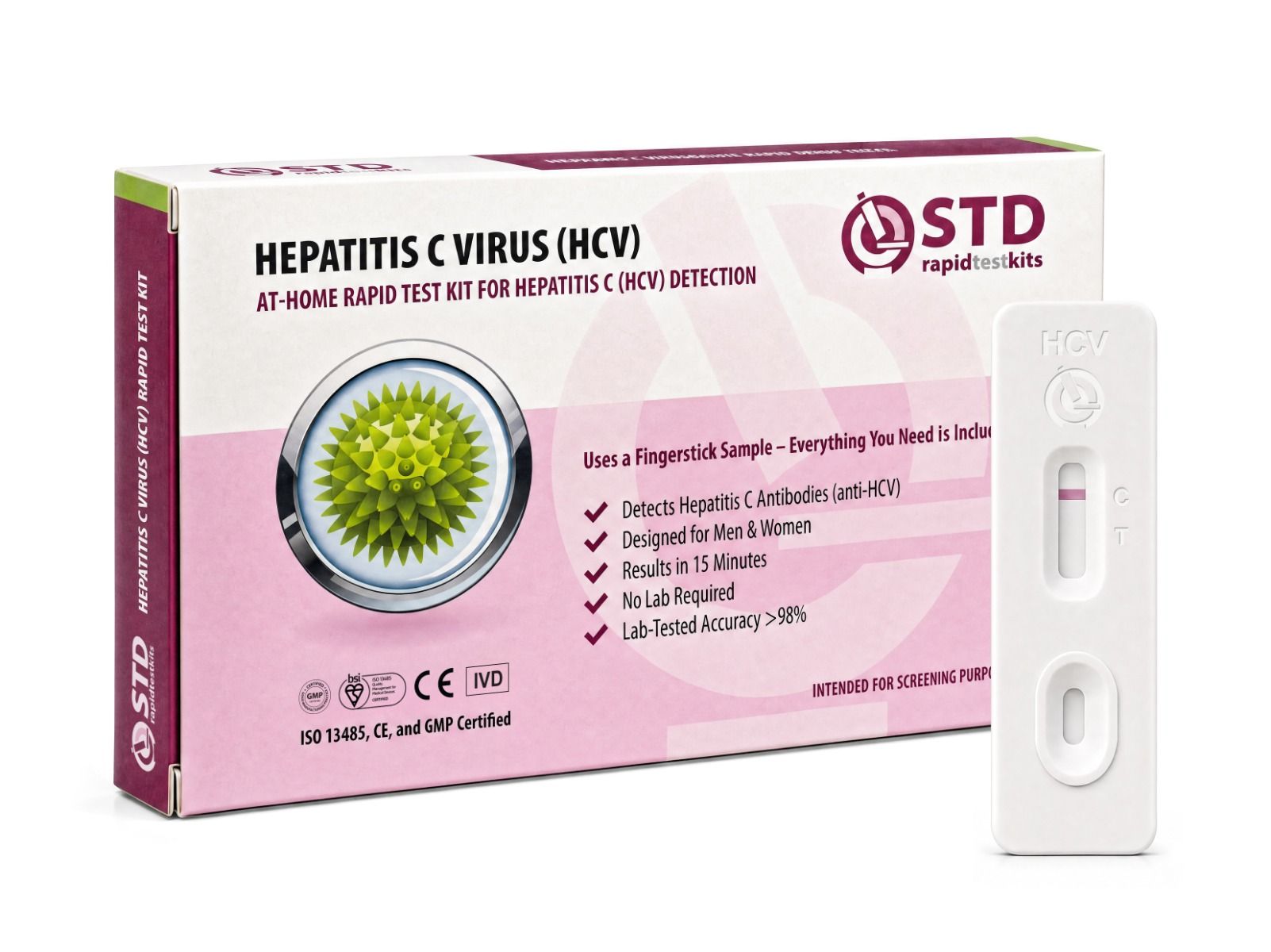
A rapid Hepatitis C test is a lateral-flow immunoassay. It looks for antibodies, the proteins your immune system makes in response to the Hepatitis C virus (HCV). When you put a fingerstick drop of blood onto the sample pad, the fluid migrates across a paper strip lined with HCV protein fragments. If anti-HCV antibodies are present in your sample, they bind to those fragments and trigger a colored line at the test (T) position. A second line at the control (C) position confirms the strip itself worked.
That means the test is asking one specific question: "has this person's immune system ever encountered Hepatitis C?" It does not ask, "is the virus currently in this person's blood?" Those are different questions, and they need different tests to answer.
The distinction matters because antibodies linger. Once your body produces anti-HCV antibodies, they typically stay detectable for life, even after the virus itself clears. According to the World Health Organization, around 30 percent of people who get infected with Hepatitis C clear the virus on their own within six months (ranging from 15 to 45 percent depending on individual immune response), without any treatment. The antibodies stick around to mark the encounter, but the virus is gone.
A rapid test that shows two lines, therefore, tells you something happened, sometime. It does not tell you whether you're currently infected, currently contagious, or in need of treatment. The follow-up step that answers those questions is a Hepatitis C RNA test, also called an HCV PCR or viral load test. That test detects the actual viral genetic material in your blood. If it comes back negative, you cleared the infection. If it comes back positive, you have an active infection that needs treatment.

How to Read Your Cassette: Lines Explained
Most over-the-counter HCV rapid tests use a simple cassette format. After your sample has run for 15 to 20 minutes (always follow your kit's specific timing, since brands vary), look at the result window. You'll see one of three patterns:
- One line at C, nothing at T. This is a negative result. No antibodies were detected. If your exposure was more than 11 weeks ago, this result is reliable. If exposure was more recent, see the window-period section below.
- Two lines, one at C and one at T. This is an antibody-positive result. The T line can be faint, sharp, dark, or barely visible; the darkness does not matter. Any visible line at T counts. You need a confirmatory PCR or HCV RNA test from a lab to determine whether the virus is still active.
- No line at C. The test is invalid. It does not matter what you see at T. The control line is the strip's internal proof of function. Without it, the result means nothing. Discard the cassette and retest with a fresh kit.
The 15 to 20 minute window is the only valid reading window. Lines that appear after about 30 minutes can be evaporation artifacts, not real positives. Lines that haven't formed by 15 minutes may still be developing. Set a timer and read inside the window your kit instructs.
Reading in good light helps. Bathroom fluorescents and yellow incandescent bulbs both make faint lines harder to see. Move to a window or a daylight-balanced lamp if you're unsure.
| What You See | What It Means | What to Do Next |
|---|---|---|
| One line at C only | No antibodies detected (negative) | If recent exposure, retest at 11 to 12 weeks |
| Two lines: C plus a faint or dark T | HCV antibodies detected (positive) | Schedule a lab HCV RNA (PCR) test |
| No line at C | Invalid test, no result | Discard and repeat with a fresh kit |
When to Test: The Window Period Explained
The window period is the time between exposure to Hepatitis C and the point when your body has made enough antibodies for a rapid test to detect them. Per CDC diagnosis and testing guidance, it usually takes 8 to 11 weeks before HCV antibodies become detectable. Some people seroconvert sooner; a small share take longer, occasionally up to six months.
What this means in practice: a negative rapid antibody test taken three days after exposure does not rule out infection. Your immune system has not had time to produce detectable antibodies yet. The right move is to retest after the window has passed, or to ask a clinician about an HCV RNA test, which detects the virus itself rather than antibodies, and turns positive within one to two weeks of infection.
If you're trying to figure out when to test, the right answer depends on how long ago your exposure was and how worried you are about a near-term answer.
| Your Situation | Best Time to Test | Next Step |
|---|---|---|
| Possible exposure less than 3 weeks ago | Wait 8 to 11 weeks for antibodies to develop | Use a clinic HCV RNA test for an earlier answer |
| Possible exposure 3 to 6+ months ago | Rapid antibody test now | If positive, confirm with a lab HCV RNA test |
| Previously antibody-positive result | Skip the antibody test | Go straight to an HCV RNA test for active infection |
| No specific exposure, routine screening | Test any time | Single test usually sufficient per CDC universal screening guidance |
Why a Faint Test Line Still Counts as Positive
Faint lines drive the most testing anxiety. Readers expect rapid tests to look like the photo on the package: two crisp, equally dark lines for positive, one bold line for negative. Real cassettes are messier than that. A T line can develop pale pink, ghost-like, or shadowy, and still be a real positive result.
The reason: the darkness of a line tracks roughly with the concentration of antibody binding at that position. People who cleared the virus years ago, who have low circulating antibody levels, often produce faint lines. People with active high-viral-load infections can produce very dark lines. Both are positive. The clinical action is the same in either case, get a lab-confirmed HCV RNA test.
What faint lines are not:
- They aren't a "less real" positive. A pale line is no less reliable than a dark one. If a line developed within the kit's reading window, it represents antibody-antigen binding on the strip.
- They aren't artifacts of running too much or too little blood, provided the control line developed normally. If the C line is sharp and the T line is faint, the strip worked correctly.
- They aren't a confirmation of current infection. Around 30 percent of people clear HCV on their own within six months of exposure, per the WHO. The antibody stays as a record; the virus does not. A faint line could be a marker of a past, resolved infection.
The bottom line is procedural, not emotional. Any visible T line, faint or sharp, means schedule a confirmatory HCV RNA test through a lab or clinic. That test tells you whether to worry about active infection.
Five Common Mistakes That Skew Rapid Test Results
Even the best at-home test can give you the wrong answer if you skip a step. When you're nervous, the kit instructions feel like fine print, and small slips compound. Here are the five missteps that most often produce inaccurate or invalid results:
- Testing too early after exposure. Antibody tests cannot detect what your immune system has not yet produced. If your exposure was within the last few weeks, a negative rapid result is unreliable. Retest at 8 to 11 weeks, or ask about RNA testing for an earlier answer.
- Skipping or mishandling the buffer solution. The buffer in your kit is not optional. It moves the sample across the strip and triggers the binding reaction. Too little, the strip stalls. Too much, you can flood the reading window and create false haze. Follow the drop count on your kit's instructions exactly.
- Reading outside the timing window. Most kits give a 15 to 20 minute reading window for a reason. Lines that haven't formed by then may still be developing. Lines that appear after 30 to 60 minutes can be evaporation artifacts and don't represent antibody binding. Set a timer.
- Dismissing a faint T line. A pale T line is still a T line. The clinical follow-up is identical regardless of darkness. Don't talk yourself out of what you saw because the photo on the box looks different.
- Reusing components or testing past the expiry date. Lancets, sample droppers, and the cassette itself are single-use. Reused lancets carry infection risk. Expired cassettes can give false negatives because the antibody-binding reagents degrade over time. Check the date on the foil pouch before you start.
If you're unsure whether you executed any of these steps correctly, the safest move is to repeat the test with a fresh kit and read carefully. Note: stdrapidtestkits.com sells the at-home rapid test kits referenced below; the guidance in this article reflects the cited public-health sources, not commercial intent.
What an Invalid Result Means and What to Do Next
An invalid result is the cassette equivalent of a coin landing on its edge. It's not positive, it's not negative, the test simply didn't run. You'll know you have one when the C (control) line never appears, no matter what you see at T. Sometimes there's a smudge of color at T, sometimes nothing, sometimes a bleed of pink across the whole window. Without a control line, none of it is interpretable.
Common reasons the control line fails to develop:
- Not enough blood reached the sample pad, so the fluid front never made it across the strip.
- The buffer was skipped, spilled, or applied to the wrong well.
- The cassette was past its expiration date and the binding reagents had degraded.
- The test was read too early, before the control line had time to form (rare, but possible if the timer was set to less than five minutes).
- A manufacturing defect, which does happen with rapid tests in small percentages.
An invalid test is not your fault and not a signal about your health. The fix is mechanical: discard the cassette, open a fresh kit, and run the test again. If you've already had two invalid results in a row, switch brands or visit a clinic for a lab-drawn antibody test, which removes the at-home variables from the equation.
What Real-World Cassettes Look Like
The marketing photo on your test kit shows an idealized cassette: bright white background, two sharp lines, perfectly centered, perfectly equal in darkness. Your real-world cassette will not look like that, and that's normal. Here's what to expect and how to interpret it:
- Clear, bold lines at C and T. Easy read. Antibody-positive, schedule confirmatory testing.
- Faint second line at T. Still positive. The line is real if you can see it; darkness scales with antibody concentration, not with the importance of the result.
- No line at C. Invalid test. Discard and retest.
- Blurred or bleeding ink across the window. Probably too much sample volume or too much buffer. The strip flooded. Discard and retest.
- Pale pink background tint everywhere. Usually harmless. That's how the sample buffer runs. As long as you can see distinct lines at C (and possibly T), interpret normally.
- A faint line that appears after 30 minutes. Likely an evaporation artifact. Lines that develop outside the reading window aren't reliable positives. Repeat the test if you're unsure.
If you're staring at your cassette and you can't tell whether you're looking at a real line or wishful thinking, take a photo under good light and show it to your clinician or a telehealth provider. Real test cassettes confuse experienced healthcare workers too. You're allowed to ask for a second opinion before you panic or dismiss what you saw.

After a Positive Result: What Happens Next
If your rapid test shows two lines, the immediate next step is a lab-drawn HCV RNA (PCR) test. This is the test that distinguishes "you had this virus at some point" from "you have this virus right now." Your primary care provider, urgent care, sexual health clinic, or local health department can order it. Most insurance plans cover the test, and many public health clinics offer it free or sliding scale.
What an RNA test tells you:
- RNA negative. Your body cleared the virus, either spontaneously (around 30 percent of people do this within six months of infection, per the WHO) or following a previous treatment course. You carry the antibodies as a record of past exposure, but you are not currently infected, not contagious, and do not need antiviral treatment. Your liver enzyme labs should be checked once to confirm no residual damage.
- RNA positive. You have a current Hepatitis C infection. This is treatable. Modern direct-acting antiviral (DAA) regimens, taken as pills for 12 to 24 weeks depending on genotype and liver health, cure more than 95 percent of cases with minimal side effects. Your provider will order genotype testing, baseline liver function panels, and an assessment of any liver fibrosis or cirrhosis before treatment starts.
One important note: a positive antibody test, even one confirmed by RNA, is not a moral failure or a permanent label. Hepatitis C cured today is genuinely gone, with the same long-term outcome as someone who never had it. Treatment is no longer a years-long ordeal of interferon injections; it's a daily oral pill for a few months. The hardest step (testing) is the one you already took.
If cost or insurance is a concern, the NHS in the UK and most US state health departments offer subsidized or free DAA treatment for diagnosed patients.
After a Negative Result: When to Retest and Why Screening Still Matters
A negative rapid test (one line at C, nothing at T) is reassuring, and it's a complete answer in certain conditions. Specifically, a negative result is reliable when:
- Your most recent possible exposure was more than 11 weeks ago, or
- You have no specific known exposure and you're testing as routine screening.
The negative result is incomplete when your exposure was within the last 8 to 11 weeks. In that situation, you may simply not have produced enough antibodies for the test to detect yet. Plan a follow-up rapid test at around 12 weeks after the exposure event, or ask your provider about an HCV RNA test, which can detect the virus directly within one to two weeks of infection and doesn't depend on antibody buildup.
Worth knowing: the CDC now recommends one-time Hepatitis C testing for all adults aged 18 and older, regardless of risk factors. The rationale is that many chronic Hep C infections go undiagnosed for years because there are no symptoms in the early stages, and routine universal screening catches them before liver damage accumulates. A clean rapid test today, even with no current exposure concerns, satisfies that recommendation.
If you're testing because of a specific exposure (shared injection equipment, an unsterile tattoo or piercing, a sexual partner with diagnosed HCV, occupational needlestick), document the date of exposure and your test dates. That timeline matters if you need follow-up testing in the weeks to come.
CDC recommends hepatitis C screening at least once in a lifetime for all adults aged 18 years and older, except in settings where the prevalence of HCV infection is less than 0.1 percent, and screening during every pregnancy.
FAQs
- What does a faint line on my Hep C rapid test mean? Am I positive?
- Yes. Any visible line at the T position, faint or sharp, counts as antibody-positive. The darkness of the line tracks roughly with antibody concentration, not with the seriousness of your situation. Schedule a lab HCV RNA test to determine whether the virus is still active. Around 30 percent of people who get HCV clear it on their own, leaving only the antibody behind, so a positive rapid result is not the same as a current infection.
- Can I trust a negative result if I tested too soon after exposure?
- Not fully. The window period for HCV antibodies is typically 8 to 11 weeks after infection, sometimes longer. If your possible exposure was within the past few weeks, your immune system may not have produced enough antibodies yet for the test to detect them. Retest at around 12 weeks after exposure, or ask your provider about an HCV RNA test, which can detect the virus directly within one to two weeks of infection.
- If I test antibody-positive, do I have Hep C for life?
- No. Antibodies stay in your blood for life as a marker of past exposure, but the virus itself can be gone. Around 30 percent of people clear HCV spontaneously within six months. Of those who progress to chronic infection, modern direct-acting antiviral pills cure more than 95 percent of cases in a course of 12 to 24 weeks. A positive antibody test is the start of a process, not a permanent diagnosis.
- Is a faint T line more likely to be a false positive than a dark one?
- No. The darkness of the line correlates with antibody concentration in your sample, not with whether the result is real or artifactual. People with low circulating antibody levels (often those who cleared the virus years ago) produce faint lines that are still genuine positives. The clinical follow-up is the same regardless of darkness: a lab HCV RNA test to check for active infection.
- What if I don't see any line at all, not even the control?
- The test is invalid, which means it didn't run correctly. An invalid result carries no health signal at all; the strip simply failed to function. Common causes are too little sample blood, mishandled buffer, an expired cassette, or rarely a manufacturing defect. Discard the cassette and run a fresh kit. If you get two invalid results in a row, switch brands or get a lab-drawn antibody test, which removes the at-home variables.
- What's the difference between a Hep C rapid test and a PCR test?
- A rapid test detects anti-HCV antibodies, your immune system's response to the virus. A PCR or HCV RNA test detects the viral genetic material itself. The rapid test answers "has your body ever seen this virus?" The PCR answers "is the virus in your blood right now?" Rapid tests are the first-line screen at home; PCR is the confirmatory test that drives treatment decisions.
- Can I have Hepatitis C and feel completely fine?
- Yes, and this is one of the reasons universal screening exists. Acute Hep C is asymptomatic in the majority of cases. Chronic Hep C can quietly damage the liver for decades before causing fatigue, dark urine, jaundice, or abdominal swelling. Many people don't know they have it until routine bloodwork flags abnormal liver enzymes. The CDC's recommendation that all adults aged 18 and older be tested at least once exists because silent infection is so common.
- Should I get tested if I have no known exposure?
- Yes, at least once. The CDC's universal screening guidance, issued in 2020, recommends one-time HCV testing for all US adults aged 18 and older, plus testing during every pregnancy. The rationale is that many people who acquired HCV through a forgotten exposure (a transfusion before 1992, occasional intranasal drug use decades ago, a minor medical procedure abroad) have no idea they're carrying it. A single at-home rapid test or lab antibody test closes the loop for most people.
Next Steps: Confirmation, Confidence, and Closing the Loop
Whatever your rapid test showed, treat the cassette as a starting point. A positive result deserves a follow-up RNA test through a lab. A negative result with recent exposure deserves a retest after the window has fully closed. An invalid result deserves a do-over with a fresh kit.
The thing rapid tests do best is lower the cost of asking. You don't need a clinic visit, a copay, or a conversation you don't feel ready to have. You can take the test in your bathroom, look at the result, and decide what to do with it. Screening access has expanded significantly compared with a decade ago. No clinic visit, no copay, no appointment needed.
Hepatitis C, once detected and treated, is curable in the vast majority of cases. The bottleneck has never been the medicine. It's been diagnosis and access to treatment. By the end of 2022, only around 20 percent of people living with hepatitis C globally had been treated, per the WHO. Testing is the part that breaks that pattern, both for you and for anyone you might unknowingly pass an infection to.
Your Next Move, Based on What You Saw
- Positive rapid result (two lines, any darkness): schedule a lab-drawn HCV RNA (PCR) test through your provider or local health department to check for active infection.
- Negative rapid result with possible recent exposure: plan a follow-up test at around 12 weeks after the exposure event, or ask about an HCV RNA test for an earlier answer.
- Invalid result (no C line): discard the cassette and run a fresh kit. Two invalids in a row, switch to a lab-drawn antibody test.
- U.S. Centers for Disease Control and Prevention. Hepatitis C basics, transmission, symptoms, and current universal screening recommendation for adults aged 18 and older.
- U.S. Centers for Disease Control and Prevention. Diagnosis and testing guidance for healthcare professionals, including the 8 to 11 week antibody window and the antibody-then-RNA confirmatory testing pathway.
- World Health Organization. Hepatitis C fact sheet covering global epidemiology, spontaneous clearance rate, direct-acting antiviral treatment duration of 12 to 24 weeks, and current global treatment coverage figures.
- UK National Health Service. Hepatitis C condition overview including symptoms, transmission routes, testing pathway, and access to subsidized treatment.
- MedlinePlus, U.S. National Library of Medicine. Plain-language Hepatitis C information including diagnostic test descriptions and treatment outlook.
