
Published: September 2025 | Last updated: May 2026 | Editorial review and quality control: Martina N.
Green or yellow discharge that doesn't quite smell like anything is one of the most confusing symptoms to interpret at home. The first instinct, especially for anyone who has had a yeast infection before, is to reach for the same antifungal that worked last time. When the discharge stays put, doubt creeps in. Here is the reality: trichomoniasis (often shortened to trich) looks and feels almost identical to a yeast infection in some cases, and almost identical to bacterial vaginosis in others. Distinguishing them by symptom alone is unreliable. The CDC's own guidance underlines this point. Trichomoniasis is the most common curable non-viral sexually transmitted infection, and the majority of people who carry it never notice symptoms (CDC: About Trichomoniasis).
This guide walks through what trichomoniasis actually looks and feels like, why it gets confused with a yeast infection or BV, and what to do when an over-the-counter antifungal hasn't cleared things up. There is also a reassurance worth saying upfront. Not every change in discharge is an STI. Color shifts can come from cycle changes, recent unprotected sex, antibiotics, douching, or a new soap. Testing matters because trichomoniasis is one of the few cases where the infection can pass quietly to a partner, and where the right treatment is fast, inexpensive, and effective.
Key Takeaways
- Green, yellow, or frothy discharge without a strong smell can be trichomoniasis, especially when over-the-counter yeast treatments haven't worked.
- Roughly 70% of people with trichomoniasis have no noticeable symptoms, so a swab or urine test, not a symptom check, is the only way to confirm it.
When Yeast Treatments Don't Quite Add Up
A common pattern in primary care looks like this. Someone has had yeast infections before, recognizes the start of something that feels familiar, treats with miconazole or fluconazole, and the discharge stays. The itch may be milder this time. There may be no itch at all. The discharge may be greenish or yellow instead of the familiar thick white. The medication didn't fail because it was the wrong dose. It failed because it was treating the wrong organism.
Many people, especially those with vaginas, default to assuming any non-dramatic discharge is a yeast infection or bacterial vaginosis. Trichomoniasis sits in that overlap. The CDC's overview notes that trichomoniasis is often completely asymptomatic, or it mimics other infections so closely that it goes undetected for months (CDC: About Trichomoniasis). Standard urgent care visits and even some routine gynecology check-ups don't always test for trich unless a patient asks specifically.
The under-recognition matters more than it seems. The CDC describes trichomoniasis as the most common nonviral sexually transmitted disease (CDC: About Trichomoniasis), so the gap between how common it is and how rarely it gets tested for has real downstream consequences for partner transmission and reinfection.
If two rounds of over-the-counter yeast medication haven't cleared the discharge, itch, or burning, the next step is testing for something else, not a third round of antifungal. The same applies to BV treatments that don't seem to stick.
How Trichomoniasis and a Yeast Infection Differ
The differences between the two conditions are real, but the overlap is wide enough that no symptom map replaces an actual test. The table below summarizes how each condition tends to present, drawn from CDC clinical descriptions. Two things stand out across the comparison. Trichomoniasis discharge is usually thin, watery, or frothy with a green or yellow color, while yeast tends to produce a thick white discharge. A yeast infection often arrives quickly with intense itching, while trichomoniasis tends to arrive quietly and linger.
| Symptom | Trichomoniasis | Yeast Infection |
|---|---|---|
| Discharge color | Green, yellow, or frothy | White, thick, cottage-cheese-like |
| Odor | Often none, sometimes a faint musty scent | Usually none |
| Itching | Sometimes present, often mild | Frequently intense |
| Burning during urination | Common | Sometimes |
| Onset | Slow, vague onset | Often after antibiotics or hormonal shifts |
| STI risk | Yes, sexually transmitted | No, not an STI |
What Trichomoniasis Feels Like, or Doesn't
The CDC reports that only about 30% of people with trichomoniasis develop any noticeable symptoms; the remaining 70% stay unaware they're carrying the infection (CDC: About Trichomoniasis). For those who do feel something, the symptoms typically fall into a few patterns shown below. Because these symptoms are mild and easy to attribute to something else, many people delay testing or treat the wrong condition for weeks. The infection has a long, low-key window where transmission is possible without anyone realizing.
| Trichomoniasis symptom | What it tends to feel like |
|---|---|
| Vaginal or penile discharge | Watery, sometimes greenish or frothy, not always present |
| Mild itching or irritation | Not severe, often mistaken for a hygiene issue |
| Burning during urination | A subtle sting or warmth, not always painful |
| Discomfort during sex | Feels like dryness or minor soreness, rarely sharp pain |
| No symptoms at all | The most common presentation in both women and men |
Why Trichomoniasis Is Easy to Miss
Trichomoniasis is caused by a single-celled parasite, Trichomonas vaginalis, which lives in the urethra and lower genital tract. Because it isn't a virus or a bacterium, it doesn't trigger the immune response that produces classic infection signs like fever or significant swelling. Many cases come to light only when a partner tests positive and asks the other to get checked.
Men carry trichomoniasis with even less warning than women. Penile or urethral symptoms are uncommon, and when they appear they tend to be mild irritation or a faint burning during urination. CDC guidance notes that trichomoniasis is diagnosed more frequently in women than in men, but men can absolutely carry the infection and pass it on (CDC: About Trichomoniasis).
None of this means the infection is harmless. Untreated trichomoniasis has been associated with a higher risk of acquiring or transmitting HIV during sex, complications during pregnancy including preterm delivery and low birth weight, and chronic vaginal inflammation.

Why Yeast Infection Treatments Don't Work on Trichomoniasis
This is where many people get tripped up. They treat trichomoniasis like a yeast infection, see the symptoms ease for a few days, and assume the medication worked. The temporary relief is usually unrelated to the antifungal. Trichomonas vaginalis is a parasite, not a fungus, so antifungals don't kill it. Vaginal symptoms can ebb and flow on their own as the local environment shifts, which is why people sometimes feel temporary improvement that has nothing to do with the cream they used.
Yeast infections are caused by an overgrowth of Candida species, fungi that live naturally on the body and become a problem when something tips the balance. Antifungals like fluconazole or miconazole shut down fungal growth. Trichomoniasis only clears with specific antibiotics in the nitroimidazole family. CDC's STI treatment guidelines name metronidazole as the first-line option, with tinidazole as an alternative for people who can't tolerate metronidazole well (CDC: STI Treatment Guidelines).
Repeated yeast treatments that don't fully resolve symptoms are a useful clinical signal. If two over-the-counter rounds haven't cleared the discharge, irritation, or burning, the next step is testing rather than a third round of the same product.
| Organism | Type | What clears it |
|---|---|---|
| Candida | Fungus (yeast) | Antifungals like fluconazole or miconazole |
| Trichomonas vaginalis | Single-celled parasite (protozoan) | Nitroimidazole antibiotics like metronidazole or tinidazole |
Testing: The Most Reliable Way to Tell What's Going On
Testing for trichomoniasis is more straightforward than it once was, but it isn't always part of the standard STI panel offered at urgent care or some primary care visits. Most clinics will run it if asked. Lab nucleic acid amplification testing (NAAT) is the gold-standard method, with very high sensitivity and specificity from either a vaginal swab or a urine sample.
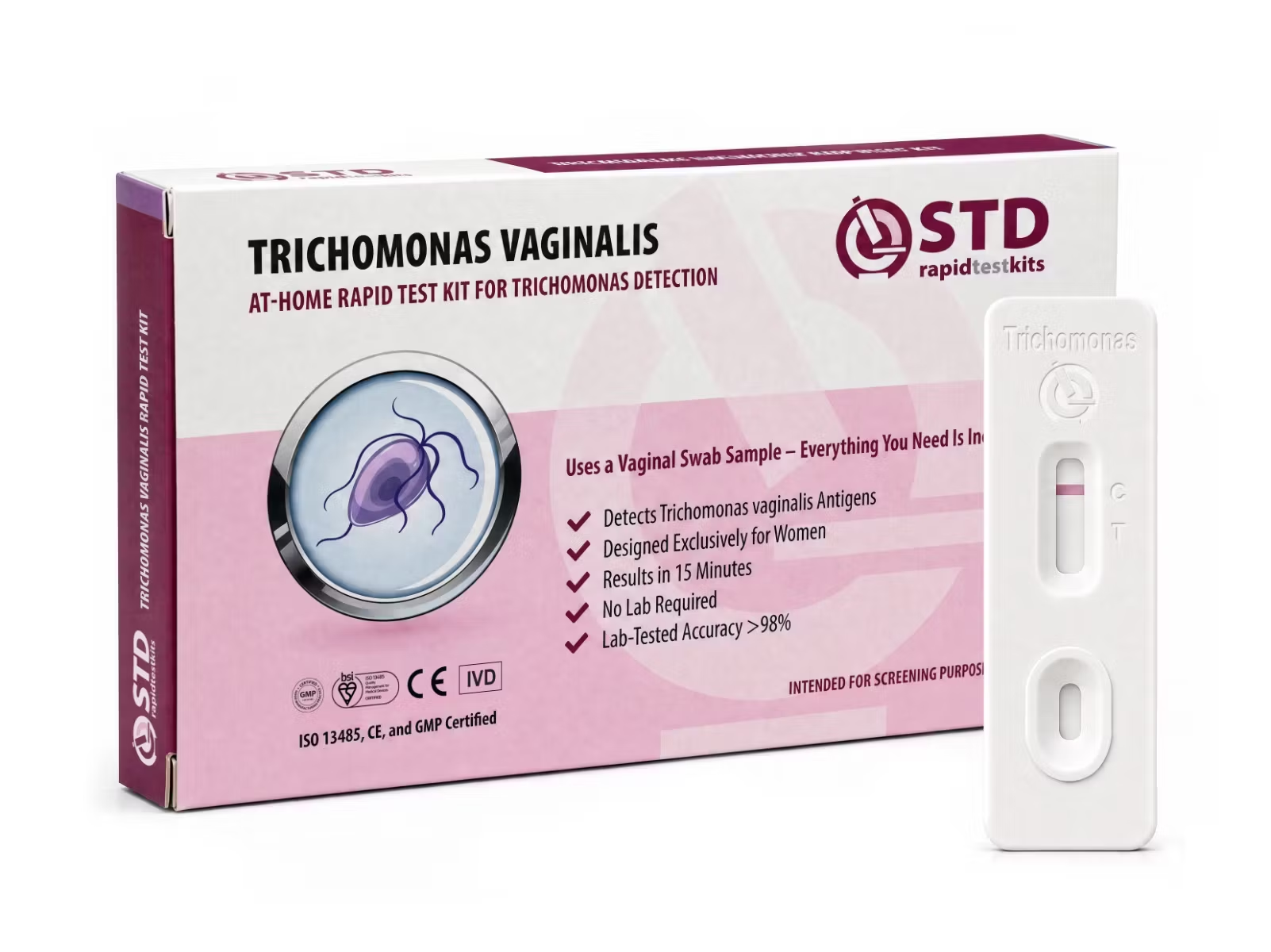
At-home rapid kits use a different chemistry. They are lateral-flow immunoassays applied to a self-collected vaginal swab, giving a screening result in roughly fifteen minutes without sending anything to a lab. They are useful for fast, private answers. A positive at-home result is worth confirming with a clinician's lab NAAT for treatment planning. The two methods are complementary rather than equivalent: lateral-flow rapid screening at home, NAAT in the lab for analytical confirmation.
One important caveat about scope. The at-home trichomoniasis swab sold on this site is validated for vaginal self-collection only, so it suits women. Men whose partner has tested positive should see a clinician for a urine NAAT, since we don't sell a male-compatible trich kit. For women, the at-home swab is a private way to get a fast answer when symptoms don't fit the familiar yeast pattern, when an over-the-counter antifungal hasn't worked, or after a new partner.
Disclosure: stdrapidtestkits.com sells the at-home rapid trichomoniasis swab described below; we recommend it where it fits the reader's situation, not for commercial reasons.
How Trichomoniasis Is Treated
Treatment is one of the simplest parts of trichomoniasis. Per the CDC's 2021 STI Treatment Guidelines, oral metronidazole is the first-line option. For women, the current recommendation is a 7-day course of 500 mg taken twice daily, which produced higher cure rates in trials than the older single-dose protocol. For men, a single 2-gram dose of metronidazole remains standard. Tinidazole is an effective alternative for patients who don't tolerate metronidazole well. The full guidelines are available at cdc.gov/std/treatment-guidelines/.
The medications are widely available with a prescription and are generally well tolerated. Side effects can include nausea, a metallic taste, and a real interaction with alcohol. Most clinicians ask patients to avoid alcohol during treatment and for at least 24 hours after the last dose of metronidazole, or 72 hours after tinidazole.
The most common reason treatment seems to fail is reinfection from a partner who hasn't been treated. Both partners need to clear the infection at the same time, even when one of them has no symptoms. The CDC notes that roughly 1 in 5 people treated for trichomoniasis are reinfected within three months, almost always because a partner was not treated simultaneously, which is why repeat testing within three months is part of the standard recommendation (CDC: About Trichomoniasis).
Is green or yellow discharge with no smell a yeast infection or trichomoniasis?
Either is possible, but the absence of strong odor combined with a green or yellow color, and no improvement after antifungal medication, points more strongly toward trichomoniasis or another non-yeast cause. Trichomoniasis is confirmed with a vaginal swab or urine NAAT, not by symptoms alone, and clears with a short course of metronidazole. Around 70% of people with trichomoniasis have no symptoms at all, which is why testing is the only reliable way to know.
How Trichomoniasis Shows Up in Long-Term Relationships
Few sexual health conversations are as fraught as a positive STI result inside a committed relationship. The first reaction is often the assumption that someone must have cheated. Trichomoniasis genuinely complicates that conclusion. The infection can persist in the body for months, and sometimes longer, without producing symptoms or being picked up on routine testing. CDC's about page for trichomoniasis acknowledges that infection can last for months or years if it isn't treated (CDC: About Trichomoniasis).
What that means in practice: a positive trichomoniasis result inside a long-term relationship doesn't automatically indicate recent infidelity. It can reflect an exposure that occurred before the relationship began and stayed below the threshold of symptoms or routine testing for a long time. None of this is an excuse or a guarantee. It is a reason to talk before reaching conclusions, and to test together rather than blame each other.
Many couples now build a baseline test into the early stages of going barrier-free, regardless of how committed the relationship is.

Testing Is About Information, Not Judgment
There is still a lot of leftover shame around STI testing, especially around infections that don't feel serious. Trichomoniasis falls into that bucket easily. A vague discharge, no fever, no pain, easy to dismiss. The framing that being tested means being reckless does real damage. Most people who acquire trichomoniasis got it through ordinary sexual contact, often from someone who didn't know they had it.
Exposure can happen during a single encounter, despite consistent condom use (trichomoniasis can pass through skin-to-skin genital contact and shared sex toys), or from a partner who tested negative years ago and never re-tested. None of this changes the practical answer. A swab takes a few minutes, a positive result clears with a short course of antibiotics, and the relief on the other side of an answer is genuinely worth it.
Most people who have trichomoniasis cannot tell. About 70% of infected people do not have any signs or symptoms.
Trusting What Your Body Is Telling You
Vague symptoms are easy to talk yourself out of. A little itch, a little discharge, a little burning that comes and goes. The temptation is to wait it out or try one more over-the-counter product. That isn't paranoia or overreaction; it is how most people respond when something feels slightly off but not alarming. The cost of waiting is mostly that the discomfort lingers, and that whatever the cause is can pass to a partner during the wait.
Among the most common STIs, trichomoniasis is also among the easiest to clear; a short antibiotic course resolves it in days. A clear answer takes a swab and a few minutes. The follow-up, if needed, is a short course of an inexpensive antibiotic. The reassurance, if it isn't trichomoniasis, is just as valuable as a positive result that lets you treat the actual cause.
Next steps if symptoms aren't clearing
- Test for trichomoniasis if two rounds of yeast medication haven't resolved the discharge, itch, or burning.
- When a partner tests positive, both people get treated at the same time, even when one feels fine, to break the reinfection loop.
- Per CDC guidance, anyone treated for trichomoniasis should re-test within three months because reinfection is common.
FAQs
- Can trichomoniasis really cause green discharge with no smell?
- Yes. Green or yellow, sometimes frothy discharge with little or no odor is one of the more recognizable presentations of trichomoniasis when symptoms appear at all. The absence of a strong fishy smell often misleads people into ruling out an STI and assuming the cause is yeast or irritation. CDC's fact sheet describes this exact pattern as a common reason trichomoniasis is mistaken for other vaginal conditions.
- How is trichomoniasis different from a yeast infection or BV when symptoms overlap?
- Yeast infections usually produce thick, white, cottage-cheese-style discharge with intense itching and no smell. BV usually produces thin, gray-white discharge with a fishy odor that gets stronger after sex. Trichomoniasis sits between them: thin, sometimes frothy, often green or yellow, with milder odor and milder itching. The most reliable distinguisher in real life is that yeast medication doesn't clear trichomoniasis, while it usually clears yeast within a few days.
- What if my partner tests positive but I feel completely fine?
- You can still have it. Trichomoniasis doesn't need symptoms to spread, and roughly 70% of people who carry it feel nothing. The right move when a partner tests positive is for both people to test and treat at the same time, even if only one has symptoms. Otherwise the infection can ping-pong back and forth between partners.
- Can men carry trichomoniasis with no symptoms?
- Most men find out they carry trich only after a partner tests positive. When urethral symptoms do show up, they usually look like a slight burning while urinating rather than visible discharge, which is why men often go untested unless prompted. A urine NAAT through a clinician is the most reliable way for men to confirm the infection.
- Can trichomoniasis pass through oral or non-penetrative sex?
- Trichomoniasis spreads primarily through genital-to-genital contact, including penis-to-vagina and vagina-to-vagina contact, and through shared sex toys that aren't cleaned between uses. Oral transmission is much less common because the parasite doesn't establish well in the mouth or throat. If unprotected genital contact happened and something feels off, the practical answer is to test rather than try to calculate the risk.
- How long can trichomoniasis stay in the body if you don't treat it?
- Trichomoniasis can persist for months or longer without symptoms when left untreated, according to CDC's about page. During that time it can be passed to partners and is associated with a higher risk of acquiring or transmitting HIV during sex, plus complications in pregnancy. It will not clear on its own, but a single course of metronidazole or tinidazole almost always resolves it.
- Do I have to tell my partner if I test positive for trichomoniasis?
- You should, and it doesn't have to be a dramatic conversation. Trichomoniasis is treatable in days, and your partner needs to be treated at the same time so reinfection doesn't become an open loop. A simple version works: 'I tested positive for trich, it clears with a short course of antibiotics, and you should get treated too so we don't keep passing it back and forth.' That's a health conversation, not a confession.
- Is green discharge always a sign of an STI?
- Not always, but it warrants checking. Green or yellow discharge can come from trichomoniasis, gonorrhea, certain non-STI bacterial infections, or a foreign body like a forgotten tampon. A persistent color change combined with itching, burning, or discomfort during sex is a useful prompt to get tested rather than assume. A negative test is reassuring; a positive one is treatable.
How we sourced this article: We combined current guidance from the CDC's STI treatment recommendations and trichomoniasis fact sheet with the World Health Organization's STI surveillance data, supplemented by NHS and MedlinePlus patient-facing materials. Around a dozen references informed the writing; the most directly relevant root-domain sources are listed below. Every external link points to a primary source on a public-health organization's domain and opens in a new tab so you can verify any claim without losing your place.
- U.S. Centers for Disease Control and Prevention. About Trichomoniasis fact sheet, including the figure that about 70% of infected people have no symptoms, the description of trichomoniasis as the most common nonviral sexually transmitted disease, that infection can last for months or years if untreated, and that reinfection occurs in about 1 in 5 people within three months.
- U.S. Centers for Disease Control and Prevention. STI Treatment Guidelines landing page, the entry point for the 2021 guideline document that contains the 7-day metronidazole regimen for women and the 2-gram single-dose regimen for men.
- World Health Organization. Sexually transmitted infections (STIs) fact sheet, used for global STI burden context.
- NHS. Trichomoniasis patient-facing overview, used for plain-English descriptions of symptoms and treatment.
- U.S. National Library of Medicine (MedlinePlus). Trichomoniasis patient information, used for plain-language background on transmission, symptoms, and screening.
