
Published: November 2025 | Last updated: May 2026 | Editorial review and quality control: Martina N.
The U.S. Food and Drug Administration recently cleared the first at-home HPV self-collection device for cervical cancer screening. For people who skip Pap appointments because of cost, distance, embarrassment, or scheduling, that single decision changes the math of getting screened at all. It also signals something broader: regulators have grown comfortable with sample collection happening outside a clinic, which lines up with where at-home STI testing has already been quietly moving for years.
This article walks through what the FDA HPV decision changes, what at-home STI testing can and cannot do today, when sample timing matters, and how to use a home kit in a way that genuinely informs your next step. If you came here because of a specific worry about a recent exposure, the window-period section is probably the one to start with.
Key Takeaways
- The FDA cleared an at-home HPV self-collection device for cervical cancer screening, the first time a non-clinician-collected HPV sample has been authorized for that use in the U.S.
- At-home STI testing already exists for HIV, syphilis, hepatitis B/C, chlamydia, gonorrhea, HSV-2, trichomoniasis, and HPV, but each infection has a window period before tests are reliable.
What the FDA at-home HPV approval changed
HPV testing used to require a clinician-collected sample taken during a pelvic exam. The FDA's recent approval changes that single requirement, the part of cervical cancer screening that drives most of the friction for patients. The kit involves a self-collected vaginal swab; the sample is then mailed to a partner laboratory that runs the same molecular HPV assay used in clinics.
The approval applies to cervical cancer screening for people with a cervix between the ages of 25 and 65 at average risk, which mirrors the population the American Cancer Society and the National Cancer Institute already recommend HPV screening for (ACS cervical cancer screening guidelines). It does not replace follow-up colposcopy or a clinical exam if a high-risk HPV type is detected, and it does not substitute for the broader pelvic exam many providers also do at the same appointment.
Who it applies to: people with a cervix between the ages of 25 and 65 at average risk of cervical cancer. What it changes: a self-collected vaginal swab replaces the clinician-collected sample taken during a pelvic exam; the laboratory analysis is the same molecular HPV assay used in clinics. What it does not replace: follow-up colposcopy if a high-risk HPV type is detected, and the broader pelvic exam many providers do at the same visit.
Who benefits most from at-home STI testing
At-home STI testing isn't only for people who suspect an infection. Many of the people who benefit most are simply trying to stay on a routine screening schedule but find traditional clinics inconvenient, expensive, or uncomfortable. Public health researchers have documented the barriers repeatedly: embarrassment, lack of nearby clinics, limited appointment availability, and fear of judgment (CDC overview of STI prevention and screening).
Removing the front desk, the waiting room, and the in-person conversation lowers the activation energy required to test. The groups that lean on home testing most heavily tend to be:
- Busy working adults: people who can't take time off to sit in a clinic during business hours.
- People in rural areas: communities where the nearest sexual health clinic is an hour or more away.
- People who avoid in-person screening: usually because of stigma, prior bad experiences, or a desire for privacy.
- Routine screeners: people who treat STI testing like dental cleanings, scheduled and unremarkable.
For these readers, an at-home kit lowers the friction that often keeps a planned screening from happening.
What kind of sample does each test use?
One misconception about STI testing is that it always requires specialized clinical equipment. In reality, many sexually transmitted infections can be detected from simple biological samples that anyone can collect with basic instructions. The sample type varies by infection because different pathogens live in different parts of the body.
| Sample type | How it is collected | Infections commonly tested |
|---|---|---|
| Vaginal or penile swab | Self-collected with a sterile swab, sealed in transport buffer | Chlamydia, gonorrhea, trichomoniasis (women), HPV (women) |
| Finger-prick blood | A small lancet collects a few drops onto a test strip or card | HIV, syphilis, hepatitis B, hepatitis C, HSV-2 |
| Urine sample | Collected in a sterile container and mailed to a CLIA-certified lab (available from mail-in lab providers; not sold on this site) | Chlamydia, gonorrhea |
Why the window period matters
Timing trips up more people than sample collection does. Right after exposure, most infections are invisible to any test, clinic or home. It takes time for bacteria to multiply, for viral material to reach measurable loads, or for the antibodies your immune system produces to build up to detectable levels. The period between exposure and reliable detection is called the window period, and testing inside it can produce a falsely reassuring negative result.
Different infections have different ranges. The CDC's STI Treatment Guidelines and HIV testing pages cover the standard windows for each (CDC on HIV testing windows).
| Infection | Earliest reliable detection | Recommended testing point |
|---|---|---|
| Chlamydia | 5 to 7 days post-exposure | About 2 weeks after exposure |
| Gonorrhea | 5 to 7 days post-exposure | About 2 weeks after exposure |
| HIV (4th-gen antigen/antibody) | 18 to 45 days | About 45 days; retest at 90 days if negative and concerned |
| Syphilis | About 3 weeks | 6 weeks after exposure |
| HSV-2 (antibody) | 3 to 6 weeks | 12 weeks for definitive seroconversion |
| HPV | Weeks to months | Routine screening interval, not exposure-based |
A practical timeline for testing after exposure
Several sexual health organizations have published broad timing guidance that overlaps well across guidelines. The CDC, Planned Parenthood, and most state public health departments converge on a similar pattern, even if exact day counts differ slightly. This table summarizes the general shape of when testing tells you something useful (CDC STI overview).
| Time after exposure | What testing can detect | Reasonable action |
|---|---|---|
| 1 to 3 days | Most infections are still undetectable | Watch for symptoms; plan testing for week 2 |
| 1 week | Early bacterial infections may be detectable | Test if symptoms appear; plan a follow-up regardless |
| 2 weeks | Reliable detection for many bacterial STIs | Standard testing window for chlamydia and gonorrhea |
| 4 to 6 weeks | Many viral infections detectable | HIV (4th gen) and syphilis testing becomes reliable |
| 3 months | Most infections detectable with high confidence | Final follow-up test for older-generation HIV and HSV-2 antibody |
This article is published by stdrapidtestkits.com, which sells at-home rapid lateral-flow STI test kits and combination panels. We recommend products that genuinely fit a reader's concern, not products that don't. We do not sell throat or rectal swab kits, we do not sell urine-sample mail-in kits, and our HPV and trichomoniasis swab kits are validated for female anatomy only. For tests we don't sell, we say so plainly and recommend a clinic visit.

How at-home STI testing works
At-home STI testing is less high-tech than it sounds. Two basic models dominate the market:
Mail-to-lab kits: you collect a urine sample, blood spot, or swab, seal it in a pre-addressed transport package, and mail it to a CLIA-certified laboratory. The lab runs the same molecular or serological assays a hospital would, and results appear in a secure online portal within a few days. Sample collection is the only thing that moves out of the clinic; the science is identical.
Rapid lateral-flow kits: you collect a sample, apply it to a test cassette with a buffer reagent, and read a colored band result at home in about 15 minutes. These use the same immunochromatographic chemistry (a colored-band antibody reaction used in clinic point-of-care tests) as widely available rapid tests. They are screening tools; a confirmed positive should be repeated with a laboratory test before treatment decisions are made.
The two at-home testing models at a glance
- Mail-to-lab: self-collected sample shipped to a CLIA-certified laboratory; lab runs the same molecular or serological assay used in hospitals; results delivered through a secure online portal in a few days.
- Rapid lateral-flow: self-collected sample read on a test cassette at home in about 15 minutes; useful as a screening tool; a positive result should be confirmed with a laboratory test before treatment.
Are at-home STD tests accurate?
When the kit either mails samples to a CLIA-certified laboratory or uses an FDA-cleared rapid lateral-flow design, at-home STI tests are designed to match the analytical performance of clinic-collected tests for the infections they detect. The most common cause of a false-negative result is testing before the infection reaches detectable levels. Sample mishandling matters far less than timing, and each infection has its own window period worth checking before testing.
What happens if a result comes back positive
Receiving a positive STI test is uncomfortable, no question. The next thing to know is that the great majority of STIs are treatable, and several are fully curable with a short course of antibiotics. Testing opens the door to whatever treatment is appropriate.
Bacterial infections like chlamydia, gonorrhea, and syphilis are treated with antibiotics, often a single dose or short course. Viral infections like HIV and HSV are not curable, but modern antiviral medications keep HIV undetectable (and untransmittable) and reduce HSV outbreaks and shedding significantly. Hepatitis C is now curable with direct-acting antivirals for the majority of people who complete treatment (CDC STI overview).
The single most important step after a positive at-home result is to follow up with a clinician. They'll confirm with a laboratory test if appropriate, prescribe treatment, and help you think about partner notification.
Chlamydia, gonorrhea, syphilis, and trichomoniasis are bacterial or parasitic and cured with a short course of medication. HIV is a manageable chronic infection on modern therapy. Hepatitis C is curable with direct-acting antivirals. The earlier any of these are found, the simpler the treatment usually is.
Cervical cancer is preventable and curable when detected early and managed effectively.
Why privacy and convenience matter for testing rates
Sexual health still carries social stigma in many communities. Even though STIs are common (the CDC reports millions of new STI infections in the U.S. each year), many people don't want to talk about getting tested, especially with someone they'll see again at the same clinic next year. Studies of testing behavior consistently identify fear of judgment as one of the leading reasons people delay screening.
Home testing addresses that friction directly. Kits ship in plain packaging without a clinic logo. Results arrive through secure online portals rather than physical mail. The entire process is built so that ordering a kit feels closer to ordering a thermometer than walking into an STI clinic.
Plain unbranded shipping with no clinic logo. Results delivered via a secure online portal rather than mailed paperwork. No clinic-side intake interview, no waiting-room exposure. Order history sits with the retailer and isn't reported to insurers, employers, or your primary care record unless you choose to share it.
Common myths about at-home STI testing
Three misconceptions circulate often enough to be worth addressing directly.
Three myths worth correcting
- Myth: home tests are less accurate than clinic tests. The lateral-flow chemistry in home rapid tests is the same technology used at point-of-care in many clinics, and mail-to-lab kits use the same analyzers as hospital labs. What matters far more than location is correct sample collection and testing after the window period closes.
- Myth: you only need to test if you have symptoms. A substantial share of STIs are asymptomatic, particularly chlamydia, gonorrhea, and HPV. The CDC recommends annual chlamydia and gonorrhea screening for sexually active women under 25 and for older women with risk factors, regardless of symptoms.
- Myth: a negative result rules out infection. A negative test taken inside the window period doesn't rule out infection; it tells you the test couldn't yet detect it. Recent exposure plus a negative test usually means a repeat test after the window closes.
When retesting is recommended
Several scenarios make retesting useful even after a clean initial test. The CDC's STI Treatment Guidelines recommend rescreening for chlamydia and gonorrhea three months after treatment (test of reinfection, not test of cure). For HIV, a 90-day repeat test confirms a clean result after a recent exposure when older antibody tests were used. For HSV-2, antibody seroconversion can take up to 12 weeks, so a single test soon after exposure isn't definitive.
Routine annual or biannual screening is the broader habit clinicians recommend for sexually active adults with new or multiple partners. The three-month rescreening interval after chlamydia or gonorrhea treatment is the most commonly missed follow-up.
Chlamydia and gonorrhea: rescreen at 3 months after treatment to catch reinfection. HIV (older antibody tests): repeat at 90 days post-exposure for a definitive negative. HSV-2 antibody: wait 12 weeks post-exposure for definitive seroconversion. Syphilis: retest at 6 weeks if the initial post-exposure test was negative.
Where the at-home HPV self-collection kit fits
The FDA-cleared HPV self-collection kit is purpose-built for cervical cancer screening in people with a cervix, not a general STI panel. It does not detect chlamydia, gonorrhea, HIV, or anything else, and it does not replace a Pap test in someone who needs both. It is most useful as a way to keep up with cervical screening between full clinic visits, particularly for people who have skipped or delayed routine screening (National Cancer Institute on cervical screening).
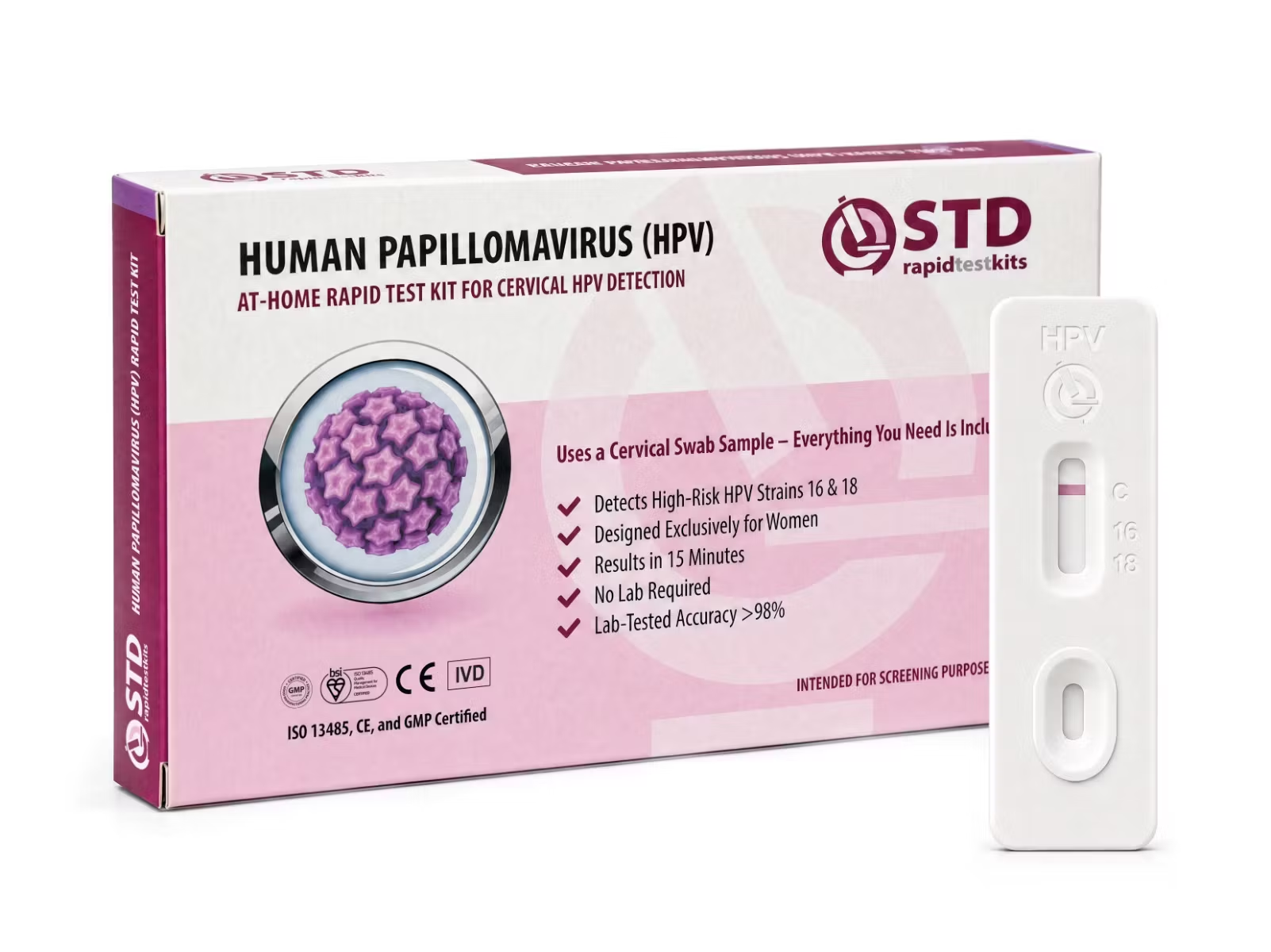
The at-home rapid HPV swab sold on this site is a different product: a lateral-flow self-test designed for at-home use by women, useful as a screening signal between formal cervical screening appointments. For men, an at-home HPV test isn't validated; high-risk HPV exposure concerns for men are usually addressed in a clinical setting where a provider can examine and biopsy any suspicious lesions.
Frequently asked questions
- I feel fine. Do I still need an STI test?
- Yes. Many common infections, including chlamydia, gonorrhea, and HPV, can persist for months or years without obvious symptoms. The CDC recommends routine screening for sexually active adults based on age, partner count, and other risk factors, regardless of how someone feels. The goal of routine screening is to catch infections before they cause complications or get passed on without anyone knowing. A regular schedule, not a specific scare, is what makes testing useful.
- Is at-home STI testing reliable or just marketing?
- It is reliable when the kit either mails samples to a CLIA-certified laboratory or uses an FDA-cleared lateral-flow design. The science behind the test is the same as what a clinic uses; the sample collection step is what moves to the home. Read the kit's own performance data and look for an explicit CLIA-lab partner or FDA clearance reference before buying.
- What if I mess up the sample collection?
- Most kits include step-by-step instructions and built-in checks for sample adequacy. CLIA-certified mail-in labs typically notify you if the sample is unusable so you can retest at no extra cost. The more common error is timing: testing too early after exposure, before the infection has reached detectable levels.
- How soon after sex should I test?
- Most bacterial STIs are reliably detectable around two weeks after exposure. Fourth-generation HIV antigen/antibody tests typically detect infection within 18 to 45 days. Syphilis usually shows on a test about six weeks after exposure. HSV-2 antibody seroconversion can take up to 12 weeks. Testing inside those windows is fine but should be followed up after the window closes if the first test is negative.
- Will anyone know I ordered an at-home kit?
- Most providers ship in plain packaging and deliver results through secure online portals rather than mailed paperwork. Your order is part of your purchase history with that retailer but it isn't reported to insurers, employers, or medical records unless you share it. If full confidentiality is important, read the provider's privacy policy before ordering.
- What happens if a test comes back positive?
- Take a breath first. Most STIs are treatable; several are curable with a short course of antibiotics. The next step is to contact a clinician, who may confirm with a laboratory test, prescribe treatment, and help with partner notification. Many telehealth services bundle this follow-up into the kit purchase. The earlier an infection is found, the simpler treatment usually is.
- Can someone have an STI for years without knowing?
- Yes. HPV can persist silently for years and is often only caught on a Pap or HPV test. Chlamydia and gonorrhea are frequently asymptomatic and can quietly cause pelvic inflammatory disease, infertility, or chronic pelvic pain. Routine screening is how silent infections get caught before they cause harm.
- Why is at-home testing expanding now?
- Sexual healthcare is following the same path as telemedicine, home blood pressure monitoring, and at-home colon cancer screening. The FDA's clearance of an at-home HPV self-collection device shows that regulators are increasingly confident in self-collected samples when paired with certified lab analysis. As access barriers shrink, the population most likely to benefit (asymptomatic adults, people in rural areas, people who avoid in-clinic testing) is much more likely to get screened.
This article was developed using current public health guidance on STI screening and emerging evidence on self-collected diagnostic testing. We reviewed reporting on the FDA's at-home HPV self-collection clearance, the CDC's STI Treatment Guidelines, the WHO's cervical cancer fact sheet, the National Cancer Institute's cervical screening summary, and the American Cancer Society's cervical cancer screening guidelines. Peer-reviewed literature on self-collected HPV samples and the comparative analytical performance of at-home STI lateral-flow tests was used to align the medical explanations with current scientific consensus.
- U.S. Food and Drug Administration. Press announcement on the clearance of an at-home HPV self-collection device for cervical cancer screening.
- U.S. Centers for Disease Control and Prevention. STI prevention, screening, and treatment overview, including the statement that millions of new STI infections occur in the U.S. each year.
- U.S. Centers for Disease Control and Prevention. HIV testing types, fourth-generation test windows, and follow-up testing guidance.
- World Health Organization. Cervical cancer fact sheet covering HPV as the primary cause and screening recommendations.
- National Cancer Institute. Cervical cancer screening patient overview covering HPV testing and screening intervals.
- American Cancer Society. Cervical cancer screening tests and recommended screening intervals for average-risk individuals aged 25 to 65.
