How Accurate Are At-Home Chlamydia Rapid Tests Compared With a Lab Test?
A rapid chlamydia cassette gives an answer in minutes. A lab NAAT takes longer but finds more infections. Here are the manufacturer's numbers for our kit, what independent reviews found for rapid chlamydia tests as a group, and how to read your own positive or negative so you know when a lab test is still worth booking.
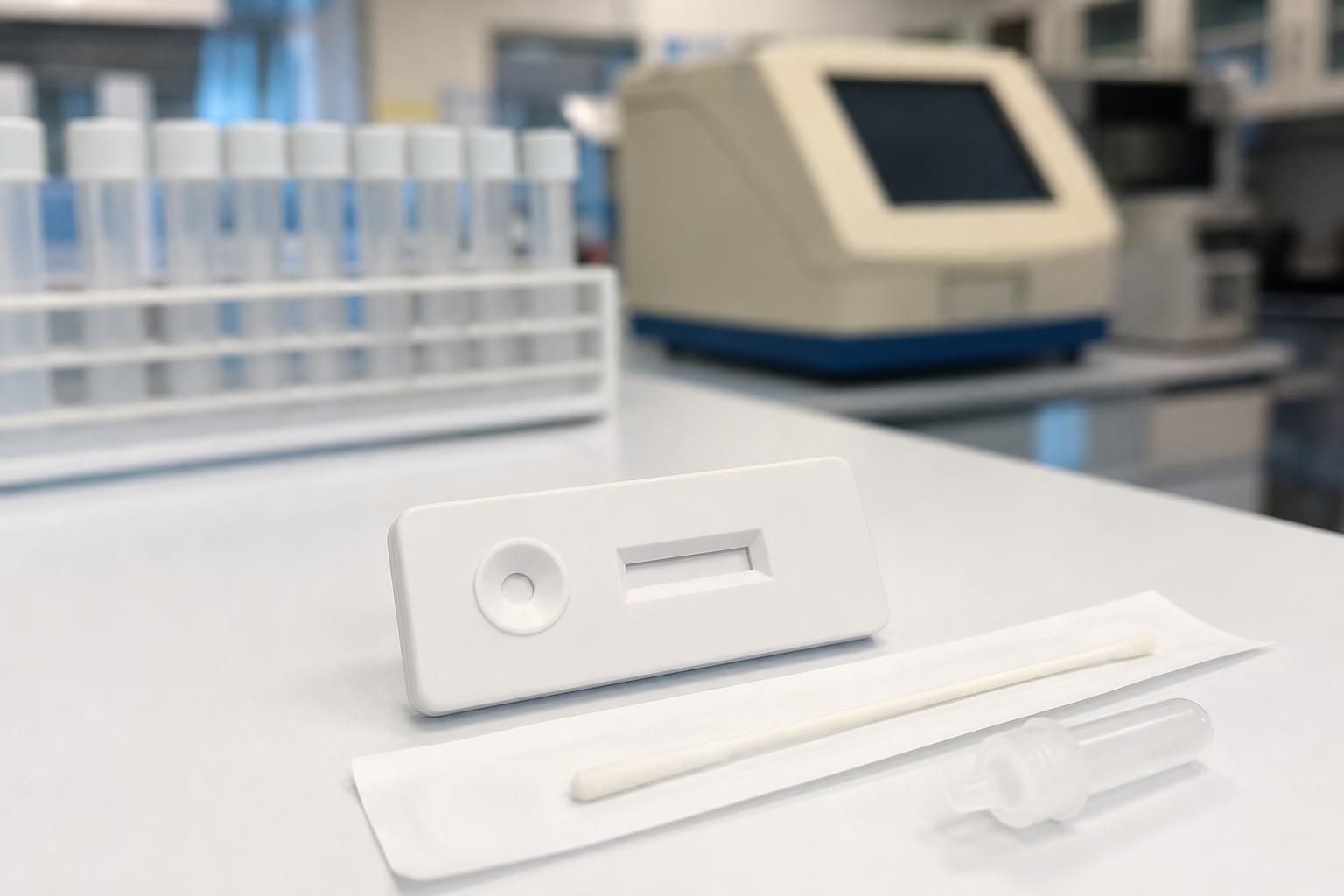



- Lab NAATs are the recommended chlamydia test; rapid antigen tests miss more infections, so a negative result needs context.
- A rapid positive is a preliminary screen to confirm with a clinician, and how often it is right depends on how common chlamydia is in people like you.
Published: October 2026 | Last updated: October 2026 | Editorial review and quality control: Martina N.
Is a rapid chlamydia test as accurate as a lab test?
No. For urogenital swabs and urine, lab NAATs are the most sensitive test. Our rapid kit's manufacturer reports 82.7–87.5% sensitivity against PCR on clinician-collected swabs; independent reviews of rapid antigen tests found about half of infections detected. Treat a rapid result as a preliminary screen and confirm positives with a clinician.
A rapid chlamydia test and a lab test can both start with a genital swab, but they work differently and miss different numbers of infections. Labs run nucleic acid amplification tests (NAATs), which copy the bacterium's genetic material until even a small amount becomes detectable. Most rapid cassettes look for chlamydia proteins, called antigens, directly, with nothing amplified.
This article is published by stdrapidtestkits.com, which sells the chlamydia rapid swab test discussed here, so weigh our kit's figures with that in mind. The article sticks to chlamydia: the sensitivity and specificity our kit's manufacturer reports, what independent reviews found for rapid chlamydia tests as a group, why the swab site matters, and what a positive or negative result means for you. For how rapid tests compare with lab testing across all STIs, see our overview of rapid STD kit accuracy compared to lab testing.
What a lab chlamydia test measures
The CDC's STI treatment guidelines name NAATs as the most sensitive and the recommended test for chlamydia (CDC STI Treatment Guidelines), and the World Health Organization calls them the gold standard (WHO chlamydia fact sheet). Because the test amplifies DNA or RNA, it can find an infection carrying very few bacteria. That matters for an infection that often causes no symptoms at all.
For lab screening, the CDC lists a vaginal swab for women and first-catch urine for men as the best samples, with cervical swabs, urethral swabs and first-void urine also usable. The same guideline says vaginal swabs patients collect themselves are equivalent in sensitivity and specificity to clinician-collected swabs when tested by NAAT. That finding belongs to NAATs. It does not carry over automatically to a rapid cassette.
The trade-off is time and access. A NAAT runs in a laboratory, so you either visit a clinic or mail a sample, then wait for the result.
NAATs are the most sensitive tests for these specimens and are the recommended test for detecting C. trachomatis infection.
How a rapid chlamydia cassette works
A lateral-flow cassette works much like a pregnancy test. The swab goes into an extraction buffer and a few drops go into the sample well. In most chlamydia cassettes, antibodies on the strip catch chlamydia antigen if enough of it is present. A colored line at the test position means a reactive result. A line at the control position shows the test ran.
The important words are "if enough is present." With no amplification step, a low-level infection can sit below what the strip can show. That is a likely reason rapid antigen tests miss more chlamydia than NAATs. The gap shows up mostly in sensitivity, the share of real infections a test catches. Specificity, the share of uninfected people correctly called negative, matters too, as the worked example further down shows.
Rapid cassette vs lab NAAT, side by side
The table puts our kit's manufacturer figures next to what public-health agencies say about lab NAATs. The kit figures come from the manufacturer's package insert, measured against PCR (a type of NAAT) on swabs collected by clinicians. Independent review figures for other rapid antigen products are in the table note, not in the kit column.
Chlamydia Rapid Cassette vs Lab NAAT
| Feature | Our rapid chlamydia cassette | Lab NAAT |
|---|---|---|
| What it detects | Lateral-flow immunoassay; the figures on file do not name the target (most such chlamydia cassettes detect antigen), no amplification | Chlamydia genetic material, amplified until detectable |
| Sample | Endocervical or urethral swab, per the manufacturer's instructions | Vaginal swab (women) or first-catch urine (men) preferred; cervical and urethral swabs also used |
| Where and how fast | At home or point of care, read in minutes | Processed in a lab; result comes back later |
| Sensitivity | Manufacturer insert: 87.5% (female cervical swab), 82.7% (male urethral swab) vs PCR | CDC: the most sensitive tests for urogenital specimens |
| Specificity | Manufacturer insert: 96.5% (female cervical swab), 93.9% (male urethral swab) vs PCR | The reference standard rapid tests are measured against |
| Self-collected swab data | None on file; insert figures come from clinician-collected swabs | CDC: self-collected vaginal swabs equivalent to clinician-collected |
| What a result means | Preliminary screen (see the results section below) | Used to diagnose and to confirm rapid results |
Kit figures are the manufacturer's own. Independent reviews of other rapid antigen products found pooled sensitivity of 48–56%; those figures are not our kit's.
What our kit's manufacturer reports, and what it doesn't
The manufacturer's package insert compares the cassette with PCR. On female cervical swabs it reports 87.5% sensitivity and 96.5% specificity. On male urethral swabs it reports 82.7% sensitivity and 93.9% specificity. Put plainly, in the manufacturer's own study the cassette missed roughly one in eight infections that PCR found in women, and about one in six in men.
Those numbers come with limits. The swabs were taken by clinicians from the cervix or the urethra, in a professional setting. The manufacturer publishes no data from people collecting their own swabs, so we have no home-collection number to give you. Under its own instructions, the kit is a preliminary screening test.
What independent reviews found for rapid chlamydia tests
Manufacturer studies are not the only evidence. A 2020 Cochrane review pooled studies of rapid point-of-care chlamydia tests and found a mean sensitivity of 48% and specificity of 98%, with NAAT as the reference (Cochrane review, 2020). Given what untreated chlamydia can do to reproductive health, its authors concluded that a screening strategy should not be based on a rapid antigen test.
A 2021 meta-analysis in eClinicalMedicine reached a similar result: pooled sensitivity of 56% for antigen-based point-of-care tests, against 94% for point-of-care tests built on NAAT technology (Zhou et al., 2021). Broken down by sample, antigen tests caught 46% of infections on cervical swabs, 52% on vaginal swabs and 57% in male urine, with wide ranges from one product to another.
Both reviews pooled many different antigen tests (the studies in the Cochrane review were published between 1999 and 2016), and their pooled sensitivity of 48% and 56% sits well below the 82.7–87.5% in our kit's insert. Results varied widely between studies and products. Neither review tested our kit, so neither tells us how it performs; the reviews cover antigen-based rapid tests, the format most chlamydia cassettes use. A negative result is best read with that range of evidence in mind. For a wider look at the evidence across infections, see what the science shows about at-home STD kit reliability.
What your result means: positives, negatives and prevalence
Sensitivity and specificity describe the test. What you want to know is whether your own result is right, and that also depends on how common chlamydia is among people like you.
Here is a worked example using the manufacturer's cervical-swab figures. Assume 1 in 20 people taking the test has chlamydia; that is an illustrative assumption, not a measured rate. Out of 1,000 people, 50 are infected and the cassette flags about 44 of them. Of the 950 who are not infected, a 96.5% specificity still produces about 33 false positives. So about 77 people see a positive, and only about 44 of them, roughly 57%, actually have chlamydia.
Now assume 1 in 5, as in a group where symptoms or a known exposure make infection more likely (again an assumption). About 175 of 203 positives are real, roughly 86%. A positive is more likely to be true when your situation already points toward infection. In both cases, confirm it with a clinician before treatment.
A negative has the opposite problem. In the 1-in-20 example, about 6 infected people get a negative result, and that count relies on the manufacturer's sensitivity. At the lower sensitivities independent reviews found, more would be missed. A negative lowers the odds but does not rule chlamydia out.
Get a lab NAAT from a clinic even after a negative rapid test if you have genital symptoms, a partner has been diagnosed with chlamydia, you are pregnant, or you tested before the window described below. In those situations a missed infection costs more than the extra appointment.
Why chlamydia is easy to miss
Most people with chlamydia have no symptoms (NHS), and the CDC notes that asymptomatic infection is common in both men and women. With nothing to prompt a visit, screening is often how an infection gets found, which raises the cost of a missed result. The CDC lists pelvic inflammatory disease, ectopic pregnancy and infertility as the most serious consequences in women (CDC: About Chlamydia), and the WHO notes painful testicular infection (epididymitis) in men.
Timing matters. The manufacturer's product information for the kit, as recorded in our catalog, gives detection from 1–2 weeks after exposure, with a retest at 2 weeks if you tested sooner. A test the day after sex can come back negative simply because there is not yet enough for the strip to detect.
So does the site of infection. Chlamydia can infect the rectum and throat, and the WHO notes oral infection usually causes no symptoms. Our kit uses a genital swab only and cannot tell you about those sites. If you had receptive anal or oral sex, ask a clinic about rectal or throat NAAT testing; we don't sell those tests.
Where a rapid test fits, and where a lab test does
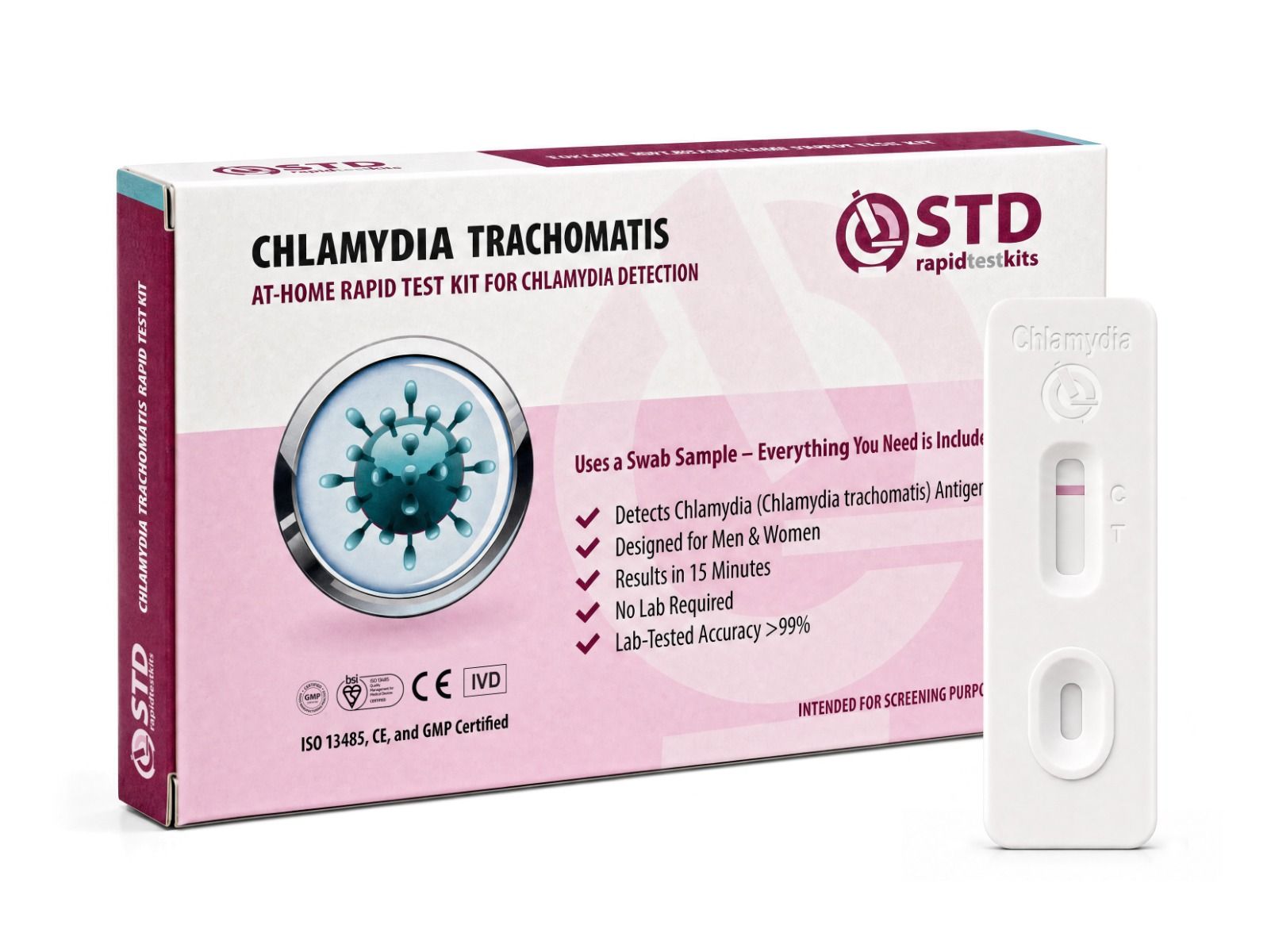
A rapid kit's strengths are practical: a result in minutes, no appointment, a flat price with no separate lab fee, and nothing on an insurance statement. For someone with no symptoms who wants a private first check between routine screens, an at-home chlamydia test is a reasonable start, with the limits above in mind: the manufacturer's figures come from clinician-collected swabs.
The warning above and the decision guide below cover the situations where a lab NAAT should come first. A lab NAAT is also the right routine test if you are a sexually active woman under 25, the group the CDC recommends screening every year (CDC screening recommendations). Costs, privacy and turnaround for each route are compared in our at-home vs lab vs mail-in STD test guide.
Choosing your next test
Work through these questions in order. The first "yes" tells you which route fits.
Rapid Cassette or Lab NAAT?
Do you have genital symptoms, are you pregnant, or has a partner been diagnosed with chlamydia?
Yes: Go to a clinic for a lab NAAT. Treatment decisions here should not rest on a rapid result, and a negative cassette could be one of the infections it misses.
Did you have receptive anal or oral sex with the partner you are worried about?
Yes: Ask a clinic for rectal or throat NAAT testing. Our kit uses a genital swab and cannot check those sites.
Was the sex you are worried about less than 2 weeks ago?
Yes: Wait until at least 2 weeks have passed before testing, or retest at that point if you have already tested. If you have symptoms, a partner has been diagnosed with chlamydia, or you are pregnant, go to a clinic now instead (step 1).
No: A rapid cassette is a reasonable private first screen. Confirm any positive with a clinician, and keep up with routine lab screening if you are in a group advised to screen.
Guidance only. A clinician can advise on your specific situation.
FAQs
- Can I use the rapid kit to check that my chlamydia treatment worked?
- It isn't the right tool. The CDC advises retesting about 3 months after treatment, and a 4-week test of cure only for pregnant people or when symptoms persist, adherence is in doubt or reinfection is suspected. Even lab NAATs can read falsely positive within 4 weeks of treatment because of leftover non-living bacteria. The manufacturer publishes no post-treatment data for the cassette, so use the lab test your clinician orders.
- Is a swab I take myself as good as one a clinician takes?
- For lab NAATs, yes, per the CDC. For our cassette there are no self-collection figures on file, as covered in the manufacturer section above.
- Can men use the rapid chlamydia test?
- Yes, the kit is for any gender and uses a urethral swab under the manufacturer's instructions. The insert's male figures are its lowest on both measures. Men with symptoms or a diagnosed partner should go straight to a lab NAAT.
This article summarizes current guidance from the U.S. Centers for Disease Control and Prevention (CDC), the World Health Organization (WHO), the NHS and cochrane.org and the other sources listed below. Each specific figure or recommendation links to the page that states it, and every page used is listed under Sources with what it supports. It is general health information written by our editorial staff, not a diagnosis or a treatment plan; how we choose topics and use sources is described in our editorial policy.
- U.S. Centers for Disease Control and Prevention. Sexually Transmitted Infections Treatment Guidelines, 2021: Chlamydial Infections. Supports NAATs as the most sensitive and recommended chlamydia test, preferred specimens, equivalence of self-collected vaginal swabs for NAAT, retesting at about 3 months, test-of-cure guidance and the most serious complications in women.
- U.S. Centers for Disease Control and Prevention. About Chlamydia (January 2025). Supports that chlamydia often has no symptoms and lists PID, ectopic pregnancy and infertility as complications of untreated infection in women.
- U.S. Centers for Disease Control and Prevention. STI Screening Recommendations (reviewed March 2024). Supports annual chlamydia screening for sexually active women under 25 and the pregnancy test-of-cure timing.
- World Health Organization. Chlamydia fact sheet (November 2025). Supports NAAT as the gold standard, that oral infection is usually asymptomatic, and epididymitis as a complication in men.
- NHS. Chlamydia (reviewed October 2024). Supports that most people with chlamydia have no symptoms.
- Grillo-Ardila CF, Torres M, Gaitán HG. Rapid point of care test for detecting urogenital Chlamydia trachomatis infection in nonpregnant women and men at reproductive age. Cochrane Database of Systematic Reviews, 2020. Supports the pooled 48% sensitivity and 98% specificity of rapid tests and the authors' conclusion against antigen-based screening.
- Zhou Y, Jiang TT, Li J, Yin YP, Chen XS. Performance of point-of-care tests for the detection of chlamydia trachomatis infections: a systematic review and meta-analysis. eClinicalMedicine, 2021. Supports pooled sensitivity of 56% for antigen-based and 94% for NAAT-based point-of-care tests, and antigen-test sensitivity by specimen.