How Accurate Are Rapid STD Test Kits Compared to Lab Testing?
Home rapid STI test kits put screening within reach in fifteen minutes, but how do they stack up against the lab gold standard? This guide breaks down sensitivity, specificity, and window periods for both methods, shows where each one earns its place in your testing plan, and explains exactly when a positive home result needs a clinic confirmation.




- FDA-cleared home rapid kits land within a few percentage points of lab NAAT for established infections, with sensitivity in the mid-90s percent range and specificity in the 98 to 99%+ range when read past the window period.
- A laboratory NAAT remains the analytical gold standard, especially for confirming a positive rapid result and for testing inside the early-infection window when pathogen load is still rising.
Published: November 2025 | Last updated: April 2026 | Editorial review and quality control: Martina N.
At-home rapid STI test kits have moved from novelty to mainstream in roughly a decade, and the obvious next question for anyone reaching for a cassette and a lancet is whether the result you get on your kitchen table is as trustworthy as the result a clinic lab would hand back. The answer depends on which infection you are testing for, how long ago the exposure happened, and what you plan to do with the result. Rapid lateral-flow kits and laboratory nucleic-acid tests are different chemistries with different strengths.
This guide compares the two side by side using the metrics that actually matter (sensitivity, specificity, and window period), shows where home rapid kits earn their place, and flags the situations where a laboratory test remains the better choice. It is written for the reader who wants a calm, specific answer and a clear next step.
How accurate are rapid STD test kits compared to lab testing?
FDA-cleared at-home rapid STI tests use lateral-flow chemistry and typically report sensitivity in the mid-90s percent range, with specificity in the 98 to 99%+ range when used after the correct window period. Laboratory nucleic acid amplification tests (NAAT/PCR) reach 95 to 99%+ sensitivity and similar specificity. Both are reliable for screening; positives from a rapid test should be confirmed with a lab NAAT, and negatives taken before the window closes should be repeated.
What "accuracy" actually means in STI testing
"Accuracy" is a marketing word. The two metrics clinical labs publish for any test are sensitivity (the share of truly infected people the test correctly flags as positive) and specificity (the share of uninfected people the test correctly flags as negative). A test can be 99% sensitive and 80% specific, or vice versa, and the headline number means very different things in each case.
For STI screening in a low-prevalence population, specificity is what protects you from being told you have an infection when you do not. Sensitivity is what protects you from a missed infection. The U.S. Centers for Disease Control and Prevention's clinical guidance for STIs emphasizes both: a screening test that is highly sensitive but produces some false positives is acceptable only when confirmation testing is built into the protocol, which is why CDC recommends NAAT-based confirmation when a screening result is positive.
Two related numbers matter to the reader at home: positive predictive value (PPV) and negative predictive value (NPV). PPV depends on how common the infection is in your population. If you test positive on a 99% specific test in a group where only 1 in 1,000 people actually have the infection, the chance the result is genuine is much lower than the specificity figure suggests. That is the mathematical reason every reputable home test kit advises confirming a positive at a clinic.
FDA clearance for an at-home STI test means the manufacturer has submitted analytical and clinical performance data showing sensitivity and specificity meet the agency's bar for the intended use. The CDC's STI testing page notes that FDA-approved self-collection options exist for HIV, syphilis, chlamydia, and gonorrhea. A kit cleared for screening is different from a confirmatory diagnostic, and that distinction is worth keeping in mind when you read the box.
Even at 99% specificity, the chance a positive result is a true infection (positive predictive value) drops sharply when the infection is rare in the population being tested. In a group where only 1 in 1,000 people actually has the infection, a 99% specific test will produce roughly ten false positives for every true positive. That math is the reason every reputable rapid kit recommends confirming a positive at a clinic with a NAAT before starting treatment or notifying partners.
How home rapid tests work
Every rapid kit on this site, and every comparable kit cleared for at-home use in the U.S. and EU, is a lateral-flow immunoassay. You collect a sample (a self-administered vaginal or penile swab for chlamydia, gonorrhea, trichomoniasis, or HPV; a fingerstick blood drop for HIV, syphilis, hepatitis B, hepatitis C, and HSV antibodies), apply it to the cassette, wait the printed time (usually 10 to 20 minutes), then read colored lines.
The chemistry is straightforward. The strip carries antibodies (or antigens) tagged with a colored label. If the target analyte is in your sample, it binds the labeled reagent, the complex flows by capillary action to a fixed test line, and a visible band appears. A second control line confirms the strip ran correctly; if the control line does not appear, the test is invalid regardless of what shows on the test line.
Lateral-flow chemistry has clear strengths: it is fast, requires no instrument, ships at room temperature in most cases, and produces a result you can read by eye. It also has a real ceiling. Lateral-flow strips detect analyte at the nanogram level, which is plenty for an established infection but not always enough for very early infection where antigen or antibody concentrations are still rising. That ceiling is why no responsible home-test manufacturer claims its kit is NAAT-equivalent; lateral-flow and NAAT are complementary screening and confirmation tools, each with strengths the other lacks.
Practically, a home rapid kit is at its best as a screening tool for adults who want a private, fast first answer about their status. A negative result past the window period is reassuring evidence of absence; a positive result is a strong indication to follow up with a clinic NAAT for confirmation, partner notification logistics, and a treatment plan.

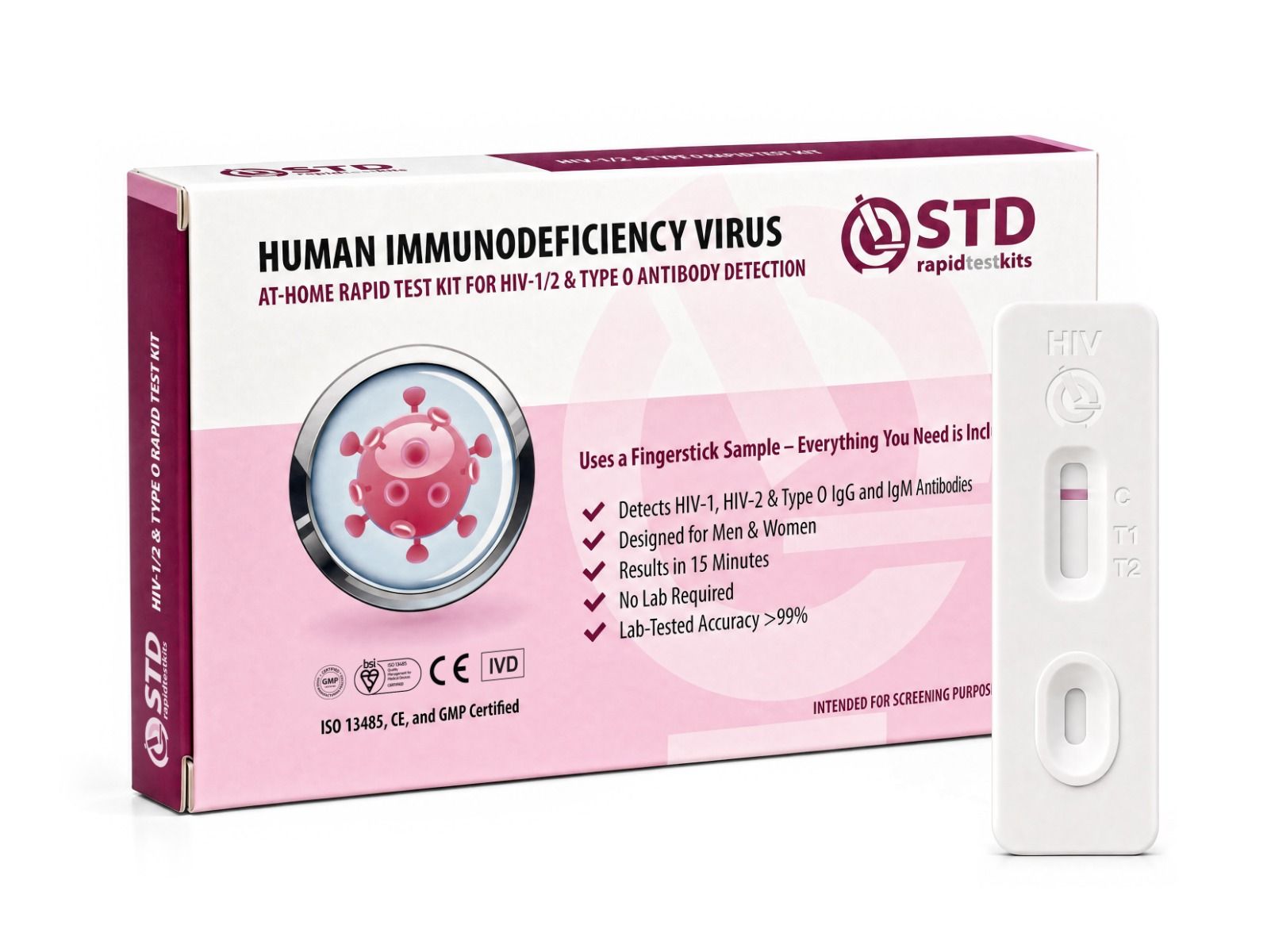
The two visible bands are the only output the strip produces. A line at the control position confirms the strip ran correctly; a line at the test position is positive for the target analyte regardless of how faint it looks. If the control line is missing, treat the result as invalid and use a fresh cassette.
How lab tests work, and why NAAT is the gold standard
Laboratory testing for the bacterial STIs (chlamydia, gonorrhea, trichomoniasis) is dominated by nucleic acid amplification testing, abbreviated NAAT. The most familiar NAAT method is PCR, but related techniques (TMA, SDA, NEAR) all work the same way: a small amount of pathogen DNA or RNA in your sample is amplified through repeated enzymatic cycles until there is enough to detect reliably. Because the chemistry creates billions of copies from a few starting molecules, a NAAT can detect infection from a sample that contains far less pathogen than a lateral-flow strip would need.
That sensitivity advantage is real and is why the CDC's chlamydia treatment guidelines name NAATs as the most sensitive tests and the recommended method for detecting C. trachomatis infection across urogenital and extragenital sites; the agency's gonorrhea guidance reaches the same conclusion for N. gonorrhoeae. For HIV, the laboratory standard is a fourth-generation antigen/antibody combination immunoassay run on an analyzer, which detects both p24 antigen (early in infection) and anti-HIV antibodies (later); a positive screening result is followed by an HIV-1/HIV-2 antibody differentiation test and, if needed, an HIV-1 RNA NAAT.
Laboratory testing has trade-offs that home testing solves. The sample has to travel to a lab; results take days; you (or your insurance) pay clinic fees; and many readers find the clinic visit itself a barrier to testing at all. CDC's annual STI surveillance reports document the consequence: a substantial share of infections in the U.S. go undiagnosed each year, with cost and access friction cited consistently as drivers.
The two technologies serve practical and complementary roles. A lab NAAT is the better tool when sensitivity matters most (very early infection, asymptomatic screening of high-prevalence groups, confirmatory testing). A home rapid kit is the better tool when access, speed, and privacy matter most (post-exposure peace of mind once the window has closed, routine screening for low-prevalence populations, repeat testing without repeat clinic visits).
Home rapid kits use lateral-flow immunoassay chemistry. Laboratory STI testing uses NAAT/PCR or fourth-generation antigen/antibody analyzers. The two are different technologies with different sensitivity profiles, especially in early infection. Treat the rapid kit as a fast screening tool whose positives benefit from lab confirmation; do not treat it as a NAAT substitute for high-clinical-suspicion or early-window cases.
Side-by-side: rapid kits vs. laboratory NAAT
The table below summarizes the practical differences a reader is likely to care about. Specific sensitivity figures vary by infection, kit, and the window-period stage at which testing happens; the ranges below are typical for the major STIs covered by FDA-cleared at-home products and for the lab tests they are most often compared against.
| Attribute | Home rapid lateral-flow kit | Laboratory NAAT or 4th-gen immunoassay |
|---|---|---|
| Sample type | Self-collected vaginal or penile swab; fingerstick blood drop | Clinician or self-collected swab, urine, or venous blood |
| Time to result | 10 to 20 minutes | 1 to 7 days (some same-day clinics faster) |
| Where it is performed | At home, by the user | Clinical reference laboratory |
| Typical sensitivity (post-window) | 92 to 99% | 95 to 99%+ |
| Typical specificity | 98 to 99%+ | 99%+ |
| Approximate cost (U.S.) | $20 to $150 per kit | $50 to $300+ per panel (often insurance-covered) |
| Best for | Privacy, screening, repeat testing past the window | Early-window detection, confirmation, complex cases |
| Lab confirmation needed for positive? | Yes (clinic NAAT) | Often built into the lab protocol |
Window periods: when each test is reliable
The single biggest source of seemingly inaccurate home rapid results is testing during the window period (the interval between exposure and when an infection becomes detectable). A negative test taken too early is mathematically reassuring against a months-old exposure but means very little about a recent one. The window varies by infection and by test technology.
HIV. Per the CDC HIV testing guidance, fourth-generation lab antigen/antibody assays detect most infections by 18 to 45 days after exposure. Antibody-only rapid kits (the technology used in most home HIV tests) generally close the window between 23 and 90 days; CDC notes that the great majority of people develop detectable antibodies within three months. A negative home HIV test taken at six weeks is informative; a negative one taken at five days is not.
Chlamydia and gonorrhea. Both can typically be detected by NAAT within 1 to 2 weeks after exposure. Lateral-flow rapid swabs require similar timing for highest sensitivity. Testing before two weeks risks a false negative; if symptoms develop or exposure is high-confidence, retesting at the two-week mark is sensible.
Syphilis. Treponemal antibody tests (the chemistry used in home syphilis kits and the lab assays they are compared against) become positive 3 to 6 weeks after exposure on average and reliably by 12 weeks. Earlier than 3 weeks is too soon for either method.
Hepatitis B and C. Both blood antibody tests, both with windows in the 8 to 12 week range. CDC's hepatitis testing pages cover the specifics; for hepatitis C, RNA tests are available at labs and can shorten the window to roughly 2 weeks for high-priority cases.
HSV-2. Antibody tests, both home and lab, take roughly 12 weeks to reliably detect seroconversion after a primary infection. This is the longest window in routine home STI testing and the one most often misunderstood. Importantly, an HSV-2 antibody test does not diagnose an active sore; that requires a clinic-collected lesion swab and a NAAT.
Window periods at a glance
- Chlamydia and gonorrhea: detectable from 1 to 2 weeks post-exposure.
- Syphilis: detectable from 3 to 6 weeks on average, reliable by 12 weeks.
- HIV (rapid antibody): window between 23 and 90 days; fourth-generation lab antigen/antibody tests detect most infections within 18 to 45 days.
- Hepatitis B and C: 8 to 12 week window for antibody tests; lab HCV RNA can shorten the window to roughly 2 weeks.
- HSV-2 antibody: roughly 12 weeks to reliably detect seroconversion; antibody tests do not diagnose an active sore.
What can go wrong with a home test
Lateral-flow chemistry is robust, but a home test is only as good as how it was used. Five failure modes account for most reader complaints:
- Testing inside the window period. This is the most common cause of false negatives by a wide margin. If your exposure was last week, the rapid result tells you about earlier exposures; it does not yet reflect the recent one.
- Sample collection error. A vaginal or penile swab needs to be rotated against the targeted tissue for the time the kit specifies; a quick wipe is not enough. A fingerstick blood drop needs to fully fill the sample well; a partial drop can produce an invalid or weak result.
- Reading the result outside the result window. Lateral-flow strips have a defined read time printed on the kit insert (often 15 to 20 minutes); reading too early can miss a developing line, and reading too late can show evaporation artifacts that look like positives.
- Damaged or expired kit. Heat-damaged reagents (a kit left in a hot car or stored in a humid bathroom) lose sensitivity. Check the expiration date on the pouch and follow the storage instructions on the box.
- Misreading a faint line. A faint test line is a positive line, regardless of how dark it looks compared to the control. If the test and control lines are both visible within the read window, treat the result as positive and confirm with a clinic NAAT.
Sample collection error is the single most common cause of an invalid swab result, which is why reading the kit insert before sample collection matters. Most user error happens because the user assumed the protocol was the same as a kit they used previously; it usually is not.
When a rapid kit is enough, and when to follow up at the lab
Use a home rapid kit confidently for:
- Routine screening when you have no symptoms and your last potential exposure was past the window period for the infection in question.
- Repeat testing on an interval. CDC recommends sexually active people test for STIs at least annually; people with multiple partners, HIV-negative people on PrEP, and pregnant people test more often.
- Post-exposure peace of mind once the window has closed, especially when clinic access is a barrier of distance, cost, or schedule.
- Privacy-sensitive situations where a clinic visit is the bigger problem than a few minutes of uncertainty about test sensitivity.
Choose a clinic visit (and a lab NAAT or lab immunoassay) when:
- You have symptoms (discharge, sores, painful urination, pelvic pain, throat pain after oral exposure, or anal discharge after receptive anal contact). Symptoms warrant a clinical exam regardless of any home result.
- You are pregnant. CDC recommends specific lab-based screening at the first prenatal visit and again in the third trimester for higher-risk patients; a home test does not replace that schedule.
- You suspect a pharyngeal (throat) or rectal infection. Our home kits are not validated for those sample types; clinic-collected swabs sent to a NAAT lab are the right tool for those exposures.
- Your home rapid result is positive. Always confirm at a clinic before starting treatment or notifying partners.
- You have a high-risk exposure within the past 72 hours and may benefit from HIV PEP (post-exposure prophylaxis), which is time-sensitive and only available through a clinical provider.
All sexually active women younger than 25 years should be tested for gonorrhea and chlamydia every year. Women 25 years and older with risk factors such as new or multiple sex partners should also be tested every year.
Reading your result and what to do next
A clear positive on a home rapid test is a real signal: it means the lateral-flow chemistry has detected enough antigen or antibody to cross the kit's threshold. The next step is a clinic visit for a confirmatory NAAT (chlamydia, gonorrhea, trichomoniasis) or a confirmatory lab immunoassay plus differentiation test (HIV, syphilis), followed by treatment as indicated. Bring the home result with you; many providers prefer to see the cassette photograph and timestamp.
A clear negative past the window period is real reassurance against the infection tested. It does not, however, give a green light for unprotected partner contact: home kits cover specific infections rather than the full spectrum, and HPV in particular has no reliable home test for men. The HPV at-home swab on this site is validated for vaginal self-collection only.
An invalid result (no control line) means the strip did not run correctly. Discard it and use a fresh kit, paying close attention to sample volume and the read window. If you get two invalid results in a row from the same lot, contact the seller; that pattern usually indicates a storage or manufacturing issue with that batch.
Whatever the result, do not stop the conversation at the cassette. A negative test is the start of a regular testing habit, and a positive test is the start of a treatment and partner-notification process that begins with a clinic visit.
Clear positive: confirm at a clinic with a NAAT (or lab immunoassay for HIV/syphilis) before treatment or partner notification. Clear negative past the window: reassuring; continue regular testing on the interval that fits your risk profile. Invalid (no control line): discard and run a fresh cassette, watching sample volume and the read window. Two invalids from the same lot suggest a storage or manufacturing issue; contact the seller.
Frequently asked questions
- How accurate is an at-home rapid STD test compared to a lab test?
- For most established infections past the window period, FDA-cleared at-home rapid kits report sensitivity in the mid-90s percent range and specificity in the 98 to 99%+ range, which lands within a few percentage points of laboratory NAAT figures. The lab's advantage shows up at the early-infection edge where pathogen load is still rising; the home kit's advantage is speed, privacy, and lower cost.
- Are at-home rapid STD tests FDA approved?
- Several at-home STI tests are FDA-cleared or FDA-authorized for over-the-counter use. CDC's STI testing page notes that FDA-approved self-collection options exist for HIV, syphilis, chlamydia, and gonorrhea. Clearance applies to the specific kit and intended use, so check each product page for cleared status before assuming it.
- What is the window period for home STD tests?
- It varies by infection. Chlamydia and gonorrhea: 1 to 2 weeks. Syphilis: 3 to 6 weeks, reliable by 12. HIV antibody rapid: 23 to 90 days. Hepatitis B and C: 8 to 12 weeks. HSV-2 antibody: roughly 12 weeks. Testing before the window closes risks a false negative.
- If my home rapid test is positive, do I need a lab confirmation?
- Yes. Even at 99% specificity, the positive predictive value of a screening test depends on how common the infection is in the population. A clinic NAAT (or a lab immunoassay plus differentiation test, for HIV) confirms the infection, identifies the specific organism if relevant, and starts the treatment and partner-notification process correctly.
- Can a home test miss an infection a lab would catch?
- Yes, in two situations: testing too early in the window period when pathogen load is still rising and below the lateral-flow threshold, and at-home swab samples that are not collected correctly. The lab NAAT's amplification step gives it a sensitivity edge in those scenarios, which is why early-exposure screening and high-clinical-suspicion cases belong at a clinic.
- What is the difference between a rapid lateral-flow test and a NAAT?
- Lateral-flow tests detect antigen or antibody by capillary flow over a strip; NAAT amplifies pathogen DNA or RNA through repeated enzymatic cycles. NAAT is more sensitive, especially in early infection, and is the laboratory gold standard for chlamydia, gonorrhea, and trichomoniasis. Lateral-flow is faster, instrument-free, and well-suited to screening past the window period.
- How often should I test for STIs?
- CDC recommends at least annual screening for sexually active people, with more frequent testing (every 3 to 6 months) for people with multiple partners, men who have sex with men, people on HIV PrEP, and people who inject drugs. Pregnant people are screened by their provider on a defined schedule.
- Are home tests reliable for HSV-2 and active herpes sores?
- Home HSV-2 tests detect antibodies and become reliably positive about 12 weeks after a primary infection. They cannot tell you whether a current sore is herpes; that requires a clinic-collected lesion swab and a NAAT. For active sore identification, or for pharyngeal or rectal swab tests we do not sell, see a clinic.
- U.S. Centers for Disease Control and Prevention. Clinical Guidance for STIs, hub for healthcare-provider STI diagnosis and treatment recommendations.
- U.S. Centers for Disease Control and Prevention. STI Treatment Guidelines: Chlamydial Infections, naming NAATs as the most sensitive and recommended laboratory test for detecting Chlamydia trachomatis.
- U.S. Centers for Disease Control and Prevention. HIV Testing Information for Patients and Providers.
- U.S. Centers for Disease Control and Prevention. Getting Tested for STIs, including FDA-approved self-collection options for HIV, syphilis, chlamydia, and gonorrhea.
- World Health Organization. Sexually Transmitted Infections Fact Sheet.
- U.K. National Health Service. Sexually Transmitted Infections Overview.