Are At-Home Instant STI Test Kits Accurate? How They Work
Rapid home STI tests use the same lateral-flow chemistry as a pregnancy test, deliver a result in 15 minutes, and report sensitivity in the low to high 90s percent depending on the infection. Knowing how the strip actually works, what it can and cannot detect, and which window period applies to your exposure is the difference between a useful screen and false reassurance.
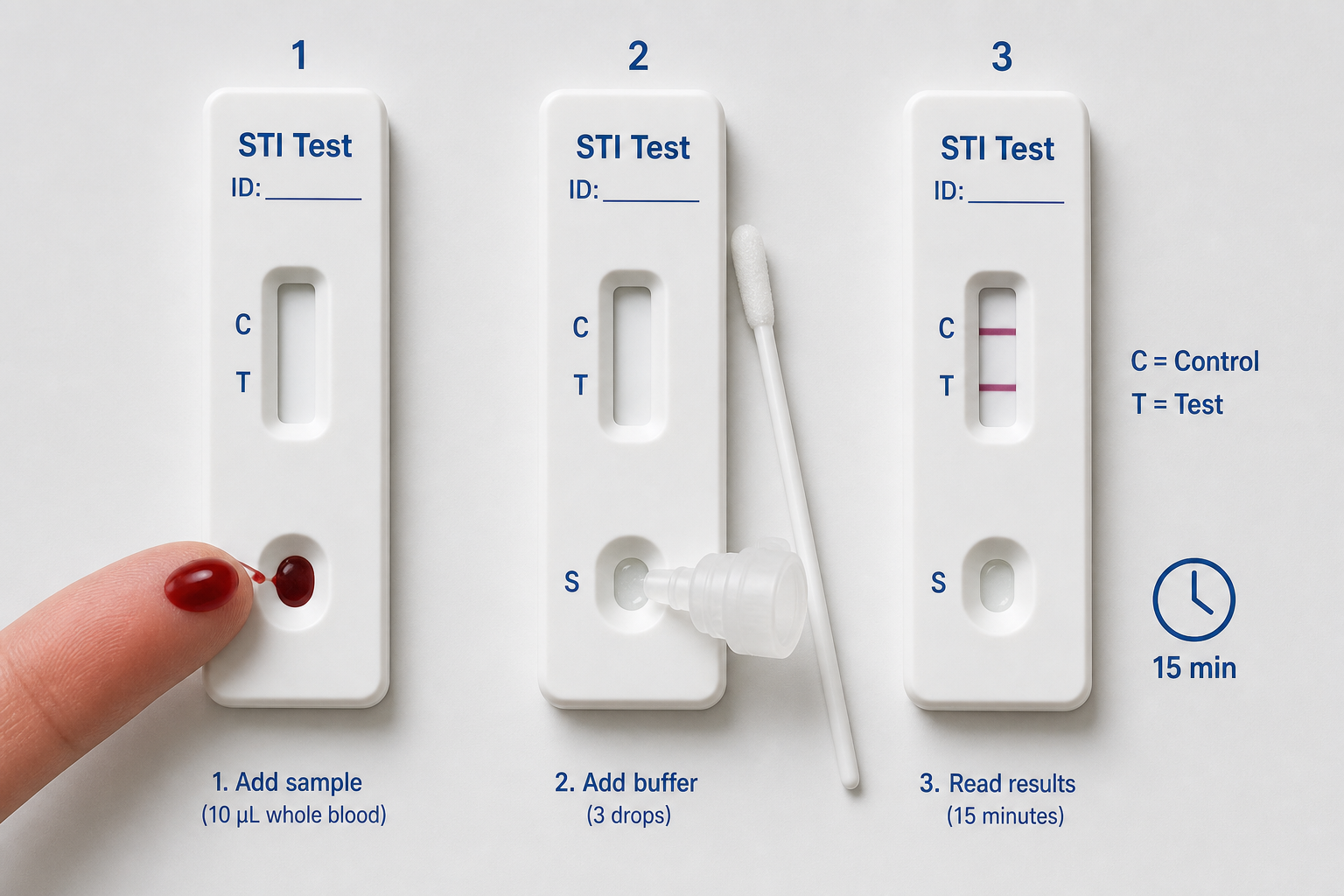



- Rapid home STI tests use the same lateral-flow chemistry as pregnancy tests, return a result in about 15 minutes, and report sensitivity in the low 90s to high 90s percent depending on infection type and on timing the test correctly to its window period.
- These kits are screening tools. A positive result still needs a laboratory test to confirm, and a negative result taken inside the window period (the gap between exposure and detectability) does not yet rule out infection.
Published: November 2025 | Last updated: May 2026 | Editorial review and quality control: Martina N.
An instant home STI test kit gives you a private result on a strip of paper inside about 15 minutes, the same way a pregnancy test does. The promise is real, and so are the limits. Knowing how the chemistry works, what it can and cannot detect, and which window period applies to your specific exposure makes the difference between a test that genuinely answers your question and a test that gives you false reassurance.
This guide walks through what a rapid lateral-flow immunoassay actually does, the published accuracy ranges for the most common infections, the window periods you need to wait through, and when a clinic visit is the better tool. Most readers landing here do not need to panic; they just need to understand how the tool works before they use it.
How accurate are instant home STI test kits?
Rapid home STI tests using lateral-flow immunoassay strips typically report sensitivity in the low 90s to high 90s percent depending on infection type, with blood-based tests (HIV, hepatitis) generally in the upper range and swab-based antigen tests (chlamydia, gonorrhea) in the lower range. Specificity is above 98 percent for most kits. They are screening tools, not diagnostic confirmations: any positive result should be confirmed with a laboratory test (NAAT for swab samples, ELISA or NAAT for blood samples), and any high-risk negative result taken before the window period has fully closed should be retested.
Key takeaways
- Rapid home STI tests use the same lateral-flow chemistry as pregnancy tests, return a result in about 15 minutes, and report sensitivity in the low 90s to high 90s percent depending on infection type and on timing the test correctly to its window period.
- These kits are screening tools. A positive result still needs a laboratory test to confirm, and a negative result taken inside the window period (the gap between exposure and detectability) does not yet rule out infection.
How instant home STI tests actually work
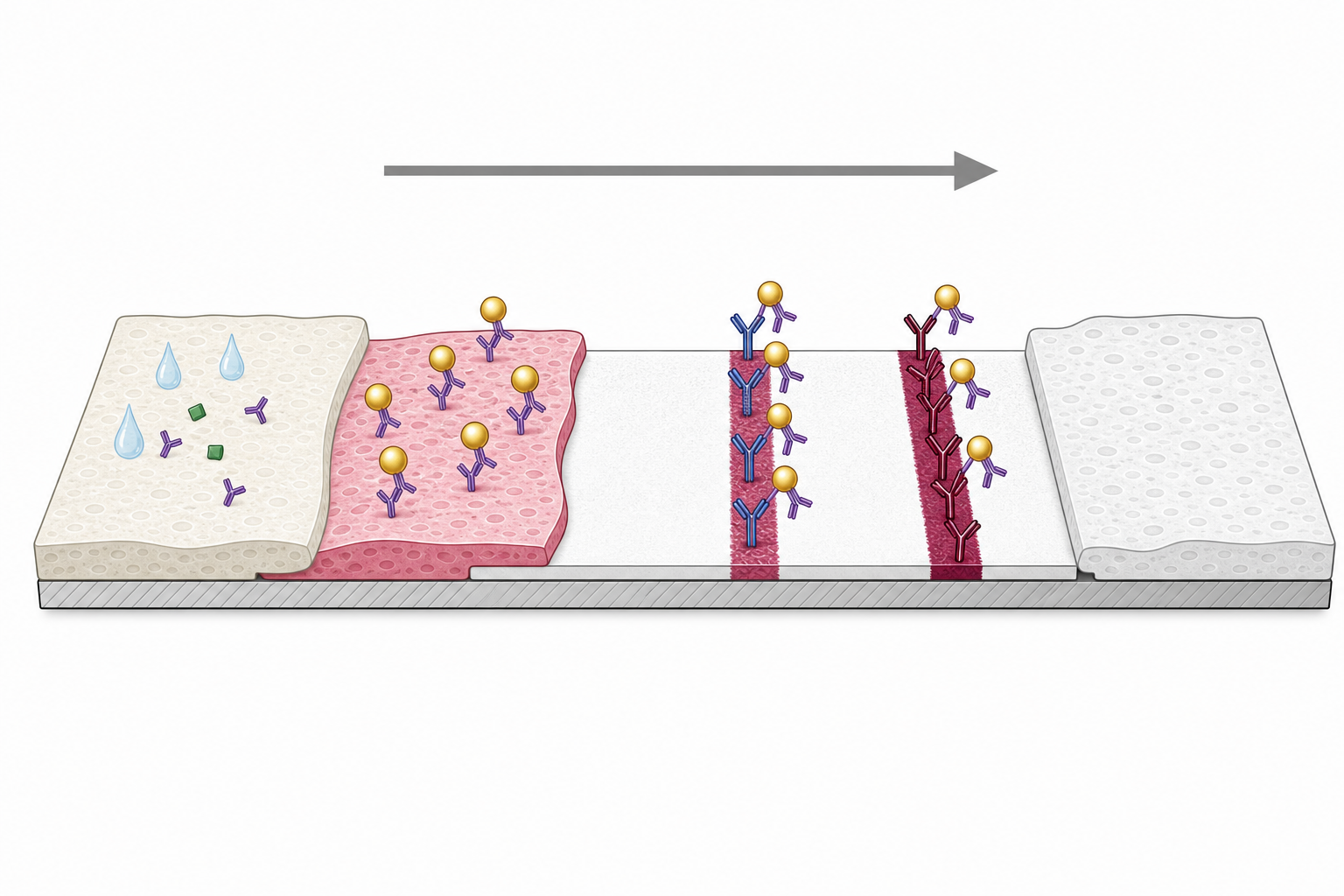
The strip inside a rapid home STI kit uses a chemistry called lateral-flow immunoassay, the same family of test that detects pregnancy hormones in a drugstore pregnancy stick. When you apply your sample (a few drops of fingerstick blood, or a self-collected vaginal or penile swab transferred into a buffer solution), capillary action draws the fluid across a strip of nitrocellulose paper.
The strip carries two zones of pre-deposited antibodies. One zone, the control line, traps a non-specific marker and turns visible whenever the sample flows through correctly. The second zone, the test line, contains antibodies tuned to a specific target: HIV antigens or antibodies for an HIV kit, treponemal antibodies for a syphilis kit, chlamydia or gonorrhea bacterial antigens for the swab-based kits. If the target is present in your sample, those antibodies bind and a colored band appears.
Two visible lines means the target was detected. One line in the control zone only means the target was not detected. No line at all means the test ran wrong (usually too little sample or expired reagents) and the result is invalid, not negative.
Three things follow from this chemistry. First, the test detects what is in the sample at the moment of testing, not historical exposures the body has already cleared. Second, the test depends on the body having produced enough antigen or antibody to cross the detection threshold, which is why window periods exist. Third, lateral flow is binary at a fixed threshold, so faint lines should be read as positive rather than as borderline. The instructions on every reputable kit explain this directly.
This is different chemistry from the laboratory test most clinics use. A laboratory nucleic acid amplification test (NAAT, sometimes called PCR) copies bacterial or viral DNA millions of times before measuring it, which lets it detect far smaller amounts of pathogen than a lateral-flow strip can, and the U.S. Centers for Disease Control and Prevention designates NAAT as the recommended gold standard for chlamydia and gonorrhea screening on the strength of that higher analytical sensitivity.
How accurate are at-home rapid STI tests?
Accuracy for any diagnostic test breaks into two numbers that move independently. Sensitivity is the percentage of truly infected samples the test correctly flags as positive. Specificity is the percentage of truly uninfected samples the test correctly clears as negative. A single "accuracy" figure mashes both together and obscures which kind of error you are most likely to encounter.
Most CE-marked and FDA-cleared rapid home STI kits report sensitivity in the low 90s to high 90s percent and specificity above 98 percent for the infections they target, when used in the recommended population and after the window period closes. Blood-based rapid tests (HIV, hepatitis B and C, syphilis) generally sit at the upper end of that band, while swab-based antigen tests for chlamydia and gonorrhea tend to land in the low to mid 90s. The CDC notes that rapid HIV antibody tests produce results in 30 minutes or less, and that any positive result needs follow-up confirmatory testing in a laboratory (CDC HIV testing overview).
The catch is that those numbers come from controlled studies on samples collected and stored under ideal conditions. Real home use introduces variables: the user collects the sample, runs the test on a kitchen counter rather than a benchtop, and reads the result with the naked eye instead of an automated reader. Sensitivity in real-world use tends to drop a few points below the package-insert figure, especially when users mistime the read window or skip steps in the instructions.
That gap is the practical reason every reputable rapid kit's instructions tell you to confirm a positive result with a laboratory test and to retest a high-risk negative outside the window period.
| Infection (rapid home test) | Sample type | Typical sensitivity | Typical specificity |
|---|---|---|---|
| HIV antibody (third or fourth generation) | Fingerstick blood | 99.0 to 99.9% | Above 99.5% |
| Syphilis (treponemal antibody) | Fingerstick blood | 95 to 98% | 98 to 99% |
| Chlamydia | Vaginal or penile swab | 92 to 97% | 98 to 99% |
| Gonorrhea | Vaginal or penile swab | 92 to 97% | 98 to 99% |
| Hepatitis B (HBsAg) | Fingerstick blood | 95 to 99% | Above 99% |
| Hepatitis C (antibody) | Fingerstick blood | 97 to 99% | Above 99% |
| HSV-2 antibody | Fingerstick blood | 90 to 97% | 95 to 98% |
Ranges drawn from published CE-mark and FDA-clearance validation studies and manufacturer instructions for use; all figures reflect lateral-flow immunoassay performance, not laboratory NAAT.
When can each test detect an infection? Window periods explained
The window period is the gap between exposure and the moment a test can reliably detect the infection. Test before the window closes and you risk a false negative even when infected. Window length depends on what the test is measuring (antigen, antibody, or pathogen genetic material) and on how long your immune system needs to mount a detectable response.
For rapid lateral-flow home tests, conservative window periods drawn from CDC and manufacturer guidance look roughly like this:
- Chlamydia and gonorrhea (swab): about 14 days from exposure. The bacteria need time to replicate to a level the strip can detect.
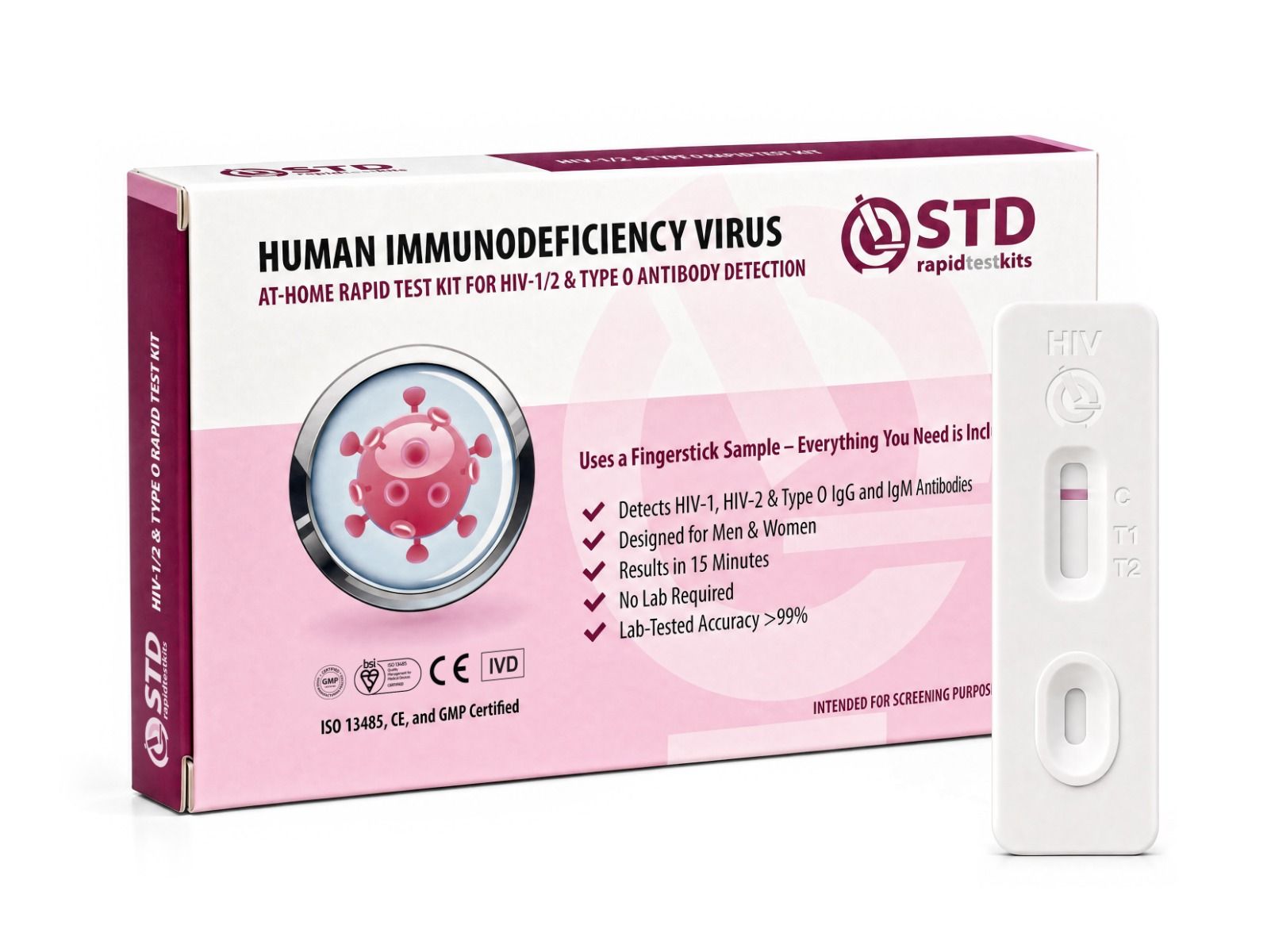
- HIV antibody rapid tests: 23 to 90 days from exposure for blood-based fingerstick tests, with most people developing detectable antibodies by week 6. Antigen-antibody (fourth-generation) laboratory tests detect earlier (around 18 to 45 days).
- Syphilis (treponemal antibody): about 3 to 6 weeks after exposure, sometimes longer.
- Hepatitis B (HBsAg surface antigen): 4 to 10 weeks after exposure.
- Hepatitis C antibody: 4 to 10 weeks for most people, occasionally up to 6 months.
- Herpes (HSV-2 antibody): 6 to 12 weeks for most people, with seroconversion sometimes taking up to 16 weeks for outliers.
- Trichomoniasis (vaginal swab): about 5 to 28 days from exposure.
Testing the day after a worrying exposure gives meaningless reassurance, because the body has not yet produced detectable antigen or antibody. CDC HIV testing guidance puts this directly: anyone who tests negative after a possible exposure should retest after the window period for the test they used (CDC HIV testing overview).
This article is published by stdrapidtestkits.com, which sells at-home STI testing kits. Recommendations here are based on fit-for-purpose for the reader's concern, not commercial benefit; if your specific situation calls for a clinic test we do not sell, this guide says so plainly.
What instant home tests cover (and what they don't)
Home rapid kits exist for a specific list of infections. They do not cover everything a clinic visit can.
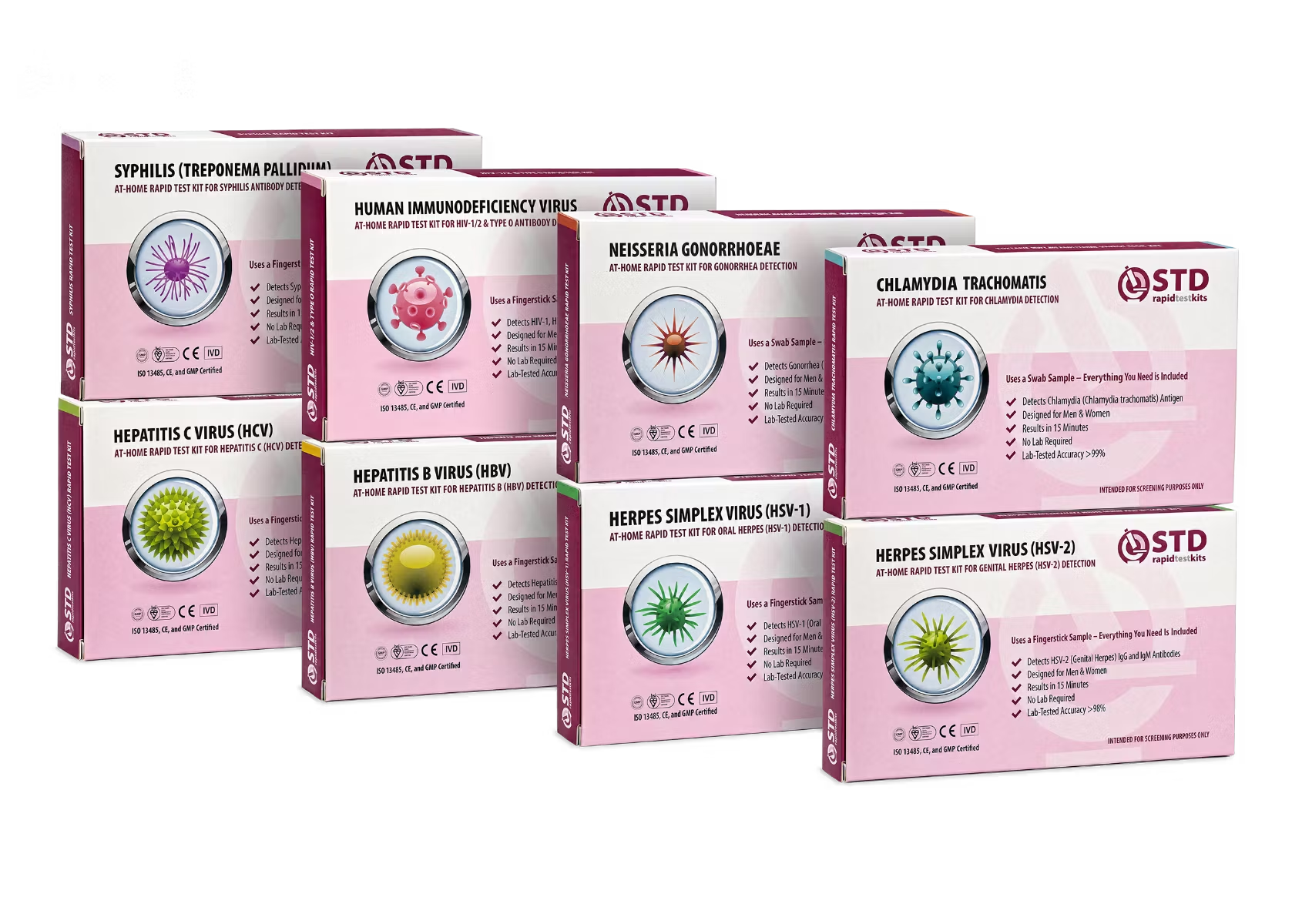
Available as rapid home tests at this site and most reputable retailers: HIV (blood), syphilis (blood), hepatitis B and hepatitis C (blood), HSV-1 and HSV-2 antibodies (blood), chlamydia and gonorrhea (vaginal or penile swab), trichomoniasis (vaginal swab, women only), and HPV (vaginal swab, women only). Multi-infection combo kits package three to ten of these strips into a single panel, which lowers the per-test cost when you want broad screening.
Not currently available as a rapid home test from this site or most retailers: pharyngeal (throat) swabs for oral chlamydia or gonorrhea, rectal swabs for chlamydia or gonorrhea acquired through receptive anal sex, and urine-sample NAAT panels. If your specific concern is throat or rectal exposure, the right tool is a clinic visit with site-specific NAAT testing, not a genital swab kit.
The trichomoniasis and HPV swabs we sell are validated for vaginal self-collection only. We do not currently offer a male-compatible rapid home test for either infection, so men with a trichomoniasis or HPV concern should see a clinic.
If you are unsure which kit fits, a multi-infection combo (a six-in-one or seven-in-one panel) covers the most common screening targets in a single test session and is appropriate when you want broad coverage after a high-risk encounter.
How to use a rapid home test correctly
The package instructions are the authoritative source. The most common mistakes that cause false results are predictable and avoidable.
Read the timing window precisely. Most rapid strips give a valid result inside a defined window (often 10 to 20 minutes after sample application). Reading too early misses lines that have not yet developed. Reading too late picks up evaporation artifacts that can mimic a faint test line. Set a phone timer.
Use the full sample volume. Lateral-flow chemistry depends on enough fluid to wet the entire strip. A skimpy fingerstick drop or an under-soaked swab buffer is a common cause of an invalid result (no control line) or a false negative (control line only because the test line never received enough sample).
Do not test inside the window period unless you intend to retest later. A negative test taken five days after a worrying exposure is not informative. Either wait until the appropriate window has closed, or treat the early test as preliminary and schedule a confirmatory retest after the window.
Treat any positive result as a screening flag, not a diagnosis. Confirmatory laboratory testing matters for two reasons: it rules out the small percentage of false positives the rapid strip will produce, and it gets you onto a treatment pathway with a clinician who can prescribe the right antibiotic or antiviral.
Mistiming the read. Reading the cassette before the timing window opens misses bands that have not yet developed. Reading after it closes picks up evaporation artifacts that look like faint test lines. Use a phone timer.
Under-filling the sample. Too little blood on a fingerstick or an under-soaked swab buffer prevents the strip from wicking properly and is a leading cause of invalid (no control band) results.
Testing inside the window period. A negative result taken before the appropriate window has closed does not rule out infection and gives reassurance that has not been earned.
Skipping laboratory confirmation on a positive. Lateral-flow strips will produce a small percentage of false positives. Any positive screening result needs a laboratory test before treatment.
When to choose a clinic instead
A rapid home test is the right tool when you want a private, fast screening result and the exposure fits what the kit is designed to detect. A clinic visit is the right tool in several specific situations.
Symptomatic exposures that suggest pelvic inflammatory disease, epididymitis, or disseminated infection should go straight to a provider. Rapid home tests do not assess complications, and antibiotics started promptly prevent permanent damage to fertility and pelvic anatomy.
Exposures involving the throat or rectum. CDC screening guidance specifically recommends site-specific NAAT testing of the pharynx or rectum after receptive oral or anal sex, because genital swabs miss infections that live only at those anatomic sites. Pharyngeal gonorrhea has gotten clinically more important in recent years because of antibiotic-resistance patterns, and a missed throat infection both delays treatment and contributes to onward transmission.
Pregnancy. Prenatal STI screening is structured into pregnancy care for good reasons; vertical transmission of syphilis, HIV, hepatitis B, and untreated chlamydia or gonorrhea has serious consequences for the baby. Confirm any home test result inside a prenatal visit and follow the schedule your provider recommends.
A positive home result of any kind. Treat it as a flag that needs a clinician's confirmation and a treatment plan. Do not order antibiotics from an unregulated source on the basis of a strip alone.
Rapid HIV tests can produce results in 30 minutes or less. Most of these tests detect HIV antibodies, and a few detect both HIV antibodies and antigens. A positive result requires a follow-up laboratory test for confirmation.
Frequently asked questions
- What is the most accurate at-home STI test?
- For HIV, modern rapid home antibody tests report sensitivity above 99 percent and specificity above 99.5 percent in published CE-mark and FDA-clearance validation studies. For chlamydia and gonorrhea, laboratory NAAT remains the gold standard, while CE-marked rapid swab kits report sensitivity in the low to mid 90s when used correctly. Accuracy is always paired with the test being used inside its validated window period and on the right sample type.
- How long after exposure should I take a home STI test?
- The shortest window is about 14 days for chlamydia and gonorrhea swabs; the longest is up to 6 months in rare cases for hepatitis C antibody. HIV antibody rapid tests need at least 6 weeks before a result becomes reliable, and herpes seroconversion takes around 12 weeks for most people. When you are unsure, wait longer rather than testing earlier, and pair any early test with a planned retest once the full window for that infection has closed.
- Can a home STI test give a false negative?
- Yes, in two situations. The most common is testing inside the window period, before your body has produced enough antigen or antibody for the strip to detect. The second is sample-collection error: too little blood, an under-soaked swab, or a swab from the wrong anatomic site for the infection. Both are addressed by following the instructions and retesting after the window closes if the exposure was high-risk.
- Are home STI tests confidential?
- Yes. Online retailers ship in plain packaging and do not report results to insurers or to public-health authorities. You read the result in private. The trade-off is that a positive result puts the burden of follow-up on you (booking a clinician visit for confirmation and treatment), where a clinic test sets that pathway up automatically.
- Do I still need to see a doctor if my home test is positive?
- Yes. A positive screening result needs laboratory confirmation, both to rule out the small fraction of false positives the rapid strip will produce and to start treatment correctly. Most STIs are highly treatable when confirmed; antibiotic choice and dose depend on the specific infection and on local resistance patterns a clinician will know.
- Can I get a home test for throat or rectal STIs?
- Not from a rapid lateral-flow kit. The home tests on this site are validated for blood (HIV, syphilis, hepatitis, herpes antibodies) or for vaginal and penile swabs (chlamydia, gonorrhea, trichomoniasis, HPV). For pharyngeal or rectal exposures, CDC guidance recommends site-specific laboratory NAAT, which is a clinic-only test. See a clinic for those concerns.
- How often should I test if I am sexually active?
- CDC recommends annual chlamydia and gonorrhea screening for all sexually active women under 25, and for women 25 and older with risk factors (new partner, multiple partners, partner with an STI). Annual HIV testing is recommended for all sexually active adults; more frequent (every 3 to 6 months) for men who have sex with men, people on PrEP, and others at higher risk. Test after every new partner if your relationship is non-monogamous, and at any point you have a worrying exposure or symptom.
- U.S. Centers for Disease Control and Prevention. STI screening recommendations by population and infection, including who should be screened and at what frequency.
- U.S. Centers for Disease Control and Prevention. HIV testing overview covering rapid antibody tests, time to result, window periods, and the recommendation to retest after a negative result during the window period.
- U.S. Centers for Disease Control and Prevention. Sexually transmitted infections hub covering testing, screening, prevention, and clinical guidance for the general public and providers.
- World Health Organization. Sexually transmitted infections fact sheet covering global epidemiology, screening, and treatment.
- U.K. National Health Service. Sexually transmitted infections overview, testing routes, and self-sampling kit guidance.
- Mayo Clinic. Sexually transmitted diseases overview, symptoms, causes, and diagnostic testing approaches.