What STDs Can At-Home Test Kits Detect?
At-home STD test kits screen for several common infections privately, in about 15 minutes, using a finger-prick blood sample or a self-collected swab. This guide walks through which infections our rapid kits detect, how the lateral-flow chemistry works, when each test is reliable after exposure, and when a clinic visit is the better tool.
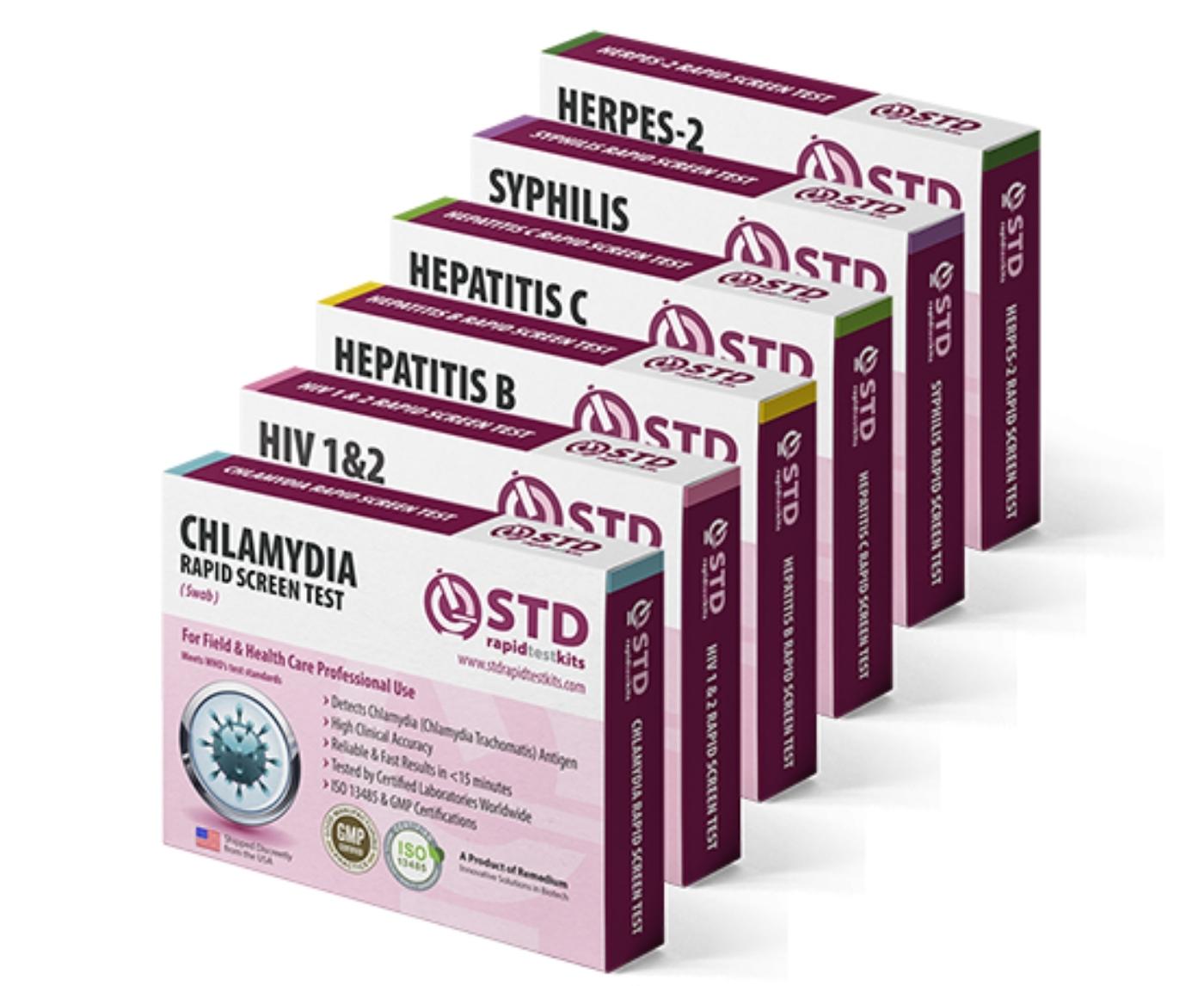



- Rapid at-home kits screen for nine common STIs across blood and swab sample types, with results visible in about 15 minutes.
- Window periods matter more than the kit itself: testing too soon after exposure is the single biggest cause of a false-negative result.
Published: August 2025 | Last updated: May 2026 | Editorial review and quality control: Martina N.
Which STIs can at-home test kits actually detect?
Rapid at-home kits screen for nine common infections: HIV, syphilis, hepatitis B and C, herpes (HSV-1 and HSV-2), chlamydia, gonorrhea, trichomoniasis, and HPV. Blood fingerstick tests cover the viral infections; self-collected genital swabs cover the bacterial and parasitic ones. Sensitivity runs in the mid-to-high 90s when used after the correct window period. Positive results warrant lab confirmation.
At-home STD testing has changed in the last few years. The rapid kits sold for self-use today screen for most of the common sexually transmitted infections people actually worry about, from HIV and syphilis to chlamydia and herpes, and they do it in about fifteen minutes on your kitchen counter without a lab visit. The catch is that not every test fits every situation. The chemistry inside a rapid lateral-flow cassette is different from a clinic NAAT, the right testing window depends on which infection you are checking for, and a few common STIs are still better handled in person. This guide covers each infection our at-home rapid kits can screen for, what sample they need, how soon after exposure they become reliable, and where a clinic remains the right tool.
This article is published by stdrapidtestkits.com, which sells at-home STI testing kits. We recommend products based on fit-for-purpose for the reader's concern, not commercial benefit.
Which STIs Our At-Home Kits Test For
Rapid lateral-flow kits sold for at-home self-use cover most of the common bacterial and viral infections that walk into a sexual health clinic. Each kit is built around one specific test technology and one specific sample type, so it helps to know which is which before you order. A practical detail worth naming up front: chlamydia, gonorrhea, and trichomoniasis often run silent, especially in male anatomy, with no burning, no discharge, no visible sign of infection. Asymptomatic carriage is how these infections spread between partners and how they linger long enough to cause complications: epididymitis (a painful infection of the tube behind the testicle) in men, tubal scarring and infertility risk in women. Screening is the only reliable way to learn your status when nothing feels wrong.
HIV. Antibody-based fingerstick blood test. Detects antibodies your immune system makes after exposure. Most rapid antibody tests become reliable around 23 to 90 days after exposure according to CDC HIV testing guidance; testing earlier within that range produces progressively less reliable results. A positive antibody result is always confirmed with a follow-up laboratory test, typically a fourth-generation antigen-antibody assay plus a viral load. If your initial result is negative inside the window period, repeat at the 12-week mark for a definitive answer.
Syphilis. Antibody fingerstick blood test. Detects treponemal antibodies from roughly 3 to 6 weeks after exposure, sometimes longer in early primary infection. Syphilis remains a public-health priority because cases keep rising in many regions and untreated infection causes long-term cardiovascular and neurological damage.
Hepatitis B. Fingerstick blood test that screens for hepatitis B surface antigen, the most reliable early marker of active infection. Window period runs roughly 4 weeks to 6 months. Many adults clear hepatitis B without treatment, but chronic infection is a leading cause of liver cancer worldwide per WHO global STI guidance.
Hepatitis C. Anti-HCV antibody fingerstick blood test. Window is typically 8 to 11 weeks for most people, occasionally extending to 6 months. Hepatitis C is now curable with direct-acting antiviral medication, so detection is the gating step to a successful course of treatment.
Herpes (HSV-1 and HSV-2). Antibody fingerstick blood tests, sold separately for each strain or as a combined panel. Antibodies typically become detectable 4 to 12 weeks after exposure, occasionally up to 16 weeks, per the manufacturer instruction-for-use documentation for the rapid HSV antibody panels in our catalog. A blood antibody test confirms whether you have been exposed at some point; it does not identify whether a current sore is herpes versus another condition. For an active lesion, a clinic swab is the right tool.
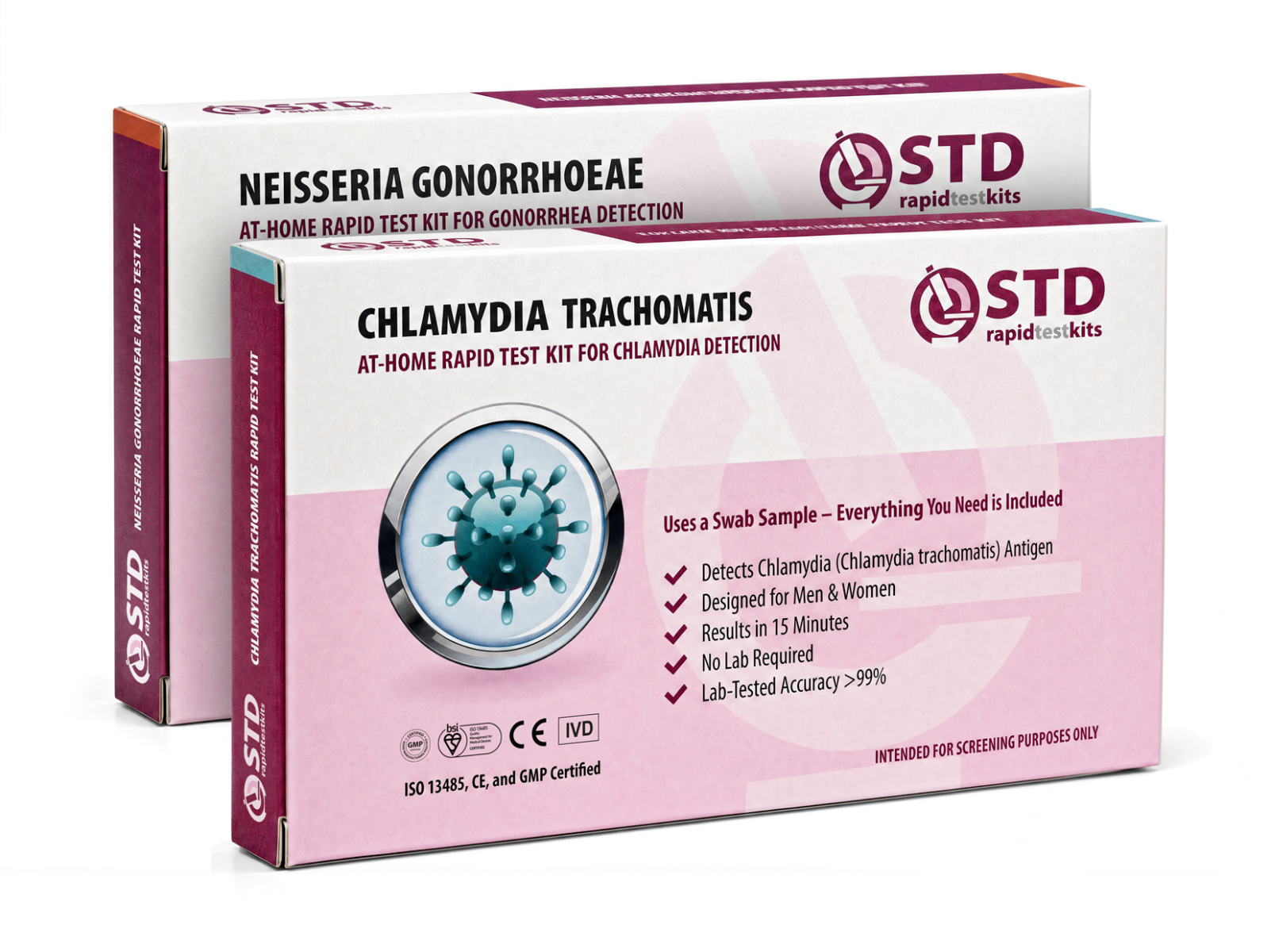
Chlamydia and gonorrhea. Self-collected vaginal or penile swab, run on a rapid lateral-flow cassette. Detection becomes reliable about 1 to 2 weeks after exposure for most people, with day 14 the safest target. These two infections frequently appear together, which is why the combined chlamydia plus gonorrhea swab is the most-purchased single category on this site. Untreated chlamydia and gonorrhea are the leading preventable causes of tubal scarring and infertility in women; in men, untreated infection can cause epididymal scarring that affects sperm transit. Treatment-resistant gonorrhea strains are an active CDC and WHO priority, so a positive rapid result is worth confirming with culture and antibiotic-sensitivity testing at a clinic when possible, since the clinician will use those results to select the most effective antibiotic regimen.
Trichomoniasis. Self-collected vaginal swab. Reliable from about a week after exposure. Our trichomoniasis kit is validated for vaginal self-swab only; a male reader who needs trichomoniasis testing should see a clinic, since we do not sell a male-compatible test.
HPV. Self-collected vaginal swab targeting common high-risk HPV strains. Like trichomoniasis, our HPV kit is validated for vaginal self-swab only. A male reader concerned about HPV exposure should consult a clinic for examination.
| Infection | Sample Type | Approx. Window Period |
|---|---|---|
| HIV (antibody) | Fingerstick blood | 23 to 90 days |
| Syphilis | Fingerstick blood | 3 to 6 weeks |
| Hepatitis B (HBsAg) | Fingerstick blood | 4 weeks to 6 months |
| Hepatitis C (anti-HCV) | Fingerstick blood | 8 to 11 weeks |
| Herpes HSV-1 / HSV-2 | Fingerstick blood (antibodies) | 4 to 12 weeks (rarely up to 16) |
| Chlamydia | Self-collected genital swab | 1 to 2 weeks |
| Gonorrhea | Self-collected genital swab | 1 to 2 weeks |
| Trichomoniasis (women only) | Self-collected vaginal swab | About 1 week |
| HPV (women only) | Self-collected vaginal swab | Variable (screens current infection) |
How Rapid Lateral-Flow Tests Work
The rapid at-home kits sold here are lateral-flow immunoassays. The technology is the same family that consumer pregnancy tests and rapid COVID-19 antigen tests use, applied to detect either antibodies in blood or pathogen markers from a swab. Understanding the mechanism explains both the strengths and the limits of at-home rapid testing.
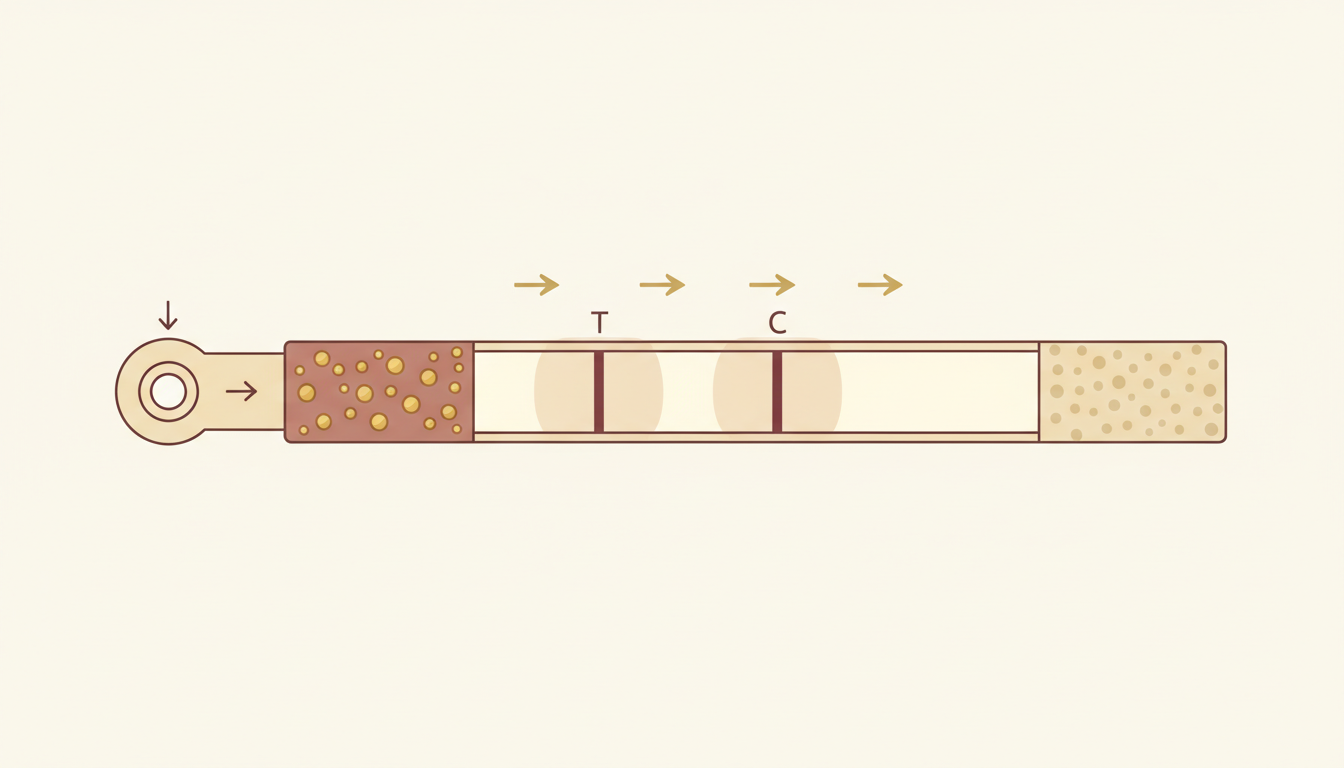
A lateral-flow cassette contains a strip of nitrocellulose membrane with two key zones: a test line coated with a capture antibody specific to your target (HIV antibody, hepatitis B surface antigen, chlamydia outer-membrane protein, and so on), and a control line that confirms the strip ran correctly. When you place a drop of sample in the well, capillary action draws fluid across the strip. If the target marker is present, it binds gold-conjugated antibodies on the conjugate pad, then deposits at the test line, producing a visible colored band. The control line forms regardless of result: a missing control line means the test is invalid and should be repeated with a fresh strip.
Two things follow from how this chemistry works. First, lateral-flow tests look for antibodies (host immune response) or for relatively abundant antigens. They do not amplify nucleic acid the way a laboratory polymerase chain reaction (PCR) or nucleic acid amplification test (NAAT) does. That difference matters when comparing accuracy: a high-quality rapid test typically reports sensitivity in the mid-to-high 90s, while laboratory NAAT reaches the high 90s and detects lower bacterial loads. The two test types serve complementary screening and confirmation roles, and labs retain higher analytical sensitivity for low-burden infections.
Second, the test cannot tell time. Antibody tests need your immune system to have produced enough antibody to register, which is why the window period exists. Antigen tests need enough pathogen present to bind. Either way, testing too early after exposure produces a false-negative result, and the rapid kit cannot warn you that the timing is off. That responsibility is yours.
The diagram below shows the basic components of a rapid lateral-flow cassette and the sample flow that produces a visible result.
Single Versus Combination Kits: Which Should You Pick?
The at-home rapid catalog comes in two shapes: single-infection kits that test for one thing only, and combination kits that bundle several lateral-flow strips into one purchase. Both have legitimate uses; the right pick depends on the specific concern that brought you here and how broadly you want to screen.
A single-infection kit makes sense when the concern is narrow and named: confirming one exposure after a partner has tested positive, checking hepatitis B status before a procedure, or distinguishing between HSV-1 and HSV-2 with a single-strain test. Single kits are cheaper per box and ship with one focused set of instructions.
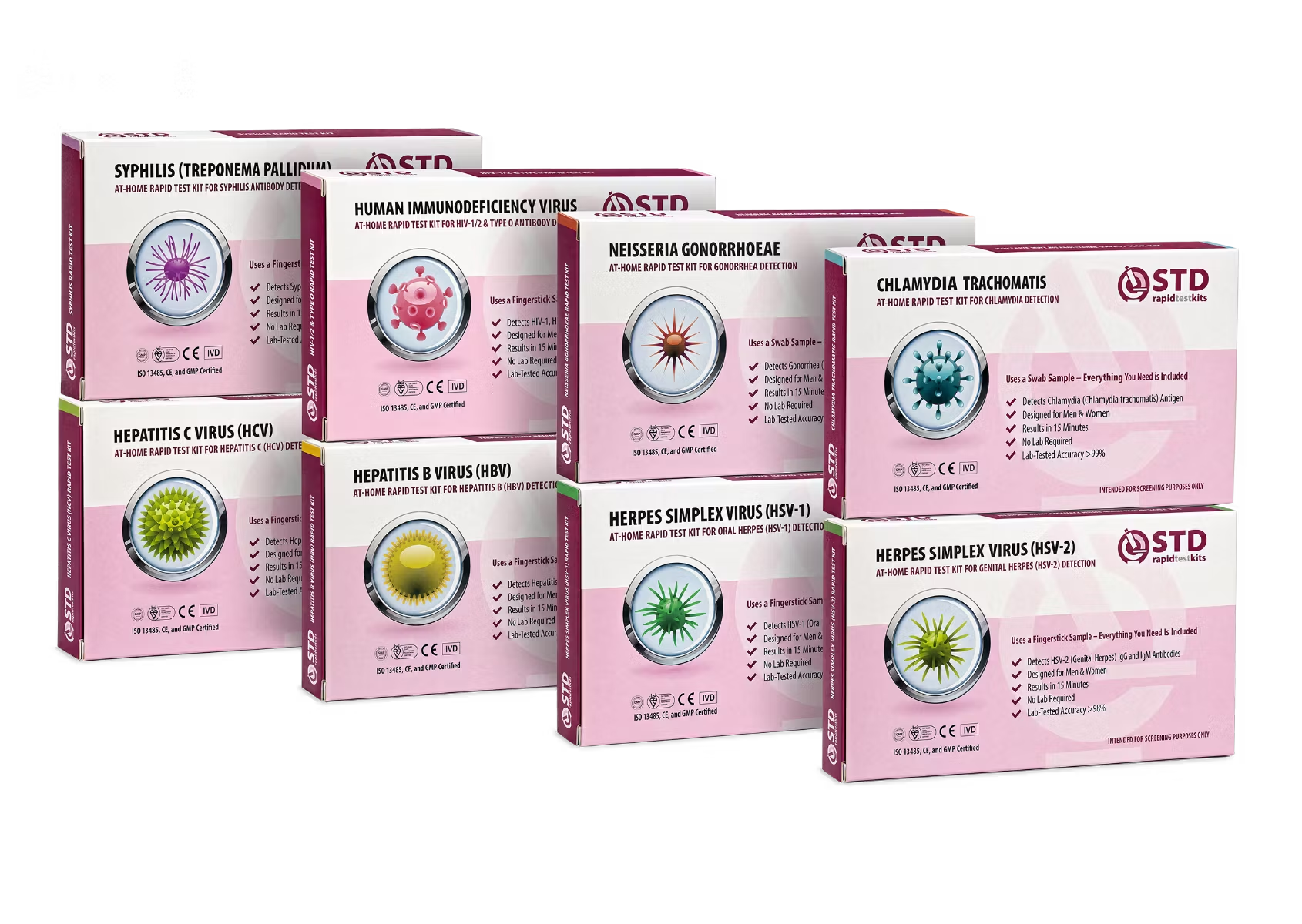
A combination kit makes sense when you want broader screening for the same exposure event. After unprotected sex with a new partner, the relevant infections to consider are not just one. The 6-in-1 panel covers HIV, syphilis, hepatitis B, hepatitis C, chlamydia, and gonorrhea in a single kit, mixing both blood and swab samples. The 8-in-1 adds herpes (HSV-1 and HSV-2) coverage and is the broadest any-gender kit on the site. The 10-in-1 (women only) adds trichomoniasis and HPV.
Combination kits cost more up front but the per-test price drops sharply. They also reduce the chance of testing for one thing, getting a clean result, and missing a co-infection that was hiding alongside it. Chlamydia and gonorrhea, in particular, frequently travel together, which is why the combined chlamydia plus gonorrhea swab is the most-purchased single category on this site.
Whichever kit you choose, the same window-period rules apply: each individual lateral-flow strip in a combination kit has its own window, and the kit is reliable only when you wait the longest of those windows after exposure.
How Accurate Are At-Home Rapid Tests, Really?
Accuracy is the question every reader has, and it takes two numbers to answer it fully. The word "accuracy" alone is too imprecise to act on. Sensitivity and specificity are the two figures worth understanding.
Sensitivity is the percentage of people who are infected that the test correctly identifies as positive. A test with 95 percent sensitivity will catch 95 out of every 100 actual infections; the other 5 are false negatives. For sexually transmitted infection screening this is the more critical of the two numbers, because a missed positive sends an infected person away thinking they are clear.
Specificity is the percentage of people who are not infected that the test correctly identifies as negative. A test with 99 percent specificity will correctly clear 99 out of every 100 uninfected people; 1 will get a false-positive result. Specificity matters because false positives generate anxiety and trigger unnecessary follow-up.
The leading rapid lateral-flow kits sold for at-home use typically report sensitivity in the mid-to-high 90s and specificity above 99 percent when used inside the correct window period. Exact figures vary by infection and by manufacturer; our full test catalog lists per-product sensitivity and specificity figures, drawn from each manufacturer's instruction-for-use document and any independent validation studies.
Two more things matter when reading these figures. Sensitivity numbers assume the test was run inside its validated window; a rapid HIV test on day 10 post-exposure has near-zero practical sensitivity because seroconversion has not yet occurred. The number on the box assumes correct timing. Lateral-flow chemistry also detects less than laboratory NAAT for chlamydia and gonorrhea, which is why a positive home result is always worth lab confirmation and why a negative with continuing symptoms still warrants a clinic visit.
What rapid at-home tests buy you is access. The reader who would not have made a clinic appointment at all is far more likely to test at home, and a screened reader who tests positive starts treatment weeks earlier than they would have otherwise. The other common source of inaccurate at-home results is user error rather than test chemistry: testing too early, collecting too thin a swab or an under-filled blood drop, reading the cassette outside its labeled time window, or storing a kit in a hot car for a week. Read the instruction insert before you collect anything, and if something feels off during the run (the control line did not appear, you bumped the cassette, you spilled reagent), use a fresh kit rather than interpreting an iffy result.
Sensitivity vs specificity at a glance
- Sensitivity in the mid-to-high 90s: the test correctly identifies most infected people, with a small fraction missed as false negatives.
- Specificity above 99 percent: fewer than 1 in 100 uninfected people receive a false-positive result.
- Both figures assume correct timing inside the validated window; testing too early collapses real-world sensitivity regardless of the printed number.
Window Periods: Why Timing Matters More Than the Kit
The most common cause of a false-negative at-home result is not a defective kit, it is testing too soon after exposure. Each infection has its own window: the time between exposure and when the test can reliably detect either the pathogen or the antibody response your body produces.
If you test inside the window, the test is asked to find something that is not yet detectable, and a negative result means very little. A negative HIV antibody test on day 3 after a possible exposure tells you essentially nothing useful: the infection has not had time to register. The same negative on day 60 carries far more weight.
Sensible practice for most exposure scenarios looks like this:
- Test once at the earliest reliable window for the most likely infection (often around 2 weeks for chlamydia and gonorrhea).
- Retest at the longer windows for slower-seroconverting infections: around 6 weeks for syphilis, around 8 to 11 weeks for hepatitis C, from 4 to 12 weeks for herpes (earlier in that range may detect antibodies, but waiting toward the upper end gives a more reliable result), up to 6 months for hepatitis B, and out to 90 days for HIV antibody tests.
- Treat any new symptoms in between as their own reason to test or to see a clinician, regardless of the schedule.
Combination kits add a small wrinkle: each strip in the kit has its own window. A 6-in-1 panel run at week 4 post-exposure will reliably screen the chlamydia and gonorrhea components, but the HIV strip in the same kit may still be inside its own window. Read the kit's documentation for the specific timing each strip needs.
If you test before the validated window for an infection has elapsed, a negative result mostly tells you that the test ran correctly, not that you are clear. Retest at the longer window. Continuing symptoms warrant a clinic visit even if a home test is negative.
What At-Home Rapid Tests Can't Do
A few infections and a few sample sites are simply outside what an at-home rapid lateral-flow kit can cover; a reader who needs one of those is better served by a clinic visit.
Throat (pharyngeal) and rectal infections. Chlamydia and gonorrhea can establish in the throat or rectum after oral or anal exposure, and those sites need swabs taken at the actual exposure site to detect. We do not sell pharyngeal or rectal swabs. A genital swab will not detect a throat infection because the bacteria are not there. If your concern is specifically a throat or rectal exposure, see a sexual health clinic for site-specific NAAT swabbing. This matters most for men who have sex with men, where rectal and pharyngeal chlamydia and gonorrhea are common and frequently asymptomatic.
Active herpes lesions. An at-home herpes blood test detects antibodies, which tells you whether you have been exposed at some point, not whether the sore on your lip or genitals today is herpes. For active lesion identification, a clinician can swab the lesion directly for PCR confirmation, which is faster and more specific than waiting for antibody seroconversion.
Urine-sample NAAT testing. The laboratory gold standard for chlamydia and gonorrhea includes urine NAAT. Our at-home rapid format uses a self-collected swab applied directly to the cassette instead. Both work, but if your clinician has specifically asked for a urine sample, that has to be processed in a lab.
Trichomoniasis and HPV in male readers. Our trichomoniasis and HPV kits are validated for vaginal self-swab only. A male reader who has been told they may have been exposed to either should book a clinic visit; we do not sell a male-compatible test for these infections.
Definitive diagnosis. Even within their validated scope, rapid kits are screening tools. A positive at-home result is a strong signal worth confirming. Confirmation by a laboratory or clinician is the appropriate next step before starting treatment, and a clinician's visit is the right place to discuss treatment options and partner notification.
Use a clinic for: throat or rectal exposure, active lesions you need identified today, male testing for trichomoniasis or HPV, ongoing symptoms despite a negative home result, or any situation where you want a clinician's interpretation alongside the test.
Privacy: Why the At-Home Format Exists
If you live with parents, a roommate, or a partner who does not know you are testing, you are the audience the at-home category was built for. Reputable rapid-kit retailers (us included) ship in plain outer packaging: no medical branding on the label, no "STD" anywhere on the box, generic sender name. Inside, the kit is sealed and the contents are not externally visible.
Results stay with you. There is no lab to mail samples to with rapid lateral-flow kits, which means no lab-result email, no portal entry that lives on someone else's server, and no insurance claim tied to a specific infection. You read your own result on the cassette and decide what to do next. That privacy is the whole point of the format and a major reason at-home testing reaches readers who would not have booked a clinic visit.
The flip side: there is no automated provider follow-up. If your test is positive, you are responsible for the next step (clinic visit, partner notification, prescription). Build that step into your plan before you test, not after.
Plain outer box with no medical branding. Generic sender name. No lab portal, no email receipt, no insurance EOB. Your result stays on the cassette in your own hands.
Reading Your Result: Negative, Positive, and What Comes Next
Each at-home rapid kit ships with its own result-reading instructions, but the underlying logic is the same across all lateral-flow tests. Two visible bands typically mean positive, one visible band at the control line means negative, and no visible control line means the test is invalid and you should rerun with a fresh strip from a new kit.
If your result is negative. First, confirm your timing was inside the kit's validated window. If it was, a single negative result is reassurance, but a follow-up test at the longer window is sensible practice for slower-seroconverting infections, especially HIV and the hepatitis viruses. Continuing symptoms despite a negative home result is its own reason to see a clinician.
If your result is positive. Take a slow breath. A positive screen is the start of a process, not a diagnosis. Most STIs are highly treatable. Book a confirmatory clinic visit within a few days, and bring or photograph the cassette result. The confirmation test depends on the infection: a NAAT for chlamydia or gonorrhea, a treponemal antibody test plus non-treponemal titer for syphilis, a fourth-generation antigen-antibody test plus viral load for HIV. Most positive at-home screens hold up on confirmation. Bacterial and parasitic infections (chlamydia, gonorrhea, syphilis, trichomoniasis) are typically curable with a short antibiotic or antiparasitic course. Hepatitis C is curable with direct-acting antivirals. HIV is managed long-term with daily antiretroviral therapy, and people with sustained undetectable viral loads cannot transmit the virus sexually (the U=U principle). Hepatitis B and herpes are also managed long-term with antivirals that allow full life expectancy and dramatically reduce transmission risk.
Telling partners. Anyone you have had unprotected contact with during the relevant window should be informed and offered a chance to test. Many state and county health departments offer anonymous partner-notification services, and most clinics will help with the conversation if you ask.
Do not stop the kit's instructions at the visible result. The information sheet inside each kit walks you through the next step appropriate to that specific infection. Read it.
Negative inside the window: retest at the longer window for the relevant infection.
Negative outside the window: reassuring; see a clinician if symptoms continue.
Positive: book confirmatory laboratory testing through a clinician or clinic before starting treatment, then notify partners during the relevant window.
Invalid (no control line): rerun with a fresh strip from a new kit; do not interpret either way.
Retesting After Treatment
For chlamydia, gonorrhea, and trichomoniasis, current CDC STI program guidance recommends a test-of-reinfection at roughly 3 months after treatment, regardless of whether your partner was also treated. Reinfection from an untreated partner is the most common cause of recurrence. Even when your own course of treatment works, re-exposure undoes it. Mark your calendar at the time of treatment, not after.
For HIV, if your initial post-exposure test was negative inside the window period, repeat at the 12-week mark for a definitive result. For syphilis, follow-up titers (a clinic-side non-treponemal test) track treatment response over the months that follow rather than a single rapid retest. For HSV antibodies, no retesting is needed; once you are seropositive, you stay seropositive.
Sexually transmitted diseases are widespread, with millions of new infections each year. Many people do not realize they have an STD because they do not have any symptoms.
Where At-Home Testing Genuinely Helps
Public-health programs have been pushing for greater testing access for years, because the largest barrier to controlling sexually transmitted infections is not the testing itself, it is people not testing in the first place. Cost, embarrassment, clinic hours, transport, all of these keep people from getting screened. At-home rapid testing removes most of those frictions in one step, per CDC sexual-health screening guidance.
Our kits are not a replacement for a sexual health clinic. They are a complementary screening layer that catches infections in people who would otherwise stay undiagnosed. The reader who orders a 6-in-1 panel after a worrying weekend is far more likely to get tested than the reader who has to call for an appointment, take a half-day off work, and sit in a waiting room. Earlier detection means earlier treatment, less onward transmission, and fewer long-term complications. Mayo Clinic's overview of sexually transmitted diseases covers the broader symptom landscape, including the signs that warrant clinical evaluation regardless of any rapid-test result.
If you have ongoing symptoms, an active lesion, or a need for site-specific testing (throat or rectal), a clinic visit is still the right tool. If you want a routine private check, a quick screen after a known exposure, or a way to verify a partner's status before a relationship becomes intimate, an at-home rapid kit fits well. Use both, and use whichever serves the specific situation you came here with.
Clinic visit: ongoing symptoms, active lesion, or need for site-specific (throat or rectal) testing.
At-home rapid kit: routine private screen, post-exposure check, or confirming status before a new partner.
How to Pick Your First (or Next) Kit
Three questions, in order, narrow the catalog down for almost every reader:
- What was the exposure, and how long ago was it? If it was less than a week ago and you are symptom-free, wait. Test on day 14 for the bacterial pair (chlamydia and gonorrhea). Test at week 4 to 6 for syphilis and hepatitis. Test at week 12 for the most reliable HIV antibody result.
- Are you testing for one specific worry, or for general reassurance? One specific worry (a partner just disclosed a positive result, for example): a single-infection rapid test or a 2-in-1 swab. General reassurance after a worrying exposure: a 6-in-1 or 8-in-1 combo.
- Did the exposure involve oral or anal sex? If yes, an at-home rapid kit covers the bloodborne component (HIV, syphilis, hepatitis), though it does not cover throat or rectal infection. Add a clinic visit for a pharyngeal or rectal NAAT, particularly important for men who have sex with men.
For a first at-home kit without a specific named worry, the 8-in-1 combo is the most useful single purchase. It gives you a baseline across the eight infections most worth knowing about (chlamydia, gonorrhea, syphilis, HIV-1, HIV-2, hepatitis B, hepatitis C, HSV-1, HSV-2), and the result becomes your reference point for future testing. For ongoing risk (open relationship, multiple partners per quarter), repeating that panel every 3 to 6 months matches the screening cadence the CDC recommends for higher-risk groups, just done from home.
If HIV is your specific worry after a known exposure (a condom slipped, a partner recently disclosed a positive status, you want to track seroconversion at 6, 9, and 12 weeks), a single-infection HIV rapid test is the cleaner buy than a full combo panel.
Which Kit Fits Your Situation?
Was the exposure less than 2 weeks ago and you are symptom-free?
Yes: Wait. Test for chlamydia and gonorrhea on day 14, syphilis at week 4 to 6, and HIV at week 12 for the most reliable result.
Do you have one specific named worry (a partner just disclosed a positive result, for example)?
Yes: Order a single-infection rapid test, or the 2-in-1 chlamydia plus gonorrhea swab if the concern is bacterial.
Do you want a broader screen after a worrying exposure or as a baseline check?
Yes: Order the 8-in-1 combo panel for the broadest any-gender screen; follow each strip's individual window period for accurate results.
No: If herpes coverage is not needed, the 6-in-1 panel also covers the major bloodborne and bacterial infections.
Three questions narrow the catalog. Walk the branches in order.
Frequently Asked Questions
- How long does it take to get results from an at-home STD test?
- The rapid lateral-flow kits sold here produce a visible result on the cassette in about 15 minutes. There is no laboratory in the loop and no online portal to wait on. The kit is read in your own bathroom or kitchen, and the result is final immediately, subject to confirmatory laboratory testing if positive.
- Are at-home STD tests as accurate as clinic tests?
- Close, but laboratory NAAT sets a higher ceiling. The rapid strips here deliver sensitivity in the mid-to-high 90s and specificity above 99 percent when timed correctly, which is solid for a home screen. Lab NAAT pushes the sensitivity ceiling higher, especially for chlamydia and gonorrhea where it can detect lower bacterial loads. The practical workflow most readers settle into: screen at home, confirm any positive at a lab.
- Do I need a doctor's prescription to buy an at-home STD test?
- No. Rapid at-home STD test kits sold here are over-the-counter products and require no prescription. They ship in discreet packaging with no infection name on the outside, and no insurance claim is filed for the screen itself.
- How soon after exposure can I test?
- It depends on the infection. Chlamydia and gonorrhea become reliably detectable about 1 to 2 weeks after exposure, with day 14 the safest target. Syphilis takes 3 to 6 weeks. HIV antibody tests, the type used in our at-home kit, are most reliable from 23 to 90 days after exposure; testing earlier in that range gives progressively less reliable results. Herpes antibodies are typically detectable from 4 to 12 weeks (rarely up to 16). Hepatitis B runs from 4 weeks to 6 months. Hepatitis C is typically 8 to 11 weeks. Testing inside any window often produces a false-negative result.
- I have no symptoms. Should I still test?
- Yes, especially if you have had unprotected sex with new or multiple partners. Chlamydia, gonorrhea, and trichomoniasis are routinely asymptomatic, particularly in male anatomy, and HIV and syphilis can also run silent for long stretches. Asymptomatic infection is how STIs spread, and regular screening is the only way to break that chain.
- Will the package look like an STD kit when it arrives?
- No. Reputable at-home rapid-test sellers ship in plain outer packaging with a generic sender name and no medical branding visible. The contents are sealed inside; nothing about the outside identifies it as a sexual-health product. This is the privacy guarantee the at-home category was built around.
- What if my at-home test is positive?
- Book a clinic visit within a few days, and bring or photograph the cassette. Your clinician will run a confirmation test matched to the infection: NAAT for chlamydia or gonorrhea, treponemal serology for syphilis, fourth-gen antigen-antibody for HIV. Bacterial infections (chlamydia, gonorrhea, syphilis, trichomoniasis) are cured with antibiotics; viral infections (HIV, hepatitis B, herpes) are managed long-term with antivirals that allow normal life expectancy.
- Can at-home tests detect throat or rectal infections?
- No. Our at-home rapid kits cannot detect throat (pharyngeal) or rectal infections. Those sites need site-specific swabs taken by a clinician. If your concern is specifically an oral or anal exposure, book a sexual-health clinic visit for site-specific NAAT testing. This is particularly important for men who have sex with men, where rectal and pharyngeal chlamydia and gonorrhea are common.
- Do I need to retest after treatment?
- For chlamydia, gonorrhea, and trichomoniasis, yes: book a follow-up test around the 3-month mark even if your partner was treated, because re-exposure from an incompletely treated partner is the most common cause of a repeat positive. For HIV, if your first post-exposure result fell inside the window, repeat at 12 weeks for a definitive answer. Syphilis follow-up uses a clinic-side titer test rather than a rapid retest, since the titer tracks treatment response over time. Once HSV antibodies appear they persist; no retesting is needed for herpes.
- U.S. Centers for Disease Control and Prevention. Sexually transmitted infections (STIs): screening, prevention, retest-after-treatment guidance, and at-risk population recommendations.
- U.S. Centers for Disease Control and Prevention. HIV testing: antibody-test window periods, fourth-generation antigen-antibody confirmation, and U=U principle (undetectable equals untransmittable).
- U.S. Centers for Disease Control and Prevention. Viral hepatitis: hepatitis B surface antigen and hepatitis C antibody testing windows, screening guidance, and direct-acting antiviral treatment.
- U.S. Centers for Disease Control and Prevention. Genital herpes (HSV-1 and HSV-2): transmission, prevention, treatment, and clinical guidance.
- World Health Organization. Sexually transmitted infections (STIs) global fact sheet: disease burden, hepatitis B chronic infection and liver-cancer link, and screening policy direction.
- U.K. National Health Service. Sexually transmitted infections (STIs): patient-facing symptoms, testing guidance, and when to see a clinician.