At-Home STD Test Brands Compared: Which Kit Is Best for You?
How rapid kits and mail-in panels really compare




- Rapid lateral-flow kits give 15-minute results at home and work well for routine screening or repeat checks. Lab-based NAAT panels have higher analytical sensitivity for low-load infections like asymptomatic chlamydia and rectal or pharyngeal gonorrhea.
- The right kit depends on what you need: speed and privacy (rapid lateral-flow), comprehensive coverage in one box (multi-panel mail-in), or clinician follow-up bundled in (services with telehealth consultations).
Published: November 2025 | Last updated: May 2026 | Editorial review and quality control: Martina N.
At-home STI tests fall into two very different categories, and buying the wrong kind wastes both money and time. Some kits give results in 15 minutes on your bathroom counter using lateral-flow strips, the same chemistry behind home pregnancy tests. Others ship a swab or fingerstick sample to a CLIA-certified lab for nucleic-acid amplification testing (NAAT), the method clinics use, with results in two to five days.
This guide compares four well-known brands across both categories, walks through the real tradeoffs (speed versus analytical sensitivity, individual versus multi-panel, privacy versus clinician support), and helps you match a kit to your actual reason for testing. The honest answer to "which is best" depends on what you need; brand marketing has very little to do with it.
The Two Categories of At-Home STI Testing
The at-home STI testing market looks crowded, but almost every product sits in one of two buckets. Understanding which bucket a kit belongs to is more useful than memorizing brand names, because the bucket determines how fast you get results, how sensitive the test is, and what you do with a positive.
Rapid lateral-flow immunoassays are the home-pregnancy-test of STI screening. You collect a sample (vaginal or penile swab for chlamydia, gonorrhea, trichomoniasis, and HPV; fingerstick blood for HIV, syphilis, hepatitis B, hepatitis C, and herpes), drop it onto a cassette with buffer, and read the result in about 15 minutes. No mailing, no lab, no waiting. The downside: lateral-flow has a higher analytical detection limit than NAAT, so very early or asymptomatic low-shedding infections can slip through. These are best treated as screening tools, with a clinic confirmatory test when a positive comes back or when symptoms persist despite a negative.
Mail-in laboratory panels are the home-collection version of what a clinic does. You collect a sample at home with the supplied kit, drop it in a prepaid envelope, and wait two to five days for a CLIA-certified lab to run NAAT (for chlamydia, gonorrhea, trichomoniasis) or fourth-generation antibody and antigen tests (for HIV, syphilis). Per the CDC's 2021 STI Treatment Guidelines, NAATs are the most sensitive tests for chlamydia and are the recommended detection method. Mail-in panels charge more and take longer, but their analytical sensitivity matches the lab-grade benchmark.
The decision rarely comes down to "which is better in the abstract." It comes down to: how soon do you need an answer, do you have a single suspected exposure or want a full screen, and would you rather pay $30 for one cassette or roughly $200 for a 7-panel mail-in box.
STD Rapid Test Kits: Lateral-Flow for 15-Minute Answers
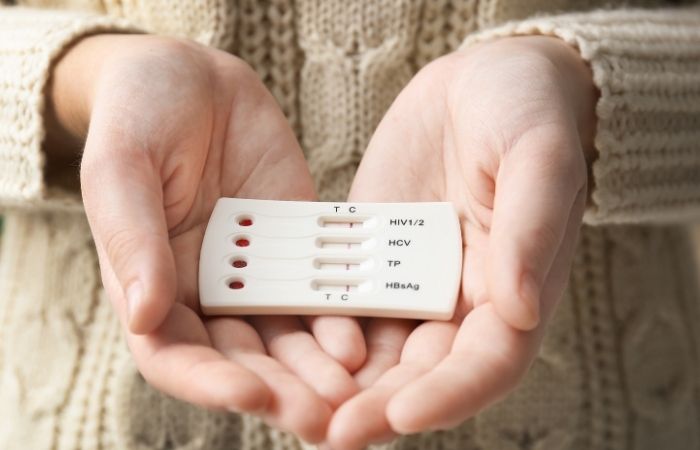
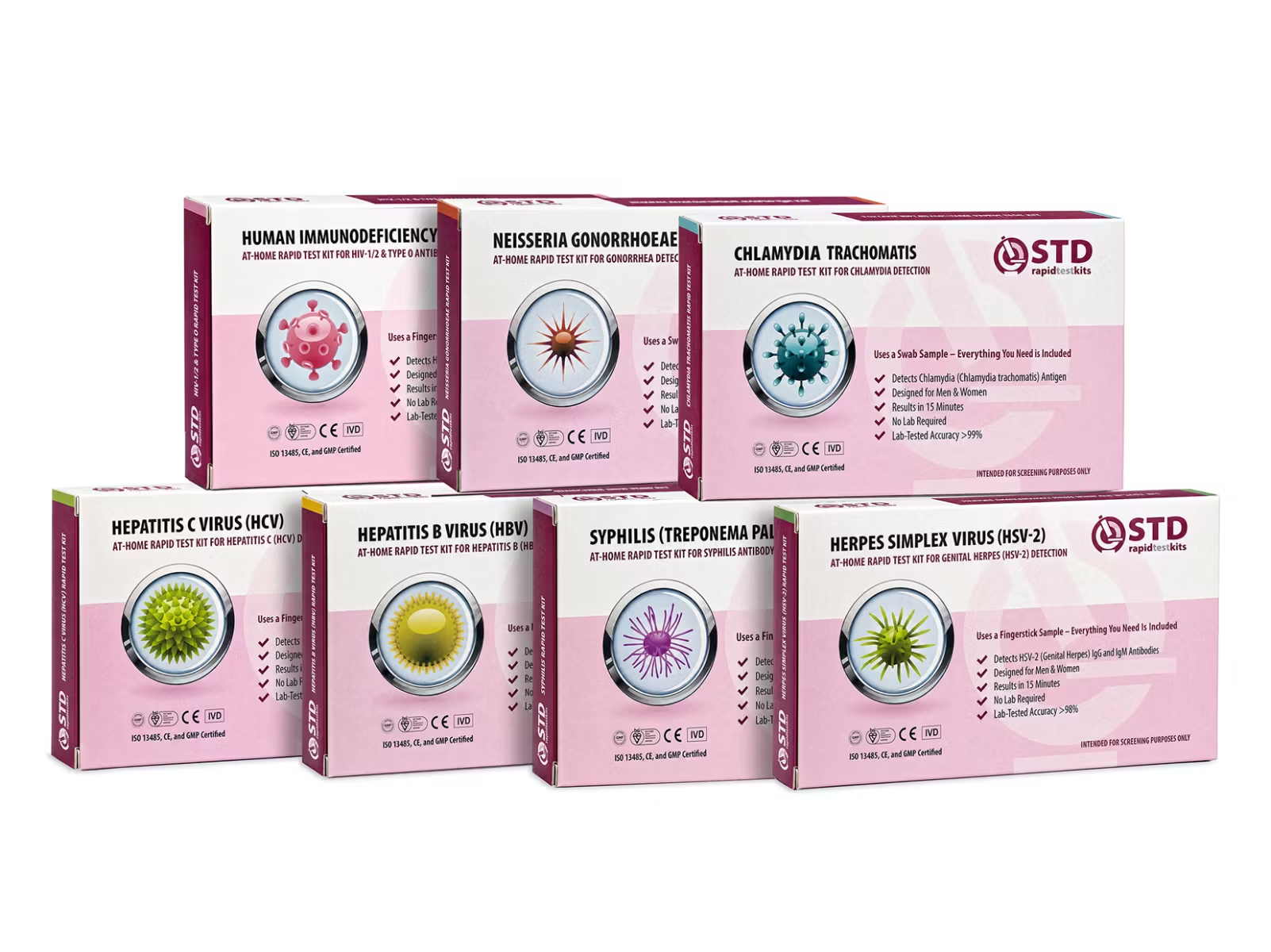
STD Rapid Test Kits (our brand, full disclosure) sells lateral-flow rapid cassettes for the most common bacterial, viral, and parasitic STIs. The catalog is split into two physical sample types: vaginal or penile swab kits for chlamydia, gonorrhea, trichomoniasis, and HPV, and fingerstick blood kits for HIV, syphilis, hepatitis B, hepatitis C, and HSV-1 and HSV-2 antibodies. Combination kits (2-in-1, 3-in-1, 6-in-1, 7-in-1, 8-in-1) let you screen for several infections from a single purchase.
What you get. A sealed cassette per test, the collection materials (swab or lancet), a small buffer bottle, and an instruction sheet showing where to read the control and test lines. Results read in roughly 15 minutes on your bathroom counter. No lab, no mailing, no online portal.
Where this approach wins. Privacy (nothing leaves your house, no name attached to a lab requisition), speed (an answer the same hour rather than next week), routine repeat screening on a known cadence, and post-exposure peace of mind once the appropriate window period has passed. Single-infection kits let you test for exactly what you are worried about without paying for a panel of seven other infections you have no realistic exposure to.
Where this approach loses. Lateral-flow chemistry has a higher minimum detection threshold than NAAT, which matters most for asymptomatic infections where bacterial or viral load is low. A negative rapid result is reassuring but not the same level of evidence as a negative lab NAAT. The other limit: our HPV and trichomoniasis kits are validated for vaginal self-swab only, so they are not a male-compatible option for those two infections.
The fit is screening at home, fast turnaround, repeat use after sexual events, and budget-friendly per-test pricing. If a result comes back positive or symptoms persist with a negative, the next step is a clinic visit for confirmatory NAAT and treatment.
myLAB Box: Comprehensive Mail-In Panels
myLAB Box (a mail-in laboratory service, not affiliated with this site) packages CLIA-certified lab testing into home-collection kits across roughly a dozen different bundles. The biggest sellers are the 5-, 8-, and 14-panel boxes, which combine vaginal or penile swabs, urine collection, and fingerstick blood to screen for chlamydia, gonorrhea, trichomoniasis, syphilis, HIV, hepatitis C, and HSV-2 in one kit. Larger panels add throat and rectal swabs for extragenital chlamydia and gonorrhea screening, which clinics increasingly recommend for people with oral or anal exposure.
What you get. A retail-sized box with each test's collection materials separated and labeled, prepaid return shipping in a discreet envelope, and an online portal where results post two to five business days after the lab receives your samples. Positives include a free phone consultation with a partner physician who can discuss next steps and, in many U.S. states, prescribe treatment for bacterial STIs.
Where this approach wins. Comprehensive coverage from a single purchase, the same NAAT analytical sensitivity as a clinic, extragenital site swabs (throat and rectum) that most home rapid brands do not offer, and a clinician on the back end for positives. Useful if you have had multiple exposures, want a thorough screen rather than a single-infection check, or specifically need a throat or rectal NAAT we cannot sell.
Where this approach loses. Wait time of several days, price points that climb into the low hundreds for the larger panels, and you still need to physically mail the sample. If your reason for testing is "I want to know tonight whether I should worry about chlamydia from a swab I can do in my bathroom," the rapid-cassette approach is simply faster.
Pick a mail-in panel like myLAB Box when at least one of these applies: (1) you want extragenital site swabs (throat or rectum) that no rapid home brand sells, (2) you want a thorough multi-infection annual screen with NAAT-grade sensitivity, or (3) you want a physician consultation built in for any positive result. If none of those apply, a single-infection rapid cassette is faster and cheaper.
LetsGetChecked: Mail-In with Built-In Clinician Follow-Up
LetsGetChecked is structured similarly to myLAB Box on the lab side. It offers 2-panel through 8-panel mail-in kits for the major STIs, processes samples in CLIA-certified labs, and posts results to an online portal in two to five days. The brand's main differentiator is how positives are handled: every positive result triggers a nurse call rather than a portal notification, and the partner clinician network can prescribe treatment for chlamydia, gonorrhea, and trichomoniasis in U.S. states where their providers are licensed.
What you get. Sample collection materials matched to the panel (mostly fingerstick blood, urine, and vaginal swab depending on which infections are included), prepaid express shipping, lab-processed results with reference ranges, and the clinician consult on positives at no extra cost. Most kits ask for a morning urine sample collected first thing on the shipping day, then dropped at the carrier within a short window so it reaches the lab within stability limits.
Where this approach wins. The clinician follow-up is the strongest in the category. If someone seeing a chlamydia positive in their portal for the first time gets a nurse call with a prescription waiting at a pharmacy, that is meaningfully better than an automated email. Useful for people who would otherwise procrastinate on the follow-through step.
Where this approach loses. Same wait time as any mail-in service, similar price tier (kits sit roughly in the $99 to $249 range depending on size), and the urine-sample collection logistics (a morning collection that has to ship same-day) are sometimes harder than they sound. Not suited to immediate post-exposure answer-seeking, or to anyone whose privacy concern includes "no mail-related paper trail at all."
Everlywell: Mail-In with a Digital-First Experience
Everlywell sells a wide health-test portfolio (food sensitivity, thyroid, fertility, and STIs are all on the menu) and treats the user-facing app as the main product. Their STI lineup includes a chlamydia and gonorrhea two-panel, a syphilis blood test, an HIV blood test, and a comprehensive panel that bundles chlamydia, gonorrhea, trichomoniasis, hepatitis C, HIV, and syphilis. Samples are processed by partner CLIA-certified labs.
What you get. Materials for blood fingerstick, urine, or vaginal swab depending on what is in the panel, prepaid shipping, and a polished mobile app where results post with plain-English explanations of each result line. Insurance-eligible kits can be paid for using HSA and FSA cards; some plans cover Everlywell directly.
Where this approach wins. The app and the result-explanation interface are genuinely well-designed. If you find lab portals confusing, Everlywell does the most to translate values into something readable. Bundled subscription pricing (monthly or quarterly health checks) and HSA/FSA acceptance also make the service appealing to people who track broader health metrics through apps.
Where this approach loses. Clinician follow-up on positives is thinner than LetsGetChecked. Everlywell refers positives to a physician network but does not include the proactive nurse call out of the box. Pricing per single panel is similar to its mail-in competitors. And again, you are paying for a lab turnaround, not a same-hour answer.
Pick Everlywell if you want the polished app and result-translation experience, you pay with HSA or FSA dollars, or you are bundling STI screening with other home-health tests (thyroid, fertility, food sensitivity) under one subscription. Pick LetsGetChecked if the proactive nurse call on a positive result is the part of the workflow you would actually use, and you want the most clinician-supported version of mail-in testing.
Side-by-Side: How These Brands Actually Compare
The table below cuts through the marketing copy and lines up the four brands on the variables that matter when you are deciding what to buy. None of these brands is universally "best." Each is the right pick in a specific scenario.
| Brand | Test method | Sample type | Result time | Best for |
|---|---|---|---|---|
| STD Rapid Test Kits | Lateral-flow immunoassay | Self-swab or fingerstick blood | About 15 minutes at home | Speed, privacy, single-infection screening |
| myLAB Box | CLIA lab NAAT and immunoassay | Swab, urine, fingerstick blood (mailed) | 2 to 5 days after lab receives sample | Comprehensive multi-site panels |
| LetsGetChecked | CLIA lab NAAT and immunoassay | Swab, urine, fingerstick blood (mailed) | 2 to 5 days after lab receives sample | Built-in clinician follow-up on positives |
| Everlywell | CLIA lab NAAT and immunoassay | Swab, urine, fingerstick blood (mailed) | 2 to 5 days after lab receives sample | App-driven, HSA/FSA-friendly experience |
How to Choose: Match the Kit to Your Reason for Testing
The trap with comparison articles is the "best overall" pick, which does not really exist for STI testing. There are four distinct buying situations, and the right tool depends on which one you are in.
You want a fast answer after a specific recent exposure. Rapid lateral-flow wins. After the window period has passed (more on that below), a 15-minute home cassette tells you what you need to know without scheduling a clinic visit or waiting for a lab. The 7-in-1 or 8-in-1 combo kits make sense when you do not know exactly which infection to worry about.
You want a thorough annual or post-relationship screen. Mail-in NAAT panels win. Higher sensitivity matters more for asymptomatic infections where bacterial or viral load is low, and a comprehensive panel covers gaps you might not have thought of (rectal or pharyngeal site swabs, for example). myLAB Box and LetsGetChecked are the two most credible options here; pick LetsGetChecked if you want a nurse to call you on a positive.
You have a specific known concern and want to test for just that. Single-infection rapid kits are usually the cheapest path. A standalone chlamydia or syphilis cassette runs under $40 and answers a single question. Buying a 14-panel for one worry is overkill.
You have symptoms. Skip the home kit and see a clinician. Severe pain, ulcers, discharge with fever, or any new pelvic pain in someone with a uterus needs an in-person exam, not a home strip. Home kits are screening and post-exposure tools rather than symptom diagnostics.
You need pharyngeal (throat) or rectal NAAT. No rapid home brand sells these, including this site. myLAB Box or LetsGetChecked offer mail-in throat and rectal swabs, or visit a clinic. Do not substitute a genital swab for an extragenital site; the infection lives where the contact happened.
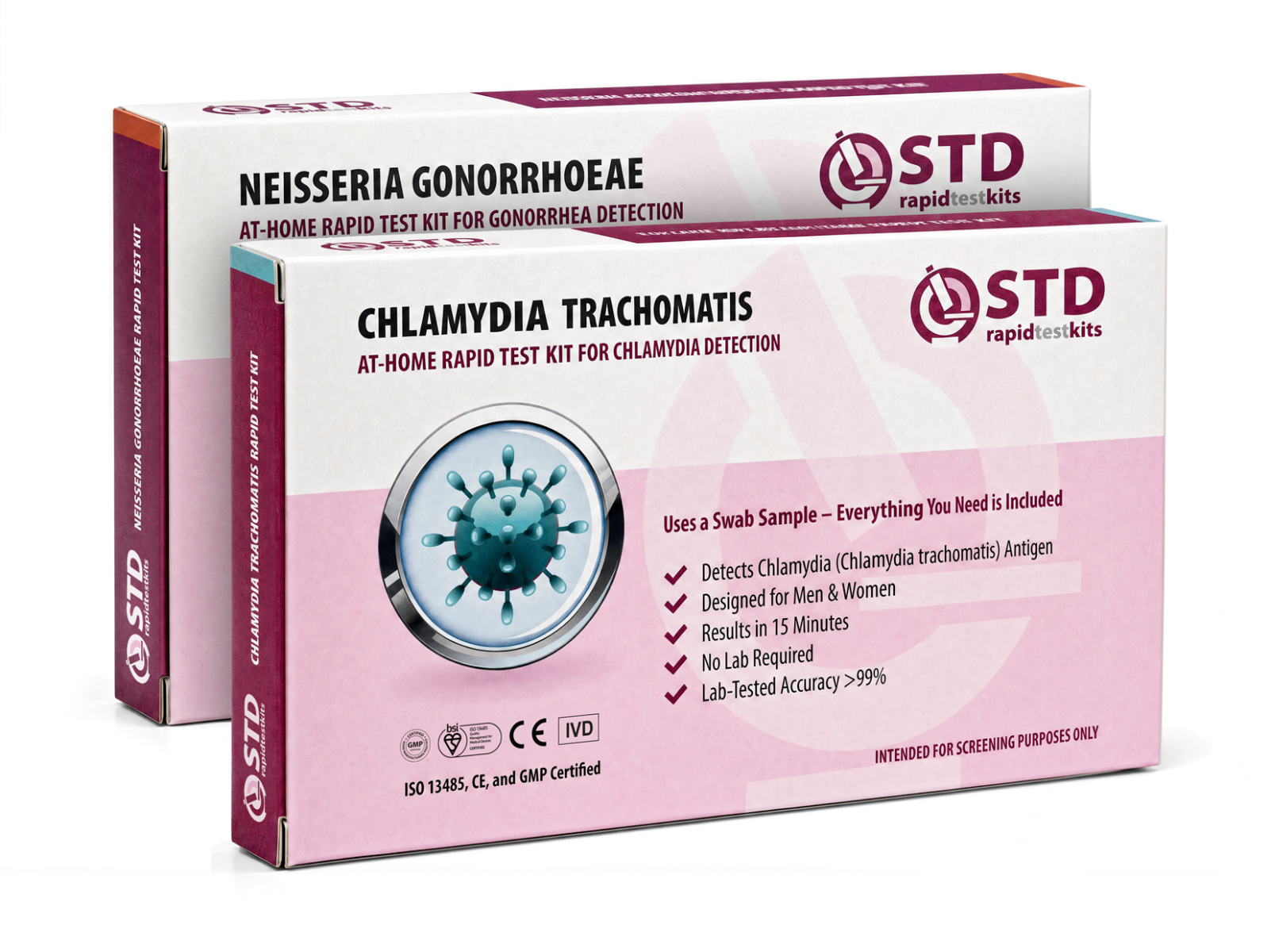
NAATs are the most sensitive tests for these specimens and are the recommended test for detecting C. trachomatis infection.
When to Test: Window Periods That Actually Matter
The single most common reason a home test gives a misleading negative is testing too soon after exposure. Every infection has a different window period (the time between exposure and when a test can reliably detect infection), and the test method matters too.
Per CDC HIV testing guidance, HIV antibody tests (including rapid lateral-flow) can usually detect HIV 23 to 90 days after exposure. Lab fourth-generation antigen and antibody combo tests detect earlier, at 18 to 45 days. If you tested with a rapid antibody kit at three weeks post-exposure and the result was negative, retest at 90 days for a definitive answer.
For chlamydia and gonorrhea, the practical window is 1 to 2 weeks after exposure, with 14 days the safer floor. Testing within the first few days of exposure misses early-load infections. Syphilis serology generally turns positive 3 to 6 weeks after exposure, sometimes later in lower-stage infection. Hepatitis B and C antibody tests have windows in the 4 to 12 weeks and 8 to 12 weeks ranges respectively.
HSV-2 antibodies (what the rapid herpes blood kit detects) take the longest. Antibody development is typically slow, and per CDC herpes information, a herpes blood test cannot reliably tell you when you got the infection. In practice, seroconversion can take several months after initial infection, so a negative HSV-2 antibody test taken within the first few weeks after a known exposure tells you very little. If you are testing because of a specific recent exposure rather than for general screening, retest at three months and again at six months if the concern persists.
If your concern is a single recent exposure and you do not want to wait out the full window, a lab NAAT (which detects the organism's genetic material rather than your immune response) shortens the wait for chlamydia and gonorrhea to about 7 to 14 days. That is one practical reason mail-in NAAT panels are worth the extra cost in early-post-exposure scenarios.
This article is published by stdrapidtestkits.com, which sells the rapid lateral-flow kits described in the first comparison entry. We recommend the kit type that fits each reader's reason for testing, not the one we make money on. For multi-site mail-in NAAT panels and bundled clinician follow-up, the other brands listed here are the right call.
Cost, Follow-Up, and What Happens After You Test
The full cost of testing is not just the kit price. A $30 rapid cassette that returns a positive triggers a clinic visit for NAAT confirmation and treatment, which adds clinic-visit cost (often free at a public-health STD clinic, billed if you go private). A $200 mail-in panel includes the lab-grade result and, with LetsGetChecked, a follow-up consultation, but you wait days for the answer.
For follow-up logistics, no home test sets you up to walk into your pharmacy with a printout and walk out with antibiotics. Bacterial STIs need a clinician prescription. Mail-in services with built-in telehealth (LetsGetChecked, myLAB Box) handle this step; rapid home tests do not. If your goal is "positive result to filled prescription with no further calls," the telehealth-bundled mail-in services are the most complete path.
For insurance, lateral-flow home kits are usually out-of-pocket. Mail-in services accept HSA and FSA cards (all four brands here do), and a few are partially covered by employer health plans. Check your specific plan's at-home test policy if cost matters.
For privacy, rapid cassettes are the most discreet (nothing is mailed, nothing is logged at a lab, no paper trail). Mail-in services arrive in unmarked packaging and bill discreetly, but a lab record does exist; if you are testing under a partner's insurance and explicitly do not want a billing record, rapid kits are the cleanest choice.
| Path to a positive result and treatment | Typical out-of-pocket cost | Time to treatment | Best when |
|---|---|---|---|
| Rapid kit + clinic confirmation + private clinician visit | $30 kit + clinic visit | Same day to a few days | You want the fastest possible screening signal |
| Mail-in panel with built-in telehealth (LetsGetChecked, myLAB Box) | $99 to $249, often HSA/FSA-eligible | Around a week including consult and pharmacy | You want one paid service to handle screening and treatment |
| Public-health STI clinic (free or sliding scale) | Often $0 | Same-day or next-day testing and treatment | Cost matters most; in-person visit acceptable |
Common Questions About At-Home STI Test Brands
- Are at-home STI tests accurate enough to trust?
- Mail-in lab NAAT panels use the same analytical method clinics use, so a properly collected sample produces a result comparable to a clinic test. Rapid lateral-flow home cassettes have a higher detection threshold, so they are accurate as screening tools but a negative does not rule out a very early or low-load infection as definitively as a NAAT. Either way, follow the instructions and the manufacturer's stated window period; the most common cause of a false negative is testing too soon after exposure.
- Should I confirm a home test positive at a clinic?
- Yes, for a positive bacterial STI result from a rapid home kit. Treatment requires a clinician prescription, and confirming with a clinic NAAT before starting antibiotics is good practice. For a positive on a mail-in NAAT panel, the result is already lab-grade; the next step is contacting a clinician (or using the brand's bundled telehealth) for treatment.
- How long after exposure should I wait before testing?
- If you can wait 14 days before testing for chlamydia or gonorrhea, a rapid kit gives you a reliable screen. For HIV, the most important threshold is 90 days for a definitive antibody result; lab antigen/antibody combo tests detect earlier, around 18 to 45 days. Syphilis serology typically turns positive at 3 to 6 weeks. HSV-2 antibodies are the slowest, with seroconversion sometimes taking several months. Testing inside the first few days after exposure rarely gives a useful answer.
- Do at-home STI tests cover throat or rectal infections?
- Most do not. Our rapid lateral-flow catalog covers genital and bloodwork only; we do not sell a pharyngeal or rectal swab kit. myLAB Box and LetsGetChecked offer mail-in extragenital site swabs in some panels. If your exposure included oral or anal contact, those routes need site-specific testing, not a genital swab.
- What is the difference between a rapid kit and a mail-in lab kit?
- Rapid kits use lateral-flow immunoassay chemistry, the same technology behind home pregnancy tests, and give a result in about 15 minutes at home. Mail-in kits ship your sample to a CLIA-certified lab that runs NAAT or fourth-generation antigen-antibody tests, the same methods clinics use, and post results in two to five days. Rapid kits win on speed and privacy; mail-in wins on analytical sensitivity and panel comprehensiveness.
- Will my insurance cover an at-home STI test?
- Mail-in services (myLAB Box, LetsGetChecked, Everlywell) accept HSA and FSA cards and some are partially covered by employer health plans. Direct-to-consumer rapid lateral-flow kits are usually out-of-pocket. Check your specific plan; STI screening is often a covered preventive service in-clinic, but the home-kit form is reimbursed less consistently.
- What happens if my home test result is positive?
- For mail-in services with bundled telehealth, expect a clinician call or message with treatment options and, for bacterial STIs in many states, a prescription sent to your pharmacy. For rapid home kits, the next step is your own clinician or a public-health STI clinic for confirmation and treatment. Bacterial STIs (chlamydia, gonorrhea, syphilis) are curable with appropriate antibiotics; viral STIs (HIV, hepatitis, HSV) are managed long-term with antivirals.
- Can I use an at-home test if I already have symptoms?
- For most symptoms, a clinic visit is better than a home test. Visible lesions, ulcers, severe pelvic pain, fever with discharge, or any concerning skin finding needs an in-person exam to differentiate STI from non-STI causes (yeast, bacterial vaginosis, contact irritation, viral skin conditions). Home tests are screening and post-exposure tools; they are not symptom diagnostics.
- U.S. Centers for Disease Control and Prevention. 2021 STI Treatment Guidelines: Chlamydia section, including the recommendation that NAATs are the most sensitive and recommended detection method.
- U.S. Centers for Disease Control and Prevention. HIV testing window periods, with antibody tests detecting infection 23 to 90 days after exposure and antigen/antibody lab tests detecting at 18 to 45 days.
- U.S. Centers for Disease Control and Prevention. STI Treatment Guidelines landing page, covering 2021 recommendations across bacterial and viral STIs.
- U.S. Centers for Disease Control and Prevention. Genital herpes overview, including the limits of blood antibody testing for determining timing of infection.
- World Health Organization. Sexually transmitted infections fact sheet covering global testing approaches and screening recommendations.