STD Testing at a Clinic vs. At Home: What It Costs in 2026
At a private clinic without insurance, expect to pay $150 to $520 or more for a standard STD panel once office visit fees, lab processing charges, and follow-up costs stack up. An equivalent at-home rapid test kit covering the same infections runs significantly less, with one upfront price, no lab bill arriving weeks later, and no waiting room. Here is exactly why that gap exists and what each option actually includes.
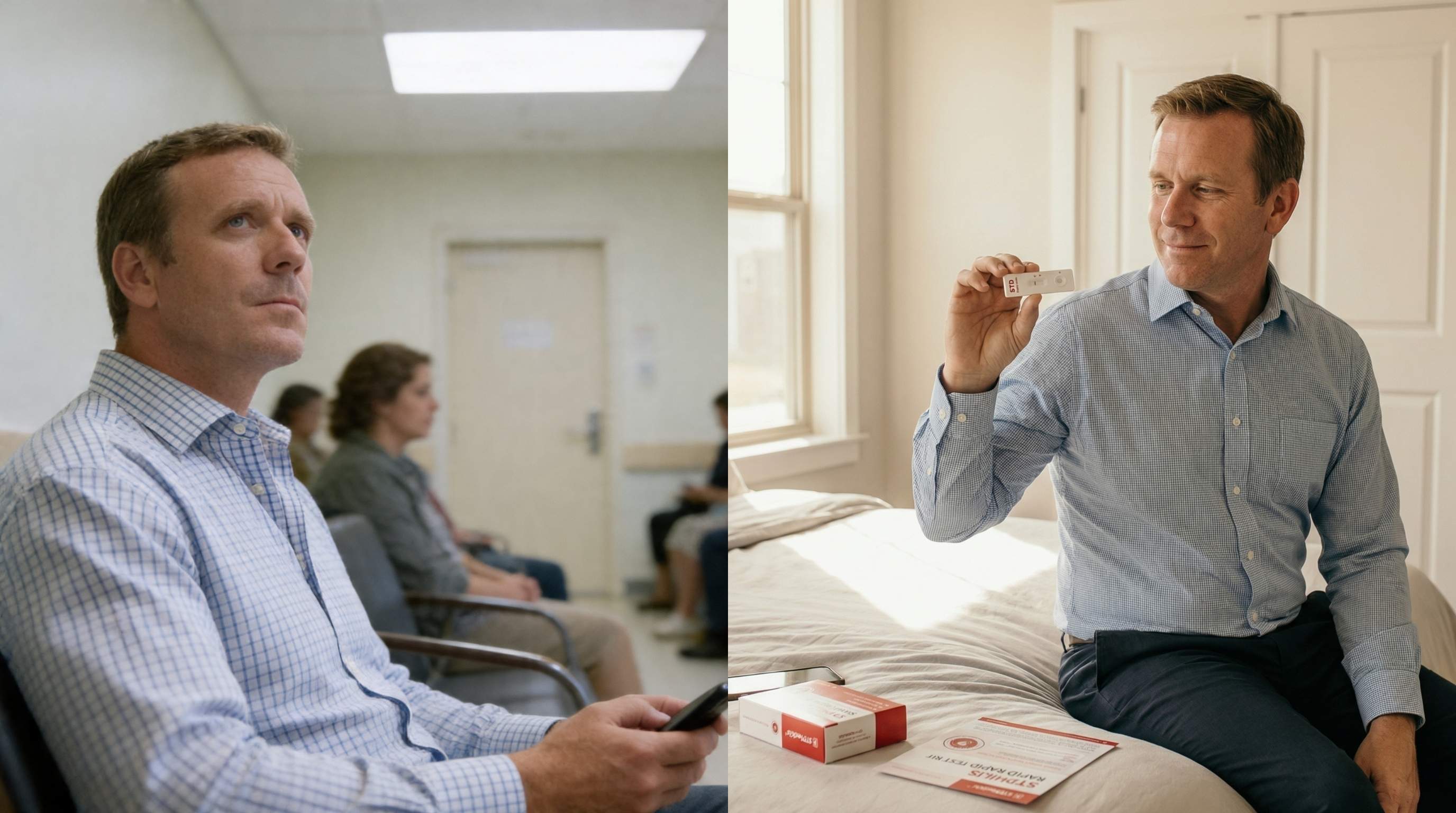



- Out-of-pocket STD testing at a private clinic or urgent care typically runs $150 to $520 once the office visit, separate lab processing fees, and any follow-up appointment are stacked together. An at-home rapid kit covering the same infections is one upfront price with no lab bill weeks later.
- FSA and HSA funds cover at-home STD test kits under IRS Code Section 213(d), effectively reducing the kit price by your marginal tax bracket (about 22% off for many earners).
Published: September 2025 | Last updated: May 2026 | Editorial review and quality control: Martina N.
At a private clinic without insurance, a standard STD panel typically runs $150 to $520 once office visit fees, lab processing charges, and any follow-up costs are added together. An at-home rapid test kit covering the same infections runs significantly less, with one upfront price, no separate lab bill weeks later, and results in 15 to 20 minutes at home. Here is exactly why that gap exists and what each option includes.
According to provisional 2024 surveillance data released by the CDC in September 2025, more than 2.2 million cases of chlamydia, gonorrhea, and syphilis were reported in the US, a 9% decline from 2023 but still a substantial national burden. Public health officials have been consistent on one point: when testing costs too much or takes too much effort, people delay. And delayed testing is where a manageable infection becomes a complicated one.
Key Takeaways
- Out-of-pocket STD testing at a private clinic or urgent care typically runs $150 to $520 once the office visit, separate lab processing fees, and any follow-up appointment are stacked together. An at-home rapid kit covering the same infections is one upfront price with no lab bill weeks later.
- FSA and HSA funds cover at-home STD test kits under IRS Code Section 213(d), effectively reducing the kit price by your marginal tax bracket (about 22% off for many earners).
What Does a Clinic Charge for STD Testing?
Walking into a clinic to get tested for one or two STDs sounds simple. In practice, the billing works in layers, and most patients only discover this after the fact. The total cost of a clinic visit typically consists of three distinct charges: the office visit fee, the lab processing fee, and in some cases, a follow-up appointment fee if results need to be discussed in person or a positive result requires confirmatory testing.
The office visit fee is charged just for being seen by a provider, regardless of what tests are ultimately ordered. At dedicated sexual health clinics run by county health departments, this fee tends to be lower. Based on each county's published clinic fee schedule, San Diego County's sexual health clinics charge a flat $40 per visit, while Salt Lake County charges $60 for county residents and $80 for those outside the county. Private urgent care centers and primary care offices are a different story. At facilities like MinuteClinic, a typical encounter for STD evaluation runs between $150 and $260, depending on the panel selected and whether rapid results are requested, based on urgent care pricing data.
The lab processing fee is separate. Once the provider collects a sample (urine, blood, or a swab), it typically goes to an off-site certified laboratory for processing. That laboratory bills independently, and those charges can range from $30 to $185 per individual test, or $125 to $400 for a comprehensive multi-STD panel, according to urgent care cost data. Some panels at private providers or hospital-affiliated labs push past $500 when expedited processing is selected. At county-run public health STD clinics, the lab fee is often bundled into a flat registration fee. San Mateo County, for example, charges $25 for a standard registration covering HIV, syphilis, gonorrhea, and chlamydia testing together, per the county's published clinic schedule. You can find local clinic fees through the CDC's GetTested locator.
Then there is the follow-up appointment. If your result comes back positive, or if the initial rapid test needs confirmation through a more detailed laboratory analysis, many clinics require an additional visit to discuss findings, review treatment options, or collect a second specimen. That visit carries its own office visit charge. For anyone already paying out of pocket, a second appointment for confirmatory testing can add another $60 to $150 on top of the original bill.
| Clinic Type | Office Visit Fee | Lab Fee (Single Panel) | Estimated Total |
|---|---|---|---|
| County/Public Health STD Clinic | $0–$80 | Often bundled or $20–$60 | $25–$140 |
| Planned Parenthood (sliding scale) | $0–$90 | Varies by income | $0–$150 |
| Urgent Care Center | $75–$150 | $30–$185 per test | $150–$400+ |
| Private Primary Care / MinuteClinic | $100–$200 | $50–$200+ per test | $260–$520+ |
| Hospital-Affiliated Lab with Provider | $150–$300 | $100–$260+ per test | $400–$730+ |
The Hidden Fees Nobody Mentions When You Book
The three-layer billing structure above is the standard framework. Within that framework, there are add-on charges that routinely catch people off guard. The most common is the expedited processing fee. If you want results in 24 to 48 hours rather than the standard 3 to 7 business days, many labs charge a premium of $20 to $50 per test on top of the base lab cost.
Specimen handling fees are another line item that appears on bills without much warning. When a provider sends a sample to a third-party lab, some facilities charge a separate handling or collection fee, labeled as a "specimen processing fee," a "collection kit charge," or simply an administrative line. Some clinics charge it and others do not, but it shows up often enough that you should ask specifically about it before any samples are collected.
If you are tested at a private clinic and your insurance covers part of the visit, you may also receive a separate bill from the laboratory, because the lab is often out-of-network even when the clinic is in-network. You go to an in-network provider, your insurance pays their portion of the office visit, and then weeks later, a lab bill arrives for the full processing cost because the lab your provider used is contracted separately. It is one of the more frustrating structural quirks of clinic billing, and it catches insured patients almost as often as uninsured ones.
Time also has a cost that does not appear on any invoice. The average wait time at a walk-in STD clinic runs 30 to 90 minutes, with the provider appointment itself adding another 30 to 60 minutes. For someone taking time off work, even two hours represents a real economic cost, one that never appears in any published price comparison but absolutely factors into the total.
What a Real Clinic Visit Costs in Practice
Here is how the numbers play out. Take someone without insurance who visits an urgent care center to test for chlamydia, gonorrhea, syphilis, and HIV, four of the most common infections to screen for after unprotected sex. The office visit fee comes to $125. The lab processes four separate tests at roughly $60 to $80 each, producing a lab bill of $240 to $320. The total before any add-ons sits at $365 to $445. They asked for 48-hour results, so an additional $40 expedited processing fee brings the running total to $405 to $485.
Three weeks later, a second bill arrives from the laboratory: $55 labeled as a "specimen handling fee" that was never mentioned at check-in. Final total: $460 to $540 for four tests at an urgent care center, before counting the two hours of time taken from work and the parking fee.
That same four-infection scope at a county public health clinic, where fees are subsidized, might run $25 to $80 all in. County clinic availability varies dramatically by city, hours are often limited to weekday business hours, and wait times regularly exceed an hour. For anyone without geographic or scheduling access to a public clinic, urgent care or private provider pricing is the realistic baseline.
An at-home rapid test kit covering the same four infections (chlamydia, gonorrhea, syphilis, and HIV) involves one price, no office, no lab bill, and results at home in 15 to 20 minutes. That is the cost structure difference in concrete terms.
Many people who have an STI don't have any symptoms. Without testing, you can't know for sure if you or your partner has one.
What About Free HIV Testing?
Here is one genuinely good deal built into the clinic system: many public sexual health clinics offer rapid HIV testing at no charge. The Salt Lake County STD Clinic waives the office visit fee entirely for HIV-only testing. San Diego County takes the same approach, with no fee for standalone HIV screening. This policy reflects federal and state grant funding specifically directed at increasing HIV testing rates, which means the subsidy is built in at the public health level and does not depend on your income or insurance status.
The CDC maintains a searchable database of free and low-cost STD testing locations through its GetTested tool, which lets you search by zip code. Community health centers, Planned Parenthood locations operating on sliding-scale fees, and university campus health services often offer HIV testing for free or close to it, regardless of whether you have insurance.
The important nuance: free HIV testing at a public clinic covers one infection. The moment you add chlamydia, gonorrhea, syphilis, or anything else to the order, the fee structure typically kicks back in. A free HIV test screens for HIV alone. If you have had unprotected sex and you are genuinely concerned, testing for only HIV misses the most common bacterial infections circulating right now. A free HIV test is a useful option when HIV is your specific and only concern. For broader peace of mind, the math changes.
The CDC's <a href="https://gettested.cdc.gov/" target="_blank" rel="noopener">GetTested locator</a> maps free and low-cost HIV testing sites by zip code. Community health centers, Planned Parenthood, and county sexual health clinics are the most common sources of fully subsidized rapid HIV screening. Phone ahead to confirm same-day availability and whether walk-ins are accepted; appointment policies vary widely by site.
At-Home Rapid STD Test Kits: What You Pay
The cost structure of at-home rapid testing is fundamentally different from clinic billing. There are no office visit fees. No lab processing charges billed separately. No follow-up appointment to interpret the result. The kit price is the total price. You collect the sample at home, run the test, and read the result, typically within 15 to 20 minutes. Everything needed to complete the test is included in the package.
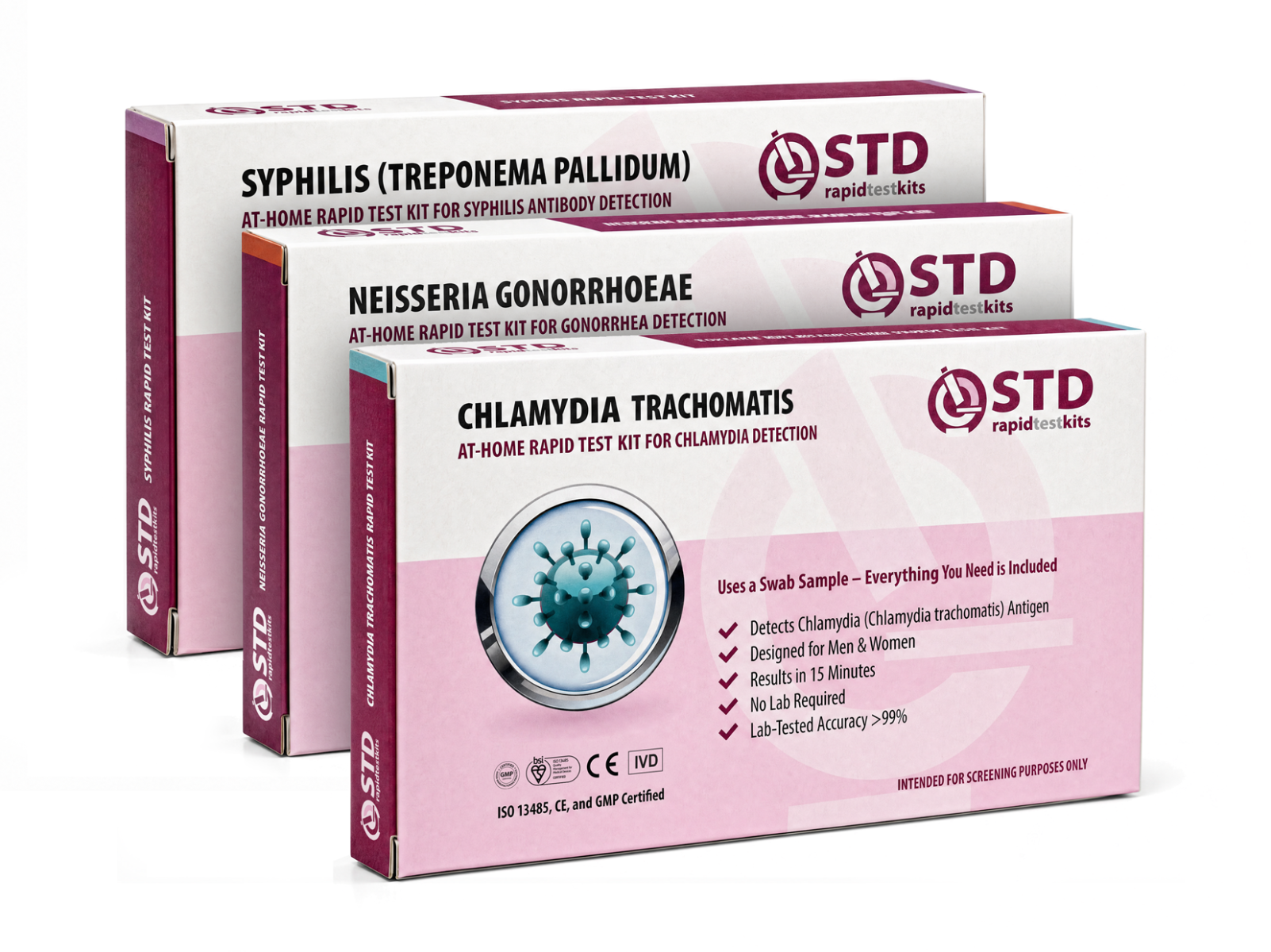
At STD Rapid Test Kits, single-infection tests cover the most commonly screened STDs with sensitivity figures that closely track lab-based screening results. The Chlamydia At-Home Rapid Test Kit (99.7% accuracy) and the Gonorrhea At-Home Rapid Test Kit (97.2% accuracy) cover the two most frequently reported bacterial STDs in the US. The HIV 1&2 At-Home Rapid Test Kit (99.7% accuracy) covers anyone who wants discreet HIV testing without the clinic visit.
These at-home kits use lateral-flow rapid test chemistry, the same format used in pharmacy pregnancy tests and at-home COVID antigen tests. Clinic laboratories use a different technology, NAAT/PCR molecular testing, which adds another layer of analytical sensitivity. The two approaches are complementary: rapid kits are designed for fast, private screening with strong sensitivity when used after the correct window period, and lab NAATs matter when confirming a positive result or testing very soon after exposure. A positive on a rapid kit is worth following up with a healthcare provider for confirmatory testing.
Combo kits consolidate cost and coverage for anyone testing for multiple infections, which is generally the smarter move after any unprotected encounter. The 7-in-1 At-Home STD Test Kit (98.5% accuracy) covers HSV-2, Chlamydia, Gonorrhea, Syphilis, HIV, Hepatitis B, and Hepatitis C in a single kit. The Complete 8-in-1 Kit (99% accuracy) adds HSV-1. Either option stacks up directly against a private clinic bill for an equivalent panel, and the gap is wide once you factor in the absent lab fees and follow-up costs.
| Testing Scope | Clinic: Public Health | Clinic: Urgent Care / Private | At-Home Rapid Kit |
|---|---|---|---|
| Single infection (e.g., chlamydia) | $25–$80 | $90–$250 (visit + lab) | Single kit, one price, no add-ons |
| 3 infections (chlamydia + gonorrhea + syphilis) | $25–$140 | $150–$400 | 3-in-1 kit (99.5% accuracy) |
| 7 infections (comprehensive panel) | Often not available | $300–$520+ | 7-in-1 kit (98.5% accuracy) |
| Follow-up if positive | +$40–$80 per visit | +$60–$150 per visit | None required for kit result |
| Lab bill arriving weeks later | Rare (bundled) | Common, often out-of-network | None, no lab involved |
| Time cost | 60–180 mins | 60–150 mins | 15–20 mins at home |

Can You Use FSA or HSA Funds for At-Home STD Tests?
Yes, and this is one of the most useful cost-reduction tools that rarely gets mentioned when people are comparing their options. At-home STD diagnostic kits qualify as eligible expenses under both Flexible Spending Accounts (FSA) and Health Savings Accounts (HSA), under IRS Code Section 213(d). The FSA Store and HSA Store both list home diagnostic tests, explicitly including HIV and STD test kits, as reimbursable purchases.
The pre-tax benefit is real money, not a rounding error. Someone in the 22% federal income tax bracket who pays for a test kit through their FSA effectively saves 22 cents on every dollar compared to paying from after-tax income. For FSA holders approaching year-end with unspent funds, an at-home STD test kit is a legitimate and genuinely useful way to use that balance before it reverts to the employer. To claim reimbursement, keep your purchase receipt and submit it through your plan's portal or app. The process typically takes under five minutes.
Clinic lab processing fees are also FSA/HSA eligible, so the tax advantage extends to clinic testing too. The transparency edge still goes firmly to at-home kits: you know the total price before you buy, there is no separate lab bill to track down for reimbursement, and there is no risk of an out-of-network charge appearing weeks later that complicates the claim.
| Feature | FSA (Flexible Spending Account) | HSA (Health Savings Account) |
|---|---|---|
| At-home STD kits eligible? | Yes | Yes |
| How to pay | FSA debit card at checkout, or submit receipt for reimbursement | HSA debit card at checkout, or submit receipt for reimbursement |
| Funds are pre-tax? | Yes, contributions come from pre-tax income | Yes, contributions are tax-deductible |
| Effective discount (22% tax bracket example) | About 22% off the listed price | About 22% off the listed price |
| Unused funds roll over? | No, use-it-or-lose-it annually (some plans allow small rollover) | Yes, funds accumulate year to year |
| Requires high-deductible health plan? | No | Yes |
| Shipping costs covered? | Varies by plan, check before submitting | Varies by plan, check before submitting |
When Should You Use a Clinic Instead of Testing at Home?
At-home rapid testing is the right call for most people in most situations, particularly for routine screening after a new partner, periodic testing for sexually active adults, or anyone who needs results quickly, privately, and without scheduling an appointment. Cost, convenience, and accuracy all line up in favor of at-home testing for routine screening. There are still specific situations where a clinic visit is the better answer regardless of price.
The first is active symptoms. If you are experiencing visible sores, noticeable discharge, pain when urinating, or a rash in the genital area, a provider needs to examine you in person. Symptoms can indicate infections that look similar (herpes lesions, syphilis chancres, and several non-STD skin conditions all share visual overlap), and only a clinical exam can distinguish them reliably. At-home rapid tests are built for asymptomatic screening; they do a different job than a physical assessment when something is clearly wrong.
The second is a positive at-home result. A positive result on a rapid test kit should be followed up with a healthcare provider for confirmatory testing and to access treatment. Treatment for bacterial STDs requires a prescription, which means a provider visit is unavoidable at that point. That reflects how the at-home model is designed to work: the kit tells you whether you need to go to the clinic, and the clinic handles confirmation and treatment.
The third is insurance coverage. Many plans cover STD testing as a preventive service under the Affordable Care Act: HIV screening for adolescents and adults aged 15 to 65, chlamydia and gonorrhea screening for sexually active women under 25, and syphilis screening for people at increased risk. If your insurance covers these tests at a low or zero co-pay through an in-network provider, the cost equation shifts and a clinic visit may be the genuinely cheaper option. Verify your specific coverage before paying out of pocket for either route. The answer varies enough by plan that it is worth a 10-minute phone call to confirm.
When a clinic visit is the better answer
- Active symptoms: visible sores, unusual discharge, painful urination, or genital rash all need an in-person clinical exam, not a rapid antigen kit.
- Positive at-home result: bring it to a provider for confirmatory testing and a prescription for any bacterial STI requiring treatment.
- Insurance that covers preventive STI screening: under the ACA, an in-network visit may carry a low or zero co-pay, which can beat the kit price.
When Is the Right Time to Test? Exact Windows by Infection
One of the most important and most overlooked factors in the cost of STD testing is timing. Testing too early after exposure often produces a false negative: the infection is present, but your immune system has not yet generated a detectable response. That false negative does more than mislead you; it means you will need to retest, which doubles the cost of a clinic visit or means buying a second kit. Getting the timing right eliminates that waste entirely.
These are the clinically established detection windows. They apply equally to clinic lab tests and at-home rapid kits.
| Infection | Test From | Notes |
|---|---|---|
| Chlamydia | 14 days after exposure | Most common reportable STD in the US |
| Gonorrhea | 3 weeks after exposure | Rates have declined slightly but remain high |
| Syphilis | 6 weeks after exposure | Cases remain at historically elevated levels |
| HIV | 6 weeks (first indicator); retest at 12 weeks for certainty | Earlier testing risks false negatives |
| Herpes HSV-1 & HSV-2 | 6 weeks after exposure | Antibody development takes time |
| Hepatitis B | 6 weeks after exposure | Vaccination available, worth discussing with a provider |
| Hepatitis C | 8–11 weeks after exposure | Longer window than most infections |
Test at Home Today: Clear Answers, No Waiting Room
Testing too early is one of the most common and most avoidable reasons people end up paying for two tests instead of one. If you are still inside the window period, note the date when it opens and set a reminder. If you are past the window for your exposure, there is no reason to wait any longer.
Between office visit fees, separate lab processing charges, potential follow-up costs, and the time cost of a clinic trip, the real-world price of clinic-based STD testing lands well above what most people expect, particularly without insurance. At-home rapid testing cuts through all of that: one upfront price, tested at home, results in 15 to 20 minutes. If you have an FSA or HSA, you are paying with pre-tax dollars on top of all of it.
The 7-in-1 At-Home STD Test Kit (98.5% accuracy) covers HSV-2, Chlamydia, Gonorrhea, Syphilis, HIV, Hepatitis B, and Hepatitis C with no lab fees, no office visit, and no waiting room. For the broadest possible panel, the Complete 8-in-1 Kit (99% accuracy) adds HSV-1. For a focused bacterial screen, the Chlamydia, Gonorrhea & Syphilis 3-in-1 Kit (99.5% accuracy) covers the three most commonly reported STDs in one test.
Testing is the fastest way to stop the guessing game. Visit STD Rapid Test Kits to find the right kit for your situation and get tested on your own terms.
Frequently Asked Questions
- Without insurance, how much does a basic STD test cost at a clinic?
- You can expect to pay between $25 and $140 at a county public health clinic. When you add up the office visit and the lab work, the same test at an urgent care or private clinic usually costs between $150 and $400. There is no national standard for pricing, and totals vary substantially by location and provider.
- Are there really hidden extra costs at STD clinics?
- Yes. The lab usually sends a separate bill for processing fees weeks after your visit. Other common add-ons are expedited results ($20 to $50 per test) and specimen handling fees. Insured patients can also get bills from out-of-network labs even after their in-network clinic visit is paid for. Before any samples are taken, ask for a written list of all expected charges.
- Are clinics really giving away free HIV tests?
- Yes. Many county-run sexual health clinics offer free rapid HIV testing to everyone, regardless of income or insurance, thanks to federal and state public health grants. The free pricing does not apply to other tests done at the same visit. The CDC's GetTested tool helps you find a free HIV testing site near you.
- Can I use my FSA or HSA card to buy an at-home STD test?
- Yes. The IRS classifies at-home STD and HIV test kits as FSA and HSA-eligible expenses under Section 213(d). You can pay with your FSA or HSA debit card at checkout, or submit a receipt for reimbursement. The pre-tax discount effectively reduces the price by your marginal tax bracket.
- How accurate are at-home rapid STD tests compared to clinic lab tests?
- STD Rapid Test Kits' panels report sensitivity and specificity in the 97.2% to 99.7% range, depending on the infection. For asymptomatic screening after potential exposure used within the correct window period, these figures are clinically meaningful. Lab NAAT/PCR tests add another layer of analytical sensitivity that matters for confirming a positive or detecting infection earlier in the window period.
- Does insurance cover STD testing at a clinic?
- Many plans cover testing as a preventive service under the ACA: HIV screening for adults 15 to 65, chlamydia and gonorrhea screening for sexually active women under 25, and syphilis screening for people at increased risk. Co-pays and deductibles can still apply. Verify your specific coverage before assuming the visit will be free.
- Is at-home testing always cheaper than a clinic visit?
- In most out-of-pocket scenarios, yes, particularly for multi-infection panels at urgent care or private clinics where total costs often exceed $300. If your insurance covers clinic visits with a small co-pay, an insured clinic visit may end up cheaper than an uninsured kit. The math depends on your specific plan and the scope of testing.
- What should I do if my at-home STD test comes back positive?
- Contact a healthcare provider for confirmatory testing and treatment. Rapid kits are accurate, and a positive result is worth acting on immediately. At that point, a visit to a clinic is appropriate. You are no longer screening; you are seeking care, and most providers can confirm and treat in a single visit.
Our article was constructed based on current advice from the most prominent public health and medical organizations, and then molded into simple language based on the situations that people actually experience, such as treatment, reinfection by a partner, no-symptom exposure, and the uncomfortable question of whether it "came back." In the background, our pool of research included more diverse public health advice, clinical advice, and medical references, but the following are the most pertinent and useful for readers who want to verify our claims for themselves.
- U.S. Centers for Disease Control and Prevention. Sexually Transmitted Infections Surveillance, 2024 (Provisional). Source for the 2.2 million chlamydia, gonorrhea, and syphilis cases reported in the US and the 9% year-over-year decline.
- U.S. Centers for Disease Control and Prevention. STI Prevalence, Incidence, and Cost Estimates in the United States. Source for the national-burden context behind delayed-testing cost framing.
- U.S. Centers for Disease Control and Prevention. GetTested: Find Free and Confidential Testing Near You. Source for the locator of free and low-cost STD testing sites cited in the free HIV testing section.
- BuyFSA. Are Lab Fees FSA/HSA Eligible? Source for the confirmation that clinic lab processing fees are also FSA/HSA eligible under IRS Section 213(d).
- U.S. Centers for Disease Control and Prevention. Sexually Transmitted Infections (STIs) Topic Index. Source for general STI testing guidance, screening recommendations, and clinician resources referenced throughout the article.
- American Family Care. How Much Do STD Tests Cost in 2025? Source for the $30 to $185 per-test and $125 to $400 multi-panel lab pricing ranges quoted for urgent-care visits, and for the MinuteClinic-style $150 to $260 office encounter range.