

Published: August 2025 | Last updated: April 2026 | Editorial review and quality control: Martina N.
How long should I wait after exposure before taking an at-home STI test?
Wait at least 1 to 2 weeks for chlamydia and gonorrhea, 3 to 6 weeks for syphilis, and 23 to 90 days for HIV using a fingerstick antibody test (most people are positive by 6 weeks). Hepatitis B surface antigen (HBsAg) tests are reliable from 3 to 9 weeks, hepatitis C antibody tests from 8 to 11 weeks, and herpes IgG from 12 to 16 weeks. After a single high-risk exposure, plan a final retest at week 12 to close every common window.
Key takeaways
- Window periods vary widely: chlamydia and gonorrhea reach detectable levels in 1 to 2 weeks, while HIV antibody tests can take up to 90 days for full confidence.
- A negative result taken inside the window period does not rule out infection. Plan a retest at the end of the longest applicable window for every infection you may have been exposed to.
Testing too soon after a possible exposure is the single most common reason at-home STI test results come back falsely negative. Each infection has its own window period, the stretch of time between exposure and when the body produces enough virus, antigen, or antibody for a test to detect it. Test before that window closes and the result can read negative even when the infection is present and transmissible.
This guide walks through the window period for every STI we cover, explains why a 15-minute home rapid test is not the same technology as a lab NAAT, and gives a sensible retest schedule for someone who had a single high-risk exposure event. The numbers come from CDC guidance and the technical specifications of common rapid assays, not generalities. Disclosure: the rapid tests described in this article are sold by stdrapidtestkits.com; we recommend products by fit-for-purpose for the reader's concern, not by commercial benefit.
What a window period actually is
The window period is the gap between exposure and when a test can reliably detect infection. During this gap the pathogen is replicating, but the level in your blood, secretions, or tissue has not yet crossed the threshold the test is designed to catch.
Different tests look for different markers, and each marker takes its own time to appear:
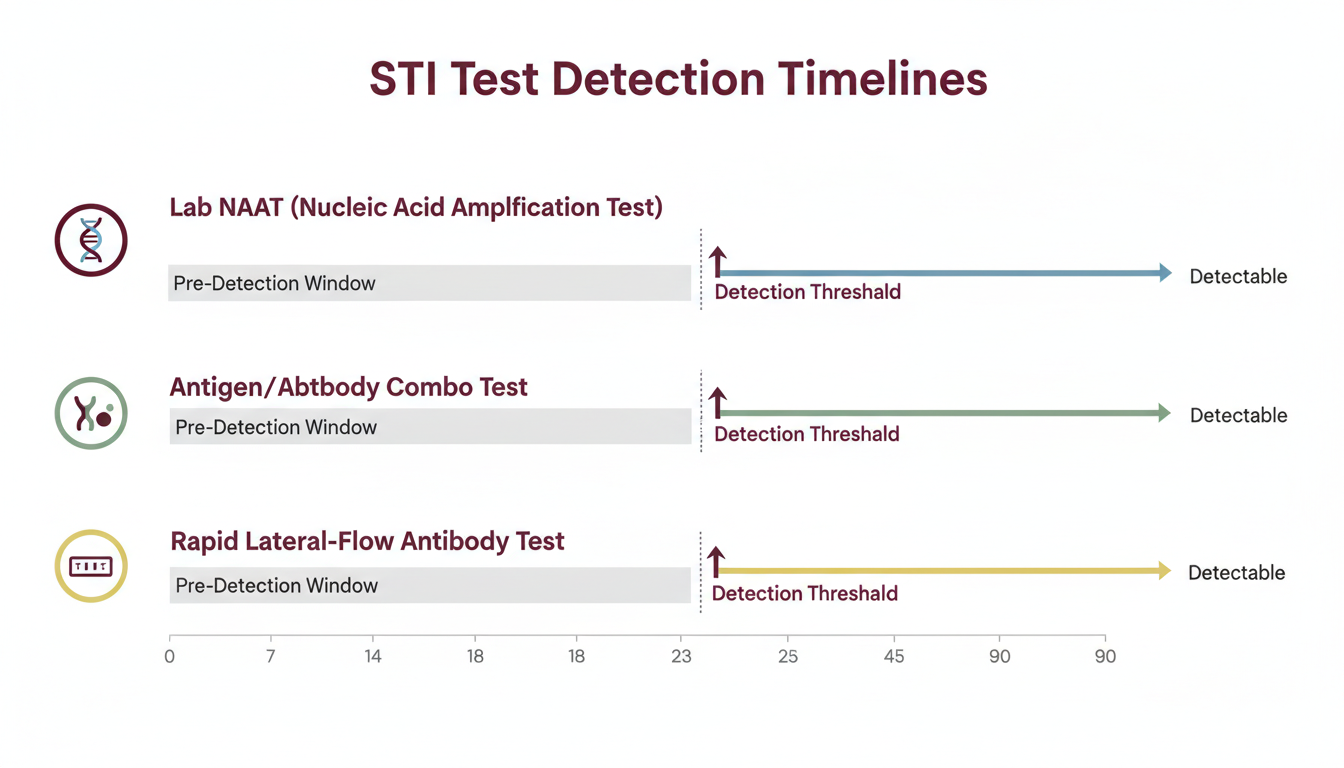
- Pathogen DNA or RNA shows up first. Lab nucleic acid amplification tests (NAATs, sometimes called PCR) detect tiny amounts of pathogen genetic material directly. These are the fastest tests to turn positive after exposure.
- Antigens, proteins on the surface of the pathogen, appear next. Some lab HIV combo tests look for the p24 antigen alongside antibodies, which shortens their window compared to antibody-only assays.
- Antibodies are the slowest to appear. Your immune system needs time to recognize the pathogen and produce them. Most rapid at-home tests, including ours for HIV, syphilis, hepatitis C, and herpes, are antibody-based, which is why their windows are the longest. (Our hepatitis B kit is the exception: it detects the surface antigen HBsAg, not antibodies.)
Knowing which marker your kit detects tells you when to use it. Our home kits use rapid lateral-flow immunoassay chemistry: the strip captures antibodies (or antigens, in the hep B and swab tests) from the sample and shows a visible line within 15 minutes. That technology is fast and private, with somewhat longer windows and lower analytical sensitivity than a lab NAAT performed on the same sample type. The two work together as complementary screening and confirmation tools rather than as interchangeable technologies.
Window periods at a glance
The table below summarizes typical detection windows for each infection. Where ranges are given, the lower number is the earliest a positive can sometimes appear, and the upper number is the conservative all-clear point used by the CDC and major laboratory references.
| Infection | Test type | Detectable from | All-clear window |
|---|---|---|---|
| Chlamydia | Self-collected swab (lateral-flow) | 1 to 2 weeks | 2 to 3 weeks |
| Gonorrhea | Self-collected swab (lateral-flow) | 1 to 2 weeks | 2 to 3 weeks |
| Trichomoniasis | Vaginal swab (lateral-flow) | 1 to 2 weeks | 2 to 3 weeks |
| HIV (antibody-only) | Fingerstick blood (lateral-flow) | 23 days | 90 days |
| HIV (antigen/antibody, lab) | Venous blood, lab | 18 days | 45 days |
| Syphilis | Fingerstick blood antibody (lateral-flow) | 3 weeks | 6 to 12 weeks |
| Hepatitis B (HBsAg antigen) | Fingerstick blood (lateral-flow) | 3 weeks | 9 weeks |
| Hepatitis C (antibody) | Fingerstick blood (lateral-flow) | 8 weeks | 11 weeks (up to 6 months) |
| Herpes HSV-1 / HSV-2 (IgG) | Fingerstick blood (lateral-flow) | 12 weeks | 16 weeks |
| HPV | Vaginal swab (women only) | Persistent infection only | Screening tool, not exposure-based |
HIV: three test technologies, three windows
HIV is the most nuanced STI to test for at home because the window depends heavily on which test technology you use. The CDC's HIV testing guidance publishes three different ranges for the three available test families:
- Nucleic acid test (NAT), lab-only: detects HIV RNA from roughly 10 to 33 days after exposure. This is the test used in some PrEP and post-exposure protocols, and it is not available as an at-home product.
- Antigen/antibody (4th-generation) lab test: detects p24 antigen and HIV antibodies together, typically positive 18 to 45 days after exposure.
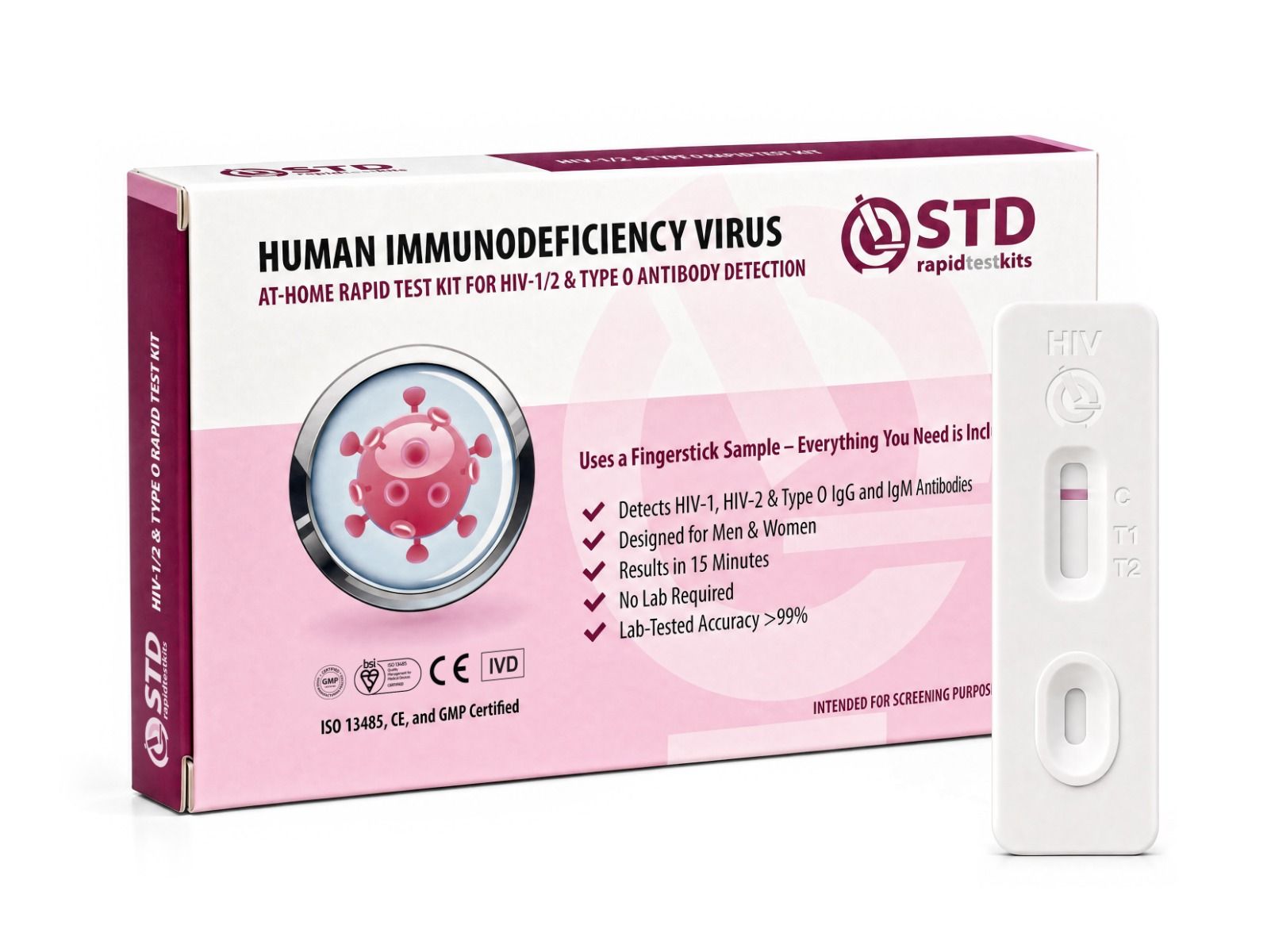
- Antibody-only rapid tests, the technology used in fingerstick at-home kits: detect HIV antibodies, with a window of 23 to 90 days. Most people seroconvert (produce detectable antibodies) by 6 weeks, but the CDC defines 90 days as the conservative all-clear point.
Our at-home HIV rapid test is an antibody-based fingerstick lateral-flow kit. The practical implication: a single negative test at three weeks post-exposure is reassuring but not definitive. Retest at six weeks, and again at twelve weeks, to close the window confidently.
If you had a higher-risk exposure (needle-sharing, condomless anal or vaginal sex with a partner whose HIV status is unknown or detectable) and want detection earlier than six weeks, ask a clinic about a lab NAT. Post-exposure prophylaxis (PEP) is also time-sensitive: it must start within 72 hours of exposure to be effective, so do not wait for any test result before seeking it.
Chlamydia and gonorrhea: the 1 to 2 week window
Chlamydia and gonorrhea are bacterial infections, and both follow similar testing timelines. Lab nucleic acid amplification tests (NAATs) on a swab sample are the CDC-recommended gold standard, with detection possible from roughly 1 to 2 weeks after exposure per standard clinical guidance. Background on these two infections, including transmission and screening, is on the CDC's sexually transmitted infections page.
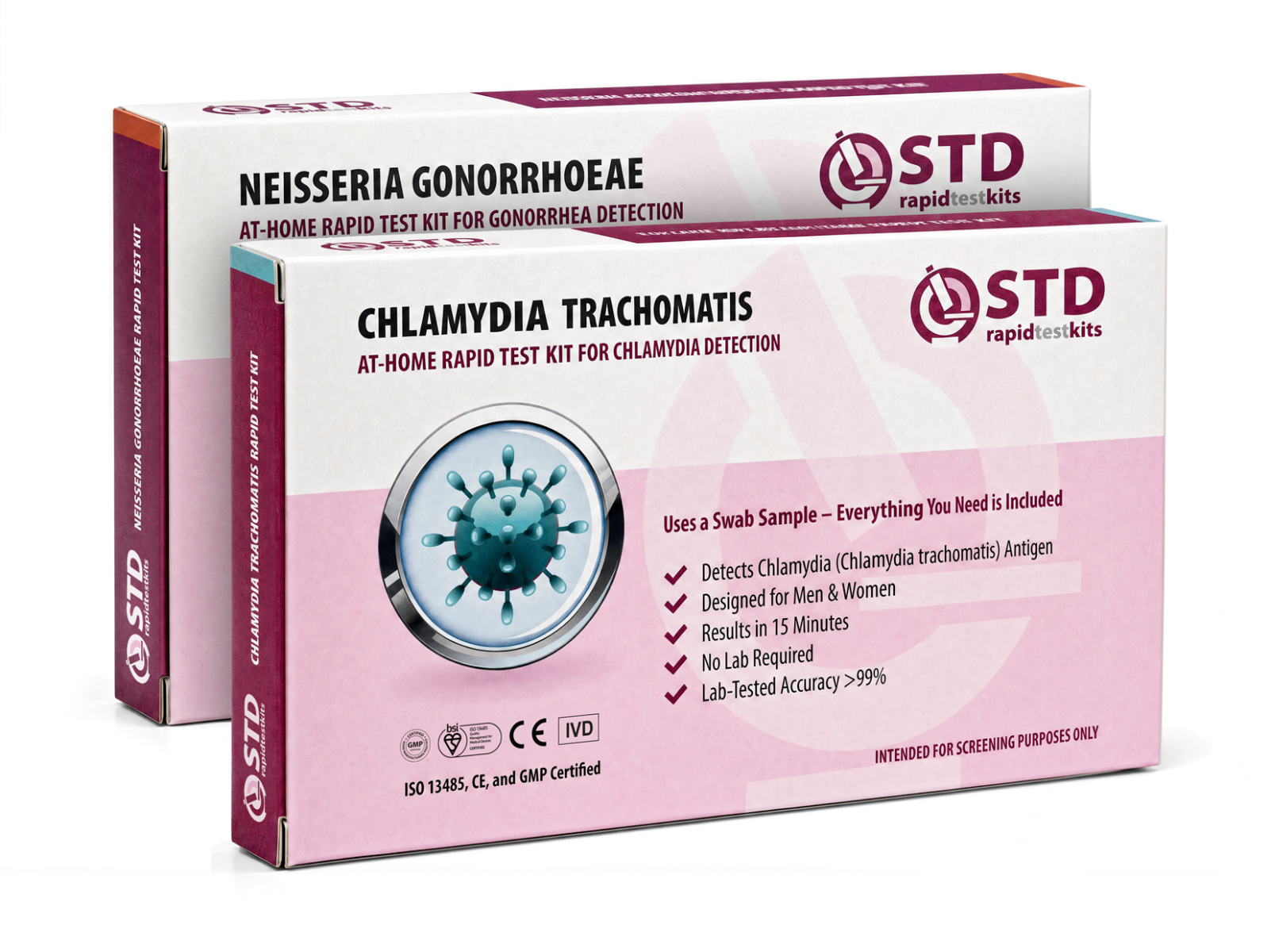
Our at-home chlamydia and gonorrhea kits use the same self-collected genital swab sample type that labs use, but with rapid lateral-flow detection chemistry instead of NAAT. The kits give a 15-minute result without leaving home, but their analytical sensitivity is lower than a lab NAAT, especially in asymptomatic infections that carry a low bacterial load. A positive home rapid result is meaningful and should prompt clinical confirmation and treatment. A negative result inside two weeks of exposure is provisional, and should be confirmed with a retest at 14 days or later, particularly if symptoms develop.
One important scope limit: pharyngeal (throat) and rectal infections are common after oral and anal exposures, and a genital swab does not detect them. Our kits are validated on self-collected vaginal or penile swabs only. If you had oral or anal exposure and want full coverage, see a clinic for site-specific NAAT testing. We do not sell pharyngeal or rectal swab kits.
Syphilis, hepatitis B, and hepatitis C: 3 to 11 week windows
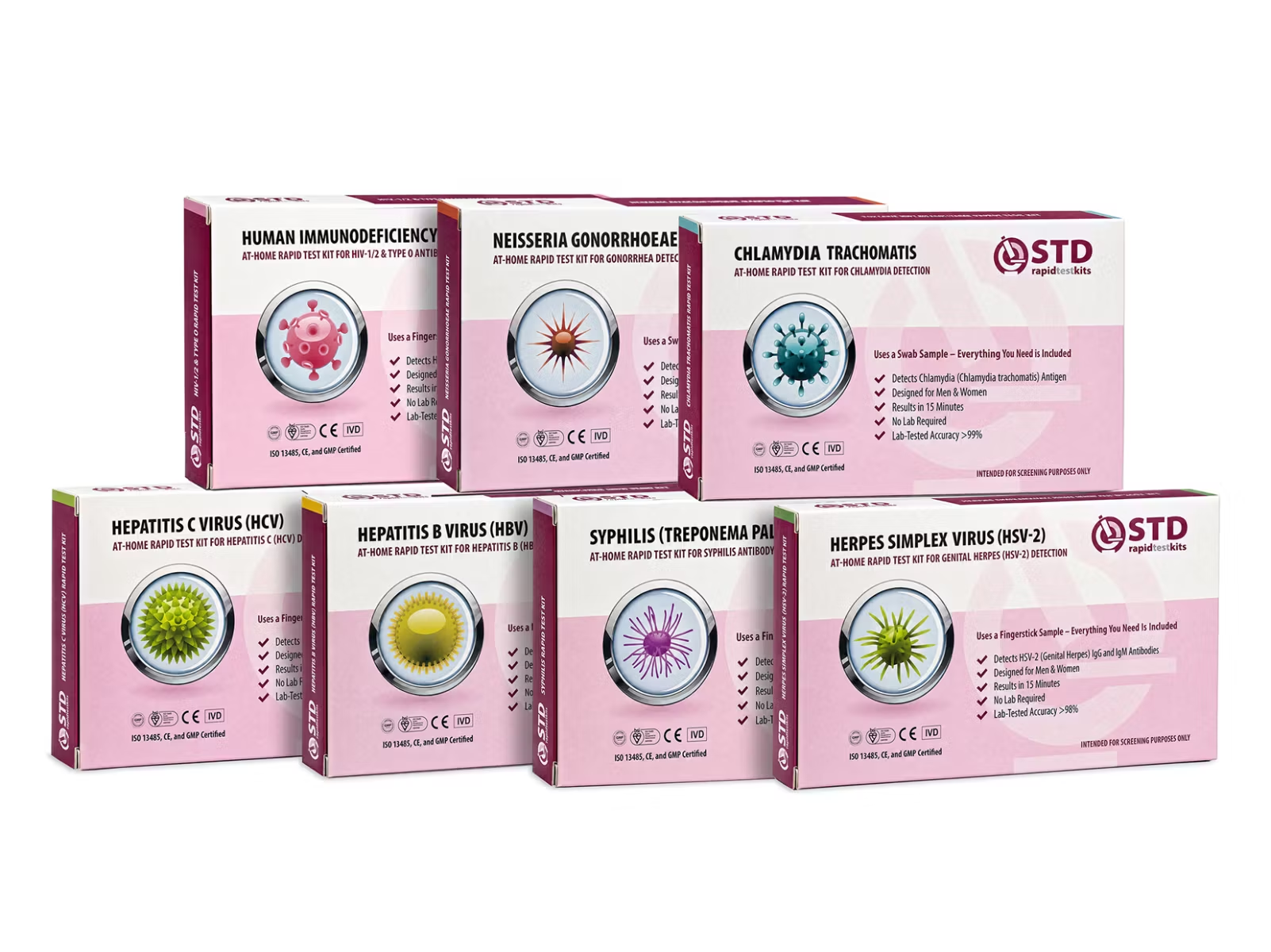
These three infections all rely on blood-based detection, and all three are covered by our fingerstick rapid kits. Their seroconversion timelines vary, and one important detail to flag up front: the hepatitis B test detects an antigen (HBsAg), while the syphilis and hepatitis C tests detect antibodies. The clinical timing windows reflect that difference.
- Syphilis: Treponemal antibody tests typically turn positive within a few weeks of exposure, with the all-clear window for most assays extending to 12 weeks per standard clinical guidance. Background on the infection itself is on the CDC's syphilis information page. A primary syphilis chancre appearing on the genitals, anus, or mouth is a strong clinical sign that often shows up before serology turns positive. A clinically suspicious lesion always justifies a clinic visit, even with a negative home test.
- Hepatitis B: HBsAg, the hepatitis B surface antigen, typically appears 3 to 6 weeks after exposure, sometimes as late as 9 weeks per standard clinical guidance. Background on the infection is on the CDC's hepatitis B page. Our home kit detects HBsAg in fingerstick blood. Hepatitis B vaccination produces detectable surface antibodies (anti-HBs) but does not cause a positive HBsAg result, so vaccinated readers will still test negative on this kit unless actively infected.
- Hepatitis C: Antibodies typically appear 8 to 11 weeks after exposure and can take up to 6 months in some people, particularly those with weakened immune systems, per standard clinical guidance. The CDC's hepatitis C page provides general background. A positive antibody result reflects exposure at some point in the past; a confirmatory HCV RNA test at a lab is needed to determine current active infection.
If you see a painless, firm, round sore (a chancre) on the genitals, anus, or mouth, see a clinician right away even if your home syphilis test is still negative. Chancres often appear before treponemal antibodies reach detectable levels in blood, so a negative home test in the first three weeks of exposure does not rule out early syphilis when a typical lesion is present.
Herpes: the longest antibody window
Herpes simplex virus type 1 and type 2 (HSV-1 and HSV-2) IgG antibody tests have the longest window of any common STI test. Antibodies typically take 12 to 16 weeks to reach detectable levels after a new infection, per standard clinical guidance. Background on HSV and blood-based testing is on the CDC's herpes overview. Some people seroconvert sooner, but planning a confirmatory retest at 12 weeks (and a final retest at 16 weeks if you want completeness) is the right approach.
Two important limitations come with herpes blood antibody testing. First, blood tests cannot tell you when you were infected, only that you have been infected at some point. Second, they cannot identify which body site is involved. If you currently have an active lesion (oral or genital), a clinic-administered swab and PCR of the lesion itself is more informative than a blood test, because it directly identifies the virus at the site. We do not sell lesion-swab kits; that test requires a clinician.
Our home kits include separate HSV-1 and HSV-2 single-infection blood antibody tests, plus a combined herpes panel. They are useful 12 weeks or more after a possible exposure to confirm seroconversion, and as part of a baseline screen for someone who wants to know their current antibody status.
A blood antibody test cannot identify the body site of infection or confirm a currently active lesion. For an active sore, a clinician's PCR swab of the lesion itself is more informative than any home antibody test, and gives a result in days rather than weeks of waiting for seroconversion.
How home rapid tests compare to lab NAATs
An at-home rapid test and a lab NAAT are not equivalent technologies, even when they sample the same body site. Understanding the difference prevents overconfidence in either result.
Lab NAATs amplify and detect tiny amounts of pathogen genetic material (DNA or RNA). They are the most analytically sensitive STI tests available and are the CDC-recommended gold standard for chlamydia, gonorrhea, and trichomoniasis screening. Lab turnaround is typically 1 to 5 business days, plus the time to schedule a clinic visit.
At-home rapid tests use lateral-flow immunoassay chemistry. The strip captures antibodies (in blood tests) or antigens (in the hep B and swab tests) from the sample and shows a visible line within 15 minutes. They are fast, private, and require no clinic visit, but their analytical sensitivity is lower than NAAT, especially in asymptomatic infections with low pathogen load. They function as screening tools rather than as laboratory-grade diagnostic confirmation.
The practical takeaway: a positive home rapid result should be confirmed and treated through a clinician, who can also arrange contact tracing and partner treatment. A negative home rapid result inside the window period is provisional. If you have ongoing symptoms or a known high-risk exposure, follow up with a clinic NAAT for a definitive answer.
Use the right tool for the job: home rapid tests for time-sensitive screening and privacy, and a clinician's lab NAAT for definitive diagnosis. Confirm any positive home result with a lab test, and follow up persistently negative results that contradict your symptoms with a clinic NAAT.
Building a sensible retest schedule after a single exposure
If you had a possible exposure event and want a clean retest plan, the cleanest approach is to test at the end of the shortest window first (so you can act on bacterial infections quickly) and again at the end of the longest window. The four-checkpoint schedule below works for a single high-risk exposure event.
If symptoms develop at any point in the schedule (genital discharge, painful urination, sores, jaundice, persistent fever, swollen lymph nodes), do not wait for the next scheduled test. See a clinician right away.
| Checkpoint | What to test for | Why this point |
|---|---|---|
| Day 14 (2 weeks) | Chlamydia, gonorrhea | First detectable window for bacterial infections; act fast on positives. |
| Week 6 | HIV antibody, syphilis, hepatitis B (HBsAg) | Most HIV antibody results are conclusive by now; chlamydia/gonorrhea retest covers the upper end of that window. |
| Week 12 | HIV antibody (final), hepatitis C, herpes IgG | All-clear point for the longest common windows. |
| Month 6 (optional) | Hepatitis C antibody | Final retest only if you remain symptomatic or had a particularly high-risk hep C exposure (shared injection equipment, healthcare needle-stick). |
What to do if a home test is positive
A positive result on a home test is an important signal, but it should not be the final word in your diagnosis. Lateral-flow rapid tests can produce false positives in a small percentage of cases, and a clinician will want to confirm and characterize the infection before treatment. Practical next steps:
- Confirm with a clinician. Lab confirmation rules out false positives, identifies the specific strain or genotype where relevant, and lets you start the right treatment. Bring the home test result with you; many clinicians will appreciate the screening data.
- Pause sexual activity until you have spoken to a clinician and started treatment. For curable bacterial infections like chlamydia and gonorrhea, that means abstaining for 7 days after starting antibiotics, and ideally until partners have also been treated. For viral infections, follow your clinician's specific guidance.
- Notify recent partners. Many state and national public health departments offer anonymous partner notification services. This protects them, gets them tested and treated, and reduces ongoing transmission. The CDC and the NHS both maintain partner-notification guidance and contact-tracing services.
- Consider concurrent screening. One STI raises your odds of having a co-infection. A full screening panel after a positive result (including HIV, syphilis, and hepatitis B and C) is standard clinical practice and worth doing even if you only tested positive for one infection.
Public-health guidance recommends annual chlamydia and gonorrhea screening for all sexually active women under 25, and for older women with risk factors such as new or multiple partners or a partner who has a sexually transmitted infection.
Frequently asked questions about STI testing windows
- How long after a possible exposure should I wait before taking an at-home STI test?
- Fourteen days is the floor for any STI test to be useful, and 12 weeks is the cleanest single all-clear point for most blood-based infections. The big outliers worth knowing are HIV antibody-only testing, where the CDC's conservative all-clear is 90 days (about 13 weeks), and hepatitis C in immunocompromised people, where seroconversion can stretch to 6 months. If you only had a low-risk bacterial exposure, a single 14-day test is meaningful on its own; for blood-borne risks, plan for the 12-week confirmatory test from the start.
- Can I rely on a single negative home test taken 2 weeks after exposure?
- Only for chlamydia and gonorrhea, and even then a confirmatory retest at the upper end of the window (around 3 weeks) is sensible. For HIV, syphilis, hepatitis, and herpes, two weeks is too early and a negative result is not yet meaningful. Plan a follow-up test at the appropriate window for each infection.
- Why is the HIV window 10 days for some tests and 90 days for others?
- The window depends on which marker the test detects. Lab nucleic acid tests find HIV RNA directly and turn positive from about 10 days. Antigen/antibody combo lab tests find p24 antigen plus antibodies and turn positive from 18 to 45 days. Antibody-only rapid tests, including at-home fingerstick kits, only find antibodies, which can take up to 90 days to reach detectable levels.
- Are at-home rapid tests as accurate as lab tests?
- They are screening tools with high specificity but lower analytical sensitivity than lab NAATs, especially for low-pathogen-load asymptomatic infections. A positive home result is meaningful and worth acting on through a clinician for confirmation and treatment. A negative home result is reassuring at the right point in the window, but a lab NAAT remains the gold standard for definitive diagnosis.
- Should I test if I had unprotected sex but have no symptoms?
- Yes. Most chlamydia, gonorrhea, and HIV infections are asymptomatic in the early phase, and many syphilis and hepatitis infections produce no symptoms for weeks or months. Testing on the schedule above protects you and your partners regardless of whether symptoms appear.
- I had a high-risk exposure last week. What should I do right now?
- If the exposure was within the last 72 hours and HIV is a concern, see a clinic immediately for post-exposure prophylaxis (PEP) evaluation. PEP is most effective when started within 72 hours. For testing itself, wait at least 14 days before the first home rapid test, and follow the retest schedule from there. Do not wait to seek PEP just because the home test will not be useful yet.
- Can a positive home test be a false alarm?
- Yes, though it is uncommon. Lateral-flow rapid tests have very high specificity, but a small percentage of positive results can still turn out to be false on lab confirmation. Always confirm a positive home test with a clinician before drawing conclusions or starting treatment.
- How often should I screen if I am sexually active with multiple partners?
- The CDC recommends annual chlamydia and gonorrhea screening for all sexually active women under 25, and for older women with new or multiple partners. Sexually active gay and bisexual men benefit from screening every 3 to 6 months. Adding an annual or biannual HIV and syphilis check is sensible for anyone with multiple partners.
- U.S. Centers for Disease Control and Prevention. HIV testing technology overview, including window periods for nucleic acid, antigen/antibody, and antibody-only tests.
- U.S. Centers for Disease Control and Prevention. Sexually transmitted infections overview, used for general background on chlamydia, gonorrhea, syphilis, and herpes (specific seroconversion timing figures reflect standard clinical guidance, not per-page CDC quotes).
- U.S. Centers for Disease Control and Prevention. Hepatitis B and hepatitis C information, used for general background on transmission and serological markers.
- World Health Organization. Sexually transmitted infections fact sheet, including global epidemiology and screening guidance.
- UK National Health Service. Sexually transmitted infections overview, partner notification, and at-home testing guidance.
