Can You Test for HIV at Home? Accuracy, Window Periods, and Confirmation Tips
At-home HIV tests are convenient and private, but a useful result depends on testing in the right window after a possible exposure and confirming any positive in a lab. This guide explains how the kits work, what their numbers really mean, and how to act on a result without panic or guesswork.




- Home HIV tests are most reliable from 23 to 90 days after a possible exposure; testing earlier risks a false negative because antibodies have not formed yet.
- FDA-cleared self-tests are excellent for screening, but every positive result needs lab confirmation, and a recent high-risk exposure deserves a clinic visit even if your home test is negative.
Published: September 2025 | Last updated: April 2026 | Editorial review and quality control: Martina N.
Testing yourself for HIV at home is genuinely useful, and it works best when you understand two specific things: how long you have to wait after a possible exposure, and what the result actually proves. Most readers searching for this topic are calmer than the internet suggests they should be. Most do not have HIV. A small share will, and for them an honest, calm explanation of timing, accuracy, and confirmation steps matters more than reassurance.
This guide walks through how at-home tests detect HIV, when they can reliably do so, what the published accuracy figures mean in plain terms, how to take the test correctly, and what to do with each kind of result.
How accurate are at-home HIV tests, and when should I take one?
FDA-cleared self-tests are highly reliable as screening tools. Blood-based rapid antibody tests typically report sensitivity around 99% and specificity above 99%; oral-fluid self-tests report sensitivity closer to 92% in field studies. The catch is timing: rapid antibody tests can reliably detect HIV between roughly 23 and 90 days after exposure (<a href="https://www.cdc.gov/hiv/testing/index.html" target="_blank" rel="noopener">CDC HIV testing guidance</a>). A negative test taken before that window does not rule out infection. Any positive result needs lab confirmation before treatment decisions.
How at-home HIV tests work
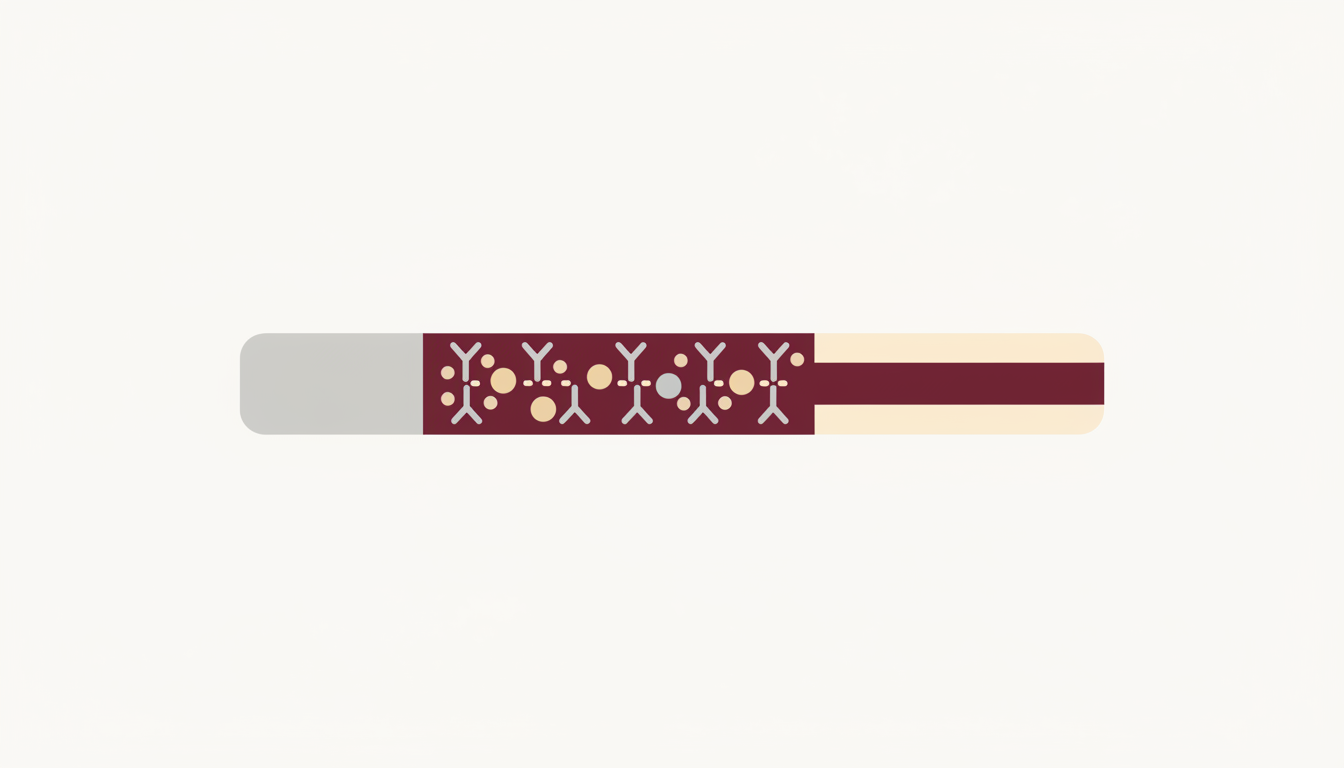
Almost every HIV test sold for home use is a lateral-flow immunoassay: a small disposable cassette that detects antibodies your immune system has produced against HIV. Some kits use a drop of blood from a fingerstick, others use a swab of oral fluid from inside your gum line. The cassette has a strip of paper coated with HIV antigens; if your sample contains matching antibodies, they bind to the strip and a colored line appears.
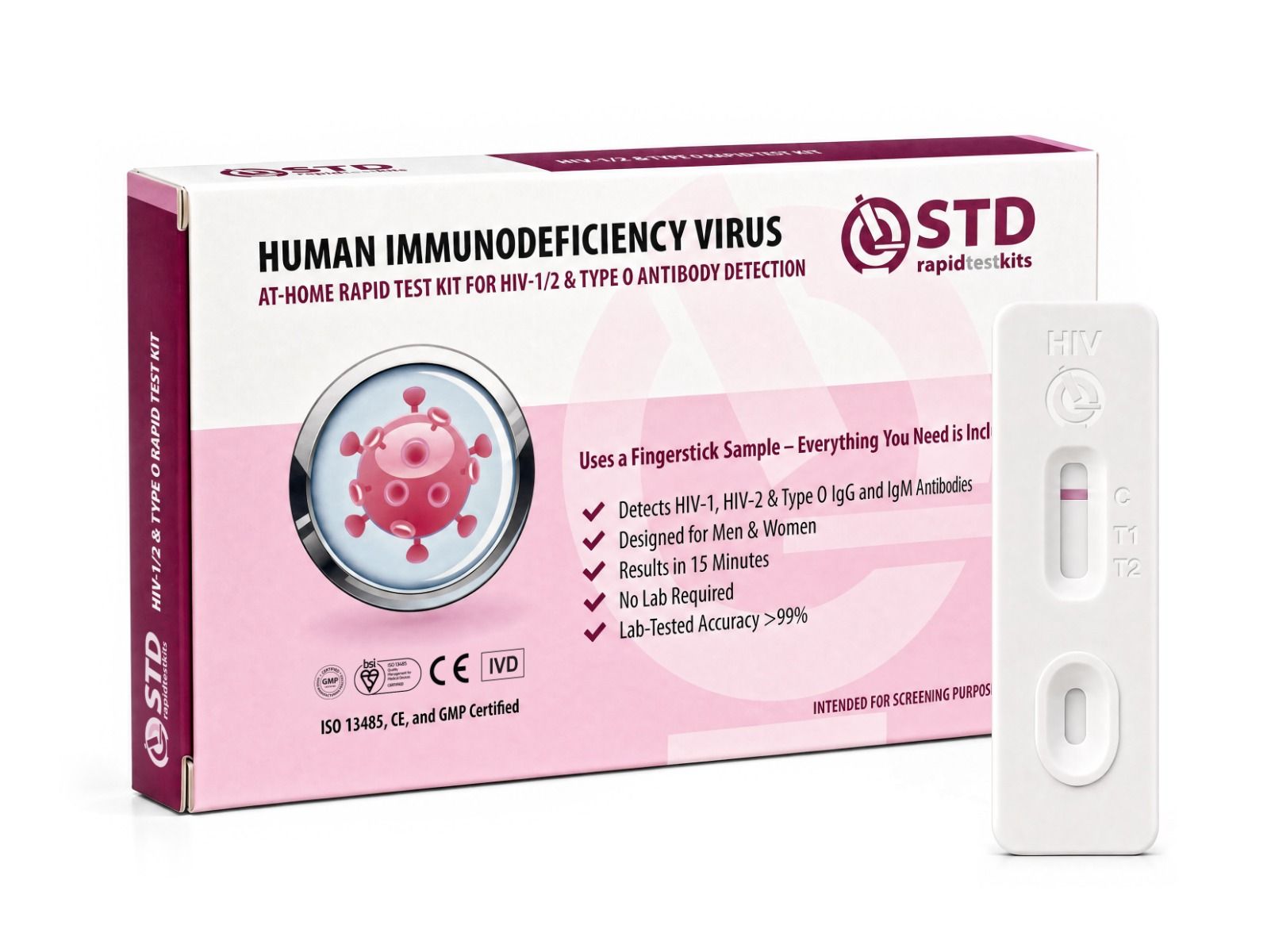
Two FDA-cleared at-home options are widely available in the United States. The OraQuick In-Home HIV Test, FDA-cleared for over-the-counter use, is an oral-fluid swab that gives a result in about 20 minutes. The Home Access HIV-1 Test System uses a fingerstick blood sample that you mail to a lab; results come back in a few days. Rapid fingerstick blood self-tests, including the kit we sell, sit between those two: blood sample, lateral-flow cassette, result on the cassette in about 15 minutes.
It helps to know what these tests are not. They are not the same as the laboratory antigen/antibody (so-called fourth-generation) test a clinic draws from a vein, and they are not nucleic-acid tests (NAT or PCR) that look for HIV's genetic material directly. Lab tests can find HIV earlier in an infection because they detect different markers. Rapid antibody home tests catch infection later but are still highly accurate once the window has passed.
The site you are reading sells a fingerstick blood antibody rapid test, not a urine, throat, or rectal sample test. If a clinician has asked you for a different sample type, see them or a sexual-health clinic; an antibody self-test will not substitute.
Window periods: when can a home test actually find HIV
The single most important fact about home HIV testing is the window period: the gap between exposure and the moment a particular test can reliably detect infection. Home rapid antibody tests have the longest window of the common test types because antibodies take weeks to form. Per the CDC's testing guidance, antibody tests can detect HIV between roughly 23 and 90 days after exposure, with the exact range depending on the test platform.
The practical implication is awkward: if you test the morning after a possible exposure and get a negative result, that result mostly tells you about exposures that happened months earlier, not last night. The kit cannot detect antibodies your body has not made yet.
Different test technologies close the gap by looking at different markers:
| Test type | Sample | Earliest reliable window | Where it is used |
|---|---|---|---|
| Antibody rapid, oral fluid (e.g., OraQuick) | Mouth swab | 23 to 90 days post-exposure | Home |
| Antibody rapid, fingerstick blood | Drop of blood from finger | 23 to 90 days post-exposure | Home or clinic |
| Antigen/antibody (fourth-generation) | Vein blood | 18 to 45 days post-exposure | Lab |
| Nucleic-acid test (NAT or PCR) | Vein blood | 10 to 33 days post-exposure | Lab, usually for high-risk exposures |
How accurate are at-home HIV tests
Two numbers matter here, and they describe different things. Sensitivity is how often a test correctly identifies someone who has HIV. Specificity is how often it correctly clears someone who does not. "Accuracy" used as a single number is imprecise and the figures floating around the internet ("99%", "over 99%", "more than 90%") usually conflate the two.
For FDA-cleared rapid antibody tests, the realistic ranges look like this. Blood-based rapid antibody tests, including the cassette format used in clinics and at home, typically report sensitivity in the high 99% range and specificity above 99% when used after the window period (per the kit's package insert; see our HIV home test product page for the figures cited by the manufacturer). The OraQuick oral-fluid self-test has historically reported a manufacturer-cited sensitivity of around 92% in field-use conditions and specificity above 99%, per the OraSure package insert that ships with the kit. Both versions are useful screens; blood draws are slightly more sensitive.
What does that 92% number really mean? Roughly, if 100 people with HIV took the OraQuick correctly and after the window, about 92 would test positive and about 8 would test negative anyway. A negative oral-fluid result after a known recent exposure is therefore not a complete reassurance; a follow-up blood-based test or a clinic visit is the next step.
The other half of the accuracy picture is what kind of mistake the test tends to make. False negatives during the window period are the dominant error mode for home tests. False positives are unusual but they happen, especially when the test runs in unusual conditions (high humidity, expired cassette, contaminated sample). That is why a positive home test is treated as a screening flag rather than a diagnosis: you need a confirmatory lab antigen/antibody panel or NAT before any treatment decision.
Home rapid lateral-flow tests are not the same technology as the NAT or fourth-generation lab tests used for diagnosis. They are complementary. The CDC's self-testing page describes self-tests as a tool to help more people learn their status in private, with clinical follow-up after any positive result.
Sensitivity = if you have HIV, will the test catch it?
Specificity = if you do not have HIV, will the test correctly clear you?
Accuracy as a single percentage glosses over which of those two failure modes is more likely. Home rapid antibody tests almost always have specificity above 99% (false positives are rare); their sensitivity depends on the sample type and on whether you have passed the window period.
Who benefits most from at-home testing
Home tests are most useful for people who would otherwise delay or skip testing. The CDC recommends at least one HIV test for everyone aged 13 to 64 as part of routine care, annual testing for people with ongoing risk factors, and testing every 3 to 6 months for people in the highest-risk categories. The bottleneck is not the recommendation; it is access and discomfort with in-person testing.
People who clearly benefit from home testing:
- Anyone reluctant to visit a clinic. Stigma, scheduling, geography, immigration status, or simple privacy concerns all prevent people from being tested. A home kit removes the friction.
- People with multiple sexual partners or a new partner. A baseline test before unprotected sex with a new partner is one of the highest-yield uses of home testing.
- Men who have sex with men, sex workers, and people who inject drugs. CDC surveillance attributes the majority of new HIV diagnoses in the United States to male-to-male sexual contact (CDC HIV statistics). For these groups, frequent testing is part of standard prevention, and a home kit between clinic visits is a reasonable supplement.
- Partners of people living with HIV. Routine testing every 3 to 6 months is recommended even when the partner is on suppressive treatment.
- People in rural or testing-desert areas. If the nearest clinic is hours away, a mailed home kit removes a real barrier.
Home testing is not a substitute for a clinic when you have a recent high-risk exposure: post-exposure prophylaxis (PEP) needs to start within 72 hours and is dispensed by a clinician, not a kit. If you are inside that window, prioritize a clinic or emergency department over a home test.
Note: this site sells the at-home HIV test featured below; we recommend products by fit-for-purpose for the reader's situation, not commercial benefit. A fuller disclosure appears later in the article.
A home kit fits best when you want a baseline before sex with a new partner, when your last test was more than a year ago, when you cannot easily get to a clinic, or when you simply prefer to read your own result in private. It is not the right first move if you are within 72 hours of a high-risk exposure (go to a clinic or emergency department for PEP) or if you are already symptomatic with acute HIV signs (fever, swollen glands, rash within weeks of exposure), where a lab antigen/antibody or NAT test is more appropriate.
How to take the test correctly
The biggest source of unreliable home test results is procedure error, not the cassette. The instructions inside the box are the authoritative reference; what follows is the framing that helps most people get a clean run.
Read the leaflet before you start. Each brand has a slightly different sample volume, transfer step, and read-time window. Skimming, then realizing halfway through that you mis-timed the transfer, is the most common avoidable mistake.
Check the expiration and storage. Lateral-flow cassettes are sensitive to heat and humidity. A kit that lived in a hot car for a summer may not perform to specification. If the desiccant pouch is open or the cassette looks discolored, do not use it.
Wash and dry your hands first. For fingerstick blood tests, residual lotion, alcohol, or soap on your finger can interfere with the sample. Warm hands also bleed more easily; if your fingertips are cold, run them under warm water for 30 seconds before lancing.
Lance the side of the fingertip, not the pad. The side of the finger has fewer nerves and bleeds more readily. Use the lancet provided, do not reuse it, and squeeze gently to express the drop you need; vigorous milking can dilute the sample with tissue fluid and skew the result.
Time the read window precisely. Most rapid cassettes are designed to be read between roughly 15 and 30 minutes. Lines that appear after the window can be artifacts. Set a timer when you transfer the sample.
Do the test in good light, on a flat surface. Faint test lines are easier to misread under poor light. A kitchen counter with overhead lighting works fine.
Do not retest immediately if the first result is unclear. An invalid run (no control line) does mean you should retest, ideally with a fresh kit. A faint test line is not invalid; treat it as positive and follow up clinically rather than running a second kit hoping for a clearer result.
The most frequent procedure errors are: testing inside the window period and treating a negative as conclusive, reading the cassette outside the time window, sampling from a finger that is wet with alcohol or lotion, using a heat-damaged or expired cassette, and retesting on the same day after an unclear result instead of seeking a lab test. Each of these is fixable; pretending the result is reliable when it is not is the only outcome that causes harm.
What your result means and what comes next
Three result patterns are worth thinking through separately. Each leads to a different next step.
Negative result, no recent high-risk exposure. This is the most common outcome and the most reassuring, with a caveat: a negative result reflects what was true at the start of the window period, not what is true today. If you tested at day 23 after an exposure, you have not yet ruled out an infection that may still be seroconverting. The conservative repeat is a second test at 90 days post-exposure, or a lab antigen/antibody test sooner.
Negative result, recent or ongoing high-risk exposure. Treat the result as provisional. If you are inside 72 hours of a single high-risk exposure (condomless sex with an HIV-positive partner who is not on suppressive treatment, sharing injection equipment, occupational needlestick), see a clinician about post-exposure prophylaxis (PEP) regardless of what the home kit says. PEP only works if started early and the home test cannot tell you about an exposure your antibodies have not had time to react to.
Positive result. A positive home test is a screening flag, not a diagnosis. It needs to be confirmed by a lab antigen/antibody test or a NAT before any treatment decision. False positives on home rapid tests are uncommon but real, and confirmation is the standard of care everywhere. If your test is positive, three things help in order: contact a clinician within a few days for confirmation, take a breath because modern HIV treatment is highly effective and most people on consistent treatment achieve undetectable viral loads, and use the support resources that come with the kit if you want to talk to someone before the clinic appointment.
Modern care matters here. People diagnosed with HIV today, started on antiretroviral therapy promptly, often live near-normal lifespans and achieve undetectable viral loads that prevent sexual transmission to partners. The earlier the diagnosis, the better that trajectory. A confirmed positive result is genuinely the start of effective treatment, not a sentence.
HIV self-tests are a great way to learn your HIV status on your own time and in your own space.
Privacy, cost, and getting confirmatory care
Privacy is the dominant reason people choose home testing over a clinic, and it is genuine. Kits ship in plain outer packaging without identifying labels. Most do not require an account or insurance. The result is read by you, in your home, with no medical record entry unless you choose to bring it to a clinician.
Cost varies. In the United States, retail home HIV tests range from roughly $30 to $50 for a single rapid lateral-flow kit. Some local health departments distribute self-tests at no cost; the CDC's self-testing program runs a national initiative that has historically offered free kits by mail.
The piece that home testing cannot solve is confirmatory care. A positive home result needs to be confirmed in a lab before treatment starts, and the confirmation pathway looks different in different countries. In the US, options include a primary-care visit, a sexual-health clinic, an urgent care, or a federally funded community health center. Confirmatory testing is usually a venous blood draw run as a fourth-generation antigen/antibody test, with NAT as a follow-up if the antigen/antibody result is reactive. Treatment, when needed, starts after confirmation and is highly effective.
If you are uninsured, ask the testing clinic about Ryan White HIV/AIDS Program funding (US) or the equivalent national program; HIV care is one of the few US health categories with reliable safety-net funding. The NHS in the United Kingdom and most European public health systems offer free confirmatory testing and treatment regardless of immigration or insurance status.
This article is published by stdrapidtestkits.com, which sells at-home STI testing kits. We recommend products based on fit-for-purpose for the reader's concern, not commercial benefit.
Where to take a positive home result for lab confirmation in the United States:
- Primary-care provider: best if you already have one and want continuity of care.
- Sexual-health or STI clinic: often free or low-cost; experienced with same-day confirmatory draws.
- Urgent care: faster than primary care if you cannot get a same-week appointment.
- Federally Qualified Health Center (FQHC) or community health center: sliding-scale fees; care available regardless of insurance status.
- Local health department: many run free HIV testing and linkage-to-care programs.
If you are uninsured, ask any of the above about Ryan White HIV/AIDS Program funding for follow-up care.
Frequently asked questions
- How accurate are at-home HIV tests really?
- FDA-cleared rapid antibody self-tests have specificity above 99% (false positives are rare) and sensitivity that depends on sample type: about 92% for oral-fluid tests and in the high 99% range for blood-based tests, when used correctly and after the window period. The number people quote as a single "accuracy" figure usually conflates those two.
- How long after a possible exposure should I test?
- For rapid antibody home tests, the CDC's range is 23 to 90 days post-exposure. Testing earlier than 23 days risks a false negative because antibodies have not fully developed yet. If you need an earlier answer, a lab antigen/antibody (fourth-generation) test or a NAT can detect infection sooner: roughly 18 to 45 days for antigen/antibody and 10 to 33 days for NAT.
- I had an exposure last night. Should I test now?
- Not yet, with one exception. A test taken hours after exposure cannot detect that exposure. If your exposure was high-risk (condomless sex with an HIV-positive partner not on suppressive treatment, shared injection equipment, occupational needlestick), see a clinician about post-exposure prophylaxis (PEP) within 72 hours. PEP works only if started early. After that, plan your home or clinic test for at least 23 days post-exposure.
- What do I do if my home test is positive?
- Treat it as a screening flag, not a diagnosis. Contact a clinician within a few days for a confirmatory lab test (fourth-generation antigen/antibody, with NAT if needed). False positives are uncommon but real, and treatment decisions are made on confirmed lab results. Modern HIV treatment is highly effective; people diagnosed today and started on therapy promptly often live near-normal lifespans.
- What if I test negative but still feel uncertain?
- If you are still inside the window period for your test type, retest at the end of that window. If you are past the window and the result was negative, the test has done its job for that exposure. Persistent worry that is not resolved by repeat testing is itself worth talking through with a clinician or a counselor; sexual-health clinics and HIV hotlines have staff trained for this.
- Are oral-fluid tests as good as blood tests?
- Both are FDA-cleared and useful, but they are not identical. Blood-based rapid tests have higher sensitivity (catch a few more true positives) than oral-fluid tests. Oral-fluid tests are easier to take and trade a small amount of sensitivity for that ease of use. If you want the strongest possible single-test answer at home, choose a blood-based kit; if barriers to a fingerstick are the limiting factor, an oral-fluid test is still a reliable screen.
- How often should sexually active adults test for HIV?
- The CDC recommends at least one HIV test for everyone aged 13 to 64 as part of routine care. People with ongoing risk factors should test annually. People in the highest-risk categories (men who have sex with men with multiple partners, people who inject drugs, sex workers) often test every 3 to 6 months. The right cadence is the one that matches your actual exposures, not a one-size number.
- U.S. Centers for Disease Control and Prevention. HIV testing overview, types of tests, and window-period guidance for antibody, antigen/antibody, and nucleic-acid tests.
- U.S. Centers for Disease Control and Prevention. Self-testing for HIV at home, programmatic guidance and follow-up steps after a positive result.
- U.S. Centers for Disease Control and Prevention. HIV statistics and surveillance data, including diagnoses by transmission category in the United States.
- HIV.gov (U.S. Department of Health and Human Services). HIV testing overview covering self-tests, the FDA-cleared rapid oral-fluid self-test (OraQuick), window periods by test type, and follow-up after a reactive result.
- World Health Organization. HIV/AIDS fact sheet covering global testing recommendations, transmission, and treatment.
- UK National Health Service. HIV and AIDS diagnosis guidance, including testing types, confirmatory pathways, and free testing access.