Published: July 2025 | Last updated: May 2026 | Editorial review and quality control: Martina N.
A positive line on an at-home HIV test is one of the most disorienting moments a person can have alone at a kitchen table. Before anything else, here is the most important thing to know: a home result is a screening result, not a diagnosis. The U.S. Centers for Disease Control and Prevention treats every reactive at-home test as a preliminary finding that must be confirmed by laboratory testing before it counts as an HIV diagnosis (CDC HIV testing guidance).
This guide walks through the next 24 hours, the next two weeks, and the long arc that follows. It explains what confirmatory testing actually looks like, how soon antiretroviral therapy can start, why the science behind Undetectable = Untransmittable changes what a positive result means today, and how to handle disclosure, work, insurance, and your own emotional bandwidth without losing yourself in the process.
Key Takeaways
- A positive at-home HIV test is a screening result. It must be confirmed by a lab-based blood test before it becomes a diagnosis.
- Modern antiretroviral therapy can drive HIV to undetectable levels within months, and an undetectable viral load means the virus cannot be transmitted sexually.
First, breathe. Then verify what the result is telling you
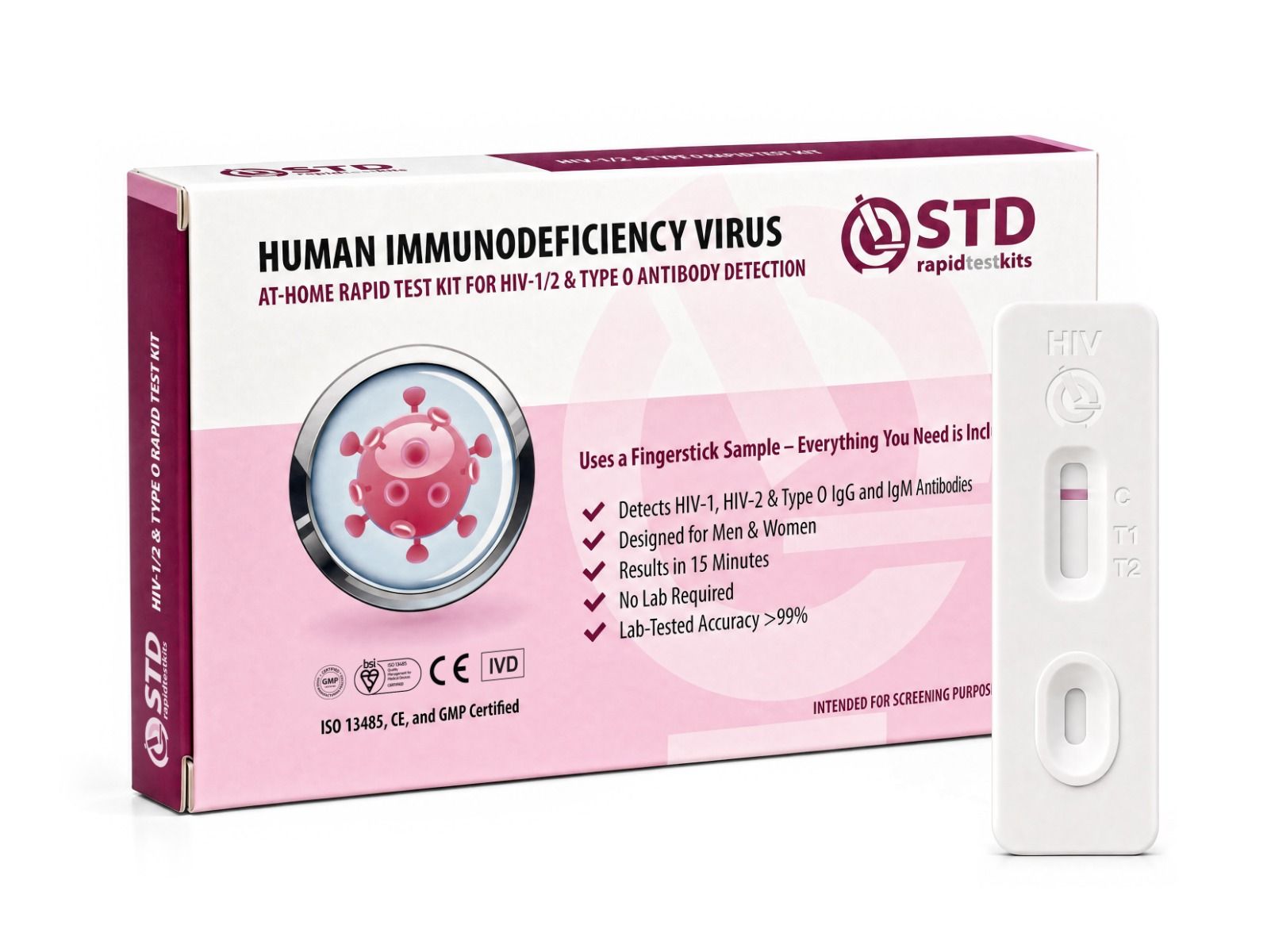
At-home HIV tests fall into two practical categories, and the difference matters for how to read your result. The oral-fluid OraQuick In-Home HIV Test is an antibody-only rapid test that reads results in roughly 20 minutes from a gum-swab sample, and the FDA-approved labeling instructs every user with a reactive result to follow up with a clinician for confirmatory testing (CDC HIV self-testing guidance). Mail-in collection kits send a fingerstick blood sample to a CLIA-certified lab that runs a fourth-generation antigen-antibody assay, with results typically returned within several business days.
Both approaches are useful screening tools, and both have known limits. The oral test has a small but real false-positive rate, which is why the manufacturer labeling tells every reactive user to follow up with a clinic-based confirmatory test before treating the result as a diagnosis. The mail-in lab tests have higher analytical sensitivity but still depend on a confirmatory algorithm before a positive becomes a diagnosis. Neither test, on its own, is the end of the conversation.
A note on window periods. Antibody-based at-home tests rely on the body having produced detectable HIV antibodies, which typically takes 23 to 90 days after exposure. A negative result during that window does not rule out infection, and the test should be repeated outside the window. A reactive result, by contrast, calls for confirmation regardless of where you are in the timeline.
Two practical things matter in the first hour after a positive: do not panic, and do not dismiss the result. False positives are uncommon, true positives are treatable, and the path forward in either case starts with the same step. That step is getting a confirmatory test scheduled today or tomorrow, not next week.
A reactive at-home test means the assay detected something consistent with HIV exposure: antibodies, antigens, or both. It does not yet distinguish between true infection, a cross-reactive antibody response to another condition, or a manufacturing or sampling artifact. The confirmatory algorithm exists specifically to separate those possibilities cleanly.
Confirm the result with a lab-based test, ideally within days
After a reactive home result, the next step is a clinic-based confirmatory test. In the United States, the CDC recommends confirming any reactive HIV test with laboratory follow-up before treating it as a diagnosis (CDC HIV testing). The typical pathway is a fourth-generation antigen-antibody immunoassay on a venous blood draw, which detects both p24 antigen (a viral protein present early in infection) and antibodies to HIV-1 and HIV-2. If that test is reactive, the lab runs a supplemental antibody differentiation immunoassay to distinguish HIV-1 from HIV-2. If those results disagree, an HIV-1 nucleic acid (RNA) test, often called a viral load test, settles the question.
Most confirmatory results come back within 1 to 5 business days. Same-day rapid confirmatory testing is available at many sexual health clinics, public health departments, and federally qualified health centers, often at no cost to the patient.
Where to go for low-cost or free confirmatory testing:
- Your state or county health department’s STI clinic. Search the CDC GetTested locator by ZIP code.
- A Planned Parenthood health center, which offers sliding-scale HIV testing and same-day linkage to care.
- A Ryan White HIV/AIDS Program clinic, which provides free HIV care to uninsured and underinsured people regardless of income.
- An LGBTQ+ community health center such as Whitman-Walker, Howard Brown, Callen-Lorde, or your regional equivalent.
- Your primary care provider, if you have an established relationship with one.
Practical tip: bring the at-home test packaging or a photo of the result window if you can. It helps the clinician document what was used and choose the right confirmatory pathway on the first visit.
What should I do in the first 48 hours after a positive at-home HIV test?
Schedule a confirmatory lab test as soon as possible at a sexual health clinic, your county health department, Planned Parenthood, or a Ryan White program site. Most return results in 1 to 5 days. Do not start, stop, or take anyone else’s antiretroviral medication before confirmation. If the lab test confirms HIV, the same clinic can usually begin antiretroviral therapy at the same visit, which the CDC calls starting treatment as soon as possible after diagnosis.
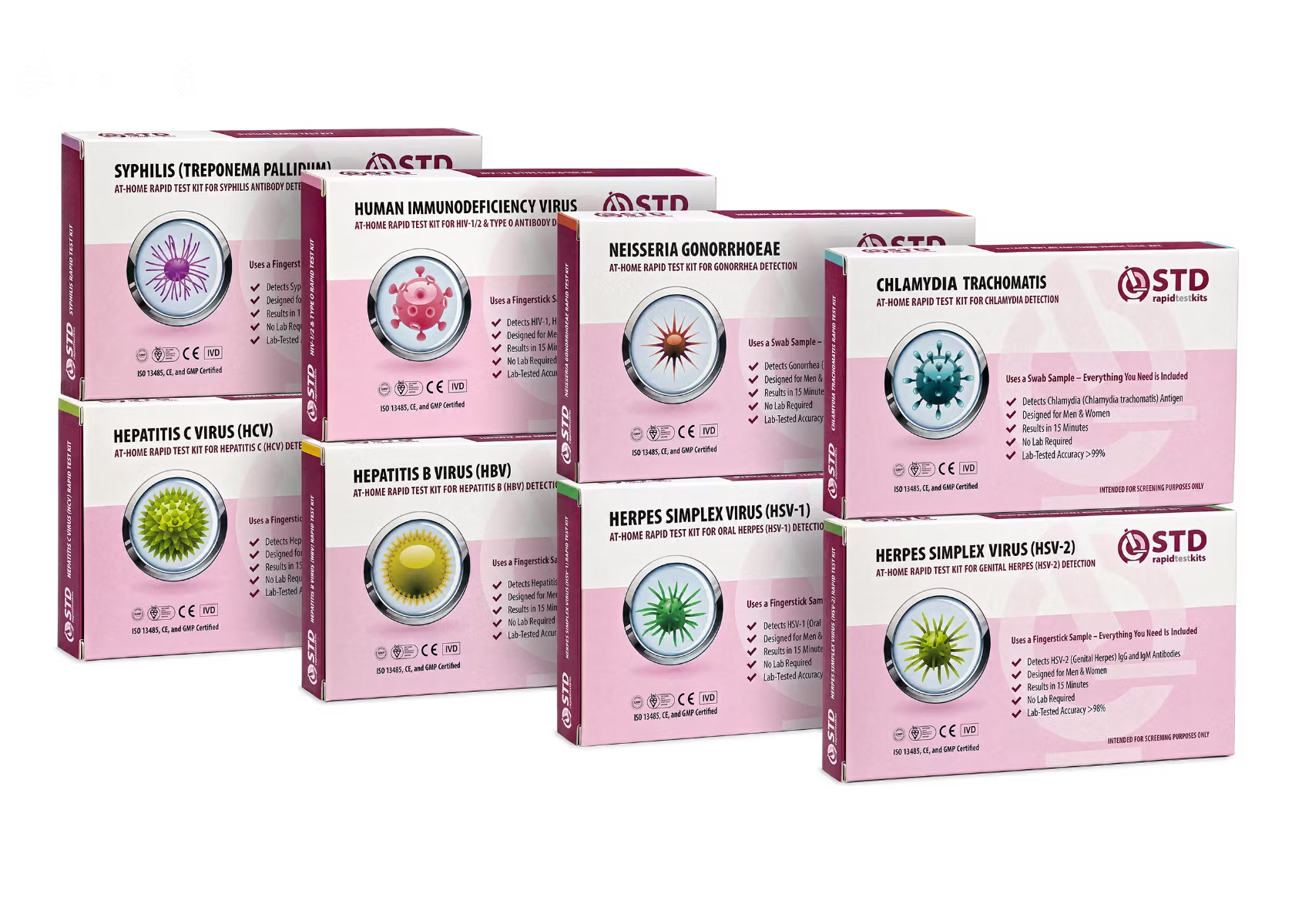
stdrapidtestkits.com publishes this article and also sells rapid at-home STI testing kits. The kits linked below are our own products. We recommend tests based on fit for the reader’s concern, not commercial benefit.
Starting antiretroviral therapy: as soon as possible after diagnosis
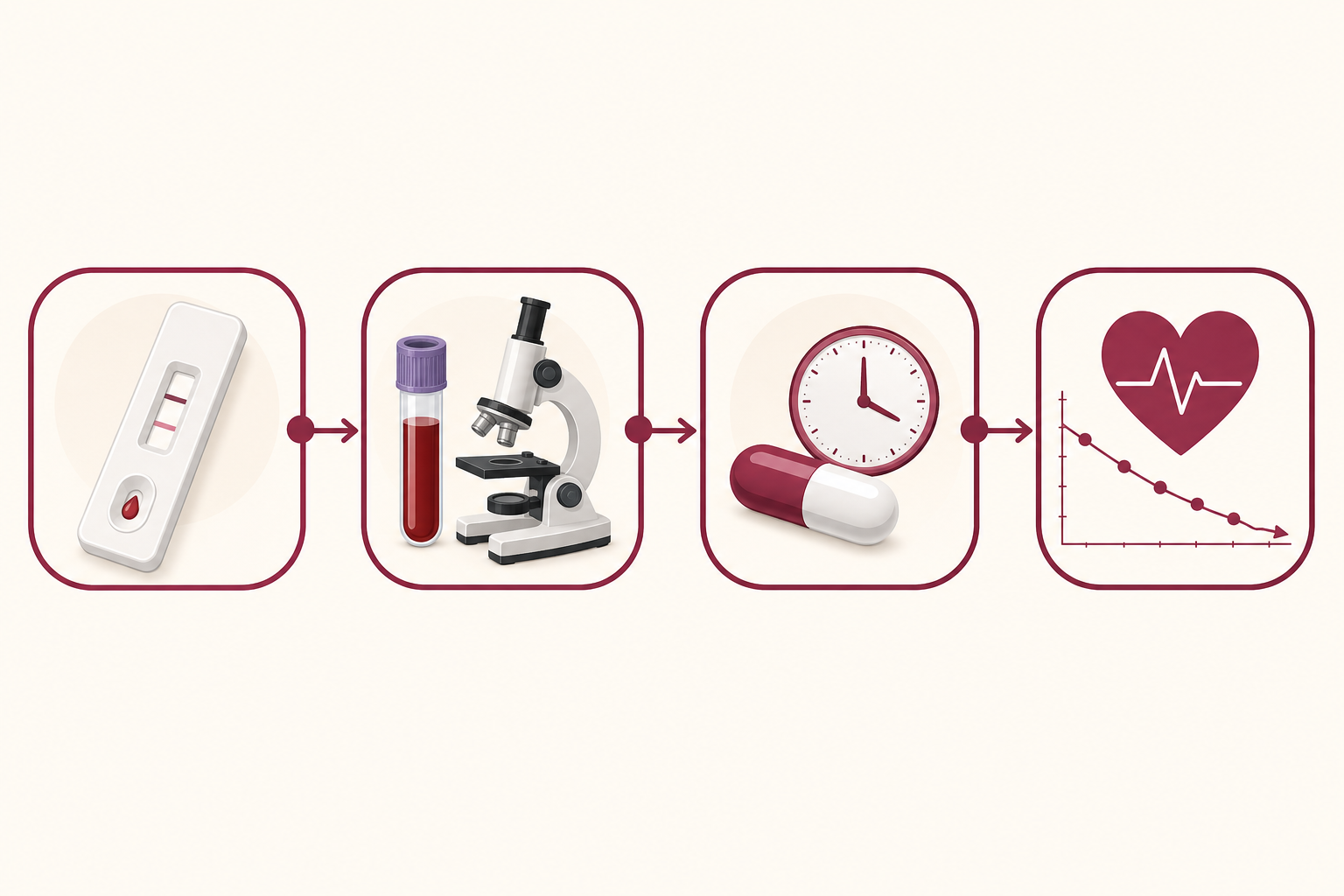
If the confirmatory test verifies HIV, the next question is when to begin antiretroviral therapy (ART). U.S. public-health guidance is clear: start as soon as possible after diagnosis, often on the same day where clinically feasible (NIH HIVinfo: HIV treatment basics; CDC Treating HIV). The rationale is straightforward. Earlier treatment preserves immune function, reduces the size of the viral reservoir, lowers onward transmission risk, and is associated with better long-term health outcomes.
What ART actually is, in plain terms: a daily combination of antiretroviral medications, often co-formulated into a single tablet, that blocks HIV from replicating. Most newer regimens are well tolerated. Common starting regimens include integrase-inhibitor-based combinations such as bictegravir/emtricitabine/tenofovir alafenamide or dolutegravir-containing tablets. Long-acting injectable ART, given every one or two months in a clinic, is now an option for people who are already virally suppressed and who prefer not to take a daily pill.
What to expect in the first months on ART:
- Most people see viral load drop substantially within 4 to 12 weeks.
- Undetectable viral load (typically defined as fewer than 200 copies per milliliter, often fewer than 20) is achieved by the majority of people within 3 to 6 months of starting effective ART.
- Side effects are usually mild and transient. Common ones include short-term gastrointestinal upset or headache. Persistent side effects are a reason to switch regimens, not to stop therapy.
- Routine bloodwork (CD4 count, viral load, kidney and liver function) is done every 3 to 6 months once you are stable.
Insurance, cost, and access: the federal Ryan White program and state AIDS Drug Assistance Programs (ADAP) cover ART for uninsured and underinsured people. Manufacturer patient-assistance programs cover the copay for many privately insured patients. Cost should not be a barrier to starting, and your clinic’s social worker or care navigator is the right person to help solve it.
Telling partners: timing, method, and what is legally required
Partner notification is one of the heaviest parts of an HIV diagnosis, and it is also one of the most important. Recent sexual partners may have been exposed and deserve the chance to test, start post-exposure prophylaxis (PEP) within 72 hours if applicable, or begin pre-exposure prophylaxis (PrEP) going forward. There is no single right way to disclose, but there are practical principles that consistently lead to better outcomes.
A few principles that hold up across most situations:
- Wait for confirmation. Disclosing a screening result that turns out to be a false positive is emotionally expensive for everyone. Confirmatory test first, disclosure after.
- Choose a setting where you feel safe. In person works for some relationships. A phone call, a secure messaging app, or a video call is equally valid. Public settings are appropriate when safety is a concern.
- Keep the message short and factual. A simple opening like “I recently learned I am HIV-positive, and I wanted you to have that information so you can get tested if you want to” gives the other person the facts without forcing a script on either side.
- Offer resources. Share where to test, what PEP and PrEP are, and that effective treatment exists. Treatment knowledge changes how people react.
- Use partner-services support if direct contact feels unsafe. Every state health department offers free, confidential partner-notification services that contact partners anonymously on your behalf. Ask your clinic to refer you, or contact your state HIV program directly.
On disclosure laws: a minority of U.S. states still have HIV-specific criminal laws that can apply to non-disclosure before sex. These laws vary widely and many have been modernized in the past five years. If you are uncertain about your state, the Center for HIV Law and Policy maintains a state-by-state map, and Lambda Legal can refer you to local counsel. Disclosure is most importantly a question of care and respect; the legal piece is real but secondary to that.
Every U.S. state health department runs a free Disease Intervention Specialist (DIS) program that will contact your sexual partners on your behalf without naming you. The service is confidential, no-cost, and available regardless of immigration status. Ask any HIV testing clinic to refer you, or contact your state HIV/STI program directly. Tools like TellYourPartner.org provide a similar option through anonymous messaging.
Processing the emotional weight: grief is appropriate, shame is not
An HIV diagnosis is a real loss to grieve. People often describe an initial period of shock, numbness, or compressed time, sometimes followed by anger, fear, or sadness about the body or future they had imagined. None of these reactions are signs of weakness, and none of them are permanent.
Common emotional reactions in the first weeks:
- Shock and disbelief, sometimes alternating with hyperfocus on logistics like scheduling and insurance.
- Anger, at a partner, at a system that did not protect you, or at the timing.
- Shame or self-blame. This is a learned response to decades of stigma. HIV is a viral infection. The moral framing attached to it has accumulated over decades of stigma and bears no relationship to the underlying biology.
- Grief for the body, identity, or future you had pictured, which often softens once treatment is going and the body feels stable again.
- Isolation, especially in the days before telling anyone. Connection with even one trusted person tends to dissolve this quickly.
What helps, based on patient-reported research and peer-support program outcomes: talking to someone within the first week, ideally a counselor familiar with HIV or a peer who has been diagnosed and is now in care; sticking with the medication routine even when motivation dips; and limiting time spent reading dated material online. Much of the highly fear-inducing HIV content on the open web was written before modern ART and U=U. HIV care today looks nothing like the pre-2010 clinical picture most of that older content describes.
Useful starting points for peer and mental-health support: the Well Project (resources by and for women living with HIV), POZ.com community forums, the Positively Trans network, and any LGBTQ+ community health center with an HIV peer-navigation program. Therapists who list HIV or sexual health as an area of specialty can be filtered for on Psychology Today and Inclusive Therapists.
First-week support priorities
- Talk to one trusted person within the first week, ideally a peer who has been diagnosed and is now in care, or a counselor familiar with HIV.
- Avoid HIV content written before about 2010. Pre-ART, pre-U=U material describes a clinical reality that no longer matches modern care.
- Ask your clinic for a peer navigator or social worker. Many HIV programs include one as a standard part of the care team.
- Watch for signs you need clinical mental-health support, not just peer support: persistent low mood, sleep disruption, intrusive shame, withdrawal from people you usually rely on.
Finding a clinician who fits the rest of your life
Choosing the right HIV care provider is partly a clinical match and partly a relational one. The clinical floor is competence in current HIV care: an infectious-disease physician, an HIV specialist, a Ryan White program clinician, or a primary-care provider who has substantial HIV experience and current certification. The relational layer is whether you feel respected, listened to, and free to ask questions about medications, side effects, and your life outside the clinic.
Qualities worth looking for in an HIV provider:
- Experience caring for people in your demographic. For LGBTQ+, transgender, BIPOC, immigrant, or other underrepresented patients, a clinician with that lived patient base usually translates to better day-to-day care.
- Willingness to start ART quickly and explain options, not just dictate a single regimen.
- A clear answer when asked how they handle 24-hour questions or refills.
- A clinic with a care navigator, social worker, or case manager on staff. These roles handle insurance, ADAP enrollment, copay assistance, and a great deal of the logistical work.
You can and should switch providers if one does not feel right. Continuity of care matters, but a provider who makes you reluctant to come in is a barrier to that continuity. Your clinic’s scheduler can usually facilitate a transfer without a gap in medication.
Checklist for evaluating a new HIV provider
- Substantial current HIV caseload or specific HIV-care certification.
- Comfort with your demographic (LGBTQ+, transgender, BIPOC, immigrant, or other) reflected in clinic staffing and intake forms.
- Willingness to start ART quickly and discuss regimen options instead of dictating one.
- On-staff care navigator, social worker, or case manager who handles insurance and ADAP.
- Clear after-hours and refill protocol, communicated up front.
Your rights: privacy, work, insurance, and immigration
HIV status carries broad legal protections in the United States, though they are not always common knowledge. Knowing what applies to your situation is part of protecting yourself. The federal framework spans medical privacy, employment, insurance, safety-net care, and immigration. Two organizations cover legal questions nationally: Lambda Legal’s HIV Project and the Center for HIV Law and Policy. Both offer free consultations and referrals (HHS Office for Civil Rights, HIPAA; ADA.gov).
| Protection | What it covers | Where to read more |
|---|---|---|
| HIPAA | Your HIV status is protected health information. Clinicians and insurers cannot share it without your authorization except in a narrow set of public-health and legal circumstances. | HHS Office for Civil Rights |
| Americans with Disabilities Act (ADA) | HIV is recognized as a disability. Employers, schools, and most public accommodations cannot discriminate based on HIV status. Reasonable accommodations are available where needed. | ADA.gov |
| Affordable Care Act (ACA) | Health insurers cannot deny coverage, charge more, or impose preexisting-condition exclusions because of HIV. | HealthCare.gov |
| Ryan White HIV/AIDS Program | Federal safety-net program funding HIV medical care, medications (through state ADAPs), and support services for uninsured and underinsured people, regardless of citizenship status. | HRSA Ryan White program |
| Immigration | The U.S. removed HIV from its inadmissibility list in 2010. HIV does not block entry, green-card applications, or naturalization. A small number of other countries still have entry restrictions. | USCIS, destination country guidance |
Undetectable equals untransmittable: what U=U means
Among the most consequential public-health findings of the past two decades is that people living with HIV who maintain an undetectable viral load on antiretroviral therapy do not transmit HIV sexually. The CDC endorses this position based on findings from the PARTNER, PARTNER2, and Opposites Attract studies, which together followed thousands of mixed-status couples over years with zero linked transmissions in the undetectable group (CDC, Treating HIV).
What “undetectable” means in practice: a viral load below the threshold of the laboratory assay, typically fewer than 200 copies of HIV RNA per milliliter of blood, with most assays reporting undetectable at fewer than 20 copies. This is what daily ART, taken as prescribed, is designed to achieve.
How most people get there:
- Start ART as soon as possible after diagnosis.
- Take the medication daily, on schedule. Modern single-pill regimens make this straightforward for most people.
- Check viral load every 3 to 6 months once stable.
- Address any side effects with your provider rather than self-stopping the medication.
People with HIV who take HIV medication as prescribed and get and keep an undetectable viral load have effectively no risk of sexually transmitting HIV to their HIV-negative partners.
Sex, dating, and intimacy after a positive result
Sex after diagnosis is possible, valid, and for most people becomes a settled question once treatment is going and viral load is suppressed. The science gives a clear floor: with an undetectable viral load, sexual transmission risk to partners is effectively zero. Many people find that the harder part is internal, working through what intimacy feels like in a body that just got new information about itself.
Practical guidance for the period between diagnosis and viral suppression:
- Use condoms or other barriers during this window, both to reduce HIV transmission risk while viral load is still detectable and to reduce risk of other STIs.
- Talk to partners about PEP (post-exposure prophylaxis, started within 72 hours of an exposure) and PrEP (ongoing pre-exposure prophylaxis) as options that further reduce their risk.
- Continue forms of intimacy that do not involve fluid exchange. Touch, oral connection, mutual pleasure, and emotional closeness do not pause because viral load is still in process.
On dating: HIV-positive people partner with HIV-negative people, with each other, and with people who do not know their own status. Apps such as Hornet, Grindr, and some general dating apps support optional HIV-status fields and information about U=U. Communities of people living with HIV, both online and in person, are large and active.
Building the support network around you
Care for HIV is medical, and it is also relational. The people most likely to do well long-term are not necessarily the ones with the easiest circumstances; they are the ones who built some combination of professional support, peer support, and practical scaffolding around their care.
- Peer networks: the Well Project, Positively Trans, POZ community forums, and any local AIDS service organization (ASO). Many regions have monthly HIV peer-support groups, free of charge.
- Hotlines: the CDC-INFO HIV line at 1-800-232-4636 for general guidance, the Trevor Project for LGBTQ+ youth, and Trans Lifeline for transgender callers in crisis.
- Mental health: a therapist familiar with HIV or sexual health, ideally covered by your insurance or available on a sliding scale through your clinic.
- Practical: a case manager or care navigator at your HIV clinic. This person handles insurance, ADAP, pharmacy logistics, and a great deal else.
Frequently Asked Questions
- How accurate are at-home HIV tests?
- The FDA-approved OraQuick In-Home HIV Test reports approximately 91.7 percent sensitivity and 99.9 percent specificity in clinical study conditions, per its FDA-approved labeling (see the FDA OraQuick information page). Sensitivity is lower than a laboratory blood test because oral-fluid antibody concentrations are lower than blood antibody concentrations. Per CDC guidance, every reactive home test result must be confirmed by a laboratory-based test before it counts as a diagnosis.
- Can an at-home HIV test give a false positive?
- Yes. False positives are uncommon but possible, and they are the reason confirmatory lab testing is required. A reactive result on an oral or fingerstick rapid test is treated as a screening signal, not a final answer. The CDC and FDA both build confirmation into the testing pathway specifically to filter false positives out.
- What is the first thing I should do after a positive at-home result?
- Schedule a confirmatory lab test at a clinic, county health department, Planned Parenthood, or a Ryan White program site. Most return results within 1 to 5 business days, and many offer same-day rapid confirmatory testing. Do not start, stop, or take anyone else’s antiretroviral medication before confirmation.
- How soon should I start HIV treatment if the result is confirmed?
- Current U.S. public-health guidance is to begin antiretroviral therapy as soon as possible after diagnosis, often on the same day where clinically feasible. Earlier treatment is associated with better long-term immune function and lower transmission risk.
- Is there a cure for HIV?
- Not yet. Modern antiretroviral therapy is highly effective, can drive the virus to undetectable levels, and is associated with near-normal life expectancy, but it is daily lifelong treatment rather than a cure. A small number of cure-related research cases exist, but no curative therapy is currently approved for general use.
- What does Undetectable = Untransmittable mean?
- U=U means that people living with HIV who take antiretroviral therapy and reach an undetectable viral load (typically below 200 copies per milliliter) do not transmit HIV through sex. The CDC endorses this position based on the PARTNER, PARTNER2, and Opposites Attract studies, which together documented zero linked sexual transmissions from undetectable participants.
- Do I have to tell my past sexual partners?
- Disclosure is strongly encouraged for partners’ health, and a minority of U.S. states have specific legal requirements around disclosure before sex going forward. If direct disclosure is not safe or comfortable, every state health department offers free, confidential partner-notification services that contact partners anonymously on your behalf.
- Will an HIV diagnosis affect my job, insurance, or ability to travel?
- HIV status is protected under HIPAA (privacy), the Americans with Disabilities Act (employment and public accommodations), and the Affordable Care Act (insurance coverage). The United States removed HIV from its immigration inadmissibility list in 2010. A small number of other countries still have entry or residency restrictions, so check your destination if you travel internationally.
- U.S. Centers for Disease Control and Prevention. HIV testing guidance, including at-home self-testing and the requirement to confirm reactive results.
- U.S. Centers for Disease Control and Prevention. Treating HIV: starting antiretroviral therapy and the evidence base for Undetectable = Untransmittable.
- National Institutes of Health, HIVinfo. HIV treatment basics, including when to start antiretroviral therapy after diagnosis.
- HIV.gov. General overview of HIV basics, prevention, testing, care, and the U.S. response framework.
- U.S. Department of Health and Human Services Office for Civil Rights. HIPAA medical privacy protections.
- U.S. Department of Justice. Americans with Disabilities Act overview, including coverage of HIV as a disability.
