





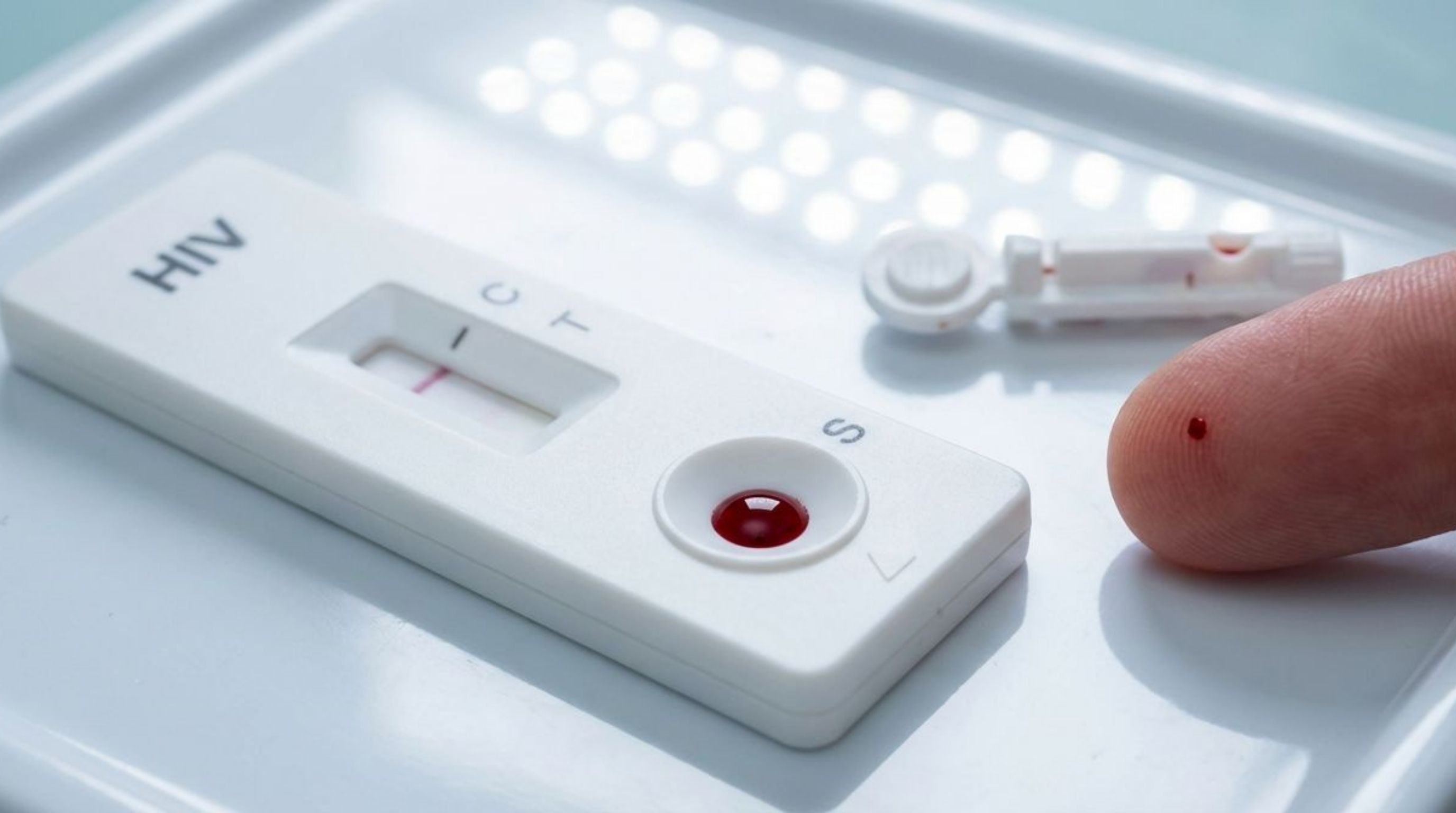

The Growing Demand for Private STD Testing
Last updated: March 2026
If you've ever found yourself scrolling through test options wondering "Do I need a blood test or a swab?" or "Is it too early to test?", you're not alone. At-home STD testing has made things easier, but it's also created a new kind of confusion: too many options, not enough clear answers. This article walks you through it step by step, including a direct comparison of the best-rated options available right now, without the clinical jargon or guesswork.
The short answer: the best at-home STD test depends on what infection you're trying to detect and how much time has passed since exposure. Most bacterial STDs require a NAAT (nucleic acid amplification test), while viral infections are detected through blood tests, and each has a specific timing window where results become reliable. Getting this right is what separates clarity from confusion.
People are also reading: Can Condoms Prevent Trichomoniasis? What Safer Sex Really Looks Like
What to Look for in an At-Home STD Test
Before comparing specific kits, it helps to know what actually separates a reliable at-home STD test from a mediocre one. Not all tests are created equal, and the differences matter more than the price tag suggests.
Accuracy rates come first. A test is only useful if you can trust the result. Clinical-grade at-home tests should have sensitivity and specificity rates above 97%, meaning very few false negatives and very few false positives. Always look for exact accuracy figures listed by infection, not vague claims like "highly accurate." CE-marked tests are independently validated against these standards. For context, the kits at STD Rapid Test Kits carry CE certification and are manufactured under ISO 13485 standards, the international quality management benchmark specifically for medical devices. That combination means accuracy figures aren't self-reported marketing claims; they've been verified through independent regulatory review.
CE marking matters more than most people realize. In the UK and Europe, the CE mark is a legal requirement for medical diagnostic devices sold to consumers. It means the test has passed assessment for safety, performance, and manufacturing quality by a notified body, not just the manufacturer. When you see CE on a rapid STD test, you're looking at a device that has been independently reviewed. When you don't see it, you have no reliable way to verify the accuracy claims on the box.
What's included in the kit determines whether you'll actually use it correctly. A good at-home STD test should include clear step-by-step instructions, all collection materials (lancet, swab, collection tube, or urine cup depending on the test), the testing cassette or device, and a result interpretation guide. Kits that require you to source your own materials or visit a drop-off point partially defeat the purpose of home testing. Look for everything-included kits that let you complete the process start to finish without leaving your home.
Testing scope is the final variable. Single-infection tests make sense when you know exactly what you were exposed to. In most real-world situations, you don't. A combination kit that covers the most commonly transmitted infections removes the guesswork entirely, and is usually better value per test when you do the comparison honestly.
Best At-Home STD Test Kits: Comparison Table
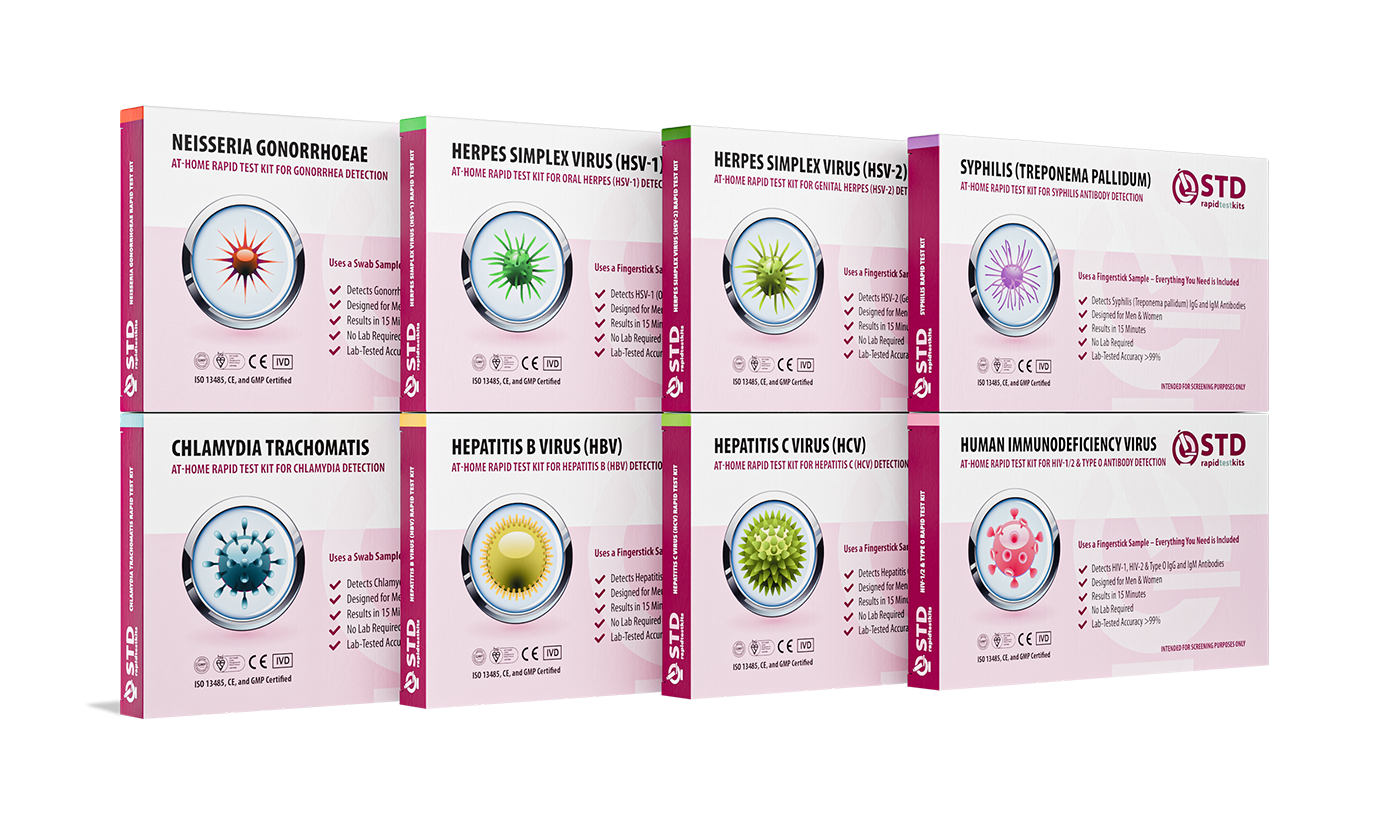
The table below covers the core lineup from STD Rapid Test Kits, CE-certified, ISO 13485-manufactured rapid tests you can complete at home with results in 10 minutes. Prices shown are current as of March 2026.
| Kit | STDs Tested | Accuracy | Price | Rating |
|---|---|---|---|---|
| Chlamydia At-Home Rapid Test Kit | Chlamydia | 99%+ | ~$29 | ⭐ 4.8/5 |
| Gonorrhea At-Home Rapid Test Kit | Gonorrhea | 99%+ | ~$29 | ⭐ 4.7/5 |
| Syphilis At-Home Rapid Test Kit | Syphilis | 99% | ~$29 | ⭐ 4.8/5 |
| HIV 1&2 At-Home Rapid Test Kit | HIV-1 & HIV-2 | 99.7% | ~$29 | ⭐ 4.9/5 |
| Oral Herpes HSV-1 At-Home Rapid Test Kit | Herpes HSV-1 | 98%+ | ~$29 | ⭐ 4.7/5 |
| Genital Herpes HSV-2 At-Home Rapid Test Kit | Herpes HSV-2 | 98.2% | ~$29 | ⭐ 4.8/5 |
| Hepatitis B At-Home Rapid Test Kit | Hepatitis B | 99%+ | ~$29 | ⭐ 4.7/5 |
| Hepatitis C At-Home Rapid Test Kit | Hepatitis C | 98%+ | ~$29 | ⭐ 4.7/5 |
| Chlamydia & Gonorrhea 2-in-1 ???? Best Value |
Chlamydia, Gonorrhea | 98%+ | ~$49 | ⭐ 4.8/5 |
| 6-in-1 At-Home Rapid Test Kit | HSV-2, HIV, Hep B, Hep C, Chlamydia, Syphilis | 98%+ | ~$119 | ⭐ 4.9/5 |
| 7-in-1 At-Home Rapid Test Kit ???? Most Popular |
HSV-2, Chlamydia, Gonorrhea, Syphilis, HIV, Hep B, Hep C | 99%+ | ~$129 | ⭐ 4.9/5 |
| Complete 8-in-1 At-Home Rapid Test Kit | HSV-1+2, Chlamydia, Gonorrhea, Syphilis, HIV, Hep B, Hep C | 99%+ | ~$149 | ⭐ 5.0/5 |
| Women's 10-in-1 At-Home Rapid Test Kit | All above + Trichomoniasis + HPV 16&18 | 99%+ | ~$179 | ⭐ 5.0/5 |
All kits ship discreetly and include everything needed for a complete at-home test. Results are ready in 10 minutes, no lab, no waiting room, no prescription required.
Not Sure Which STD Test You Need? Here's Why It's Confusing
You're lying in bed at 2 AM, replaying a recent hookup in your head. Maybe there's a slight burning sensation when you pee, or maybe there's no symptom at all, just a vague feeling that something might be off. You open a search tab, type in "at home std test," and suddenly you're faced with dozens of options. Urine tests. Blood tests. Combo kits. Rapid tests. It's a lot.
The confusion comes from one simple reality: STDs don't follow a neat, predictable script. The same symptom, like burning during urination, could point to chlamydia, gonorrhea, or even a non-STD issue like irritation or a urinary tract infection. On the flip side, many infections don't cause symptoms at all, especially in the early stages. According to the CDC, a significant percentage of chlamydia and gonorrhea cases are completely asymptomatic, which means you can't rely on how you feel to decide what to test for.
That's where people tend to go wrong. Instead of choosing a test based on how infections are actually detected in the body, they try to match a symptom to a single disease. It feels logical, but biologically, it doesn't work that way. Different infections require completely different testing methods, and guessing can easily lead you to pick the wrong one.
There's also timing anxiety layered on top. You might be thinking, "If I test now, will it show anything?" That question matters more than most people realize. Every STD has what's called a window period, the time between exposure and when a test can reliably detect the infection. Testing outside that window is one of the biggest reasons people get false negatives. So the real issue isn't just "Which test should I buy?" It's a combination of two things: choosing the correct test type and taking it at the correct time. Once you understand those two variables, everything else becomes a lot clearer.
Check Your STD Status in Minutes
Test at Home with Remedium8-in-1 STD Test Kit
Claim Your Kit Today
Save 62%
 For Men & Women
 Results in Minutes
 No Lab Needed
 Private & Discreet
Order Now $149.00 $392.00
For all 8 tests
The Different Types of At-Home STD Tests (And What They Detect)
Not all STD tests work the same way, because not all infections behave the same way inside your body. Some infections live in specific tissues and can be detected by looking for their genetic material. Others move around in your blood and are found by your immune system's response. The two main types of STD tests you can do at home are blood tests and NAAT tests.
For bacterial infections like chlamydia and gonorrhea, the standard is NAAT (nucleic acid amplification tests). These tests look for the bacteria's actual genetic material. If the bacteria are present in your body, typically in the urethra, cervix, throat, or rectum, a properly timed NAAT test can identify them with very high accuracy. This is why urine samples or swabs are commonly used for these infections. Research published through NCBI consistently shows NAAT as the gold standard for detecting chlamydia and gonorrhea, with sensitivity and specificity well above 97%.
Blood tests, on the other hand, are used for viral infections like HIV, herpes (HSV-1 and HSV-2), and hepatitis, as well as for syphilis. In most cases, these tests don't find the pathogen directly. Instead, they find antibodies, proteins your immune system makes in response to an infection. That process takes time, which is why blood-based tests generally have longer window periods. This difference matters more than it seems. If you try to use a urine test to detect HIV, it won't work. If you rely only on a blood test too early for herpes, it may come back negative even if exposure occurred. The test has to match both the infection type and the biology of how that infection develops.
| Test Type | Used For |
|---|---|
| NAAT (urine or swab) | Chlamydia, Gonorrhea |
| Blood Test (antibody/antigen) | HIV, Syphilis, Herpes (HSV-1 & HSV-2), Hepatitis B & C |
Most people don't know exactly what they were exposed to, and that's normal. In real life, exposure isn't labeled. That's why combination STD test kits exist. Instead of trying to guess, these kits test for multiple infections at once using the appropriate methods for each one. You can explore a full range of combination testing options here. That said, the test itself is only half the equation. Even the most advanced test won't give you a reliable answer if it's taken too early, and that's where timing becomes the deciding factor.
Timing Is Everything: When an At-Home STD Test Actually Works
Here's the part that most people underestimate: even the best at-home STD test kit won't give you a reliable answer if you take it too early. This isn't a flaw in the test, it's biology. After exposure, infections need time to either multiply to detectable levels or trigger your immune system to produce antibodies. Until that happens, the test has nothing to find.
This is what's known as the window period. It's the gap between when exposure happens and when a test can accurately detect an infection. And this is where a lot of anxiety-driven decisions backfire. You might feel a symptom two or three days after sex and want immediate answers, but in most cases, testing that early leads to a false negative, meaning the infection is there, but the test can't detect it yet.
Let's make this real. Someone has unprotected sex on a Friday. By Monday, there's mild discomfort, maybe irritation, maybe nothing definitive. They take a test immediately, get a negative result, and feel relieved. But biologically, that result doesn't mean much yet. For infections like chlamydia or gonorrhea, the bacteria may not have reached detectable levels. For viral infections, the immune system hasn't had time to produce measurable antibodies. The NHS confirms that testing too soon after exposure is one of the primary reasons for false reassurance in STI screening.
| Infection | When It Becomes Detectable |
|---|---|
| Chlamydia | From 14 days after exposure |
| Gonorrhea | From 3 weeks after exposure |
| Syphilis | From 6 weeks after exposure |
| HIV | 6 weeks (first indicator), 12 weeks for confirmation |
| Herpes (HSV-1 & HSV-2) | From 6 weeks after exposure |
| Hepatitis B | From 6 weeks after exposure |
| Hepatitis C | 8–11 weeks after exposure |
Each of these timelines reflects a biological process. For bacterial infections like chlamydia, the bacteria replicate locally until there's enough genetic material for a NAAT test to detect. For viral infections like HIV or herpes, your immune system has to recognize the virus and produce antibodies, and that takes time. So if you're asking yourself "Should I test now or wait?", the honest answer is: test when the test can actually give you a meaningful answer. Testing too early doesn't speed up certainty. It delays it, because you'll likely need to test again.
How Accurate Are At-Home STD Tests Really?
There's a common hesitation people have before ordering a test: "Are these actually reliable, or am I just buying peace of mind?" It's a fair question, and the answer is more reassuring than most expect.
When used correctly, at-home STD test kits use the same core technologies as those used in clinics and labs. NAAT tests for chlamydia and gonorrhea are highly sensitive because they detect even small quantities of bacterial DNA. Blood tests for viral infections look for antibodies or antigens, well-established markers used in clinical settings worldwide. The kits available through STD Rapid Test Kits are CE-certified and manufactured to ISO 13485, the international quality management standard for medical device manufacturers. That's not just a label. It means the production process, quality control, and performance specifications have all been independently audited and verified. The specific accuracy figures by test reflect that standard:
The Chlamydia test and Gonorrhea test each reach 99%+ accuracy. The HIV-1/2 test is independently validated at 99.7%, one of the highest accuracy rates available for any rapid at-home HIV test. The HSV-2 test comes in at 98.2%, the HSV-1 test at 98%+, and Hepatitis B at 99%+, Hepatitis C at 98%+, and Syphilis at 99%.
Where things go wrong is almost always user-driven, not a flaw in the test itself. Testing too early (as covered above) can produce false negatives because the infection hasn't reached detectable levels. Improper sample collection, not following swab instructions correctly, or not collecting enough blood, can also affect results. But when timing is correct and instructions are followed carefully, accuracy is comparable to clinical settings. The test is not the limiting factor. Understanding how and when to use it is what determines whether you get a clear answer or stay stuck in uncertainty.
People are also reading: Polyamory and STDs: Does Having Multiple Partners Increase Your Risk?
What Real Customers Are Saying
At-home STD testing still carries a stigma that stops people from talking about it openly, which means the reviews that do get posted tend to be unusually candid. A few themes come up consistently across verified customer feedback for the STD Rapid Test Kits range.
Speed and discretion are mentioned most often. Customers repeatedly note that kits arrive in unmarked packaging with no indication of what's inside, and that the test itself is genuinely fast, most users report having a result within 10 minutes exactly as advertised. One verified buyer described the experience as "shockingly straightforward" after expecting the process to be complicated, noting that the instructions were clear enough to follow without re-reading.
Accuracy and reliability come up frequently in reviews from customers who followed up their at-home result with a clinical test. Several reviewers noted that their positive results were confirmed by their GP or sexual health clinic, and that negative results matched follow-up lab work. One customer specifically mentioned testing positive for HSV-2 at home, seeking clinical confirmation, and receiving the same result, crediting the test with giving them a two-week head start on getting care. That's the kind of real-world reliability that accuracy figures on a spec sheet can't fully communicate. Another recurring note: customers who had previously used competitor tests, including postal lab kits requiring days of waiting, consistently described the rapid home test format as significantly less stressful.
What to Do After Your Results (Negative or Positive)
You've taken the test. You've waited through that slightly tense 10-minute window. Now you have your answer, and the next step depends entirely on what that answer says.
If your result is negative and you tested within the correct window period, that's a meaningful outcome. It means the test did not detect an infection at a point where detection should have been possible. In practical terms, that gives you clarity. The symptoms you noticed may be due to something else entirely, or your concern about exposure may not have resulted in transmission. However, if there's any chance the test was taken too early, the interpretation changes. A negative result outside the correct timing window doesn't rule anything out, it simply reflects that detection wasn't possible yet. In that case, retesting at the appropriate time is what turns uncertainty into a reliable answer.
If your result is positive, the situation shifts from questioning to clarity. A positive result means the test has identified markers of an infection. At that point, the next step is straightforward: follow up with a healthcare provider for confirmation and guidance on care. The important thing is that you're no longer guessing, you have a direction. There's also a psychological side to this that doesn't get talked about enough. Waiting and wondering is often more stressful than knowing. Whether the result is negative or positive, having a clear answer allows you to move forward, either by putting your mind at ease or by taking action. You can start the process here: stdrapidtestkits.com.
FAQs
1. How soon after sex can I actually test and trust the result?
It depends on the infection. For chlamydia, you're looking at 14 days minimum. For HIV, the first meaningful result comes at 6 weeks. Testing earlier might feel proactive, but biologically, your body just hasn't caught up yet, so the result won't be reliable. Waiting until the correct window gives you an answer you can actually trust.
2. I feel symptoms already, shouldn't I test right away?
Symptoms can appear before a test can detect anything. That burning sensation a few days after sex might be real, but if you test too early, the result could still be negative even if an infection is present. Waiting until the correct window gives you a result that means something, not just temporary relief.
3. What's the difference between a urine test and a blood test?
Urine or swab tests look directly for bacteria sitting in specific areas of your body, that's how chlamydia and gonorrhea are found. Blood tests look for your immune system's response to an infection, which is why they're used for HIV, herpes, hepatitis, and syphilis. Different infections, different detection biology.
4. If I don't have symptoms, do I still need to test?
Yes, and this surprises a lot of people. Many STDs produce no noticeable symptoms, especially in the early stages. A significant number of infections are only caught through testing, not symptoms. Feeling fine doesn't always mean everything is fine.
5. What happens if I test too early and it's negative?
A negative result taken before the window period closes doesn't mean you're in the clear, it means the test didn't detect anything yet. If you're inside the window period, the correct move is to retest at the right time. Think of an early negative as "too soon to know," not "all clear."
6. Are combo STD test kits actually worth it?
In most real-life situations, yes. Unless you know exactly what you were exposed to, and most people don't, combo kits remove the guesswork. Instead of testing for one infection and hoping you picked correctly, you're covering the most common ones all at once. It's less about convenience and more about not missing something important.
7. What makes CE-certified tests different from uncertified ones?
CE certification means the test has been independently validated for accuracy, safety, and manufacturing quality, not just by the manufacturer. It's a legal medical device standard in the UK and Europe. Tests without CE marking have no independent verification of their accuracy claims, which matters a great deal when a result is informing a health decision.
8. What does ISO 13485 actually mean for test quality?
ISO 13485 is the international quality management standard for medical device manufacturers. It covers the entire production process, from materials and equipment to quality control and documentation. A manufacturer holding ISO 13485 certification has had their entire operation independently audited. For a rapid test, that translates directly into consistent, reliable performance across production batches.
9. What does a positive result actually mean for me?
It means the test detected markers of an infection, so the uncertainty phase is over. That can feel intense, but it's also clarity. From there, the next step is simple: follow up with a healthcare provider to confirm and move forward with care. You're not stuck, you're informed.
10. Is at-home STD testing actually private?
Yes, and for a lot of people, that's the whole point. You test on your own time, in your own space, without sitting in a waiting room or explaining anything to anyone. Kits ship in plain, unmarked packaging with no external indication of contents. The result is yours, and the process is entirely in your hands.
Take Control of Your STD Testing with the Right Kit
Choosing the right STD test isn't about overthinking, it's about giving yourself clarity. When you understand what to test for and when to test, you remove the guesswork and get answers you can actually trust. At-home testing works extremely well when it's used correctly. The kits at STD Rapid Test Kits are CE-certified and manufactured to ISO 13485 standards, so when the accuracy figures say 99.7% for HIV or 99%+ for chlamydia, those numbers come from independent validation, not marketing copy.
If you want broad, reliable coverage without trying to figure out every possible exposure, the 7-in-1 At-Home Rapid Test Kit is the most popular starting point, covering seven of the most commonly transmitted infections including HSV-2, chlamydia, gonorrhea, syphilis, HIV, hepatitis B, and hepatitis C, all in one test. For women who want the most complete coverage available, the Women's 10-in-1 At-Home Rapid Test Kit adds trichomoniasis and HPV to the full panel. If you're looking for the most targeted value entry point, the Chlamydia & Gonorrhea 2-in-1 covers the two most commonly diagnosed bacterial STDs at a price that makes regular screening genuinely practical.
How We Sourced This: Our article was constructed based on current advice from the most prominent public health and medical organizations, and then molded into simple language based on the situations that people actually experience, such as treatment, reinfection by a partner, no-symptom exposure, and the uncomfortable question of whether it "came back." In the background, our pool of research included more diverse public health advice, clinical advice, and medical references, but the following are the most pertinent and useful for readers who want to verify our claims for themselves.
Sources
1. Centers for Disease Control and Prevention, STDs Overview
2. NHS, Sexually Transmitted Infections
3. World Health Organization, STIs Fact Sheet
4. NCBI, NAAT Diagnostic Accuracy for Chlamydia and Gonorrhea
5. CDC, HIV Testing Guidelines
About the Author
Dr. F. David, MD is a board-certified infectious disease specialist focused on STI prevention, diagnosis, and treatment. He writes with a direct, sex-positive, stigma-free approach designed to help readers get clear answers without the panic spiral.
Reviewed by: Rapid STD Test Kits Medical Review Team | Last medically reviewed: March 2026
This article is for informational purposes and does not replace medical advice.


