
Published: November 2025 | Last updated: May 2026 | Editorial review and quality control: Martina N.
Polyamory often gets talked about like it's inherently risky, but that framing skips the science. This article unpacks what really shapes your STD risk, how transmission works across connected partners, and the practical steps that keep your sexual health under your control. If you've ever Googled symptoms after a new connection or quietly wondered whether your setup is "safe enough," you're in the right place.
Having more than one partner can raise the number of potential exposure points, but it doesn't automatically put you at high risk. What shapes risk is how infections move through a network, how often everyone tests, and whether barriers stay consistent. In many cases, someone in a well-run polyamorous setup carries less hidden risk than someone in an untested monogamous one.
Key Takeaways
- Number of partners is one factor, not the whole story. What matters is whether infections in your network get caught early through testing and blocked through barriers.
- A structured polyamorous setup with regular testing and open status sharing can carry less hidden risk than an untested monogamous one.
Does Polyamory Really Increase STD Risk, or Is That a Myth?
Most people start with the same assumption: more partners means more risk. It sounds logical, but it's incomplete. Your real STD risk depends on exposure pathways and whether infections have a viable chance to travel down them, not only on how many partners are in your life.
Picture this: you've started seeing someone new, and a few days later you're scrolling through symptom checkers wondering if you should test immediately. That moment of low-grade panic is incredibly common. But the real risk from that encounter depends on whether your partner currently has an active infection, whether protection was used, and whether testing has been part of the conversation.
From a biological standpoint, transmission needs a chain: an infection has to be present in one partner, transferred through a specific kind of contact, and successfully colonize the new body. If any one link in that chain is broken, whether by a barrier, by treatment, or by an already-cleared infection, nothing happens. So even with multiple partners, your real risk stays low when those chains get interrupted consistently.
This is where polyamory gets misunderstood. People assume it's chaotic and unstructured, when in practice many polyamorous networks are highly intentional about testing cadence, status sharing, and barrier use. That structure can lower unknown exposure compared with relationships where testing simply isn't discussed.
So yes, more partners can mean more potential exposure points. But "potential" is the keyword. Risk only becomes real when those exposures connect to an actual untreated infection and there's no barrier or testing system to catch it. Per the U.S. Centers for Disease Control and Prevention's STI prevention guidance, the main behavioral protections include consistent condom or barrier use, partner status communication, and routine screening.
An STI passes only when all three are present: an active infection in one partner, a contact route that suits that pathogen, and no interruption (no barrier, no treatment, no early detection). Break any one link and transmission stops. This is why relationship structure alone doesn't determine your risk.
How STDs Move Through Multi-Partner Networks
To understand risk in polyamory, you have to zoom out from "me and this person" and look at the bigger picture: networks. STDs move through connected groups, not just between two individuals. Researchers call this a transmission network, and it's the single most important concept for understanding your real exposure.
Say you have two partners. Each of them may have other partners. Your effective exposure isn't just those two people; it's everyone within a few hops of you in the network. The structure of that network matters more than its size.
If everyone in that network tests on a regular cadence and shares results, infections get caught early and pulled out of the chain before they propagate further. If no one tests, infections can spread silently. That gap is especially dangerous for chlamydia and gonorrhea, which often produce no early symptoms but remain transmissible.
The biological reason is straightforward. Bacteria like Chlamydia trachomatis and Neisseria gonorrhoeae replicate inside mucosal cells without immediately triggering a strong, noticeable immune response. So a person can carry and pass the infection on without ever feeling sick, sometimes for months. According to the World Health Organization's fact sheet on sexually transmitted infections, most STI cases worldwide are asymptomatic, which is why screening (rather than symptom-watching) is the prevention strategy that works.
Number of partners alone is therefore an incomplete picture of exposure. Someone with one untested partner may carry more hidden risk than someone with three partners who all test on a quarterly cadence and use barriers.
| Relationship type | Exposure pattern | Risk dynamics |
|---|---|---|
| Monogamous, no testing | Single partner, unknown status | Risk depends entirely on partner's hidden exposure history |
| Monogamous, tested | Single partner, confirmed status | Low risk when both partners test and remain exclusive |
| Polyamorous, unstructured | Multiple partners, inconsistent testing | Higher risk due to unknown transmission pathways |
| Polyamorous, structured | Multiple partners, regular testing and clear communication | Controlled risk with early detection and interrupted spread |
What Really Drives Risk Up (or Down) When You Have Multiple Partners
Once you understand transmission as a network problem, the next question becomes practical: what makes a difference? What pushes risk up, and what keeps it low?
Consistency matters more than perfection. Barrier use during sex (external condoms, internal condoms, dental dams for oral contact) reduces the chance that bacteria or viruses cross mucous membranes, which is where most STIs establish themselves. When barriers go on every time the relevant act happens, they interrupt transmission at the most critical moment. Per the CDC's STI prevention guidance, consistent condom use is a key behavioral protection against most STIs.
Testing is the second major factor, and most people underestimate it. The majority of STIs don't announce themselves. Chlamydia and gonorrhea can live in the reproductive tract for weeks while remaining transmissible. HIV, syphilis, and hepatitis can sit in the body for weeks to months before producing antibodies detectable on standard tests. Regular testing turns invisible risk into something you can act on. Catch an infection early in the cycle, treat or manage it, and the chain breaks before anyone else in the network is exposed.
Communication plays a larger role than most people realize. Knowing when your partners last tested, whether they've had new partners since, and what barriers they use with others creates a shared map of risk. Status sharing is about building that shared map, not about interrogating partners.
And then there's the moment a lot of polyamorous people know well: you notice something a little off, maybe a sensation, an unusual discharge, or a small sore, and your brain immediately runs to worst-case scenarios. The internet will happily tell you it's every infection at once. In reality, many such symptoms aren't STIs at all. But the only way to know is to test, not to guess.
If you're in a multi-partner setup, the most important shift you can make is moving from assumption to verification. Instead of wondering whether you might be at risk, you actively check. Consistent verification is what keeps risk controlled, even as your number of connections changes. This is also why at-home testing has become so practical for polyamorous people. It removes the friction of clinic scheduling, waiting rooms, and awkward conversations, and gives you clear answers on your own timeline.
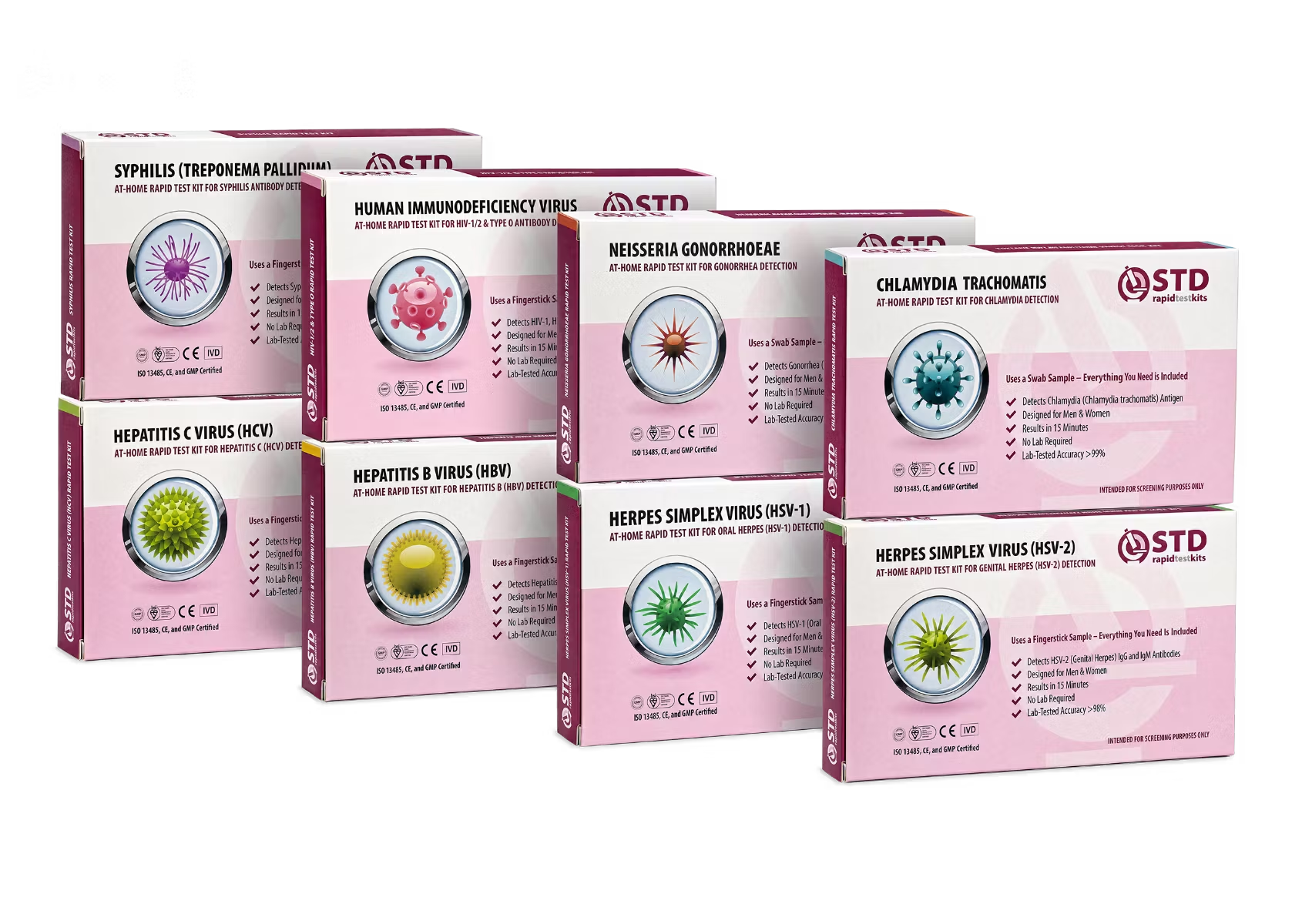
This article is published by stdrapidtestkits.com, which sells at-home STI testing kits. We recommend products based on what genuinely fits a reader's concern, not on commercial benefit. The lab-grade NAAT is still the diagnostic gold standard for bacterial STIs; at-home rapid tests are a useful, lower-friction screening layer worth confirming clinically on a positive.
STD Testing in Polyamory: What to Take, When to Take It, and What Results Mean
After a new partner, the instinct is to test immediately for peace of mind. But your body doesn't work on that timeline. Every STI has a biological "window period," which is the time it takes for the infection (or your immune response to it) to reach detectable levels.
If you test too early, the infection can be present in your body but invisible on the test. False negatives at this stage can lead to a falsely reassuring result and onward transmission. So instead of guessing, match the right test to the right timing.
Test type matters. Laboratory testing for chlamydia and gonorrhea uses nucleic acid amplification tests (NAATs), which detect bacterial genetic material directly and identify infections before symptoms start. NAATs are the laboratory standard recommended by the CDC for bacterial STI diagnosis.
At-home rapid tests for chlamydia and gonorrhea use lateral-flow chemistry on the same swab sample type a clinic NAAT uses. They're a useful screening layer for someone testing frequently between partners, and a positive result is worth confirming with a clinic NAAT when you can.
For viral infections (HIV, herpes, hepatitis B, hepatitis C) and for syphilis, testing relies on detecting either the pathogen itself or the antibodies your immune system produces against it. Antibody responses take time to build, which is the entire reason "window period" exists. The windows you need to follow are below.
| Infection | At-home sample type | Earliest reliable detection after exposure |
|---|---|---|
| Chlamydia | Self-swab (lateral flow) | 14 days |
| Gonorrhea | Self-swab (lateral flow) | 3 weeks |
| Syphilis | Fingerstick blood | 6 weeks |
| HIV | Fingerstick blood | 6 weeks first indicator; retest at 12 weeks for certainty |
| HSV-2 | Fingerstick blood (antibody) | 6 to 12 weeks |
| Hepatitis B | Fingerstick blood | 6 weeks |
| Hepatitis C | Fingerstick blood | 8 to 11 weeks |
How Often Should You Test If You Have Multiple Partners?
Most people want a clean rule, something like "test every three months and you're fine." Real life is more layered than that. Testing frequency should track new exposure, not a calendar number.
If you're adding partners regularly, your testing schedule should follow that pattern, with each new connection triggering its own round of tests at the right window. Think of testing as syncing to your sex life, not sitting passively on a fixed quarterly date.
Concretely: when you have a new partner and want clarity, you don't test immediately. You test at the appropriate detection point for each infection. If you continue to have new partners over time, a routine baseline (every three to six months) becomes your floor, with additional tests stacked on top for specific recent exposures.
There's a psychological side to this too. You might find yourself replaying a moment in your head, refreshing messages waiting for reassurance, or fixating on whether everything was "safe." Consistent testing eliminates that uncertainty. Instead of relying on memory or assumptions, you work with actual data.
Biologically, this matters because many infections are silent. Without testing, they can persist and spread through a network unnoticed. With testing, they get identified and removed from the chain. According to the CDC's guide to getting tested for STIs, sexually active people with multiple partners or new partners are recommended to screen at least annually for the major bacterial STIs, with more frequent testing (every three to six months) for higher-exposure scenarios.
The real question isn't "how often should you test?" It's: test often enough that no exposure goes unchecked past its detection window. Risk stays low when every exposure is covered by a properly timed test.
Can You Be "Low Risk" in Polyamory?
This is the question people don't always ask out loud, but it sits there in the background: is it possible to have multiple partners and still be genuinely low risk? Yes, but only if you understand what "low risk" really means.
Low risk doesn't mean zero exposure. It means you've reduced the probability that an infection can get into your body, multiply, and spread further. Three things have to work together: barriers, testing, and awareness of your network.
Picture a scenario where everyone in a connected group tests on a regular cadence, shares results openly, and uses barriers consistently. Even if an infection appears, it gets caught early and removed from the chain before it spreads further. Catching infections early in a tested network is how risk stays controlled with multiple partners.
Compare that to someone in a monogamous relationship where no one has tested in two years. If one partner had a pre-relationship exposure that never produced symptoms (which is common for HSV-2, HPV, and asymptomatic chlamydia), that infection can sit there silently and stay completely unnoticed. Biologically, that situation can carry more hidden risk than a well-managed polyamorous network.
When both you and your partners know your status, decisions are grounded in data, not assumption, and visibility becomes the deciding factor.
This is also where the stigma around polyamory tends to fall apart on closer inspection. Relationship labels don't determine risk. What determines it is whether infections have an uninterrupted path to spread, and that path can be blocked regardless of how the relationship is defined.
The Real Takeaway: It's Not About the Number of Partners
The pattern by this point: the number of partners you have influences exposure, but it doesn't define your risk by itself. What matters is what surrounds those connections.
STIs spread through opportunity, not assumptions. If there's an active untreated infection, no barrier, and no testing, transmission becomes likely. If any one of those elements is interrupted (barrier protection, regular testing, or early detection), the chain breaks.
This is why two people can have wildly different risk levels with the same number of partners. One person relies on assumptions and ad-hoc testing. The other builds a system: tests at the right times, communicates openly, uses barriers consistently. Biologically those are two very different environments for an infection to spread in.
A huge portion of STI anxiety comes from uncertainty, not actual infection. The spiral of checking symptoms, replaying encounters, wondering if something feels "off," usually comes from not knowing your status with certainty.
Testing cuts through that. It replaces speculation with a clear answer, which is why it functions as both a safety measure and a mental reset.
If you're navigating polyamory, the most useful shift you can make is this: stop thinking in terms of "how many partners is too many," and start thinking in terms of "how controlled is my system?" That's the question that determines your risk. Polyamory doesn't automatically raise your risk. Uncertainty does, and testing is how you eliminate it.
Talking with sex partners about STDs and using condoms the right way every time you have sex are critical first steps to staying healthy.
FAQs
- Does having multiple partners automatically mean higher STD risk?
- Not automatically. It means more potential exposure points, not more confirmed risk. What matters is whether infections in your network are caught early through testing and blocked through barriers. Someone with one untested partner can carry more hidden risk than someone with three partners who all test regularly.
- How often should I test if I'm seeing multiple people?
- Match your testing to your real exposure pattern, not a fixed calendar date. After a new partner, wait for the right window period for each infection before testing. If you have multiple ongoing connections, a routine three-to-six-month baseline plus additional tests after specific exposures is a workable floor.
- Can STDs really spread if no one has symptoms?
- Yes, and this surprises people. Chlamydia and gonorrhea both often produce no early symptoms while remaining transmissible. Per CDC and WHO guidance, most STI cases worldwide are asymptomatic, which is precisely why screening rather than symptom-watching is the recommended prevention strategy.
- Is one untested partner riskier than several tested partners?
- Often yes. One unknown is functionally worse than several knowns. With untested partners you're relying on assumptions about exposure history. With tested partners you're working from actual data.
- When should I test after sleeping with a new partner?
- Window periods exist because your immune system or the pathogen needs time to reach detectable levels. Testing before the window closes can produce a false negative even if you are infected. The practical windows: chlamydia 14 days, gonorrhea three weeks, HIV six weeks with a retest at twelve, syphilis and hepatitis B six weeks, hepatitis C eight to eleven weeks.
- What does a negative STD test actually tell me?
- That no infection was detected at that moment. If you tested after the correct window period, that's a reliable answer. If you tested before the window closed, it's a "not yet detectable" result, which is different from "you're in the clear."
- Do condoms completely eliminate STD risk?
- They lower risk substantially but not to zero. They work well at keeping fluids from crossing the genital, anal, or oral mucosa, which prevents most bacterial and viral transmission via those routes. Skin-to-skin infections like herpes and HPV can still transmit from areas the condom doesn't cover. They're a strong protective layer, not the only one.
- U.S. Centers for Disease Control and Prevention. STI prevention overview, including consistent condom use as a key behavioral protection and routine screening guidance.
- World Health Organization. Sexually transmitted infections (STIs) fact sheet, including data on asymptomatic prevalence and global incidence.
- NHS. Sexually transmitted infections (STIs) overview, including general guidance on clinic access and testing.
- U.S. Centers for Disease Control and Prevention. Getting tested for STIs, screening frequency recommendations including for people with multiple or new partners.
- U.S. Centers for Disease Control and Prevention. HIV testing overview, including window periods and confirmatory retest recommendations.
