
Published: September 2025 | Last updated: April 2026 | Editorial review and quality control: Martina N.
A single positive test rarely tells the whole story. People who pick up one sexually transmitted infection sit at higher risk of picking up a second, sometimes during the very same exposure event, sometimes because the first infection physically makes the second one easier to acquire. Public-health agencies have tracked this overlap for decades, and modern at-home testing panels are built around the assumption that one diagnosis often comes with company. This guide walks through which STIs cluster, how the biology actually works, what the specific pairings look like, and how to test for several at once without booking a clinic visit.
Can you have more than one STD at the same time?
Yes. Concurrent infection with two or more STIs is common, and clinicians screen for it routinely. Chlamydia and gonorrhea travel together so often that lab panels test for both off the same swab as standard workflow. People living with HIV are diagnosed with another STI at meaningfully higher rates than the general population, per the CDC's 2021 STI Treatment Guidelines. Home rapid kits exist that screen for six to ten infections off a single collection session because one positive rarely closes the question.
Key Takeaways
- Co-infection is common: chlamydia and gonorrhea travel together so often that labs screen for both off the same swab as standard practice.
- Having any single STI raises HIV-acquisition risk roughly two- to fivefold, mostly through inflammation and broken mucosa that create an entry point.
Why one infection makes a second easier to catch
Co-infection is not random. There is a clear set of biological reasons why somebody with one STI is more likely to acquire a second, and most of them come down to two themes: damaged tissue and an immune system that gets pulled into the wrong fight.
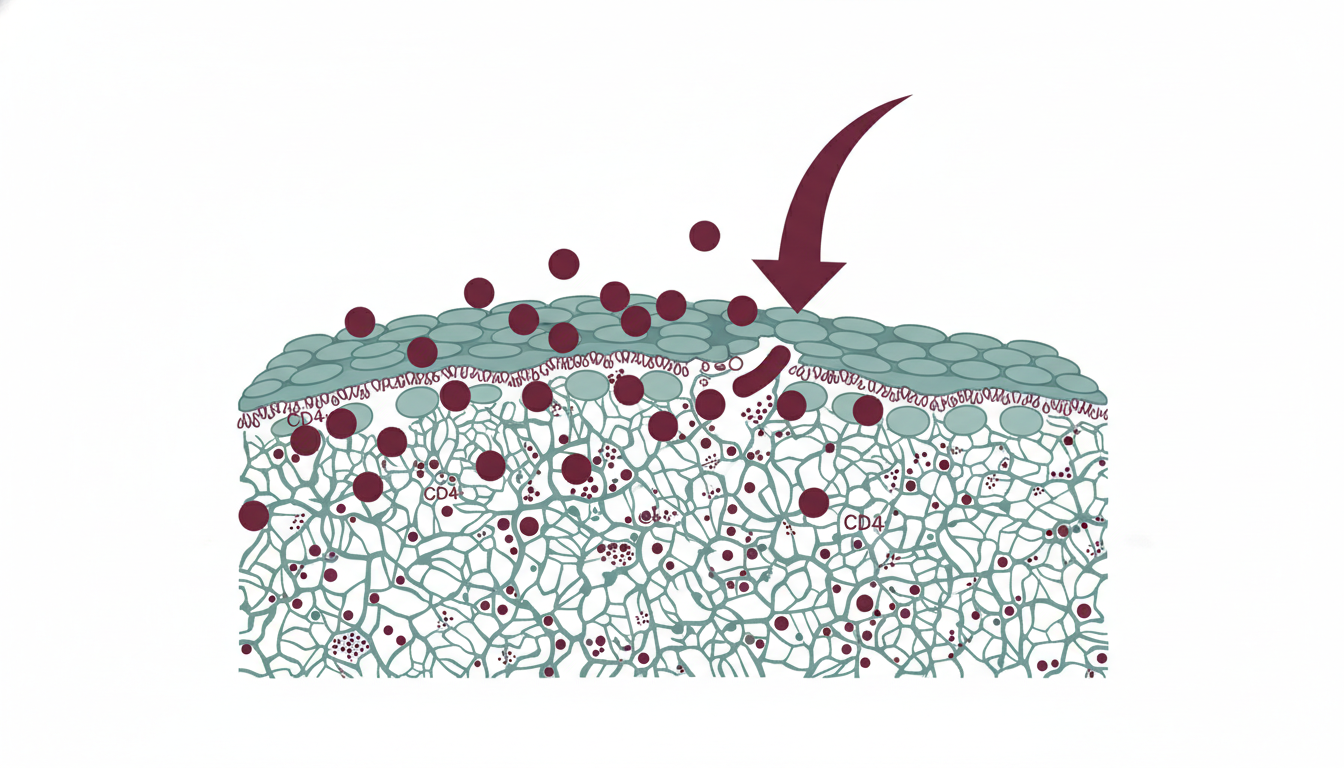
Open sores from syphilis (called chancres), herpes (HSV-1 or HSV-2), and chancroid create a literal break in the skin or mucous membrane. Healthy genital tissue has tight cell-to-cell junctions that act as a barrier; an ulcer punches a hole in that barrier. The CDC's review of HIV-STI biology notes that ulcerative diseases bleed easily and can come into contact with vaginal, cervical, oral, urethral, and rectal mucosa during sex (CDC MMWR, HIV Prevention Through STD Treatment). The result is a direct entry point for any other pathogen present.
Inflammatory STIs that don't form open sores still create the same vulnerability through a different mechanism. Gonorrhea and chlamydia both irritate the urethral and cervical lining, and the body responds by sending CD4+ T-cells (the same cells HIV targets) to the site of inflammation. The CDC documents that gonococcal infection in men increases HIV shedding in semen roughly tenfold, with effective antibiotic treatment rapidly reducing that figure (CDC MMWR). Two people having sex when one has untreated gonorrhea are working against a stacked deck.
Then there is the immune-suppression mechanism. HIV is the textbook example: as the virus depletes CD4+ cells, the body becomes worse at clearing other infections. Untreated HIV is associated with higher rates of syphilis, herpes outbreaks, gonorrhea, chlamydia, and aggressive HPV-driven cancers. The relationship runs both ways. The WHO fact sheet on STIs states plainly that herpes, gonorrhea, and syphilis can increase the risk of HIV acquisition (WHO, STIs Fact Sheet).
Add to all of this the simple statistical fact that the same risk behavior, condomless sex with a partner whose status is unknown, exposes you to every pathogen that partner is currently carrying. A single act of unprotected intercourse with someone who has both chlamydia and gonorrhea can transmit both during the same encounter. The pathogens don't queue up.
The STD pairings that show up together most
Surveillance data and clinical practice converge on a handful of co-infection patterns that account for the majority of cases.
Chlamydia and gonorrhea are the canonical pair. Both are bacterial, both colonize the same urogenital tissues, and both spread through the same kinds of unprotected sex. The CDC's 2024 surveillance report counted roughly 1.5 million chlamydia and 543,000 gonorrhea cases in the United States, and labs screen for both off the same swab as standard workflow (CDC, STI Surveillance 2024). Concurrent positives are common enough that the 2021 Treatment Guidelines recommend empirical co-treatment when one is found and the other has not yet returned (CDC 2021 STI Treatment Guidelines).
HIV and syphilis are the next most clinically important pairing, and the relationship is bidirectional. A primary syphilis chancre is a textbook entry route for HIV. Once HIV is established, syphilis tends to progress faster and to less typical clinical presentations. CDC's 2024 surveillance found 190,242 reported syphilis cases, with congenital syphilis rising for the twelfth straight year (CDC, 2024). Routine HIV testing alongside any positive syphilis test is now the standard of care.
HIV and HSV-2 overlap heavily because herpes ulcers act as both a portal and a marker of risk. People with HSV-2 have a measurably higher likelihood of acquiring HIV from a given exposure, and people living with HIV shed HSV-2 more often and at higher viral loads.
Trichomoniasis with bacterial vaginosis or chlamydia is a frequent triad in women. Trichomoniasis irritates the vaginal mucosa, alters the local pH, and disrupts protective lactobacilli. Once that ecology is off, the threshold for picking up a second bacterial or viral STI drops.
HPV with anything else is statistically common but mechanically distinct. HPV is widespread enough that finding it alongside another STI usually reflects shared exposure rather than one infection enabling the other. The exception is high-risk HPV plus HIV, where immune suppression accelerates HPV-driven cervical and anal cancers.
Hepatitis B and hepatitis C can co-occur with HIV in people sharing both unprotected sex and injection-drug exposure routes. The three together carry significantly higher liver-disease and complication risk than any single infection alone.
A note on the recommendations below: we sell at-home STI test kits and link to our products where they fit the specific testing need described in each section.
| Common co-infection pair | Why they cluster | Recommended action |
|---|---|---|
| Chlamydia + gonorrhea | Same tissue, same exposure route, similar bacterial niche | Test both off one swab; treat together if one is positive |
| HIV + syphilis | Syphilis chancres are an HIV portal; mutual immune effects | Auto-screen for HIV at any syphilis diagnosis and vice versa |
| HIV + HSV-2 | HSV ulcers ease HIV transmission; HIV worsens herpes outbreaks | Consider HSV antibody testing if HIV-positive |
| Trichomoniasis + BV + chlamydia | Disrupted vaginal flora lowers barrier to other STIs | Comprehensive female-panel testing |
| HPV + HIV | Immunosuppression accelerates HPV-driven cancers | More frequent cervical and anal screening if HIV-positive |
| Hepatitis B/C + HIV | Shared transmission routes (sex and injection drug use) | Test for all three together, especially with risk factors |
Why co-infections muddy symptoms and slow diagnosis
One reason co-infections matter clinically is that the symptoms overlap so heavily that no single complaint points to a single cause. Painful urination can come from chlamydia, from gonorrhea, from trichomoniasis, from a urinary tract infection, or from a herpes outbreak affecting the urethra. Vaginal discharge has at least four common STI explanations and several non-STI ones. A reader who treats one suspected infection and stops there often leaves a second one untreated.
The clinical consequences accumulate. Untreated chlamydia or gonorrhea can ascend to the upper reproductive tract and cause pelvic inflammatory disease, which is associated with scarring, ectopic pregnancy, and infertility (CDC, About Gonorrhea). When both infections are present and only one is treated, the second continues to do damage silently. Antibiotic resistance is a parallel concern. Gonorrhea has lost first-line treatment options repeatedly over the last few decades, which is why CDC's 2021 guidelines moved to higher-dose ceftriaxone monotherapy and continue to monitor resistance trends (CDC 2021 STI Treatment Guidelines).
Diagnostic ambiguity also delays partner notification. If somebody with chlamydia plus undiagnosed trichomoniasis tells a partner only about the chlamydia, that partner gets treated for one infection and continues spreading the other. Public-health partner-services teams ask about the full picture for exactly this reason.
None of this is a reason to panic at the first symptom. It is a reason to test broadly. Pinning down what is actually happening with a multi-infection panel is more useful than guessing without one.
If you test positive for one STI and treat only that one, an undetected second infection can continue to cause silent damage and spread to partners. The CDC's 2021 guidelines specifically recommend screening for HIV and other STIs at the time of any single diagnosis. Ask for a full panel rather than a single test, or use a home kit that covers several infections from one collection session.
How to test for several STIs at once
The case for panel testing rather than single-infection testing comes down to two things: co-infection is common, and the cost of finding out late is high. There are three practical paths to multi-STI screening.
Lab-based panel through a clinic. A clinician orders chlamydia and gonorrhea NAATs (nucleic-acid amplification tests, the laboratory gold standard), syphilis serology, HIV antigen-antibody testing, and hepatitis B and C antibodies as appropriate. Results take a few days. This is the most analytically sensitive approach and is recommended whenever symptoms or known exposure point to higher-acuity infection (CDC, Clinical Guidance for STIs).
Lab-mailed home collection. Several services mail you a collection kit, you self-collect samples and mail them back, and a CLIA-certified lab runs NAATs and serology and returns results online. Window periods are the same as in-clinic testing.
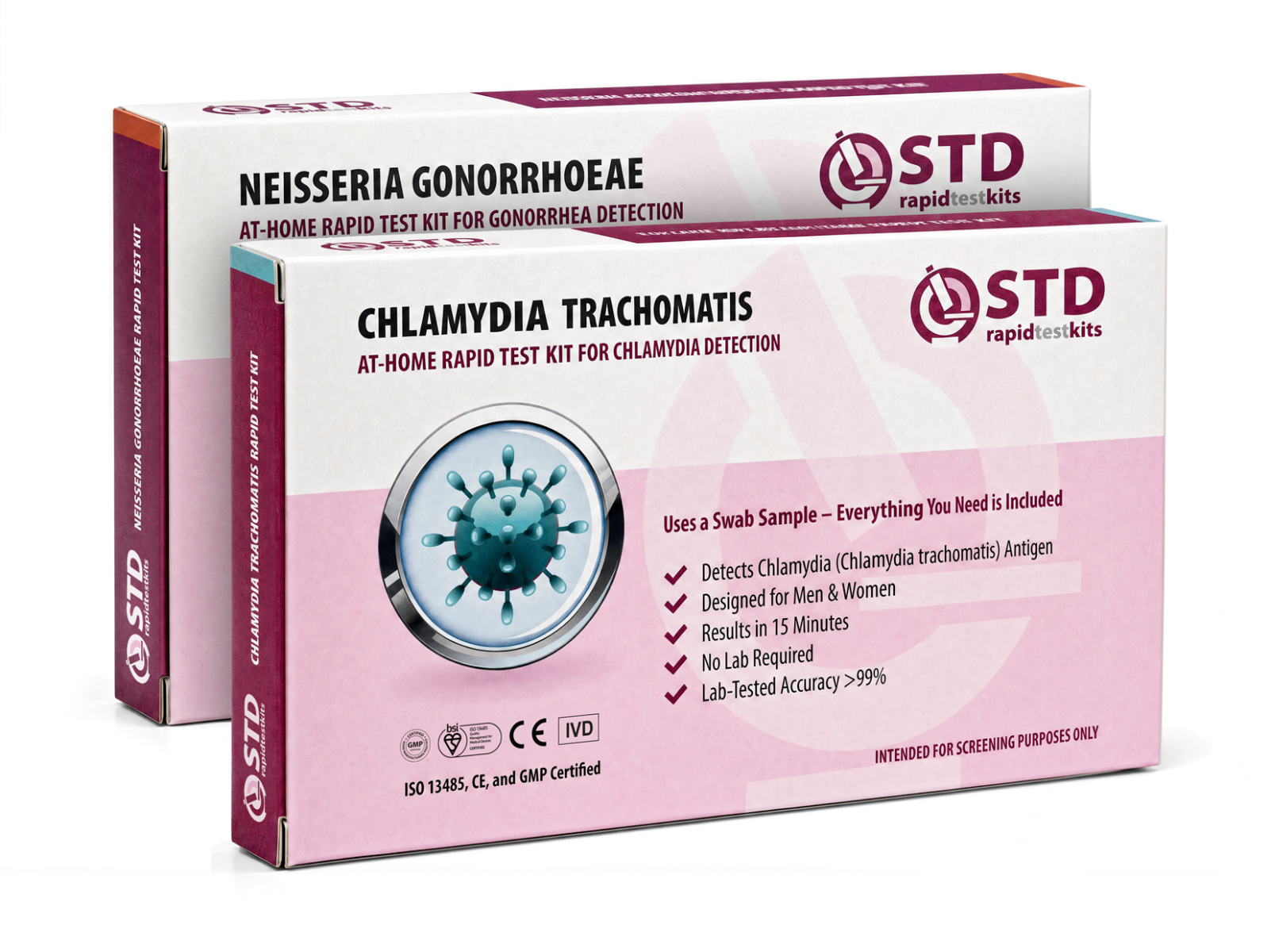
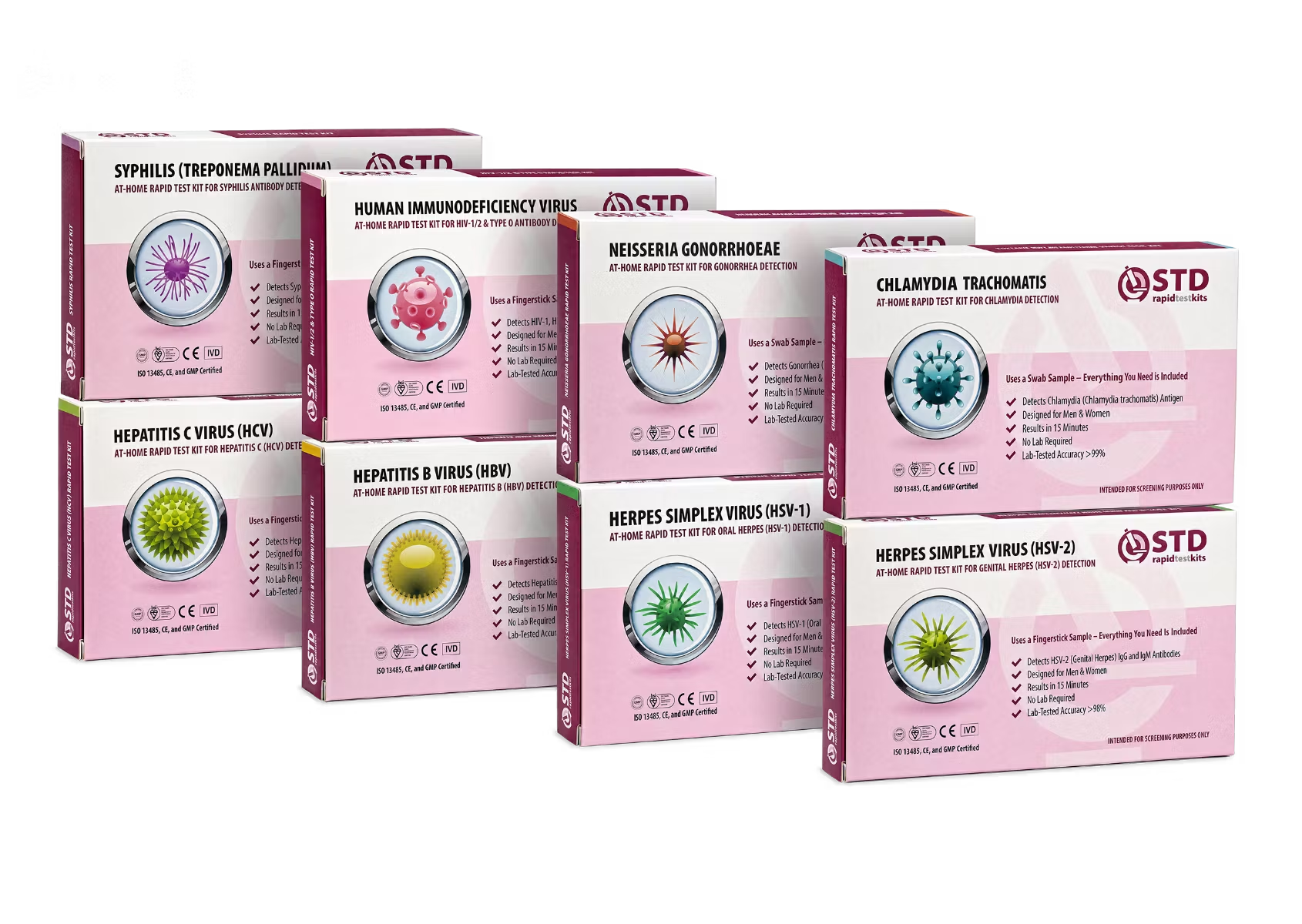
Rapid lateral-flow home panels. Multi-infection home kits use the same swab or fingerstick blood draw to run several lateral-flow strips in parallel. Results return in roughly 15 minutes per strip. The chemistry is different from a NAAT: lateral-flow detects antigens or antibodies via a binding strip rather than amplifying genetic material. That makes the test faster and cheaper, with somewhat lower analytical sensitivity than a NAAT, especially in early infection. The right way to think about lateral-flow home testing is as a screening tool. A positive home result is a strong signal that needs confirmation; a negative result means look at your window period and re-test if you tested too early.
For somebody who is asymptomatic, well past the relevant exposure windows, and screening as part of a routine sexual-health check, a home panel covering six to eight common STIs is reasonable and meaningfully more useful than a single-infection test. For somebody with clear symptoms or a known exposure to a high-acuity infection like syphilis or HIV, a clinic-based NAAT-and-serology workup is the better path.
Treating co-infections: what to expect
The treatment plan depends on which infections are present and how they interact, but a few patterns hold across most cases.
Bacterial infections. Chlamydia, gonorrhea, syphilis, and trichomoniasis are all treated with antibiotics, though the specific drug differs. The 2021 guidelines recommend doxycycline for chlamydia, ceftriaxone for gonorrhea, benzathine penicillin G for syphilis, and metronidazole for trichomoniasis (CDC 2021 STI Treatment Guidelines). When chlamydia and gonorrhea are both present, a standard regimen treats both at once.
Viral infections. HIV is managed with lifelong antiretroviral therapy, which suppresses the virus to undetectable levels in most people who take it consistently. Genital herpes is suppressed with antivirals like valacyclovir or acyclovir during outbreaks; daily suppressive therapy reduces both outbreaks and transmission risk. HPV usually clears on its own, though high-risk strains require monitoring through cervical or anal screening, and any precancerous changes are treated by removal.
Hepatitis. Hepatitis B is managed with antivirals when chronic; acute infection often clears spontaneously. Hepatitis C now has direct-acting antivirals that cure the infection in over 95% of people who complete the course (WHO, Hepatitis C Fact Sheet).
Do not stop treatment of one infection because the other one improved; antibiotics for chlamydia do not cure HIV, and antivirals for HIV do not cure syphilis. Each infection needs its own complete course. Partner notification also matters more when several infections are present: a partner treated for only one of the infections your test caught may continue to carry and transmit the others.
Antibiotic courses for bacterial STIs work only if you complete them. Stopping early because symptoms cleared is the single most common reason an infection persists or develops resistance. The CDC recommends a follow-up test for chlamydia and gonorrhea about three months after treatment to confirm cure and check for reinfection from an untreated partner.
Lowering your odds of a co-infection
Most of the protective tools that work for single STIs work for co-infections too. The main difference is that the layered approach matters more, because closing one route while another stays open still leaves you exposed to several pathogens at once.
Barrier methods. Latex or polyurethane condoms used correctly reduce transmission of every fluid-borne STI substantially. They do not cover skin-to-skin areas outside the condom, which is why HSV, HPV, and syphilis chancres can still transmit despite condom use. Dental dams reduce oral-genital transmission for HSV and syphilis.
Vaccination. The HPV vaccine prevents the high-risk strains responsible for cervical, anal, and oropharyngeal cancers. The CDC recommends routine vaccination through age 26, with shared clinical decision-making between ages 27 and 45. Hepatitis B vaccination is a routine part of childhood immunization in most countries; adults at risk who were not vaccinated should ask about a catch-up series.
PrEP for HIV. Pre-exposure prophylaxis, taken daily or as a long-acting injection, reduces the risk of getting HIV from sex by about 99% when taken as prescribed (CDC HIV Nexus, Clinical Guidance for PrEP). PrEP does not cover any other STI, so people on PrEP still benefit from periodic multi-infection screening.
Routine screening cadence. The 2021 guidelines suggest annual screening for sexually active women under 25, sexually active men who have sex with men, and anybody with new or multiple partners. People with risk factors for HIV should screen at least once a year for HIV plus a broader STI panel (CDC, About STIs).
Open partner conversations. Talking to a partner about testing history is uncomfortable but more useful than relying on assumed status. Partners who test together before unprotected sex catch co-infections before they spread.
When to test after possible exposure
Window periods, the time between exposure and a reliable positive result, vary substantially across infections. The NHS suggests waiting up to seven weeks before considering a general STI screen complete, but the specific timing depends on which infection you're testing for and a few of them run longer than that (NHS, Sexually Transmitted Infections). A panel taken too early can miss one component while accurately catching another, which is why understanding the timeline matters for co-infection screening.
Chlamydia and gonorrhea become detectable on most tests within one to two weeks. Lab NAATs are sensitive earlier than lateral-flow swabs; the at-home rapid swabs in our catalog are validated from day 14 onward.
Syphilis antibody tests typically turn positive three to six weeks after exposure. Some people seroconvert as early as ten days; others take up to twelve weeks. A negative result inside three weeks is not a clean clearance.
HIV has the widest window. Fourth-generation lab antigen-antibody tests detect HIV in most people within 45 days; rapid antibody-only tests have a longer window, typically 23 to 90 days (CDC, HIV Testing). Seven weeks is not enough for HIV specifically; plan to retest at the longer interval if HIV is part of your concern.
Hepatitis B antibody and antigen tests typically turn positive between three and six weeks after exposure. Hepatitis C tests have a longer window: four to ten weeks for RNA-based detection, eight to eleven weeks for antibodies.
HSV antibody tests can take six to sixteen weeks to seroconvert. If concern is about an active lesion, the better test is a clinic-administered swab PCR taken from the lesion itself, which is more sensitive than a blood antibody test in early infection.
A single panel taken five days after a worrying exposure may correctly catch chlamydia and gonorrhea while missing HIV, syphilis, and HSV. Plan to retest at the longer windows if your concern includes those infections, or use the panel as an early screen and follow up at six to twelve weeks for a more complete picture.
Persons seeking treatment or evaluation for a particular STI should be screened for HIV and other STIs as indicated by community prevalence and individual risk factors.
FAQs
- Can you really have more than one STD at the same time?
- Yes, and the clinical workflow is built around it. Standard lab panels run chlamydia and gonorrhea off the same swab because co-positives are routine. The 2021 CDC Treatment Guidelines specifically recommend screening for HIV and additional STIs at the time of any single STI diagnosis. Home multi-infection kits exist precisely because finding one infection is a reason to check for others, not a reason to stop testing.
- Which STDs travel together most often?
- Chlamydia plus gonorrhea is the most common pairing, followed by HIV plus syphilis, HIV plus HSV-2, and trichomoniasis plus bacterial vaginosis in women. HPV is widespread enough that finding it alongside another STI usually reflects shared exposure rather than one infection driving the other.
- Does having an STI make it easier to catch HIV?
- Yes. The CDC has documented a two- to fivefold increase in HIV acquisition risk among people with another untreated STI. Ulcerative infections like syphilis and HSV create direct entry points; inflammatory infections like gonorrhea and chlamydia recruit the very immune cells HIV targets to the site of inflammation.
- Will treating one STI cure the other?
- Almost never, unless both happen to respond to the same drug. Doxycycline used for chlamydia does not cure HIV. Antiretrovirals for HIV do not cure syphilis. Each infection needs its own appropriate treatment, even when both are present and even after symptoms clear.
- How accurate are home rapid panels for several infections?
- Home rapid lateral-flow panels are useful for screening when used after the appropriate window period. Sensitivity is meaningfully lower than laboratory NAATs in early infection, but specificity is high, so a positive result is a strong signal worth confirming and a clean negative outside the window is informative. Lab-based NAATs and serology remain the diagnostic gold standard.
- How long should I wait after possible exposure to test?
- Window periods vary by infection. Chlamydia and gonorrhea: about 14 days. Syphilis: three to six weeks. HIV: up to 90 days, with most fourth-generation lab tests positive by 45 days. Hepatitis B: three to six weeks. HSV antibodies: six to sixteen weeks. A panel taken too early can miss one infection while correctly catching another.
- Should my partner test if I test positive for a co-infection?
- Yes, and they should test for the full panel, not only the infections you tested positive for. A partner treated for chlamydia alone while still carrying undetected gonorrhea or trichomoniasis can re-expose you and transmit forward to other partners.
- What if I have no symptoms but suspect exposure?
- Most STIs are silent for at least part of their course. Chlamydia in particular is asymptomatic in the majority of cases. The right move when symptoms are absent but exposure is suspected is a panel screen at the right time-window for the infections you're worried about. A negative panel taken at the appropriate interval is meaningful reassurance.
- U.S. Centers for Disease Control and Prevention. Sexually Transmitted Infections Treatment Guidelines, 2021 (MMWR Recommendations and Reports). Includes co-infection screening recommendations and antibiotic regimens for chlamydia, gonorrhea, syphilis, and trichomoniasis.
- U.S. Centers for Disease Control and Prevention. HIV Prevention Through Early Detection and Treatment of Other Sexually Transmitted Diseases (MMWR). Source for the two- to fivefold HIV-acquisition risk multiplier and the biological mechanisms by which ulcerative and inflammatory STIs facilitate HIV transmission.
- U.S. Centers for Disease Control and Prevention. STI Surveillance, 2024. Provisional case counts for chlamydia (1.5 million), gonorrhea (543,409), and syphilis (190,242) in the United States.
- U.S. Centers for Disease Control and Prevention. HIV Nexus Clinical Guidance for PrEP. Source for the figure that oral and injectable PrEP reduce the risk of getting HIV from sex by about 99% when taken as prescribed.
- World Health Organization. Sexually Transmitted Infections (STIs) Fact Sheet. Global prevalence figures, the relationship between STIs and HIV transmission risk, and burden estimates for the four curable bacterial and parasitic STIs.
- U.K. National Health Service. Sexually Transmitted Infections (STIs). General guidance on testing window periods (up to seven weeks for general STI screening) and clinical presentation of common STIs.
