How to Prevent STDs: A Practical Layered Guide
No single move prevents every STI. The strategies that actually work stack: barrier protection during sex, two key vaccines, routine testing on a schedule that matches your life, and honest conversations with the people you sleep with. Here is what each layer does, where each one falls short, and how to combine them so the gaps in one layer are covered by the next.




- Condoms used consistently and correctly are highly effective at preventing HIV and reduce the risk of fluid-borne infections like gonorrhea and chlamydia, but they offer only partial protection against skin-to-skin infections such as herpes and HPV.
- Most STIs cause no symptoms, so testing is not a reaction to feeling ill; it is a routine on a schedule, the way a dental check-up is.
Published: November 2025 | Last updated: April 2026 | Editorial review and quality control: Martina N.
Prevention is the part of sexual health that gets oversold in slogans and undersold in practice. "Use protection" is true but incomplete. The honest version is that no single tool prevents every sexually transmitted infection, and the people who stay healthiest are the ones who layer several modest tools together. Condoms cover most of the fluid-borne risks. Two vaccines cover most of the cancer-causing and liver-disease risks. Routine testing catches the silent infections that have no symptoms at all. PrEP closes the gap on HIV for people whose situation calls for it. And a five-minute conversation before sex closes more gaps than any of those alone.
This guide walks through each layer, explains what it actually protects against and what it does not, and shows you how to assemble a routine that fits your real life. The goal is not zero risk; that is not how human sexuality works. The goal is informed risk, where you know what you are choosing and what you are protecting yourself from at every step.
What is the most effective way to prevent STDs?
Layer four habits: use external or internal condoms correctly every time you have penetrative or oral sex, get the HPV and hepatitis B vaccines on schedule, test routinely (annually for most sexually active adults; every 3 to 6 months if you have new or multiple partners), and talk with each new partner about testing status before sex. People at substantial HIV risk add daily PrEP, which the CDC describes as highly effective when taken as prescribed. No single layer prevents every infection; the combination is what works.
Key takeaways
- Condoms used consistently and correctly are highly effective at preventing HIV and reduce the risk of fluid-borne infections like gonorrhea and chlamydia, but they offer only partial protection against skin-to-skin infections such as herpes and HPV.
- Most STIs cause no symptoms, so testing is not a reaction to feeling ill; it is a routine on a schedule, the way a dental check-up is.
What STIs are and how they actually spread
Sexually transmitted infections (STIs, also called STDs when they cause obvious disease) are bacterial, viral, parasitic, or fungal infections that pass between people during sexual contact. The list of common ones is shorter than the anxiety around them suggests: chlamydia, gonorrhea, syphilis, trichomoniasis, HIV, hepatitis B, hepatitis C, herpes (HSV-1 and HSV-2), and HPV. Together they account for most diagnoses worldwide.
The route of transmission decides which prevention tools work. Some infections (HIV, gonorrhea, chlamydia, hepatitis B and C) move through bodily fluids, mostly during vaginal, anal, or oral sex. Barrier methods like condoms reduce fluid contact dramatically and so reduce these infections dramatically. Other infections (herpes, HPV, syphilis chancres) spread through direct skin-to-skin contact in genital, anal, or oral areas. Condoms cover only the skin under the latex, so a sore or wart on a thigh or groin can still transmit even with perfect condom use. That is why a layered approach matters: vaccines (for HPV and hepatitis B) and testing close gaps that condoms cannot.
According to the World Health Organization, more than 1 million curable STIs are acquired worldwide every day, the majority of them asymptomatic (WHO STI fact sheet). "Asymptomatic" is the central problem. You cannot reliably tell whether you or a partner has an STI by looking. Most people transmitting chlamydia or gonorrhea feel completely fine. This is the entire reason routine testing exists.
Fluid-borne infections (condoms work well): HIV, gonorrhea, chlamydia, hepatitis B, hepatitis C, trichomoniasis. These pass through semen, vaginal fluid, blood, or rectal fluid. A barrier between fluids is most of the protection.
Skin-to-skin infections (condoms help, but not enough): herpes (HSV-1 and HSV-2), HPV, syphilis (chancre stage). A sore or wart outside the area the condom covers can still transmit. Vaccines (HPV and hepatitis B) and routine testing close most of this gap.
Mixed-route or special-case: hepatitis B can transmit by both fluids and minor blood contact; HIV transmits efficiently through shared injection equipment in addition to sex.
Use condoms correctly every time
External condoms (the kind worn on a penis) and internal condoms (the kind inserted into the vagina or anus) are the most effective tool the average person has against fluid-borne STIs and unplanned pregnancy at the same time. The CDC writes that consistent and correct condom use is "highly effective in preventing the spread of HIV" and that condoms also reduce risk for gonorrhea, chlamydia, syphilis (when the chancre is on a covered area), trichomoniasis, and hepatitis B (CDC: Condom Use). They are less effective against herpes and HPV because those spread through skin-to-skin contact in areas the condom does not cover, but even there they reduce risk meaningfully.
The word doing all the work in those guidelines is "correctly." Real-world condom failure is almost always a use problem, not a product problem. The most common mistakes are easy to fix.
- Check the expiration date printed on the wrapper. Latex degrades; an expired condom is more likely to break.
- Store somewhere cool and dry. A wallet for months, a glove compartment in summer, or a sunny windowsill all weaken latex. A bedside drawer is fine.
- Open with your fingers, not your teeth. A nick you cannot see is still a nick.
- Pinch the tip and roll all the way down before any genital contact, not after a few minutes of unprotected start.
- Use water-based or silicone-based lubricant. Oil-based products (lotion, baby oil, coconut oil, petroleum jelly) break down latex within minutes.
- One condom per encounter. Reusing a condom is not safe at any point. Two condoms layered together is also not safer; the friction makes both more likely to break.
- Withdraw while still erect and hold the base of the condom so it does not slip off inside.
Lambskin condoms are an exception worth knowing about. They prevent pregnancy but the natural pores are large enough for viruses to pass through, so they do not protect against HIV or other STIs. For STI protection use latex, polyurethane, or polyisoprene.
"Condoms break all the time." When stored and used correctly, modern condoms rarely break. Most reported breakage traces back to expired stock, oil-based lubricant, or putting it on inside-out and flipping it.
"Condoms ruin sensation." Ultra-thin and lubricated varieties are designed for minimal sensation loss. If a condom feels wrong, the size is usually the issue; condoms come in different widths, and the standard size is not standard for everyone.
"You only need them with new partners." Established partners can still acquire STIs through previous exposures, oral sex, or non-monogamous moments either party did not disclose. Condoms remain useful until both partners have negative test results and an explicit agreement.
Get the HPV and hepatitis B vaccines
Two vaccines are routinely recommended for STI prevention. They cover risks that condoms cannot fully address, and they last for years.
HPV vaccine. Human papillomavirus is the most common STI in the world; most sexually active adults will be exposed at some point. Most infections clear on their own, but persistent infection with high-risk HPV types causes nearly all cervical cancer plus a significant share of anal, throat, vulvar, vaginal, and penile cancers. The vaccine is highly effective at preventing the strains responsible for most of those cancers. Per CDC and ACIP guidance, routine vaccination is recommended starting at age 11 to 12 (can begin at age 9), and catch-up vaccination is recommended through age 26 if not already vaccinated. For ages 27 to 45, vaccination falls under shared clinical decision-making with a provider, who weighs likely past exposure against ongoing risk (CDC HPV vaccine recommendations).
Hepatitis B vaccine. Hepatitis B is sexually transmissible, can become chronic, and chronic infection raises long-term risk of liver disease and liver cancer. The CDC recommends the vaccine for all infants, children and adolescents under 19 who have not been vaccinated, and adults aged 19 to 59. Adults 60 and older with risk factors should also be vaccinated (CDC hepatitis B vaccination). The series is two or three shots over a few months. Most healthy people do not need a booster.
If you do not know your vaccination history, your primary-care provider can pull your record or run a hepatitis B antibody test to see whether you are already protected. There is no vaccine for HIV, herpes, chlamydia, gonorrhea, syphilis, or hepatitis C, so for those infections the prevention layers are barriers, testing, and (for HIV) PrEP.
Vaccine timing in plain English
- HPV vaccine: routine at ages 11 to 12, catch-up through age 26, shared decision-making with a clinician for ages 27 to 45.
- Hepatitis B vaccine: recommended for everyone under 60 who has not been vaccinated; recommended for adults 60 and older with risk factors such as multiple partners, injection drug use, or living with someone with chronic hepatitis B.
- If you cannot find your records, ask for a hepatitis B antibody titer; an HPV record check usually requires a clinic visit or phone call to your previous provider.
Test routinely, not reactively
Testing is the layer most people skip. Symptoms are not a reliable trigger because most STIs have none, especially in the first weeks. The CDC's screening recommendations differ by infection and population, but the broad pattern looks like this (CDC STI screening recommendations).
- HIV: at least once for every adult aged 13 to 64; at least annually for sexually active gay and bisexual men and others at higher risk.
- Chlamydia and gonorrhea: annually for sexually active women under 25 and for older women with risk factors; at least annually for sexually active gay and bisexual men, with site-specific testing (genital, rectal, throat) regardless of condom use.
- Syphilis: at least annually for sexually active gay and bisexual men, people living with HIV, and people taking PrEP; routine in pregnancy.
- Hepatitis C: at least once for every adult over 18, and during every pregnancy.
Outside those baselines, the right cadence depends on your situation. Annual testing covers most monogamous or low-partner-count adults. Every 3 to 6 months covers people with new or multiple partners, anyone in non-monogamous arrangements, and anyone whose partner's status is unknown. After any exposure that worried you, test once the relevant window period has passed (about 14 days for chlamydia and gonorrhea, 4 to 6 weeks for early HIV with a fourth-generation antigen-antibody test, 12 weeks for HSV-2 antibody seroconversion).
Routine testing is also the single best way to head off the long-term complications people fear most. Untreated chlamydia and gonorrhea are the leading preventable causes of pelvic inflammatory disease, fallopian-tube scarring, and ectopic pregnancy in women, and of epididymitis in men, all of which can affect future fertility. Most of those infections are completely asymptomatic, so the only way to catch them is on a schedule. Antibiotic treatment started early resolves the infection without lasting damage in most cases.
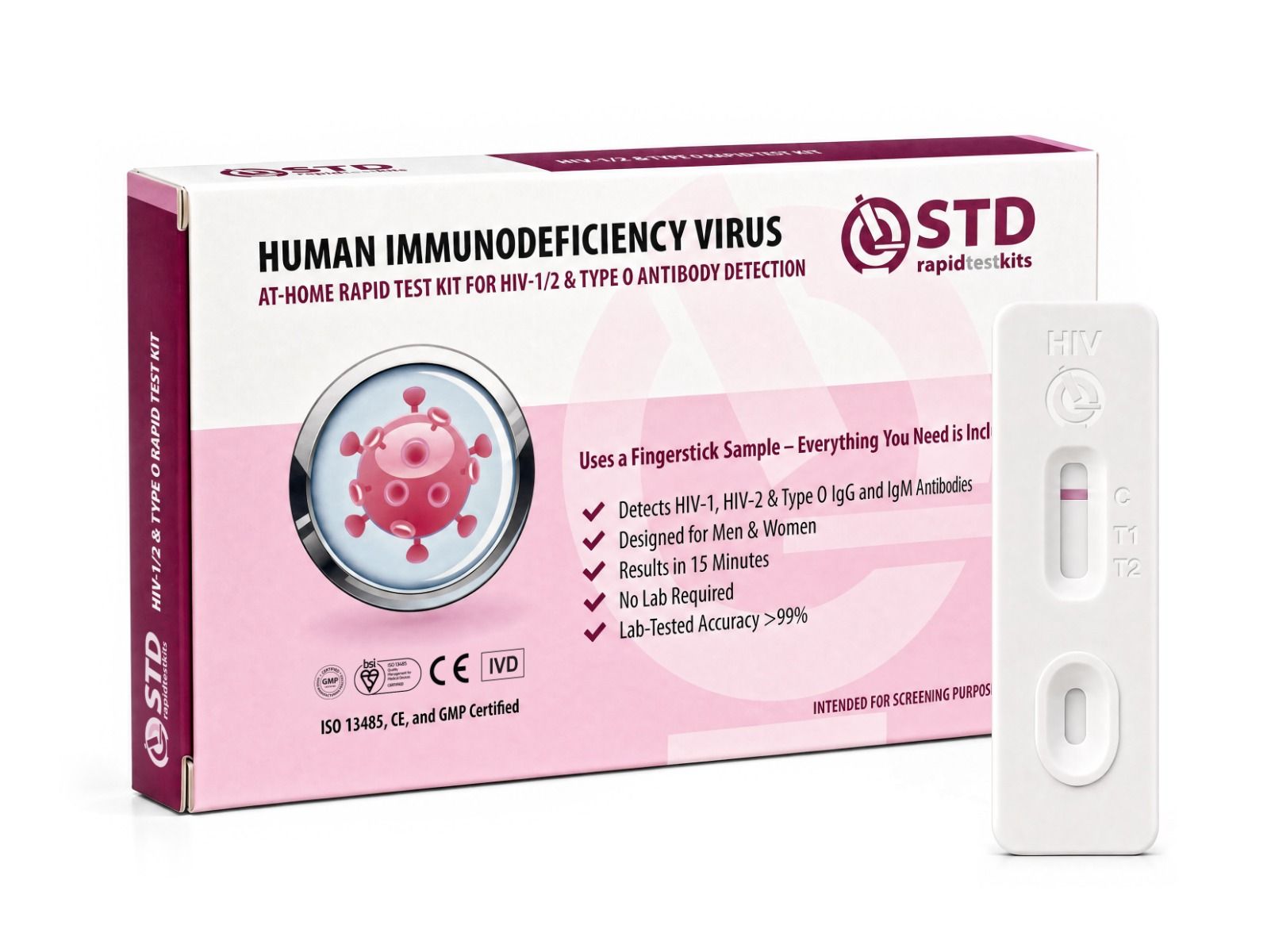
At-home rapid lateral-flow tests cover the privacy and accessibility gap between "I should test" and "I made a clinic appointment." They are screening tools, not laboratory NAATs, so a positive result is worth confirming with a lab test where possible. But for closing the every-three-months loop in real life, they remove most of the friction. Disclosure: we sell at-home rapid lateral-flow STI test kits; the panel below is one of our products, recommended here because it fits this prevention layer.
| If you... | Test at least | Plus after any new exposure |
|---|---|---|
| Have one tested negative partner | Annually | If anything changes |
| Have new or multiple partners | Every 3 to 6 months | After the relevant window period |
| Are pregnant or planning to be | At first prenatal visit (HIV, syphilis, hep B, hep C); repeat in third trimester for higher risk | Test if symptoms appear |
| Are taking PrEP | HIV every 3 months; other STIs every 3 to 6 months | Continue same cadence |
| Are sexually active gay or bisexual men | HIV, syphilis, gonorrhea, chlamydia at least annually | Site-specific testing where contact occurred |

Talk with each new partner before sex
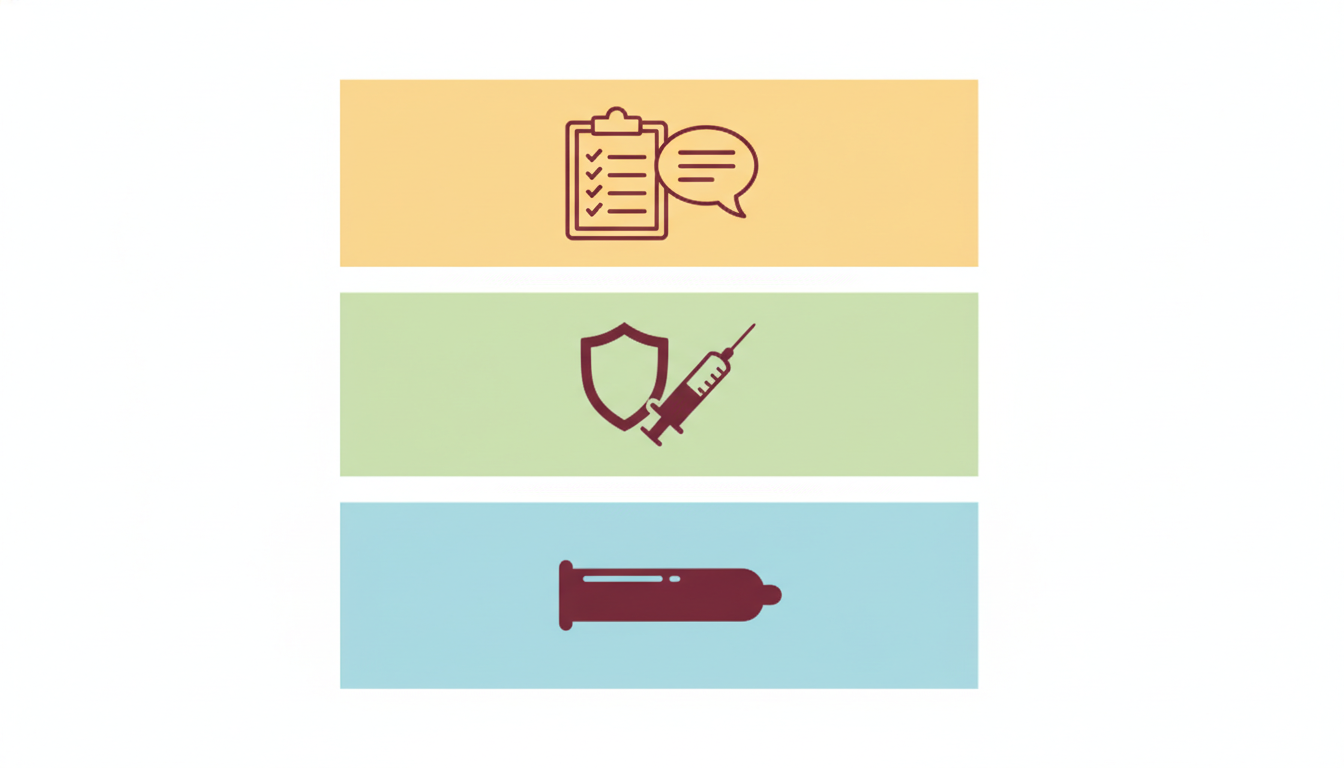
The conversation people most dread is the one that closes the biggest gap in their prevention layer. "Have you been tested recently? Do you know your status?" is awkward exactly once per partner and worth far more than any single condom or vaccine. It surfaces information no test can see, like recent exposures within a window period, an existing diagnosis someone is managing, or a partner's own preferences for testing cadence.
The conversation does not have to be clinical. A reasonable script: "I get tested every few months and I'm clear as of [date]. What about you?" That invites disclosure without interrogation. If the answer is "I don't know," the next move is testing together before unprotected sex, not skipping the conversation. If the answer reveals a positive diagnosis someone is managing, that is not the end of the conversation; many STIs are treatable or controllable, and people on suppressive therapy for HIV with an undetectable viral load do not transmit the virus to sexual partners (the U=U principle, "undetectable equals untransmittable").
Communication also covers questions condoms cannot answer. Are you both monogamous? What are your boundaries about oral sex without barriers? Do you want to test together before stopping condom use? These questions sound formal in print and feel completely normal once you have had them a few times.
Send a text instead of waiting for an in-person moment. "Hey, before things go further this weekend, I wanted to check in about testing and what we're each comfortable with." Written form gives both people time to think. The American Sexual Health Association has plain-language scripts and partner-communication tip sheets that are worth reading once.

Use PrEP if your HIV risk is meaningful
PrEP (pre-exposure prophylaxis) is a daily oral medication, or in some cases a long-acting injectable, that prevents HIV infection in HIV-negative people. The CDC describes PrEP as greatly reducing the chance of getting HIV from sex or injection drug use when taken as prescribed (CDC: PrEP for HIV prevention). Daily PrEP pills reach maximum protection at about 7 days of use for receptive anal sex and roughly 21 days for receptive vaginal sex and injection drug use, per the same CDC guidance.
PrEP is for people whose situation makes HIV exposure plausible: a partner living with HIV who is not virally suppressed, recent bacterial STI diagnoses, sex work, or sharing injection equipment. It is not a replacement for condoms; it does not prevent any other STI, and it does not prevent pregnancy. It is the layer that closes HIV specifically, on top of the rest of the layers.
Talk with a primary-care provider, sexual-health clinic, or telehealth PrEP service if you think it might fit. The intake is a baseline HIV test, kidney function check, and STI screen, then a refill cadence with quarterly testing built in. Most insurance plans and many state programs cover PrEP at no cost.
PrEP time-to-protection windows
- Receptive anal sex: maximum protection at about 7 days of daily PrEP, per CDC.
- Receptive vaginal sex and injection drug use: maximum protection at about 21 days of daily PrEP, per CDC.
- Use condoms during the ramp-up period; PrEP does not protect against any other STI, only HIV.
- Quarterly HIV testing and STI screening are part of the standard PrEP follow-up cadence.
Other safer-sex practices that matter
A few smaller habits round out the picture and address transmission routes that the bigger layers do not.
Barriers for oral sex. Oral sex is not zero-risk. Gonorrhea, chlamydia, herpes, syphilis, and HPV all transmit through oral contact, and pharyngeal (throat) gonorrhea is a known driver of antibiotic-resistant strains. External condoms work for fellatio. For oral-vaginal or oral-anal contact, dental dams (a thin square of latex or polyurethane) provide a barrier. A condom cut open lengthwise works in a pinch.
Lubricant. Friction during sex causes microtears in mucosal tissue, and microtears are a transmission route for HIV and other infections. Adding a water-based or silicone-based lubricant reduces tearing and reduces condom breakage at the same time. Skip oil-based products with latex.
Stay current on cervical screening if you have a cervix. Pap smears and HPV co-testing detect persistent high-risk HPV infection before it progresses to cancer, even if you were vaccinated. Vaccination reduces the risk of the most aggressive strains; screening catches what the vaccine missed.
Be honest about exposure routes the kit you have does not cover. At-home swab tests cover genital sample sites. They do not cover the throat or rectum. If your exposure was oral or rectal, a clinic-administered swab from that anatomical site is the right test, and home-test kits are an adjunct, not a substitute.
Sexual-health clinics and Planned Parenthood locations often hand out dental dams free, the same way they distribute condoms. Online retailers stock flavored and unflavored versions in bulk. If you do not have one and want a barrier in the moment, you can cut a non-lambskin external condom open along the side, unroll it flat, and use that as a single-use dam. Avoid plastic wrap; it is not validated for STI prevention and tears more easily than purpose-made latex.
Avoid heavy substance use during sex
Alcohol and recreational drugs are not STI risk factors in themselves; the risk is what they do to decision-making in the moment. Multiple CDC and public-health analyses have documented that intoxication is associated with skipped condoms, partners not discussed in advance, and exposure routes that would have been avoided sober. This is not a moral judgment; it is a tactical observation. If a substance routinely changes the sexual choices you make, prevention works better when you decide in advance, while sober, what your rules are, and stick to them.
The pattern matters most for people who use substances regularly and people who use injection drugs. Sharing needles or other injection equipment transmits HIV, hepatitis B, and hepatitis C efficiently. If injection is part of your situation, syringe services programs (needle exchanges, sometimes called harm-reduction clinics) provide sterile equipment, naloxone, and access to PrEP and STI testing without judgment. Using your own equipment every time, never sharing, and carrying naloxone are the high-impact moves.
The North American Syringe Exchange Network (NASEN) maintains a directory of syringe services programs across the U.S., and the CDC's harm-reduction page lists what these programs offer (sterile syringes, naloxone training, HIV and hepatitis C testing, links to PrEP and treatment). Services are free and confidential at most locations. If you inject drugs, getting on the local program's mailing list is the single most efficient way to lower your HIV and hepatitis C risk while you decide what longer-term steps make sense.
If you do get an STI, treat it promptly
Diagnosis is not the end of anyone's sexual life. Most STIs are either fully curable (chlamydia, gonorrhea, syphilis, trichomoniasis) or controllable on long-term therapy (HIV, herpes, hepatitis B). What matters for your health and your partners' health is moving fast.
Take the full course of treatment. Bacterial STIs respond to antibiotics; partial courses select for resistant strains, which is the same global problem that makes WHO flag antibiotic-resistant gonorrhea as a serious threat.
Notify recent partners. Most clinics offer expedited partner therapy (where you receive treatment for your partner) or anonymous notification services. The notification can sting; the alternative is one of those partners passing it back to you or to someone else.
Pause sex until your provider says you are no longer infectious. For chlamydia and gonorrhea this is usually 7 days after starting antibiotics. For herpes outbreaks, until lesions heal. For HIV, until viral load is suppressed.
Re-test where indicated. The CDC recommends re-testing for chlamydia and gonorrhea about 3 months after treatment, because reinfection (often from an untreated partner) is the most common cause of "the antibiotics didn't work."
Knowing your STI status is a critical step in prevention.
Frequently asked questions
- Are condoms 100% effective against STDs?
- No. Condoms used consistently and correctly are highly effective against fluid-borne infections like HIV, gonorrhea, and chlamydia. They are less effective against skin-to-skin infections like herpes and HPV because those can transmit from areas the condom does not cover. They still reduce risk meaningfully for those infections; they just do not eliminate it.
- Do non-latex condoms protect against STDs?
- Polyurethane and polyisoprene condoms protect against STDs at rates comparable to latex and are good options for people with a latex allergy. Lambskin condoms are different: their natural pores are large enough for viruses to pass through, so they prevent pregnancy but not HIV or other STIs.
- How often should I get tested if I am sexually active?
- For most sexually active adults, once a year covers the baseline. If you have new or multiple partners, are in a non-monogamous arrangement, or are on PrEP, every 3 to 6 months is the right cadence. After a specific exposure that worried you, wait out the window period for that infection before testing (roughly two weeks for chlamydia and gonorrhea, four to six weeks for HIV with a fourth-generation antigen-antibody test, 12 weeks for HSV-2 antibodies).
- Can I use two condoms at once for extra protection?
- No. Two condoms layered (whether two external, or one external and one internal) increase friction between them and make breakage more likely, not less. One condom, used correctly with a compatible lubricant, is the more protective choice.
- What should I do if a condom breaks during sex?
- Stop, check, and consider next steps. Emergency contraception is an option for pregnancy prevention if relevant. For STI risk, ask a clinic about post-exposure prophylaxis (PEP) for HIV, which can prevent infection if started within 72 hours. Test for STIs after the relevant window periods (about 14 days for chlamydia and gonorrhea, 4 to 6 weeks for early HIV).
- Is the HPV vaccine still useful if I am already sexually active?
- Yes, in many cases. Routine vaccination is recommended through age 26 even for sexually active people, and shared clinical decision-making applies through age 45. You may have already been exposed to some HPV strains; the vaccine still protects against the strains you have not encountered.
- What is PrEP and do I need it?
- PrEP is daily oral medication (or in some cases an injection) that prevents HIV infection in HIV-negative people. It is for people whose situation makes HIV exposure plausible: a partner with detectable HIV, repeated bacterial STI diagnoses, sex work, or sharing injection equipment. Talk with a sexual-health clinic or PrEP-focused telehealth service to see whether it fits.
- Can untreated STIs cause infertility?
- Yes, which is why routine testing matters even when nothing feels wrong. Untreated chlamydia and gonorrhea are the leading preventable causes of pelvic inflammatory disease and fallopian-tube scarring in women, and of epididymitis in men, all of which can affect fertility. Most of those infections are asymptomatic, so they are caught only on a screening schedule. Antibiotics started early almost always resolve the infection without long-term damage.
- U.S. Centers for Disease Control and Prevention. How to Prevent STIs: overview of layered prevention strategies including condoms, vaccination, testing, and partner reduction.
- U.S. Centers for Disease Control and Prevention. Condom Use: effectiveness for HIV and other STI prevention, correct-use guidance, and limitations for skin-to-skin infections.
- U.S. Centers for Disease Control and Prevention. HPV Vaccine Recommendations: routine vaccination ages, catch-up window, and shared clinical decision-making for ages 27 to 45.
- U.S. Centers for Disease Control and Prevention. Hepatitis B Vaccination: recommended populations, dosing schedule, and effectiveness.
- U.S. Centers for Disease Control and Prevention. STI Screening Recommendations: routine screening intervals by infection and population for sexually active adults.
- U.S. Centers for Disease Control and Prevention. PrEP for HIV Prevention: effectiveness, time-to-protection windows by exposure route, and prescribing guidance.
- World Health Organization. Sexually Transmitted Infections (STIs) Fact Sheet: global burden, daily incidence, asymptomatic-infection statistics, and antimicrobial-resistance concerns.
- UK National Health Service. Sexually Transmitted Infections (STIs): testing, clinic-visit guidance, and protective measures during the testing window.