







Last updated: April 2026
The first few days after sex are often dominated by non-STD explanations: friction irritation, a post-sex UTI, bacterial vaginosis triggered by pH disruption, or a yeast infection flaring up. Most of those conditions either resolve on their own or make their nature obvious quickly. A symptom that is still present at day seven is a different conversation entirely. Either the initial condition didn't clear as expected, treatment didn't work, something was misidentified, or, and this is the part most people are really Googling at the one-week mark, an STD is now biologically in play in a way it simply wasn't in the first three days. This article breaks down every likely scenario, tells you what your one-week symptom most plausibly is, and gives you a clear testing plan based on what's actually going on.
People are also reading: STD Testing in the US: Every Option, Every Cost, Explained
Why One Week Is a Genuinely Different Diagnostic Window
The biology of STD transmission has specific timelines, and the one-week mark matters for one critical reason: several of the most common sexually transmitted infections can now produce their first symptoms. Chlamydia's incubation period runs from 5 to 14 days, which means the earliest-presenting cases arrive right around day 7. Genital herpes has an average incubation of 4 days, with a typical range of 2 to 12 days, so a first outbreak starting around one week post-exposure is well within normal timing. Trichomoniasis can trigger symptoms anywhere from 5 to 28 days after exposure, putting the one-week mark squarely in its early symptomatic window. Gonorrhea in men can show symptoms within 1 to 14 days, so persistence of a discharge or burning sensation at day 7 is entirely consistent with an active gonorrhea infection.
What this means practically: a symptom that appeared in the first 1 to 3 days after sex and is still present at day 7 has either been there longer than the natural recovery window of a non-STD condition, or it began around day 4 to 7, which overlaps with the initial symptom onset for several infections. In both scenarios, the calculus has shifted. You're no longer in the "most likely friction or BV" zone. You're in a territory where a real STD exposure is a plausible and meaningful possibility that deserves attention rather than more waiting.
This does not mean panic. It means information. A symptom at one week is not a diagnosis; it's a signal that you need a clearer answer than "wait and see," and that the right tools (testing, not just OTC treatments) should be on the table. The most dangerous STDs, the ones that damage fertility, increase HIV risk, and spread silently, are often the ones with the mildest or most ambiguous symptoms. The dramatic presentation is actually the easy case to catch. It's the subtle, persistent, easy-to-dismiss symptom at one week that gets misidentified and left untreated the longest.
Symptoms at One Week That Point Toward a Specific STD
Different infections have distinct symptomatic fingerprints, and one week after sex is often long enough for those fingerprints to become readable. Not every presentation maps cleanly to one infection, but there are patterns worth knowing.
Chlamydia is the one most people don't see coming at one week, precisely because its symptoms are so easy to miss. It's the most common reportable STI in the United States, and its incubation period of 5 to 14 days means early-onset symptoms begin appearing right around day 7. The challenge is that roughly 70% of women and 50% of men with chlamydia never develop noticeable symptoms at all. For those who do, women typically experience an unusual vaginal discharge, a mild burning sensation during urination, and sometimes pelvic discomfort. Men can get a watery urethral discharge and a burning sensation when urinating. People often describe it as "something just feels slightly off" rather than any obvious alarm-bell presentation, which is exactly why it's so widely underdiagnosed. At one week, it's easy to chalk up to residual BV, a UTI, or general irritation.
Gonorrhea at the one-week mark looks considerably different, especially for people with a penis. Symptoms in men typically appear within 1 to 14 days of exposure, and the presentation is less ambiguous: a thick, cloudy, or yellowish-green urethral discharge paired with a distinct burning during urination. A man who noticed burning on day 2 or 3, that is now accompanied by visible discharge at day 7, is looking at a gonorrhea presentation that is essentially textbook. For women, gonorrhea is frequently asymptomatic, but when symptoms do appear they can include increased vaginal discharge, urination discomfort, and occasionally spotting between periods, easily confused with BV or a yeast infection.
Genital herpes deserves particular attention at one week because its average incubation of 4 days puts the first outbreak squarely in the days 4 to 10 range. The first herpes outbreak is almost always the most severe; the virus is new to the body, the immune response hasn't calibrated yet, and the symptom load reflects that. The classic presentation includes small, fluid-filled blisters or open sores in the genital area, a tingling or burning sensation in the skin before blisters form, and sometimes flu-like symptoms, fever, body aches, swollen lymph nodes in the groin, which many people don't associate with an STD at all. If you're a week out from sex and noticing sores you've never had before alongside a general feeling of being under the weather, this combination is clinically significant and warrants prompt evaluation rather than waiting it out.
Trichomoniasis rounds out the picture at the one-week mark. Its symptomatic window of 5 to 28 days means week one is genuinely plausible for first symptoms, particularly in women. Trich presents as a frothy, yellowish-green vaginal discharge with a notably unpleasant odor, paired with itching, burning, and soreness in the genital area. It's frequently misidentified as BV or yeast because the symptoms overlap closely, but the frothy texture and persistent odor are somewhat distinctive. In men, trich is usually silent, but when symptoms do appear they include urethral irritation, burning after urination, and occasionally a thin penile discharge. According to the CDC, trichomoniasis is one of the most common curable STIs in the United States, yet it's systematically missed because it so closely resembles conditions people manage themselves with OTC products.
| Infection | Typical Onset | Symptom Pattern at 1 Week | Often Mistaken For |
|---|---|---|---|
| Chlamydia | 5–14 days | Mild burning on urination, subtle discharge change, often no symptoms | UTI, BV, residual irritation |
| Gonorrhea (men) | 1–14 days | Thick cloudy/yellow-green urethral discharge, clear burning on urination | UTI, but discharge distinguishes it |
| Gonorrhea (women) | Up to 10 days | Often no symptoms; may include increased discharge, urination discomfort | BV, yeast infection |
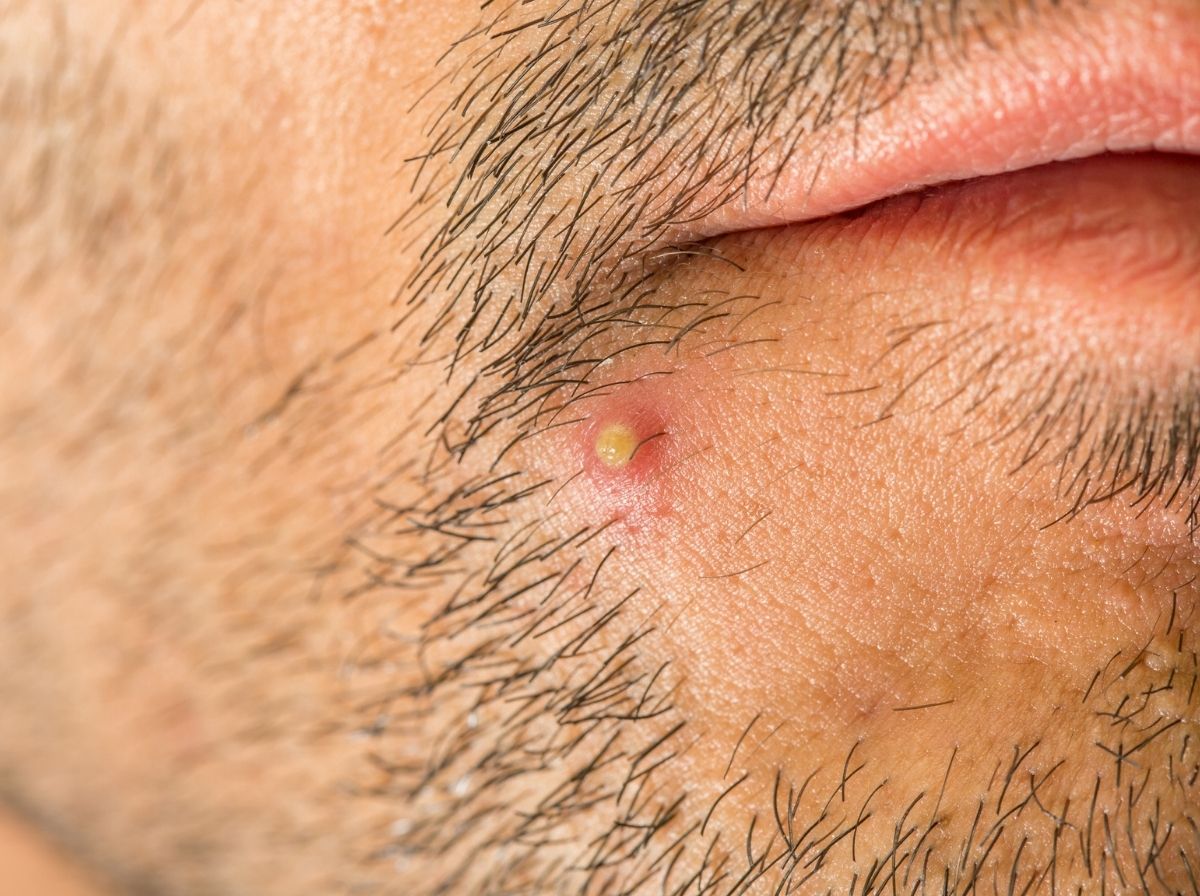
| Genital Herpes HSV-2 | 2–12 days (avg. 4) | Blisters or sores, tingling/burning in skin, possible flu-like symptoms | Ingrown hair, razor bumps, skin irritation |
| Trichomoniasis | 5–28 days | Frothy yellow-green discharge, strong odor, itching, and soreness | BV, yeast infection |
When Symptoms at One Week Are About Anxiety, Not Infection
Before going further into specific causes, one pattern needs addressing plainly, because it explains a meaningful portion of week-long symptoms, and it's almost never mentioned in medical articles: the symptom that is real in sensation but has no detectable physical cause.
The body's stress response amplifies pain and sensation perception throughout the pelvis. Cortisol and adrenaline lower the threshold at which nerve endings register normal physical sensation as discomfort. In practical terms, the slight urethral awareness that's always there and usually ignored becomes, under sustained anxiety about a sexual exposure, something that registers as burning. Mild vaginal sensitivity that's entirely normal becomes something that feels like it might be a symptom. This isn't fabrication; the nerve signals are real. The cause is stress rather than infection.
The distinguishing characteristic of anxiety-amplified sensation versus actual infection is consistency and progression. A real infection has a stable, localized, progressively worsening pattern. It doesn't shift location hour to hour. It doesn't improve when you're distracted and return when you think about it again. It doesn't feel different depending on whether you just read something frightening online. Anxiety-amplified sensation does all of those things; it varies with attention, fluctuates with stress levels, and often has no fixed location or consistent character. If the symptom you're tracking genuinely shifts and fades depending on how much you're thinking about it, that's diagnostically meaningful information pointing away from infection.
This isn't a reason to dismiss what you're feeling. It's a reason to apply the framework in this article rather than cycling through new OTC products or catastrophic interpretations. Test at the correct window, address any identifiable non-STD condition, and stop checking symptoms every hour. The checking perpetuates the anxiety cycle, which perpetuates the sensation, which increases the checking. The fastest way out of that loop is an actual result, not more monitoring.
Check Your STD Status in Minutes
Test at Home with Remedium3-in-1 STD Test Kit
 For Men & Women
 Results in Minutes
 No Lab Needed
 Private & Discreet
Order Now $69.00 $147.00
For all 3 tests
When the Original Condition Just Didn't Clear
A significant portion of people with week-long post-sex symptoms are dealing with a non-STD condition that was either misidentified from the start or undertreated. Bacterial vaginosis treated with an OTC yeast product will not clear in a week because the wrong treatment was used, BV is a bacterial imbalance, not a fungal one, and antifungals do nothing for it. A yeast infection treated with a one-day dose may linger for 5 to 7 days before fully resolving, or may not clear at all if the infection was moderate to severe. A UTI left untreated or incompletely treated will not only persist but potentially worsen.
The pattern to look for is directional change. A non-STD condition on its way out behaves differently from one that's stuck or escalating. BV resolving means progressively less discharge and improving odor. A yeast infection clearing means reducing itching and normalizing discharge texture. A healing friction irritation feels progressively less raw and tender. If the symptom at day 7 is trending in the right direction, less intense, less frequent, less bothersome, that's a meaningful signal that whatever it is, it's finishing, not escalating.
The symptom that concerns clinicians at one week is the one that isn't trending down. Itching that's the same or worse. Discharge that hasn't changed in character or quantity. Burning during urination that was present on day 2 and is just as sharp on day 7. That pattern of flat or worsening persistence is the clearest signal that something is either being undertreated or was misidentified from the start, and that the right next move isn't a second round of the same OTC product.
The Treatment Failure Problem: When You Tried Something, and It Didn't Work
One of the most common scenarios behind a week-long post-sex symptom: something appeared a few days after sex, you identified it as a yeast infection or a UTI, treated it with an OTC product, and it either didn't fully resolve or came back almost immediately. This pattern is extremely common in health forums and it has a consistent explanation.
OTC yeast infection treatments work well for classic Candida overgrowth, but they do nothing for BV, trichomoniasis, or gonorrhea, all of which can present with symptoms that overlap significantly with a yeast infection. If you're dealing with a frothy or off-colored discharge alongside itching and the yeast treatment didn't help, trichomoniasis is a strong candidate that an OTC antifungal will never address. BV requires prescription antibiotics targeting the specific anaerobic bacteria involved. And if there's any STD component, even a silent one, no OTC product touches it.
The UTI path has a similar failure mode. OTC UTI test strips measure for white blood cells and nitrites, markers of bacterial bladder infection. They don't detect gonorrhea, chlamydia, or any STD. A person with early gonorrhea or chlamydia causing urethral symptoms may test negative on a UTI strip, technically accurate, since they don't have a bladder infection, but still have an active STD requiring a completely different type of test to identify. This mismatch is why "treated for UTI, still have symptoms at one week" is one of the most common presentations in sexual health clinics.
The practical implication is simple: if you've already tried an OTC treatment and you're at one week with symptoms still present, the OTC phase of this situation is over. Whatever is causing these symptoms has either resisted the treatment or was something the treatment was never designed to address. At this point, you need information that only proper testing can provide.
People are also reading: Burning, Itching, or Discharge 3 Days After Sex? Here's What It Actually Means
What About Symptoms After Oral or Anal Sex?
Most post-sex symptom content is written with vaginal intercourse in mind, which leaves a lot of people Googling week-long symptoms from a different type of exposure with no useful frame of reference.
Oral sex carries real STD transmission risk for several infections, and the symptom picture at one week looks different. A sore throat that developed 3 to 7 days after giving oral sex and hasn't resolved is a recognized presentation of pharyngeal gonorrhea, gonorrhea of the throat. Pharyngeal gonorrhea is frequently asymptomatic, but when it does produce symptoms, persistent soreness, mild swelling, or discharge at the back of the throat are the most common ones. It's routinely dismissed as a standard sore throat or dismissed as post-nasal drip. If the timing lines up with a recent oral encounter, it's worth testing specifically for throat gonorrhea, which requires a throat swab rather than a standard urine or genital test. Chlamydia can also infect the throat, though symptomatic pharyngeal chlamydia is less common. Herpes can be transmitted orally, and a week-long sore or cluster of blisters inside or around the mouth following oral sex should not be assumed to be a standard cold sore without proper testing.
After anal sex, week-long rectal symptoms, persistent discomfort, discharge, or a feeling of internal irritation that isn't resolving can indicate rectal gonorrhea or rectal chlamydia. Both are frequently asymptomatic, but when symptoms do appear, they include rectal discharge, discomfort with bowel movements, and localized soreness. Standard urine STD tests do not capture rectal infections; a rectal swab is required. This is a gap in at-home rapid testing that's worth knowing: if the exposure was anal and rectal symptoms are present at one week, a clinical evaluation with appropriate site-specific testing is the right call alongside at-home blood-based testing.
What Your Symptoms at One Week Are Actually Telling You, and What to Do Next
At one week out, your symptoms are either winding down, holding steady, or escalating. Each pattern points in a different direction, and the right response depends on reading which lane you're in accurately.
If itching started a few days ago and has intensified, combined with a discharge that's either cottage-cheese textured or frothy and strong-smelling, you're in territory that requires differentiation between yeast, BV, and trichomoniasis. All three look similar and feel similar, but they require completely different treatments, a yeast treatment does nothing for BV or trich, and BV antibiotics do nothing for trich. One week of worsening symptoms means self-diagnosis has run its course. A proper test is the only way forward. Trichomoniasis is detectable right now when symptoms are active, so there's no reason to wait.
If you have a penis and there's a visible discharge from the urethra alongside burning, this is not a pattern to sit with at one week. Gonorrhea in men produces this presentation within the first 1 to 2 weeks and doesn't improve without treatment. Untreated gonorrhea can progress to epididymitis, with real consequences for fertility. Evaluation now, not waiting for a longer testing window.
If you're noticing sores, blisters, or unusual skin changes in the genital area that weren't there before, herpes is the most plausible new-onset STD at the one-week mark given its incubation timeline. The critical thing to understand is that the first outbreak is also when a swab test is most accurate, the virus is shedding actively from the lesions. Waiting for lesions to heal before testing means missing the window where a swab gives the most direct result. Test now, not later.
If the symptom is purely systemic, fatigue, body aches, mild fever, sore throat, without any localized genital symptom: the picture at one week is far more consistent with a coincidental viral illness than with an STD's acute phase. HIV's acute phase typically begins 2 to 4 weeks after transmission, not at day 7, so flu-like symptoms alone at one week are very unlikely to reflect a new HIV infection. If a rash develops alongside systemic symptoms at 2 to 4 weeks post-exposure, that combination becomes more relevant to the HIV timeline. At one week, it doesn't yet. Plan an HIV test at the 6-week window regardless of current symptoms. A conclusive result at 6 weeks, with a retest at 12 weeks for complete certainty, is the only reliable answer.
If you have genuinely no symptoms but you're here because of an exposure you're worried about, symptoms are an unreliable guide to infection status. According to provisional CDC surveillance data released in September 2025, over 2.2 million cases of chlamydia, gonorrhea, and syphilis were reported in the United States in 2024, and the vast majority were carried asymptomatically for some period before diagnosis. Even with declining case numbers, down 9% from 2023 in the third consecutive year of decreases, the absolute burden remains over 13% higher than a decade ago. Testing at the correct window is the only reliable way to know your actual status.
| Infection | Test From | At One Week: Test Now or Wait? |
|---|---|---|
| Chlamydia | 14 days after exposure | Wait until day 14 for a reliable result; symptoms now warrant testing then |
| Gonorrhea | 3 weeks after exposure | Symptomatic men should seek evaluation now; full window at 3 weeks |
| Herpes HSV-1 & HSV-2 | 6 weeks after exposure (blood); swab if sores are active | Swab active sores now if present, most accurate during outbreak; blood test at 6 weeks |
| Trichomoniasis | Detectable when symptomatic | Test now, active symptoms make detection reliable |
| Syphilis | 6 weeks after exposure | Too early for blood test; wait for full window |
| HIV | 6 weeks (first indicator); 12 weeks for certainty | Too early for reliable result; plan test at 6 weeks |
| Hepatitis B | 6 weeks after exposure | Too early; plan test at 6 weeks |
| Hepatitis C | 8–11 weeks after exposure | Too early; plan test at 8–11 weeks |
The most efficient approach: test now with an at-home rapid kit for the infections in their detectable window, and calendar follow-up tests for the ones that need more time. The Complete 8-in-1 Rapid Test Kit covers HSV-1, HSV-2, Chlamydia, Gonorrhea, Syphilis, HIV, Hepatitis B, and Hepatitis C with 99% accuracy from a single at-home test, results in minutes, no clinic, no waiting room. Whatever comes back positive gets treated. Whatever comes back negative at this stage gets rechecked at the full window. That's the complete plan.
FAQs
1. I still have burning a week after sex. Should I be worried about an STD?
At one week, burning that hasn't resolved is worth investigating rather than waiting out. Friction irritation and mild post-sex UTIs should have improved or resolved by now. Chlamydia and gonorrhea can both produce urethral burning in their early symptomatic phase, which begins around the one-week mark. Testing at the correct window, day 14 for chlamydia, 3 weeks for gonorrhea, is the right next step, alongside ruling out a persistent UTI or BV with a proper assessment rather than another round of the same OTC treatment.
2. I treated what I thought was a yeast infection, and it didn't clear. What now?
If an OTC antifungal didn't clear symptoms in 5 to 7 days, either the infection was severe enough to need a longer or stronger course, or what you have isn't a yeast infection. Bacterial vaginosis, trichomoniasis, and gonorrhea can all mimic yeast infection symptoms closely enough to fool an OTC self-diagnosis. BV requires prescription antibiotics; trichomoniasis requires a specific antibiotic, not an antifungal; and gonorrhea won't respond to either. The smart move at this point is a test that identifies what's actually present, not a second OTC treatment that might be for the wrong thing entirely.
3. Can herpes actually show up one week after sex?
Yes, and one week is actually one of the most common timing windows for a first outbreak. The average incubation for genital herpes is around 4 days, with a range of 2 to 12 days. A first outbreak beginning anywhere from day 5 to day 10 is entirely within normal timing. The first outbreak is typically the most severe, with blisters or sores, possible flu-like symptoms, and significant genital discomfort. If that's what you're experiencing at one week, a swab of an active sore is the most accurate diagnostic tool available right now, more reliable at this stage than a blood test.
4. I have discharge that's different, and it won't go away. What could it be at one week?
Discharge that changed after sex and hasn't normalized after a week points to one of four things: BV, trichomoniasis, gonorrhea, or early chlamydia. The character of the discharge helps distinguish them: thin, grey, and fishy-smelling suggests BV; frothy, yellow-green, and odorous suggests trichomoniasis; thick, cloudy, or yellowish suggests gonorrhea. Chlamydia's discharge change, when present, is usually subtle and watery. None of these resolves reliably without identification and the right treatment. A test at the correct window tells you which one you're dealing with.
5. Is it too early to test for STDs at one week?
It depends on the infection. Trichomoniasis is testable when symptoms are present, so week one works. Chlamydia is reliable from day 14. Gonorrhea has a full window at 3 weeks, though symptomatic men should seek evaluation sooner. Herpes can be detected via swab from an active sore at any point during an outbreak. Syphilis, HIV, and hepatitis B each need 6 weeks minimum; hepatitis C needs 8 to 11 weeks. Testing now for what's detectable and planning follow-ups for what isn't is the most practical approach.
6. I have flu-like symptoms one week after sex. Could this be HIV?
At one week, this is very unlikely to be HIV's acute phase, which typically begins 2 to 4 weeks after transmission, not at 7 days. Flu-like symptoms at one week are far more likely to be a coincidental viral illness or anxiety-producing physical symptoms. That said, if you had a genuine HIV exposure risk, don't rely on timing alone to dismiss it, plan a proper test at the 6-week window. A test at 6 weeks followed by a retest at 12 weeks gives you a reliable answer, which no amount of symptom monitoring can.
7. I had oral sex. Could a sore throat one week later be an STD?
Yes, pharyngeal gonorrhea is a real and underdiagnosed infection that can produce a persistent sore throat 3 to 7 days after giving oral sex. It's often dismissed as a standard throat infection. If your sore throat appeared in that post-exposure window and hasn't resolved, it's worth specifically requesting a throat swab for gonorrhea rather than assuming it's a common cold. Pharyngeal chlamydia is less common but also possible. Standard genital STD tests don't cover throat infections; site-specific swabbing is required.
8. My partner just told me they tested positive. I had sex with them a week ago, and I feel fine. Do I need to test?
Yes, without question. Feeling fine means very little when it comes to STDs; chlamydia produces no symptoms in roughly 70% of women, gonorrhea is asymptomatic in up to 50% of women, and trichomoniasis is asymptomatic in about 70% of infected people overall. A confirmed exposure means testing at the correct window is not optional; it's the only way to know your status and make informed decisions about treatment and partner communication.
9. How long should friction irritation or a condom reaction last? When does it become suspicious?
Friction irritation typically peaks within 24 to 48 hours and resolves within 3 to 4 days. A condom sensitivity or latex reaction follows a similar timeline, with localized redness and itching that fades as the allergen clears the skin. If external irritation is still present and unchanged at one week, it has outlasted the natural recovery window for those causes. At that point, either the tissue was injured more significantly than typical friction, there's an underlying skin condition, or something else is driving the persistent symptom, and testing becomes the appropriate next step.
10. Can symptoms from sex come and go for a week and still not be an STD?
Yes, but the pattern matters. Symptoms that vary throughout the day, better when you're distracted, worse when you're anxious, shifting in character and location, are more consistent with anxiety-amplified sensation than with infection. Real infections produce consistent, localized, progressively worsening symptoms that don't respond to distraction. That said, trichomoniasis is specifically known for symptoms that come and go, which makes it harder to track. Intermittent or not, a test provides more useful information than symptom interpretation alone.
Test What's There. Plan for What Isn't Yet.
A week of symptoms after sex is your body asking you to stop guessing and start getting answers. Whether what you're dealing with is a stubborn non-STD condition that needs the right treatment, an early chlamydia or gonorrhea infection making itself known, a first herpes outbreak that needs identification, or trichomoniasis that's been flying under the radar, none of those get better by waiting. They get better with accurate information and the right response to it.
The Complete 8-in-1 Rapid Test Kit tests for HSV-1, HSV-2, Chlamydia, Gonorrhea, Syphilis, HIV, Hepatitis B, and Hepatitis C with 99% accuracy from a single at-home test, results in minutes, no clinic, no waiting room. For women who want full coverage including trichomoniasis and HPV, the Women's 10-in-1 Complete Kit covers all ten of the most common infections in one test. And if you want to start with the bacterial infections most commonly transmitted through unprotected sex, the Chlamydia, Gonorrhea & Syphilis 3-in-1 Kit covers those three with 99.5% accuracy. Visit STD Rapid Test Kits to find the right test for where you are right now, your results, your privacy, your next step.
How We Sourced This: Our article was constructed based on current advice from the most prominent public health and medical organizations, and then molded into simple language based on the situations that people actually experience, such as treatment, reinfection by a partner, no-symptom exposure, and the uncomfortable question of whether it "came back." In the background, our pool of research included more diverse public health advice, clinical advice, and medical references, but the following are the most pertinent and useful for readers who want to verify our claims for themselves.
Sources
1. CDC, Sexually Transmitted Infections Surveillance, 2024 (Provisional)
3. Mayo Clinic, Sexually Transmitted Disease (STD) Symptoms
4. Mayo Clinic, Trichomoniasis, Diagnosis and Treatment
5. MedlinePlus, Chlamydia Infections
6. Planned Parenthood, What Are the Symptoms of Trichomoniasis?
About the Author
Dr. F. David, MD is a board-certified infectious disease specialist focused on STI prevention, diagnosis, and treatment. He writes with a direct, sex-positive, stigma-free approach designed to help readers get clear answers without the panic spiral.
Reviewed by: Rapid STD Test Kits Medical Review Team | Last medically reviewed: April 2026
This article is for informational purposes and does not replace medical advice.


