
Published: September 2025 | Last updated: May 2026 | Editorial review and quality control: Martina N.
Three days after sex and something feels different. Maybe it burns when you pee. Maybe there is a new itch, or unfamiliar discharge, or just a vague sense that something is not quite right. The first instinct, especially at 2 a.m. with a search engine open, is to assume the worst. The biology says otherwise.
The 3-day window is a strange one. It is too early for most STDs to have produced symptoms, but it is exactly the right window for several common conditions that sex itself can trigger. This article walks through each of those causes, gives you a clear way to tell them apart, and shows you when to test for STDs at the right window rather than the wrong one.
Key Takeaways
- Three days is too soon for most STDs to produce symptoms. The biology of incubation puts chlamydia, herpes, HIV, and syphilis well outside this window.
- What you are most likely experiencing at 3 days is a UTI, bacterial vaginosis, a yeast infection, friction irritation, or a condom reaction. Each one has a different fix, and self-diagnosis has a real error rate.
Why 3 Days Is a Biological Gray Zone for STD Symptoms
Every STD has an incubation period, the time between exposure and noticeable symptoms. For most common infections, that window is longer than three days. Per CDC guidance, chlamydia typically takes 7 to 21 days before any symptoms appear, gonorrhea ranges from 2 to 14 days, herpes averages 4 to 7 days before vesicles form, HIV's acute flu-like phase usually arrives 2 to 4 weeks after transmission, and syphilis takes 3 weeks on average (with an outer range of 10 to 90 days) before the first sore appears.
What this means practically: if you had sex 3 days ago and you are feeling something now, the biology of STD transmission makes it unlikely that an STD is the direct cause of your current symptoms. The pathogen needs time to replicate, establish itself in host tissue, and trigger an immune response before your body produces the discharge, burning, or irritation you can actually feel.
That said, unlikely is not impossible. A small subset of gonorrhea cases in men show symptoms within 2 to 5 days. And if you had a pre-existing, undetected infection before this encounter, what feels like a new symptom may be an older one becoming noticeable. These are edge cases. The much more probable explanation, in most cases, is one of several common conditions that sex itself can trigger or worsen, none of which are sexually transmitted.

The Most Common Culprit: Friction, Irritation, and Micro-Trauma
Sex is a physical act. Sometimes it is rough. Sometimes there is not enough natural or added lubrication. Sometimes a new position puts pressure on tissue that is not used to the contact. The result, a burning or chafed feeling for a few days afterward, is one of the most frequently searched post-sex symptoms and one of the most benign explanations available.
The urethra and surrounding tissue are delicate. Vigorous sex can create micro-abrasions, small surface tears in the mucous membrane that do not bleed and are not visible to the naked eye but that sting when urine passes over them. This is why the burning feels sharp during urination, often within 24 to 72 hours after sex. The sensation can mimic a UTI or an STD. The distinguishing detail is location: if the burning is at the opening of the urethra or on the surrounding skin rather than deep in the bladder, and there is no fever or constant urgency, friction is a plausible explanation.
For people with a vulva, the labia and vaginal opening are especially susceptible to friction-related irritation. This presents as a raw, tender, or slightly swollen feeling rather than a deep internal burn. The tissue usually settles back down within 2 to 4 days. The key signal is direction of travel: irritation from friction improves on its own. If symptoms are getting worse over 48 hours rather than better, something else is going on.
Condoms can be the irritant too. Latex sensitivities are more common than most people realize, and even a mild reaction (not a full allergy) can produce localized itching, redness, and burning that peaks 1 to 3 days after exposure. Spermicides, flavored lubricants, scented condoms, and warming or tingling products are all common culprits. If this was a new brand, or a product you do not normally use, consider that before assuming infection.
Is It a UTI? What Happens to Your Urinary Tract After Sex
If the burning is internal and intensifies during urination, a urinary tract infection triggered by sex is one of the most probable explanations at the 3-day mark. Post-sex UTIs are so common they have an unofficial nickname: honeymoon cystitis. They are not sexually transmitted infections. Sex causes them through physical mechanics rather than pathogen transmission.
During intercourse, bacteria that live naturally around the vaginal and rectal areas can be pushed toward the urethra. From there, they can travel up into the bladder, multiply, and cause infection. UTI symptoms commonly emerge within 24 to 72 hours after sex, which puts the 3-day mark squarely inside the typical window for symptom onset. The classic combination: persistent burning during urination, a strong urge to urinate even when the bladder is nearly empty, cloudy or strong-smelling urine, and pelvic pressure in the lower abdomen.
The clearest difference between a UTI and an STD symptom at this stage is the texture of the discomfort. A UTI is almost entirely urinary; it burns when you pee, you feel like you need to go constantly, and the discomfort centers around the bladder. STD symptoms, when they do appear later, more often involve genital discharge, sores, or burning that extends beyond the act of urinating. If your main symptom is the textbook burning-pee-plus-constant-urgency combination, a UTI is statistically the far more probable cause than an STD at 3 days post-exposure.
UTIs are also straightforward to address. An over-the-counter UTI test strip can give you a preliminary answer in minutes. If it comes back positive, or symptoms worsen, see a healthcare provider promptly. Untreated UTIs can progress to kidney infections within days, so this is not something to ride out indefinitely. The NHS cystitis guide covers self-care steps that help while you arrange care.
A UTI is centered in the bladder and dominates urination itself. STD symptoms more often involve a new genital discharge, sores, or a burning sensation that lasts beyond the act of peeing. If your symptom is purely the burning-pee-plus-urgency combination, a UTI is the far more probable cause at 3 days, and an OTC UTI test strip gives a useful first read in minutes.
Bacterial Vaginosis: The Infection Sex Triggers That Is Not an STD
Bacterial vaginosis is the most commonly misunderstood post-sex condition, and it appears at almost exactly the 3-day mark after a new sexual encounter. BV is not a sexually transmitted infection, even though sex can trigger it. That overlap is part of why BV gets so frequently confused with an STD.
The vagina maintains a careful ecosystem of bacteria, dominated by lactobacilli that keep the environment mildly acidic. Semen has an alkaline pH, and when it enters the vaginal canal, it temporarily disrupts that acidic balance. For many people, this has no noticeable effect. For others, particularly those with a new partner, a more frequent sex schedule than usual, or an already slightly disrupted microbiome, the pH shift is enough to cause an overgrowth of anaerobic bacteria, which is the definition of BV.
When BV does produce noticeable symptoms, the CDC BV fact sheet lists several to watch for, including a thin gray or white vaginal discharge, a strong fishy odor (often more noticeable after sex), vaginal itching, and a burning sensation during urination. The NHS notes that BV does not usually cause significant soreness or itching on its own. If those symptoms are prominent alongside discharge, a concurrent yeast infection may be in the picture. BV almost never produces sores, blisters, or the thick cottage-cheese-like discharge associated with yeast.
The timing matters: BV can develop within 2 to 3 days of a new sexual encounter, which makes it one of the most plausible explanations for symptoms at the 3-day mark. CDC data shows that many people with BV have no symptoms at all, so if you do have symptoms, you are already in the minority. BV needs a prescription antibiotic to clear up reliably. It will not resolve with an over-the-counter yeast treatment, which is one of the most common and frustrating mismatches people run into when self-diagnosing.
Many people with BV do not have symptoms.
Could It Be a Yeast Infection? Why Sex Sets Them Off
Yeast infections are not STDs. They are caused by an overgrowth of Candida, a fungus that already exists in the vaginal environment, and sex is one of the most common triggers for setting that overgrowth in motion. The mechanism is similar to BV: the vaginal pH and microbiome shift, and yeast multiplies faster than the body can regulate it.
Yeast infection symptoms are distinct enough that, once you know what to look for, they are usually recognizable. The hallmarks are intense itching in and around the vagina, a thick white odorless discharge that resembles cottage cheese, redness and swelling of the vulva, and a burning sensation that worsens during urination or sex. The itching is typically more pronounced than what you would experience with BV or friction; it can be relentless and hard to ignore.
Sex triggers yeast infections in several ways. Oral sex can introduce Candida from the mouth to the genitals. Semen's alkaline pH disrupts vaginal acidity. Friction and warmth from intercourse create conditions where yeast thrives. If you recently took antibiotics, even a course that ended before this encounter, your lactobacilli may still be depleted, leaving you more vulnerable to overgrowth. Some people are simply more prone to post-sex yeast infections than others due to hormonal patterns or microbiome composition.
The good news is that a straightforward yeast infection is usually treatable with an over-the-counter antifungal. The frustrating news is that yeast symptoms overlap with several STDs, particularly trichomoniasis and early-stage gonorrhea, which is exactly why self-diagnosis has a meaningful error rate. If you treat for yeast and symptoms have not resolved in 3 to 7 days, or this keeps recurring after sex with a particular partner, it is worth getting properly tested rather than cycling through OTC treatments.
Yeast: intense itching plus a thick, white, odorless cottage-cheese-textured discharge. BV: milder itch plus a thin gray discharge plus a fishy odor that gets stronger after sex. The treatment is different for each, which is why getting the diagnosis right matters before reaching for the pharmacy aisle.
If You Have a Penis: What 3-Day Symptoms Mean for You
Most post-sex symptom content online is written with a vagina in mind, which leaves a lot of men searching for burning and discharge 3 days after sex with no useful frame of reference. The picture looks different for people with a penis, and it deserves its own section.
First, the big one: the non-STD conditions that dominate the female experience at 3 days (BV, yeast, pH disruption) do not apply in the same way to male anatomy. Men can get yeast infections, but they are less common and present differently. Redness, itching, or a rash on the head of the penis, sometimes with a white discharge under the foreskin. This is typically the same Candida overgrowth as a vaginal yeast infection and can pass back and forth between partners during sex. It is not an STD. If your female partner keeps getting yeast infections after sex with you, this is worth investigating together.
Friction irritation is real for men too, especially with vigorous sex or insufficient lubrication. The frenulum and glans are sensitive tissue, and micro-abrasions there can produce a raw, tender feeling for 2 to 4 days that improves on its own. A condom or lubricant sensitivity can produce localized redness and itching on the shaft or glans that peaks 1 to 3 days post-exposure and then fades.
The symptom in men that does deserve faster attention at 3 days is urethral discharge alongside burning. A new discharge from the tip of the penis combined with a burning sensation during urination, especially if the discharge is cloudy, yellow, or greenish, fits a presentation that gonorrhea can produce within 2 to 5 days of exposure in men. This is meaningfully different from every other symptom on this list. It does not mean wait for a testing window. It means get evaluated promptly. Early gonorrhea responds well to antibiotic treatment, but left untreated, it can progress to epididymitis and testicular complications. If you are also experiencing testicular or scrotal pain 3 days after sex, that warrants the same level of urgency.
For men with no discharge, just a vague burning or discomfort during urination, a post-sex UTI is less common in male anatomy but not impossible, particularly in men over 50 or those with any urinary history. More often in men, this presentation points toward friction-related urethral irritation, or, if the timeline extends beyond a week, toward chlamydia or gonorrhea that has not yet fully declared itself. The practical answer is the same: test at the correct window and do not wait for symptoms to confirm what the test will tell you anyway.
Cloudy, yellow, or greenish discharge from the penis plus burning during urination at 3 days post-exposure fits a presentation gonorrhea can produce this early in men. Seek prompt clinical evaluation rather than waiting out the standard 3-week testing window. Early gonorrhea responds well to antibiotic treatment.
When Symptoms at 3 Days Might Actually Be STD-Related
Most post-sex symptoms at 3 days are not STD symptoms, but a few specific scenarios deserve straight talk because they are the ones where an STD genuinely does enter the picture.
The first is gonorrhea in men. In people with a penis, gonorrhea can produce a thick, cloudy urethral discharge and burning during urination in as few as 2 to 5 days after exposure. If you are male-bodied and experiencing visible discharge alongside burning, a gonorrhea exposure 3 days ago is biologically consistent and warrants prompt evaluation rather than a wait-and-see approach.
The second is a pre-existing, undetected infection. A large proportion of the most common STDs produce no symptoms at all, or symptoms so mild they go unnoticed. CDC clinical guidance emphasizes that infections like chlamydia frequently produce no noticeable symptoms in the people who carry them. If you had an undetected infection before this most recent encounter, the physical activity of sex itself can sometimes irritate infected tissue enough to amplify symptoms. What feels like a new symptom may actually be an older infection finally making itself known.
The third is trichomoniasis, a parasitic STD with an incubation period of 5 to 28 days. While 3 days is on the early end, some people begin to notice the first faint signs (slight discharge change, mild internal itch) in the 3 to 5 day window. Trichomoniasis is one of the most underdiagnosed STDs precisely because its symptoms mimic BV and yeast so closely.
A note on the worry most readers actually have: HIV. Three days is too early to feel HIV symptoms and too early for any current test to detect it. HIV's acute flu-like phase typically arrives 2 to 4 weeks post-transmission, and the CDC's recommended window for a conclusive HIV result with a fourth-generation antigen/antibody test is roughly 45 days, with retesting at 12 weeks for definitive confirmation. Single-exposure transmission risk from most sexual acts is low in absolute terms, and there is no useful action at 3 days other than to put the right testing dates on a calendar. If the encounter was very high-risk (a known HIV-positive partner without viral suppression, a needle-related exposure), post-exposure prophylaxis (PEP) is time-sensitive and must be started within 72 hours; that decision needs a clinician, not a search engine.
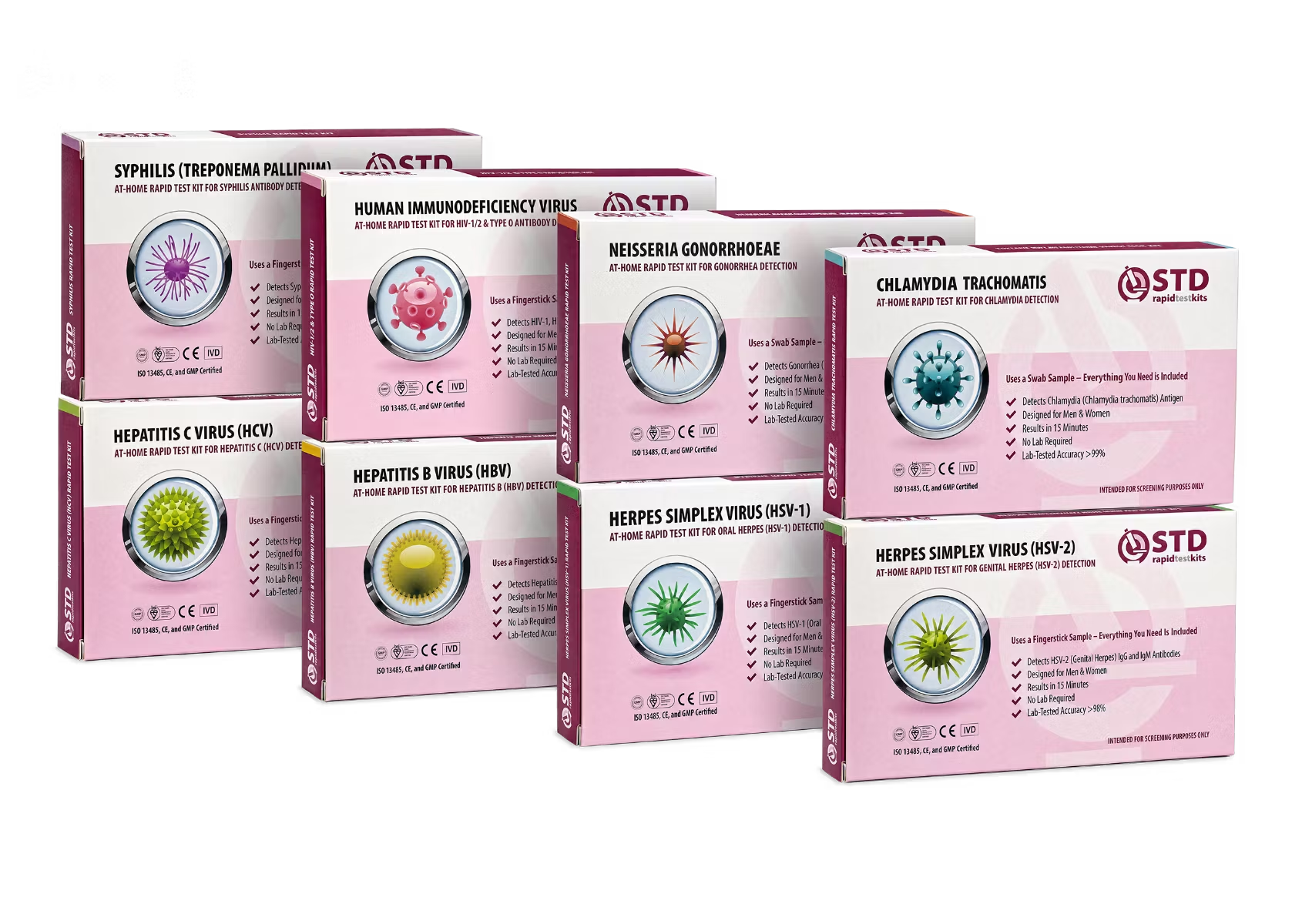
A note on what this site sells: stdrapidtestkits.com offers at-home rapid lateral-flow STI test kits. The panel below covers the eight most common infections. Use it at the correct window for each infection rather than at 3 days, when most STIs cannot yet be detected. We recommend products based on fit for the reader's concern, not commercial benefit.
| Symptom | Most likely cause at 3 days | Action |
|---|---|---|
| Burning when peeing, urgency to urinate | UTI triggered by sex | OTC test strip now; see provider if positive |
| Thin gray discharge, fishy odor after sex | Bacterial vaginosis (BV), not an STD | See provider for antibiotic prescription |
| Thick white odorless discharge, intense itching | Yeast infection, not an STD | OTC antifungal; test for trich if it does not clear |
| External rawness, redness, tenderness only | Friction irritation or condom/lubricant reaction | Monitor; should improve within 4 days |
| Cloudy or yellow discharge from penis + burning | Gonorrhea, can appear 2 to 5 days post-exposure in men | Seek evaluation now; do not wait for window |
| Mild internal itch, slight discharge change | BV, yeast, or early trichomoniasis | Test for BV/yeast now; STD test at correct window |
| No symptoms at all | Most common outcome; most STDs are asymptomatic | Still test at correct window after any exposure risk |
The Testing Section: When, What, and Why the Timing Matters
Here is where a lot of people make a mistake. They either test immediately after exposure (before any STD would be detectable) and get a false negative, or they assume that because symptoms have not appeared, they are in the clear. Neither approach is right. STD testing has specific window periods, the minimum time after exposure before a test can reliably detect an infection. Testing before that window closes gives results you cannot trust.
If your symptoms at 3 days point toward a UTI, BV, or yeast infection, address those now. They do not require a waiting period. Get tested or treated through a healthcare provider or urgent care. But if there was a genuine STD exposure risk, mark your calendar for the correct testing windows below and test at those times regardless of whether symptoms appear.
| Infection | Test from | Notes |
|---|---|---|
| Chlamydia | 14 days after exposure | Most common bacterial STD; often zero symptoms |
| Gonorrhea | 3 weeks after exposure | Can show symptoms earlier in men; still test at window |
| Syphilis | 6 weeks after exposure | First sore (chancre) may appear before this window |
| HIV | 6 weeks (first indicator); retest at 12 weeks for certainty | Acute flu-like phase usually 2 to 4 weeks post-transmission |
| Herpes HSV-1 and HSV-2 | 6 weeks after exposure | Most people never have visible symptoms |
| Hepatitis B | 6 weeks after exposure | Vaccine-preventable; check your vaccination status |
| Hepatitis C | 8 to 11 weeks after exposure | Often asymptomatic for years |
What to Do Right Now, Based on Your Symptoms
Three days after sex and something is off. The right next step depends on what you are actually experiencing. Here is a practical breakdown that lets you act on the information in this article without panic and without burying your head in the sand.
If the main symptom is burning when you pee combined with a constant urgent need to urinate, treat this as a probable post-sex UTI. Pick up a UTI test strip from a pharmacy, drink water consistently, and see a healthcare provider if the test comes back positive or symptoms worsen within 24 hours. Do not wait out a UTI; it can escalate to a kidney infection within days if left untreated.
If you are noticing a gray or off-white vaginal discharge with a fishy odor, especially one that gets stronger after sex, this is the classic presentation of bacterial vaginosis. BV will not resolve with an OTC yeast treatment. You need a proper diagnosis and a prescription antibiotic from a healthcare provider rather than guessing at a fix from the pharmacy aisle.
If the dominant experience is intense itching alongside thick white discharge with little or no odor, a yeast infection triggered by the encounter is likely. OTC antifungals are a reasonable first step. If this is a recurring pattern, a yeast infection after every encounter with a particular partner, that pattern deserves a deeper conversation with a healthcare provider.
If you are experiencing rawness, tenderness, or external irritation without any discharge change, friction or a condom sensitivity reaction is the most probable explanation. Give it a few days, avoid further irritation, and monitor whether it improves. It should. If it does not, or a rash develops, see a provider.
And if your symptom is a visible discharge from the penis alongside burning at 3 days post-exposure, particularly a discharge that is thick, cloudy, or yellow-green, do not wait for a testing window. Seek evaluation promptly. Gonorrhea in men can produce symptoms this early and responds well to early antibiotic treatment.
- Burning when peeing plus urgency: probable UTI. Try an OTC test strip; see a provider if positive.
- Gray or off-white fishy discharge: probable BV. Book a provider for a prescription antibiotic.
- Thick white odorless discharge plus intense itching: probable yeast. OTC antifungal as first step.
- Raw or tender skin only, no discharge: probable friction or condom reaction. Monitor; should improve within 4 days.
- Cloudy or yellow discharge from penis plus burning: possible gonorrhea. Seek evaluation now; do not wait for the testing window.
The Anxiety Factor Nobody Talks About
One more cause of post-sex physical symptoms almost never makes it into medical articles: the measurable physical effect of anxiety on genital sensation. This is not speculative. It is grounded in how the nervous system works.
Under stress, cortisol and adrenaline elevate the sensitivity of pain receptors throughout the body, including in the pelvic region. This is well-documented in chronic pelvic pain research: psychological stress lowers the threshold at which nerve endings register sensation as discomfort. In practical terms, mild and entirely normal post-sex sensations (slight tenderness, a faint awareness of the urethral area, minor vaginal sensitivity) can register as significantly more alarming under the amplifying effect of anxiety than they would on an ordinary day. The sensation is real. The neurological mechanism is real. The cause, however, is stress rather than infection.
The 3-day post-sex window is the peak of post-exposure anxiety for most people, which is exactly when this effect is most pronounced. Symptoms that shift location, intensify when you focus on them, vary hour to hour, or feel different every time you check are patterns more consistent with anxiety-amplified normal sensation than with the consistent, localized, progressively worsening pattern of an actual infection. A UTI gets worse over time, not better when you are distracted. BV discharge does not disappear when you stop thinking about it. Real infection symptoms are stubborn and consistent in a way that anxiety-produced ones typically are not.
This does not mean dismiss what you feel. The right response is to apply the triage framework above. Address identifiable symptoms directly and book an STD test at the correct window. Between now and those results, give yourself permission to stop checking and stop cataloging every sensation in the region.
Real infection symptoms are consistent and progressively worsen over time. Anxiety-amplified sensations shift location, intensify when you focus on them, and vary when your attention is elsewhere. If a sensation feels different every time you check on it, that is information about your nervous system, not about an infection.
FAQs
- Can STD symptoms really show up just three days after sex?
- Very rarely, and effectively only for gonorrhea in men. Every other common STI takes longer than three days to produce symptoms: chlamydia needs at least a week, herpes 4 to 7 days, HIV 2 to 4 weeks, syphilis 3 weeks on average. At three days, the far more probable causes are a UTI, bacterial vaginosis, a yeast infection, or friction irritation.
- Can sex change my discharge even when I do not have an STD?
- Yes. Semen has an alkaline pH that temporarily shifts the vaginal environment. This can change the smell, feel, or color of discharge within 24 to 72 hours. The most common downstream condition is bacterial vaginosis, which produces a thin, gray or off-white discharge with a fishy odor, especially after sex. If the change fades within a couple of days with no other symptoms, it was likely a transient pH shift. If it persists or worsens, see a provider.
- How can I tell a UTI from an STD at three days post-sex?
- A UTI is almost entirely about urination: it burns when you pee, you feel like you need to go constantly, the discomfort centers around the bladder, and the urine itself may look cloudy or smell strong. STD symptoms, when they do appear, more often involve a new genital discharge, sores, or burning that extends beyond the act of urinating. An OTC UTI test strip can give you a quick read on the urinary side. For STDs, you need to test at the correct window for each infection, not on day three.
- Can a new partner cause itching or irritation without giving me an infection?
- Yes. A new partner brings different bacteria, different semen pH, different skincare products, and potentially different lubricants or condoms. Any of those can temporarily shift the vaginal microbiome or cause a localized sensitivity reaction without an infection ever being present. If the irritation is mild, only external, and resolves within a few days, a microbiome adjustment or sensitivity reaction is the most likely explanation. If it spreads, worsens, or comes with discharge or odor, investigate further.
- How long after sex can I get a reliable STD test result?
- It depends on the infection. Chlamydia: 14 days. Gonorrhea: 3 weeks. Syphilis: 6 weeks. HIV: 6 weeks for an initial indicator and 12 weeks for definitive confirmation. Herpes HSV-1 and HSV-2: 6 weeks. Hepatitis B: 6 weeks. Hepatitis C: 8 to 11 weeks. Testing before these windows produces false negatives that feel reassuring but are not informative. Day 3 is too early for any of them.
- I used a condom. Can I still get a UTI or BV after sex?
- Yes to both. Condoms substantially reduce STD risk but they do not change the physical mechanics of sex that drive UTIs and BV. Intercourse can still push bacteria toward the urethra. Friction and warmth still occur. And semen is not the only thing that can shift vaginal pH; lubricants and the act of sex itself can too. Condoms are excellent STD protection. They are not protection against every condition that follows sex.
- Could the itching and burning be a latex or lubricant reaction instead of an STD?
- Often, yes. Latex sensitivities and outright allergies are more common than people assume, and they produce localized itching, redness, and a burning or stinging feeling that peaks 1 to 3 days after contact and then fades. Spermicides, scented or flavored lubricants, and warming or tingling products are also frequent culprits. If you suspect a latex issue, polyurethane or polyisoprene condoms are an easy switch.
- What is the single most useful thing to do if I am worried after a risky encounter?
- Do two things on different timelines. Right now, address any non-STD condition that is acting up: a UTI, BV, yeast infection, or friction irritation. Do not let those worsen while you wait. Then, at the correct window for each STD you may have been exposed to, run a rapid at-home test panel. Handle what is treatable now. Test for what needs a window later. That sequence is the most logical and useful response.
Test When It Counts: At-Home Kits That Give Real Answers
Whatever is causing your symptoms right now, one thing is settled: if this encounter carried any risk of STD exposure, testing at the correct window is non-negotiable. Not because every encounter leads to infection, but because the most common STDs are asymptomatic. You could be carrying one without knowing, or your partner could be. Testing is the most responsible thing a sexually active person can do for themselves and for the people they sleep with.
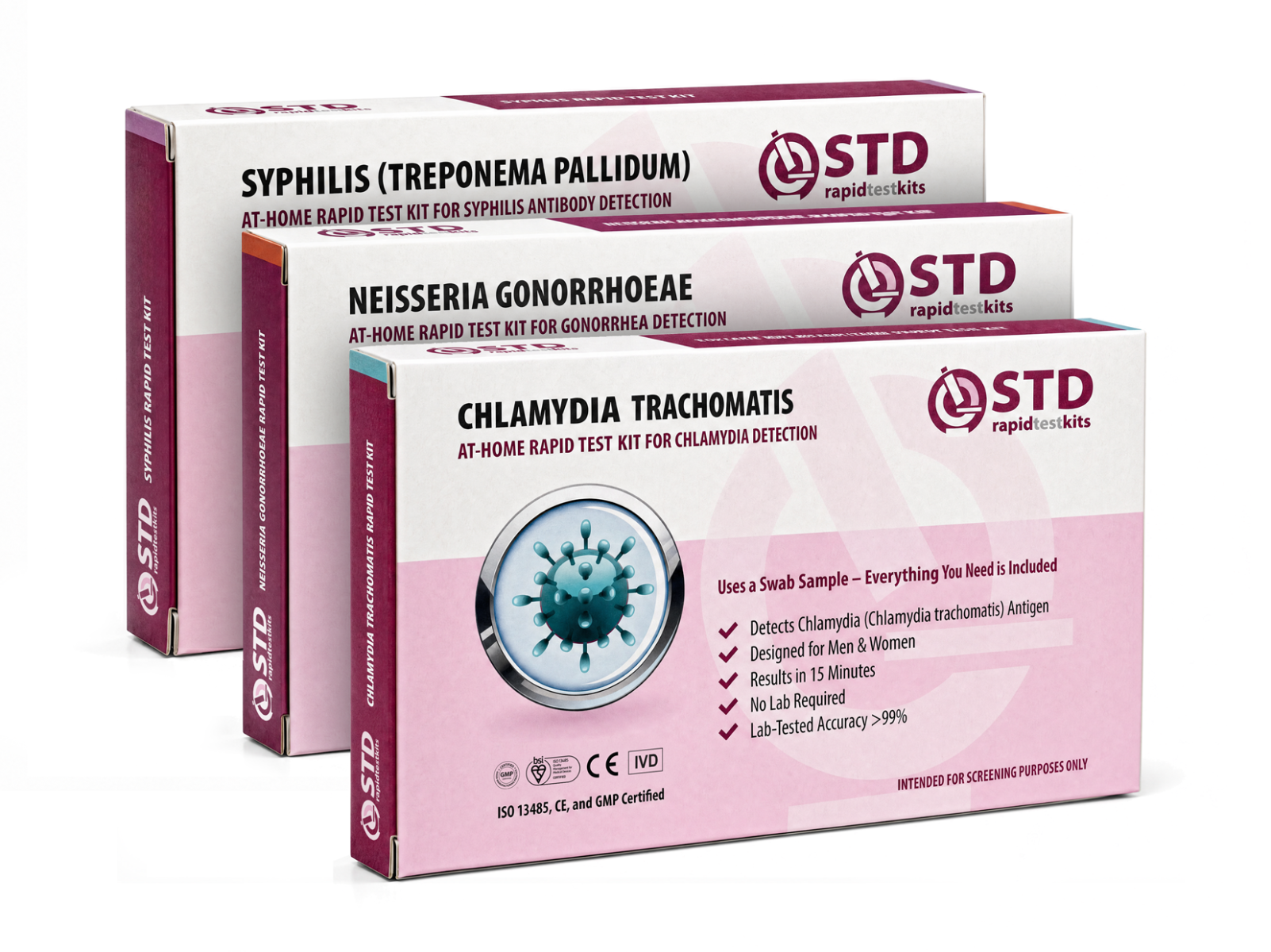
For broad coverage, the Complete 8-in-1 Rapid Test Kit covers HSV-1, HSV-2, Chlamydia, Gonorrhea, Syphilis, HIV, Hepatitis B, and Hepatitis C from a single at-home test, with results in around 15 minutes. If you would rather start with the three bacterial infections most likely to follow unprotected sex, the Chlamydia, Gonorrhea, and Syphilis 3-in-1 Kit covers exactly those. For women who want trichomoniasis and HPV coverage in addition to the bloodborne panel, the Women's 10-in-1 Complete Kit packages it all together; the trichomoniasis and HPV components are validated for vaginal self-swab only, so that specific kit is women-only and male readers needing those tests should see a clinic.
Our article was constructed based on current advice from the most prominent public health and medical organizations, and then molded into simple language based on the situations that people actually experience, such as treatment, reinfection by a partner, no-symptom exposure, and the uncomfortable question of whether it "came back." In the background, our pool of research included more diverse public health advice, clinical advice, and medical references, but the following are the most pertinent and useful for readers who want to verify our claims for themselves.
- U.S. Centers for Disease Control and Prevention. About Bacterial Vaginosis (BV). Reference for BV symptoms, asymptomatic prevalence, and BV's status as not a sexually transmitted infection.
- U.S. Centers for Disease Control and Prevention. Sexually Transmitted Diseases (STDs) clinical resource hub. Reference for STD incubation periods, testing window periods, and the general finding that many STIs are commonly asymptomatic.
- U.S. Centers for Disease Control and Prevention. Gonorrhea fact sheet. Reference for gonorrhea symptoms in men and women, diagnosis, treatment guidance, and complications of untreated infection (including epididymitis).
- U.S. Centers for Disease Control and Prevention. Sexually Transmitted Infections Surveillance, annual U.S. report. Reference for reported case totals for chlamydia, gonorrhea, and syphilis.
- NHS (U.K.). Bacterial vaginosis. Reference for BV symptoms, the limited role of itching and soreness in classic BV, and treatment guidance.
- NHS (U.K.). Cystitis. Reference for post-sex urinary tract infection (honeymoon cystitis) symptoms and self-care guidance.
