
Published: September 2025 | Last updated: May 2026 | Editorial review and quality control: Martina N.
The same handful of symptoms can come from very different places. Itching that won't quit, an unfamiliar discharge, a sting when you pee. Most people read those signs and assume yeast, because that is the explanation we hear about most often. If the itch is external, the discharge is thick and white, and nothing has changed sexually in recent weeks, yeast is the most probable cause and usually responds within a few days to over-the-counter treatment. Sometimes the answer is chlamydia. And sometimes it is both at once, which is the worst situation for guessing your way through.
This guide walks through how the two infections feel side by side, what response to over-the-counter yeast treatment really tells you, and when to stop treating and start testing. The short version: if three to five days of antifungal treatment haven't moved the needle, the next step is testing rather than a stronger cream.
Key Takeaways
- Yeast usually brings thick, clumpy, white discharge with intense external itching. Chlamydia tends to bring thinner, watery, or yellowish discharge with a deeper burn during urination, and very often no symptoms at all.
- If three to five days of antifungal treatment hasn't helped, don't escalate the cream. Test for chlamydia and bacterial vaginosis, since the right treatment depends on what you have.
Why this mix-up happens so often
You are not the first person to mistake one for the other, and you won't be the last. The symptoms of common vaginal infections (yeast, bacterial vaginosis, chlamydia, trichomoniasis) overlap on almost every axis: itching, discharge, irritation, and an off feeling that something isn't right. Even clinicians sometimes make a guess based on a phone description rather than a swab.
Part of the confusion is cultural. Yeast infections get framed as a routine female annoyance, treatable with a tube of cream from the drugstore aisle. That framing makes it easy to assume any new itch is yeast and skip straight to the OTC cure. Chlamydia, meanwhile, hides. According to the CDC's chlamydia overview, most chlamydia infections in women cause no noticeable symptoms at all, and when they do, the signs are subtle: mild irritation, vague pelvic discomfort, or slightly unusual discharge.
The CDC notes that most chlamydia infections in women produce no noticeable symptoms at all. Mild irritation or a small change in discharge can be the only outward sign, which is why so many cases get treated as yeast and never get tested.
Symptom by symptom: yeast vs chlamydia
The table below compares the two infections on the symptoms readers most often try to interpret on their own. No single row is diagnostic, since both infections vary from person to person and from one episode to the next. The overall pattern is what gives you the strongest clue.
| Symptom | Yeast Infection | Chlamydia |
|---|---|---|
| Discharge | Thick, white, clumpy (cottage-cheese texture), usually no odor | Thinner, watery, or yellowish; sometimes mucousy; may have a noticeable odor |
| Itching | Intense external itch around the vulva; often with burning and swelling | Mild internal irritation, or none at all |
| Odor | None, or a slightly yeasty / bready smell | Sometimes stronger or unpleasant; can be absent |
| Burning while urinating | Occasional, usually because urine touches inflamed external skin | Common, and felt deeper inside the urethra |
| Pelvic pain | Rare | More likely, especially if the infection has been around a while |
| Onset timing | Often after antibiotics, hormonal shifts, sex, or a damp gym routine | Usually 1 to 3 weeks after a new sexual exposure |
| Response to OTC antifungals | Visibly improves within 1 to 3 days | No improvement, or symptoms get worse |
"I took Monistat. It didn't work." What now?
If you have already self-treated for yeast (an OTC cream like Monistat or a single oral fluconazole pill) and you are still uncomfortable after 3 to 5 days, that is a real signal. The cause isn't automatically an STI. Recurrent yeast has its own set of causes too: resistant strains, hormonal changes, undiagnosed diabetes. In any of these scenarios, the next step is testing rather than another round of antifungals.
The pattern is common: a mild itch, a little discharge, an assumption of yeast, a quick OTC purchase. A few days later, the discharge is thinner instead of clumpy, urination starts to sting, and the original treatment is clearly not the answer. By the time the realization lands, the underlying infection has had a head start.
Untreated chlamydia can climb from the cervix into the uterus and fallopian tubes and trigger pelvic inflammatory disease (PID). PID can cause permanent scarring that blocks the fallopian tubes, leading to infertility or a life-threatening ectopic pregnancy, per the <a href="https://www.cdc.gov/chlamydia/about/index.html" target="_blank" rel="noopener">CDC's chlamydia overview</a>. Most of these complications are preventable when the infection is caught and treated early, which is why ruling chlamydia in or out matters when antifungals aren't working.

When yeast and chlamydia happen at the same time
Here is the part that catches people off guard: it is entirely possible to have both infections at once. The vaginal microbiome is a fragile ecosystem. A course of antibiotics for chlamydia can wipe out the lactobacilli that keep yeast in check, which is why some people develop a yeast infection a week or two after starting chlamydia treatment. Others pick up both during the same exposure, especially when the microbiome was already off balance going in.
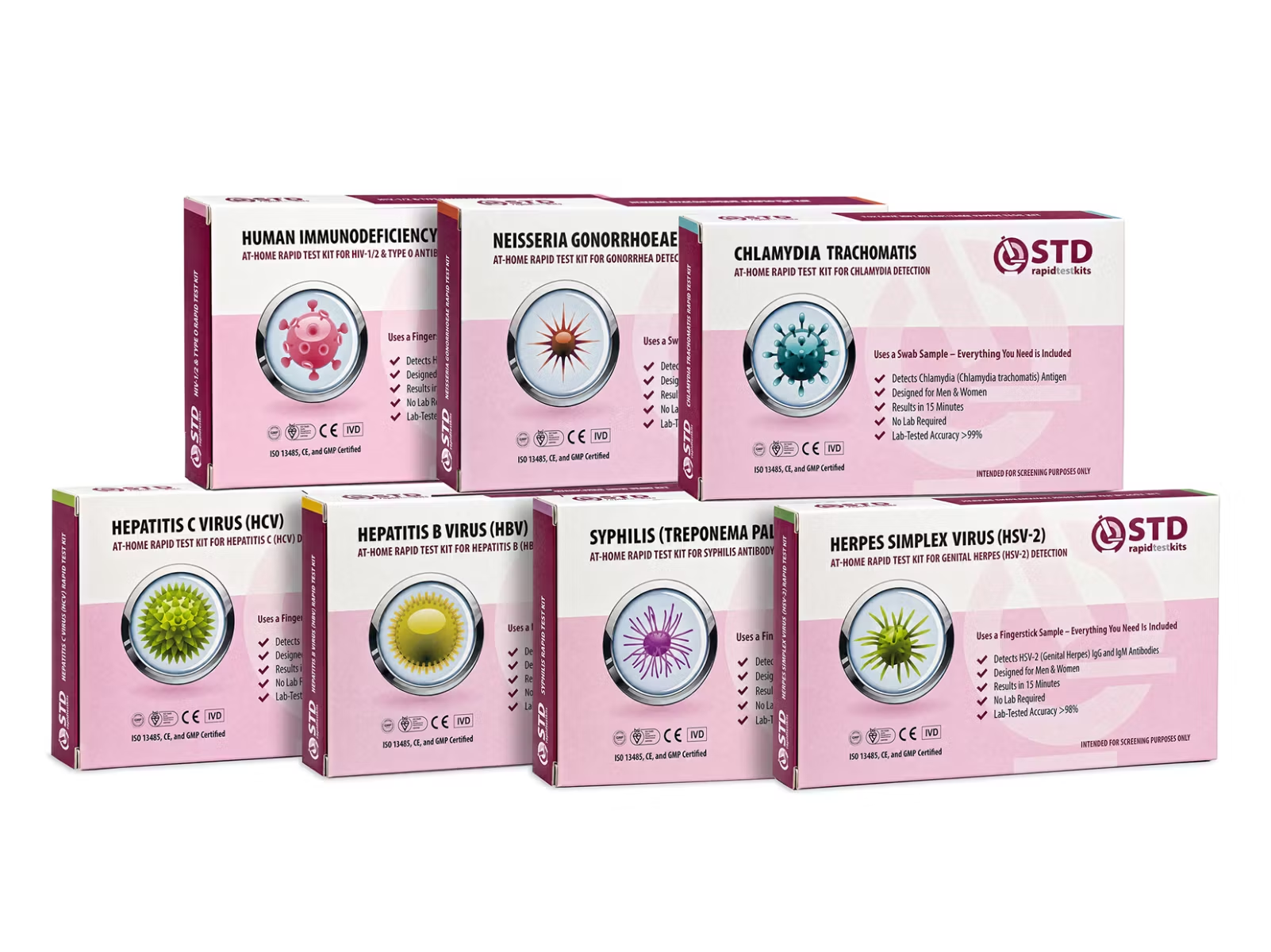
When the two coexist, the symptoms blur. You can have clumpy discharge from yeast, a burn during urination from chlamydia, and pelvic discomfort that doesn't fit either pattern cleanly. Self-diagnosis is even harder under those conditions, which is why many clinicians order a panel rather than a single test, and why combination at-home test kits exist.
Symptoms only partly resolve after a full course of OTC antifungal treatment. New symptoms (burning urination, deeper pelvic discomfort, bleeding between periods) appear mid-treatment. Discharge changes character: from clumpy to thin, or develops an odor it didn't have before. Any of these patterns, especially after recent new sexual contact, is a reason to test for chlamydia as well as treat the yeast.
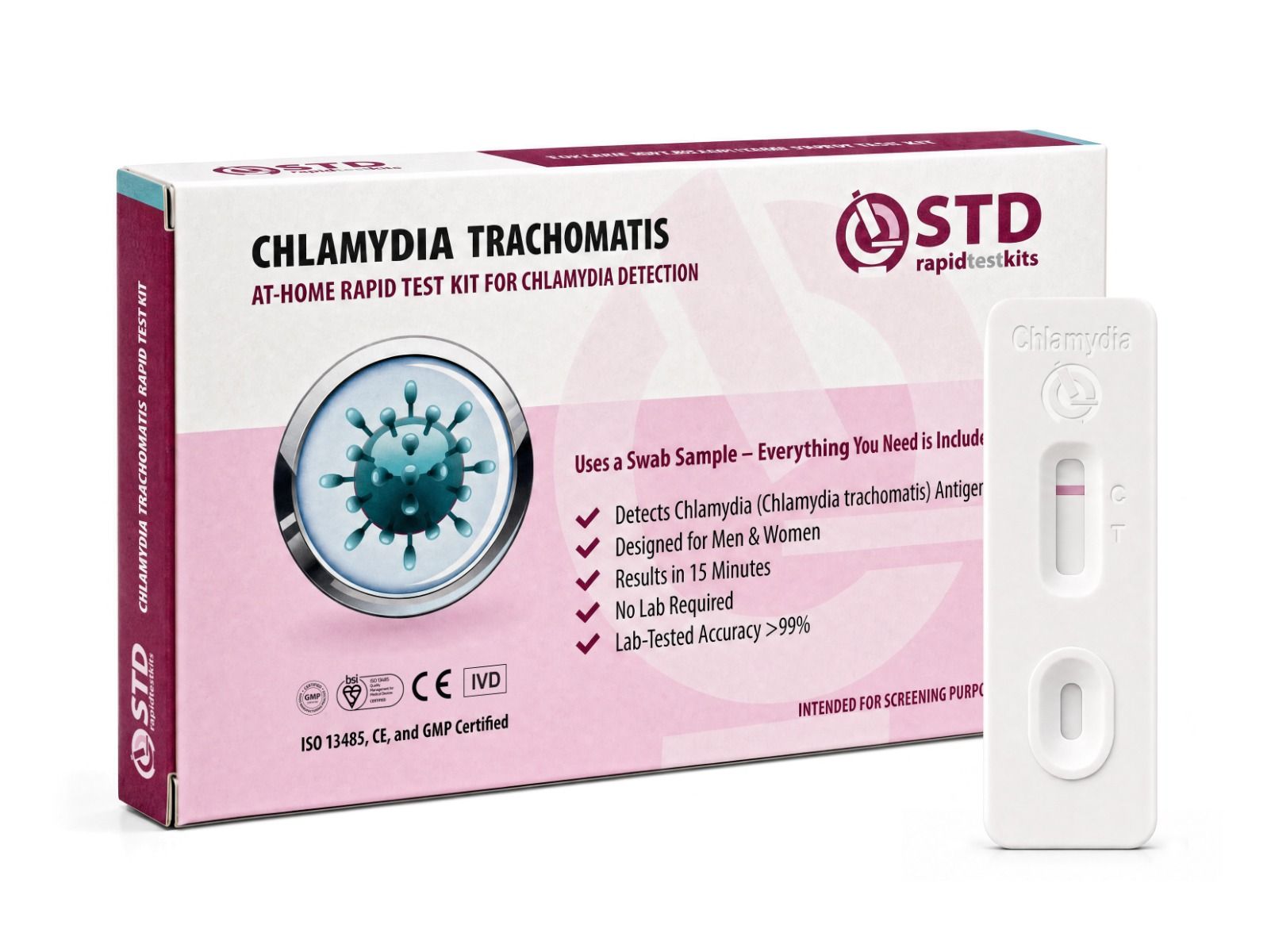
How soon after sex can you test?
Timing is one of the most under-discussed parts of testing. Test too early and you risk a false negative that talks you into the wrong sense of safety. Wait too long and you risk passing the infection on while you wonder. The two infections also have very different testing windows.
| Infection | Earliest Reliable Testing | Peak Accuracy Timing | How to Test |
|---|---|---|---|
| Chlamydia (lab NAAT) | About 7 days post-exposure | 14+ days post-exposure | Lab nucleic acid amplification test (NAAT) on swab or urine |
| Chlamydia (rapid at-home) | About 14 days post-exposure | 14+ days post-exposure | Rapid lateral-flow swab cassette, self-collected |
| Yeast infection | When symptoms start (usually 1 to 3 days after a trigger) | As soon as symptoms appear | Symptom-based assessment, microscopy, or culture (clinic) |
What if you don't have any symptoms at all?
This is where chlamydia gets dangerous. The infection often lives quietly in the cervix without producing burning, itching, or discharge. The longer it sits there, the more likely it is to climb upward into the reproductive tract. Annual screening is the only reliable way to catch it.
The CDC's STI screening recommendations call for yearly chlamydia testing for sexually active women under 25, and for older women with new or multiple partners, regardless of how they feel. The same logic applies for anyone in a non-monogamous relationship or whose partner has untested partners. The right cadence is yearly, plus any time you have had a new exposure.
The CDC recommends annual chlamydia and gonorrhea screening for sexually active women under 25, and for older women with new or multiple partners. A negative test once doesn't mean you are covered for life; the right cadence is yearly, plus any time you have had a new exposure.
When and why to retest
If you tested positive for chlamydia and finished treatment, retesting is not paranoia. It is part of the standard guideline. The CDC's chlamydia treatment guidelines recommend a follow-up test about 3 months after treatment, even if your symptoms have cleared. The goal isn't to second-guess the antibiotic. It is to catch reinfection, which is common when partners weren't treated at the same time.
Recurrent yeast has a different story. Many people self-treat with OTC antifungals two or three times in a single year before realizing the underlying problem isn't pure yeast at all. A clinician visit (or a broader at-home panel that screens for the most common STIs alongside vaginal infections) can untangle whether you are dealing with resistant yeast, undiagnosed bacterial vaginosis, an STI, or some combination.
Annual screening of all sexually active women younger than 25 years is recommended, as is screening of older women at increased risk for infection.
Talking to a partner
Letting a partner know you tested positive can feel awkward, but the alternative is worse. An untreated partner can reinfect you, can stay infected themselves long enough to develop complications, and can pass the infection on to anyone else in their orbit. Partner notification breaks that loop.
The conversation does not need to be dramatic. A short, factual message works: "I just found out I might have an infection. I am getting tested to be sure, and you should consider it too. No judgment, I just want both of us to be okay." Most people respond with appreciation. The ones who do not are telling you something useful about the relationship.
Anonymous partner-notification services such as DontSpreadIt, TellYourPartner, and STDcheck's Tell Your Partner tool let you send a notification by text or email without revealing your identity. Some at-home testing companies also let you ship a test kit directly to a partner. The point is to give the other person enough information to act.
What if your test comes back positive?
If a chlamydia test comes back positive, take a breath. This is one of the most common bacterial STIs in the world, and it is curable. The standard treatment, per the CDC chlamydia treatment guidelines, is a 7-day course of doxycycline (100 mg twice daily). Azithromycin is an alternative when doxycycline isn't an option. Most cases clear within a couple of weeks.

After a positive chlamydia test: four steps
- Finish the full antibiotic course, even if symptoms clear within a few days.
- Avoid sex during treatment and for 7 days after the last dose (or 7 days after a single-dose azithromycin regimen).
- Make sure recent partners are tested and treated. Many states allow expedited partner therapy.
- Retest about 3 months after treatment to catch reinfection, even if you feel fine.
If your STI test comes back negative
You may also test negative for STIs but still be dealing with yeast or bacterial vaginosis. In that case, a clinician can prescribe a more targeted antifungal or a course of metronidazole based on the diagnosis. Either way, see a clinician for follow-up instead of reaching for another round of OTC cream.
FAQs
- Can chlamydia really feel like a yeast infection?
- Yes. The two overlap more than people think. Chlamydia doesn't always announce itself; it can feel like mild irritation, slightly unusual discharge, or nothing at all. If you have a yeast-style itch that isn't responding to antifungal treatment, especially after a recent new partner, testing for chlamydia is the most efficient way to find out what is going on.
- What kind of discharge should I expect with each?
- Yeast typically produces thick, white, clumpy discharge that looks a bit like cottage cheese, with little or no smell. Chlamydia, when it does produce discharge, is more often thin, watery, or yellow-green, and may carry an odor. The catch: many people with chlamydia have no discharge at all, so the absence of discharge doesn't mean you are in the clear.
- Can I have both infections at the same time?
- Yes, and it happens more often than you might think. Some people develop a yeast infection after a course of antibiotics for chlamydia, because the antibiotics disrupt the lactobacilli that normally keep yeast in check. Others pick up both during a single exposure when the vaginal microbiome was already off balance. If symptoms only partly resolve after yeast treatment, co-infection is worth ruling out.
- Will Monistat cure chlamydia?
- No. Monistat treats fungal infections like yeast. Chlamydia is a bacterial infection and only responds to specific antibiotics, most commonly doxycycline or azithromycin. If antifungal treatment isn't helping, it is time to test for the bacterial cause rather than try a stronger antifungal.
- I've had yeast before, and this time feels different. Should I be worried?
- Trust the difference. If something feels off, burning instead of itching, thinner or differently colored discharge, pelvic heaviness, it might not be yeast at all. If you have been sexually active recently, an STI screen is a low-effort way to either rule it out or catch something early.
- Can I test for chlamydia right after sex?
- Technically yes, but the result might not be reliable. Chlamydia takes around 7 days to be detectable on a lab NAAT and closer to 14 days on a rapid lateral-flow test. A negative test on day 1 doesn't tell you much. Retest at 14 days for a result you can trust.
- Do men get yeast infections too?
- They can. Penile yeast tends to look like redness, itching, or a rash on the head of the penis, often after antibiotics or unprotected sex with a partner who has yeast. Chlamydia in men can produce discharge, testicular pain, or no symptoms at all. Either way, ongoing irritation "down there" is not something to wait out.
- What if I keep getting yeast infections after sex?
- Recurrent post-sex yeast infections can come from a few different sources: hormonal shifts, lubricant or condom sensitivity, an undertreated previous yeast infection, or an STI in the background that is keeping the irritation alive. If you have used OTC antifungals more than twice in the same year without lasting relief, the right next move is a broader test panel rather than a third tube of cream.
How we sourced this article: Our editorial team summarized current guidance from the U.S. Centers for Disease Control and Prevention, the American College of Obstetricians and Gynecologists, the NHS, and Mayo Clinic, alongside the relevant entries in the CDC's STI Treatment Guidelines. We do not provide clinical diagnosis. For symptoms that concern you, see a licensed provider.
- U.S. Centers for Disease Control and Prevention. About Chlamydia: symptoms, transmission, complications including PID, and screening recommendations.
- U.S. Centers for Disease Control and Prevention. Sexually Transmitted Infections Treatment Guidelines: chlamydial infections (recommended treatment regimens and 3-month retest guidance).
- U.S. Centers for Disease Control and Prevention. STI screening recommendations by population (annual chlamydia screening for sexually active women under 25).
- NHS (United Kingdom). Chlamydia: symptoms, testing, treatment, and partner notification guidance.
- Mayo Clinic. Diseases and conditions: yeast infection (vaginal) and chlamydia trachomatis topic pages used for symptom and complication context.
- American College of Obstetricians and Gynecologists. Patient-facing FAQs on vaginitis, vaginal discharge, and sexually transmitted infections used for clinical-distinction context.
