
Published: October 2025 | Last updated: May 2026 | Editorial review and quality control: Martina N.
A negative STI panel feels like an answer. The burning, the smell, the discharge that turned up after sex, those should clear up now, right? For a lot of people, they don't. Symptoms return within days, sometimes worse than before. The reason almost always lands in one of three places: bacterial vaginosis, a yeast infection, or trichomoniasis.
Standard sexual-health screens miss two of those three by design. Bacterial vaginosis (BV) and vulvovaginal candidiasis (the clinical name for a yeast infection) are not classified as sexually transmitted infections, so most rapid clinic panels skip them. Trichomoniasis is an STI, but it is frequently left off basic urine NAAT screens unless you specifically request it. The result is a familiar pattern: a clean STI test, persistent symptoms, and a self-treatment loop with over-the-counter antifungals that often makes things worse before it makes them better.
This guide walks through how to tell the three apart, when each one calls for a different test, and how to break the cycle of treating one infection while ignoring another. The encouraging part: all three conditions respond well to the right treatment once they are identified correctly, and most people are symptom-free within one to two weeks of starting the matched medication. The goal here is fewer guess-and-check rounds at urgent care and clearer answers about what is actually going on inside your body.
Key Takeaways
- Burning, odor, and unusual discharge after sex are most often caused by bacterial vaginosis, a yeast infection, or trichomoniasis, none of which a routine four-infection STI panel reliably catches.
- Each of the three needs a different test, and at least one (trichomoniasis) is frequently left off standard clinic screens unless you specifically ask for it.
When a Clean STI Panel Doesn't Mean Clear Answers
A standard rapid STI panel from a sexual-health clinic typically tests for chlamydia, gonorrhea, syphilis, and HIV. Some clinics add hepatitis B, hepatitis C, or HSV-2 antibodies. What is almost never on that list, unless someone specifically requests it: trichomoniasis, bacterial vaginosis, or yeast.
The gap is structural, not malicious. BV and yeast are not classified as STIs. They are vaginal-flora imbalances that sex can trigger or worsen but that are not transmitted person-to-person the way chlamydia or gonorrhea are. Most clinics route them through primary care or gynecology workflows rather than the sexual-health screening line. Trichomoniasis is genuinely an STI, but standard urine NAAT panels in many U.S. clinics do not include trichomoniasis by default, which keeps it off most routine screening orders unless a clinician adds it (CDC STI treatment guidelines).
The practical effect is the pattern that drives most reader questions on this topic. Someone walks out of a clinic with a clean printout, assumes the burning and discharge must be friction, soap, or hormones, treats with an over-the-counter antifungal, feels better for a week, and watches the symptoms return. Two more weeks pass, the cycle restarts, and a different prescriber writes for metronidazole on the second visit, sometimes correctly, sometimes not.
This is not a rare edge case. The U.S. Centers for Disease Control and Prevention estimates trichomoniasis affects more than two million people in the United States in a given year, and around 70% of those infections cause no symptoms (CDC trichomoniasis overview). Bacterial vaginosis is the most common vaginal condition in women aged 15 to 44, according to the CDC (CDC bacterial vaginosis overview). Vulvovaginal yeast is the second-most-common cause of vaginitis, and roughly three out of four women experience at least one episode in their lifetime according to Mayo Clinic (Mayo Clinic on vaginal yeast infection).
None of these three would show up positive on a routine STI panel. None of them resolve reliably from over-the-counter antifungals when the actual cause is something else. All three respond well to the right treatment once the diagnosis is correct, which is why the question of which one you have matters more than the question of whether your last STI screen came back clean.
Trichomoniasis is the most common curable sexually transmitted infection in the United States. Most people who are infected (about 70%) do not have any signs or symptoms.
BV, Yeast, and Trich: Three Different Signatures
The reason these three get confused is symptom overlap. Burning, itching, irritation, and discharge changes can show up in any of them. The differences live in the specifics: discharge color and texture, smell, whether the dominant complaint is itch or burn, and whether sex makes it sharply worse or only mildly.
Bacterial vaginosis (BV) typically produces a thin, grayish or off-white discharge with a strong fishy smell. The odor often intensifies right after sex, because semen is alkaline and shifts an already-imbalanced vaginal pH further off baseline. Itching and burning happen but are usually milder than the smell change. BV is caused by an overgrowth of anaerobic bacteria (often Gardnerella vaginalis) that crowds out the protective Lactobacillus species (Mayo Clinic on bacterial vaginosis). It responds to oral or vaginal metronidazole, clindamycin, or tinidazole.
Vulvovaginal candidiasis (yeast infection) presents differently. The discharge is thick, white, and clumpy, often described as cottage-cheese texture. There is usually no strong smell. The dominant complaint is intense itching, often with redness, swelling of the vulva, and soreness during sex. Yeast is caused by an overgrowth of Candida species, most commonly Candida albicans. It responds to over-the-counter or prescription antifungals such as fluconazole, miconazole, or clotrimazole.
Trichomoniasis is the parasite in the room. Trichomonas vaginalis is a single-celled protozoan transmitted through sexual contact. When symptoms appear, they tend to include a frothy yellow-green discharge with a musty or unpleasant smell, burning during or after sex, vulvar irritation, and sometimes spotting between periods. The catch is that around 70% of infected people have no symptoms at all, particularly men (CDC trichomoniasis overview). Trichomoniasis does not respond to antifungals at all. The standard treatment is oral metronidazole or tinidazole, and partner treatment is required to prevent reinfection.
The summary table below lays the three side by side. Use it as a starting orientation, not a final diagnostic. Symptom overlap is real, and even experienced clinicians get the call wrong without lab confirmation.
| Infection | Usual Discharge | Smell | Dominant Symptom | Sexually Transmitted? |
|---|---|---|---|---|
| Bacterial vaginosis (BV) | Thin, grayish or off-white | Strong fishy odor, often worse after sex | Smell change, mild itch or burn | No, but sex can trigger or worsen it |
| Yeast infection | Thick, white, cottage-cheese texture | Little or no odor | Intense itch, redness, soreness | No, but sex can worsen it |
| Trichomoniasis | Frothy, yellow-green | Musty or unpleasant | Burning during or after sex, often asymptomatic | Yes, fully sexually transmitted |
If my STI test is clean, what's actually causing the burning?
Most of the time, one of three things: bacterial vaginosis (a flora imbalance, not an STI), a yeast infection (also not an STI), or trichomoniasis (an STI that is frequently left off basic urine panels unless requested). Each one needs a different test, and treating the wrong one keeps the symptoms cycling.
Why Misdiagnosis Is So Common
Symptom-based diagnosis of vaginal infections is famously unreliable. Reviews of clinical accuracy in primary-care settings have repeatedly shown that diagnosis based on history and physical exam alone is wrong in a substantial fraction of cases, often misclassifying BV as yeast or vice versa, and missing trichomoniasis entirely. Modern guidelines call for laboratory confirmation, but in practice most people self-diagnose first, treat with whatever is on the pharmacy shelf, and only escalate to a clinician when the symptoms come back (Mayo Clinic on bacterial vaginosis).
The over-the-counter shelf creates its own bias. Antifungal creams and oral fluconazole are widely available and aggressively marketed, while BV and trich treatments require prescriptions. The default mental model becomes: itching plus discharge equals yeast, treat with cream, move on. The first round of antifungal sometimes works because mild yeast really was part of the picture, or because the symptoms were going to fluctuate on their own. The second round, when the actual culprit was BV or trich, fails. By then the timing has already drifted far enough from the original exposure that pinning down the cause becomes harder.
Co-infection is the other complication. Having BV and yeast at the same time is not unusual, especially after a course of antibiotics that killed off the protective Lactobacillus species and let both opportunistic organisms take hold. Trichomoniasis plus BV is also documented; women with trichomoniasis are more likely to have BV concurrently than the general population. Treating one infection without testing for the other can leave you feeling partially better but still symptomatic, which fuels the impression that nothing is working.
The third factor is the partner gap. With trichomoniasis specifically, partners are usually asymptomatic carriers. A woman gets diagnosed and treated, returns to her partner who was never tested or treated, and the parasite moves right back. The CDC identifies expedited partner therapy as an option for trichomoniasis in states where it is legally permitted, meaning the diagnosed patient can receive a prescription to pass to their partner without a separate clinic visit (CDC STI treatment guidelines). This step gets skipped frequently in real-world care.

How to Test for Each One, and When
Each of the three has a different test pathway, and the timing rules differ as well. Here is how the testing landscape looks in practice, with both clinic and at-home options.
Bacterial vaginosis is diagnosed in clinic by Amsel criteria (a combination of clinical findings, vaginal pH above 4.5, the presence of clue cells on microscopy, and a positive whiff test on potassium hydroxide), or by molecular nucleic-acid tests that quantify the bacterial mix. Most at-home BV tests rely on vaginal pH plus a self-swab. They can flag a likely imbalance but do not typically distinguish bacterial subtypes. Test as soon as symptoms appear; there is no incubation window to wait for, because BV is a flora shift rather than an exposure-based infection (NHS on bacterial vaginosis).
Yeast infections are confirmed by microscopy or culture from a vaginal swab. A wet mount looking for budding yeast or pseudohyphae is the most common quick test. At-home yeast diagnostics are limited; most kits rely on the same pH-plus-symptom approach as BV testing and cannot reliably distinguish yeast from BV without microscopy. Test when itching, redness, and characteristic discharge first appear.
Trichomoniasis testing has the most options and the most variability. NAAT has very high sensitivity and is the U.S. clinical gold standard; older wet-mount microscopy is substantially less sensitive (CDC STI treatment guidelines). NAAT can use a urine sample for men or a vaginal swab for women. At-home rapid antigen tests use a vaginal self-swab and lateral-flow chemistry; they are useful for screening when symptoms are present and offer privacy and speed, but a positive result is generally worth confirming with a lab NAAT, and a negative result with persistent symptoms is worth retesting in a clinic. Window timing for trich is not as well-established as for chlamydia or gonorrhea; the CDC notes incubation can range from days to several weeks, so testing too early after a single exposure can produce a false negative.
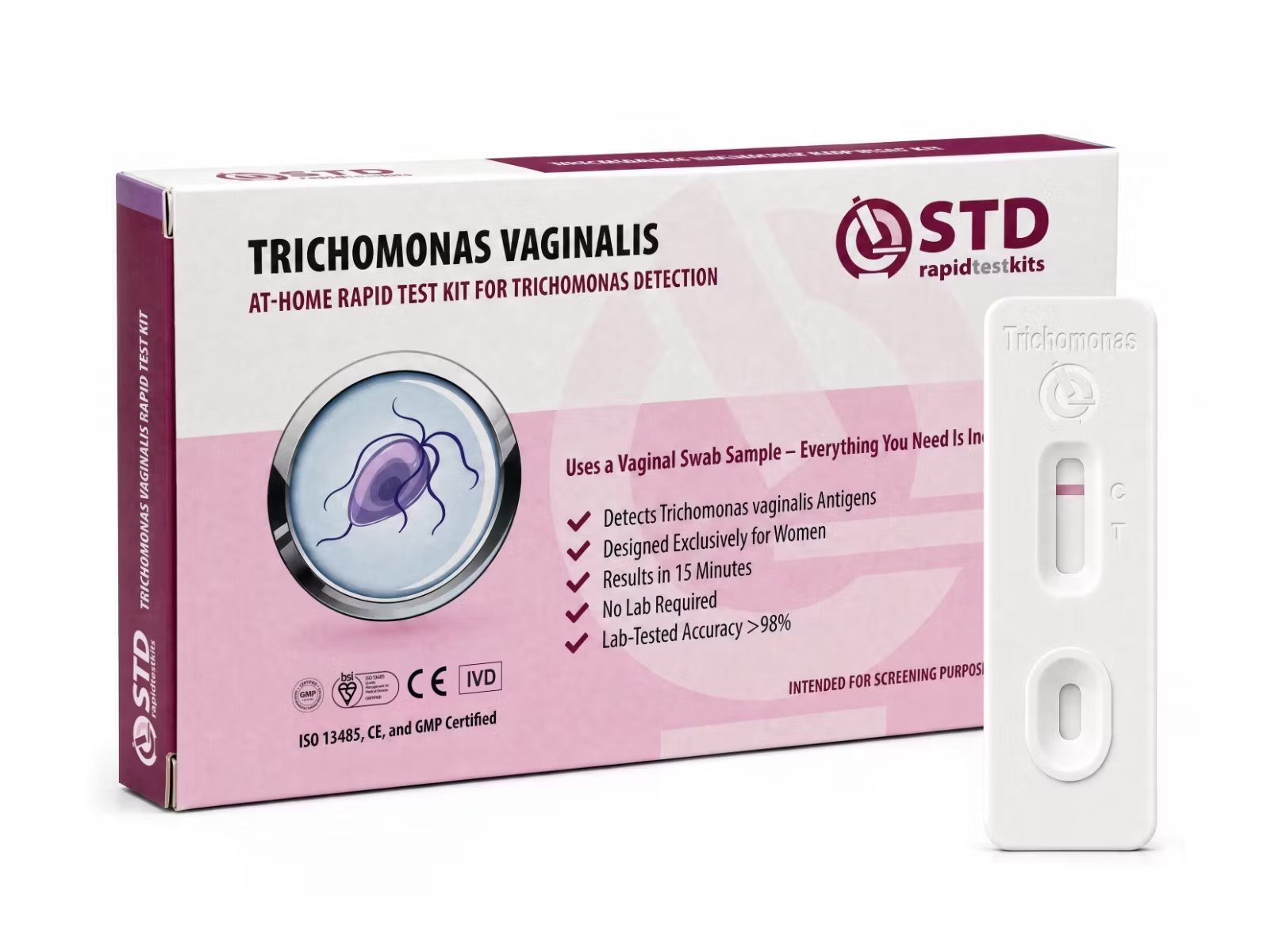
A note on what we sell, since the next paragraph mentions our own product: this site sells at-home rapid lateral-flow STI test kits, including the trichomoniasis kit described below. Our at-home trichomoniasis kit is a rapid lateral-flow test using a vaginal self-swab. It is validated for female anatomy only; male readers concerned about trichomoniasis should see a clinic, since we do not currently offer a male-compatible at-home trich kit. The home kit is a screening tool, not a substitute for a lab NAAT; the two are complementary rather than equivalent.
| Infection | Common Test Type | Sample | When to Test |
|---|---|---|---|
| BV | Amsel criteria, microscopy, or molecular swab | Vaginal swab plus pH | As soon as symptoms appear |
| Yeast | Microscopy or culture (wet mount most common) | Vaginal swab | When itching and discharge first appear |
| Trichomoniasis | Lab NAAT (gold standard) or rapid lateral-flow antigen test | Vaginal swab (women) or urine (men, in clinic) | When symptoms appear, or several days to weeks after a known exposure |
When the Same Symptoms Keep Coming Back
Recurrent symptoms are the loudest signal that something has been missed. The pattern usually looks like this: an initial diagnosis, a course of treatment that brings partial relief, a few weeks of feeling normal, and then the same burning, itching, or discharge returns. Each iteration, the natural response is to assume the same diagnosis is back. Sometimes that is true. Just as often, the original diagnosis was incomplete or wrong from the start.
For BV, recurrence within three months happens in roughly half of treated cases without further intervention. The triggers are well-described: unprotected sex (semen shifts vaginal pH), new sexual partners, douching, certain soaps and intimate washes, and hormonal changes around the menstrual cycle. Recurrent BV sometimes responds to a longer course of vaginal metronidazole or to a maintenance regimen, and clinicians may also recommend pH-stabilizing approaches and avoiding internal washing.
For yeast, recurrence (defined as four or more confirmed episodes per year) often signals one of three scenarios. The first is a non-albicans Candida species (such as Candida glabrata) that is resistant to standard fluconazole. The second is an underlying factor that keeps re-triggering yeast: poorly controlled diabetes, frequent antibiotic courses, or hormonal contraception in some patients. The third, and the most commonly missed, is that the recurring "yeast" was never actually yeast in the first place. It was BV, trichomoniasis, or a combination, treated with antifungals that did nothing.
For trichomoniasis, recurrence almost always means the partner was not treated. Trichomonas vaginalis can persist asymptomatically in male carriers for weeks or months, and a single round of metronidazole in the diagnosed patient does nothing about that reservoir. The CDC recommends partner treatment for every trichomoniasis diagnosis, with both partners completing the medication and abstaining from sex until treatment is finished and any symptoms have cleared (CDC STI treatment guidelines). Skipping this step is the single most common reason trichomoniasis keeps returning.
Reinfection patterns also vary by infection type. The summary table below shows what triggers each one and whether partner treatment is part of the standard care plan.
| Infection | Common Reinfection Trigger | Partner Treatment Needed? |
|---|---|---|
| BV | Unprotected sex, new partner, douching, soap or wash products | Not routinely required for opposite-sex partners; same-sex female partners may benefit |
| Yeast | Antibiotics, hormonal shifts, uncontrolled diabetes, friction | Not usually, unless a male partner has confirmed candidal balanitis |
| Trichomoniasis | Untreated partner, re-exposure | Yes, always treat all current sexual partners |
What to Do Next
The first move is to stop guessing. If symptoms have come back after one round of over-the-counter antifungal treatment, the working assumption should not be "more antifungal." It should be: get tested for all three, including the one most often left off the panel.
An at-home approach makes sense when symptoms are present, when the local clinic does not order trichomoniasis routinely, or when privacy and speed matter. A trichomoniasis self-swab can confirm or rule out one of the most-missed diagnoses in well under an hour. For BV and yeast, an at-home pH-plus-swab kit is a useful starting point; results that suggest BV should be confirmed with a clinician for prescription treatment, since metronidazole and clindamycin are not over-the-counter in the United States.
A clinic visit is the better path when symptoms are severe (significant pain, fever, lower-abdominal pain, or unusual bleeding), during pregnancy, when symptoms have persisted for more than a few weeks despite home treatment, or when a partner has been told they tested positive for an STI. Pelvic inflammatory disease, which untreated trichomoniasis and other STIs can contribute to, requires clinical management and sometimes intravenous antibiotics.
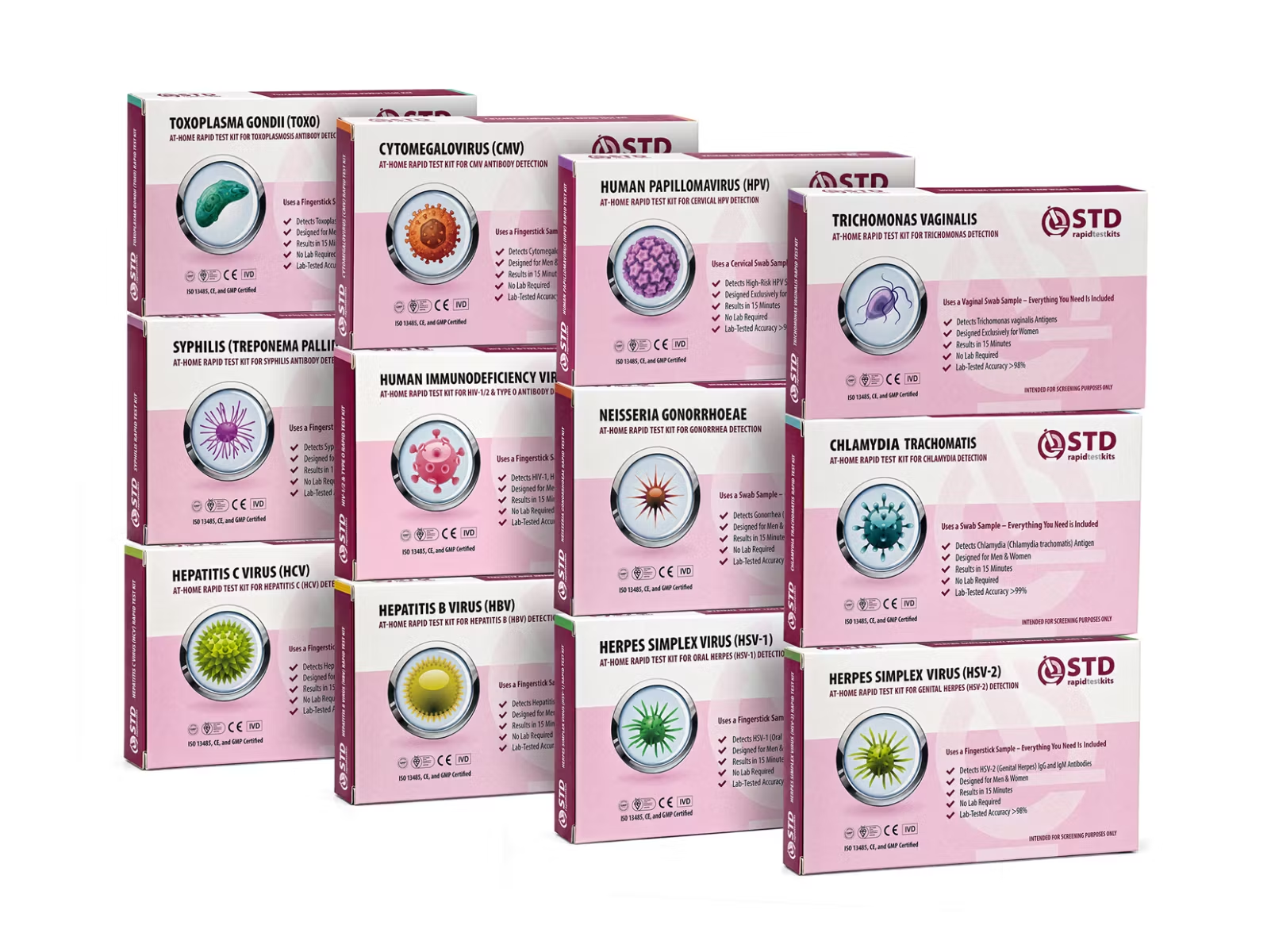
For anyone who wants the broader peace-of-mind sweep alongside the BV-yeast-trich question, a multi-infection panel that screens for trichomoniasis, chlamydia, gonorrhea, syphilis, HIV, hepatitis, herpes, and HPV in one order makes the testing logistics easier. The 10-test combination kit below is validated for female anatomy and covers most of what someone in this situation would otherwise have to schedule three separate clinic visits to rule out.
FAQs
- Can you have trichomoniasis and not know it?
- Yes, very easily. The CDC reports that about 70% of people with trichomoniasis have no symptoms, and the rate of asymptomatic carriage is even higher in men. That is why trich spreads quietly between partners and why someone can be reinfected by a partner who feels completely fine.
- Can BV and a yeast infection happen at the same time?
- Yes. Co-infection is well-documented and is one of the most common reasons over-the-counter antifungal treatment only partially works. If your symptoms shift in character mid-treatment, or if discharge changes texture from cottage-cheese to thin and gray, suspect a mixed picture and ask for testing for both.
- Why does it still burn even though my STI test came back clean?
- Most basic STI panels test for chlamydia, gonorrhea, syphilis, and HIV. They do not include trichomoniasis, BV, or yeast unless specifically ordered. A clean panel rules out four common infections, not all the possible causes of burning, itching, or unusual discharge.
- Can men get these infections too?
- Men can get trichomoniasis (usually without symptoms) and a candidal infection of the penis (called candidal balanitis). They do not get BV in the same form, since BV is a vaginal-flora condition, but their genital flora can carry organisms that contribute to a partner's BV. If a female partner has been diagnosed with trich, the male partner needs to be treated as well.
- Can trichomoniasis cause serious complications?
- Untreated trichomoniasis is associated with an increased risk of HIV acquisition, low-birth-weight delivery in pregnancy, and pelvic inflammatory disease in women. It is treatable with a single dose or short course of oral metronidazole or tinidazole, but partner treatment is required to prevent reinfection.
- How soon after sex can I test for trichomoniasis?
- The CDC describes the trichomoniasis incubation period as poorly defined, with symptoms (when they appear) often emerging anywhere from a few days to about a month after exposure. If symptoms are already present, test now. If you are testing after a single known exposure with no symptoms yet, waiting one to two weeks improves sensitivity, and a follow-up test if symptoms develop is a good idea.
- Do I need to tell my partner if I have BV?
- BV is not technically an STI, and routine partner treatment is not recommended for opposite-sex partners. Same-sex female partners may benefit from concurrent treatment because BV-associated bacteria can transfer between vaginas. Talking to a partner is reasonable if BV keeps recurring after sex, since it can help identify shared triggers like products or practices that affect vaginal pH.
- Can I test for BV, yeast, and trichomoniasis all at once?
- Yes, in a clinic. Modern molecular vaginitis panels swab once and run BV, yeast, and trich in parallel. At home the picture is more piecemeal: a trichomoniasis rapid self-swab is the strongest standalone option, while BV and yeast at-home kits typically rely on pH plus visual symptom scoring rather than direct organism detection. If symptoms are unclear, the cleanest path is a single clinic visit for a full vaginitis panel.
This article was constructed from current public-health and clinical guidance from the U.S. Centers for Disease Control and Prevention, the U.K. National Health Service, and Mayo Clinic. Where specific figures or recommendations appear in the body, the relevant source is linked inline. The references list below highlights the six sources used directly in this update.
- U.S. Centers for Disease Control and Prevention. Trichomoniasis basic facts, prevalence, and asymptomatic-carriage estimates.
- U.S. Centers for Disease Control and Prevention. Bacterial vaginosis basic overview and epidemiology in women aged 15 to 44.
- U.S. Centers for Disease Control and Prevention. Sexually Transmitted Infections Treatment Guidelines, trichomoniasis chapter, including diagnostic methods, treatment regimens, partner-management guidance, and abstinence advice during treatment.
- Mayo Clinic. Bacterial vaginosis: symptoms, causes, the role of Gardnerella vaginalis overgrowth, and diagnostic considerations.
- Mayo Clinic. Vaginal yeast infection: symptoms, lifetime prevalence in women, and standard antifungal treatment options.
- U.K. National Health Service. Bacterial vaginosis patient-facing overview, including symptom descriptions, testing pathway, and when to seek care.
