






Quick Answer: A painless genital sore can be an early sign of syphilis, but it can also be caused by herpes, HPV, molluscum contagiosum, or even non-STD skin conditions. The only way to know for sure is testing at the right time after exposure.
When Silence Is a Symptom
A painless genital sore is most classically associated with syphilis. The first-stage lesion, called a chancre, is often firm, round, and completely painless. That’s not a typo. Completely painless. According to guidance from the Centers for Disease Control and Prevention, many people do not notice it at all, especially if it appears internally.
But here’s where nuance matters. Not every painless sore equals syphilis. And not every syphilis sore behaves exactly the same way. Bodies don’t read textbooks. They improvise.
I once spoke with a 29-year-old patient, Marcus, who described finding a small ulcer at the base of his penis. “It looked too clean to be a pimple,” he said. “But it didn’t hurt, so I figured it couldn’t be serious.” He waited three weeks. The sore disappeared. He felt relieved. Two months later, he developed a rash on his palms.
That’s the thing about some STDs. They don’t scream. They whisper.
What a Syphilis Chancre Actually Looks Like
Let’s get clinical for a moment. A primary syphilis sore, often called a chancre, typically appears about three weeks after exposure, though it can range from 10 to 90 days. It usually presents as a single, round ulcer with firm edges and a clean base. It may look almost polished. There is often no pus, and it rarely itches.
The absence of pain is not reassuring. It is characteristic.
Many people searching “syphilis chancre painless” are surprised to learn that pain is not required for infection. In fact, the lack of pain is part of what makes syphilis easier to miss.
| Feature | Syphilis Chancre | Herpes Lesion | Ingrown Hair / Folliculitis |
|---|---|---|---|
| Pain Level | Usually painless | Often painful or burning | Tender when pressed |
| Number of Sores | Usually one | Often multiple clustered blisters | Single bump |
| Texture | Firm edges, clean ulcer | Fluid-filled blisters that break open | Raised bump with possible hair visible |
| Healing Time | 3–6 weeks without treatment | 2–4 weeks | Days to 1–2 weeks |
Notice something important in that table. Healing does not equal harmless. A syphilis sore can disappear on its own. That does not mean the infection is gone. It simply means it has moved to the next stage.
But Can Herpes Ever Be Painless?
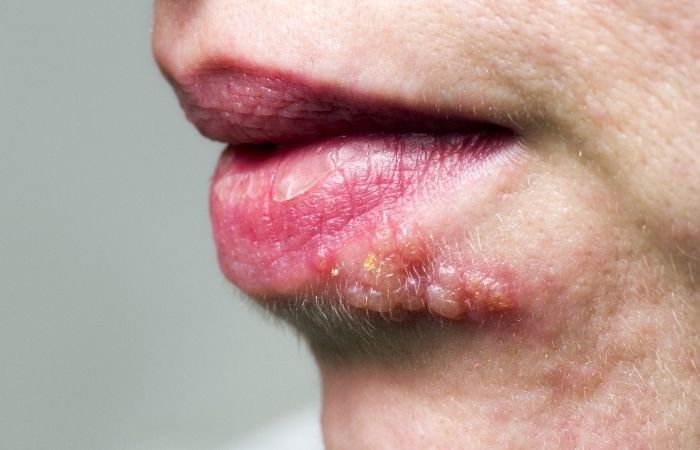
This is where Google searches get messy. While herpes (HSV-1 or HSV-2) is more commonly associated with painful blisters, it is absolutely possible to have mild or even painless outbreaks. Some people report only a subtle raw spot. Others notice what looks like a paper cut. A few feel nothing at all.
A 34-year-old woman named Alina once described her first outbreak as “a shallow sore that didn’t hurt unless I stretched the skin.” She assumed it was friction from sex. It wasn’t until her partner tested positive that she reconsidered.
Herpes lesions often begin as small fluid-filled blisters before breaking open into shallow ulcers. Even if pain is minimal, tingling, itching, or a flu-like feeling sometimes accompanies early infection. But not always. The absence of dramatic symptoms does not eliminate herpes from the differential.
That’s why the search term “herpes sore without pain” exists. Because it happens.
People are also reading: White, Yellow, Green: When Discharge Isn’t Normal Anymore
Other Causes of a Painless Genital Sore
Not every genital ulcer is an STD. And not every STD ulcer is dangerous in the same way. Some conditions mimic sexually transmitted infections so convincingly that even experienced clinicians rely on lab testing to differentiate them.
Molluscum contagiosum, a viral skin infection, can create small dome-shaped bumps with a central dimple. They are usually painless. Human papillomavirus, or HPV, can cause flesh-colored growths that don’t hurt but may persist. Even minor trauma during shaving can create ulcers that look more dramatic than they are.
Then there are non-infectious causes. Fixed drug eruptions, autoimmune conditions, and benign cysts can all present as isolated sores. Which is why guessing based on pain alone is unreliable.
When someone types “STD ulcer vs pimple” into a search bar at 2 a.m., what they’re really asking is: How worried should I be?
Timing Changes Everything
The most overlooked detail in all of this is timing. When did exposure happen? How long has the sore been present? Different infections appear on different schedules.
Syphilis often shows up about three weeks after exposure. Herpes can appear within two to twelve days. Other conditions may take longer or present inconsistently.
| Condition | Typical Time From Exposure to Sore | Does It Always Hurt? |
|---|---|---|
| Syphilis | 10–90 days (average ~21 days) | No, often painless |
| Herpes (HSV-1/HSV-2) | 2–12 days | Usually painful, but can be mild or painless |
| Molluscum Contagiosum | 2–7 weeks | Painless |
| HPV (Genital Warts) | Weeks to months | Painless |
If you had unprotected sex four days ago and notice a sore today, syphilis is statistically less likely. If it’s been three weeks, it moves higher on the list. Context matters.
This is where the no-nonsense investigator voice steps in. We do not diagnose based on vibes. We test based on timing.
The Part Nobody Wants to Hear
A painless sore can disappear without treatment. Especially with syphilis. That does not mean the infection cleared. It means the bacteria have moved deeper into your body. Weeks or months later, new symptoms can emerge, including rashes, swollen lymph nodes, or systemic complications.
One patient told me, “I thought because it went away, I dodged something.” That’s common. Our brains equate visible healing with safety. But infectious disease doesn’t follow emotional logic.
If you are currently staring at a sore that doesn’t hurt, the goal is not panic. The goal is clarity.
Clarity comes from testing at the correct window period. Not from pressing it again to see if it suddenly starts hurting.
Testing: The Only Way Out of the Spiral
If syphilis is on the table, a blood test is required. For herpes, a swab of an active sore or a blood antibody test may be recommended depending on timing. The key is not just testing, but testing at the right time to avoid false reassurance.
There is a difference between testing too early and testing responsibly. A syphilis blood test is most reliable a few weeks after exposure. Testing immediately after noticing a sore may still require follow-up.
If your head is racing right now, this is your grounding step. You can access discreet at-home testing through STD Rapid Test Kits. A comprehensive Combo STD Home Test Kit can screen for multiple infections at once, including syphilis, so you don’t have to play diagnostic roulette alone.
Testing is not an admission of guilt. It is an act of self-respect.
What If It’s Not Syphilis? The Differential Diagnosis Nobody Talks About
Let’s slow this down. Not every painless genital sore is syphilis. In fact, depending on your sexual history, shaving habits, immune status, and recent exposures, several other explanations may sit higher on the probability list.
Picture this: Jordan notices a small ulcer near the base of his penis. No pain. No itching. He immediately Googles “painless genital ulcer syphilis” and feels his chest tighten. But Jordan also shaved aggressively three days earlier. A nicked follicle can ulcerate. Trauma can mimic infection. The body does not always label its wounds clearly.
There are viral, bacterial, inflammatory, and even medication-related causes of genital sores that do not hurt. And here’s where clinical humility matters: sometimes even doctors cannot distinguish them visually.
This is why testing exists. Not to scare you. To prevent guesswork.
Check Your STD Status in Minutes
Test at Home with Remedium7-in-1 STD Test Kit
 For Men & Women
 Results in Minutes
 No Lab Needed
 Private & Discreet
Order Now $129.00 $343.00
For all 7 tests
When It’s Herpes, But Not the Way You Expect
Most people imagine herpes as clusters of painful blisters. That’s the classic presentation. But medicine is full of exceptions. Some first outbreaks are dramatic. Others are so subtle they barely register.
A painless herpes sore is less common, but absolutely possible. It may look like a shallow erosion or a tiny ulcer without significant redness. Some people experience only mild irritation or a tingling sensation before it appears. Others feel nothing at all.
In recurrent herpes infections, outbreaks are often milder than the first episode. That means someone who already carries the virus may experience a small sore that heals quickly and never becomes dramatically painful. Searching “can herpes be painless” is not irrational. It’s medically reasonable.
The only way to confirm herpes from a visible sore is through a swab test while the lesion is active. Blood tests can detect antibodies but cannot always pinpoint when infection occurred. Timing matters. Swabbing too late, after the sore crusts or heals, reduces accuracy.
Could It Be HPV or Molluscum?
HPV usually causes bumps to grow instead of open sores. They are usually the color of flesh, have a texture, and don't hurt. They can show up weeks or months after being exposed, and they usually cause more emotional pain than physical pain.
Molluscum contagiosum produces small, dome-shaped bumps with a central indentation. They are usually painless and can spread through skin-to-skin contact. While not always classified strictly as an STD, molluscum in the genital area is often transmitted sexually in adults.
Both conditions can linger. Both can be mistaken for other things. And neither usually hurts.
The absence of pain does not narrow the field as much as people think.
How Long Does a Painless Syphilis Sore Last?
This is one of the most common anxiety-driven searches: “how long does a syphilis sore last?” The answer is deceptively calming. A primary chancre often heals within three to six weeks, even without treatment.
And that’s exactly why it’s dangerous to rely on disappearance as proof of safety.
Imagine noticing a sore in early March. By April, it’s gone. Relief floods in. You move on. But untreated syphilis can silently progress to secondary stage, where rashes, fever, and systemic symptoms may develop. Some people never connect the dots because the original sore felt so minor.
The healing timeline of a lesion does not reflect eradication of the bacteria. Only treatment does.
The Emotional Spiral Is Real
Let’s talk about the part nobody writes in textbooks. The emotional component. A painless genital sore can trigger shame that feels disproportionate to the physical symptom.
I’ve had patients whisper, “I feel dirty,” even when the sore turned out to be a benign cyst. I’ve had others panic silently, avoiding partners while waiting for test results. The mind fills in worst-case scenarios long before labs confirm anything.
Here’s the grounded truth. Sexually transmitted infections are infections. They are not moral verdicts. They do not measure your worth. They do not define your identity.
Testing is an act of responsibility, not confession.
When to Test for Maximum Accuracy
If you are worried about syphilis, a blood test is typically reliable about three to six weeks after exposure. Testing too early may not detect antibodies yet. That does not mean you are negative. It may mean you are early.
For herpes, swabbing an active sore within the first few days yields the best results. Blood tests for HSV antibodies are more informative several weeks after infection, but interpretation can be nuanced.
The key question is not “Should I test?” It is “When will testing give me the clearest answer?”
| Infection | Best Initial Test | Optimal Testing Time After Exposure | Retest Recommended? |
|---|---|---|---|
| Syphilis | Blood antibody test | 3–6 weeks | Yes, if tested earlier than 3 weeks |
| Herpes (HSV) | Swab of active sore | Within first few days of lesion | Consider antibody test at 6–12 weeks |
| HPV | Clinical exam | Variable, weeks to months | Depends on presentation |
| Molluscum | Clinical exam | When lesions appear | Usually not required |
Timing your test correctly reduces both false reassurance and unnecessary panic.
What If It’s Completely Painless and You Feel Fine?
This is where people get stuck. “I feel fine,” they say. “There’s just this one sore.”
Early-stage syphilis often causes no other symptoms. No fever. No fatigue. No discharge. Just one solitary ulcer. It may even appear internally on the cervix or inside the rectum, making it easy to miss entirely.
A painless genital sore with no other symptoms does not rule out infection. In fact, it can be typical of early disease.
That doesn’t mean you should assume the worst. It means you should move from assumption to information.
The Smart Next Step
If you are within the correct testing window, now is the moment to act. Waiting for pain to appear is not a strategy. Waiting for the sore to disappear is not a strategy. Testing is.
You can order discreet testing directly through STD Rapid Test Kits without stepping into a clinic waiting room. If you want broader reassurance, a Combo STD Home Test Kit screens for multiple infections at once, including syphilis.
This is not about panic. It is about clarity. And clarity is power.
What Happens If You Ignore It?
Let’s walk through a quiet but common scenario. You notice a painless genital sore. You tell yourself it’s probably friction, shaving, maybe a pimple. You wait. A week passes. It doesn’t hurt. Two weeks pass. It fades. You exhale.
If it was a minor skin injury, that’s the end of the story. But if it was early syphilis, the disappearance of the sore is not the disappearance of the infection. The bacteria move from the local site into the bloodstream. The next stage may not appear for weeks.
Secondary syphilis can bring rashes on the palms and soles, swollen lymph nodes, patchy hair loss, or flu-like symptoms. Some people never connect those later symptoms to the painless sore that came before. The timeline feels disconnected. But biologically, it isn’t.
This is not meant to alarm you. It’s meant to explain why painless does not equal passive.
People are also reading: Can You Get the Chlamydia Vaccine Yet? Here’s the Real Timeline
The Biology Behind Why It Doesn’t Hurt
One question patients ask often is, “Why wouldn’t it hurt if it’s an infection?” Pain usually signals inflammation. With a syphilitic chancre, the immune response is present but not intensely inflammatory at the surface. The ulcer can form without significant nerve irritation.
In contrast, herpes tends to inflame nerve endings more directly, which is why burning or tingling is common. But immune responses vary from person to person. Some individuals mount mild inflammatory reactions. Others experience stronger ones. Pain perception is not universal.
Understanding this physiology can be strangely comforting. It explains the silence. It removes the mystery. The body is not hiding something from you. It is simply responding in its own way.
Internal Sores: The Ones You Can’t See
Here’s another layer many people don’t consider. Not all genital sores are external. A syphilis chancre can form on the cervix, inside the rectum, or in the throat after oral exposure. In those cases, there may be no visible sign at all.
Someone might search “genital sore but no symptoms” and still miss the possibility of an internal lesion. Mild rectal discomfort, unusual discharge, or nothing at all can accompany early infection.
This is why sexual history matters. If there has been oral, vaginal, or anal contact within the previous one to three months, testing can be more informative than visual inspection alone.
The Window Period Trap
Testing too early is one of the most common pitfalls. You feel anxious. You test immediately. The result comes back negative. Relief washes over you. But if the test was performed before antibodies developed, that result may not reflect your true status.
For syphilis, antibodies typically become detectable within three to six weeks. Testing at one week after exposure may not be reliable. For herpes, antibody testing too early can miss new infections as well.
There is a difference between early reassurance and accurate reassurance. The latter sometimes requires patience.
A balanced strategy might involve testing when the sore is active and then repeating bloodwork at the recommended window period. It feels inconvenient. It is medically sound.
Micro-Scene: The Second Test That Brought Peace
Elena noticed a painless sore three weeks after a new partner. She tested immediately. Her initial blood test for syphilis was negative. Her provider advised repeating the test at six weeks to confirm.
Waiting felt unbearable. She described checking her phone daily, rehearsing conversations in her head. But when the six-week result returned negative again, the relief was grounded in biology, not guesswork.
That second test wasn’t about fear. It was about certainty.
When It’s Definitely Time to Seek Immediate Care
Most painless genital sores are not medical emergencies. But there are exceptions. If you experience severe swelling, high fever, spreading redness, intense pain, or systemic symptoms, immediate medical evaluation is warranted.
Likewise, if there was a recent high-risk exposure such as unprotected sex with a partner known to have an STI, or if sexual assault occurred, urgent medical care should not be delayed. Early treatment in some infections can prevent complications.
Urgency is based on context, not just pain level.
Breaking the “If It Doesn’t Hurt, It’s Fine” Myth
There is a deeply ingrained belief that dangerous things hurt. We expect pain to be the alarm bell. But infectious diseases do not follow that emotional rulebook.
Syphilis is one of the clearest examples of this myth. Its early stage is often quiet. Its middle stage can be dramatic. Its late stage can be devastating if untreated. The early painless sore is simply the opening chapter.
On the flip side, not every painless lesion is serious. Some are benign cysts. Some are shaving injuries. Some are harmless viral bumps that resolve without intervention.
The purpose of testing is not to catastrophize. It is to separate signal from noise.
What You Should Not Do
You should not attempt to self-diagnose by comparing images online alone. Lighting, skin tone, camera angles, and lesion evolution all influence appearance. What looks identical in one person may represent something different in another.
You should not pick at the sore to “see what happens.” Trauma can introduce secondary infection and complicate diagnosis. You should not apply random topical creams in hopes of erasing it without understanding the cause.
And you should not let shame delay testing. That delay is often more harmful than the infection itself.
Check Your STD Status in Minutes
Test at Home with Remedium6-in-1 STD Test Kit
 For Men & WomenResults in MinutesNo Lab NeededPrivate & Discreet
Order Now $119.00 $294.00
For all 6 tests
Reclaiming Control Through Action
If you are within the appropriate testing window, moving forward with screening is the most grounded step you can take. Accessing discreet testing through STD Rapid Test Kits allows you to move from speculation to data without unnecessary exposure or waiting room anxiety.
If you are unsure which infection to prioritize, a broader screening approach such as the Combo STD Home Test Kit can reduce uncertainty by checking for multiple common infections simultaneously.
Taking action shifts the energy. Instead of spiraling through “what if,” you begin moving toward “here’s what I know.”
FAQs
1. Okay, be honest. If it doesn’t hurt, is it really that serious?
I get why you’re asking that. We’re trained to think pain equals danger. But early syphilis is famous for being painless. That’s part of why it spreads quietly. A sore that doesn’t hurt isn’t automatically dangerous, but it absolutely deserves a closer look. Silence is not the same thing as safety.
2. If the sore disappeared, can I just move on with my life?
I wish it worked that way. Some sores, especially syphilis chancres, heal on their own in a few weeks. But the bacteria don’t pack their bags and leave when the skin closes. They can move deeper into the body. If you never tested while it was there, getting tested now is still smart. Disappearing symptoms don’t equal a clean bill of health.
3. What if it’s just one tiny spot and I feel completely fine?
That’s actually textbook early-stage syphilis for many people. One sore. No fever. No drama. You feel normal. That’s why it’s so easy to ignore. Feeling fine is great. But if there was a recent sexual exposure, testing replaces guessing with clarity.
4. Can herpes really be painless, or is that just internet paranoia?
It can be painless. Not common, but very real. Some people get classic painful blisters. Others get what looks like a shallow paper cut. A few barely notice anything at all. Bodies don’t read the same script. If the sore is still present, a swab test gives the clearest answer.
5. I shaved recently. Could I just be overthinking an ingrown hair?
Absolutely possible. Ingrown hairs can ulcerate and look dramatic. They’re usually a bit tender if you press them, and sometimes you can see a trapped hair. But here’s the catch: even experienced clinicians don’t diagnose by vibes alone. If there’s any doubt and recent risk, a simple test can save you weeks of mental gymnastics.
6. How long does a syphilis sore usually stick around?
Typically three to six weeks. Sometimes shorter. Sometimes longer. The tricky part? It heals even without treatment. That’s why people miss it. The clock on the skin is not the same as the clock in the bloodstream.
7. If I test now and it’s negative, am I in the clear?
Maybe. But timing matters. If it’s been less than three weeks since possible exposure, a blood test for syphilis might be too early. That doesn’t mean you’re positive. It just means antibodies may not be detectable yet. In those cases, repeating the test at the proper window period gives you a much firmer answer.
8. I’m embarrassed to even ask someone about this. Is that normal?
Completely. Sexual health still carries stigma, even though STIs are incredibly common. You are not reckless. You are not dirty. You are a human who had sex. Testing is care. That’s it.
9. What if my partner doesn’t have symptoms?
There are many infections, like syphilis and herpes, that can be present without any obvious signs. Just because your partner is feeling fine doesn't mean there is no risk. That's why talking openly and testing together are more important than seeing symptoms.
10. Last question. Am I overreacting?
You’re reacting. There’s a difference. Noticing something new on your body and wanting clarity is responsible. The overreaction would be doing nothing because you’re afraid of what you might find. Information is steadier than imagination. Testing brings you back to solid ground.
You Deserve Clarity, Not Guesswork
A painless genital sore can feel confusing because it defies expectation. We expect pain to warn us. We expect danger to shout. But sometimes health whispers. That whisper is not a reason to panic. It is a reason to pause and get information.
If you are in the right time frame for testing, so go ahead and screen instead of guessing. STD Rapid Test Kits offer private options, such as the Combo STD Home Test Kit, which does a full screening. Knowing your status takes away your worry and gives you clarity. And clarity allows you to protect yourself and your partners with confidence.
How We Sourced This Article: This guide was developed using current clinical guidance from major public health authorities, peer-reviewed infectious disease research, and real-world patient scenarios commonly seen in sexual health practice.
Sources
1. Centers for Disease Control and Prevention – Syphilis Fact Sheet
2. Centers for Disease Control and Prevention – Genital Herpes Fact Sheet
3. World Health Organization – Syphilis Overview
4. Mayo Clinic – Syphilis Symptoms and Causes
5. NCBI – Syphilis Clinical Overview
6. Planned Parenthood – Syphilis Information
About the Author
Dr. F. David, MD is a board-certified infectious disease specialist focused on STI prevention, diagnosis, and treatment. He combines clinical precision with a candid, stigma-free approach to sexual health education.
Reviewed by: Jordan Patel, PA-C | Last medically reviewed: February 2026
This article is for informational purposes only and should not be used as medical advice.


