
Published: November 2025 | Last updated: May 2026 | Editorial review and quality control: Martina N.
Discharge changes color for a reason. Sometimes the reason is hormones, sometimes diet, sometimes friction from a new condom. Sometimes the reason is the first quiet signal of an infection that will keep getting worse if you wait. The job of this guide is to help you tell those situations apart with calm, specific information, and then point you to the test that actually answers your question.
White, yellow, and green are the three colors people search for most. Each one means something different, and each one calls for a slightly different response. We will walk through what each color usually means, when an at-home rapid swab is the right tool, when a clinic visit is the better call, and what current CDC and WHO guidance says about timing and follow-up.
Key Takeaways
- White discharge is usually normal. Thick, clumpy white with itching points to yeast. A sticky off-white discharge with a fishy smell after sex points to bacterial vaginosis (BV).
- Yellow or green discharge is rarely normal. The CDC links these colors to chlamydia, gonorrhea, and trichomoniasis, and recommends testing within days, not weeks.
What Each Color Usually Means
Discharge is working tissue. It lubricates, flushes bacteria, and signals what your immune system is doing in real time. When the color shifts, the chemistry behind the color is shifting too. White is mostly cells and water from the cervical or urethral lining. Yellow usually means white blood cells (neutrophils) have arrived to fight something off. Green often means a heavier load of white cells plus a specific microbe, most often Trichomonas vaginalis or, less often, advanced gonorrhea.
The Mayo Clinic notes that color alone is an unreliable signal in isolation, but combined with texture, smell, and other symptoms it becomes useful (Mayo Clinic: vaginal discharge). The table below maps the three most-searched colors to what they tend to indicate. Read it as a starting point, not a diagnosis. Color is one input. Texture, smell, itching, burning, and timing in your cycle all matter.
| Color and texture | Most likely meaning | Normal or worth testing? |
|---|---|---|
| White, thin and stretchy | Ovulation, arousal, or luteal phase | Normal |
| White, thick and clumpy (cottage-cheese) | Yeast (Candida) infection | Worth treating, especially with itching or soreness |
| Off-white or gray, fishy smell | Bacterial vaginosis (BV) | Worth treating; not an STI but linked to higher STI risk |
| Yellow, light, no strong odor | Diet, hormones, or early STI | Worth monitoring closely; test if it persists more than a few days |
| Yellow, thick or with strong odor | Chlamydia or gonorrhea | Test within days |
| Green, frothy, foul or fishy smell | Trichomoniasis or advanced gonorrhea | Test now |
Quick answer: should I worry about my discharge color?
White is usually normal, especially around ovulation or arousal. Thick, clumpy white with itching points to yeast. Yellow can be normal occasionally, but it is more often early chlamydia or gonorrhea. Green is almost never normal and is most often trichomoniasis. If your discharge is yellow or green, or thick and itchy, test within one to two weeks of noticing it. The CDC notes that abnormal discharge is one of the most common reasons people get tested for STIs, and most cases are treatable with a short course of antibiotics or antiparasitics.
STD or Something Else? The Pattern Behind the Color
The first question most people want answered is whether their discharge points to a sexually transmitted infection or to something else like yeast or bacterial vaginosis. The pattern matters more than the color alone. Yeast (Candida albicans) usually shows up as thick, clumpy white discharge that resembles cottage cheese, paired with intense itching, especially around the vulva. BV typically shows up as thin gray or off-white discharge with a strong fishy smell, often most noticeable after sex. Neither yeast nor BV is sexually transmitted, though both can flare after a change in sexual activity, antibiotic use, or pH disruption from douching (CDC: about bacterial vaginosis).
When discharge turns yellow or green, or comes with painful urination, spotting, or pelvic ache, the picture shifts toward sexually transmitted infections. Three of them account for the bulk of color-only complaints: chlamydia, gonorrhea, and trichomoniasis. Chlamydia is particularly easy to miss because the CDC notes that most chlamydia infections cause no symptoms (CDC: about chlamydia). Trichomoniasis is the most common curable STI worldwide, with an estimated 156 million new infections each year according to WHO modeling (WHO: STI fact sheet). Here is how each one tends to present.
| Infection | Typical discharge | Other signals worth noting |
|---|---|---|
| Chlamydia | Yellowish, mild smell, increased volume | Pain with urination, spotting between periods, low pelvic ache. Often silent (most cases asymptomatic per CDC) |
| Gonorrhea | Yellow or green, thick, sometimes foul-smelling | Burning during urination, cramps, rectal discomfort if exposure was anal |
| Trichomoniasis | Green or yellow, frothy, fishy smell | Genital redness, pain during sex, visible irritation; up to 70% of cases are asymptomatic |
What Is Happening Inside Your Body When You See Color
Color does not appear in a vacuum. Each shift in hue corresponds to a shift in cell types and microbial load. White comes from healthy mucus and shed epithelial cells. Yellow appears when neutrophils (the immune system's first responders) flood the area to fight bacteria. Green is usually neutrophils plus a heavy concentration of a specific organism, most often Trichomonas vaginalis, the parasite that causes trichomoniasis (CDC: about trichomoniasis).
For people with vaginas, the cervix and vaginal walls naturally produce a few milliliters of fluid each day, varying with the menstrual cycle and arousal. The fluid is acidic when the vaginal microbiome is dominated by Lactobacillus species. When that balance breaks (from antibiotics, douching, semen, or infection), pH rises and the color, smell, and texture of the fluid shift in predictable ways. For people with penises, visible discharge is much rarer outside of arousal and ejaculation. When colored discharge appears in another context, especially in the morning or after using the bathroom, it is almost always worth testing. The urethra is short and shared with semen and urine, so an early gonococcal or chlamydial infection often shows up as a small visible drop before any pain begins.

When Should You Test?
If you have already noticed unusual discharge, you can usually test right away. Antigen and antibody loads are typically high enough to detect once symptoms appear. The window-period concern is mostly for people testing after a recent unprotected encounter with no symptoms yet. Testing too early in that scenario can return a false negative. Testing too late risks complications and onward transmission.
The CDC's 2021 STI Treatment Guidelines and the WHO STI fact sheet give the timing windows below (CDC: 2021 STI Treatment Guidelines). These windows are based on lab NAAT (nucleic acid amplification) testing, the gold standard used by clinics. At-home rapid lateral-flow tests work most reliably once symptoms have started or when antigen levels reach the higher end of the window, which is the next section of this guide.
| Infection | Earliest reliable test (NAAT) | Best accuracy window |
|---|---|---|
| Chlamydia | 5 to 7 days post-exposure | 1 to 2 weeks |
| Gonorrhea | 5 to 7 days post-exposure | 1 to 2 weeks |
| Trichomoniasis | 7 days post-exposure | 1 to 4 weeks |
At-Home Rapid Test vs Lab NAAT: Which Tool for Which Question
The two main test technologies for chlamydia, gonorrhea, and trichomoniasis are different tools that solve different problems. Lab NAATs (the technology behind PCR) detect tiny amounts of bacterial or parasitic DNA or RNA. They are the gold standard for analytical sensitivity and can detect infection days before symptoms appear. The trade-off: you have to visit a clinic or mail a sample, and results usually take 2 to 7 days.
At-home rapid tests use lateral-flow immunoassays, the same chemistry behind home pregnancy tests and rapid COVID antigen tests. They detect bacterial or parasitic antigens directly from a self-collected swab, work best once antigen levels are higher (typically when symptoms are present), give a result in about 15 minutes, and let you skip the clinic. Sensitivity of rapid lateral-flow chemistry is meaningfully lower than NAAT in early asymptomatic infection, so a positive at-home result is highly informative, while an unexpected negative during a window-period concern should be confirmed with a lab NAAT once you reach the high end of the window.
At-home lateral-flow swab tests are the right tool when you already have a symptom (like discharge), want a fast private answer, and are willing to confirm an unexpected negative with a lab NAAT if symptoms persist. They are less suitable for asymptomatic screening within the first week of a possible exposure. For that scenario, wait until the high end of the window or use a lab NAAT.
What Happens If You Wait: PID, Infertility, and Other Costs
Most people who delay testing are not careless. They are scared of what the result might mean, scared of what a partner might think, or scared of clinic costs and questions. The body does not respond to fear. Untreated chlamydia or gonorrhea keeps progressing, and over weeks or months the bacteria can travel upward in people with vaginas, infecting the uterus, fallopian tubes, and ovaries. The CDC estimates that about 1 in 8 women with a history of pelvic inflammatory disease (PID) will have trouble getting pregnant later, and PID also raises the risk of ectopic pregnancy and chronic pelvic pain (CDC: pelvic inflammatory disease).
In people with penises, the same bacteria can inflame the testicles and the epididymis, sometimes causing pain that gets dismissed as a workout injury. Untreated trichomoniasis is also linked to higher risk of acquiring other STIs including HIV, because the inflammation creates microscopic vulnerabilities in genital tissue. None of this requires the infection to be dramatic at the start. The quiet ones do the same long-term damage as the loud ones, just over a longer timeline. Early detection plus a single course of antibiotics or antiparasitics is what prevents most of these complications.
Untreated, chlamydia and gonorrhea can spread into the uterus and fallopian tubes and cause pelvic inflammatory disease. PID can lead to long-term pelvic pain, ectopic pregnancy, and infertility.
What to Do Right Now
If you have noticed colored discharge, you have three reasonable next steps. First, write down what you are seeing: color, texture, smell, when it started, and any other symptoms like itching, burning, spotting, or pelvic ache. That short list will save you time at the clinic or when reading test results.
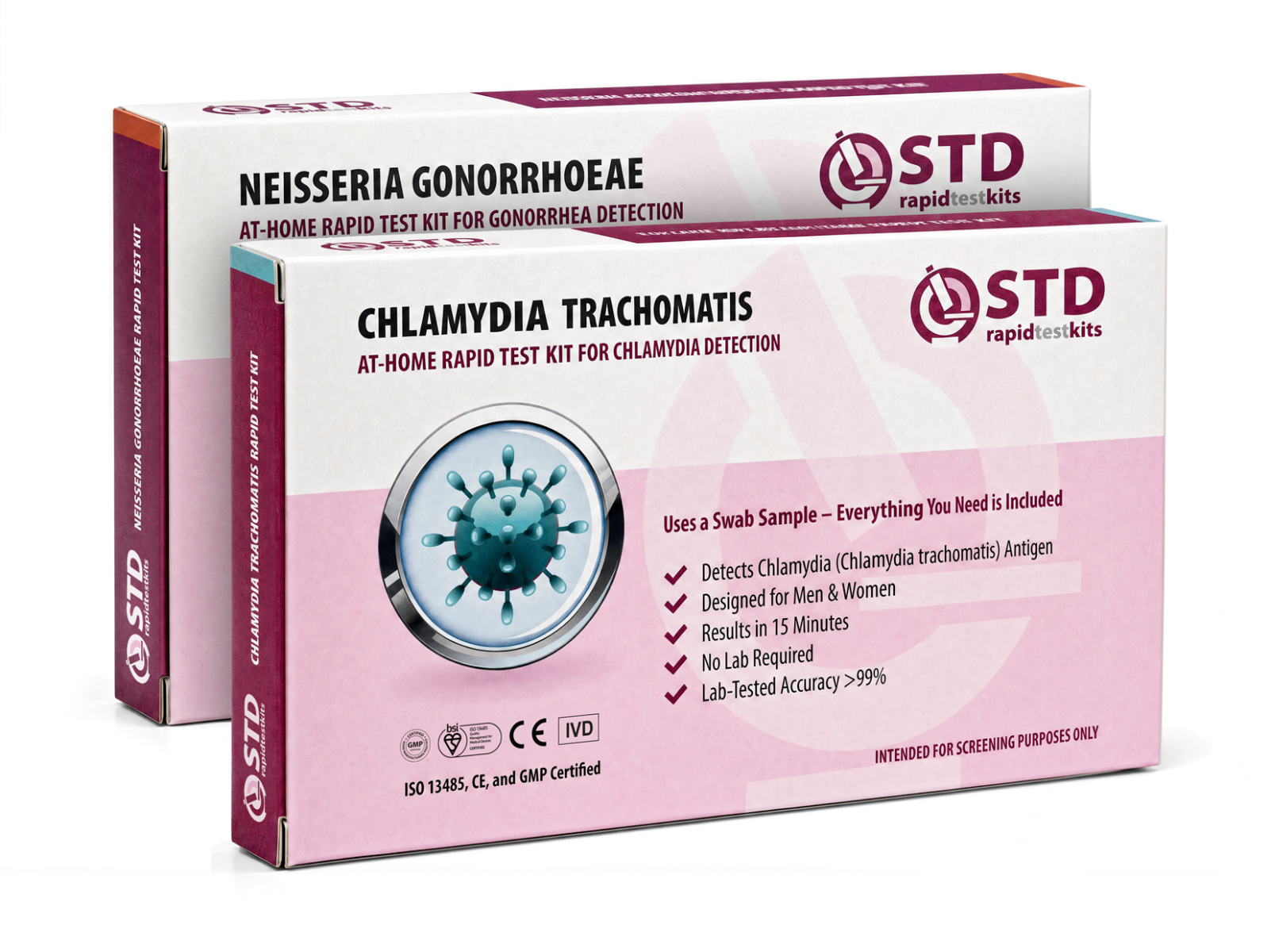
Second, test. If your discharge is yellow or green, or thick and itchy, an at-home swab test for the most likely infections is the fastest way to a clear answer. Our rapid swab kits cover chlamydia and gonorrhea, the two infections most often behind unexplained yellow or green discharge, and use a self-collected vaginal or penile swab. The result is visible in about 15 minutes, the kit ships discreetly, and you can confirm a positive with a lab NAAT for any extra assurance before treatment.
Third, while you wait for the result, avoid sexual activity or use a barrier method. This protects the people you care about and protects your own peace of mind. If the test is positive, treatment for chlamydia or gonorrhea is usually a short course of antibiotics; trichomoniasis is treated with a single oral medication such as metronidazole or tinidazole.
How to Tell a Partner Without Drama
This is the part many people dread, and it is also the part that determines whether the infection comes back. STIs do not follow tidy narratives. You can carry chlamydia or trichomoniasis for months without knowing, then pass it back and forth between partners every time you reconcile or stop using barriers. Transmission is biology, not a moral verdict, and current partners deserve the chance to test before complications develop on their side.
The phrasing that tends to work, for people who use it, is short, direct, and oriented around shared health. One simple sentence does three things at once: it signals you took action first, it frames the issue as shared rather than accusatory, and it hands the other person a concrete next step. Whatever they say in response is information you can work with. The CDC also runs partner services in many states, which can help with confidential notification if a face-to-face conversation feels unsafe.
"I noticed something off and I tested. I want both of us covered, can you test too?"
That one sentence sets the tone (shared health, not blame), gives the other person a concrete next step, and keeps the door open for whatever they need to say back.
Frequently Asked Questions
- Is green discharge always an STD?
- Green discharge points strongly toward an STI most of the time, usually trichomoniasis or advanced gonorrhea. Severe bacterial vaginosis can occasionally tint discharge greenish too, especially when paired with a strong fishy smell. Either way, green is not a color to wait out. Test within a few days, even if there is no pain or itching.
- Can I really have an STD with no pain, smell, or itching?
- Yes, and it is more common than people realize. The CDC notes that most chlamydia infections, and a large share of gonorrhea infections, are asymptomatic for weeks or months. You may only notice a faint yellow stain on your underwear or a slight increase in volume. The absence of pain is not the absence of infection; it is one of the main reasons routine screening exists.
- What if the discharge disappears after a few days?
- Symptoms can come and go. The body might temporarily rebalance, but the underlying infection does not vanish on its own. Untreated chlamydia and gonorrhea, in particular, often go quiet for weeks before causing pelvic complications. If you saw a clear color change once, especially yellow or green, test anyway.
- Can men have unusual discharge without other symptoms?
- Yes. Many early STIs in men are quieter than people expect. A single streak in underwear, a faint yellow tint on the urethral opening in the morning, or a small amount of moisture that does not match your usual pattern may be the only clue. Test rather than wait for a more dramatic symptom; chlamydia and gonorrhea often progress to epididymitis (inflammation of the tubes behind the testicles) before they get loud.
- Is thick white discharge always yeast?
- Not always. Yeast typically shows up as thick, clumpy white discharge with intense itching and sometimes a slight odor of bread or beer. Hormonal shifts, friction during sex, and stress can also change consistency. If you have thick white discharge plus itching or redness, yeast is the leading suspect. If there is no itch, especially in someone sexually active, ruling out STIs is still worth doing.
- Do condoms fully prevent STD-related discharge?
- Condoms substantially reduce the risk of bacterial STIs, including chlamydia, gonorrhea, and trichomoniasis. They are not 100 percent. Some infections also spread through skin-to-skin contact in areas a condom does not cover. If you are seeing color changes after consistent condom use, testing is still a smart move.
- How fast will treatment clear up the discharge?
- Antibiotics for chlamydia and gonorrhea usually start working within 24 to 48 hours, with discharge resolving over the next several days. Trichomoniasis responds to a single oral medication course (usually metronidazole or tinidazole) within about a week. Avoid sex until the full course is finished and your provider gives the go-ahead, even if you feel better, since untreated partners can reinfect you.
- Can stress or hormones turn discharge yellow or green?
- Hormones can change volume, texture, and even slightly tint the color of discharge over a cycle. Stress can shift the balance of vaginal flora and trigger BV. Neither hormones nor stress typically produce a clear yellow or green tint, especially with no other obvious cause. If the color shift is noticeable, treat it as a microbial signal and test.
If You Want Broader Peace of Mind
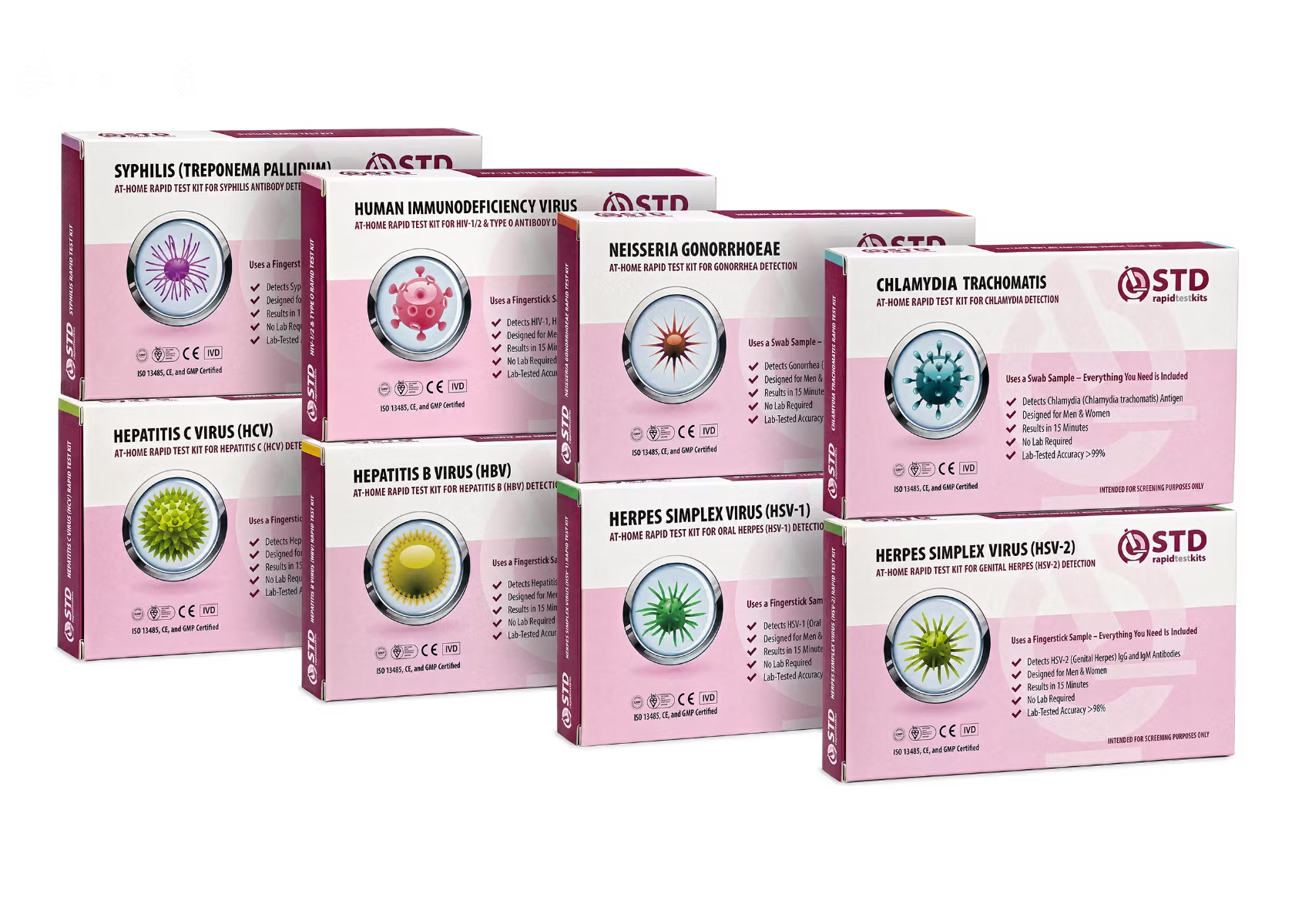
If discharge is one of several reasons you want a fuller picture, including HIV, syphilis, or hepatitis status, an 8-in-1 panel covers the most commonly screened infections in a single shipment. Same lateral-flow technology, mix of self-collected swab and fingerstick blood samples, results in about 15 minutes per test.
How we sourced this article: We combined current guidance from the CDC, WHO, NHS, and Mayo Clinic with reviewed clinical references on lateral-flow versus NAAT testing, then translated it into plain-language action items. Statistics on incidence, asymptomatic rates, and PID risk are from the cited public-health agencies. Product accuracy claims reflect what each linked product page states.
- Mayo Clinic. Vaginal discharge: when changes in color, texture, or smell warrant evaluation.
- U.S. Centers for Disease Control and Prevention. Bacterial vaginosis fact sheet, including symptoms and how BV differs from sexually transmitted infections.
- U.S. Centers for Disease Control and Prevention. About chlamydia, including the high asymptomatic-rate caveat that drives routine screening recommendations.
- U.S. Centers for Disease Control and Prevention. About trichomoniasis, including symptom variability and the high asymptomatic-rate caveat.
- U.S. Centers for Disease Control and Prevention. Pelvic inflammatory disease fact sheet, including the 1-in-8 infertility statistic and ectopic-pregnancy risk after untreated chlamydia and gonorrhea.
- U.S. Centers for Disease Control and Prevention. 2021 STI Treatment Guidelines covering chlamydia, gonorrhea, and trichomoniasis screening and treatment.
- World Health Organization. Sexually transmitted infections fact sheet, with global burden estimates and the high share of asymptomatic cases.
- NHS. Vaginal discharge guidance, including normal cyclic variation and when to seek care.
- Cleveland Clinic. Vaginal discharge: causes, colors, and what is normal versus what is not.
