Published: August 2025 | Last updated: May 2026 | Editorial review and quality control: Martina N.
You see a tingling spot on your lip after a hookup, scroll back through your weekend, and feel your stomach drop. The math your brain runs in that moment, what counted as risk, what didn't, who kissed whom, is real. So is the panic. The facts are usually less alarming than late-night search results suggest, and the path from worry to clarity is mostly a few steps of pattern recognition, timing, and one small testing decision.
This guide walks through what a cold sore actually is, how to tell one from the look-alikes that fool people every week, whether you really caught it from this exposure or simply triggered something your body has carried for years, and what to do next. The short version is that a single lip blister rarely changes the shape of a sex life, and the rest of the page lays out the practical steps from observation to test to follow-up.
Key Takeaways
- Most cold sores on the lip are caused by herpes simplex virus type 1 (HSV-1), which the World Health Organization estimates is carried by about 64% of people under 50 worldwide. The single blister you spotted is far more common than the silence around it suggests.
- Confirming HSV is a question of timing. A clinic swab from a fresh blister is most accurate during an active outbreak; the CDC notes a blood antibody test can take up to 16 weeks or more after a new exposure to reliably detect infection.
What a cold sore actually is
The cold sore on your lip is a small, fluid-filled blister caused by herpes simplex virus type 1 (HSV-1). Most adults who carry the virus picked it up in childhood from a non-sexual source: a parent's kiss on the cheek, a shared cup at daycare, a sibling who had the same tingle in the corner of their mouth. Once HSV-1 enters the body, it travels along facial nerves to a cluster of cells called the trigeminal ganglion and stays there, dormant, for life.
When something irritates that nerve, sun, fever, stress, hormonal change, or friction from kissing or oral sex, the virus reactivates and travels back down to the skin. The familiar cycle plays out over one to two weeks:
- Day 1: a tingle, itch, or numb feeling in one spot, usually on the vermillion border (the edge where lip meets facial skin) or just below the nostril.
- Days 2 to 3: a small cluster of clear vesicles forms over a red base.
- Days 4 to 6: the vesicles rupture, weep, and crust over.
- Days 7 to 14: the crust falls off, the skin underneath looks pink and new, and the lip returns to baseline.
The first outbreak someone ever has tends to be the most intense, occasionally with fever, swollen lymph nodes, and several blisters at once. Recurrences are usually milder and shorter, often a single blister that resolves in under a week, per the NHS overview of cold sores.
Day 1: tingle or itch in one spot. Days 2 to 3: clear vesicles form on a red base. Days 4 to 6: vesicles rupture and crust over. Days 7 to 14: the crust falls off and the skin underneath returns to baseline.
Cold sore vs pimple vs canker sore vs angular cheilitis
The mirror gives you four common candidates for "small thing on or near my lip," and each has a fingerprint:
- Cold sore (HSV-1): lives on the outer lip, especially the vermillion border, in a cluster of small clear blisters on a red base. Tingles before it appears. Crusts over.
- Pimple (acne): usually on the skin above or below the lip, not on the vermillion border itself. Has a visible pore or whitehead. Hurts when pressed but does not tingle in advance.
- Canker sore (aphthous ulcer): lives inside the mouth, on the inner lip, gum, or cheek. White or yellow center with a thin red ring. Burns with salty or acidic foods. Never on the outer lip skin.
- Angular cheilitis: lives at the corner of the mouth where lips meet, often both sides at once. Looks cracked, red, and inflamed rather than blistered. Often caused by yeast, bacteria, or chronic moisture, not HSV.
Two clues separate cold sores from the rest most reliably: the prodrome (the tingle 12 to 24 hours before anything is visible) and the location (the vermillion border, where lip skin meets facial skin). When both are present, HSV-1 is the most likely cause. If the spot is on a movable mucosal surface inside the mouth, painful with food, and never blisters, it is almost certainly a canker sore, which is unrelated to herpes.
Did you catch HSV-1 from this exposure, or did your body wake an old virus up?
This is the question that decides how much weight a cold sore deserves, and the honest answer is that you cannot tell from the blister alone. Three patterns are all possible:
A new infection from this exposure. A first-ever HSV-1 outbreak typically appears within 1 to 3 weeks after the contact that transmitted the virus, per MedlinePlus. If your partner had an active cold sore (or shed virus without symptoms) and the timing matches, this is plausible.
A reactivation of a virus you have carried since childhood. The World Health Organization estimates about 64% of people under 50 carry HSV-1 worldwide, and most acquired it before age 10. A first symptomatic outbreak in adulthood is common: stress, sleep loss, sun, friction, or hormonal change can wake a long-dormant virus, and the trigger sometimes coincides with a sexual encounter that did not actually transmit anything new.
A reactivation triggered by an exposure that did not transmit anything. Kissing or oral contact may cause friction or stress on the lip area without contributing any new viral particles. The body still reads it as a trigger, and the virus that was already in the trigeminal ganglion comes out.
Without prior antibody testing, there is no way to retroactively determine which pattern applies. What changes practically is whether your partner needs to be informed about a new exposure. If you have evidence (childhood cold sores, an old positive HSV-1 antibody result), the conversation is about a familiar virus. If this is genuinely your first-ever outbreak, a baseline antibody test now plus a follow-up timed to the antibody window helps map what happened. The CDC's herpes testing guidance states that current blood antibody tests can take up to 16 weeks or more after exposure to detect infection.
The blister alone cannot tell you which of the three patterns applies. If this is genuinely your first-ever outbreak and you want to know whether the virus is new, plan a baseline antibody test now and a follow-up several months out. The CDC notes that current blood antibody tests can take up to 16 weeks or more after exposure to reliably detect infection, so timing the follow-up around that window matters more than testing immediately.
HSV-1 vs HSV-2: which virus is most likely on your lip
There are two herpes simplex viruses, and they are slightly different actors:
- HSV-1 is the typical cause of oral cold sores. It can also cause genital herpes when transmitted by oral-genital contact, and the CDC notes that some cases of genital herpes are due to HSV-1, transmitted through oral sex.
- HSV-2 is the typical cause of genital herpes and recurs more often in the genital area than HSV-1 does. Oral HSV-2 is uncommon but possible, usually after oral exposure during a partner's genital outbreak.
For a single blister on the vermillion border of the lip, HSV-1 is overwhelmingly the more likely virus, regardless of how it arrived. HSV-2 on the lip recurs rarely, often once and then quietly forever, which is why nearly all oral cold sores someone has more than once are HSV-1.
A blood antibody test (IgG) can distinguish the two when timed correctly. The body needs time to produce enough type-specific antibodies for a typed assay to differentiate HSV-1 from HSV-2, and CDC herpes testing guidance notes that current tests can take up to 16 weeks or more after exposure to detect infection. Earlier than that window, a negative result is unreliable. A swab taken from a fresh blister and tested by PCR can also identify the type, but only during an active outbreak.
Is a cold sore after oral sex actually a sexually transmitted disease?
By the medical definition, yes: cold sores are caused by HSV-1, a virus that can transmit during sexual contact (and also non-sexually, which is how most carriers acquired it as children). About 64% of people under 50 carry HSV-1 worldwide, per the World Health Organization. A single lip blister does not mean your sex life changes shape. The practical concern after oral sex is whether the virus also reached the genitals, which an at-home blood antibody test can answer once enough time has passed for antibodies to develop, up to 16 weeks or more after the exposure per the CDC.
When to test, and which test fits the question you are asking
Two different tests answer two different questions, and choosing the right one saves a lot of repeat testing.
A swab during an active outbreak answers "what is on my lip right now?" Healthcare providers can swab the fluid from a fresh blister and send it to a lab for PCR or viral culture. PCR is the more sensitive option and is the standard at most clinics. This test types the virus (HSV-1 vs HSV-2) and is most accurate during the first 48 hours of a new blister, before the lesion crusts over.
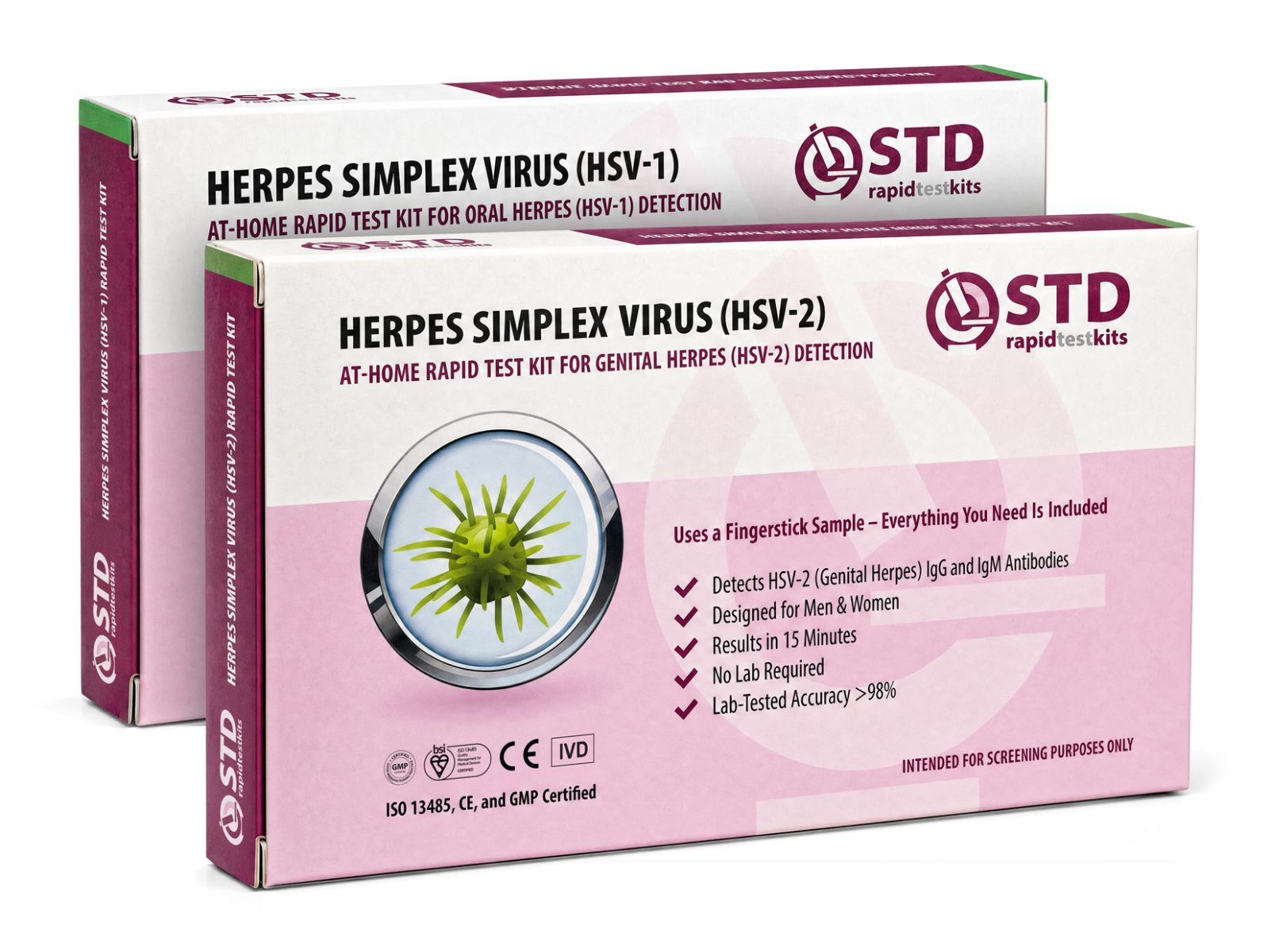
A blood antibody test (IgG) answers "am I a carrier?" The body produces type-specific antibodies after exposure, but the rise is slow. The CDC notes that current antibody tests can take up to 16 weeks or more after a new exposure to reliably detect infection. A negative IgG in the first month or two after a new exposure does not rule out anything; testing is most useful once that antibody window has passed. At-home rapid lateral-flow blood antibody tests use a fingerstick sample and give a result in about 15 minutes.
A few practical notes about home testing:
- If your concern is "did I catch HSV from this partner?", a baseline antibody test now plus a follow-up after the antibody window has closed gives the cleanest answer.
- If your concern is "did the virus also reach my genitals?", an HSV-2 antibody test is what most home kits screen for; an HSV-1 antibody test is more useful for documenting overall status.
- The at-home rapid tests sold here are lateral-flow immunoassays, not lab NAATs. They are screening tools. A positive result is worth confirming through your provider, especially in pregnancy or if it changes a relationship decision.
Treating an active outbreak
Most cold sores heal on their own. Treatment shortens the outbreak by a day or two and reduces discomfort, which matters when the sore lands on a wedding day, a work trip, or a date night.
- Oral antivirals (prescription): acyclovir, valacyclovir, and famciclovir. Most effective when started at the first tingle. A single high-dose course of valacyclovir, taken at the prodrome, can sometimes abort an outbreak entirely.
- Topical antivirals: penciclovir cream (prescription) and acyclovir cream (varies by country). Modest reduction in healing time when applied early.
- Topical docosanol (over-the-counter): sold as Abreva in the United States. May shorten outbreaks by about half a day if started at the first tingle.
- Symptom care: cool compresses for swelling, lip balm to keep the crust pliable, ibuprofen or acetaminophen for pain, sunscreen on the lip during recovery.
Avoid picking the scab; it extends healing and increases the chance of scarring. Skip lipstick and shared towels until the sore is fully crusted and dry. People who are immunocompromised, pregnant, or having frequent recurrences benefit from a clinician-led plan that may include daily suppressive antivirals.
Over-the-counter docosanol (Abreva): may shorten an outbreak by about half a day when started at the first tingle. Prescription oral antivirals (acyclovir, valacyclovir, famciclovir): typically shorten an outbreak by 1 to 2 days; a high-dose valacyclovir course at the prodrome can sometimes prevent the blister entirely. Daily suppressive prescription dosing is reserved for frequent recurrences (about six or more per year) or higher-risk situations such as pregnancy or immunocompromise.
Sex, kissing, and partners during and after the outbreak
The transmission rules are simpler than they sound. The risk is highest during an active outbreak, when the blister is shedding virus directly onto skin or mucous membranes. The risk drops substantially once the sore is fully crusted, and drops further once the skin has healed.
- During an outbreak (tingle through fully healed): no kissing on the lips, no oral sex, no sharing utensils, lip balm, or drinks. The most common transmission scenario is oral-to-genital during oral sex while a blister is forming or active.
- Between outbreaks: asymptomatic shedding still happens, but at much lower rates. Daily suppressive antivirals reduce shedding for people with frequent recurrences. Condoms and dental dams reduce, but do not eliminate, transmission risk because lesions can occur outside the protected area.
- Disclosure: there is no legal requirement in most jurisdictions to disclose cold sores, but disclosure is a kindness that lets partners make their own informed choices, especially before oral sex. Framing it as "I get cold sores, here is what we do during an outbreak" is usually all the conversation needs to be.
Most people with HSV-1 infection acquired it during childhood, often without symptoms. Both HSV-1 and HSV-2 can cause genital herpes, and oral-to-genital transmission is one route by which HSV-1 can cause genital infection.
When to skip the home test and book a clinician visit
The at-home antibody test fits many situations, but not all. See a healthcare provider promptly if any of the following apply:
- Severe pain, very large blisters, or blisters spreading beyond the lip area, which can signal a primary HSV infection that benefits from prescription antivirals.
- Any blistering, redness, or discomfort near the eye. Ocular HSV can damage vision and needs same-day evaluation.
- A first outbreak during pregnancy, especially in the third trimester. HSV in late pregnancy has implications for delivery planning.
- Compromised immune function (HIV, organ transplant, chemotherapy, biologics for autoimmune disease). Outbreaks can be more severe and prolonged.
- The sore has not healed in 14 days, or recurrences happen more than five to six times per year.
- Painful symptoms in the genitals matching the timing of the lip outbreak. Concurrent oral and genital lesions deserve clinical evaluation, not a home test alone.
For uncomplicated, recognizable cold sores in otherwise healthy adults, a home test for documenting HSV status (timed once the antibody window has passed) is generally appropriate.
Any blistering, redness, or pain near the eye after a cold sore exposure needs same-day clinical evaluation. Ocular HSV can affect vision and is treated promptly to prevent corneal damage. Do not wait to see if it resolves on its own.
Should you test for anything else after this exposure?
If the same encounter that worried you about a cold sore was also an unprotected sexual exposure, an HSV test alone covers only one infection. Other common STIs from oral or genital contact (HIV, syphilis, chlamydia, gonorrhea, hepatitis B, hepatitis C) each have their own testing windows and sample types. A combination panel groups the most common ones into a single round of fingerstick blood plus self-collected swab samples, which is often the pragmatic choice when one event has prompted broader screening.
The combo kit below covers eight of those infections. It is not a replacement for the targeted HSV antibody test above; it answers the wider question of "what else might I have been exposed to?"

The emotional weight, and how to put it down
A cold sore is a small medical event with a disproportionately large emotional weight. The blister is visible, the thoughts are louder, and mirrors feel like accusations. A few things help cool the heat.
Numbers help. About 64% of people under 50 carry HSV-1, per the WHO. The cute barista, the ex, the friend you trust most: statistically, several of them carry the same virus, and most of them have never been told.
Naming the situation cuts the spiral. Said out loud to a partner or trusted friend, "I have a cold sore, I am treating it, I am pausing kissing for a week," the situation stops being a secret. Most people find the conversation lands far more simply than they expected.
Focus on what is in your control. Treat the blister, time the test correctly, keep your routines (sleep, sun protection, stress management) as steady as you can. The virus interrupts the week; it does not get to define the month.
Most people, after the first outbreak, are surprised at how quickly the sore moves from center stage to background noise. Some never have a recurrence. Many have one or two a year, often around predictable triggers, and learn to head them off at the tingle.
About 64% of people under 50 carry HSV-1, per the World Health Organization. In any room of thirty people, roughly twenty are likely carrying the same virus, and most of them have never been told.
FAQs
- How long after oral sex can a cold sore appear?
- A new HSV-1 infection typically appears within 1 to 3 weeks after the contact that transmitted it, per MedlinePlus. If you are already an HSV-1 carrier, a reactivation can happen within 24 to 48 hours of a trigger like friction, stress, or sun.
- Can a cold sore on my lip cause genital herpes in a partner?
- Yes. HSV-1 can transmit from an active oral cold sore to a partner's genital area during oral sex. Risk is highest during the tingle-and-blister phase and drops once the sore is fully crusted and healed. Avoid oral sex during an outbreak.
- Does having a cold sore mean I have an STD?
- Technically yes. HSV-1 qualifies as a sexually transmitted infection because it can transmit through sexual contact. In practice, the majority of carriers picked it up as children from a non-sexual source, so most people, and many clinicians, do not treat a lip sore as an STD in the everyday sense of the term.
- Do I have to tell partners I get cold sores?
- Disclosure is not legally required in most places, but it is generally appreciated. A short, factual mention ("I get cold sores; we skip oral sex when one is active") is usually all the conversation needs.
- Will I get cold sores forever now?
- Possibly. Some people have one outbreak and never another. Others have a few per year. Triggers (stress, sun, illness, hormonal change) tend to follow a personal pattern; learning yours and acting at the first tingle reduces both frequency and severity.
- Can I test for HSV-1 at home?
- Yes, but timing matters. The CDC notes that current antibody tests can take up to 16 weeks or more after a new exposure to reliably detect infection, so a negative result earlier than that is not conclusive. Home rapid blood kits use a fingerstick and return a result on the spot, and any positive screen is worth confirming with your provider.
- What can speed up healing?
- Starting an antiviral (acyclovir, valacyclovir, or topical docosanol) at the first tingle can shorten the outbreak by a day or two. Keep the area clean, do not pick the scab, and use sunscreen on the lip during recovery.
- When do I need a doctor instead of an at-home test?
- See a clinician for severe pain, blisters spreading beyond the lip, any involvement near the eye, a first outbreak during pregnancy, immunocompromise, sores that do not heal within 14 days, or genital symptoms in the same timeframe.
- U.S. Centers for Disease Control and Prevention. About Genital Herpes: HSV type distribution and the statement that some cases of genital herpes are due to HSV-1 spread through oral sex.
- World Health Organization. Herpes Simplex Virus Fact Sheet: global HSV-1 prevalence (about 64% of people under 50) and asymptomatic shedding.
- U.S. National Library of Medicine, MedlinePlus. Oral herpes: clinical course, incubation of 1 to 3 weeks, and reactivation triggers.
- U.K. National Health Service. Cold sores: appearance, life cycle, self-care, and when to see a clinician.
- InformedHealth.org via the U.S. National Library of Medicine NCBI Bookshelf. Cold sores: differential diagnosis, treatment options, and recurrence patterns.
- U.S. Centers for Disease Control and Prevention. Herpes Testing: blood antibody window, including the statement that current tests can take up to 16 weeks or more after exposure to detect infection.
