







Quick Answer: Yes, you can get an STD from BDSM scenes that don’t involve penetration, especially through skin-to-skin contact, shared toys, or gear that carries microscopic blood, vaginal fluid, or semen. Testing is recommended if any of those exposures occurred.
This Article Is for You If You’ve Ever Wondered: “Was That Safe?”
Not everyone walks out of a BDSM dungeon worried about STDs. In fact, the biggest myths around kink often go unspoken: that it’s somehow safer than “regular” sex, that condoms aren’t necessary if there’s no penis involved, or that toys and leather gear can’t carry infections.
But the truth is, kink scenes often involve exactly the kind of conditions that STDs thrive in: exposed skin, shared objects, sweat, fluids, and microabrasions you may not even feel. You don’t need to be bleeding. You don’t even need to have had direct contact with a penis or vagina. Exposure doesn’t care about your labels, it cares about biology. That’s why this guide goes beyond traditional “sex ed” and speaks to the specific exposures that happen during BDSM, impact play, and toy-based interactions.
Maybe your scene involved rope burns that broke the skin. Maybe you were the bottom in a group scene with shared equipment. Maybe you used a dildo with someone and wiped it off, but didn’t sanitize it. If any of that sounds familiar, you’re in the right place.
How STDs Actually Spread in BDSM: The Forgotten Routes
We tend to think of STDs as being passed through “sex” as it’s conventionally defined: penis-in-vagina or penis-in-anus contact, or maybe unprotected oral. But transmission doesn’t wait for penetration. Let’s talk about the lesser-known, but medically documented, ways STDs can spread in kink scenes:
First, shared toys. Dildos, plugs, and even internal electro-stim devices can retain viral particles or bacteria if not cleaned properly. One 2016 study published in the Journal of Sexual Medicine found that HPV DNA could persist on silicone dildos even after washing with soap and water. Without full disinfection between partners, or use of a new condom per partner, this creates a clear transmission route.
Second, impact play with skin exposure. Flogging, spanking, paddling, or whipping can cause microtears in the skin. Even if you don’t see blood, those abrasions are enough for viruses like Herpes or Hepatitis B to enter. And if you’re playing bareback, that means your skin was directly in contact with a partner’s fluids or your own broken skin touched shared surfaces.
Third, latex and leather gear. While external contact with latex clothing seems low-risk, think about what’s happening underneath. Bodies sweat. Condoms break. Gloves leak. If someone uses a glove to penetrate a partner, then uses that glove again on you, yes, that’s a possible transmission pathway, especially for Trichomoniasis, Chlamydia, or Gonorrhea.
Fourth, body fluid exchange that feels “minor.” Saliva from floggers in someone’s mouth. Blood specks from scratching or needle play. Anal secretions transferred by a plug, even if there was no direct anal sex. These are all common in play parties or intense scenes, and they’re rarely talked about outside medical spaces.
| Exposure Scenario | STD Risk | Testing Recommendation |
|---|---|---|
| Shared dildo used on multiple people | High (Herpes, HPV, Chlamydia, Gonorrhea) | Test within 7–14 days; retest at 4 weeks if negative |
| Flogging or paddling with skin abrasions | Medium (Herpes, Hepatitis B) | Test at 3–6 weeks depending on symptoms |
| Latex glove penetration reused between partners | High (Trich, Gonorrhea, Syphilis) | Test within 2 weeks; consider retest |
| Rope play with genital contact | Low to medium (HPV, HSV) | Monitor for symptoms; test if unsure |
Table 1. Common kink exposures and their STD testing implications. Based on case studies, CDC guidance, and peer-reviewed risk models.
Real Talk: Case Study From a Dungeon to a Doctor’s Office
Casey, 27, identifies as nonbinary and active in the rope and impact play scene. After a weekend at a regional kink event, they noticed a burning sensation during urination. They hadn’t had what most people would call “sex”, no penetration, no oral. Just a scene involving suspension bondage, some genital rope harnesses, and a few toys used during orgasm control play.
They put it off at first. “It can’t be an STD,” Casey thought. “I didn’t even f anyone.” But after four days of worsening symptoms, they went to a clinic. The test? Positive for Chlamydia. The nurse explained that it likely came from a shared toy, one that had been rinsed but not sanitized, used by a previous partner at the event.
This isn’t an outlier. According to CDC screening guidance, STDs can be transmitted through contact with mucous membranes, even without ejaculation or penetration. That means anyone participating in toy use, genital rubbing, oral play, or scenes involving bodily fluids has potential exposure.
Casey now builds toy sanitizing protocols into their aftercare routine, and gets tested every 3 months, even if they “didn’t have sex.”

People are also looking for: HIV Testing at Home: Swap Anxiety for Answers in 20 Minutes
More Than Just “Sex”: Understanding Testing Needs in the Kink Community
Let’s call this out: most public health messaging around STDs is built for cisgender, heterosexual, monogamous couples. It’s inadequate. Kink doesn’t fit that mold, and neither do the exposures it includes. Many kinksters identify as queer, nonbinary, or polyamorous. Their play may involve groups, fluid bonding, blood play, or extended scenes with physical intimacy but no “sex.”
So how do you know when to test? The answer isn’t about labels, it’s about what your body was exposed to. Here’s a simplified overview of STD window periods relevant to common kink exposures:
| STD | Common Kink Exposure Route | Earliest Reliable Test Date | Best Time to Test |
|---|---|---|---|
| Chlamydia | Shared toys, glove play | 7 days | 14 days |
| Herpes (HSV) | Skin contact during impact play or genital rubbing | 7–14 days (if symptoms appear) | If symptomatic or exposure known |
| Syphilis | Blood exposure, mucous contact | 3 weeks | 6 weeks+ |
| Hepatitis B | Open skin + blood/fluid contact | 3–6 weeks | 6–12 weeks |
Table 2. Testing timelines based on non-penetrative exposures during BDSM and kink play.
When Should You Get Tested After a BDSM Scene?
Let’s say the scene ended two nights ago. You’re sore, maybe bruised, but that’s expected. What wasn’t expected was the anxiety creeping in now: Was that plug actually sanitized? Did that tiny scratch on your thigh bleed more than you realized? Is it even worth testing if nothing looks “wrong” yet?
Timing matters, but not as much as you might think. While some STDs show up on tests within days, others take weeks to appear. Testing too early can give you false reassurance. But waiting too long may increase risk of transmission if you’re sexually active again before knowing your status.
If you had clear fluid exchange, such as shared toys without barriers, skin-to-skin genital contact, or visible blood, it’s best to test within 7 to 14 days, then again at 4 to 6 weeks for confirmation. If your scene included only light impact play with no open skin or fluids, risk is low, but not zero. Herpes, for instance, spreads through microscopic skin contact even without symptoms.
Here’s a general rule of thumb: If you’re asking “should I get tested?”, that’s usually your answer. Testing isn’t just a diagnosis tool. It’s a trauma-informed way to calm your brain, clarify your risk, and act responsibly with future partners.
And if you’re not sure where to start, here’s a simple way to take action without the anxiety of booking a clinic appointment:
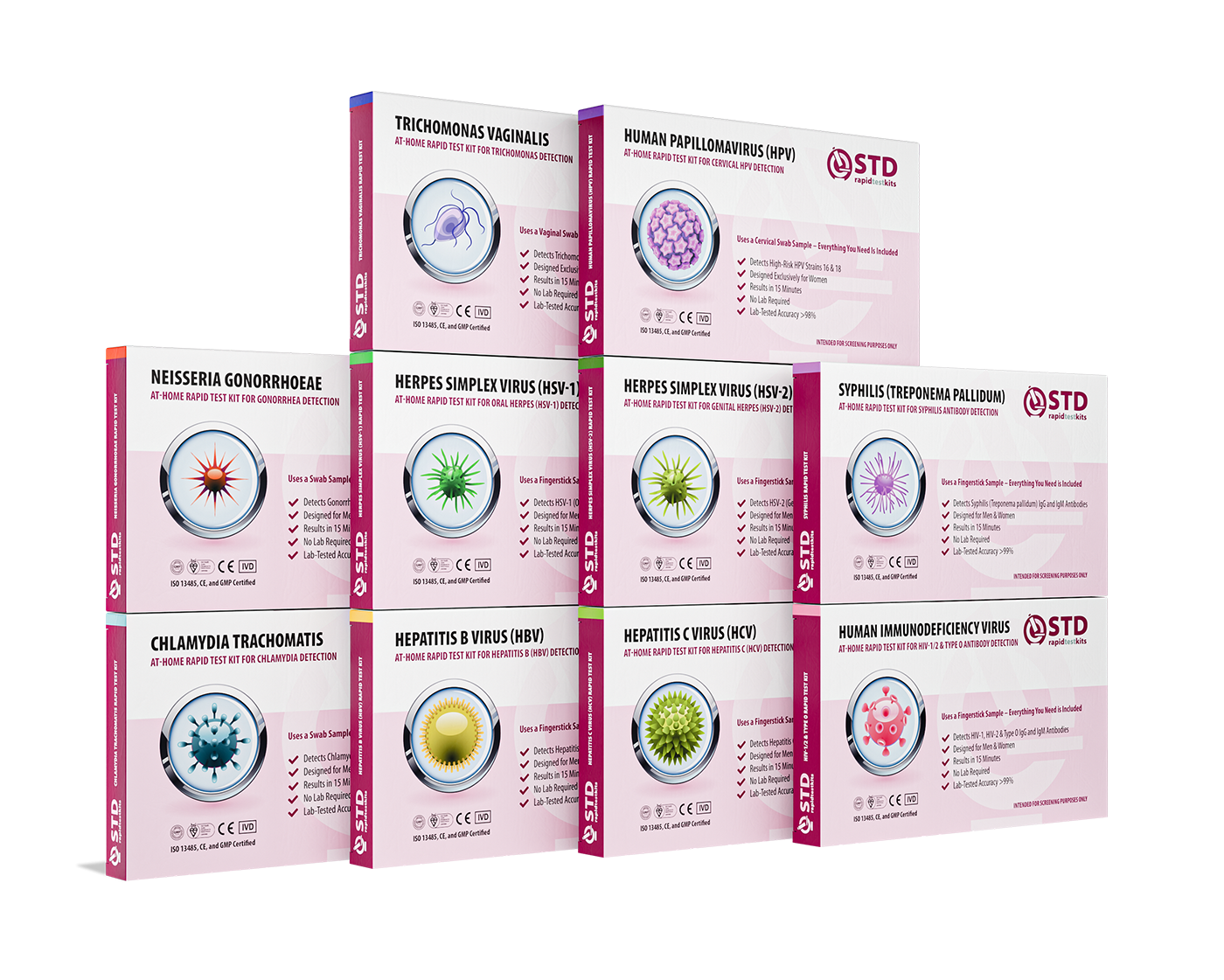
Order a discreet Combo STD Home Test Kit, it checks for the most common STDs and arrives in unmarked packaging with fast results you can read at home.
Clinic Testing vs At-Home Rapid Kits: Which Is Right After Kink?
In the kink world, privacy isn’t a luxury, it’s a boundary. That’s why many kinksters choose at-home STD tests rather than clinics, which can feel judgmental, gender-binary, or even triggering.
Thing is, both methods have strengths: and both come with trade-offs.
Rapid at-home kits offer real-time answers, usually within 10–15 minutes. You prick your finger, apply blood to a cassette, and watch for lines. These are great for high-prevalence infections like Syphilis or HIV, especially if you’re within the accuracy window.
Mail-in kits often test urine or swab samples and are lab-processed. These can be more sensitive for Chlamydia, Gonorrhea, and Trichomoniasis, especially when the sample site matters (genital, rectal, or oral exposure). You’ll get results in a few days via a secure portal.
Clinics can offer comprehensive panels, blood draws, and even visual exams for symptoms. But they also come with stigma, long wait times, and less control over who handles your data.
| Testing Method | Ideal For | Result Speed | Privacy Level |
|---|---|---|---|
| At-Home Rapid Test Kit | Immediate peace of mind, impact scenes | 10–20 minutes | Very high (results stay with you) |
| Mail-In Lab Test | Toy use, fluid exposures, comprehensive testing | 2–4 business days | High (anonymous ID codes) |
| In-Clinic Testing | Visible symptoms, post-assault, high-risk exposures | Same day to several days | Moderate (requires ID, face-to-face) |
Table 3. Comparing testing methods after BDSM exposure. Choose based on risk type, timing, and comfort level.
The Myth of “No Sex, No Risk” , Why It’s Dangerous
“We didn’t even have sex.” It’s the most common, and most misleading, rationale people give to avoid testing. The problem? STDs don’t require traditional intercourse. And in many cases, the absence of penetration just means people skip using barriers altogether.
This false sense of safety is especially prevalent in kink communities, where scenes often look, and feel, radically different from mainstream sex. But bodies still touch. Sweat still drips. Toys still slip between people. And those moments, while intimate and empowering, can still carry viral or bacterial load.
Herpes spreads from skin. Syphilis can be passed through a sore on a buttock. HPV can linger on a harness or dildo. If you’ve ever had someone else's fluids near your genitals, anus, or mouth, your body doesn't care whether it was labeled "sex." Exposure is exposure.
Testing isn’t about shame. It’s about transparency, for yourself and your future scenes. Think of it as aftercare for your health, just like water, rest, and emotional check-ins.
Check Your STD Status in Minutes
Test at Home with Remedium10-in-1 STD Test Kit
 For Women
 Results in Minutes
 No Lab Needed
 Private & Discreet
Order Now $189.00 $490.00
For all 10 tests
When Testing Feels Like a Confession
Some people don't get tested for STDs because they don't want to admit something, not because they don't care. Like taking a test means you were "dirty," "bad," or "reckless." That stigma hurts even more in queer or kink spaces, where people from the outside world already judge them harshly.
But here's the truth: testing is a form of self-respect. It's how you care for the bodies you play with. It's how you show up in community. And it's how you de-escalate the anxiety spiral that hits when something feels off after a scene.
Ravi, 32, shared his experience after a flogging scene ended with broken skin and some blood: “I felt gross even thinking I could have gotten something. But once I did the test at home, I felt like I could breathe again. It gave me back control.”
Whether you're a top, bottom, switch, or voyeur, testing doesn't define your role. It defines your awareness. And in kink, awareness is power.
Remember: you can order testing kits discreetly, with results in minutes. You don’t need permission to get clarity.
Retesting and What to Do If You’re Still Unsure
So maybe you tested once. Maybe it came back negative. But something still doesn’t sit right. Or maybe you got tested a little too early, before the window period closed for every STD.
This is where retesting matters, especially after BDSM scenes where exposures are unconventional or hard to track. Fluid exchange might not be obvious. Tiny abrasions might go unnoticed. And symptoms? They can be subtle, delayed, or completely absent, especially for STDs like Chlamydia, Trichomoniasis, and HPV.
Here’s a real-world example: Lena, 29, tested negative for everything one week after a toy-heavy group scene. But at week five, they developed unusual discharge and retested, positive for Gonorrhea. The first test wasn’t wrong, it was just too early.
If your original exposure was recent and involved fluids, mucous membranes, or toys, it’s wise to retest at the 4–6 week mark, especially for Syphilis, Gonorrhea, Herpes, and Hepatitis B. And if you're in an ongoing play relationship with someone who tested positive, get checked again after treatment windows too.
You can use a combo STD kit for peace of mind, and retesting doesn’t require explaining anything to a clinic. It’s private, affordable, and gives you back your agency.
Prevention in Kink: Beyond Condoms
In a lot of kink scenes, condoms aren’t even part of the equation, because sex, as traditionally defined, isn’t happening. But that doesn’t mean there aren’t smart, low-effort ways to reduce risk. Let’s walk through a few kink-specific strategies that don’t ruin the vibe:
First, barrier rotation. If you’re using toys on multiple partners, or even multiple orifices, change the condom on the toy each time. Even better, clean with medical-grade sanitizer like alcohol or boiling (for non-porous toys) between uses. Soap and water may not kill viruses like HPV or Herpes.
Second, glove up. Medical gloves are cheap, come in every color imaginable, and add a new sensory layer. Use a fresh glove per partner or activity. If fluids get on them, treat them like you would a used condom, off and in the trash.
Third, play safer with blood and impact. If you're doing any scene that might break the skin (needles, paddling, caning), don’t share gear without thorough sterilization. Wipe down surfaces. Use individual tools if you can. Treat blood exposure seriously, even if it’s “just a scratch.” Hepatitis B is far more contagious than HIV through blood.
And lastly, normalize testing as part of aftercare. Offer your results when negotiating a scene. Ask for theirs without shame. Some doms even schedule testing days like a ritual, it shows care, not suspicion.
You can explore testing options that fit your play style, without needing to leave home or explain your kink to a stranger.
People are also reading: The Silent Spreaders: 7 STDs That Lurk in Women’s Bodies for Months
If You Test Positive After Kink, Here’s What Happens Next
First: breathe. A positive STD result after a kink scene doesn’t mean you were irresponsible. It doesn’t mean your scene was unsafe. It just means biology did its thing, and now you get to do yours: treat, disclose, and heal.
Most common STDs are treatable with one course of antibiotics or antivirals. Clinics can offer follow-up testing, prescriptions, and support for partner notification. But you can also access treatment through telehealth if the idea of explaining a kink scene in person makes you freeze.
Dev, 35, got a positive Chlamydia test two weeks after a leather play party. “I didn’t even know you could get it from a shared toy,” he said. “But I got treated, let my partners know, and now I always keep alcohol wipes and extra condoms in my bag.”
If you’re unsure how to tell a play partner about a positive result, scripts help. Try: “Hey, I recently tested positive for X and wanted to let you know in case you want to get checked too. I respect our scene and want you to have the info to take care of yourself.”
That’s it. You don’t owe shame. You owe honesty. And remember: people respect transparency more than they respect silence.
If you’re feeling stuck, reframe this: Testing is not confession. It’s self-knowledge.
Before You Play Again: The Final Aftercare Step
Testing isn’t just a reaction, it can be part of your ritual. The same way you plan a scene, negotiate a safeword, or hydrate after rope play, you can make testing part of your rhythm. It doesn’t have to be scary. It doesn’t even have to be public.
It can look like this: You and a partner swap recent results before a new scene. You agree to wipe down toys before and after. You set a calendar reminder to test every three months, or after any high-fluid or high-intensity weekend. You track your exposure, not out of paranoia, but out of care.
You deserve to feel safe in your pleasure. And your body deserves clarity, not just consent.
Don’t wait and wonder, get the clarity you deserve. This at-home combo test kit checks for the most common STDs discreetly and quickly.
FAQs
1. Wait, can I really get an STD if there wasn’t any “sex”?
Yep. No penetration, no ejaculation, no oral, and still a risk. STDs like Herpes and HPV don’t care about your definition of sex. They spread through skin-to-skin contact, shared toys, and even sweat or saliva in some cases. If you had any scene where someone’s fluids or body touched yours, testing’s worth it.
2. How risky is it to share toys during a scene?
If those toys touch genitals, mouths, or anuses and aren’t sanitized between people, yeah, that’s a real exposure. Think of a dildo like a toothbrush: you wouldn’t borrow one after a stranger. Covering toys with condoms and swapping them between uses helps, but disinfection matters too. Some viruses can hang around longer than you'd think.
3. I got spanked hard enough to bruise, should I be worried?
Maybe. If the spanking caused even tiny tears in the skin, and there was any contact with another person’s fluids or a shared implement, that’s enough for something like Hepatitis B or Syphilis to sneak in. If the gear was clean and nobody bled, risk is low, but not zero.
4. What about rope play? Isn’t that mostly safe?
Usually, yes. But rope that wraps around genitals or mucous membranes can cause micro-abrasions. Combine that with shared ropes or intense body contact, and there's a small but real risk, especially for Herpes or HPV. Think of it as “low risk” but not “no risk.”
5. I didn’t see any blood or body fluids, am I in the clear?
Not necessarily. Some fluids (like pre-cum, vaginal secretions, or anal mucus) aren’t always visible. And you won’t always notice broken skin in the heat of a scene. If anything involved genital contact, toy sharing, or intense skin contact, a test gives peace of mind.
6. How long should I wait before getting tested after a scene?
If you want the most accurate results: wait 7 to 14 days for basic STDs like Chlamydia and Gonorrhea, and around 4 to 6 weeks for things like Syphilis and Hep B. Too soon, and the test might miss it. But if you have symptoms, don’t wait, test now, then again later if needed.
7. Do rapid at-home kits actually work for kinky exposures?
Yes, as long as you're testing at the right time. Rapid kits are great for flagging HIV, Syphilis, and sometimes Hepatitis B. Just follow the instructions, use clean hands, and remember that a negative result early on doesn’t always mean you’re in the clear forever. Retesting is part of the process.
8. How do I tell a play partner I tested positive?
Keep it simple and kind. You could say, “Hey, I got tested after our scene and something came up. I wanted you to know so you can take care of yourself too.” You’re not accusing anyone, you’re being responsible. Most people appreciate the honesty more than you realize.
9. Can I keep playing if I have an STD?
Totally, if you manage it responsibly. Lots of people in kink communities live with Herpes, HPV, or even chronic conditions like HIV. The key is disclosure, protection, and testing. Your status doesn’t define your play. Your care and honesty do.
10. Okay, but do people really test after BDSM scenes?
More and more, yes. Especially in communities where consent culture is strong, testing is seen as part of aftercare, not punishment. Some folks test every 3 months. Others do it after big parties or group scenes. If you’re wondering whether you should... you probably already know the answer.
You Deserve Answers, Not Assumptions
If you're reading this after a scene that left you uncertain, you're not alone, and you're not broken. The truth is, many kink scenes involve more biological risk than people realize. That doesn't mean they're unsafe. It just means safety takes more than a safe word.
Whether you're a dungeon regular, rope bunny, sadist, or just experimenting, your body deserves clarity. And your mind deserves calm. That starts with knowledge. It continues with testing.
This Combo STD Test Kit can be your next best step. It's fast, discreet, and trauma-informed, just like the care you give your partners.
How We Sourced This Article: We combined current guidance from leading medical organizations with peer-reviewed research and lived-experience reporting to make this guide practical, compassionate, and accurate. In total, around fifteen references informed the writing; below, we’ve highlighted six of the most relevant and reader-friendly sources. Every external link in this article was checked to ensure it leads to a reputable destination and opens in a new tab, so you can verify claims without losing your place.
Sources
1. CDC STD Screening Recommendations
2. Planned Parenthood – STDs, HIV & Safer Sex
About the Author
Dr. F. David, MD is a board-certified infectious disease specialist focused on STI prevention, diagnosis, and treatment. He blends clinical precision with a no-nonsense, sex-positive approach and is committed to expanding access for readers in both urban and off-grid settings.
Reviewed by: Dr. Carla Mejía, MPH | Last medically reviewed: September 2025
This article is for informational purposes and does not replace medical advice.


