
Published: June 2025 | Last updated: May 2026 | Editorial review and quality control: Martina N.
The positive test result on your phone does not have to be evidence of betrayal. Recurring STD diagnoses inside a committed monogamous relationship are common, deeply confusing, and almost always more about biology and timing than about who slept with whom. Dormant viruses, partial treatment, mismatched test windows, and silent infections that pre-date the relationship explain most repeat results that look impossible at first.
This guide walks through what the medical language actually means, why a negative test sometimes flips to positive a few weeks later, and what couples can do together to reset their testing baseline without accusations. The reading takes about fifteen minutes. The conversation it makes possible takes longer, and is worth it.
Key Takeaways
- A second positive test inside a closed relationship rarely means cheating. Dormant viruses, partial antibiotic courses, and untreated partners account for the majority of repeat diagnoses.
- The fix is structural, not moral. Both partners complete treatment together, wait the recommended interval before resuming sex, and retest at three months for bacterial infections.
Recurring, reinfection, or reactivation: three different things
The first piece of clarity is language. “My STD came back” can mean three biologically different things, and the right next step depends on which one is actually happening.
Recurring infections are usually viral. Herpes simplex virus (HSV-1 and HSV-2) and most strains of human papillomavirus (HPV) stay in the body after the first infection. The immune system controls them most of the time, then loses ground when something tips the balance: stress, illness, a poor sleep stretch, hormonal shifts, or another concurrent infection. Repeat outbreaks are the same virus reappearing, not a new exposure from a new partner.
Reinfection is what happens with bacterial STIs like chlamydia and gonorrhea. The CDC's chlamydia treatment guideline explicitly identifies reinfection from an untreated sex partner as the most common reason a second test comes back positive. The original antibiotic course worked. A new bacterial load arrived because one side of the couple still carried it.
Reactivation overlaps with the recurring category but deserves its own word for herpes specifically. A person tests positive again, has symptoms again, and assumes new exposure must have happened. Nothing new happened. The virus that has lived in dorsal root ganglia since the first infection, sometimes years or decades earlier, surfaced again because the immune signal that suppressed it weakened.
The table below shows which word fits which infection, and what each pattern actually implies for next steps.
| Term | Applies to | What it means | Typical example |
|---|---|---|---|
| Recurring | Herpes, HPV | Same infection flaring up again, no new exposure | Cold sore or genital outbreak months after the first one, no new partner |
| Reinfection | Chlamydia, gonorrhea, trichomoniasis | Same infection, new exposure from an untreated partner | Second positive chlamydia test after partner skipped antibiotics |
| Reactivation | Herpes (HSV-1, HSV-2) | Latent virus exits dormancy without new sexual contact | First herpes outbreak years into a faithful relationship |
Why a negative test is not always a clean slate
Every STI test has a window period, which is the gap between exposure and the moment the test can reliably detect the infection. Testing before the window closes can return negative while the infection is already present. That negative is technically a false negative, although the test itself worked correctly; it was simply asked the question too early.
Window periods vary by infection and test type. Bacterial infections like chlamydia and gonorrhea typically become detectable within one to two weeks of exposure on a nucleic acid amplification test (NAAT). Syphilis antibodies usually appear within three to six weeks. Herpes antibody tests can take two to twelve weeks depending on the assay, and a small fraction of people seroconvert later still. HIV depends heavily on test generation: modern fourth-generation antigen-antibody tests detect most infections by about 45 days, per CDC HIV testing guidance.
The practical implication for monogamous couples is uncomfortable but useful. A panel done one week after a possible exposure tells you very little. A panel done six weeks later tells you a lot more. A retest three months out for bacterial STIs, which the CDC recommends in its chlamydia and gonorrhea guidance, exists precisely because reinfection is the dominant pattern.
The table below shows the practical timing realities for the most common infections covered by at-home and clinic-based screening.
| Infection | Typical window period | When symptoms appear | False negative risk if tested early |
|---|---|---|---|
| Chlamydia | 7 to 14 days (NAAT) | Often none; burning urination or discharge if present | Real risk in the first 1 to 2 weeks |
| Gonorrhea | 5 to 14 days (NAAT) | Discharge, burning urination, sometimes none | Real risk in the first week |
| Syphilis | 3 to 6 weeks (antibody) | Painless chancre at 10 to 90 days | High risk in the first 3 weeks |
| Herpes (HSV-2 antibody) | 2 to 12 weeks | First outbreak 2 to 20 days; many have none | Real risk for several weeks |
| HIV (4th-generation antigen-antibody) | Most by 45 days | Acute flu-like illness at 2 to 4 weeks; often none | Real risk in the first month |
Dormant infections: how STDs hide for months or years
The single most common shock for couples in long-term relationships is a first-time positive for an infection that one partner has carried, undetected, since before the relationship began. Four infections account for almost all of these scenarios.
Herpes is the classic example. HSV-2 is overwhelmingly genital; HSV-1 is more often oral but increasingly genital as well. According to the WHO herpes simplex virus fact sheet, an estimated 520 million people aged 15 to 49 carry HSV-2 worldwide, the large majority without knowing. Some never develop a recognizable outbreak. Others wait years for the first one. A first symptomatic outbreak inside a long monogamous relationship does not establish when the virus was acquired.
HPV behaves similarly. A person can acquire an HPV strain in their early twenties, clear it from detectable testing, then have an abnormal Pap smear emerge a decade later because a low-level persistent infection finally caused cellular changes. HPV can persist at low levels even when standard testing finds no detectable viral DNA, which is why CDC HPV resources emphasize cervical screening through Pap and HPV co-testing rather than one-time home testing.
Syphilis is the most surprising of the three, because most people associate it with the early-stage chancre or secondary-stage rash. Untreated, syphilis enters a latent stage that can last for years and only resurface during routine bloodwork or a new immune shift. A first positive syphilis test in a 15-year marriage is often a pre-relationship infection finally caught by a thorough panel, not a new exposure.
HIV can sit in the same category for couples who tested in the wrong window. A panel done within a few weeks of a possible exposure can return negative even when the infection is present; the modern fourth-generation antigen-antibody test reaches its full sensitivity at about 45 days, and antibody-only assays can take longer. A first positive HIV result inside a long relationship is rarely useful to self-interpret. It warrants immediate clinical consultation and a confirmatory laboratory test, not a unilateral conclusion about who exposed whom.
Bacterial vaginosis (BV) confuses this picture too. BV is not an STI, but it can flare after sex and produce symptoms that mimic one. Couples sometimes spiral into accusations over what turns out to be a vaginal microbiome imbalance, fully treatable, no infidelity involved.
At-home rapid lateral-flow tests use the same swab or fingerstick chemistry as clinic point-of-care tests, but they are not the same as a full laboratory NAAT panel. Most rapid kits screen for one or a small set of infections at a time. HSV-1 specifically, and some atypical STI presentations, require a separate test. If you or your partner have a history of cold sores or genital ulcers, a dedicated HSV blood test is the right tool, not a generic multi-STI panel.
Testing together still leaves gaps
Walking into a clinic together and walking out with two negative results feels like a clean slate. It often is not. The reasons are mechanical, not interpersonal.
The first reason is window-period overlap with relationship transitions. Two people start exclusivity, get tested at week two, both come back negative. One had an exposure in the three weeks before exclusivity that has not yet seroconverted or reached NAAT-detectable load. Two weeks later a symptom appears, the panel goes positive, and the relationship that felt safe now feels suspect. The biology was just running on a slower clock than the relationship.
The second reason is panel scope. Not every clinic STI panel covers every infection. Trichomoniasis is frequently omitted from urgent-care panels, particularly for male patients where it is harder to detect on routine samples. Herpes is rarely included unless a specific blood test is requested. A panel can come back negative for what was tested while a different infection was already present and never assessed.
The third reason is test type. Lateral-flow rapid tests, including the at-home rapid kits sold by sites like this one, are screening tools. They have meaningfully high sensitivity and specificity for the infections they test, but they are not the same analytical instrument as a laboratory NAAT or a fourth-generation HIV antigen-antibody assay. A positive rapid result is worth confirming in a lab when possible. A negative rapid result close to the window edge is worth retesting later.
- Window-period timing: an exposure just before exclusivity may not yet be detectable on the panel done at the start of the relationship.
- Incomplete panel scope: standard urgent-care panels often skip trichomoniasis and herpes unless a specific test is requested.
- Test-type limitations: lateral-flow rapid kits are screening tools, not laboratory NAAT or fourth-generation HIV assays; results near the window edge are worth confirming.
Why the same chlamydia keeps coming back after treatment
For couples who already know they had chlamydia or gonorrhea, the most demoralizing outcome is a positive follow-up test after both finished treatment. Four mechanisms account for almost all of these.
The first is incomplete treatment by one partner. The current first-line chlamydia treatment in the CDC's 2021 guidelines is doxycycline 100 mg twice daily for seven days. A partner who took the antibiotics for three days, felt fine, and stopped, did not clear the infection. They reseed it as soon as sex resumes.
The second is resuming sex before the seven-day course (and any additional grace period the provider recommended) ends. Even one act of unprotected sex inside that window can pass the infection back.
The third is testing too early after treatment. Some bacterial DNA fragments can persist in mucosal samples for two to three weeks after the infection is biologically cleared, producing a positive NAAT in the absence of viable bacteria. CDC guidance recommends not retesting for test-of-cure for at least three to four weeks after treatment in cases where retesting is clinically indicated.
The fourth is a different exposure inside a relationship that was assumed to be monogamous but was not. This does happen. Distinguishing it from the first three mechanisms requires honest conversation rather than test interpretation. The biology cannot tell the couple which case applies; only the partners can.
The practical guidance for couples in this situation is consistent across CDC and WHO sources: treat both partners simultaneously even if only one tested positive, abstain from sex through the full antibiotic course, retest at three months to confirm clearance and screen for any new infection, and assume nothing about “clean slate” status until both retests are in.
Reinfection rates among persons treated for chlamydia or gonorrhea remain high, and most reinfections originate from sex with an untreated partner. CDC recommends retesting approximately three months after treatment.
When at-home testing helps, and where it falls short
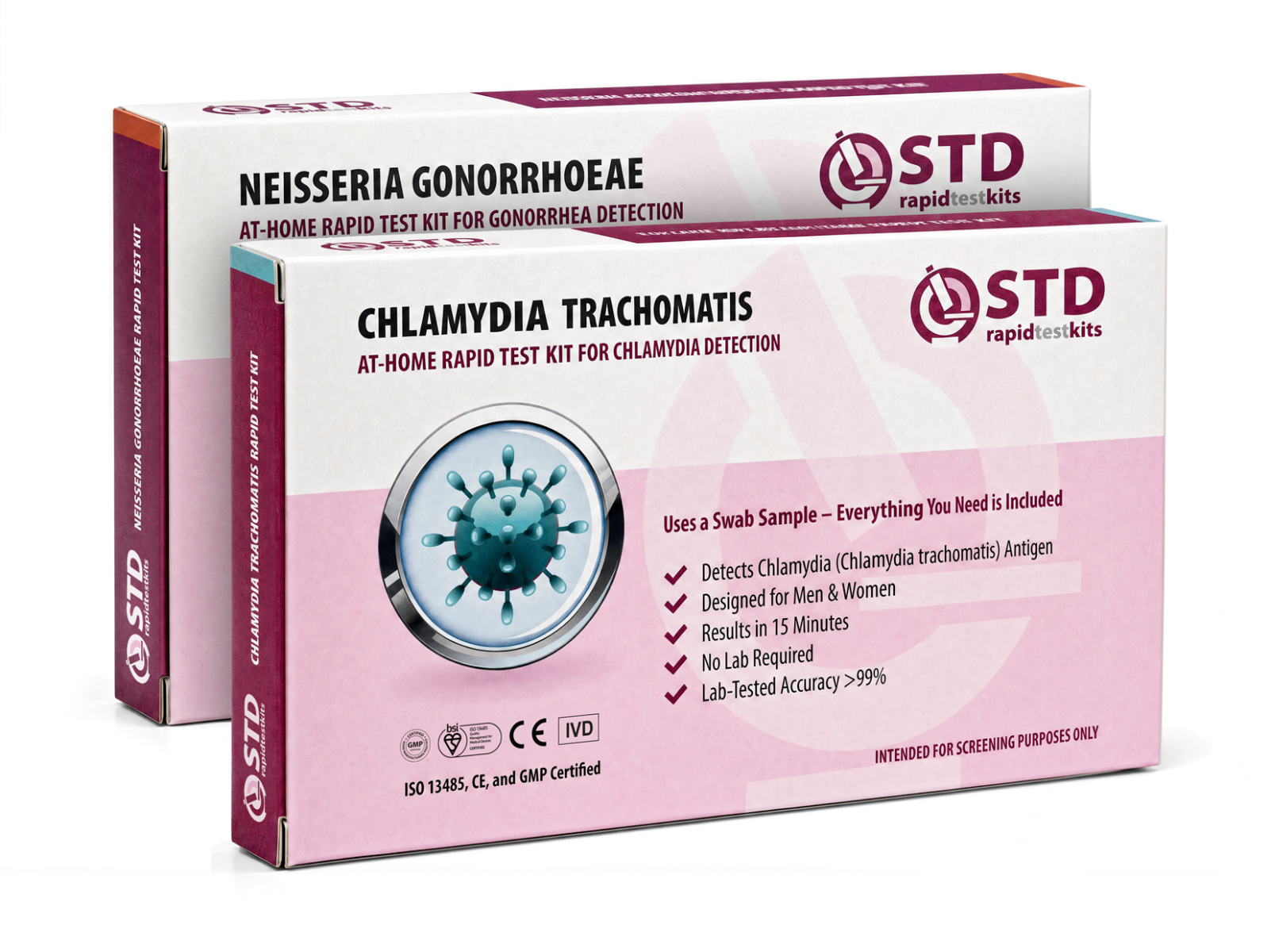
We sell rapid at-home STI tests, including the kits referenced in this article. Recommendations are based on fit-for-purpose for the reader's concern, not on commercial benefit.
At-home rapid testing earns its place in this story for one specific reason: it removes the activation energy from getting tested. A reader sitting with a confusing result, or a couple trying to align their testing without sitting in a clinic waiting room, can run the test on their own schedule, in private, and have a result in about fifteen minutes.
The screening utility is real. The sample types are clinically appropriate (self-collected vaginal or penile swabs for chlamydia, gonorrhea, trichomoniasis, and HPV; fingerstick blood for HIV, syphilis, hepatitis, and herpes antibody panels). The lateral-flow chemistry is the same family used in clinical point-of-care testing. Used inside the manufacturer's window and on the right sample type, the kits answer the question they are designed to answer.
A positive result on a rapid lateral-flow test is a screening positive, not a final clinical diagnosis. Confirmation with a laboratory NAAT (for bacterial infections) or a confirmatory antibody assay (for blood-based infections) is the right next step before starting treatment. No rapid kit can date an infection either. A positive tells you the infection is present now. It cannot tell you whether it arrived last week, last year, or before the relationship started. That dating question, when it matters, is one for an experienced clinician and a complete history.
Building a couple's testing reset
A reset that actually works has five moving parts. Each one is unglamorous on its own, and most couples skip at least one. The combination is what closes the gap.
It begins with a synchronized baseline panel: both partners testing for the same set of infections at the same time, ideally with a multi-infection panel rather than a single-test kit, so neither side has unknown exposures sitting outside the test scope. The baseline matters because everything that follows depends on knowing what is and is not already present.
If anything comes back positive, both partners need treatment, not just the index case. Bacterial STIs (chlamydia, gonorrhea, trichomoniasis, syphilis) follow the same guideline globally: treat the index case and every recent sexual partner, even when the partner tested negative on the day of the panel. Untreated negative partners are the single largest source of reinfection.
Abstinence through the treatment window is part of the same package. Seven days of antibiotic dosing, plus any grace days the clinician specifies, are not a suggestion; even one act of unprotected sex inside that window can reseed the infection on either side.
A planned retest at three months for bacterial STIs is the single guideline most couples skip, and the one that catches an unintentional reinfection or a missed exposure before it builds into a longer pattern. The trigger for this retest is not new symptoms; it is the calendar.
Viral recurrence is a separate plan. Herpes outbreaks are managed with antivirals, suppressive therapy in some cases, and a frank acknowledgement that a relationship involving someone with HSV is one that learns to plan around the virus rather than eliminate it. HPV is monitored with cervical screening (Pap and HPV co-testing) rather than home tests.
Starting the conversation when you are scared
Most readers who reach this page are not stuck on the medicine. They are stuck on what to say. The fear of accusing a partner of cheating, or of being accused, often delays the testing conversation until the situation is worse than it had to be.
A few framings help. Lead with the test, not the suspicion: “I got a result that is confusing me, and I want us to test together so we can both be on the same page.” Ask about exposure timeline before the relationship, not just inside it; many positives are old infections finally showing up, and the timeline conversation is part of the medical workup, not an interrogation. Offer the at-home option so neither partner has to walk into a clinic before they are ready.
Give the conversation a structural shape. Decide in advance what the plan is if the second test is also positive, what the plan is if the partner refuses to test, and what each of you needs from the other in either case. Pre-deciding keeps the decisions grounded in care rather than driven by the panic of the moment.
If a partner refuses to test or refuses to talk about it, that is information too. It is no longer a testing question. It is a relationship question, and the testing answer can wait until the bigger question gets addressed. You can still test for yourself, treat yourself completely if needed, and protect yourself with barriers in the interim.
- Lead with the test, not the suspicion. Try: “I got a result that is confusing me, and I want us to test together so we can both be on the same page.”
- Ask about pre-relationship exposure, not just recent. Many positives are old infections finally surfacing; the timeline question is medical workup, not interrogation.
- Offer the at-home option. Neither partner has to walk into a clinic before they are ready, which lowers the activation cost of agreeing to retest.
What recurring STDs are not
Recurring STD diagnoses inside a monogamous relationship are not a moral verdict on either partner. They are a signal that the testing baseline, the treatment plan, or the panel scope did not cover everything that needed covering. Sometimes they are a signal that something happened outside the relationship; mostly they are not.
The reader who landed on this page after a frightening result is doing the right thing by getting more information before making large decisions. The right next steps are usually small, concrete, and shared.
Four next steps for couples facing a confusing result
- Retest at the correct window for the specific infection: bacterial STIs at three months after treatment, herpes antibody at 12+ weeks after possible exposure, HIV fourth-generation at 45 days or beyond.
- Treat both partners simultaneously and completely for bacterial STIs, even when only one partner's test was positive.
- Screen for infections the first panel did not cover. Standard urgent-care panels often skip trichomoniasis and herpes; a multi-infection panel or a specific add-on test closes the scope gap.
- Have the conversation the test result made unavoidable. Lead with the test, not the suspicion, and decide in advance how you will handle each possible outcome.
FAQs
- Can I really get an STD if both of us are faithful?
- Yes. Many STIs can stay in the body, often without symptoms, from before the relationship began. Herpes, HPV, and even latent syphilis are well-documented examples. A first-time positive years into a closed relationship does not establish when the infection was acquired; most often it is a pre-relationship infection only now becoming detectable or symptomatic.
- Why does my chlamydia keep coming back even after I finished my antibiotics?
- The most common reason is that one partner did not finish their full antibiotic course, or that sex resumed during the treatment window. Per CDC guidance, reinfection from an untreated partner is the leading cause of repeat positive tests. Both partners need to complete the full course, abstain from sex through the treatment window, and retest at three months.
- My partner tested negative and I tested positive. Does that mean they cheated?
- Not necessarily. Window periods, lower-sensitivity panels, and infections like herpes that may only show on specific blood tests can all produce mismatched results between partners. Retesting at the correct window with the right panel scope often resolves the mismatch without infidelity being the explanation.
- How can herpes show up years into a relationship?
- The virus lives in nerve ganglia near the spine and stays there permanently after the first infection. Stress, illness, or hormonal shifts lower immune suppression enough for a detectable outbreak to surface. Because many first infections never produce a visible episode, the initial acquisition could be years or even decades before the first recognizable outbreak occurs.
- Do we both need to take antibiotics if only one of us tested positive?
- For bacterial STIs like chlamydia and gonorrhea, current CDC guidance is to treat both the index case and all recent sex partners regardless of the partner's test result. Treating only the positive partner is the single most reliable way to set up reinfection on the next sexual contact.
- How long should we wait before having sex again after treatment?
- The CDC's standard guidance for chlamydia and gonorrhea is to wait seven days after a single-dose treatment ends, or until both partners have completed a full multi-day course. Symptoms clearing earlier does not mean the bacteria have cleared. Resuming sex inside that window is the most common avoidable cause of reinfection.
- When should we retest after treatment?
- For chlamydia and gonorrhea, CDC recommends retesting approximately three months after treatment, regardless of whether you have symptoms. Reinfection is the most common reason for a second positive result, and a planned retest catches it before it builds into a longer pattern.
- What if my partner refuses to test or talk about this?
- That moves the situation out of a testing question and into a relationship question. You can still test for yourself, get treatment if you need it, and use barriers in the interim. Your medical care does not depend on your partner's willingness to participate, even if the trust conversation might.
How we sourced this article: Our article was constructed based on current advice from the most prominent public health and medical organizations, and then molded into simple language based on the situations that people actually experience. The clinical guidance summarized here is drawn from the CDC's Sexually Transmitted Infections Treatment Guidelines, WHO fact sheets, and current NHS guidance. The reasoning is medically reviewed and intended for general information; it does not replace a conversation with a licensed clinician.
- U.S. Centers for Disease Control and Prevention. Sexually Transmitted Infections Treatment Guidelines, 2021. Authoritative source for window periods, retesting intervals, and partner-treatment guidance referenced throughout this article.
- U.S. Centers for Disease Control and Prevention. Chlamydial Infections treatment guideline. Source for the doxycycline 100 mg twice-daily for seven days first-line regimen, partner-treatment guidance, and three-month retest recommendation cited in the reinfection section.
- World Health Organization. Herpes simplex virus fact sheet. Source for the 520-million HSV-2 carrier estimate and the description of asymptomatic and reactivation patterns referenced in the dormant-infections section.
- U.S. Centers for Disease Control and Prevention. Herpes (Genital Herpes). Source for HSV-2 latency, asymptomatic carriage, and recurrent outbreak patterns.
- U.S. Centers for Disease Control and Prevention. HPV (Human Papillomavirus) landing page. Referenced for general HPV background and the CDC's emphasis on cervical screening through Pap and HPV co-testing rather than one-time home testing.
- U.S. Centers for Disease Control and Prevention. HIV testing guidance. Source for the fourth-generation antigen-antibody detection window referenced in the window-period table.
- U.K. National Health Service. Sexually transmitted infections overview. Cross-reference for window-period and partner-treatment guidance consistent with CDC recommendations.
