Red Spots on the Vulva: STD Sign or Just Razor Burn?
Red spots on your vulva can come from harmless shaving irritation, contact reactions, or the early sign of an STD like herpes or syphilis. The patterns overlap. This guide walks through what each cause typically looks like, when watchful waiting is reasonable, and when a quick at-home test gives you a clear answer instead of weeks of guessing.



- Friction and shaving-related spots typically clear in 2 to 3 days; folliculitis may take 5 to 10 days. Persistent, blistering, or recurring spots warrant testing, especially after new sexual contact.
- Herpes, syphilis, and HPV can each begin as a subtle red bump that mimics an ingrown hair, so a 'looks like nothing' bump after new sexual contact still deserves a window-period test.
Published: November 2025 | Last updated: April 2026 | Editorial review and quality control: Martina N.
The first thing your brain does when a red dot shows up near your vulva is jump to the worst case. That panic is normal, and most of the time it isn't warranted: the majority of red spots clear up within a few days, though some don't. The pattern is what matters, not the first glimpse in a mirror.
Vulvar skin is reactive. It responds to friction, shaving, new soaps and laundry detergents, hormonal shifts around your period, and yes, to infections. The same red dot can be a clogged hair follicle one week and an early sign of something contagious another. Timing, change over a few days, and other symptoms like tingling or recent sexual exposure tell you more than appearance alone. This guide walks through how to read those signals, when watchful waiting is fine, and when a quick at-home test will save you weeks of guessing.
Are red spots on the vulva an STD?
Most red spots on the vulva come from harmless friction, shaving irritation, or contact reactions, not an STD. But certain infections (genital herpes, primary syphilis, HPV) can each begin as a single red bump that initially looks like an ingrown hair. The deciding factors are how the spot changes over 5 to 7 days, whether you've had recent unprotected sexual contact, and whether other symptoms appear (blistering, tingling, fever, swollen groin lymph nodes). If any of those apply, testing inside the right window period gives you a clear answer.
Key Takeaways
- Friction and shaving-related spots typically clear in 2 to 3 days; folliculitis may take 5 to 10 days. Persistent, blistering, or recurring spots warrant testing, especially after new sexual contact.
- Herpes, syphilis, and HPV can each begin as a subtle red bump that mimics an ingrown hair, so a 'looks like nothing' bump after new sexual contact still deserves a window-period test.
This article is published by stdrapidtestkits.com, which sells at-home STI testing kits. We recommend products based on fit-for-purpose for the reader's concern, not commercial benefit. Our at-home Trichomoniasis and HPV swabs are validated for vaginal self-swab only.
What you're actually looking at
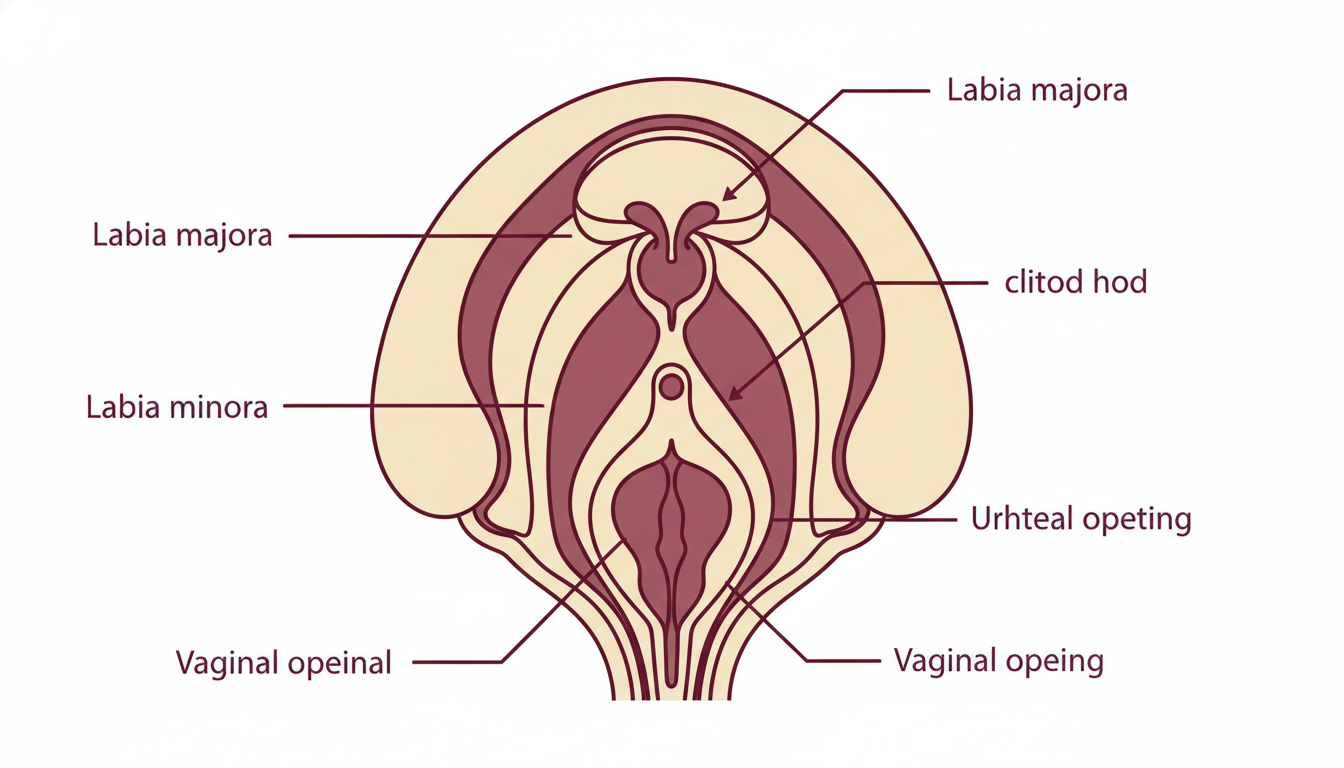
Vulvar anatomy is reactive. Sebaceous glands (called Fordyce spots) sit just under the skin of the labia. Hair follicles run along the labia majora and mons. Sweat glands and folds of skin touch each other and trap warmth, which makes friction and minor irritation common. The same area is often shaved or waxed, covered by tight clothing, exposed to scented products, and shifted by hormonal changes across the menstrual cycle. All of that can produce small red bumps that have nothing to do with sex.
A single red bump rarely identifies its own cause from appearance alone. The questions that narrow it down are about pattern and context. Did this appear within hours after shaving? Or days to weeks after a new sexual partner? Is it growing, or fading? Does it hurt, tingle, or itch? Is it accompanied by discharge changes, fever, or swollen lymph nodes in the groin?
Where most red spots actually come from (the non-STD causes)
Most spots on a healthy vulva have nothing to do with sexually transmitted infections. The five common patterns:
Razor burn and ingrown hairs. Show up within hours to a day after shaving or waxing. They cluster along the hairline, sting or itch, and usually fade in 2 to 3 days with rest from shaving. An ingrown hair may form a small dome with a visible curled hair underneath.
Folliculitis. Inflammation of one or more hair follicles, often from heat, sweat, or tight clothing. The bumps look like small red pimples, sometimes with a white or yellow center. It usually clears with looser breathable underwear, less heat, and warm compresses.
Contact dermatitis. An allergic or irritant reaction to a product: scented soap, laundry detergent, fabric softener, lubricant, latex condoms, scented pads or panty liners, even toilet paper. Patchy redness or small bumps that itch, fading once the trigger is removed.
Friction and chafing. Long sex sessions, exercise, or tight clothing without enough lubrication can produce small red marks or shallow microtears. These usually resolve within 24 to 48 hours.
Yeast infection (vulvovaginal candidiasis). Mostly causes itching, white discharge, and external redness rather than discrete bumps, though scratching can produce raw red patches that look like a rash. CDC guidance on vulvovaginal candidiasis describes the typical presentation and over-the-counter treatment options.
Less common but worth knowing about: lichen sclerosus and other vulvar dermatologic conditions can cause persistent skin changes (white patches, fragile skin, chronic itching). These are best diagnosed by a clinician, not assumed at home.
If your spot fits one of these, testing usually isn't needed unless symptoms worsen or persist past a week:
- Razor burn or ingrown hair after shaving (clears in 2 to 3 days)
- Folliculitis from heat, sweat, or tight clothing (clears in 5 to 10 days)
- Contact dermatitis after a new soap, detergent, lube, or pad (fades when the trigger is removed)
- Friction or chafing after long sex or exercise (resolves in 24 to 48 hours)
- Yeast infection with itching plus white discharge (responds to over-the-counter antifungals)
STDs that can start as a red spot
A handful of common STDs first appear as a red bump or spot on the vulva. They look benign at the start, which is exactly what makes them easy to miss.
Herpes simplex (HSV-1 and HSV-2) often begins as a small red dot or cluster of red dots that tingle, sting, or burn. Within a few days the spot may evolve into a fluid-filled blister, then rupture into a shallow ulcer, then crust over. A first outbreak can come with flu-like symptoms (fever, swollen groin lymph nodes, body aches). Recurrences are usually milder and tend to appear in the same spot. Genital HSV-1, often transmitted via oral-to-genital contact, is a meaningful share of new genital herpes diagnoses, and according to CDC genital herpes information many people with the virus are unaware they carry it.
Primary syphilis begins with a single firm, painless ulcer called a chancre. The chancre often goes unnoticed because it doesn't hurt. It heals on its own in 3 to 6 weeks, but the infection moves into the bloodstream and progresses to secondary syphilis (a body-wide rash, often on the palms and soles) if untreated. The CDC's syphilis fact sheet describes the primary chancre, its typical timing after exposure, and emphasizes early testing because the chancre is short-lived but the underlying infection is not.
HPV (human papillomavirus) causes most cases of genital warts. Warts can appear as raised cauliflower-like growths, but they can also appear as flat, smooth red or pink patches that don't itch or hurt. Many HPV strains cause no visible signs at all. CDC HPV information notes that most sexually active people will be exposed to HPV at some point, and that the high-risk strains (which cause cervical and other cancers) are not the same strains that cause visible warts.
Trichomoniasis is a parasitic infection that often presents with frothy, foul-smelling discharge and irritation. In some cases the only external sign is mild redness or vulvar swelling. CDC trichomoniasis information notes that millions of U.S. infections occur each year, many of them undiagnosed.
Chlamydia and gonorrhea rarely cause visible red spots on the vulva. When they do produce external symptoms, it's usually mild itching or redness alongside abnormal discharge. Both are commonly asymptomatic, which is why a swab test after new sexual contact is the standard recommendation regardless of visible signs.
Side-by-side: how the patterns actually compare
The clearest way to think about a red spot is along three axes: when it appeared, how it feels, and what it does over the next several days. The table below summarizes the typical signature of each cause.
| Cause | Onset after trigger | Pain or itch | Pattern | Typical course |
|---|---|---|---|---|
| Razor burn / ingrown hair | Hours to 24 hours after shaving | Mild sting or itch | Cluster along the hairline | Fades in 2 to 3 days with rest from shaving |
| Folliculitis | 1 to 3 days after heat/sweat | Mild tenderness | Multiple papules or pustules on follicles | Clears in 5 to 10 days |
| Contact dermatitis | Hours after exposure to new product | Itch, sometimes burning | Patchy redness, often diffuse | Fades once trigger is removed |
| Herpes (HSV-1 or HSV-2) | 2 to 12 days after sexual contact | Tingling, burning, sometimes painful | Single dot or cluster, often blisters | 10 to 14 days for first outbreak; recurrences shorter |
| Primary syphilis (chancre) | A few weeks after exposure (varies by individual) | Painless | Single firm round ulcer | Heals on its own in 3 to 6 weeks; infection persists |
| HPV (genital warts) | Weeks to months after exposure | Painless, usually no itch | Flat or raised, smooth or cauliflower | Persistent until treated |
| Friction or chafing | Immediate after sex/exercise | Mild soreness | Linear marks or microtears | Resolves in 24 to 48 hours |
How herpes typically unfolds
Even when herpes is what's behind a red spot, the symptoms follow a sequence that's worth recognizing. Catching the early stages reduces the chance of unknowingly passing it on.
Day 1 to 2 (prodrome, the pre-blister warning phase): tingling, itching, mild burning, sometimes nothing visible yet. Some people feel a faint ache in the lower back, hip, or buttocks where the nerve roots run.
Day 2 to 4 (eruption): one or more red bumps appear. The bumps may be tender or feel raw to the touch.
Day 4 to 6 (vesicle and ulcer): the bumps become small fluid-filled blisters, then rupture into shallow ulcers. This is often the most uncomfortable stage.
Day 7 to 10 (crusting): the ulcers crust over and start healing.
Day 10 to 14 (resolution): scabs come off, redness fades. Healing is usually complete within two weeks for a first outbreak.
A first outbreak is generally the most severe. Recurrences (triggered by stress, illness, menstruation, or sleep deprivation) tend to be milder and shorter, often without flu-like symptoms. Not every outbreak follows this pattern exactly: some people have classic vesicular lesions, others have a single small red bump that never blisters, others have what looks like a small fissure or tear.
Most people with genital herpes have no symptoms or have very mild symptoms... Most people do not know they have a herpes infection.
When to wait, when to test
Not every red spot needs a lab visit, and testing too early gives misleading results. Each STD has a window period: the time between exposure and when a test can reliably detect the infection. Testing inside the window can produce a false negative.
A reasonable wait-and-watch approach: if the spot is painless, isolated, not growing, and you've had no recent sexual contact, monitor for 3 to 5 days. Skip shaving in that area, switch to loose breathable underwear, avoid scented products, and watch for change.
Test sooner if any of these apply: the spot blisters or ulcerates, recurs in the same place, comes with flu-like symptoms or swollen groin lymph nodes, lasts more than 7 days, or appeared after a new sexual partner or unprotected oral sex. The table below summarizes typical window periods for the infections that most often present this way.
| Infection | Best test type | Earliest reliable test | Most accurate window |
|---|---|---|---|
| Herpes (HSV-1 or HSV-2) | Swab of an active lesion (clinic) or IgG blood antibody (home) | Swab: first 1 to 5 days of lesion. Blood: 4 to 6 weeks | 12 to 16 weeks for blood IgG |
| Syphilis | Blood test (treponemal and non-treponemal) | 3 to 6 weeks after exposure | 6+ weeks for peak accuracy |
| HPV (visible warts) | Visual diagnosis or biopsy by a clinician | When warts appear | No standard home test for women's external warts; cervical screening via Pap is separate |
| Trichomoniasis | Vaginal self-swab (women only) | 5 to 7 days after exposure | 1 to 2 weeks |
| Chlamydia / Gonorrhea | Vaginal self-swab | 1 to 2 weeks after exposure | 2 weeks for highest reliability |
What our at-home kits do, and what they don't
Worth being concrete about what's actually available for at-home testing, so you can pick the right tool for the question you're asking.
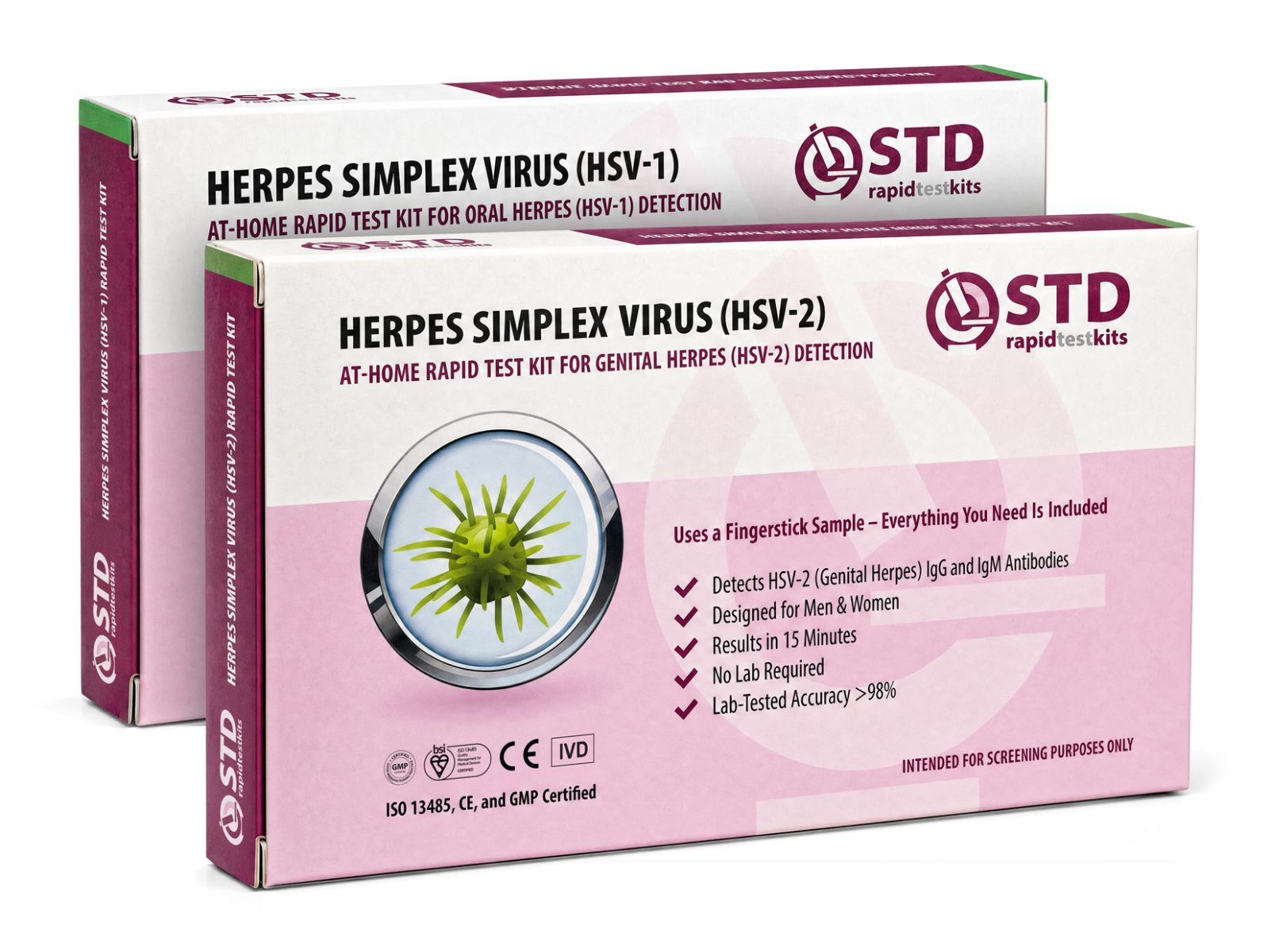
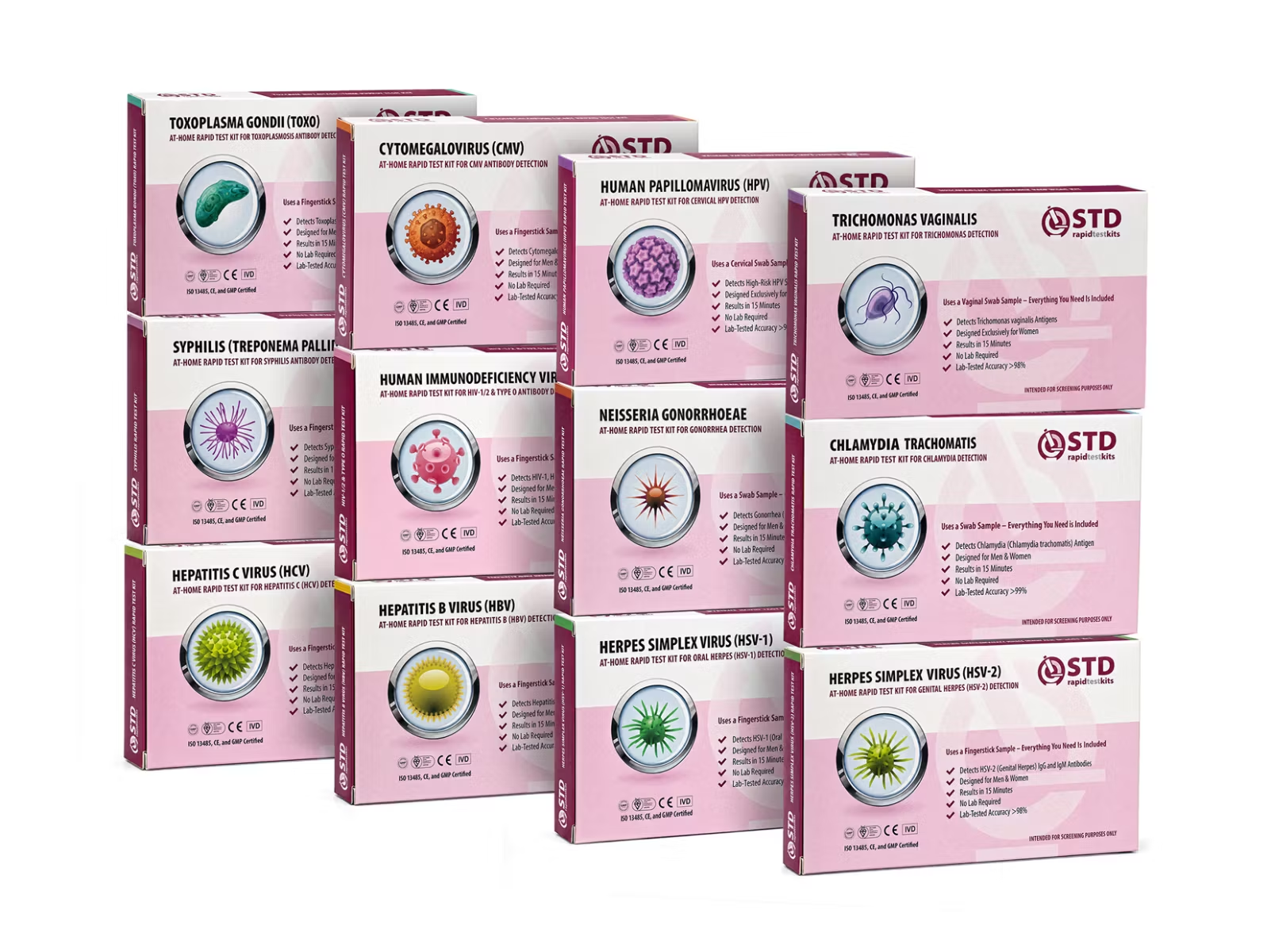
Our rapid lateral-flow swab kits cover chlamydia, gonorrhea, trichomoniasis, and HPV. Trichomoniasis and HPV swabs are validated for vaginal self-swab only; we don't sell male-anatomy versions of those. Our rapid lateral-flow blood tests (fingerstick) cover HIV, syphilis, hepatitis B, hepatitis C, HSV-1 antibodies, and HSV-2 antibodies, plus a combined HSV-1 plus HSV-2 panel. These are screening tools using lateral-flow chemistry; a positive result is worth confirming with a lab NAAT or treponemal test where applicable, and labs use molecular methods (PCR / NAAT) for higher analytical sensitivity. The two are complementary, not equivalent.
If your concern is an active vulvar lesion in its first 5 days, a clinic visit for a viral PCR swab is the most sensitive option for herpes; the at-home HSV blood antibody test is more useful for the 12-week-or-later confirmation question.
We do sell: rapid lateral-flow self-tests for chlamydia, gonorrhea, trichomoniasis (women), HPV (women), HIV, syphilis, hepatitis B, hepatitis C, HSV-1, HSV-2, and combination panels.
We don't sell: pharyngeal (throat) swabs, rectal swabs, urine-sample tests, or lab-processed mail-in NAAT panels. If those match your situation, a clinic or sexual-health center is the right next stop.
Negative test, bumps still there
A negative test plus persistent symptoms usually means one of three things: tested too early (window period not closed), the wrong test type for the stage of infection, or the cause was never an STD to begin with.
Herpes is the most common case of timing mismatch. The IgG blood antibody test can take 12 to 16 weeks after exposure to reliably show a positive result. A swab of a fresh lesion is more sensitive in the first week, but by the time many people get tested the lesion may already be healing.
The practical move: if symptoms persist or evolve and your first test came back negative, retest at the recommended interval (typically 12 weeks for HSV antibodies). Two clean tests across the full window period give you real reassurance, not partial reassurance.
If the cause was never sexual to begin with (lichen sclerosus, recurrent contact dermatitis, persistent folliculitis, or another vulvar dermatologic condition), a vulvar dermatologist or gynecologist is the right next step.
Book an in-person visit (rather than relying on at-home testing) if any of these apply:
- You have an active visible lesion in its first 5 days and want the most sensitive HSV result. A clinic PCR swab is more sensitive on a fresh lesion than a home blood antibody test.
- Symptoms have persisted or returned for more than a few weeks despite a negative at-home test. Repeat at-home testing past the full window period; if it stays negative and symptoms persist, a clinical exam is the next step.
- You suspect a non-STD vulvar skin condition (lichen sclerosus, eczema, recurrent folliculitis). These need a vulvar dermatologist or gynecologist for diagnosis, not a home test.
How to do a vulvar self-check
Knowing your baseline is the single most useful habit you can build for this. Most people have never looked carefully at their own vulva, which makes spotting a real change much harder.
The setup is simple: a hand mirror, decent lighting, and five minutes once a month. You're not running a clinical exam, you're noticing what's normal for your body so you can recognize when something is new.
Looking at your own anatomy isn't paranoia or vanity. It's the same instinct that lets you notice when a mole on your arm has changed shape.
Vulvar self-check: what's normal and what's worth noting
- Normal: asymmetric labia, color variation across folds, small white-yellow Fordyce spots (oil glands just under the skin), visible hair follicles, small skin tags, faded scars from past ingrown hairs.
- Normal: slight discharge that changes texture across the menstrual cycle.
- Worth noting: a new red spot or bump that wasn't there last month, or an ulcer that doesn't heal in a week.
- Worth noting: a new wart-like growth, color or texture changes in the same area over time, persistent itching or burning without obvious cause.
- Worth noting: painful spots, especially with tingling or burning sensations beforehand.
Telling a partner
If you've spotted something and you're getting tested, telling a current or recent sexual partner is part of looking after both of you. It doesn't have to be a confession, and it doesn't require a diagnosis you don't yet have.
If a test comes back positive, the same principles apply. Most STDs are treatable; many are common; most partners' reactions to honesty are better than the worst-case scenario you've imagined. Planned Parenthood and similar sexual-health resources publish guidance on disclosure conversations if you'd like a starting point before you talk.
You don't need a long explanation. A short, calm message works better than a rehearsed speech:
"Hey, I noticed a small bump and I'm getting it checked out. I wanted to tell you so you can watch for anything similar."
That's the whole script. No diagnosis announced, no blame attached. If a result comes back positive later, you can update them with the same calm tone: what it is, what the treatment looks like, and what you're doing next.
The bottom line
Red spots on the vulva are common, and most of them are not STDs. The patterns that point toward testing are: blistering, persistence past 5 to 7 days, recurrence in the same place, appearance after new sexual contact, and accompanying systemic symptoms like fever or swollen lymph nodes. An at-home rapid test gives you the answer in about 15 minutes for most of the infections in question, and a clinic visit is the more sensitive option for swabbing an active herpes lesion in its first week.
The single most useful habit is knowing your own baseline so a real change is recognizable. The single most useful action when something looks off is testing inside the right window period rather than testing too early and getting partial reassurance.
FAQs
- Can a red bump really be herpes if it looks like a pimple?
- Yes. Herpes doesn't always show up in dramatic clusters. The first outbreak is sometimes a single small red bump that tingles, then blisters over a couple of days, then crusts over. People often mistake their first outbreak for an ingrown hair or a shaving nick. The clue is that herpes lesions tend to recur in the same spot, often during stress or illness, while ingrown hairs don't follow that pattern.
- How do I tell razor burn from herpes?
- Razor burn appears within hours of shaving, clusters along the hairline, calms down within 2 to 3 days with rest, and feels mostly like a surface sting. Herpes typically appears 2 to 12 days after sexual contact, can come with a tingling or burning sensation before any visible bump, often blisters within 2 to 4 days, and lasts 10 to 14 days for a first outbreak. If you didn't shave and the bump is changing rather than fading, herpes is more likely than razor burn.
- I only had oral sex. Can a red bump still be an STD?
- Yes. Oral sex can transmit HSV-1 from a partner's mouth to your genitals, and genital HSV-1 from oral-to-genital contact is well documented. Syphilis can also pass during oral sex. Both can show up as a red bump on the vulva even without any vaginal or anal intercourse. The absence of penetration doesn't eliminate the possibility.
- The spot disappeared before I could test. Now what?
- Common with both herpes and primary syphilis: the visible sign fades while the infection itself doesn't. A swab during an active lesion is the most sensitive test and isn't an option once it heals, but blood antibody tests can still detect past or established infection. For HSV, the IgG blood antibody test is most accurate at 12 weeks or more after exposure. For syphilis, blood serology becomes reliable around 6 weeks.
- Do herpes bumps always hurt?
- No. The classic painful-blister presentation is real but not universal. Some people have a tingling or burning sensation and minimal pain; others have a single quiet red bump with no obvious sensation; others get the textbook painful clustered blisters. The variability is one of the main reasons herpes goes undiagnosed.
- Can HPV cause a red bump without it looking like a wart?
- Yes, sometimes. The strains that cause genital warts (low-risk HPV types 6 and 11 most commonly) can produce flat or smooth red or pink patches, not just the cauliflower-shaped raised warts that get pictured in textbooks. The high-risk HPV strains that cause cervical and other cancers usually cause no visible signs at all and are detected through cervical screening rather than self-inspection.
- When exactly should I test if I notice a red spot after sex?
- If the spot is currently active and you can get to a clinic, an HSV PCR swab in the first 5 days is the most sensitive option for herpes. For at-home testing, the timing depends on infection: chlamydia and gonorrhea swabs are reliable from 1 to 2 weeks after exposure, syphilis blood serology from 3 to 6 weeks, and HSV blood antibody tests are most accurate at 12 to 16 weeks. If you test inside the window period and get a negative result but symptoms persist, retest at the longer interval to be sure.
- U.S. Centers for Disease Control and Prevention. Genital herpes information page covering symptoms, transmission, and the fact that most people with HSV are unaware they carry it.
- U.S. Centers for Disease Control and Prevention. Syphilis fact sheet covering primary chancre presentation, healing course, and the importance of early testing.
- U.S. Centers for Disease Control and Prevention. HPV fact sheet covering wart vs high-risk strain distinction and screening guidance.
- U.S. Centers for Disease Control and Prevention. Trichomoniasis information page covering symptoms, transmission, and prevalence in the U.S.
- U.S. Centers for Disease Control and Prevention. STI Treatment Guidelines on vulvovaginal candidiasis (yeast infection presentation and treatment).
- World Health Organization. Sexually transmitted infections fact sheet on global prevalence and presentation patterns.
- MedlinePlus (U.S. National Library of Medicine). Genital sores in women: differential causes and when to seek evaluation.