
Published: November 2025 | Last updated: May 2026 | Editorial review and quality control: Martina N.
A 19-year-old student walks into the campus health center with burning during urination and a low ache in the pelvis. Twenty minutes later she leaves with a urinary tract infection diagnosis, a short course of antibiotics, and no sexually transmitted infection test on file. Three weeks later, a partner calls to say he just tested positive for chlamydia. She had it the whole time.
This pattern repeats on college campuses across the country, and it is the single biggest reason chlamydia spreads quietly through student populations. The infection mimics common urinary symptoms, frequently produces no symptoms at all, and rarely triggers proactive screening in busy student health centers that operate on outdated, symptom-driven testing protocols. The CDC's chlamydia information page identifies people younger than 25 as the group for whom annual screening is recommended, reflecting how concentrated new infections are in this age band.
This guide explains why the misses happen, what the gaps look like inside a typical campus clinic visit, how the timing of testing affects results, and what students can do when the first line of help misses the mark. It is written for sexually active students who suspect something might be off, partners who have been told to "go get checked," and anyone who has walked out of a clinic still unsure.
Key Takeaways
- Chlamydia often presents like a urinary tract infection or with no symptoms at all, so unless a student specifically asks for STI testing, many campus clinics will not run one even when the case fits the CDC's annual screening criteria.
- Testing too soon after exposure can produce a false negative. Lab-based NAAT tests become reliably accurate around 7 to 14 days post-exposure, and the CDC recommends a follow-up test about 3 months after any positive treatment to check for reinfection.
Why Chlamydia Often Looks Like a UTI in a Campus Clinic Visit
The most common misdiagnosis pattern in college health centers is straightforward. A student arrives with burning during urination, pelvic pressure, or vague lower-abdominal discomfort. The provider runs a urine dipstick, sees a result that could fit a urinary tract infection, and prescribes a short course of antibiotics. The visit takes 10 to 15 minutes. Sexual history rarely comes up unless the student volunteers it.
The problem is that chlamydia produces nearly identical lower-tract symptoms in some patients. In women, it can cause burning during urination, intermenstrual spotting, or mild pelvic pain. In men, it can cause urethral irritation, a small increase in urinary frequency, or clear-to-cloudy penile discharge. When these symptoms appear in a college student worried about a UTI, the cognitive frame is set before a careful differential is even considered. The provider treats what the patient came in worried about, not what the patient actually has.
The second part of the problem is structural. Campus health centers serve thousands of students with small clinical teams, often on tight per-visit time budgets. Many operate under separate "primary care" and "sexual health" workflows, where STI screening is treated as an opt-in service rather than a default part of urinary or pelvic-symptom evaluation. Unless a student specifically uses the words "STI test" or discloses recent unprotected sex, the testing pathway is often never opened.
The CDC's 2021 STI Treatment Guidelines are clear that anyone in this age group presenting with urinary or genital symptoms should be considered for chlamydia and gonorrhea testing alongside any UTI workup, especially given how often the two overlap clinically. Asking students to self-navigate that gap is where the system most consistently falls short.
Both infections can cause burning during urination and pelvic pressure, which is why a brief visit can land on the wrong diagnosis. The practical difference is the test: a urine dipstick checks for nitrites and white blood cells suggestive of a urinary infection, but it cannot detect chlamydia. Chlamydia requires a urine NAAT or a swab. If your visit ended without one of those, the chlamydia question has not actually been answered.
The Silent Infection Problem: When No Symptoms Means No Test
Here is the part that makes chlamydia uniquely dangerous in dense, sexually active populations: most people who carry it have no idea. The CDC's chlamydia information page states that chlamydia often has no symptoms, and the CDC's 2021 STI Treatment Guidelines note that asymptomatic infection is common in both men and women. In a dorm-and-hookup environment with inconsistent condom use, that turns a single positive case into a network of silent transmissions within weeks.
The clinical response to asymptomatic cases is also frequently wrong. The CDC recommends annual chlamydia screening for all sexually active women under 25, regardless of symptoms. The US Preventive Services Task Force independently recommends screening all sexually active women aged 24 and younger, without mandating a specific interval, and adds screening for older women with new or multiple partners. Either way, "no symptoms" is not an exit criterion from the screening recommendation.
In practice, many campus health centers still operate on a symptom-driven testing model. A student who is asymptomatic but wants peace of mind after a new partner may be told, gently, that they "do not really need a test." That advice is outdated by current CDC and USPSTF standards. The table below shows the common ways the testing pathway breaks in a typical campus visit.
| Student scenario | Typical provider action | Why chlamydia gets missed |
|---|---|---|
| Burning urination, no other symptoms named | Treated as UTI without STI test | Symptoms overlap with UTI; sexual history not asked |
| General health checkup, no specific complaint | No STI testing offered unless requested | Annual screening guideline not applied by default |
| Asymptomatic, new partner since last test | Told testing is not needed without symptoms | Relies on outdated symptom-based testing logic |
| Mild discharge in a male student | Treated as friction or soap irritation | Discharge dismissed without confirmatory STI test |
Test Timing Matters More Than Most Students Are Told
Even when a student does get tested, the timing of the test relative to the exposure determines whether it can find an early infection at all. Chlamydia tests measure either the organism's genetic material (lab-based nucleic acid amplification, or NAAT) or its surface antigens (rapid lateral-flow). Both need a detectable amount of the organism to be present in the sample. In the first few days after exposure, that load is often below the limit of detection.
The clinical guidance is that lab-based NAAT testing becomes reliably accurate around 7 to 14 days post-exposure. Earlier than that, a negative result does not rule out infection. A student who has unprotected sex on a Friday and tests on Monday morning is testing well inside the window of false-negative risk, and a "negative" result in that window is not a clean bill of health.
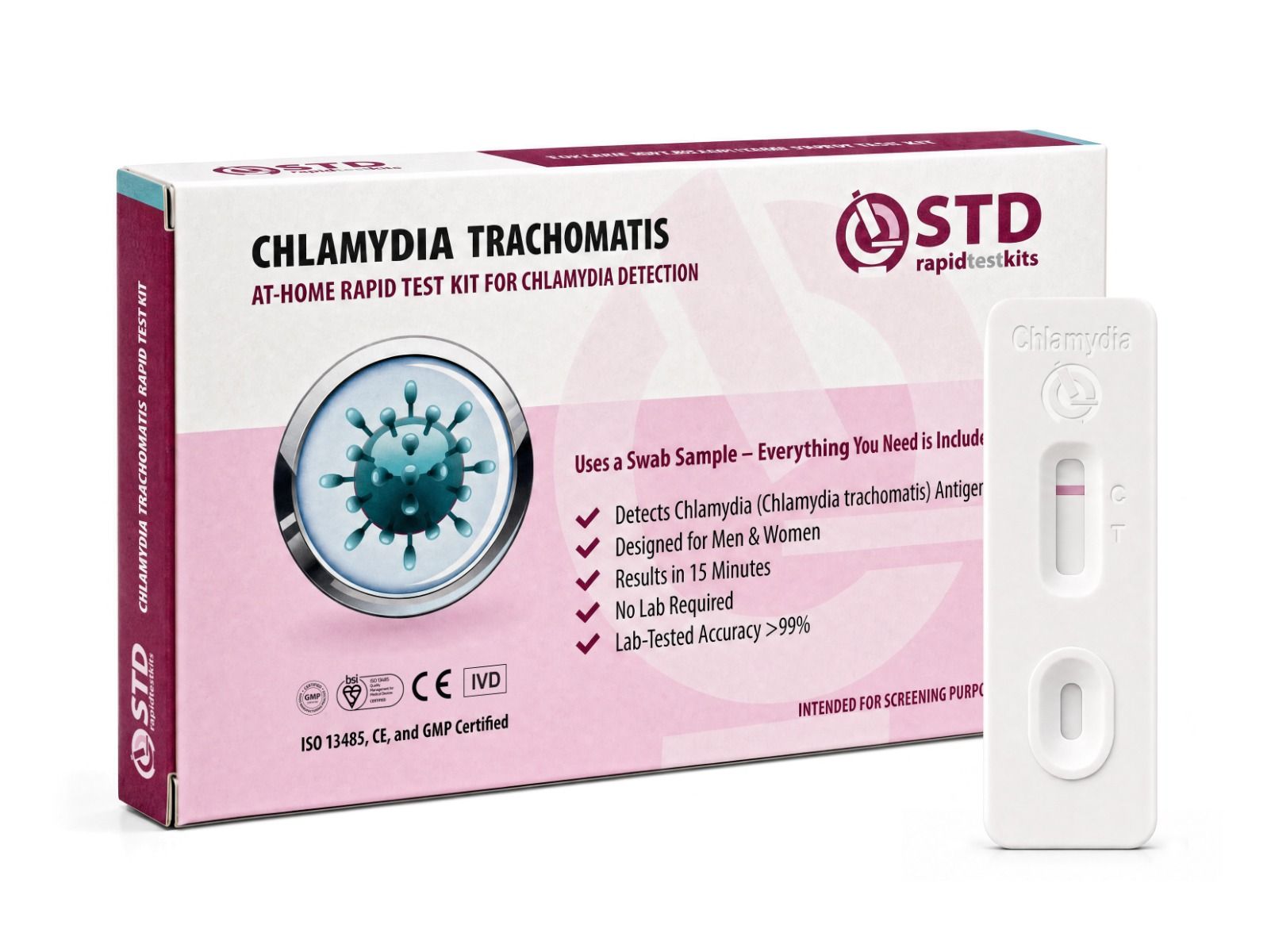
Rapid lateral-flow home tests, including the at-home swab tests sold on this site, work on the same biology but with less analytical sensitivity than lab NAAT. They become useful in roughly the 10 to 14 day window post-exposure for symptomatic or higher-suspicion cases, and they are most accurate when a clear infection has had time to establish. The right way to think about them is as a private, fast screening tool: a positive result is worth confirming with a clinic-administered NAAT when possible, and a negative result during a high-suspicion case warrants a repeat test or a clinic NAAT in another 1 to 2 weeks. The two technologies are complementary, not equivalent.
The table below compares the common chlamydia test types and when each becomes most reliable.
| Test type | Sample | Most reliable window | Limitations |
|---|---|---|---|
| Lab NAAT (clinic or mail-in) | Urine or swab | 7 to 14 days post-exposure | Highest sensitivity; lab turnaround of 1 to 5 days |
| At-home rapid lateral-flow | Self-collected swab | 10 to 14 days post-exposure | Lower sensitivity than NAAT; confirm a positive with NAAT |
| Clinic-administered screening | Urine or cervical swab | 1 to 2 weeks post-exposure | Depends on clinic hours and triage workflow |
Hookup Culture, Stigma, and the Quiet Cost of Silence
Sexual health on college campuses tends to fall into two extremes: overhyped panic around "dirty" STIs, or near-complete silence. The middle ground of normalized, proactive care is often missing. Between hookup culture, alcohol-fueled weekends, and a real desire to be seen as healthy and drama-free, many students internalize a dangerous belief: if they do not talk about it, it will go away. With chlamydia, it usually does not.
That belief is reinforced by the way many campus health systems work. Students who feel judged, rushed, or dismissed by clinic staff stop asking questions. When STI testing is buried behind vague appointment categories or requires saying "I had unprotected sex" out loud at the front desk, fewer people request it. Asymptomatic infections take advantage of every barrier between a worried 19-year-old and a 15-minute swab.
This is not a story about reckless students. It is a story about institutional systems that assume people will self-advocate, when many do not yet know how. The behavior of a first-semester student away from home for the first time is not the failure point. The failure point is a clinic visit designed for a patient who already knows the script.
- Opaque appointment categories. If "STI screening" is not a clearly labelled appointment type on the campus portal, students default to "general" visits where testing is not built into the workflow.
- Disclosure-at-the-front-desk requirement. When booking or check-in forces a student to verbally explain why they want an STI test in a shared waiting area, many quietly drop the request.
- Symptom-driven triage logic. Older clinic protocols only open an STI test pathway when there is a complaint, even though the CDC's annual screening recommendation is symptom-independent for people under 25.
What Happens When Chlamydia Goes Untreated
The reason all of this matters is that untreated chlamydia has real, measurable consequences, especially for people with uteruses. If the infection spreads from the cervix into the upper reproductive tract, it can cause pelvic inflammatory disease (PID). PID can lead to chronic pelvic pain, scarring of the fallopian tubes, tubal-factor infertility, and increased risk of ectopic pregnancy, per the CDC's pelvic inflammatory disease information. The damage often happens silently, in the months between an undetected infection and a fertility workup years later.
In men, untreated chlamydia can cause epididymitis, which presents as testicular pain and swelling, and in some cases contributes to fertility problems. Reactive arthritis is a less common but documented complication. Untreated chlamydia in either sex also raises susceptibility to HIV if exposed during a future encounter, because chlamydia-related inflammation makes the genital mucosa more vulnerable.
These outcomes are rarely walked through in a brief campus clinic visit. Most students leave with no specific picture of what untreated chlamydia can cost over the next few years. And students who were given general antibiotics for a presumed UTI sometimes assume they are covered against chlamydia, too. They usually are not: the standard first-line antibiotics for uncomplicated UTI (such as nitrofurantoin and trimethoprim/sulfamethoxazole) do not effectively treat chlamydia. The current CDC-recommended treatment is doxycycline 100 mg orally twice daily for 7 days, with azithromycin as an alternative.
If you were treated for a UTI with nitrofurantoin or trimethoprim/sulfamethoxazole and your symptoms did not fully clear (or you were never tested for STIs in the first place), that course of antibiotics did not treat chlamydia. The two infections require different drugs. If chlamydia is on the table, ask for a doxycycline or azithromycin regimen specifically.
What to Do If Your Clinic Visit Did Not Feel Right
So what happens when you walk out of the health center still unsure, still untested, or still feeling like something was missed? The first thing to know is that your instinct matters. If something does not feel right, physically or emotionally, you have the right to follow up, ask again, or get a second opinion. Especially with a condition where many cases produce no symptoms at all, "I just want to know" is a legitimate reason to test.
Three concrete options that work:
- Ask the campus clinic directly for an STI panel. You do not need to disclose specifics. "I would like to be screened for STIs, including chlamydia" is a complete sentence and a routine request. If the staff member who fields it pushes back, ask to speak with a different provider.
- Use a community health resource. Planned Parenthood, county health departments, and federally funded Title X clinics offer low-cost or free STI testing, often without an appointment and with confidential billing.
- Use an at-home rapid test kit. Self-collected swab tests for chlamydia are available without prescription, return a result within about 15 minutes, and ship in discreet packaging. Best used at least 10 to 14 days after a suspected exposure for the most reliable read.
If your clinic treated you for a UTI without running an STI test, and your symptoms did not fully resolve, retesting is appropriate. If a recent partner has tested positive, retesting is more than appropriate. It is the next correct step regardless of how you feel.
How Campuses and Students Can Close the Gap
Misdiagnosing chlamydia on college campuses is not just a healthcare gap. It is a communication gap. Closing it takes more than handing out condoms during freshman orientation. It takes consistent, low-shame conversations and small structural changes that make testing easy to request and easy to receive.
On the institutional side, the most effective changes are practical. Campus clinic staff, including front-desk and triage roles, can be trained to discuss sexual health without loaded language or gatekeeping. Sexual history can be included as a default question in any urinary-symptom visit, the way blood pressure is included as a default vital sign. Clear signage, anonymous request options, and trauma-informed intake forms shorten the distance between "I am worried" and "I have been tested."
On the student side, the most effective shift is normalizing the conversation. Asking a new partner when they were last screened, or suggesting both partners test before stopping condoms, treats testing like brushing your teeth instead of like a confession. Some colleges now offer free mail-in test kits or self-swab pickup stations in residence halls. These programs work because they remove the social cost of asking. Even on a campus without these programs, you have the right to say "I would like to be tested for STIs," with no further explanation required. You have the right to a second opinion. You have the right to order a test privately, on your own time.
Annual chlamydia screening of all sexually active women younger than 25 years is recommended, as is screening of older women at increased risk for infection.
The Practical Bottom Line
Chlamydia is one of the most common reportable infections in the country, and college populations carry a disproportionate share of new diagnoses. Most cases produce no symptoms. Many of the cases that do produce symptoms get mistaken for UTIs in a 12-minute clinic visit. The default infrastructure at many campus health centers does not catch these gaps on its own. None of that is your fault, and none of it has to define your testing decisions.
If you are sexually active and under 25, annual chlamydia screening is the CDC's recommendation, with or without symptoms. If you have had a new partner since your last test, screening again is reasonable. If you were treated for a UTI and the symptoms did not fully clear, retesting for chlamydia is reasonable. If a partner has called to say they tested positive, testing is the next correct step. After any positive treatment, plan to retest about 3 months later to check for reinfection, which is more common than the original diagnosis would suggest.
Treat testing as the shortest practical path from uncertainty to a definitive answer, and use it the same way on campus, off campus, and at every stage of a sexual life beyond it.
Frequently Asked Questions
- Can chlamydia really be mistaken for a UTI?
- Yes. The early symptoms overlap closely with a urinary tract infection, especially burning during urination and a feeling of pelvic pressure. If your provider does not ask about sexual history or order an STI test, treatment for the wrong infection is a realistic outcome of a typical 10 to 15 minute campus clinic visit.
- How long after exposure can I reliably test for chlamydia?
- The practical rule is to wait at least 7 days after a suspected exposure before a lab NAAT, and at least 10 to 14 days before an at-home rapid test. Testing earlier than that raises the risk of a negative result that misses an early infection, so if you tested very soon after a known exposure and the test was negative, plan a repeat in another week or two.
- If I was treated for a UTI, was chlamydia treated too?
- Usually not. The standard first-line UTI antibiotics, such as nitrofurantoin and trimethoprim/sulfamethoxazole, are not effective against chlamydia. The CDC-recommended chlamydia treatment is doxycycline 100 mg orally twice daily for 7 days, with azithromycin as an alternative. If you are unsure whether chlamydia was treated, retesting is the cleanest answer.
- I feel fine. Should I still get tested?
- If you are sexually active, yes. The CDC's bottom-line recommendation is annual screening for all sexually active women under 25, for older women with new or multiple partners, and for men who have sex with men, regardless of how you feel. The reason the recommendation is symptom-independent is that asymptomatic chlamydia is common in both men and women, per the CDC's STI Treatment Guidelines.
- Do at-home rapid chlamydia tests work?
- Yes, with caveats. Rapid lateral-flow at-home tests can detect chlamydia from a self-collected swab in about 15 minutes. They use less analytically sensitive chemistry than laboratory NAAT, so they are best used as a private screening tool. A positive result should be confirmed by a clinic NAAT when possible. A negative result during high-suspicion symptoms warrants a repeat test or a clinic visit in 1 to 2 weeks.
- Can men have chlamydia without knowing it?
- Yes. Many men with chlamydia have no noticeable symptoms. Mild urethral irritation, a brief change in urinary frequency, or a small amount of clear discharge are often dismissed as friction, dehydration, or soap irritation. Annual screening is recommended for sexually active men in higher-risk groups regardless of how they feel.
- What happens if I test positive?
- Chlamydia is straightforwardly treatable with a 7-day course of doxycycline (or azithromycin as an alternative). Avoid sex for 7 days after the start of treatment, notify recent partners so they can be tested and treated, and plan to retest about 3 months later to check for reinfection. Reinfection is common when partners are not also treated.
- Why did my campus clinic not offer an STI test?
- Many campus clinics still run symptom-driven testing pathways that require either obvious symptoms or a direct request. Because chlamydia is often asymptomatic and its symptoms overlap with UTIs, the testing pathway is frequently not opened by default. Asking directly for an STI panel is appropriate, routine, and worth doing even if the conversation feels awkward in the moment.
- U.S. Centers for Disease Control and Prevention. About Chlamydia. Source for the qualitative statement that chlamydia often has no symptoms and for the annual screening recommendation for people younger than 25.
- U.S. Centers for Disease Control and Prevention. Sexually Transmitted Infections Treatment Guidelines, 2021. Source for the asymptomatic-infection statement and for the doxycycline 100 mg twice daily for 7 days treatment regimen cited above.
- U.S. Centers for Disease Control and Prevention. Chlamydial Infections, STI Treatment Guidelines clinical reference, used here for the treatment regimen and asymptomatic-infection language.
- U.S. Preventive Services Task Force. Screening for Chlamydia and Gonorrhea recommendation statement, used here as the source for screening guidance in women aged 24 and younger (no specific interval mandated).
- MedlinePlus (U.S. National Library of Medicine). Chlamydia Infections consumer health page, used here for plain-language symptom and complication descriptions.
- NHS (United Kingdom). Chlamydia patient information page, used here as a cross-reference for symptom presentation and testing guidance.
- U.S. Centers for Disease Control and Prevention. About Pelvic Inflammatory Disease (PID), used here for the consequences of untreated chlamydia (fallopian tube scarring, infertility, ectopic pregnancy).
