Which At-Home STD Tests Actually Work? The Top 8 of 2025
Pick the right at-home STD test for your timing and risk




- At-home kits split into two chemistries: rapid lateral-flow strips (15-minute result, screen-grade sensitivity) and mail-in NAAT panels (2 to 7 days, lab-grade sensitivity). Pick by timing and goal, not price.
- Bacterial STIs need 14 to 21 days post-exposure to test reliably. Fourth-generation Ag/Ab HIV combo tests can read from about 18 days; antibody-only HIV and syphilis tests need 3 to 12 weeks. Testing earlier returns false reassurance.
Published: November 2025 | Last updated: May 2026 | Editorial review and quality control: Martina N.
At-home STD testing has exploded since 2020, but a growing share of the market is selling outdated lateral-flow chemistry in new packaging and calling it 2025-ready. The honest picture is more useful: the category covers everything from 15-minute lateral-flow strips to mail-in NAAT panels that match what a clinic lab runs, and they are not interchangeable. Not every kit works the same way. Not every kit suits every timing.
This guide reviews the eight at-home STD test categories most ordered in the U.S. for 2025. It explains what each kit actually detects, what realistic accuracy looks like once timing is factored in, and when a clinic follow-up is worth the extra wait. The aim is to help you pick the right test for your situation, not the most expensive panel, and to flag the cases where free clinic testing remains the smarter call.
Key Takeaways
- At-home kits split into two chemistries: rapid lateral-flow strips (15-minute result, screen-grade sensitivity) and mail-in NAAT panels (2 to 7 days, lab-grade sensitivity). Pick by timing and goal, not price.
- Bacterial STIs need 14 to 21 days post-exposure to test reliably. Fourth-generation Ag/Ab HIV combo tests can read from about 18 days; antibody-only HIV and syphilis tests need 3 to 12 weeks. Testing earlier returns false reassurance.
Why At-Home Testing Took Over in 2025
Two forces drove the shift. The first was logistical. COVID-era telehealth normalized home sample collection, and supply chains for lateral-flow cassettes scaled up to meet demand. The second was emotional. Routine STI screening at a clinic still carries real friction, from appointment wait times to anxiety about insurance billing privacy. The CDC's STI surveillance summaries have noted that asymptomatic testing rates remain below recommended thresholds for high-priority groups even as overall diagnoses climb.
At-home kits remove most of that friction. No appointment, no waiting room, no insurance paper trail. For chlamydia, where infection often causes no symptoms (especially in women) per CDC chlamydia guidance, easy access matters more than perfect lab sensitivity. A test you actually take beats a clinical gold standard you never schedule.
There are still cases where clinic care wins: pharyngeal and rectal swabs (which our at-home kits do not cover), retest-after-treatment in pregnancy, evaluation of complicated cases like pelvic inflammatory disease or neurosyphilis, and treatment itself. At-home kits and clinic care complement each other rather than replace one another.
- No appointment scheduling, no waiting-room time, no front-desk conversation before the result.
- No insurance claim, so no third-party billing record tied to a sexual-health visit.
- No clinic chart entry unless you choose to share the result with a provider yourself.
Friction kills compliance, and the CDC's surveillance data continues to show asymptomatic screening rates below target in clinic-only models. Removing the friction is the point.
Meet the Top 8: What We Reviewed and How
This roundup covers the eight categories of at-home STD test most ordered in the U.S. through 2025. The list mixes single-infection rapid kits (one infection, about 15-minute result, lateral-flow chemistry), multi-infection mail-in panels (full panel, sample mailed to a lab, results in 2 to 7 days), and newer at-home molecular tests that use PCR-style chemistry for both speed and lab-level sensitivity.
The review criteria were ease of use, time-to-result, sample type, scope of infections covered, FDA clearance status, and clarity of the result interface. Pricing changes too often to lock in, so it is omitted; the manufacturer sites all publish current prices. Where a kit category covers multiple brands, the listed brand is a representative example. Kits we could not verify FDA clearance for were excluded.
| Test Kit | Chemistry | Tests Included | Result Speed | Best For |
|---|---|---|---|---|
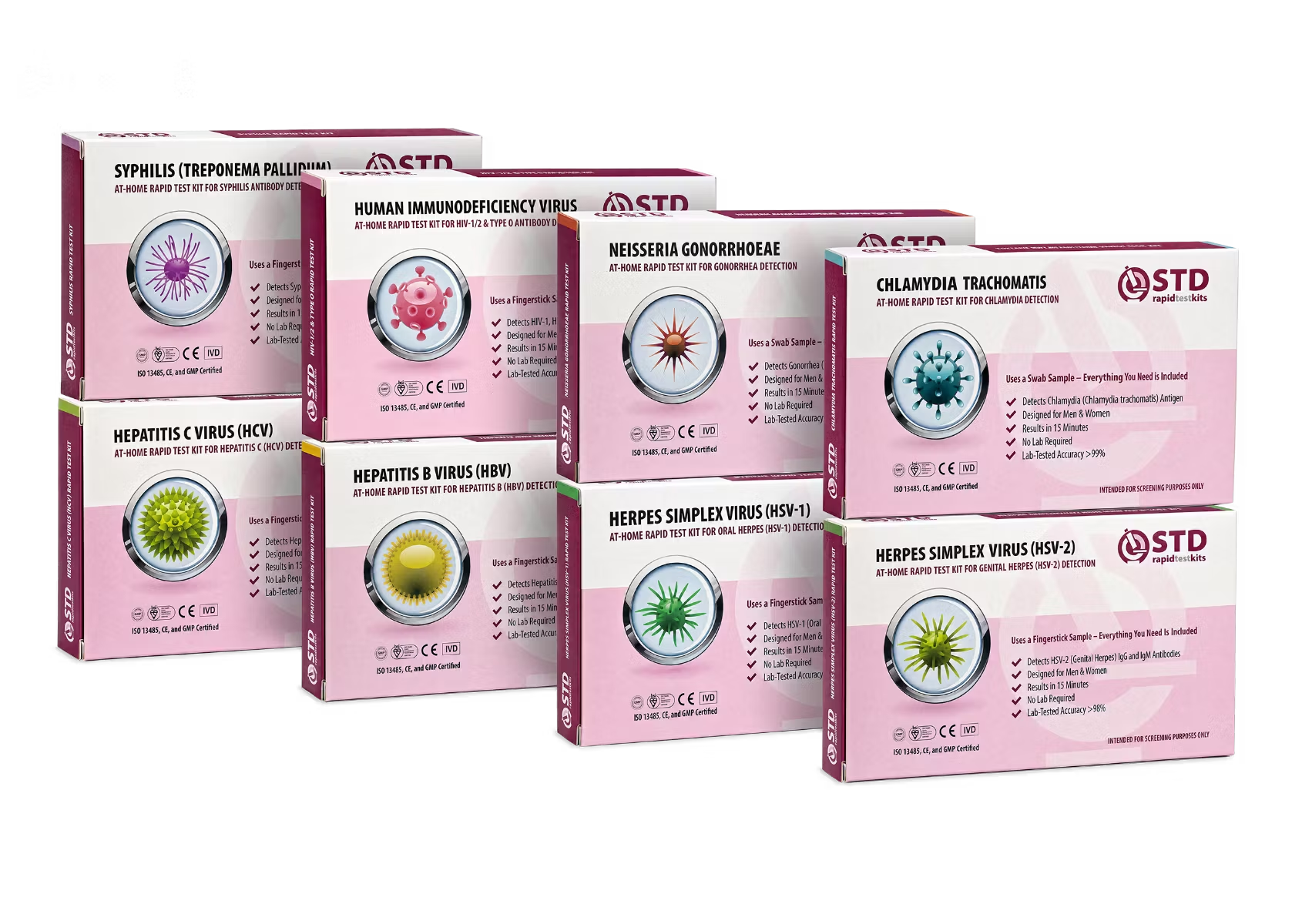
| STD Rapid Test Kits Combo | Rapid lateral-flow | Up to 10 infections in one panel (Chlamydia, Gonorrhea, Syphilis, HIV, more) | About 15 minutes | Fast in-home screening of multiple infections |
| LetsGetChecked | Mail-in lab NAAT | Varies: 2 to 8 STIs per kit | 2 to 5 days | Asymptomatic comprehensive screening |
| Everlywell | Mail-in lab NAAT | Common STIs plus optional add-ons | 2 to 4 days | Bundling with broader wellness panels |
| Nurx | Mail-in lab NAAT | HIV, Herpes, HPV, others | 3 to 7 days | Includes follow-up telehealth visit |
| myLAB Box | Mail-in lab NAAT | Up to 14 STIs | 3 to 6 days | Full-spectrum screening across many infections |
| OraQuick In-Home HIV | Rapid oral-fluid antibody | HIV only | 20 to 40 minutes | Single-focus FDA-approved HIV check |
| Binx Health | Mail-in lab NAAT | Chlamydia, Gonorrhea | 2 to 3 days | Targeted bacterial-STI screen |
| Molecular at-home test | Rapid PCR-based | Select STIs (varies by brand) | About 30 minutes | Lab-level chemistry with rapid turnaround |
The Truth About Accuracy: What "Works" Really Means
Accuracy is not just about the test, it is about timing and sample quality. Even a high-sensitivity kit returns a false negative if used too soon after exposure. Most at-home rapid kits use lateral-flow immunoassay chemistry, which looks for antibodies or antigens on a paper strip. Mail-in lab kits typically use NAAT (nucleic acid amplification testing), the chemistry clinical laboratories use, run on a self-collected swab or urine sample. NAAT is more analytically sensitive than lateral-flow, especially in early or low-titer infections; the two are complementary, not equivalent.
For chlamydia and gonorrhea, per CDC STI screening guidance, NAAT on urine or a self-collected vaginal swab is the preferred laboratory method. Rapid lateral-flow swab cassettes are useful for screening 14 or more days after exposure, but a positive should be confirmed with NAAT, and a negative within the first 5 days post-exposure should be re-checked later when sensitivity has peaked.
For HIV, fourth-generation antigen-antibody combo tests detect infection earlier than older antibody-only tests, typically from 18 to 45 days post-exposure per the CDC's HIV testing overview. Antibody-only rapid kits have a longer window of 23 to 90 days. A confirmatory laboratory test is recommended after any positive home result.
For syphilis, treponemal antibody assays (the chemistry behind most at-home syphilis kits) become reactive about 3 to 6 weeks after exposure per CDC. Reactive results need confirmatory non-treponemal testing (RPR or VDRL) at a clinic to distinguish active from prior treated infection.
No HIV test can detect HIV immediately after infection. The time it takes for a test to detect HIV varies depending on different factors, including the type of test being used.
Which at-home STD test is the most accurate?
Mail-in lab kits using NAAT (nucleic acid amplification testing) match clinic-grade sensitivity, typically in the mid-to-high 90s percent depending on the infection, when used after the window period closes. Rapid lateral-flow at-home kits are less sensitive but return results in 15 to 30 minutes and work well for screening 14 or more days after exposure. The most accurate kit is the one matched to your timing and the specific infection you are checking for, not the broadest or most expensive panel.
Window Periods Matter: When to Test for Each STD
The window period is the time between exposure and when a test can reliably detect infection. It is not the same as the incubation period (when symptoms might appear). For many STIs the window opens well before symptoms (if symptoms appear at all), so testing too early is the most common reason people get a falsely reassuring negative.
For chlamydia and gonorrhea, NAAT becomes detectable from about day 5 after exposure, with peak sensitivity around day 14 per CDC laboratory guidance. For HIV, fourth-generation Ag/Ab combo tests reach detection in most people by 18 to 45 days; antibody-only tests can take up to 90 days. For syphilis, treponemal antibody tests become reactive about 3 to 6 weeks after exposure. Trichomoniasis NAAT or rapid antigen detection becomes reliable from about day 5, with peak sensitivity at 2 to 4 weeks.
Here is the timing summary by infection. Notice that HIV and syphilis lag bacterial STIs by weeks because antibody-based tests need time for the immune response to register. After a high-risk exposure, plan a baseline test plus a follow-up at 30 to 60 days.
| Infection | Common Test Type | Window Period | Peak Accuracy | Retest Needed? |
|---|---|---|---|---|
| Chlamydia | NAAT (lab) / lateral-flow (home) | 5 to 14 days | 14 to 21 days | Yes, if tested before day 14 |
| Gonorrhea | NAAT (lab) / lateral-flow (home) | 3 to 14 days | 14 to 21 days | Yes, if symptoms persist or worsen |
| HIV (Ag/Ab combo) | Fourth-gen lab test | 18 to 45 days | 45 days | Yes, after high-risk exposure |
| HIV (antibody only) | Rapid blood or oral | 23 to 90 days | 12 weeks | Always, at 6 weeks and 90 days |
| Syphilis | Treponemal antibody | 3 to 6 weeks | 6 to 12 weeks | Yes, post-treatment to confirm cure |
| Trichomoniasis | Rapid antigen / NAAT | 5 to 28 days | 2 to 4 weeks | Optional unless symptoms return |
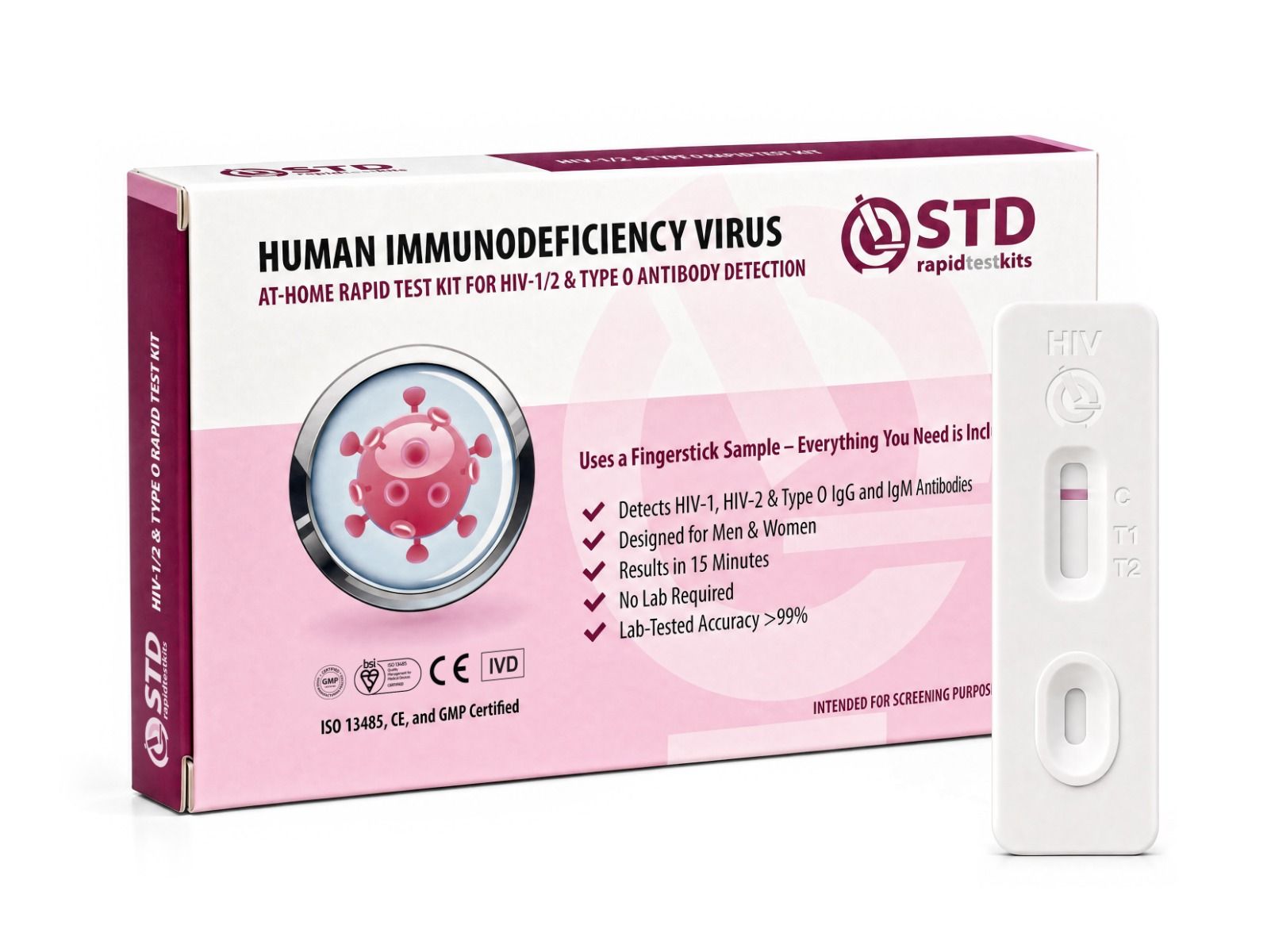
Rapid Tests vs Lab Kits: When One Beats the Other
The short version: rapid lateral-flow kits trade some sensitivity for speed and privacy; mail-in lab kits trade some speed for NAAT-grade sensitivity. They serve different jobs and most people doing serious self-screening end up using both at different points.
A rapid lateral-flow test (15 to 30 minutes, at home, no shipping) is the right tool when:
- it has been at least 14 days since the exposure event,
- you want a same-day answer before a date, trip, or new partnership,
- you are screening between formal clinic visits as a top-up,
- you have a specific infection in mind (chlamydia and gonorrhea swab, or HIV blood) rather than needing a 10-infection panel.
A mail-in NAAT panel (2 to 7 days, sample posted to a lab) is the right tool when:
- you want full-spectrum screening across 6 to 14 infections at once,
- you are retesting after treatment or after a confirmed positive,
- timing is well past the window and you want the lowest possible false-negative rate,
- you need a documented lab result for a clinic record or insurance.
A hybrid approach is common in 2025: a rapid screen for fast reassurance when something happens, plus a mail-in panel for documented results at the next planned screening cycle.
| Test Type | Privacy | Speed | Sensitivity | Best Fit For |
|---|---|---|---|---|
| At-home rapid lateral-flow | Very high | 10 to 30 minutes | Moderate to high (after window closes) | Urgent screening, anxiety relief |
| Mail-in lab NAAT | High | 2 to 7 days total | High (clinical lab standard) | Comprehensive panels, post-treatment confirmation |
| At-home rapid molecular (PCR) | Very high | About 30 minutes | High (lab chemistry, fewer infections) | Speed plus lab-level sensitivity for select tests |
When to Test After a Possible Exposure
The most common at-home testing mistake is testing too early. Anxiety drives the urge to test the day after a worrying event, but for most STIs that first result will not be reliable. Below is the timing logic by exposure-to-test interval, drawn from CDC guidance and FDA-approved kit labeling.
If a high-risk HIV exposure happened in the last 72 hours, post-exposure prophylaxis (PEP) is more urgent than testing right now. PEP is time-sensitive and dramatically reduces the risk of seroconversion, so contact a clinic or telehealth provider immediately rather than waiting on a home test. If visible symptoms appear at any point (lesion, abnormal discharge, burning urination, unexplained pelvic pain), test right away regardless of the timeline below, because symptomatic infection bypasses much of the window-period question and warrants clinical evaluation.
- 0 to 5 days after exposure: Wait unless symptoms are present. Testing this early returns mostly false negatives for chlamydia, gonorrhea, HIV, and syphilis.
- 6 to 13 days: A chlamydia or gonorrhea NAAT may be reliable, but plan a follow-up. HIV and syphilis are still too early.
- 14 to 21 days: Most bacterial STI NAAT tests are at peak sensitivity. Fourth-generation HIV Ag/Ab combo tests start to read reliably.
- 21 to 45 days: Rapid lateral-flow blood tests become useful at this point for HIV antibody detection. Bacterial STIs covered.
- 12 weeks (90 days): The full antibody window for HIV closes. A negative at this point is conclusive per CDC guidance.
- Symptomatic at any time: Test immediately and seek clinic evaluation, regardless of how long since the exposure.

Retesting: Why One Test Is Often Not Enough
Retesting is not just for people with symptoms. It applies to anyone who tested early in the window, had a high-risk exposure, or completed treatment for a confirmed infection. Timing rules differ by why you are retesting.
After treatment for bacterial infections like chlamydia or gonorrhea, NAAT-based tests can pick up residual non-viable nucleic acid for several weeks. Most clinicians recommend waiting at least 3 weeks after completing antibiotics before a test-of-cure, per CDC STI treatment guidance. Testing sooner can produce a positive result from cleared but still-detectable bacterial DNA, which is not a treatment failure.
For HIV and syphilis, retesting follows window-period logic rather than treatment logic. After a high-risk exposure, the standard CDC pattern is a baseline test, a follow-up at 4 to 6 weeks, and a confirmatory test at 3 months. For at-home antibody-only HIV kits, the 3-month re-test is essential, not optional. A negative at 3 weeks does not rule out infection.
The CDC also recommends a chlamydia and gonorrhea test-of-cure 3 months after a positive diagnosis, regardless of whether treatment seemed successful, because of high reinfection rates. This is a strong use case for a mail-in NAAT panel rather than a rapid screen, because documented lab results matter at the medical-record level.
Privacy, Packaging, and What to Expect
Privacy is the main reason people pick at-home testing over a clinic, so every FDA-cleared kit on the market ships in plain, unmarked packaging. The exterior shows the shipper's logo (USPS, UPS, FedEx) but no diagnostic branding, no product name, no return-address giveaway. Inside, the kit comes in a sealed inner pouch with instructions, collection materials, and the test device or shipping envelope.
Shipping speed varies. Some brands offer 1 to 2 day express delivery; others use standard ground that can take up to a week. If you are testing around travel or before an event, factor in delivery time. Mail-in kits add lab processing time on top of shipping: typically 2 to 5 business days after the lab receives the sample.
For result delivery, mail-in lab kits use secure online portals with multi-factor authentication. Most require a short registration step that links the kit to a profile (not your insurance) and a secure way to access results, typically without a paper trail. For rapid at-home tests, results appear on the device itself in your bathroom, no logins or uploads required.
Insurance and clinical disclosure are also worth noting. At-home tests are typically out-of-pocket purchases, so there is no insurance claim and no notification to a primary care provider. If you want results in your medical record, you need to share them with your clinician yourself.
| Channel | Privacy level | Speed to result | Insurance trail |
|---|---|---|---|
| At-home rapid kit | Very high (no portal, no shipping back) | 10 to 30 minutes | None |
| At-home mail-in lab kit | High (sample shipped, results via secure portal) | 2 to 7 days total | None (out-of-pocket purchase) |
| Clinic visit | Moderate (chart entry, billing code) | Same day to a week | Yes if billed through insurance |
If You Test Positive: What Happens Next
A positive at-home result is the beginning of a clear path, not a verdict. Most common STIs are fully curable with antibiotics (chlamydia, gonorrhea, syphilis, trichomoniasis), and the others are manageable with antiviral medication (HIV, herpes). The first 30 minutes are usually the hardest. The next steps are concrete.
First, plan a confirmatory test. A reactive lateral-flow result has a small false-positive rate, so a clinic NAAT (for chlamydia/gonorrhea/trichomoniasis) or a lab Ag/Ab confirmation (for HIV/syphilis/hepatitis) is the next step before starting treatment. Telehealth services can order most confirmations without an in-person visit.
Second, notify recent partners. You do not have to explain in detail; anonymous partner-notification services in most states will send a sexual-health alert on your behalf. The CDC and most state health departments host these tools at no cost.
Third, start treatment. Bacterial STIs typically resolve with a single antibiotic course (azithromycin or doxycycline for chlamydia, ceftriaxone for gonorrhea, benzathine penicillin for syphilis). HIV treatment in 2025 is highly effective; people who start antiretroviral therapy promptly and maintain an undetectable viral load do not transmit HIV to sexual partners. Herpes management uses suppressive antivirals like valacyclovir.
A positive result reflects exposure, not character. Most bacterial STIs clear with a single antibiotic course, and for HIV and herpes, treatment started promptly keeps long-term outcomes excellent and partner-transmission risk very low.
Frequently Asked Questions
- Can I trust an at-home STD test if I have no symptoms?
- Yes, and asymptomatic testing is exactly what these kits are designed for. The CDC estimates that most chlamydia infections in women and roughly half of gonorrhea infections in men show no symptoms. Routine screening when you feel fine is how those silent infections get caught early, before they progress to pelvic inflammatory disease or affect fertility.
- What if my test is negative but something still feels wrong?
- A negative test taken within the first 5 days after exposure is not conclusive. Wait until the window closes (14 to 21 days for bacterial STIs, longer for HIV and syphilis) and retest. Symptoms can also be unrelated to STIs: yeast imbalance, UTI, irritation from a new product, or hormonal cycle changes. If symptoms persist beyond a week or two, see a clinician for a full evaluation.
- How discreet is the packaging?
- Very. All FDA-cleared kits arrive in unmarked outer packaging with only the courier logo visible. Results go to a password-protected portal (not email), and no insurance claim is generated, so the test leaves no third-party paper trail.
- Are there fake or unreliable STD kits in 2025?
- Yes, especially on third-party marketplaces with no manufacturer transparency. Stick to brands with explicit FDA clearance or named CLIA-certified lab partners, and check the product page for published sensitivity and specificity data. If a kit has no validation information and no clear manufacturer info, skip it. The FDA's home-use test database is a good cross-reference.
- Can I use an at-home test during pregnancy?
- Most at-home test collection is non-invasive (urine, fingerstick blood, self-collected vaginal swab) and safe during pregnancy. However, results that affect prenatal care, especially HIV, syphilis, hepatitis B, and chlamydia/gonorrhea, should always be confirmed at a clinic per CDC perinatal screening guidelines. Talk to your OB before relying on a home result for any treatment decision during pregnancy.
- My partner tested negative. Do I still need to test?
- Yes. Different timing, different past exposures, different windows. A partner's negative result reflects their status at the moment of their test, not yours. STIs can also persist undetected for months in one partner without affecting the other. Mutual testing is the standard for any new sexual relationship, and re-testing at the start of any committed exclusive partnership.
- How fast can I actually get results?
- Rapid lateral-flow kits return results in 15 to 30 minutes after running the test at home. Mail-in lab kits take 2 to 7 days total (shipping plus lab processing). Some mail-in services offer priority lab handling for an extra fee. If you need a result before a specific date, pick a rapid kit and factor in any shipping time for the kit itself.
- What if I mess up the test?
- It happens, especially with self-collected swabs or fingerstick blood. Most kits are single-use. Contact the manufacturer for a replacement (most will send one), or order a second kit. Do not try to interpret a damaged or improperly run test, because the result is unreliable. A failed run is a delay, not a verdict on your testing ability.
Answers, Not Assumptions
Nobody should have to guess their status in 2025. Tests now exist that fit in a drawer, arrive in plain packaging, and return real answers in 15 minutes or by mail in a week. Whether the trigger is a specific exposure event, a new partnership, or a quarterly check-in habit, the act of testing reflects self-respect, not paranoia.
The right kit depends on three things: how recent the exposure was, which infections you are screening for, and whether you want a quick screen or a documented panel. A 14-day rapid lateral-flow test for HIV plus a mail-in NAAT panel at the 3-month mark covers most realistic risk patterns. A standing every-three-to-six-month combo screen covers asymptomatic baseline care.
If you do test positive, that is information, not a verdict. Confirm with a clinic, notify partners on your terms, start treatment, and use the result as a reset rather than a label.
This article was constructed based on current public-health guidance from the CDC, WHO, NHS, and FDA, plus peer-reviewed literature on at-home sample collection and lateral-flow versus NAAT chemistries. Sample test categories were cross-referenced against manufacturer documentation and the FDA's home-use test database. The article does not constitute clinical diagnosis or personalized medical advice. For symptoms that concern you, see a licensed clinician.
- U.S. Centers for Disease Control and Prevention. STI screening recommendations, surveillance data, and treatment guidelines (2025).
- U.S. Centers for Disease Control and Prevention. HIV testing overview, window periods, and Ag/Ab versus antibody-only test interpretation.
- U.S. Food and Drug Administration. Authority on home-use diagnostic devices, including FDA-cleared HIV and STI rapid kits.
- World Health Organization. Sexually transmitted infections (STIs) fact sheet, global prevalence and screening guidance.
- U.S. Centers for Disease Control and Prevention. Chlamydia overview: asymptomatic infection patterns, NAAT recommendations, and test-of-cure timing.
- U.S. Centers for Disease Control and Prevention. STI program overview covering surveillance, screening, and treatment guidance.
- National Health Service (UK). At-home STI testing, accuracy, and the role of self-collected samples in screening.