STD Rash vs Allergic Reaction: How to Tell the Difference
How to spot the difference, and when guessing isn't safe.
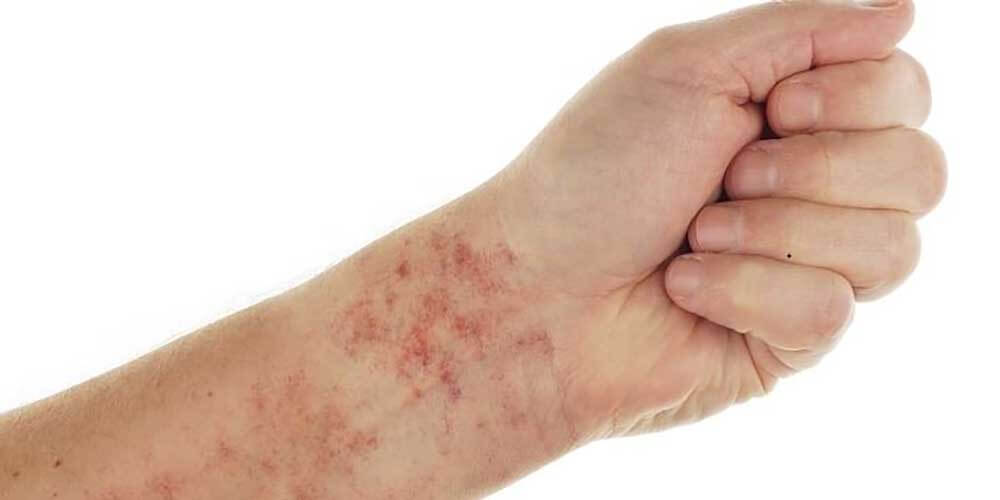



- Allergic and irritant reactions usually appear within minutes to hours of contact and improve when you remove the trigger or apply a topical steroid; STD rashes typically appear days to weeks after exposure and don't respond to allergy medications.
- Visual identification on its own is unreliable. Herpes is regularly misread as ingrown hairs, syphilis as eczema, and contact dermatitis as a yeast infection. A swab during an active lesion or a blood antibody test once enough time has passed is the only way to be sure.
Published: August 2025 | Last updated: May 2026 | Editorial review and quality control: Martina N.
The morning after sex, you spot something on your skin. A red patch, a cluster of bumps, a sore that wasn't there yesterday. Your stomach drops and your phone fills with search tabs. Was it the new condom, the lube, the laundry detergent, or something else entirely?
Both sexually transmitted infections and everyday skin irritants can produce symptoms that look unsettlingly alike. Add late-night anxiety and a few half-read forum posts, and the line between “allergic reaction” and “infection” starts to blur fast. The honest reality: telling them apart by sight alone is genuinely hard, even for clinicians, which is why testing matters whenever the picture doesn't quickly resolve.
This guide walks through how clinicians actually distinguish common STD rashes from contact reactions, how the timeline and location patterns differ, and which tests give you a real answer. If a bump appeared an hour after sex and is fading by morning, that's almost certainly an irritant. If something is still developing two weeks out, the picture changes, and so does the right next step.
Key Takeaways
- Allergic and irritant reactions usually appear within minutes to hours of contact and improve when you remove the trigger or apply a topical steroid; STD rashes typically appear days to weeks after exposure and don't respond to allergy medications.
- Visual identification on its own is unreliable. Herpes is regularly misread as ingrown hairs, syphilis as eczema, and contact dermatitis as a yeast infection. A swab during an active lesion or a blood antibody test once enough time has passed is the only way to be sure.
Why STD rashes and contact reactions look so similar
The skin has a limited repertoire of responses. Whether the trigger is a virus replicating in nerve cells, a bacterium spreading through the bloodstream, or a chemical your immune system suddenly decided it disliked, the visible result tends to land in the same handful of patterns: redness, papules, vesicles (small fluid-filled blisters), plaques, scaling, weeping, swelling. That overlap is the core problem. Two completely different processes can produce nearly identical pictures on the surface.
Three factors do most of the diagnostic work, and none of them are the appearance of the rash by itself:
- Timing relative to the trigger. Allergic reactions appear within minutes to hours; STD rashes typically take days to weeks to develop after exposure.
- Location and distribution. Contact reactions stay where the irritant touched skin. Infections follow patterns set by the organism, sometimes spreading well beyond the contact site.
- Associated symptoms like fever, swollen lymph nodes, fatigue, or sore throat, which point toward systemic infection rather than local irritation.
A latex contact reaction shows up where latex touched skin, within hours of use, and stays where it started. A secondary syphilis rash appears weeks to months after the original chancre, often on the palms and soles, and typically rides along with fatigue, low-grade fever, and swollen glands per the CDC's STI guidance. Same visual category at first glance, very different stories underneath.
Reading the rash on its own and ignoring the rest of the picture is where most people go wrong. Three signals together (timing, location, and what else is happening systemically) tell a much more reliable story than the appearance of the skin alone.
Can you tell an STD rash apart from an allergic reaction by looking?
Usually no, at least not reliably. The most useful signals are timing (allergic reactions appear within minutes to hours; STD rashes appear days to weeks after exposure), location (allergic reactions stay where the irritant touched skin; STD rashes follow infection patterns), and accompanying symptoms (STD rashes often come with fever, fatigue, or swollen lymph nodes; allergies don't). When timing or location doesn't fit a contact reaction, get tested. A clinic swab during an active lesion, or a blood antibody test once enough time has passed, will give you a real answer.
What STD rashes actually look like
A handful of infections cause most of the rashes that bring people to a search engine after sex. Knowing the visual signature of each helps narrow possibilities, but no single pattern is exclusive enough to confirm a diagnosis without testing.
Genital herpes (HSV-2 most often, sometimes HSV-1). A cluster of small painful fluid-filled blisters on a red base. The area usually tingles, burns, or itches for a day or two before the blisters appear. They break, weep, then crust over within roughly a week. Lesions sit on the labia, penile shaft, scrotum, perianal skin, or inner thighs. Recurrent outbreaks are typically smaller and shorter than the first one. Per CDC genital herpes guidance, many people have very mild symptoms or none at all after initial exposure and may not notice an outbreak for weeks or months, which is part of why genital herpes is so frequently misread as another skin condition.
Oral herpes (cold sores). Same biology as genital herpes, different real estate. Lesions cluster on the vermillion border of the lip or just outside it, and may appear inside the mouth during a first outbreak. They tingle before they erupt, then crust, then heal over roughly seven to ten days.
Primary syphilis (chancre). A single painless ulcer at the site of contact, generally 0.5 to 2 centimeters wide, with a clean firm raised edge. Because it doesn't hurt and frequently appears on hidden surfaces (the cervix, the anal canal, the inside of the lip), people miss it. It heals on its own within three to six weeks even without treatment, which leads to false reassurance. The infection has not gone anywhere.
Secondary syphilis rash. Several weeks to a few months after the chancre, a copper-red or pink rash develops, classically including the palms and soles, often involving the trunk and limbs. Spots are flat to slightly raised, generally not itchy, and may coexist with patchy hair loss, low-grade fever, fatigue, and swollen lymph nodes. Palm and sole involvement is unusual for most other rashes and is one of the strongest single clues toward syphilis. The CDC syphilis page describes the staged progression and the secondary rash pattern.
Acute HIV exanthem. Two to four weeks after exposure, a substantial share of newly infected people develop a flu-like illness, and a portion of those develop a maculopapular pink-to-red rash on the upper trunk, neck, or face. It tends to appear with fever, sore throat, swollen glands, headache, and muscle aches, per the CDC's HIV basics resource. The rash itself fades in one to two weeks; the infection does not.
Scabies and pubic lice. Scabies and pubic lice are parasitic infestations transmitted through close skin-to-skin contact during sex, and they are frequently mistaken for STD rashes. Scabies produces intensely itchy small red bumps and short squiggly burrow lines, worst at night, usually in skin folds (between fingers, under breasts, around the waistband, on the genitals). Pubic lice cause itching in the pubic area, with tiny crawling lice and pale eggs (nits) attached to hair shafts visible on close inspection.
HPV genital warts. Skin-colored to slightly grey soft growths on the genitals, anus, or surrounding skin. They can be flat, dome-shaped, or cauliflower-textured, single or in clusters. Warts are usually painless and may be itchy or tender if irritated by clothing or sex. Note that the HPV strains associated with cervical cancer risk are different strains and typically do not produce visible warts. Visible warts are a sign of low-risk strains; cancer-risk strains require Pap or HPV DNA screening to detect.
What allergic and irritant skin reactions look like
Contact reactions split into two camps. Irritant contact dermatitis happens when a chemical directly damages the skin barrier (think harsh detergents or fragranced wipes). Allergic contact dermatitis is a delayed immune response, technically a type IV (delayed immune) hypersensitivity reaction, that takes 12 to 72 hours to develop after the second or later exposure to the trigger. Both produce redness, itching, sometimes weeping or vesicles, and the rash typically stops sharply at the line where the trigger touched skin. The NHS contact dermatitis page describes the typical pattern of itchy, dry, red, cracked, or blistered skin where contact occurred.
The usual culprits behind a post-sex skin reaction:
- Latex. True IgE-mediated latex allergy is uncommon and can be life-threatening (immediate hives, swelling, breathing trouble). Far more common is irritant contact reaction or delayed allergy to latex condoms, producing localized redness and itching where the condom touched skin within minutes to hours. Switching to nitrile or polyurethane condoms resolves it.
- Lubricant ingredients. Glycerin, parabens, propylene glycol, and nonoxynol-9 (a spermicide still used in some condoms and lubes) can irritate genital and anal mucosa. The reaction often produces burning, stinging, and visible inflammation immediately or within hours of use.
- Body wash, scented soap, laundry detergent. Fragrances and preservatives are the usual triggers. Reactions cluster in skin folds and on areas where the product sat (groin, inner thighs, perianal skin). Switching to a fragrance-free product and applying a low-potency hydrocortisone for a few days usually clears it.
- Friction and trapped sweat. Chafing alone causes shiny, raw, sometimes weeping patches in skin folds. Heat and moisture trapped under clothing during and after sex can produce intertrigo, which can become secondarily infected with yeast.
The distinguishing features of contact reactions are speed of onset (minutes to a couple of days, not weeks), a sharp boundary that matches the trigger's footprint, and rapid response to removing the irritant or applying a topical steroid.
Latex allergy with hives spreading beyond the contact area, swelling of the face, lips, or tongue, or trouble breathing during or after sex is anaphylaxis, not a routine contact rash. Stop, call your local emergency number, and treat it the way you would any anaphylactic reaction. The information in this article is about distinguishing common skin reactions from STDs, not about managing severe systemic allergies.
Side-by-side: how the patterns differ
Clinicians don't usually diagnose by single features. They build a picture from timing, location, character of the rash, and what else is going on systemically. The table below summarizes the constellation of features for each category. Use it as a triage tool, not a diagnosis. If two or more rows in the STD column fit your situation, that's a strong signal to test rather than wait. Our at-home rapid tests use lateral-flow immunoassay chemistry; a positive result is worth confirming with a lab test, but they give a fast initial answer without a clinic visit.
| Feature | STD rash | Allergic or irritant reaction |
|---|---|---|
| Onset after trigger | Days to weeks (HSV days to a few weeks; secondary syphilis weeks to months; acute HIV 2 to 4 weeks) | Minutes to hours (irritant) or 12 to 72 hours (delayed allergic) |
| Location | Often genitals, perianal skin, mouth, palms, soles, or upper trunk depending on infection | Where skin actually touched the irritant (condom area, lube area, detergent zone) |
| Border | Diffuse, irregular, can spread | Sharp, often matches the shape of the trigger |
| Itch | Variable. Herpes burns more than itches; syphilis rash is usually not itchy | Usually very itchy |
| Blisters | Yes for herpes (clustered vesicles) | Sometimes (small vesicles within a sharply bounded plaque) |
| Fever, sore throat, swollen glands | Common with acute HIV, possible with herpes and secondary syphilis | Rare or absent |
| Response to topical steroid or antihistamine | Minimal | Usually rapid improvement |
| Course without treatment | Persists, recurs, or moves through stages | Resolves once trigger is removed |
Other skin conditions that aren't STDs and aren't allergies
Not every post-sex rash falls into the STD-or-allergy binary. Several common skin conditions favor the same body areas and get confused for both:
- Tinea cruris (jock itch). A fungal infection of the groin, inner thighs, and perineum. The classic pattern is a red ring with a slightly raised, scaly, advancing edge and a clearer center. It itches, often spreads outward, and responds to over-the-counter antifungals like clotrimazole. Common in people who sweat heavily or wear damp clothing.
- Folliculitis. Inflammation of hair follicles after shaving, waxing, or friction. Looks like small red bumps or pustules, sometimes with a hair visible at the center, frequently confused with herpes. Usually resolves with warm compresses and time. Recurrent or extensive folliculitis warrants a doctor's evaluation.
- Pearly penile papules and vestibular papillae. Normal anatomic variants, not infections, often mistaken for warts. Pearly penile papules are tiny smooth dome-shaped bumps in a single or double row around the corona of the penis. Vestibular papillae are similar small projections inside the labia minora. Both are harmless and require no treatment.
- Psoriasis. A non-infectious autoimmune condition that can affect the genitals, producing well-defined, smooth, salmon-pink plaques. Genital psoriasis is often less scaly than psoriasis elsewhere and is sometimes mistaken for a chronic STD.
- Lichen sclerosus. A chronic inflammatory condition causing white, thinned, fragile patches on genital skin. More common in women, can also affect men. Needs medical evaluation because untreated disease can scar.
- Yeast infection (candidiasis). Itchy red rash, often with white discharge in women, with satellite small red bumps around the main red patch. Frequent in skin folds. Treatable with antifungals.
A new bump or patch on genital skin is not automatically an STD. Skin reacts to friction, heat, sweat, hormones, and shaving as readily as it reacts to infection, and the only way to separate one from another is to evaluate the bump in context, ideally with a clinician who can examine, swab, or order bloodwork.
Most people who have genital herpes have no symptoms or have very mild symptoms. You may not notice mild symptoms or you may mistake them for another skin condition, such as a pimple or ingrown hair.
When to test, what test, and which sample
Testing is the only path from “what is this?” to a real answer. The right test depends on what's currently visible on your skin, when exposure happened, and which infections you're trying to rule in or out.
Active genital lesion (sore, blister, or ulcer). The clinical gold standard is a swab from the lesion sent for PCR. A clinician scrapes the base of an open sore or aspirates a fresh blister, and the lab tests the sample for HSV-1, HSV-2, or treponemal DNA. PCR is most accurate while the lesion is wet and active. Once a sore has crusted over, sensitivity drops sharply, which is why “wait it out” often means missing the diagnosis.
Past possible exposure with no current lesion. Blood antibody testing is the right tool. Antibodies to HSV-2 generally take 12 weeks to develop reliably. Syphilis antibodies appear about three to six weeks after exposure. Modern HIV antibody-and-antigen (fourth-generation) tests detect infection from roughly 18 to 45 days after exposure; older standalone antibody tests need closer to 90 days.
Asymptomatic screening at a routine visit. A typical CDC-recommended panel for sexually active adults includes chlamydia and gonorrhea (urine or genital swab NAAT), HIV (blood), and syphilis (blood). Herpes serology is not part of routine asymptomatic screening because positive results in low-risk people often turn out to be false positives, and a positive without symptoms or a partner with confirmed HSV doesn't change much about management.
Where at-home rapid tests fit. The kits we sell on this site are lateral-flow immunoassays. They use the same blood or swab sample type as lab tests but a different chemistry. Lab NAAT remains the analytical gold standard for active swab-based detection (chlamydia, gonorrhea, herpes via PCR), so a positive at-home rapid result is worth confirming with a lab test. The advantage of at-home testing is speed, privacy, and lower friction. The complementary lab test is the right next step after a positive screen.
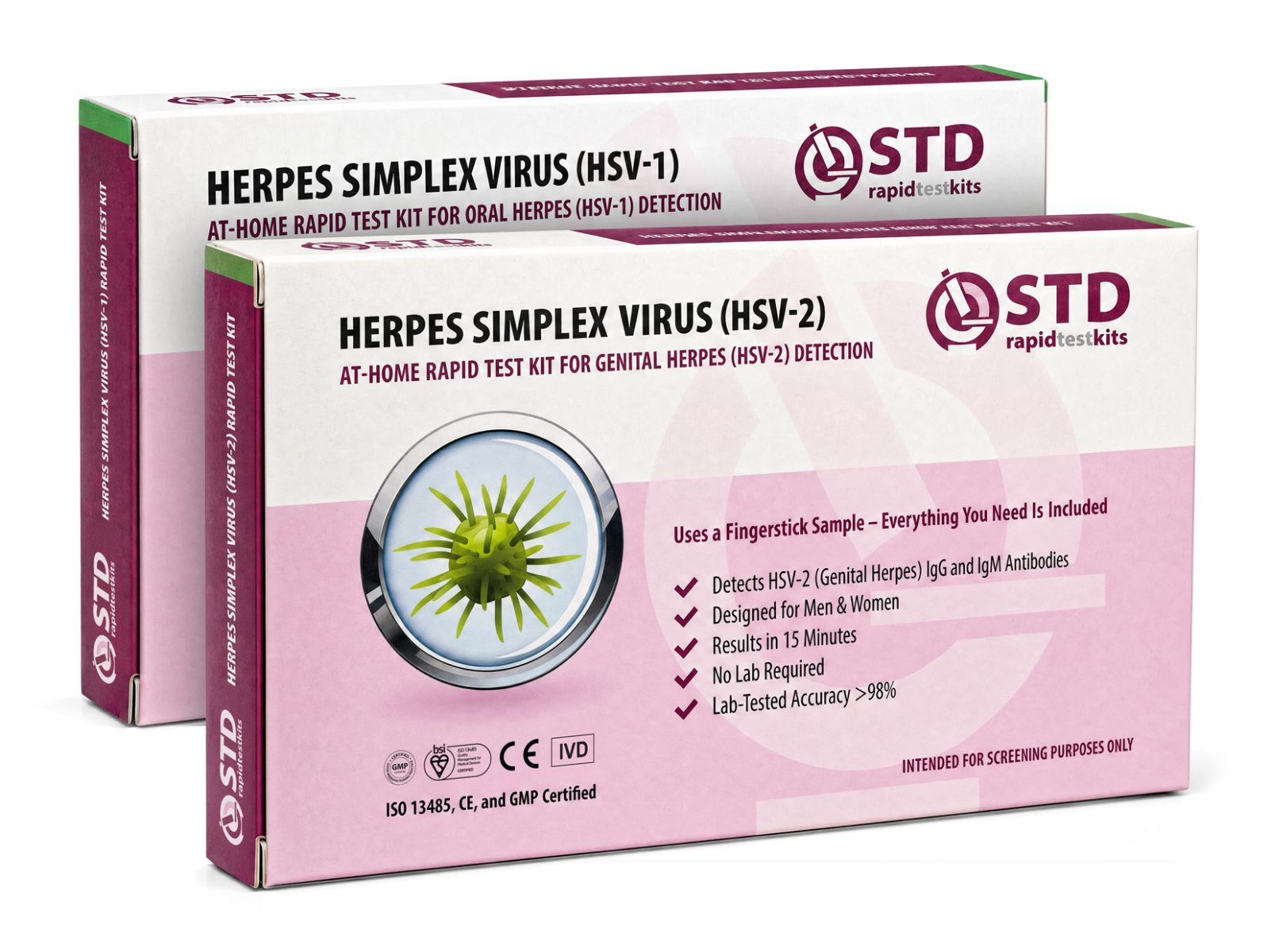
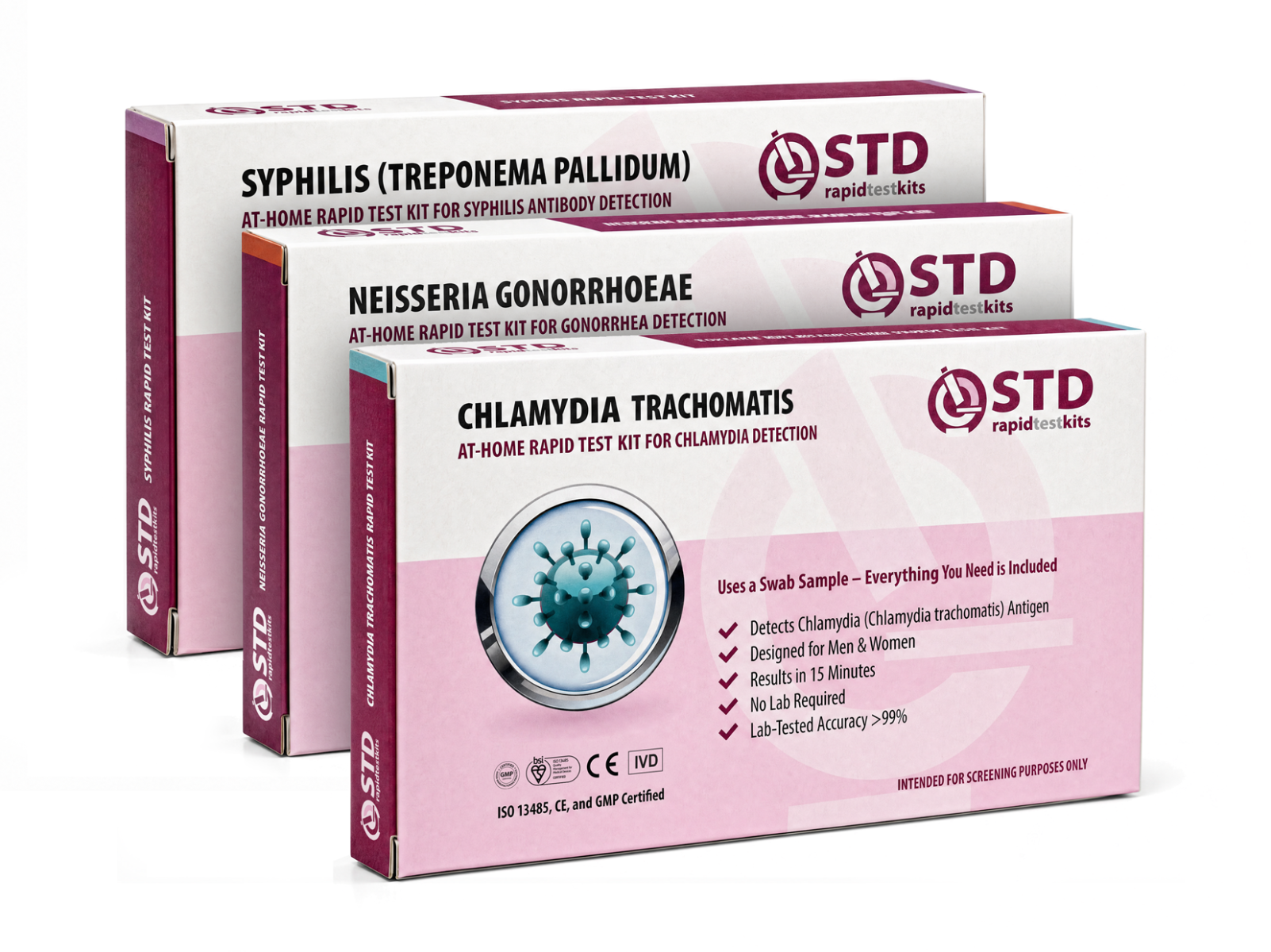
If a rash is currently active and you can get to a clinic, ask for a swab. If you can't, or you're trying to figure out whether to escalate, an at-home rapid test for HIV, syphilis, hepatitis B, hepatitis C, or herpes can give you a starting answer in about 15 minutes and tell you whether a clinic visit is urgent. If recent exposure puts more than one STI on your radar, a multi-infection panel is a practical first screen.
Active sore today: clinic swab for PCR is the most accurate option, and PCR sensitivity is highest while the lesion is still wet. Past exposure with nothing currently visible: blood antibody testing, with HSV-2 reliable from about 12 weeks, syphilis from about 3 to 6 weeks, and modern fourth-generation HIV from roughly 18 to 45 days. At-home lateral-flow tests give a fast first answer; a positive should be confirmed with a lab test.
How to talk to a partner without spiraling
If you're going to test, you may want to talk to a current or recent partner about it. A rash is a health observation, not a moral verdict; it means something is happening on your skin that you want to understand. Whether it turns out to be an irritant, a fungal infection, or an STD, the action is the same: figure out what it is and treat it. You also do not have to disclose a diagnosis you do not yet have, and waiting for results before reaching out is respectful, not evasive.
“I'm getting something on my skin checked out, and depending on what it is, I'll let you know if you should test too” is a complete and respectful sentence. You're not hiding anything; you're not jumping ahead of the data either.
Some lines that work in real conversations:
- “I noticed a rash and I'm getting it checked. I wanted to give you a heads-up in case it turns out to be something we should both test for.”
- “I tested positive for X. I'd like you to test too. Here's how, and here's what's covered by treatment.”
- “I'm not sure what this is yet, but I want to be upfront. Can we both pause until I have results?”
Either way, getting a result and knowing your status is the right next step regardless of how any conversation goes.
You do not need to disclose a diagnosis you do not yet have. Waiting for test results before reaching out is respectful, not evasive. The respectful move is to test, get an answer, and then share whatever the answer is.
Frequently asked questions
- Can an allergic reaction look like herpes?
- Yes. Folliculitis after shaving, contact dermatitis, and friction reactions can all produce small red bumps and tiny vesicles that look very similar to early herpes. The most reliable difference is timing and recurrence. Herpes tends to come back at the same site over months or years; allergic reactions don't repeat unless you re-encounter the trigger. A swab during an active lesion can confirm.
- How fast does an STD rash appear after sex?
- The most useful rule is the one-hour test. If something appeared within an hour or two of sex, it is almost certainly irritation or a contact reaction, not an STD. Beyond that window the picture changes. Genital herpes typically takes days to a few weeks from exposure. Primary syphilis chancres appear roughly 10 to 90 days out, with an average around 21 days. Secondary syphilis rash develops weeks to months after the chancre. Acute HIV rash typically appears 2 to 4 weeks after exposure.
- What does a syphilis rash look like?
- Secondary syphilis classically produces flat or slightly raised copper-red to pink spots, often involving the palms and soles, sometimes accompanied by patchy hair loss and low-grade fever. The rash is not usually itchy, which sets it apart from most allergic reactions. Palm-and-sole involvement is uncommon for almost any other rash and is one of the strongest single clues.
- Can I have an STD without a rash?
- Yes, and most people with chlamydia, gonorrhea, or HIV are asymptomatic for long stretches. Skin findings are one possible symptom, not a required one. If you've had a possible exposure, periodic testing is the only way to catch silent infections, regardless of whether your skin looks clear.
- Do allergic rashes go away on their own?
- Most do, within 24 to 72 hours of removing the trigger. A topical hydrocortisone cream and an oral antihistamine can speed resolution. If a rash is still there after a week, or it appeared without an obvious irritant, get it evaluated rather than continuing to treat it as an allergy.
- Is it safe to test while a rash is active?
- For swab-based tests of an active lesion, that's actually the best time to test, since PCR is most sensitive while the sore is wet. For blood antibody tests, the rash itself doesn't change the result. What matters is how long since possible exposure, because antibodies take time to build.
- Can I have both an allergy and an STD at the same time?
- Yes, and it's not unusual. A latex contact reaction sitting on top of an existing herpes outbreak is a real combination, and so is a fungal infection plus a developing primary syphilis chancre. If a rash is more painful, larger, or more systemic than a typical contact reaction, treat it as worth testing.
- What if my rash is gone by the time I test?
- For blood-based tests, that's fine; you're looking for systemic antibodies, not the lesion itself. For swab-based tests, a healed lesion can no longer be sampled productively. Track the timeline (when it appeared, how long it lasted, whether it has happened before) and bring that information to a clinic or your test instructions.
- U.S. Centers for Disease Control and Prevention. STI Information and Resources hub, including stage-specific symptom and timeline guidance for genital herpes and syphilis.
- U.S. Centers for Disease Control and Prevention. HIV Basics, including the 2 to 4 week acute exanthem timeline and screening guidance.
- U.S. Centers for Disease Control and Prevention. Genital Herpes information hub, including the note that most people with genital herpes have no or very mild symptoms easily mistaken for other skin conditions.
- U.S. Centers for Disease Control and Prevention. Syphilis information hub, including primary chancre, secondary rash with palm and sole involvement, and stage progression.
- U.K. National Health Service. Contact dermatitis (irritant vs allergic mechanism, time to onset, and management).
- National Library of Medicine, StatPearls. Contact Dermatitis (clinical features, type IV hypersensitivity mechanism, and differential diagnosis).