I Gave Someone Herpes: What to Say and What to Do Next
Disclosure, testing, and steps back to feeling human after herpes.




- Most herpes transmission happens between people who do not know they are infected; the virus can shed from skin that looks completely normal.
- Disclosure, accurate testing, and antiviral suppression therapy are the three concrete steps that genuinely change outcomes for both partners.
Published: September 2025 | Last updated: May 2026 | Editorial review and quality control: Martina N.
Finding out you may have passed herpes to a partner is the kind of moment that splits time into before and after. There is a phone call, or a text, or a conversation across the kitchen table, and suddenly the version of yourself you knew an hour ago feels like a stranger. In its place is someone trying to understand how this happened, what to say, what to do next, and whether the person you care about will ever look at you the same way again.
If that is where you are right now, take a breath. You are not the first person to face this, and you will not be the last. According to the U.S. Centers for Disease Control and Prevention, the majority of people carrying HSV-2 in the United States have no idea they have it. That means transmission inside committed relationships, hookups, and long-term partnerships happens constantly, between people who genuinely believed they had no reason to disclose. None of that makes this any easier to sit with. It does mean you are not a singular failure of character.
If you believe you have transmitted herpes to a partner, you have three jobs in front of you: tell them honestly, get clear answers about your own status, and stop using shame as a substitute for action. None of it has to happen in the next hour. All of it gets easier once you start moving.
Key takeaways
- Most herpes transmission happens between people who do not know they are infected; the virus can shed from skin that looks completely normal.
- Disclosure, accurate testing, and antiviral suppression therapy are the three concrete steps that genuinely change outcomes for both partners.
How herpes spreads when you cannot see anything wrong
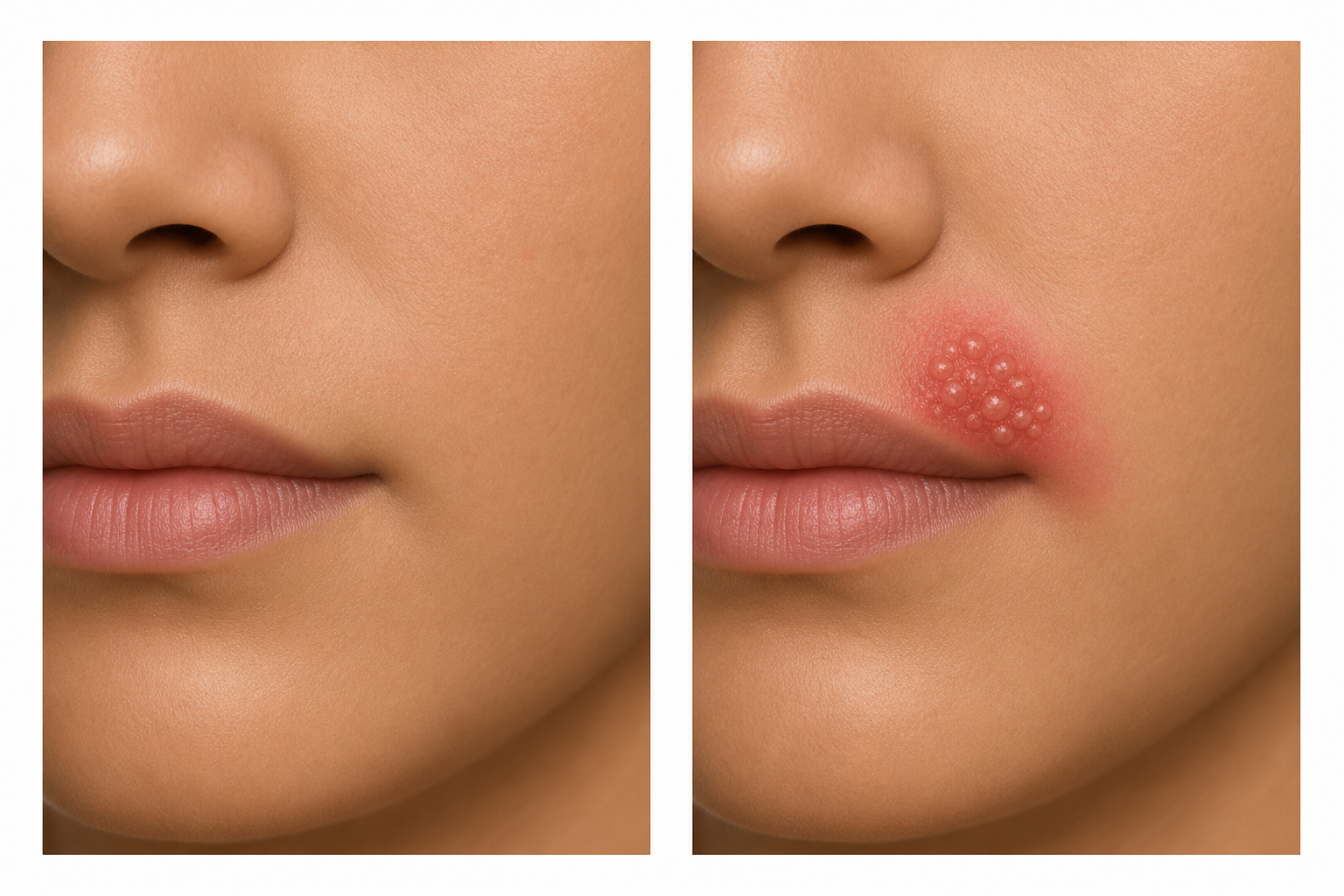
The hardest fact about herpes simplex virus is that it does not need a visible sore to be contagious. The virus lives in nerve clusters near the spinal cord and travels back to the skin in cycles. During those cycles, infected cells release viral particles into a process clinicians call asymptomatic shedding. There are no sores, no pain, no warning signals at all, and the infection is still transmissible.
Per CDC clinical guidance, most genital HSV-2 infections are acquired from partners with no symptoms at the time of contact. Asymptomatic shedding can occur even when skin looks completely normal, with significant variation between individuals and across the course of an infection.
The practical takeaways: you can carry herpes for years without realising it; condoms reduce risk substantially but do not eliminate it, because skin-to-skin contact outside the area a condom covers is enough for transmission; and without a documented negative IgG antibody result from one partner inside the relevant testing window, the question of who gave it to whom is often impossible to answer with certainty.
| What the science says | What it means for you |
|---|---|
| Most HSV-2 infections in the U.S. go undiagnosed | If you tested positive recently, you may have been carrying the virus for months or years |
| Asymptomatic shedding can happen on days when nothing is visible | Skin can look completely normal and still be infectious |
| Skin-to-skin contact, not just intercourse, is enough for transmission | Condoms reduce risk but cover only the area they physically cover |
What to say when you tell them
The disclosure conversation is the part most people dread, and the part that almost always feels better afterward than they expect. The goal is not to perform the right script. The goal is to be honest about what you know, honest about what you do not, and clear about what you are willing to do next.
Lead with the facts. Tell them what your test result was, when you got it, and what kind of test it was (a blood antibody test for IgG, a swab from a lesion, a positive PCR). The more specific you can be, the easier it is for them to act on the information.
Skip the deflections. Phrases like "you might have caught it from someone else" or "there is no way to know who started this" are technically true and almost always read as evasion in the moment. The timing-and-uncertainty conversation can come later, after they have absorbed the news. First, give them a clean, honest sentence about what you have learned about yourself.
Make space for their reaction. Anger, sadness, silence, questions you cannot answer. All of it is normal. None of it means you did the wrong thing by telling them. The only wrong move at this stage is to stop being available because their response is uncomfortable for you.
"I want to talk to you about something serious. I just tested positive for herpes, and I did not know I had it when we were together. There is a chance I passed it to you. I am sorry. I want to be honest with you and help you figure out what to do next, on whatever timeline works for you."
You can use that, you can rewrite it, you can do this over the phone or in person. What matters is that the words come from you, in your own voice, before they hear them from anyone else.
After the first conversation: practical steps
Once the news is out, the work shifts from emotional to logistical. Both of you need accurate information; both of you need to make decisions about testing, treatment, and what comes next. The four steps below cover the most useful next moves, in roughly the order most clinicians would suggest.
- Encourage them to test, but do not pressure. Standard STI panels often do not include herpes blood tests by default. Let them know what kind of test is appropriate (an IgG antibody blood draw if they have no symptoms, or a swab if they have a lesion) and that timing matters: antibody tests are most accurate roughly 12 to 16 weeks after exposure.
- Offer to share your results. A screenshot, a patient-portal printout, or a copy of your lab report removes ambiguity and helps rebuild trust. They get to see exactly what you saw, on the date you saw it.
- Ask your provider about antiviral suppression. Daily valacyclovir reduces both outbreak frequency and the rate of asymptomatic viral shedding, which lowers transmission risk to a current or future partner. The CDC's herpes treatment guidance covers the standard dosing options.
- Stay reachable, but give them room. After hard news, people often need quiet to process. Texting once to check in is fine. Bombarding them with apologies, explanations, or proof of remorse is exhausting for both of you. Let them set the pace of follow-up.
Testing windows, test types, and what "negative" really means
STI testing is more nuanced than the lab order forms imply, and herpes is among the most confusing infections to interpret. The two main test categories answer different questions and have different timelines for accuracy.
A swab test (PCR or viral culture) takes a sample directly from a sore or suspicious lesion. It is most accurate during the first 48 hours of an active outbreak, while viral particles are still abundant on the skin surface. If you do not currently have a lesion, this test is not the right tool.
An antibody blood test (IgG) looks for the immune system's long-term response to the virus. It cannot tell you when you were infected, only that your body has produced antibodies at some point. The window for a reliable IgG result is roughly 12 to 16 weeks after exposure, sometimes longer in people whose seroconversion is slow. A negative IgG result inside that window does not rule out a recent infection.
The CDC explicitly does not recommend the IgM herpes blood test for diagnosis. IgM antibodies cross-react between HSV-1 and HSV-2 and can produce false positives in people who have had cold sores their entire life.
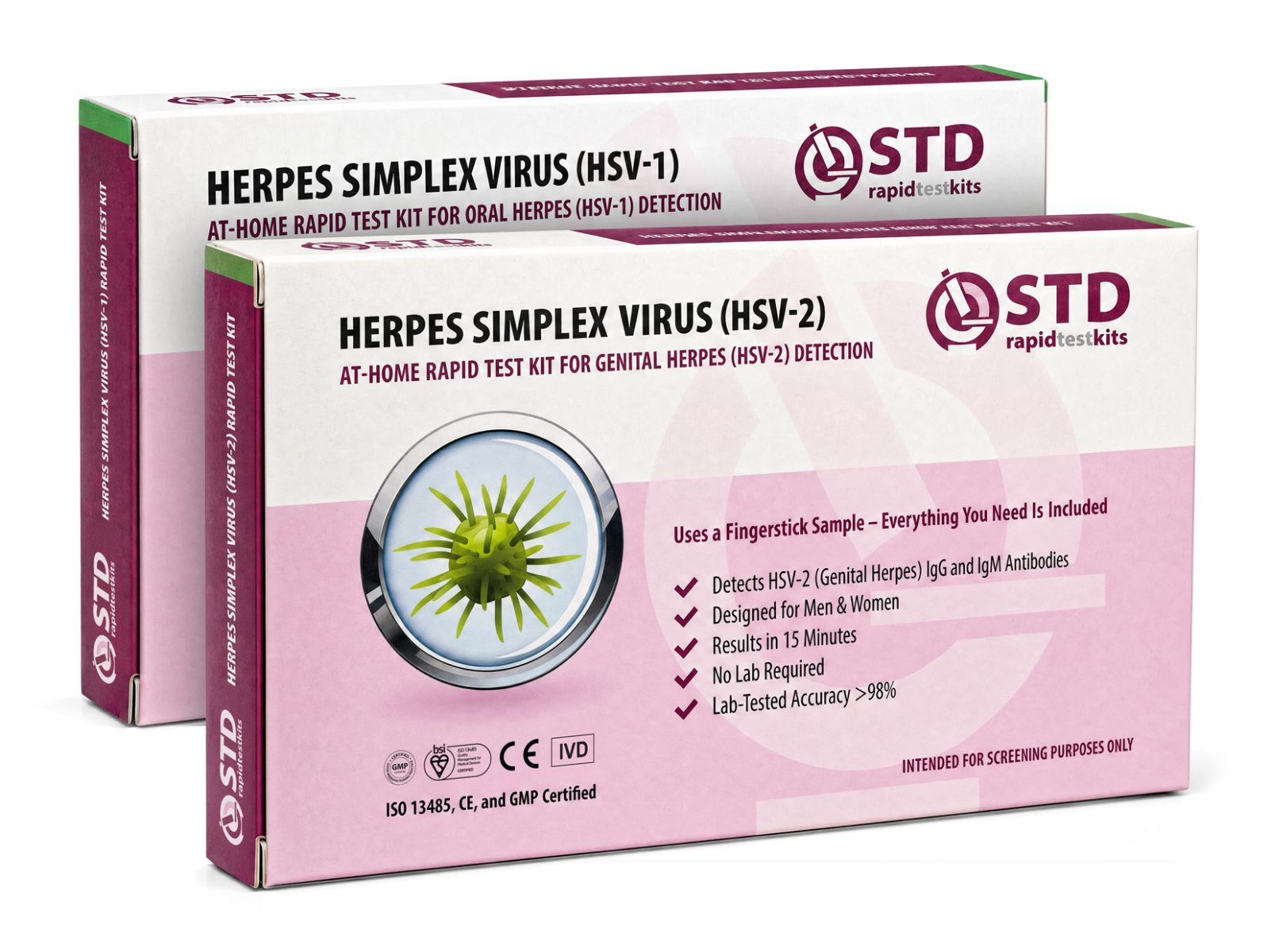
This site sells at-home rapid herpes tests; the kit below is one screening option to consider alongside a clinic visit, not a substitute for one.
| Test type | Best for | Window for accuracy |
|---|---|---|
| Swab (PCR or culture) | Active sore or lesion | Within 48 hours of an outbreak appearing |
| IgG blood test (antibody) | Confirming long-standing infection | Most reliable at 12 to 16 weeks after exposure |
| IgM blood test | Not recommended by CDC | High false-positive rate; results are hard to interpret |
Guilt is a feeling. Responsibility is a plan.
Guilt sounds like a verdict. It tells you that you are bad, that you do not deserve love, that this moment defines you. Responsibility sounds like a sentence you can finish: "I will tell them, I will support them through testing, I will get on antivirals, I will be honest with the next person I become intimate with." Guilt paralyses you in place; responsibility gives you something concrete to do with your hands.
Both can be present at once. The work is not pretending you do not feel guilty. It is refusing to let guilt be the only thing in the room. People who get stuck inside guilt isolate, ghost the partner they exposed, drink, scroll, and avoid getting tested themselves because every confirmation feels like another guilty verdict. People who pick up responsibility instead make appointments, send the message, fill the prescription, and then go for a walk because they have already done the next right thing.
That does not erase the harm. The other person is still going to feel angry, sad, or scared. They get to feel those things. Your job is not to talk them out of it. Your job is to keep showing up while they work through it.
Most genital herpes infections are transmitted by persons unaware that they have the infection or who are asymptomatic when transmission occurs.
Can a relationship survive a herpes diagnosis?
Relationships can and frequently do survive this kind of disclosure. The ones that hold together tend to share a few features. The disclosing partner takes the conversation seriously without spiralling into self-pity. The receiving partner is given honest information and the time to process it. Both people get tested. Both people read the same plain-English material on transmission. Both people talk to a clinician about antiviral suppression and condom use rather than relying on Google for the medical answers.
What does not work is treating the diagnosis as an unspoken thing both people carry separately. Herpes inside a relationship is most damaging when shame keeps either partner from talking about it. The infection itself, with proper management, becomes a logistical detail. Couples who talk about it openly, including testing schedules, outbreak triggers, and antiviral use, navigate the relationship far better than those who treat the diagnosis as unspeakable.
If your relationship was already on shaky ground before this, herpes is not the reason it ends. It is sometimes the catalyst that surfaces what was already there. That is painful, and it is also useful information. Whatever happens, you can come out of the conversation knowing you told the truth.
- Both partners get tested with the right test type, at the right time (a swab during an outbreak, an IgG blood test 12 to 16 weeks after exposure).
- Antiviral suppression is discussed with a clinician rather than guessed at on Reddit or in a forum thread.
- The diagnosis is talked about openly between you, on a real schedule, instead of being carried in silence by either partner.
Healing is not linear (and that is okay)
You will have days when you feel relatively at peace and days when a passing reference to STIs in a TV show puts you back in bed for the afternoon. That is normal. The shame that accompanies herpes is socially manufactured, deeply absorbed, and does not unwind on a tidy schedule.
A few practices help.
- Talk to one trusted person who is not your exposed partner. A therapist, a support-group peer, a sibling, a close friend. Carrying this alone is the version of the situation that breaks people. Connection is the version that does not.
- Limit late-night spiraling on Google. The forum thread that ranks at 1 a.m. is not representative of the science. Stick to root pages from CDC, WHO, NHS, and the American Sexual Health Association when you want information. Save the personal stories for daylight hours and curated communities.
- Reframe how you describe yourself. There is a difference between "I infected someone" and "I unknowingly transmitted something I did not realize I had, and I am responding now in the most honest way I can." Both can be true. The second one is also a sentence you can keep repeating without falling apart.
- Notice your own outbreak triggers. Stress, sleep deprivation, sun exposure, hormonal shifts, and certain illnesses can prompt outbreaks in many people. Tracking what tends to precede an outbreak puts a small amount of agency back in your hands.
Your future has not disappeared
According to the World Health Organization, an estimated 3.8 billion people under age 50 carry HSV-1 globally, and roughly 520 million people aged 15 to 49 carry HSV-2. Herpes is one of the most common chronic infections on the planet. Most of those people are dating, partnered, sexually active, raising children, building careers, and living lives that look identical to the lives of people without HSV.
Your dating life still exists. So does your sex life. Both will involve more honest conversations than they did before, and that is a skill that genuinely improves the rest of your relationships. The first disclosure is the worst one. Each subsequent conversation gets shorter and lower-stakes, because you have learned how to deliver the information in a way that leaves room for the other person to ask questions and decide for themselves.
Pregnancy and parenthood are not off-limits either. Most people with herpes have uncomplicated pregnancies and healthy children. If you are pregnant or planning to be, your obstetrician will discuss antiviral suppression in the third trimester and a delivery plan that minimizes neonatal transmission risk based on outbreak status near the due date.
FAQs
- Can I really transmit herpes if I have no symptoms?
- Yes. The virus can shed from intact skin or mucosa during periods clinicians call asymptomatic shedding. There are no warning signs at all: no tingling, no soreness, no visible bumps. That is exactly why most new infections come from people who had no idea they were carriers.
- Is it my fault if I did not know I had herpes?
- Responsibility and fault are not the same thing. If you did not know, you did not know, and that is the situation most people with HSV-2 are in. What matters now is what you do with the information you have. Owning the conversation honestly says more about your character than the test result ever will.
- Should I get tested even if I feel fine?
- Yes. Herpes can be silent for years. A blood antibody test or a self-collected rapid test gives you a clear baseline, and a baseline is the starting point for every other decision you might make about testing partners, starting suppressive therapy, or planning a pregnancy.
- How do I bring up the conversation?
- Be specific and short. "I just tested positive for herpes. I did not know I had it when we were together. I want to be honest in case you need to get tested." That is enough to start. They will ask the questions they need to ask. You do not have to deliver a TED Talk.
- What if my partner already had it before me?
- Possible, and more common than people assume. Asymptomatic carriers can pass the virus without warning, and seroconversion timing is fuzzy. Unless one of you has a documented negative IgG result from within the full 12 to 16 week window before exposure, the source of an infection is rarely possible to prove. The conversation is more useful when it is about what you both do next, not who started it.
- Will antiviral medication stop me from transmitting again?
- Daily suppressive therapy with valacyclovir or a similar antiviral reduces both outbreak frequency and asymptomatic shedding, lowering transmission risk significantly. It does not eliminate the risk entirely. Combined with condom use and avoiding sex during outbreaks, suppression is the most evidence-based way to lower transmission risk to a partner.
- Can I still have kids?
- Herpes does not affect fertility. Two things to raise with your OB if you become pregnant: suppressive antivirals in the third trimester (especially after a primary infection late in pregnancy), and a delivery-mode discussion if an outbreak is active near your due date. Your obstetrician will know the standard protocol.
- What if I just want to disappear after all of this?
- That impulse is a normal response to shame. The problem is that disappearing usually deepens the shame instead of resolving it. The smallest plausible action is enough: book a test, send the message, talk to one person who already knows you and likes you. You do not have to feel ready. You just have to do the next concrete thing.
How we sourced this article: We combined current guidance from leading public-health organizations (CDC, WHO, NHS) with peer-reviewed clinical literature and patient-facing resources from the American Sexual Health Association and Mayo Clinic. The intent is plain-English action items grounded in current clinical guidance, not personal medical advice. Every quantitative claim is anchored to a source listed below; specific clinical decisions belong with your provider.
- U.S. Centers for Disease Control and Prevention. About Genital Herpes: prevalence, transmission, and undiagnosed-infection statistics.
- U.S. Centers for Disease Control and Prevention. Sexually Transmitted Infections Treatment Guidelines: herpes diagnosis, IgG testing windows, and antiviral suppression dosing.
- World Health Organization. Herpes simplex virus fact sheet: global HSV-1 and HSV-2 prevalence estimates.
- Mayo Clinic. Genital herpes: symptoms, causes, and management overview.
- American Sexual Health Association. Herpes: prevalence, transmission, symptoms, testing, and treatment overview.