
Published: June 2025 | Last updated: May 2026 | Editorial review and quality control: Martina N.
Could a sore throat really be gonorrhea?
Yes, if you had oral sex in the past two weeks. Pharyngeal gonorrhea is a real bacterial infection of the throat, often without symptoms or with only a mild sore throat and no fever. Diagnosis requires a clinic throat-swab NAAT, ideally 7 to 14 days after exposure. Treatment is a single ceftriaxone injection.
A sore throat that lingers a week after a hookup is one of the most quietly common ways oral gonorrhea gets missed. The infection sits at the back of the throat, often without a fever, often without much pain, and almost never gets caught by a standard strep test. Most throat-swab STI tests only happen when you specifically ask for them, which is how some people walk around with a bacterial infection for weeks while urgent care keeps prescribing the wrong antibiotic.
The good news is that a sore throat after oral sex is usually just a sore throat. Allergies, dry indoor air, post-nasal drip, and viral pharyngitis cause the overwhelming majority of cases. For the smaller share that turn out to be pharyngeal gonorrhea, the testing path is different from a strep panel, the right place to go is different too, and the stakes go beyond a single sore throat. Untreated throat infections are one of the main settings where Neisseria gonorrhoeae evolves resistance to the antibiotics we have left.
Key Takeaways
- Throat gonorrhea typically causes no symptoms or only a mild persistent sore throat without fever, which is why a standard urgent-care strep panel will not catch it after oral exposure.
- A clinic throat-swab NAAT is the only validated test for pharyngeal gonorrhea. Wait at least 7 days after oral exposure (peak accuracy at 14 days), and ask explicitly for a throat swab. Home rapid kits cover the genital and bloodwork risk from the same exposure, not the throat itself.
Why a sore throat after oral sex deserves a second look
Pharyngeal gonorrhea is the clinical name for a Neisseria gonorrhoeae infection in the throat. It happens when bacteria from an infected partner's genitals come into contact with the back of the throat or tonsils during oral sex. Per CDC STI Treatment Guidelines, the majority of throat infections produce no symptoms, which is why anyone basing decisions on "I feel fine" is making a guess instead of a diagnosis.
When throat gonorrhea does cause symptoms, the most common ones are a persistent sore throat lasting more than a week, mild redness or swelling at the back of the throat, occasional white or yellowish patches on the tonsils, painful swallowing, and rarely swollen lymph nodes under the jaw. Fever is uncommon. Cough is also uncommon. The pain is usually milder than strep, which is part of why the diagnosis gets dismissed at urgent care.
Untreated throat infections silently fuel the spread of antibiotic-resistant strains. The throat is a place where Neisseria gonorrhoeae can swap genetic material with other bacteria living in the mouth, and that exchange is one of the documented drivers of how the bug develops resistance to drugs like ceftriaxone. We come back to this further down, because it is the reason public-health authorities now treat asymptomatic pharyngeal infection as worth catching.
Viral infections, allergies, dry indoor air, acid reflux, and seasonal colds cause the vast majority of throat irritation. If you have not had oral sex in the last two weeks, throat gonorrhea is extremely unlikely. This guide is for the people who did have oral exposure and want to think clearly about whether to test.
Strep, mono, or gonorrhea? Why doctors miss the difference
Three common conditions cause overlapping throat symptoms: streptococcal pharyngitis (strep throat), infectious mononucleosis, and pharyngeal gonorrhea. The first two get tested routinely at urgent care. The third almost never does, unless you ask. The clinical clue most often used to differentiate them is the absence or presence of a fever, plus your sexual exposure history in the last two weeks.
Strep typically arrives suddenly, with a fever often above 101°F, severe sharp pain on swallowing, swollen anterior cervical lymph nodes, and white patches on the tonsils. Mononucleosis tends to come with profound fatigue, low-grade fever, and dramatically swollen tonsils that can persist for weeks. Pharyngeal gonorrhea, when symptomatic at all, is the quiet one: a persistent dull soreness without much else going on.
One critical point about the urgent-care workup: a strep rapid test does not detect gonorrhea. The two pathogens are completely different bacteria, and the rapid antigen test for group A streptococcus has no cross-reactivity with Neisseria gonorrhoeae. A negative strep test after a possible oral-sex exposure is not reassurance, just a result for one specific bug.
Symptom comparison at a glance
The single most useful frame for telling these three conditions apart is the fever question paired with your exposure history in the last two weeks. The table below lines up the features clinicians use in practice; none of it replaces a lab test when the exposure timing fits, but it helps a reader decide whether the testing decision applies to them.
| Symptom or sign | Strep throat | Mononucleosis | Pharyngeal gonorrhea |
|---|---|---|---|
| Fever | Common, often above 101°F | Low-grade | Rare |
| Onset | Sudden, 12 to 24 hours | Gradual over days | Subtle, often unnoticed |
| Sore throat severity | Severe | Moderate to severe | Mild to moderate, or absent |
| White patches on tonsils | Common | Common, often confluent | Possible, often subtle |
| Swollen lymph nodes | Common, anterior cervical | Common, posterior cervical | Uncommon |
| Time since oral sex | Unrelated | Possible if recent kissing | Within 2 to 14 days |
| How it is diagnosed | Rapid strep test or culture | Monospot or EBV antibody | Throat-swab NAAT |
How oral gonorrhea spreads, and where kissing fits in
The dominant transmission route is performing oral sex on a partner who has gonorrhea in their genitals or anus. Mouth-to-penis contact is the most efficient route documented in clinical literature, with mouth-to-vulva and mouth-to-anus close behind. The bacteria do not need ejaculation to transfer; pre-ejaculate fluid or surface bacterial colonization is enough. Receiving oral sex from a partner with throat gonorrhea is the second route, less common but well documented. The CDC STI Treatment Guidelines explicitly include the pharynx among the recognized anatomic sites of gonococcal infection alongside the urethra, cervix, and rectum, and direct clinicians to test the throat whenever oral exposure has occurred.
What about kissing? The risk is low. Most pharyngeal gonorrhea cases come from oral sex, not kissing. A small number of cases have been documented where deep tongue-kissing appears to be the most likely transmission route, particularly in populations with high background prevalence and when one or both partners had gum inflammation, oral cuts, or recent dental work. For the average person, kissing alone is not a high-yield risk; oral sex is.
The reverse-direction risk also exists: someone with throat gonorrhea can transmit it to a new partner's genitals by performing oral sex on them. This is one of the reasons clinics see ping-pong reinfections between partners who only treated one body site at a time. There is also a documented self-inoculation route in which a person with pharyngeal infection transfers bacteria to their own genitals through hand contact during sex, which is part of why a single exposure event often shows up in multiple body sites by the time someone is tested.
Oral gonorrhea transmission, ranked
- Performing oral sex on a partner with genital or anal gonorrhea is the dominant route. Mouth-to-penis is the most efficient, but mouth-to-vulva and mouth-to-anus are also documented. Pre-ejaculate fluid or surface colonization is enough.
- Receiving oral sex from a partner with throat gonorrhea is the documented secondary route. Less common, but enough to cause partner-to-partner ping-pong reinfection if only one body site is treated.
- Kissing alone is low risk for the average person. The handful of documented cases involve deep tongue-kissing in high-prevalence populations with gum inflammation or recent dental work.
What happens if pharyngeal gonorrhea goes untreated
Most untreated pharyngeal infections clear locally without dramatic consequences, but the picture changes when the bacterium has time to multiply, spread to other anatomic sites, and meet antibiotics it has already learned to evade.
Locally, an untreated throat infection can extend to the tonsils and produce tonsillitis, peritonsillar abscess, or persistent cervical lymphadenopathy. The bigger problem is that the throat acts as a quiet reservoir. People with asymptomatic pharyngeal gonorrhea unknowingly transmit to new partners, and the self-inoculation route can carry bacteria from throat to a person's own genitals. Once gonorrhea is established at a genital site, it produces the well-known downstream complications: pelvic inflammatory disease (PID) in women, which is a leading cause of tubal-factor infertility and ectopic pregnancy, and epididymitis or, less commonly, urethral stricture in men. The CDC's gonorrhea topic page describes these downstream effects in detail.
In a small proportion of untreated cases the bacterium enters the bloodstream and seeds distant tissues, a complication called disseminated gonococcal infection (DGI). Classic DGI presents with the triad of migratory polyarthritis, tenosynovitis (inflamed tendon sheaths, often in the wrists and ankles), and a sparse pustular skin rash. Rarer presentations include endocarditis (infection of the heart valves) and meningitis. DGI is uncommon, and it is treatable when caught early with intravenous ceftriaxone, which is why a known exposure plus new joint or skin symptoms is worth a same-day clinical evaluation rather than waiting on a routine test result.
If you have a known or suspected gonorrhea exposure and develop joint pain, joint swelling, or pustular skin lesions, especially with fever, see a clinician promptly rather than waiting for a routine test result. Disseminated gonococcal infection is treatable but is a medical priority once it is causing systemic symptoms.
Who is most at risk for pharyngeal gonorrhea
Risk is driven by the kind and frequency of oral-sex contact rather than by identity in itself. That said, certain patterns of sexual contact concentrate risk meaningfully, and U.S. and European surveillance data consistently flag the same groups:
- Men who have sex with men (MSM), particularly those with multiple recent partners. The combination of receptive oral sex and insertive oral sex within the same network circulates the bacterium efficiently.
- Anyone who regularly receives or gives oral sex with new or untreated partners, regardless of orientation or anatomy.
- Sex workers and their clients, where partner counts are higher and condom use during oral sex is often lower than during vaginal or anal sex.
- People in non-monogamous or polyamorous arrangements where partner testing cadence is informal or inconsistent.
- Adolescents and young adults aged 15 to 24, who account for a disproportionate share of new gonorrhea cases across all anatomic sites in U.S. surveillance data.
Risk is additive. Receiving oral sex from a partner whose last STI test you have not seen, without a barrier, is the single most common scenario behind a pharyngeal infection.
Per the <a href="https://www.cdc.gov/std/treatment-guidelines/gonorrhea-adults.htm" target="_blank" rel="noopener noreferrer">CDC STI Treatment Guidelines</a>: annual gonorrhea screening for sexually active women under 25, three-to-six-monthly screening for MSM with multiple partners, and event-driven testing for anyone with a new or higher-risk partner. Multi-site testing (throat, genital, rectum) is recommended whenever the exposure history covers multiple sites. The throat is routinely skipped on default panels, so ask explicitly for it.
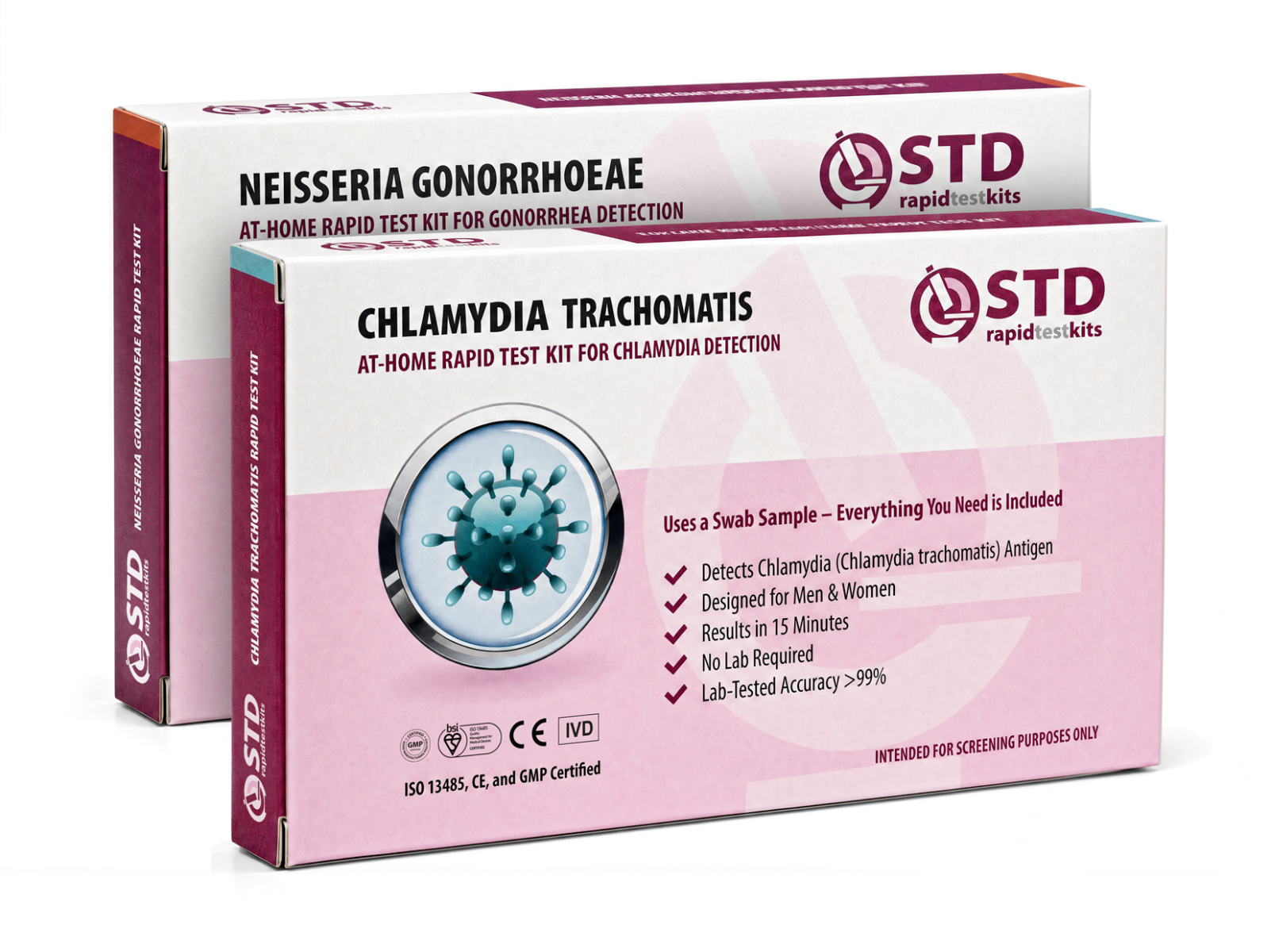
stdrapidtestkits.com sells at-home rapid lateral-flow kits for genital and blood-based STI screening. We recommend the panel below because it fits the genital and bloodwork risk from the same oral-sex exposure event, not because of commercial benefit. We do not sell a pharyngeal throat-swab kit; that result belongs at a clinic.
When to test: the window-period math
The "window period" is the gap between exposure and the moment when a test will reliably detect infection. Test too early and you risk a false negative, because the bacteria need time to multiply enough to be detectable on a swab. For pharyngeal gonorrhea using a NAAT, the operational guidance from most STI clinics is to wait at least 7 days post-exposure, with peak accuracy at 14 days or later. Pharyngeal NAAT has high sensitivity once the window period is met, per the CDC STI Treatment Guidelines.
If symptoms appear before that window, providers may still test you sooner, and a positive result on an early test is reliable. A negative result on an early test is the one to be skeptical of: if the timing was tight and symptoms continue, retest at the 14-day mark before assuming you are clear. The UK NHS gonorrhoea guidance notes that symptoms, when they appear, typically start around two weeks after exposure, which matches the window-period math.
The bloodwork windows are longer and worth knowing separately. After an oral-sex exposure with a new partner, current-generation HIV antigen/antibody (4th-generation) tests are reliable from about 18 to 45 days post-exposure, syphilis antibody from 3 to 6 weeks, hepatitis B surface antigen from 3 to 6 weeks, and hepatitis C antibody from approximately 8 to 11 weeks for most people, with a small proportion requiring up to 6 months for seroconversion per CDC hepatitis C testing guidance. The throat-swab NAAT for gonorrhea and chlamydia is the earliest of any test you can take from a single exposure event.
| Days since exposure | Test reliability | What to do |
|---|---|---|
| 0 to 5 days | Too early, high false-negative risk | Wait, monitor for symptoms |
| 5 to 7 days | Possible early detection | Test if symptomatic; plan a retest |
| 7 to 14 days | Increasingly reliable | Test now; this is the action window |
| 14 days or later | Peak reliability per CDC guidance | Test once; consider partner notification if positive |
Testing your throat: where to go and what to ask for
For the throat-specific swab test you need here, a clinic throat-swab NAAT is the route. We do not sell pharyngeal swab kits at stdrapidtestkits.com. Our rapid lateral-flow swab kits are validated for genital self-collection only. If your concern is strictly about a sore throat after oral sex, the right move is a sexual health clinic, an urgent care that can order a NAAT, or a telehealth provider who can issue a lab requisition for a throat swab.
The clinic path is the lab gold standard: a healthcare provider runs a sterile swab firmly across both tonsillar pillars and the posterior pharyngeal wall, places the sample in transport medium, and sends it to a laboratory NAAT, the most sensitive test method available. Results return in one to three days at most clinics. You need to specifically request a "throat-swab NAAT for gonorrhea and chlamydia," because most routine STI panels only test urine or genital specimens. If you walk in and ask for "a full STI test," the throat will likely be skipped. If oral, genital, and anal exposure all happened during the same encounter, ask for three-site testing.
What our home kits do cover is the genital and bloodwork risk from the same exposure event. Oral sex with a partner who has gonorrhea often happens alongside genital-to-genital contact, and one encounter can also carry HIV, syphilis, and hepatitis exposure. The at-home lateral-flow kits we carry use a self-collected genital swab (or a fingerprick blood drop, depending on the kit) and return a result in about 15 minutes. A positive result is worth confirming with a lab NAAT. None of this is a substitute for a throat swab when the throat is the only exposed site.
Whichever path you choose, sample collection rules matter. For a clinic throat swab, avoid eating, drinking, smoking, or brushing teeth for at least 30 minutes before collection. For an at-home genital swab or fingerprick, follow the kit instructions exactly. Done correctly, the test will pick up an infection that has had time to develop past the window period.
| Feature | Clinic throat-swab NAAT | Our home rapid lateral-flow kits |
|---|---|---|
| Sample type | Throat (pharyngeal swab) | Genital self-swab or fingerprick blood |
| What it detects | Pharyngeal gonorrhea and chlamydia | Genital gonorrhea, chlamydia, and bloodborne STIs (varies by kit) |
| Turnaround | 1 to 3 business days from lab | About 15 minutes at home |
| Where used | Clinic, urgent care, or telehealth-ordered lab visit | At home, private |
| Confirmation needed | No, NAAT is the gold standard | Yes for any positive, with a lab NAAT |
| Best fit | Throat-only exposure or lingering throat symptoms | Genital exposure, or wanting bloodwork screening from the same encounter |
What to do if you test positive
The first thing is not to spiral. A positive throat result is treatable. The current first-line treatment for pharyngeal gonorrhea is a single intramuscular dose of ceftriaxone (500 mg for most adults, 1 g for people weighing 150 kg or more), per the 2021 CDC STI Treatment Guidelines. Per Cleveland Clinic guidance, ceftriaxone remains the only reliably effective first-line option for pharyngeal infection, and the older oral regimens (cefixime, ofloxacin, azithromycin alone, doxycycline alone) are no longer recommended as first-line therapy. Some providers add doxycycline if chlamydia coinfection has not been ruled out. The injection happens in a clinic, telehealth, or sexual health center; do not self-treat with leftover or borrowed antibiotics, since the wrong dose accelerates resistance.
Because the throat is harder to clear than genital sites, CDC also recommends a test of cure 7 to 14 days after treatment specifically for pharyngeal infections. The bacteria can persist in the throat even after a clinically appropriate dose, particularly given the resistance trends discussed below. The test of cure is how you confirm the bug is gone. Avoid all sexual contact, including kissing and oral sex with a sexual partner, for at least seven days after treatment and until any partners have completed their own course.
Partner notification is the other half of finishing the job. Anyone you had oral or genital contact with in the past 60 days needs to know so they can test and treat. Public health departments offer anonymous notification services if direct conversation feels impossible. The shape of that message can be short and matter-of-fact: a recent test came back positive, here is what kind, you might want to get checked.
Drug-resistant Neisseria gonorrhoeae has progressively developed resistance to nearly every class of antibiotics used to treat it, leaving ceftriaxone as the last recommended first-line option.
Why antibiotic resistance makes this more urgent
The World Health Organization identifies gonorrhea as a major threat for antibiotic resistance. The bacterium has progressively shrugged off every class of antibiotic introduced against it: sulfonamides in the 1940s, penicillin in the 1980s, tetracyclines, fluoroquinolones (ciprofloxacin, ofloxacin) by the 2000s, and azithromycin in the 2020s. Ceftriaxone-resistant strains have now been documented in the UK, Japan, France, Australia, and the United States. The CDC tracks drug-resistant gonorrhea among its priority antimicrobial-resistance threats.
The throat is implicated in this evolution because it is a mixed bacterial environment. Neisseria gonorrhoeae shares the back of the throat with dozens of harmless Neisseria species (commensal flora). When gonorrhea sets up shop next to them and gets exposed to subtherapeutic doses of antibiotics, the bacterium readily picks up resistance genes from its harmless cousins through a process called horizontal gene transfer. Resistance markers tend to appear at the throat first and then spread to genital infections. This is also why CDC moved off the older dual therapy with azithromycin in 2021: rising azithromycin minimum inhibitory concentrations made the second drug less useful while contributing to broader resistance pressure.
Drug classes gonorrhea has already developed resistance to: sulfonamides (1940s), penicillin (1980s), tetracyclines, fluoroquinolones including ciprofloxacin and ofloxacin (2000s), and azithromycin (2020s). Ceftriaxone is the last broadly recommended first-line antibiotic. Ceftriaxone-resistant strains have been documented in the UK, Japan, France, Australia, and the United States since 2018.
Mouthwash, condoms, and realistic risk reduction
Honest prevention guidance for oral gonorrhea separates measures with real evidence from measures that sound reassuring but do not move the needle. A 2016 Australian randomized trial published in Sexually Transmitted Infections found that a single use of a commercial alcohol-based mouthwash reduced the bacterial load of Neisseria gonorrhoeae in the throat compared to a saline control, but the effect was short-lived. The larger OMEGA trial did not confirm a clinically meaningful effect on infection clearance. Mouthwash does not clear an established infection, and it does not replace antibiotics.
Condoms and dental dams during oral sex are the barrier methods with real evidence behind them. Consistent use significantly reduces oral transmission of gonorrhea, chlamydia, syphilis, and HIV. The blunt reason most people skip them during oral is preference and social norm, not any medical contraindication. Real-world adherence is poor (oral-sex barrier use is far below the rate for vaginal-sex barrier use in surveys), so the protection only shows up when the barrier gets used. Layering on testing every 3 to 6 months for sexually active people with new or multiple partners covers the gap that the barrier-method skip leaves open.
Doxycycline post-exposure prophylaxis (doxy-PEP) adds a clinician-prescribed layer for higher-risk populations. The 2023 CDC update to the STI Treatment Guidelines recommends a 200 mg dose of doxycycline within 72 hours of unprotected oral, anal, or vaginal sex for MSM and transgender women with a recent bacterial STI, with evidence of substantial reduction in chlamydia and syphilis incidence and a more modest reduction in gonorrhea. Doxy-PEP requires a clinician's prescription rather than a do-it-yourself approach. Get-tested-together as a relationship norm is another practical lever; it does reduce the silent-carrier dynamic behind most pharyngeal infections.
Mouthwash briefly lowers bacterial load in the throat but does not clear infection and is no substitute for antibiotics. Barrier methods (condoms and dental dams) are the prevention tools with consistent evidence. For people skipping barriers, testing every 3 to 6 months covers the gap, and doxy-PEP is worth asking a clinician about if you are in a higher-risk group.
Telling a partner without the shame spiral
This part tends to feel harder than the diagnosis itself. The conversation does not need to be a confession or a long explanation. A short, factual message protects everyone and starts the partner's own treatment timeline. Most people respond more calmly than the asker expects. The conversation tends to go better in writing than in person for a first message, because writing gives both people time to absorb and respond without an immediate emotional reaction. Anonymous notification services run by health departments and through some online STI testing platforms exist when direct conversation is not safe or feasible.
Most sexually active adults will encounter an STI at some point. Notifying partners carries the same social logic as telling a coworker you tested positive for flu, except the stakes are higher.
- "I tested positive for gonorrhea in my throat. You should get tested too."
- "I got a recent STI screening that came back positive for gonorrhea, please get checked."
Public health departments and several telehealth platforms also offer anonymous partner notification when direct contact is not feasible.
When a sore throat is probably just a sore throat
If you have not had oral sex in the past several weeks, your sore throat is almost certainly something else. Viral pharyngitis, allergies, post-nasal drip from sinus inflammation, dry indoor air during winter heating season, and acid reflux are the common explanations. None of those need a swab.
The combination that warrants testing is: oral sex within the last 14 days, plus a sore throat that is lingering, mild but persistent, and not improving with over-the-counter remedies, especially in the absence of fever and cough. That is the clinical pattern that distinguishes possible pharyngeal gonorrhea from the everyday sore throat. When the pattern lines up, a single throat-swab test resolves the question in days at most.
If your test is negative and your symptoms are still present after a week or two, follow up with a primary care provider for a full workup. Other less common causes (mononucleosis in young adults, oral candidiasis, oral HSV-1 reactivation, viral pharyngitis from adenovirus) all have their own diagnostic paths.
Three things together signal a real testing decision: oral sex within the last 14 days, a sore throat that is mild but persistent (no fever, no cough), and symptoms not improving on over-the-counter remedies. Missing any of those? Almost certainly not gonorrhea.
Should you test? Walk through the decision
Did you have oral sex within the last 14 days, and has the sore throat lingered past a typical viral course (more than 7 to 10 days)?
Yes: Your exposure history fits the testing pattern. Move to step 2.
No: Pharyngeal gonorrhea is unlikely. Manage with rest and over-the-counter remedies; revisit if symptoms persist past 10 days or if a new oral-sex exposure occurs.
Can you book a sexual health clinic, urgent care, or telehealth visit and explicitly request a throat-swab NAAT for gonorrhea and chlamydia (plus three-site testing if the same encounter involved genital or anal contact)?
Yes: Book the swab. While the lab processes the throat sample, consider an at-home rapid combo kit to screen the genital and bloodwork risk from the same encounter (HIV, syphilis, hepatitis B, hepatitis C).
No: Order an at-home rapid combo kit now to cover the genital and bloodborne risk from the same encounter, and keep looking for a clinic that can swab the throat. Home kits do not test the throat itself.
Did the throat-swab NAAT come back positive?
Yes: Receive the single intramuscular ceftriaxone dose at a clinic, return 7 to 14 days later for a test of cure, and notify any sexual partners from the past 60 days so they can test and treat.
No: If symptoms continue past 10 to 14 days despite a negative result, follow up with a primary care provider for a broader workup (mono, oral candidiasis, HSV-1 reactivation, adenoviral pharyngitis).
Guidance only. A clinician can advise based on your specific situation.
Frequently asked questions
- How long after oral sex should I wait before testing my throat?
- Test at the 14-day mark for peak reliability. At 7 days the test is usually accurate, but any negative before day 7 should be repeated, especially if symptoms are continuing. Pharyngeal NAAT has high sensitivity once the window period is met, per CDC guidance.
- Will a regular STI test panel include my throat?
- Standard panels skip the throat by default. Say "throat-swab NAAT for gonorrhea and chlamydia" when you book, or you will leave with a urine or genital result that says nothing about the body site at risk. If multiple sites were exposed during the same encounter, ask for three-site testing.
- Can throat gonorrhea go away on its own?
- Sometimes the symptoms ease, but the bacteria can persist for weeks to months and stay transmissible the entire time. Untreated cases also fuel antibiotic resistance, so waiting it out is a poor trade against a single antibiotic dose. In a small number of cases the bacterium can spread into the bloodstream as disseminated gonococcal infection, which is the part of the picture that occasionally turns serious.
- Will the antibiotics for strep throat also clear gonorrhea?
- Probably not. Strep throat is treated with penicillin or amoxicillin; pharyngeal gonorrhea requires ceftriaxone, a different drug class. Taking strep antibiotics may temporarily reduce gonorrhea symptoms without clearing the infection, which masks the diagnosis and complicates later treatment.
- Can I get gonorrhea just from kissing?
- For most people the probability is low. Oral sex remains the documented transmission route. The handful of confirmed kissing-only cases come from high-prevalence populations where at least one partner had active gum disease or fresh oral wounds, conditions that lift baseline risk meaningfully.
- Can oral gonorrhea cause infertility?
- Not directly from the throat infection. The infertility risk comes from gonorrhea spreading to genital sites and causing pelvic inflammatory disease in women, which damages the fallopian tubes, or epididymitis in men. The reason untreated pharyngeal infection still matters for fertility is that it acts as a silent reservoir that can self-inoculate or transmit to a partner's genital tract, where the lasting damage happens.
- Do I really need a follow-up test after treatment?
- Yes for pharyngeal infections, 7 to 14 days post-treatment. The throat clears slower than genital sites, and rising ceftriaxone resistance makes confirmed cure especially important here.
- What if my home-test result is positive?
- Treat any positive on a home rapid kit as a strong screening signal. Connect with a clinician (in person or telehealth) who can confirm with a laboratory NAAT, prescribe ceftriaxone, and arrange a test of cure. Do not self-treat with leftover or online-purchased antibiotics; gonorrhea treatment is dose-specific and the wrong dose accelerates resistance. Ceftriaxone has no clinically significant interaction with alcohol, but sexual contact, including kissing a sexual partner, should be avoided for at least seven days after the injection and until any partners have completed their own course.
- U.S. Centers for Disease Control and Prevention. Sexually Transmitted Infections Treatment Guidelines, 2021 (with 2023 update covering doxy-PEP). Gonococcal infections among adolescents and adults section, including pharyngeal gonorrhea ceftriaxone dosing, three-site testing recommendations, and test-of-cure guidance.
- U.S. Centers for Disease Control and Prevention. About Gonorrhea. Background on transmission, asymptomatic carriage, pharyngeal infection patterns, and downstream complications including PID and disseminated gonococcal infection.
- World Health Organization. Sexually Transmitted Infections (STIs) Fact Sheet. Global epidemiology and the WHO position that gonorrhea antimicrobial resistance is a major public-health threat.
- NHS. Gonorrhoea overview. Symptom presentation, testing pathway through UK sexual health clinics, the around-two-week incubation window, and treatment regimen used in NHS guidance.
- U.S. Centers for Disease Control and Prevention. Antimicrobial resistance overview, listing drug-resistant Neisseria gonorrhoeae among priority resistance threats.
- Cleveland Clinic. Gonorrhea: causes, symptoms, tests, and treatment. Clinician-reviewed overview supporting the ceftriaxone first-line treatment statement and testing-method descriptions.
- U.S. Centers for Disease Control and Prevention. Hepatitis C testing guidance, used here for the hepatitis C antibody window-period range after a single exposure.
