

Published: October 2025 | Last updated: April 2026 | Editorial review and quality control: Martina N.
Most sex-ed classes describe sexually transmitted infections as something that happens below the belt. The reality is messier. The same bacteria that causes urethritis can settle in an eye and look like a stubborn case of pink eye. The same gonococcus that infects a urethra can colonize a throat and feel like a tickle that strep tests miss. Herpes can hop onto a finger and get diagnosed as a spider bite for two weeks before anyone tests it.
This article walks through six places STDs commonly show up that people don't think to check, why those sites get missed, and what testing actually looks like for each one. stdrapidtestkits.com, which publishes this article, sells at-home rapid tests covering genital swab and fingerstick blood screening; some extragenital sites covered here require a clinic-administered swab not in our catalog, and we flag those cases where relevant.
Can STDs really show up outside the genitals?
Yes. Chlamydia can infect the eye (adult inclusion conjunctivitis). Gonorrhea infects the throat after oral sex, often without symptoms. Herpes can settle on a finger or hand (herpetic whitlow). Secondary syphilis often presents as a painless body rash on the palms and soles. HIV's acute stage frequently shows up as a flu-like illness with a torso rash. Most extragenital infections are silent or get misdiagnosed as allergies, a cold, eczema, or hemorrhoids, which is why testing matters whenever symptoms don't fit the usual picture.
Key Takeaways
- STDs don't stay below the belt: chlamydia, gonorrhea, herpes, and syphilis all have well-documented presentations in the eye, throat, hand, rectum, or skin, and most are missed because providers don't think to test for them.
- If a 'normal' infection isn't responding to standard treatment (pink eye that won't clear, a sore throat strep tests don't explain, a finger blister called a spider bite), recent sexual contact is worth raising with your provider, and at-home genital or blood testing can fill in part of the picture.
Why STDs don't stay where you expect
STDs are caused by bacteria, viruses, and parasites that travel in body fluids and on skin. They don't have a sense of geography. If Chlamydia trachomatis ends up on a contact lens, it will try to colonize the conjunctiva. If herpes simplex virus type 1 lands on a small cut on a thumb, it will replicate there. The infection follows the contact, not the body part it's stereotypically associated with.
Three routes account for most non-genital infections:
- Direct contact during oral, anal, or manual sex. The throat, rectum, and hand are all common contact sites. Pharyngeal gonorrhea and rectal chlamydia are well-documented in CDC surveillance.
- Self-inoculation via fingers or fomites. Touching infected genital fluid and then rubbing an eye, sharing a towel, or touching a small cut on a hand are all documented transmission paths.
- Hematogenous spread. Some infections (syphilis, HIV) become systemic after the initial entry site, so the rash or lesion you eventually see may be nowhere near where the bacteria first entered.
Most public-health surveillance data still focuses on genital infections, which means extragenital cases are systematically under-counted. The CDC's 2021 STI Treatment Guidelines specifically call out the need for site-specific testing in people with a relevant exposure history, noting that anorectal chlamydia is found in a substantial proportion of women with urogenital infection. Site-specific swabs are part of standard care for anyone with a relevant exposure.
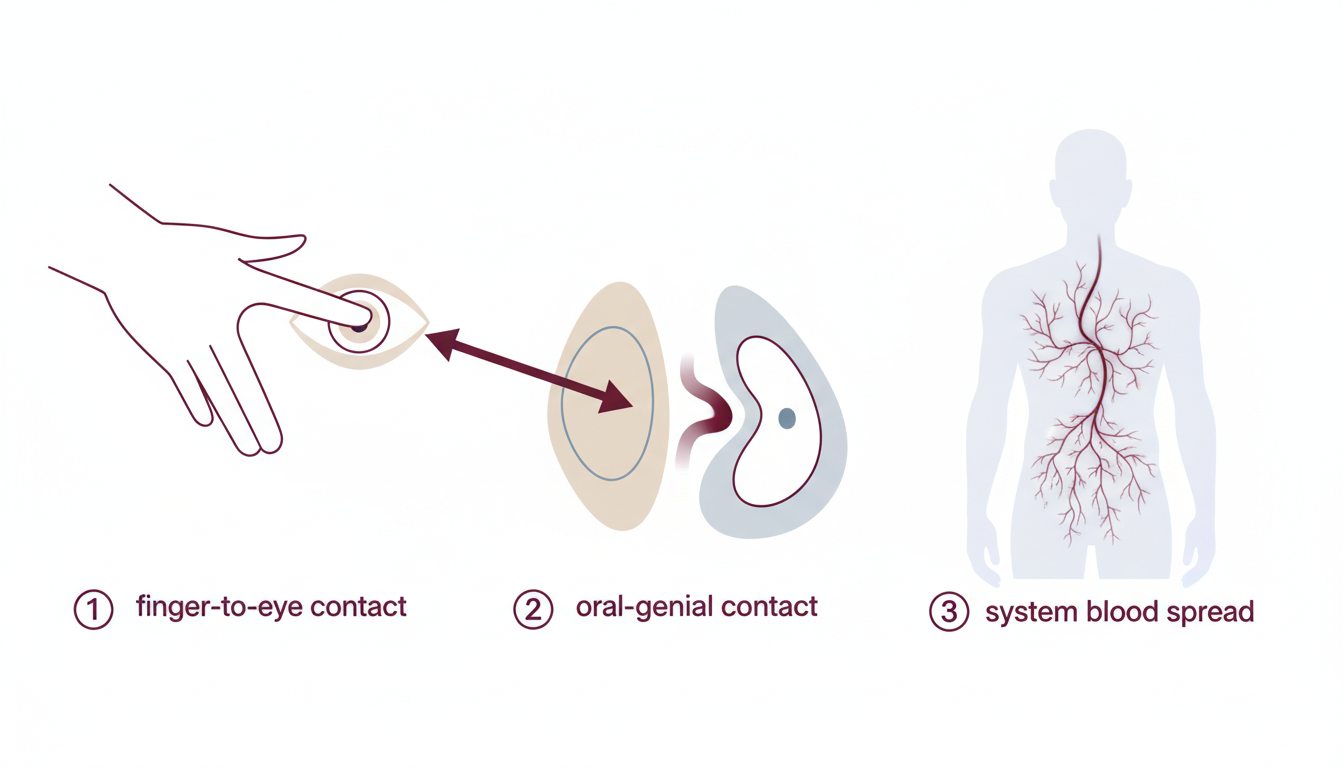
1. Chlamydia in the eye (adult inclusion conjunctivitis)
The medical name for chlamydia in the eye is adult inclusion conjunctivitis. It's caused by the same Chlamydia trachomatis serovars (D through K) that cause genital chlamydia. The bacteria reach the eye through finger-to-eye contact after touching infected genital fluid, through oral sex with secretions reaching the eye, or, less commonly, through shared towels or pillowcases.
It looks deceptively like ordinary pink eye, which is why it gets misdiagnosed so often. The hallmark differences clinicians describe are gradual onset (usually one eye first), a sticky yellow or yellow-green discharge that crusts the lashes overnight, and a gritty or sandy sensation under the eyelid. Without treatment, adult inclusion conjunctivitis can persist for weeks to months and may eventually involve the cornea, with the occasional development of corneal opacities and vascularization (Merck Manual professional reference).
A typical clinical pattern: a young adult presents with a unilateral red eye that's been getting worse for a week, has tried over-the-counter drops without improvement, and is finally asked about recent sexual contact only after a second visit. The eye swab returns positive for C. trachomatis via nucleic acid amplification testing (NAAT). Antibiotic eye drops don't fix it because the infection is intracellular and systemic, so it needs oral antibiotics to clear.
| Symptom | Eye Chlamydia (Adult Inclusion Conjunctivitis) | Typical Pink Eye (Viral or Bacterial) |
|---|---|---|
| Onset | Gradual, usually one eye first | Often sudden, frequently both eyes |
| Discharge | Sticky yellow to yellow-green, crusts lashes overnight | Watery (viral) or thicker (bacterial), short-lived |
| Duration without treatment | Weeks to months; can persist much longer | Usually 7 to 10 days |
| Sensation | Gritty, sandy feeling under the eyelid | Itchy or burning, less grittiness |
| Helpful history | Recent oral, genital, or hand-to-genital contact | Recent cold or flu symptoms |
| Response to ordinary antibiotic drops | Minimal; needs oral antibiotics | Bacterial cases usually improve |
How eye chlamydia is treated
The CDC's 2021 STI Treatment Guidelines for chlamydia recommend doxycycline 100 mg orally twice daily for 7 days as the preferred treatment, with azithromycin 1 g as a single dose as an alternative. The same systemic regimen treats ocular involvement, since the infection is treated as a body-wide infection rather than a surface eye problem. Topical antibiotic drops alone do not clear it. Sexual partners should be evaluated and treated to prevent ping-pong reinfection.
If your eye symptoms aren't improving after 3 to 5 days of standard pink-eye treatment and you've had any sexual contact in the previous few weeks (oral, genital, or even fluid contact through hands), it's worth asking your provider directly to consider chlamydia. A genital NAAT (urine, vaginal, or penile swab) is often used in parallel, because if you have ocular chlamydia you very likely have genital chlamydia too.
At-home rapid kits are a useful first step here. They don't collect eye swabs, but a positive genital test in someone with eye symptoms is enough information for most providers to treat both with oral antibiotics. A negative genital test in someone with persistent eye symptoms doesn't fully rule out ocular chlamydia, so an in-clinic eye swab is still worth pursuing if symptoms continue.
2. Gonorrhea in the throat (pharyngeal gonorrhea)
Pharyngeal gonorrhea is gonorrhea infection of the throat, transmitted almost exclusively through oral sex. It's also one of the most under-diagnosed STDs in the United States, because most cases produce no symptoms at all. When symptoms do occur, they're vague: a mild sore throat, scratchy feeling, occasional swollen lymph nodes in the neck. Strep tests come back negative. COVID and flu tests come back negative. The provider tells the patient it's probably allergies.
The reason this matters: throat gonorrhea is a quiet reservoir. People who don't know they have it can pass it to partners through kissing or oral sex, and untreated infections contribute to the spread of antibiotic-resistant gonorrhea strains, which the CDC has noted are increasingly difficult to treat (CDC gonorrhea overview).
The CDC's 2021 STI Treatment Guidelines recommend a single intramuscular injection of ceftriaxone 500 mg (1 g for people weighing more than 150 kg) for uncomplicated infections, including pharyngeal cases. Pharyngeal gonorrhea is harder to clear than genital gonorrhea, so a test-of-cure 7 to 14 days after treatment is often recommended for throat infections specifically.
Our rapid kits cover genital swab and fingerstick blood testing. Pharyngeal gonorrhea is diagnosed by an oropharyngeal swab sent for NAAT, which is a clinic-administered test we do not ship. If you suspect throat gonorrhea (sore throat that won't quit, recent oral exposure, partner with confirmed gonorrhea), see a sexual-health clinic and ask specifically for an oropharyngeal swab. Our combo genital and blood kits below cover the parallel infection risk from the same exposure event.
3. Herpes on the hand (herpetic whitlow)
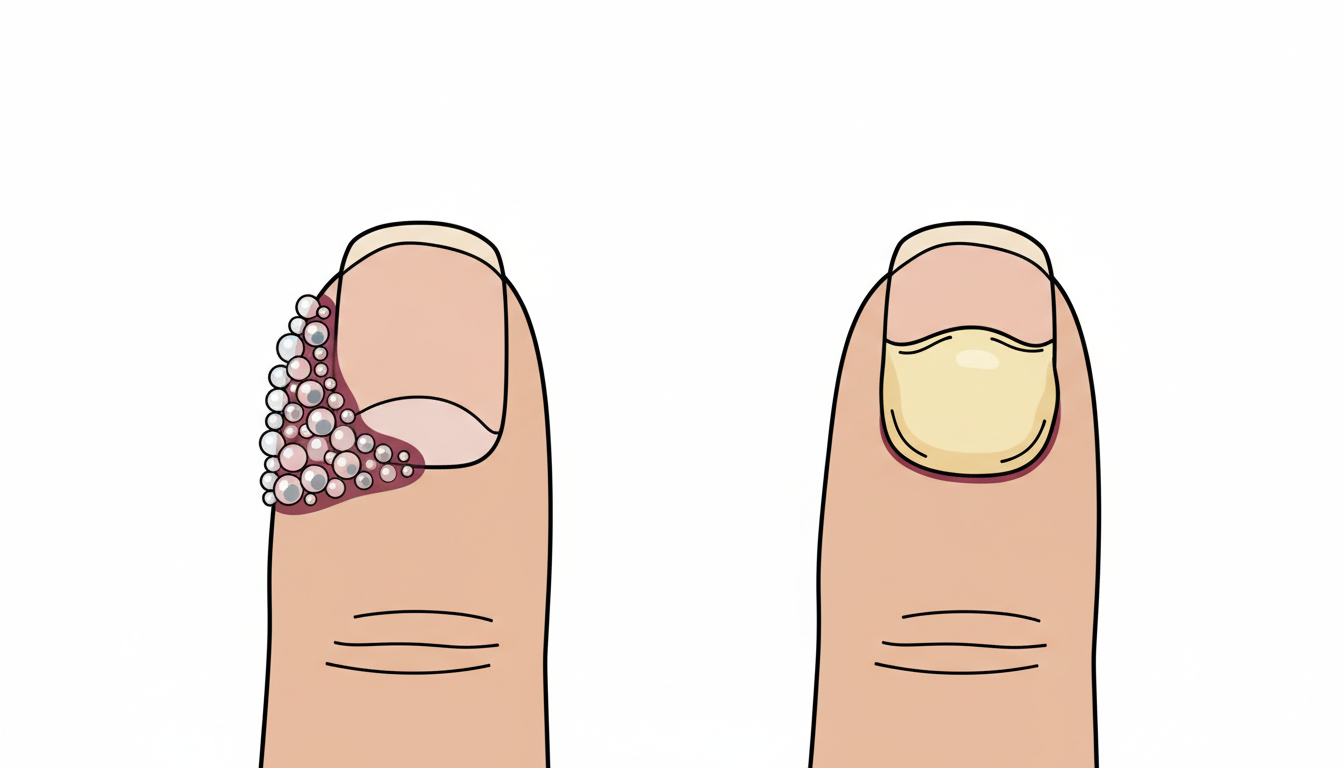
Herpetic whitlow is a herpes simplex virus infection of a finger or thumb. Either HSV-1 or HSV-2 can cause it. The virus enters through a small break in the skin, typically a hangnail, paper cut, or torn cuticle. Once it's in, it follows the same painful blister pattern as a cold sore: tingling or itching first, then a cluster of small fluid-filled blisters, then a tender, swollen finger that can throb for one to two weeks before crusting over.
Whitlow appears disproportionately in dental and healthcare workers who handle mucous membranes without gloves, in parents and caregivers of small children with active cold sores, and in people who engage in manual sexual activity (fingering, fisting) with a partner experiencing an active genital herpes outbreak or asymptomatic shedding.
Whitlow is often misdiagnosed at urgent care as a bacterial felon (deep finger abscess), spider bite, or paronychia. The giveaway is the cluster of small clear or cloudy blisters in a tight grouping rather than a single bigger pus pocket. Squeezing or lancing a whitlow does not help and can make it worse, since the lesion is viral.
Treatment is oral antiviral medication (acyclovir, valacyclovir, or famciclovir) started as early in the outbreak as possible. The CDC's herpes overview covers the systemic management. There's no cure, but antivirals shorten outbreaks and reduce shedding. Recurrences are possible, since herpes establishes lifelong latent infection in nerve roots near the original entry site.
For testing, our at-home herpes kits use a fingerstick blood draw to detect IgG antibodies to HSV-1 or HSV-2, indicating past or established infection. They are not designed to swab a lesion. If you have an active blister and want a precise diagnosis, a clinic can swab the lesion for PCR, which is the gold standard for active outbreaks. Our blood antibody tests answer a different question: 'have I been exposed to HSV at any point' rather than 'is this specific blister herpes.'
4. Rectal chlamydia and gonorrhea
Rectal STDs are common in anyone who has receptive anal sex, regardless of gender or orientation, and the rectum is one of the most under-tested sites in routine STI screening. Symptoms, when they exist, get mistaken for hemorrhoids, anal fissures, irritable bowel syndrome, or food intolerance. Most rectal infections are completely silent.
When rectal chlamydia or gonorrhea does cause symptoms, they include:
- Rectal pain or itching
- Mucus or pus discharge
- Bleeding during bowel movements
- A persistent feeling of needing to have a bowel movement (tenesmus)
- Painful straining
Many primary-care providers don't routinely swab the rectum unless a patient explicitly discloses receptive anal sex. CDC surveillance data consistently shows that urine-only screening misses a substantial fraction of extragenital chlamydia and gonorrhea cases. The 2021 STI Treatment Guidelines explicitly recommend site-specific testing (urine plus pharyngeal plus rectal swabs) in people with a relevant exposure history.
Rectal chlamydia is treated the same way as genital chlamydia (doxycycline 100 mg twice daily for 7 days, per the CDC guidelines). Rectal gonorrhea is treated with ceftriaxone 500 mg IM (or 1 g for higher body weight) the same as urogenital gonorrhea. A specific concern with rectal chlamydia is the possibility of a more invasive serovar called LGV (lymphogranuloma venereum), which causes deeper tissue involvement and requires a longer 21-day course of doxycycline.
Our chlamydia and gonorrhea swab kits are validated for self-collected vaginal or penile swabs only. Rectal chlamydia and gonorrhea are diagnosed by clinician-collected or carefully self-collected rectal swabs sent for NAAT, which is not what our home kits ship. If your symptoms or exposure history point toward rectal infection, see a sexual-health clinic and ask specifically for a rectal swab. Our genital combo kit can still be useful as a parallel screen, since rectal infections often co-exist with genital infections from the same exposure.
5. Skin symptoms that aren't what they seem
Several STDs cause rashes, sores, or skin lesions that get confused with eczema, allergic reactions, or routine bacterial skin infections. The more common offenders are syphilis, acute HIV, and HPV.
Secondary syphilis: the painless rash on palms and soles
Primary syphilis is a painless ulcer (chancre) at the site of infection (genital, anal, or oral) that often goes unnoticed because it doesn't hurt. Weeks to a few months later, untreated syphilis can progress to a secondary stage with a body-wide rash. The classic pattern is a rough, copper-colored or reddish-brown rash on the palms of the hands and soles of the feet, sometimes with a fine rash on the trunk and limbs. The rash is usually painless and not itchy, which is part of why it gets brushed off as a reaction or a viral exanthem. Per the CDC syphilis overview, syphilis is curable with antibiotics; current treatment regimens vary by disease stage and are detailed in the CDC's STI Treatment Guidelines. Outcomes are best when caught early.
Acute HIV: the flu-like illness with a torso rash
About 2 to 4 weeks after HIV exposure, many people develop an acute retroviral syndrome that includes fever, sore throat, swollen lymph nodes, fatigue, mouth ulcers, and a fine non-itchy rash on the chest and back. This phase is often mistaken for mononucleosis or a bad flu, which means it's the easiest stage of HIV to miss. Fourth-generation antigen-antibody blood tests can detect HIV by approximately 18 to 45 days after exposure, with sensitivity improving over the window (CDC HIV testing overview).
HPV: warts that can show up away from the genitals
Human papillomavirus is most associated with genital warts and cervical cancer risk, but warts can also appear on the inner thighs, the perianal area, the groin, and occasionally on hands. They're often mistaken for skin tags, ingrown hairs, or shaving irritation. Most low-risk HPV strains cause warts; high-risk strains (16, 18, and others) drive the cancer risk. ACIP currently recommends routine HPV vaccination through age 26 and shared clinical decision-making for vaccination through age 45.
If you notice a rough, copper or reddish-brown rash on your palms or soles a few weeks to a few months after a possible exposure, especially if it doesn't itch and doesn't fit any obvious allergic or skin condition, secondary syphilis is on the differential. Bloodwork (a clinic visit, or our at-home syphilis fingerstick test) gives a direct answer; secondary syphilis is fully curable with antibiotics when caught at this stage.
6. Oral and genital herpes cross over
The folk-knowledge version of herpes is that HSV-1 causes cold sores on the mouth and HSV-2 causes blisters on the genitals. Reality is messier. Either strain can infect either site, and population-level surveillance shows that genital HSV-1 is now responsible for a substantial fraction of new genital herpes cases in younger adults, largely transmitted through oral sex.
The clinical implication: a person with a history of cold sores can transmit HSV-1 genitally to a partner during oral sex, and a person with genital HSV-2 can transmit it orally to a partner who performs oral sex on them. Visible sores aren't required for transmission. Asymptomatic viral shedding (active virus in saliva or genital secretions without any visible lesion) accounts for a meaningful share of transmission events.
Asymptomatic shedding is also why partner-blame after an outbreak rarely produces a useful answer. People can carry HSV for years before their first noticed outbreak, or never have a noticed outbreak at all. The CDC herpes overview notes that most people with HSV-2 are unaware they have it.
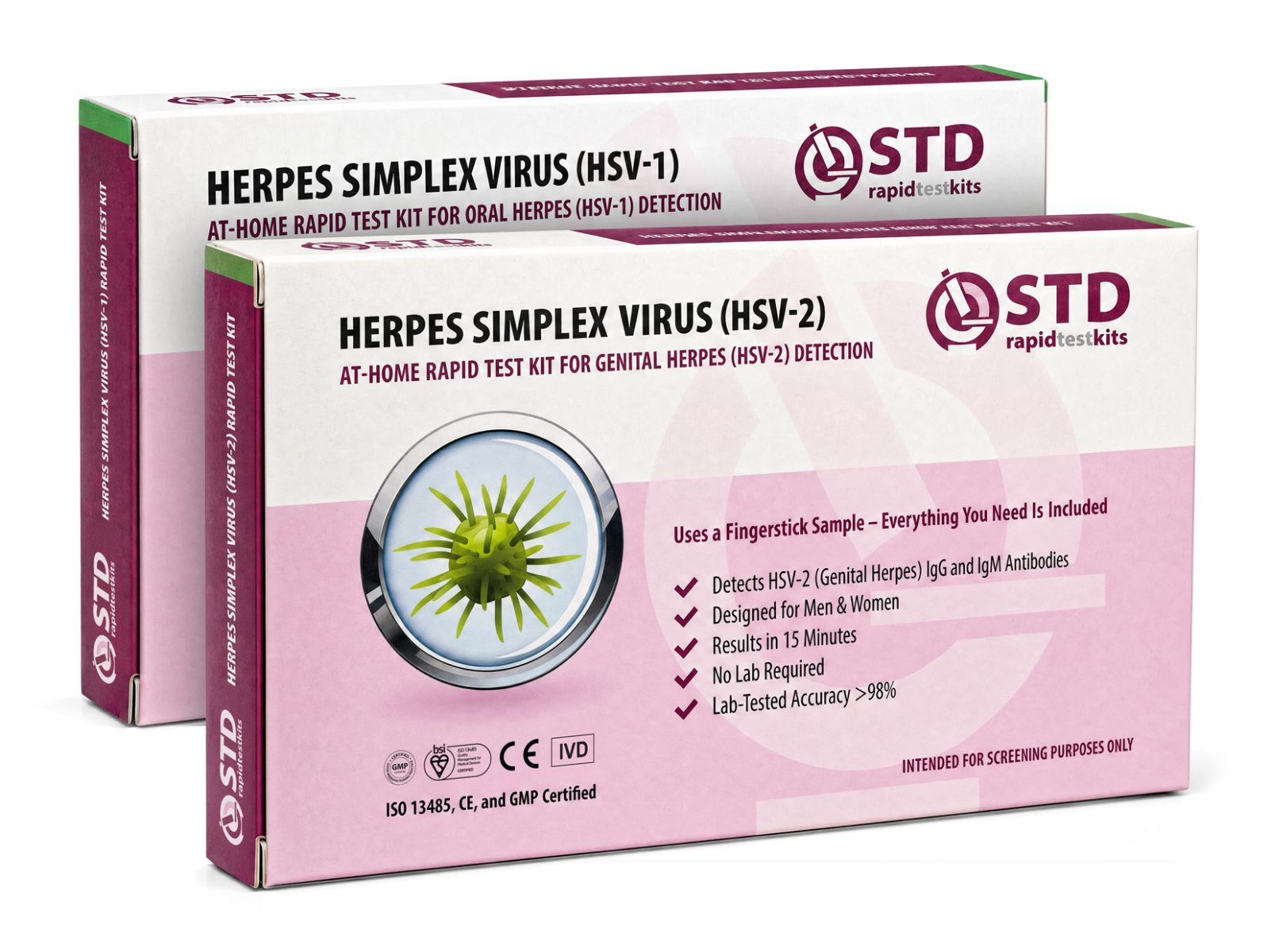
Type-specific blood antibody testing tells you which strain you carry (HSV-1, HSV-2, or both), but it cannot tell you when you got it or where on the body it currently lives. For an active blister, lesion-swab PCR at a clinic gives a direct answer about that specific outbreak.
Type-specific blood antibody testing (HSV-1, HSV-2, or both) is available at home, but it tells you which strain you carry, not when you were infected or which body site it currently favors. For a current outbreak, only a lesion-swab PCR at a clinic answers that question directly. The two tests are useful for different reasons and often work well together.
When and how to test, by site of concern
If you've read this far, the practical question is which test answers the situation you're worried about. Site-specific guidance:
- Eye symptoms (red, sticky, gritty, won't clear): See an in-person provider for an eye swab. In parallel, an at-home genital chlamydia or chlamydia-plus-gonorrhea swab is useful, because a positive genital result usually confirms the working diagnosis.
- Throat symptoms after oral sex (sore throat, scratchiness, swollen neck nodes that won't clear): See a sexual-health clinic and request a pharyngeal swab. We don't sell this. A clinic visit is the right answer for the throat itself.
- Finger or hand blisters (painful cluster, tingling first): See a clinician for lesion swab PCR if the blister is active. Our home herpes blood test answers a separate question (overall HSV exposure status) and is most useful between outbreaks.
- Rectal symptoms after receptive anal sex: See a sexual-health clinic for a rectal swab. We don't sell this. A genital combo kit can still be a useful parallel screen.
- Skin rash on palms, soles, or torso (painless, started a few weeks after a possible exposure): Get a syphilis blood test (we sell one) and an HIV blood test (we sell one). Acute HIV and secondary syphilis are both bloodwork diagnoses, which is exactly what fingerstick rapid kits are designed for.
- Genital warts or unusual genital lumps: See a clinician for a visual exam. HPV is a clinical diagnosis; biopsies are sometimes needed for atypical lesions.
The general principle: if you're noticing a symptom in an unusual location and you've had any sexual contact in the previous few weeks, an STD is on the differential. Asking for a test directly, including specifying the site, is the most reliable way to get the right one ordered.
FAQs
- Can you really get chlamydia in your eye?
- Yes. It's called adult inclusion conjunctivitis. The same Chlamydia trachomatis serovars that cause genital chlamydia can infect the eye when infected genital fluid reaches the conjunctiva, usually through finger contact, oral sex, or shared towels. It looks similar to ordinary pink eye, but lasts much longer and needs oral antibiotics rather than just eye drops.
- What does herpetic whitlow look like?
- It usually starts as tingling or itching on a finger, followed by a cluster of small clear or cloudy fluid-filled blisters in a tight grouping, with surrounding redness and swelling. The finger throbs for one to two weeks before the blisters crust over. It's frequently misdiagnosed at urgent care as a spider bite, a bacterial finger abscess, or paronychia.
- Can STDs really infect the throat?
- Yes. Gonorrhea and chlamydia can both colonize the throat after oral sex. Most pharyngeal infections produce no symptoms, which is part of why they go undiagnosed. When symptoms do occur, they tend to be a mild persistent sore throat that doesn't fit a viral or strep pattern. Diagnosis requires a clinic-administered oropharyngeal swab.
- What STDs cause body rashes?
- Secondary syphilis often shows up as a rough copper or reddish-brown rash on palms and soles, painless and not itchy. Acute HIV can produce a fine non-itchy rash on the chest and back as part of a flu-like illness 2 to 4 weeks after exposure. Disseminated gonococcal infection is rare but can cause scattered pustular skin lesions on the limbs along with joint pain. Bloodwork rules in or out the first two reliably.
- Can you get an STD from kissing?
- Most STDs do not transmit through kissing. The exceptions are HSV-1 (oral herpes, which is well-documented to spread via kissing, especially when one person has a cold sore or is shedding asymptomatically) and, rarely, pharyngeal gonorrhea (recent research suggests deep kissing may transmit it in some cases, though oral sex remains the dominant route).
- If my eye symptoms are STD-related, can I diagnose this at home?
- Not directly. Home kits don't ship eye swabs. A practical approach: use a home chlamydia or chlamydia-plus-gonorrhea genital swab to check whether you have a parallel genital infection. If that's positive in someone with eye symptoms, most providers will treat both with oral antibiotics. For a definitive eye diagnosis, a clinician should perform a conjunctival swab for NAAT.
- Are at-home rapid STD tests as accurate as clinic tests?
- At-home rapid lateral-flow tests typically report sensitivity in the mid-90s and specificity above 99 percent for the infections they screen, when used after the correct window period. Clinic NAAT tests have somewhat higher analytical sensitivity, especially in asymptomatic cases. The two are complementary rather than equivalent: home tests are excellent for fast, private screening; a positive home result is worth confirming with a clinic NAAT, especially before treatment decisions.
- If I test positive, what should I do?
- Start standard treatment as directed by your provider, which usually means oral antibiotics for chlamydia, gonorrhea, or syphilis, or antiviral medication for herpes. Notify recent sexual partners so they can be tested and treated; anonymous notification services are available if a direct conversation feels difficult. For pharyngeal gonorrhea specifically, a test-of-cure 7 to 14 days after treatment is recommended.
The body keeps the score, only if you know where to look
Sexual health isn't only a question of what's happening below the belt. The mouth, eyes, hands, rectum, and skin all show up as infection sites in real CDC surveillance data, and most of those cases get caught late or missed entirely because neither patient nor provider thinks to ask. Pattern recognition matters: a pink eye that won't clear, a sore throat without a viral explanation, a finger blister called a spider bite, a painless rash on the palms a few weeks after a new partner. Each of those is a reason to ask whether an STD is on the differential and to test for the ones that bloodwork or genital swabs can answer at home.
If something feels off and the standard explanations don't fit, the most useful thing you can do is name the question out loud, to your provider or to a home test. Untested infections don't go away on their own and they don't stay where they started.
Pharyngeal and rectal infections with chlamydia and gonorrhea are common, are usually asymptomatic, and are missed by urogenital screening alone. Site-specific testing is recommended in persons with a relevant exposure history.
- U.S. Centers for Disease Control and Prevention. STI Treatment Guidelines, 2021, including site-specific testing recommendations and chlamydia treatment regimens.
- U.S. Centers for Disease Control and Prevention. Gonorrhea overview covering pharyngeal infection, asymptomatic course, and antibiotic resistance.
- U.S. Centers for Disease Control and Prevention. Genital herpes overview covering HSV-1 versus HSV-2, asymptomatic shedding, and the fact that most people with HSV-2 are unaware they carry it.
- U.S. Centers for Disease Control and Prevention. Syphilis overview covering primary chancre, secondary rash on palms and soles, stages of disease, and curability with antibiotics.
- U.S. Centers for Disease Control and Prevention. HIV testing overview, including window periods showing antigen-antibody lab tests can usually detect HIV 18 to 45 days after exposure.
- World Health Organization. Sexually transmitted infections fact sheet covering global epidemiology and screening recommendations.
- Merck Manual Professional Edition. Adult inclusion conjunctivitis clinical reference covering presentation, occasional corneal opacities and vascularization, and systemic antibiotic treatment.
- U.K. National Health Service. Chlamydia condition page covering symptoms, testing routes, and treatment.
