Published: November 2025 | Last updated: May 2026 | Editorial review and quality control: Martina N.
Finding out a partner knew about an STI and chose not to tell you is two wounds at once. There is the medical question of what you might have been exposed to, and there is the deeper question of how someone you trusted made that choice for you. Both deserve a real answer, and both have a path forward.
This guide walks through the five things that actually help in the days and weeks after non-disclosure: testing on the right schedule, documenting what you know, understanding your legal options, getting medical follow-up, and giving yourself room to recover. The goal is to put choices back in your hands, calmly and on a timeline that makes sense for what was actually exposed.
Key Takeaways
- Test on a schedule matched to the infection's window period (not just once), and start documenting communication with the partner the same week.
- Most states criminalize knowing HIV non-disclosure, and civil claims for emotional distress or negligence are possible for other STIs depending on jurisdiction.
This Is More Common Than People Realize
Non-disclosure is not rare, and you are not overreacting for treating it as a serious event. The CDC's partner-services guidance describes notification as a shared responsibility between provider and patient and notes that even with active counseling, many partners still go untold. People with herpes, HPV, or HIV often delay disclosure for months or years out of shame, fear of rejection, or wishful thinking that an asymptomatic period means the infection is gone.
None of that erases what was taken from you. Informed consent applies to sex the same way it applies to any other medical exposure: you have the right to know what your body is being put in contact with before you say yes. When that information is withheld, you are owed both medical follow-up and acknowledgment that the harm was real, regardless of whether transmission occurred.
Below is the practical sequence that helps the most people: test, document, understand the law, see a clinician, and then make space for the emotional work. You do not have to do all of it at once.
Time spent counseling patients about the importance of notifying partners is associated with improved notification outcomes.
Step One: Test, Even If You Have No Symptoms
Testing after non-disclosure can feel like confirming the worst happened. It does not work that way. Testing is how you take the question off the table so you can make decisions on real information instead of fear. Most STIs are silent in their early phase, which means a person can feel completely fine while an infection is establishing itself. A negative test in the first week after exposure is also not a final answer for many infections, because antibodies and viral markers take time to become detectable.
If a partner withheld their status, the panel that covers the most ground is:
- HIV (1st-line: lab antigen/antibody, plus NAAT if exposure was very recent)
- Chlamydia and gonorrhea (urine NAAT or self-collected swab)
- Syphilis (treponemal blood test)
- Hepatitis B and Hepatitis C (blood)
- Herpes type 1 and type 2 (IgG antibody blood test, only after the window period closes)
- Trichomoniasis (vaginal swab; this kit at home is validated for women only)
- HPV (cervical screening for those with a cervix; our at-home kit is validated for women only)
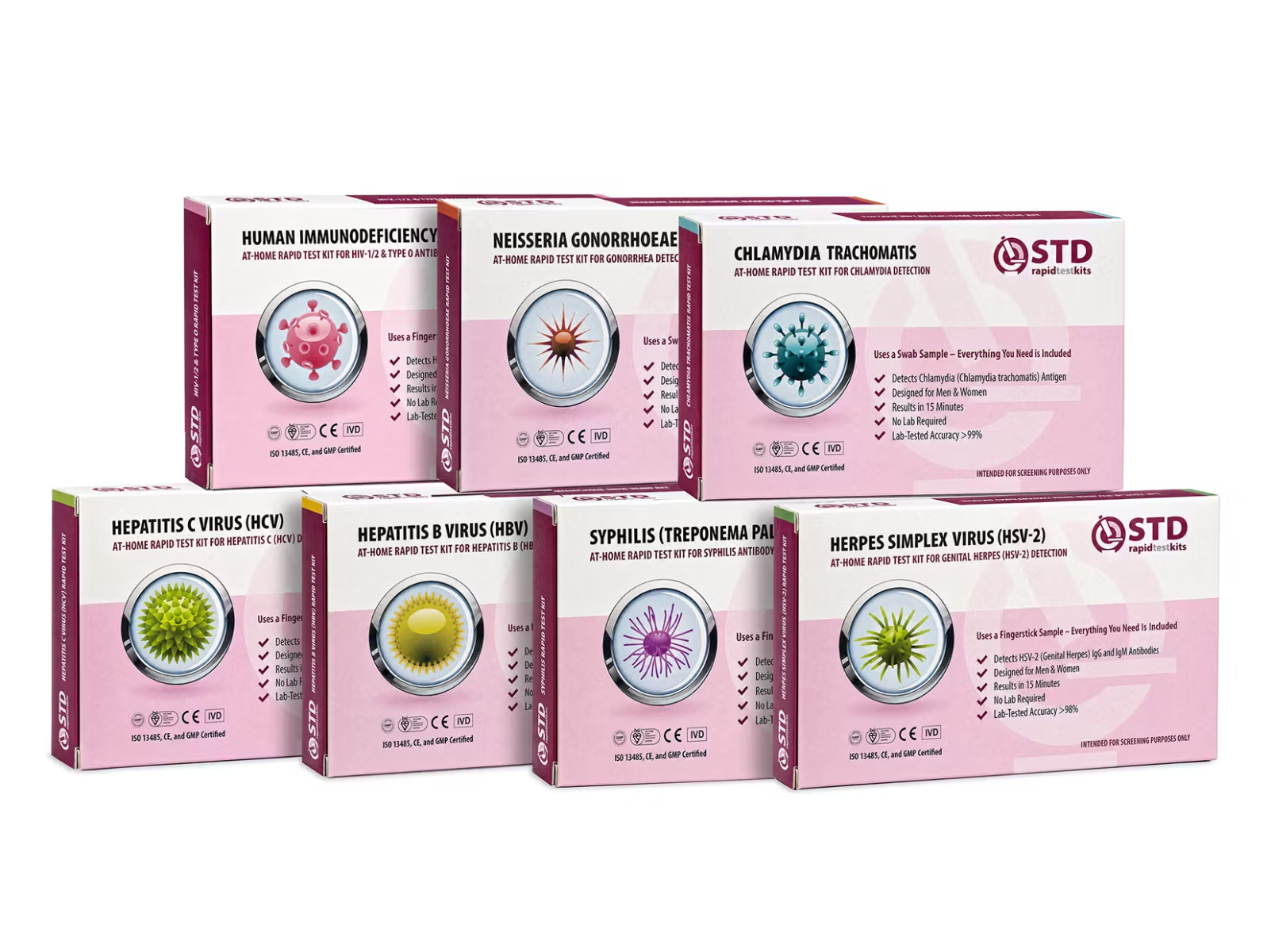
If a clinic visit is overwhelming or you want privacy first, an at-home rapid combo kit can cover the highest-yield infections in one sitting. Order, swab or fingerstick, read the result in about fifteen minutes. Anything reactive should be confirmed with a lab test through a clinician, since at-home rapid tests are screening tools, not diagnostic NAAT.
A single negative test in the first week after exposure does not rule out an infection. Antibodies and viral markers take weeks to become detectable, so plan one early test plus one confirmatory retest after the relevant window closes. The table in the next section lists the specific windows for each infection.
When to Test After a Possible Exposure
Each infection has its own detection window. Testing too early gives a false negative; waiting too long delays treatment that works best early. The CDC's HIV testing page gives the most precise windows, and the table below summarizes the others against current guidance.
| Infection | Earliest reliable detection | Confirmatory retest | Notes |
|---|---|---|---|
| HIV (NAAT) | 10 to 33 days after exposure | If negative, retest at 45 days | Most sensitive early test (<a href="https://www.cdc.gov/hiv/testing/">CDC HIV testing windows</a>) |
| HIV (lab antigen/antibody) | 18 to 45 days | Retest at 90 days for definitive ruling out | Standard 4th-generation lab test |
| HIV (rapid antibody / self-test) | 23 to 90 days | Retest at 90 days if negative | Includes most at-home rapid tests |
| Chlamydia and gonorrhea | 1 to 2 weeks (NAAT) | Retest in 3 months after treatment | Curable with antibiotics |
| Syphilis | 3 to 6 weeks | Retest at 90 days for confidence | Watch for painless sore, then later body or palm/sole rash |
| Herpes (IgG antibody) | 4 to 6 weeks for initial seroconversion | 12 to 16 weeks for definitive result | Antibody tests cannot date the infection |
| Hepatitis B | 3 to 6 weeks (HBsAg) | Retest at 6 months | Vaccination history matters for interpretation |
| Hepatitis C | 8 to 11 weeks (antibody) | Retest at 6 months | NAAT can detect earlier in high-risk exposure |
This article is published by stdrapidtestkits.com, which sells at-home STI testing kits. Product mentions below are kept to two and chosen for fit with the article's actual topic, not commercial benefit.
Step Two: Start Documenting From Day One
Documentation is the part of this process that feels strange while you are doing it and becomes the most useful thing later. Trauma reorganizes memory in ways that make timelines and exact phrasings slip out of reach within weeks. Writing things down while they are clear gives you anchors for any conversation with a clinician, lawyer, or health department later, and it helps you separate what was actually said from what you have been replaying.
Open a private note or document and capture five basics, listed below. Even a verbal admission is worth recording in your own log with the date and time. You are not committing to legal action by writing it down.
What to capture in your documentation log
- The date you found out about the partner's diagnosis, and how you found out.
- Any text messages, DMs, emails, or social media posts that reference the diagnosis (screenshot with the date visible).
- Test dates, tests ordered, and results as they come in.
- Any in-person admissions: the date, your best recollection of the exact wording, and any witnesses.
- Visit notes from a clinician, including their name and the appointment date.
Step Three: Understand Your Legal Options
The legal landscape varies dramatically by infection and by state. The Center for HIV Law and Policy maintains the most current map of how each U.S. state treats knowing HIV exposure, and the picture is messier than a single statistic captures: many states have HIV-specific criminal statutes, several have repealed or modernized theirs in the last decade, and others use general assault or sexual battery laws to prosecute non-disclosure cases.
For other infections, the legal route is usually civil rather than criminal. Common claims include:
- Negligent or intentional transmission (a tort claim, even if no transmission occurred in some jurisdictions)
- Battery or sexual battery, when consent is argued to have been invalidated by the deception
- Intentional or negligent infliction of emotional distress
- Fraud, when the partner actively misrepresented their status
Cases generally need three things to be viable: evidence the partner knew their status, evidence they failed to disclose, and either documented exposure or a positive diagnosis. That is exactly why step two matters as much as step one.
You do not have to involve police to explore options. Organizations such as the Center for HIV Law and Policy, Lambda Legal, and the ACLU can help you understand what your state allows. Many state and county legal aid offices offer free initial consultations on health-related civil claims, and most will tell you on that first call whether a case is worth pursuing where you live.
Step Four: Talk to a Clinician (Even Briefly)
This step gets skipped because it can feel exposing in a way that home testing does not. A clinician you trust changes the math, though, because there are time-sensitive interventions only they can provide. Telehealth counts; you do not have to walk into a waiting room to access this care.
What a clinician can do that an at-home kit cannot:
- Start HIV post-exposure prophylaxis (PEP) if you are within 72 hours of a possible HIV exposure. The CDC's PEP guidance is explicit on this: PEP must be started within 72 hours (3 days) after a recent possible exposure to HIV. Earlier is better.
- Prescribe suppressive or episodic antivirals for herpes (acyclovir, valacyclovir, famciclovir), which reduce outbreak frequency and partner transmission risk.
- Order lab NAAT for chlamydia, gonorrhea, and HIV (the gold-standard confirmatory tests after a screening positive).
- Schedule follow-up testing at the right intervals so you are not guessing about window periods on your own.
- Refer you to mental health support, partner-services counseling, or legal aid as needed.
If you cannot say the words out loud at the visit, write them in advance and hand the clinician your notes. They have heard versions of this story many times; the part of it that is hardest for you is the part they treat with the least visible reaction.

Step Five: Make Room for Recovery
Recovery from this kind of consent violation runs on a different clock than the medical side, and it tends to take longer. When someone chooses to keep you in the dark about something that affects your body, they are making a decision you should have been part of. The grief that follows is not the same as the grief from a typical breakup, and it does not respond to the same advice.
What people commonly experience in the weeks after non-disclosure: shock, hyper-focus on the medical questions, sudden anger weeks later when the medical questions are settled, intrusive replays of the relationship, distrust of new partners, or a flat numbness that comes and goes. All of these are normal trauma responses to a consent violation. They are not evidence that something is wrong with you.
What helps, in roughly the order people report finding useful: a few sessions with a therapist who has experience with sexual trauma, a peer support group (online groups for HSV-positive or HIV-positive people are mature and welcoming), writing the partner a letter you do not send, and a deliberate pause on dating until you have your medical results and your bearings. None of this requires forgiving them.
Online communities for HSV-positive and HIV-positive people are mature and welcoming. The Herpes Opportunity, HSV Singles, and Positive Singles forums are well-moderated starting points for herpes. For HIV, The Well Project and POZ.com host active support communities. A few sessions with a therapist trained in sexual trauma also helps, even if you do not plan a long course of therapy.
What If They Genuinely Did Not Know?
This is the gray area that complicates many cases. Some people are sexually active, untested, and asymptomatic, and they pass on an infection they had no idea they carried. Chlamydia is silent in the majority of women and a large share of men. HPV is often invisible. Herpes can be transmitted during asymptomatic shedding, sometimes years after the initial infection.
If the partner truly did not know, the legal calculus changes. Most criminal statutes require knowledge, and most civil claims require either knowledge or recklessness (such as having symptoms and not investigating). What does not change is the medical follow-up you need or the validity of feeling violated. Choosing to be sexually active without periodic testing is a decision that affects partners, even if no individual is acting maliciously. You are allowed to set boundaries based on that pattern alone.
If their account of not-knowing turns out to be true and you want to maintain the relationship, that is a separate conversation about testing routines, condoms, and disclosure norms going forward. If it turns out to be untrue, the documentation from step two is what makes that case provable.

If You Want to Confront Them
Some people need closure from a direct conversation. Others need silence and space. Both are legitimate, and there is no universally correct sequence. Before reaching out, work through three quick questions:
- Are you physically and emotionally safe to have contact? If there is any concern about retaliation, either skip direct contact or have a third party (friend, counselor, legal advocate) present or copied.
- What do you actually want from the conversation: acknowledgment, apology, accountability, or just to say it once out loud? Naming it changes how you write the message.
- Are you considering legal action? If yes, talk to an attorney before initiating contact, because their advice on phrasing and channel can preserve options you would otherwise foreclose.
Keep any message you send factual, dated, and free of language that could be read as a threat. The template below is one workable shape.
"I tested positive for [infection] after we were together. I have since learned that you knew your status and chose not to tell me. I am writing to make clear that this caused real harm and that I am reviewing my next steps."
That is enough. You are not obligated to negotiate, explain, or absorb their reaction in real time. Send it and step away from the device.
Privacy and Discretion at Home
If you are not ready to walk into a clinic, an at-home rapid test kit gives you a private way to start. The packaging is plain, the test runs in about fifteen minutes per infection, and you do not have to explain anything to anyone before you have your own information. Anything reactive should be confirmed with a lab NAAT through a clinician, but the screening result tells you whether that confirmation is urgent or routine.
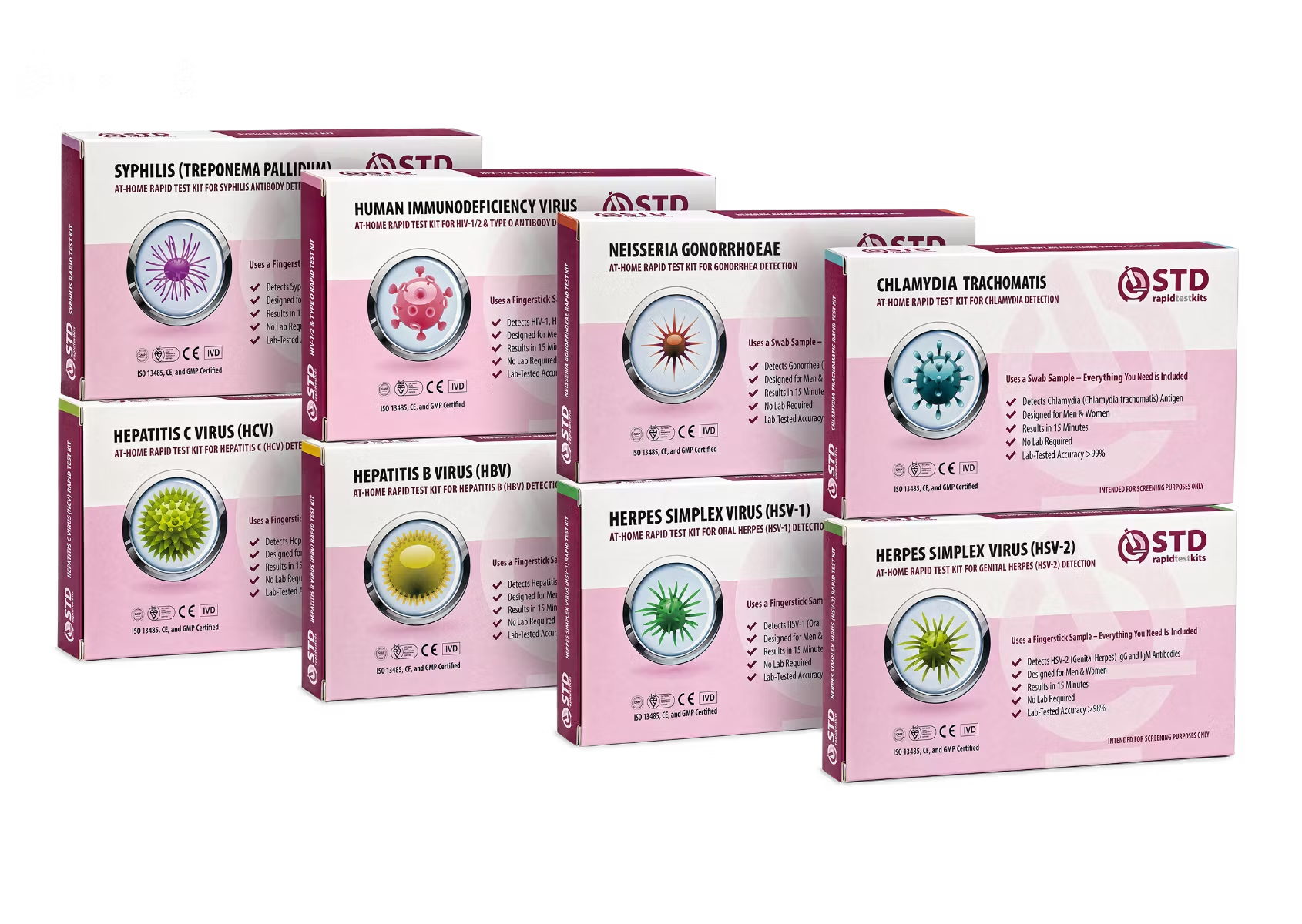
The combo kits below cover the most common exposures in one order. The 8-in-1 panel is validated for both men and women; the at-home trichomoniasis and HPV components in our wider catalog are validated for vaginal self-swab only, so male readers needing trich or HPV testing should plan a clinic visit for those two specifically. Everything else (HIV, syphilis, hepatitis B and C, herpes, chlamydia, gonorrhea) is any-gender at home.
You Were Exposed, but You Are Not Without Options
Someone made a choice for you. The path back to your own footing has a small number of concrete steps, and you do not have to do them in a single day. Test on a real schedule. Write down what you know while it is fresh. Talk to a clinician about PEP if you are inside the 72-hour HIV window. Talk to a legal advocate when you have the bandwidth, even just to learn what is possible in your state. Make space for the emotional work, and give it the same patience you would give a friend in your position.
Whatever you decide about the partner, about disclosure to future partners, or about whether to pursue any legal remedy, the decision is yours to make on your timeline. The point of this guide is to put the information back in your hands so the choice is informed. That is the part of consent the other person took from you, and it is the first part you take back.
Frequently Asked Questions
- Can I press charges if a partner knowingly gave me an STI?
- Possibly, depending on your state and which infection is involved. Many U.S. states have HIV-specific criminal statutes that apply to knowing exposure or non-disclosure, and several allow civil suits for negligent or intentional transmission of other STIs such as herpes or syphilis. The Center for HIV Law and Policy maintains the clearest map of state-by-state HIV laws. For non-HIV infections, a brief consultation with a personal injury attorney or legal aid lawyer in your state is the fastest way to know what is actionable where you live.
- What if the partner says they did not know they had an infection?
- It is plausible. Chlamydia, HPV, and herpes can stay silent for months or years, and many people who transmit have never been tested. If they truly did not know, criminal liability usually does not apply, but civil claims for negligence may still be possible if they had clear symptoms and chose not to investigate. Either way, your medical follow-up needs do not change, and you are entitled to set future boundaries based on whether they have a regular testing routine.
- I have no symptoms. Should I still test?
- Yes. Most STIs are silent in their early phase, and several (chlamydia, HPV, syphilis, HIV) cause long-term harm if treatment is delayed. Test on the schedule for each infection's window period rather than just once: a single early test can miss an infection that has not yet become detectable. The table above shows the windows the CDC currently uses.
- Can I get tested without telling anyone?
- Yes. At-home rapid kits ship in plain packaging, run in about fifteen minutes per test, and require no clinician contact for the screening result. If the screen comes back reactive, you will want to confirm with a lab NAAT through a clinician, but you control when and where that happens. Clinic visits, when you do them, are confidential under standard medical privacy law.
- Do I have to tell future partners I was exposed?
- If you tested negative through the full window period, you have no transmissible infection to disclose, and the decision to share the experience is personal. If you contracted something like HIV or HSV, ethical and (in many states) legal disclosure obligations apply going forward. The diagnosis is medical information, not an identity, and there are mature scripts and support groups for handling those conversations well.
- What if I want to confront the partner?
- Decide what you want out of it before you make contact: closure, acknowledgment, accountability, or simply to say it once. Keep any message factual and dated, and avoid threats or emotionally charged phrasing. If you are considering legal action, consult an attorney before sending anything. If safety is a concern, route the message through a third party or skip direct contact entirely.
- How long should I wait before testing?
- It depends on the infection. HIV NAAT becomes reliable around 10 to 33 days, lab antigen/antibody at 18 to 45 days, and antibody-only or rapid tests at 23 to 90 days per the CDC. Chlamydia and gonorrhea are detectable on NAAT within 1 to 2 weeks. Syphilis takes 3 to 6 weeks. Herpes IgG antibody seroconverts at 4 to 6 weeks but is not definitive until 12 to 16 weeks. Plan one early test and one confirmatory retest after the relevant window closes.
- Will anyone find out I was exposed?
- Not unless you tell them or your jurisdiction's mandatory reporting rules apply (which generally cover positive HIV diagnoses to public health departments, not exposures). At-home tests are private by design, and clinical visits are protected under standard medical privacy law. Partner-services notification, when used, is anonymous to the partner being notified.
- U.S. Centers for Disease Control and Prevention. HIV testing window periods for NAAT, antigen/antibody, and antibody-only tests.
- U.S. Centers for Disease Control and Prevention. PEP (post-exposure prophylaxis) for HIV: must be started within 72 hours of exposure.
- U.S. Centers for Disease Control and Prevention. STI Treatment Guidelines, Clinical Partner Services chapter on partner notification.
- U.S. Centers for Disease Control and Prevention. Talk. Test. Treat. Partner-disclosure guidance for individuals.
- U.S. Centers for Disease Control and Prevention. About Sexually Transmitted Infections (STIs) overview.
- Center for HIV Law and Policy. HIV criminalization map and analysis of state-by-state laws on knowing HIV exposure or non-disclosure.
