Published: October 2025 | Last updated: May 2026 | Editorial review and quality control: Martina N.
Where they swab depends on where you've had sex. That is the entire logic behind site-specific STD testing, and it is why a single urine cup or a single fingerstick rarely tells the whole story. If your contact has been oral or anal, the infections most likely to live there will not appear in a urethral or vaginal sample. This guide walks through what each test site actually checks for, what the swab feels like, and where at-home options stop and a clinic visit becomes the right call. The goal is to match the test to what your body has actually been exposed to.
Key Takeaways
- Gonorrhea and chlamydia colonize the specific tissue they touch, so a throat exposure needs a throat swab and a rectal exposure needs a rectal swab to be reliably caught.
- HIV, syphilis, and hepatitis B and C move through the bloodstream, so a single fingerstick or blood draw screens for them regardless of which body site was exposed.
Why the exposure site drives the test
Think of STD testing as a location-specific question. If a sample only checks the urethra, the result only describes the urethra. That works when every sexual contact has been penis-in-vagina. The moment oral or anal sex enters the picture, new tissue surfaces are introduced. Each contact point is its own potential infection site.
Gonorrhea and chlamydia are bacterial infections that colonize the tissue they touch. They do not generally travel through the bloodstream to set up shop in unrelated body parts. A throat exposure produces a throat infection. A rectal exposure produces a rectal infection. Neither will reliably appear in a urine sample. The U.S. Centers for Disease Control and Prevention specifically recommends that providers screen for chlamydia and gonorrhea at anatomic sites of exposure based on each patient's sexual history (CDC STI Treatment Guidelines, screening recommendations).
A thorough provider will ask about the types of sex you have had. The reason is accurate testing, never judgment. If you are using an at-home kit, the kit needs to cover the body sites that match your exposure history. A clean result on one site is not the same as being free of infection.
This article describes every test site a clinic might use for a full STD workup: throat, genital, rectal, and blood draw. The at-home rapid kits sold on this site are narrower in scope. They cover the most common genital infections via self-collected vaginal or penile swab (chlamydia, gonorrhea, plus trichomoniasis and HPV for women), and the bloodborne infections via fingerstick (HIV, syphilis, hepatitis B, hepatitis C, and herpes antibodies). We do not sell throat-swab or rectal-swab kits. If your exposure was specifically oral or anal, a clinic visit is the right route for those swabs. The matching blood tests can still be ordered through us in parallel.
Throat testing after oral exposure
Oral sex, whether given or received, can transmit gonorrhea and chlamydia into the pharynx. Both are bacterial infections that can settle quietly on the tonsillar pillars or posterior pharyngeal wall and cause no obvious symptoms. Herpes simplex virus (HSV-1 and less commonly HSV-2) can also produce oral lesions, and a primary syphilis chancre can appear on the lip or inside the mouth after oral contact with an infected partner.
The CDC recommends pharyngeal screening for gonorrhea and chlamydia in sexually active men who have sex with men and in others based on reported sexual practices (CDC STI Treatment Guidelines, screening recommendations). Asymptomatic pharyngeal infection is the norm rather than the exception. Most pharyngeal gonorrhea cases produce no sore throat, no white patches, and no fever, which is exactly why a swab is the only way to find them.
What the test actually involves at a clinic is below.
| Sample type | What it detects | What the experience is like |
|---|---|---|
| Pharyngeal swab | Pharyngeal gonorrhea and chlamydia | A soft swab rubbed across the tonsillar pillars and back of the throat, similar to a COVID test but typically gentler |
| Visual exam | Oral herpes lesions, syphilis chancre, oral warts | Provider inspects the mouth, lips, and inside cheeks for ulcers, vesicles, or white patches |
| Fingerstick or blood draw | Syphilis (RPR/TP-PA), HIV antibodies and antigen, HSV-2 antibodies, hepatitis B and C | A small blood sample run as part of a standard STD panel |
Genital testing for people with a penis
Most clinic visits for penile-anatomy STD testing now use a urine sample rather than a urethral swab. The reader pees into a cup, ideally first-catch urine after holding for one to two hours, and the lab runs a nucleic-acid amplification test (NAAT) for chlamydia and gonorrhea (CDC screening recommendations). NAATs are the laboratory gold standard for these two infections.
The trade-off is scope. A urine NAAT only checks the urethra. If oral or anal sex has happened, the urine result describes one tissue site and not the others. Pharyngeal or rectal swabs need to be added when relevant.
Syphilis, HIV, and hepatitis B and C are still tested through a fingerstick or a small blood draw. Herpes antibody screening also runs from blood, though it is not part of routine asymptomatic screening per CDC guidance and is usually reserved for people with concern about HSV exposure or visible lesions.
Visible-lesion conditions (genital warts caused by HPV, herpes outbreaks, primary syphilis chancres) are typically identified by a visual exam. A swab from a lesion can be sent for HSV PCR or, for a suspected chancre, for darkfield microscopy.
| Sample type | What it detects | What the experience is like |
|---|---|---|
| Urine sample (first-catch) | Chlamydia and gonorrhea in the urethra | Pee into a cup, painless, under a minute |
| Urethral swab (uncommon now) | Chlamydia and gonorrhea | Thin swab inserted a short distance into the urethral opening, used only when a sample is needed during a symptomatic exam |
| Fingerstick or blood draw | HIV, syphilis, hepatitis B, hepatitis C, herpes antibodies | Standard blood sample, often run as a full STD panel |
| Visual exam | Genital warts, herpes lesions, syphilis chancre | Provider checks for visible lesions and discharge, painless |
Genital testing for people with a vagina
Vaginal-anatomy testing has more options because the relevant infections live in slightly different places. A self-collected vaginal swab is the CDC-recommended sample type for chlamydia and gonorrhea NAAT screening in women, and is preferred over urine for sensitivity (CDC screening recommendations). A clinician-collected cervical swab is also acceptable. Urine is reasonable when a swab is not available but performs slightly less well in vaginal-anatomy patients.
A self-swab is exactly what it sounds like: a soft swab inserted about two inches into the vagina, rotated for a few seconds, then withdrawn. Most women find it considerably less invasive than a speculum exam.
Trichomoniasis (caused by a parasite) and bacterial vaginosis (an overgrowth of native bacteria rather than a true STD) also show up on vaginal samples. Trichomoniasis can be detected on rapid lateral-flow swab tests or on NAAT. Pelvic exams with a speculum are reserved for symptomatic concerns: visible sores, abnormal discharge, suspected cervicitis, or evaluation of pelvic inflammatory disease.
Bloodborne infections (HIV, syphilis, hepatitis B and C, herpes antibodies) follow the same blood-draw or fingerstick logic as penile-anatomy testing.
| Sample type | What it detects | What the experience is like |
|---|---|---|
| Vaginal swab (self- or provider-collected) | Chlamydia, gonorrhea, trichomoniasis, HPV when validated | Soft swab inserted about two inches, rotated briefly, withdrawn |
| Urine sample | Chlamydia, gonorrhea | First-catch urine, slightly lower sensitivity than a vaginal swab in vaginal anatomy |
| Fingerstick or blood draw | HIV, syphilis, hepatitis B, hepatitis C, herpes antibodies | Standard blood sample |
| Pelvic exam with speculum | Cervicitis, visible herpes lesions, warts, pelvic inflammatory disease signs | Reserved for symptomatic evaluation, not used for asymptomatic screening |
Can a blood test screen for everything at once?
A common misconception is that a blood draw can screen for every STD in one go. It cannot. The infections that move through the bloodstream (HIV, syphilis, hepatitis B and C) are detectable in blood once the body has produced enough antibodies or antigen for the test to register. The infections that colonize tissue (gonorrhea, chlamydia, trichomoniasis, HPV) generally are not detectable in blood because the pathogen does not enter circulation in screening-relevant amounts.
This is why a complete clinic panel usually includes more than one sample type. A blood-only screen will miss localized gonorrhea or chlamydia. A urine-only screen will miss bloodborne infections and will miss any throat or rectal site that has not been swabbed.
Window periods matter too. HIV fourth-generation antigen-antibody tests detect most infections by about 45 days post-exposure (CDC HIV testing). Syphilis antibodies generally appear within 3 weeks to 3 months. Chlamydia and gonorrhea NAATs are usually reliable within 1 to 2 weeks of exposure (CDC screening recommendations). Testing too early can produce a false negative regardless of which sample type is collected.
Bloodborne (use fingerstick or blood draw): HIV, syphilis, hepatitis B, hepatitis C, herpes antibodies.
Tissue-resident (use swab or urine at the exposed site): chlamydia, gonorrhea, trichomoniasis, HPV.
A complete workup usually means one blood sample plus the swab or urine that matches each exposure route.
Rectal testing after anal exposure
The rectum is the body site most often left out of routine STD workups, and the omission has consequences. Gonorrhea and chlamydia can colonize the rectal mucosa silently after receptive anal sex. CDC's surveillance and screening guidance specifically calls for rectal NAAT screening in sexually active men who have sex with men and in others based on reported sexual practices (CDC screening recommendations).
Rectal infections usually cause no pain, no discharge, and no irritation. Untreated, they can spread, contribute to inflammation that elevates HIV transmission risk, and pass to future partners through anal, oral, or genital contact.
The test itself is a simple swab. A soft, sterile swab is inserted about 1 to 2 inches into the rectum, rotated briefly, and withdrawn. It is not a colonoscopy, and it is not typically painful, though it may feel unfamiliar. Some clinics allow self-collection in a private room, which many people prefer.
Providers outside of dedicated sexual-health clinics do not always offer rectal screening by default. Asking specifically, or selecting a clinic that handles full sexual-history screening, is the way to make sure the right swab is collected.
| Sample type | What it detects | What the experience is like |
|---|---|---|
| Rectal swab (self- or provider-collected) | Rectal chlamydia and gonorrhea | Soft swab inserted 1 to 2 inches, rotated, withdrawn; brief and typically painless |
| Visual exam of perianal area | Anal warts, herpes lesions, primary syphilis chancre | Provider inspects only the visible external area; internal anoscopy is reserved for symptomatic evaluation |
| Fingerstick or blood draw | HIV, syphilis, hepatitis B, hepatitis C, herpes antibodies | Standard blood sample, picks up bloodborne infections regardless of exposure site |
Asymptomatic infections are common
Most STDs spend most of their course in an asymptomatic state. CDC notes that chlamydia is asymptomatic in the majority of cases (CDC chlamydia overview). Rectal and pharyngeal gonorrhea infections are similarly silent in most carriers.
That silence creates two problems. First, untreated infections can progress: chlamydia and gonorrhea in the female reproductive tract can lead to pelvic inflammatory disease and fertility complications, and rectal inflammation can elevate HIV transmission risk. Second, an asymptomatic person remains contagious. Sexual partners can be infected by someone who feels completely fine.
This is the reason routine screening exists. A urine-only or blood-only screen can feel reassuring, but a clean result on one site says nothing about untested sites. For sexually active people with multiple partners, CDC suggests yearly screening at minimum, with more frequent testing when partner counts or exposure profiles change.
Chlamydia, gonorrhea, and HIV can all spread from someone who feels completely normal. The useful question is which body sites have been exposed and whether each one has been tested.
What our at-home test kits cover
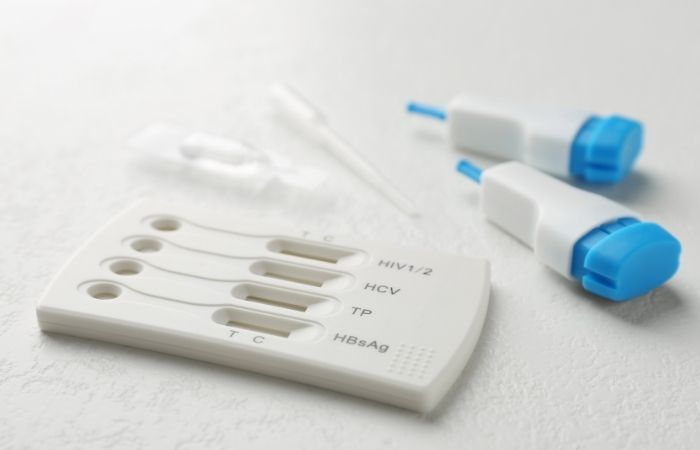
At-home rapid testing kits, including the ones sold on this site, mirror what clinics do for genital and bloodborne infections. Sample collection is the part you handle yourself: a self-collected vaginal or penile swab for chlamydia or gonorrhea, plus trichomoniasis or HPV with the women-only swab kits, and a fingerstick blood sample for HIV, syphilis, hepatitis B, hepatitis C, and herpes antibodies.
What at-home kits on this site do not cover: pharyngeal swabs and rectal swabs. These need to be collected in a clinic setting, both because the tissue site is harder to self-sample reliably and because the lateral-flow technology used in rapid kits is validated for vaginal and penile self-collection, not for throat or rectal samples.
If your concern is purely genital or bloodborne, a single combination kit can give you a private, 15-minute result without a clinic visit. If your concern includes oral or anal exposure, the right path is a clinic for the matching swabs, with the at-home bloodwork as a useful add-on for HIV and syphilis screening.
When a combination panel makes sense
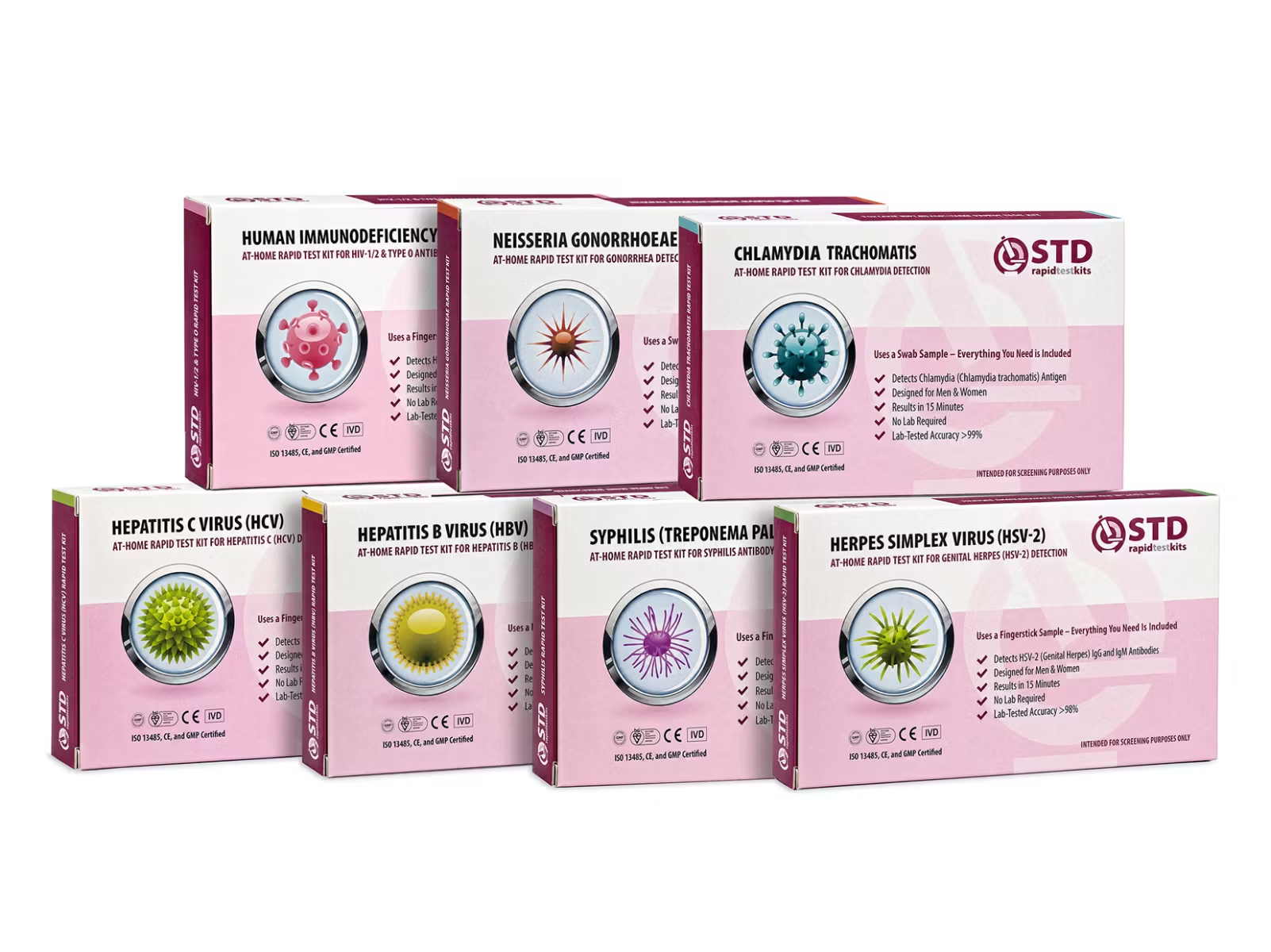
A multi-infection panel is the natural fit when more than one concern is on your radar. Common scenarios: a new partner with unknown testing history, multiple recent partners, or a single higher-risk exposure event where you want a broad screening sweep rather than picking one infection at a time. Combination kits cover the most common bacterial and bloodborne infections in one workflow.
What a combination panel does not change: the window-period logic still applies. HIV needs about 45 days post-exposure for a fourth-generation antigen-antibody test to be reliable in most cases. Syphilis antibodies can take up to 3 months. Chlamydia and gonorrhea show up within 1 to 2 weeks. Testing the day after a possible exposure will mostly produce false negatives, regardless of how many infections the kit screens for.
If HIV is your single concern
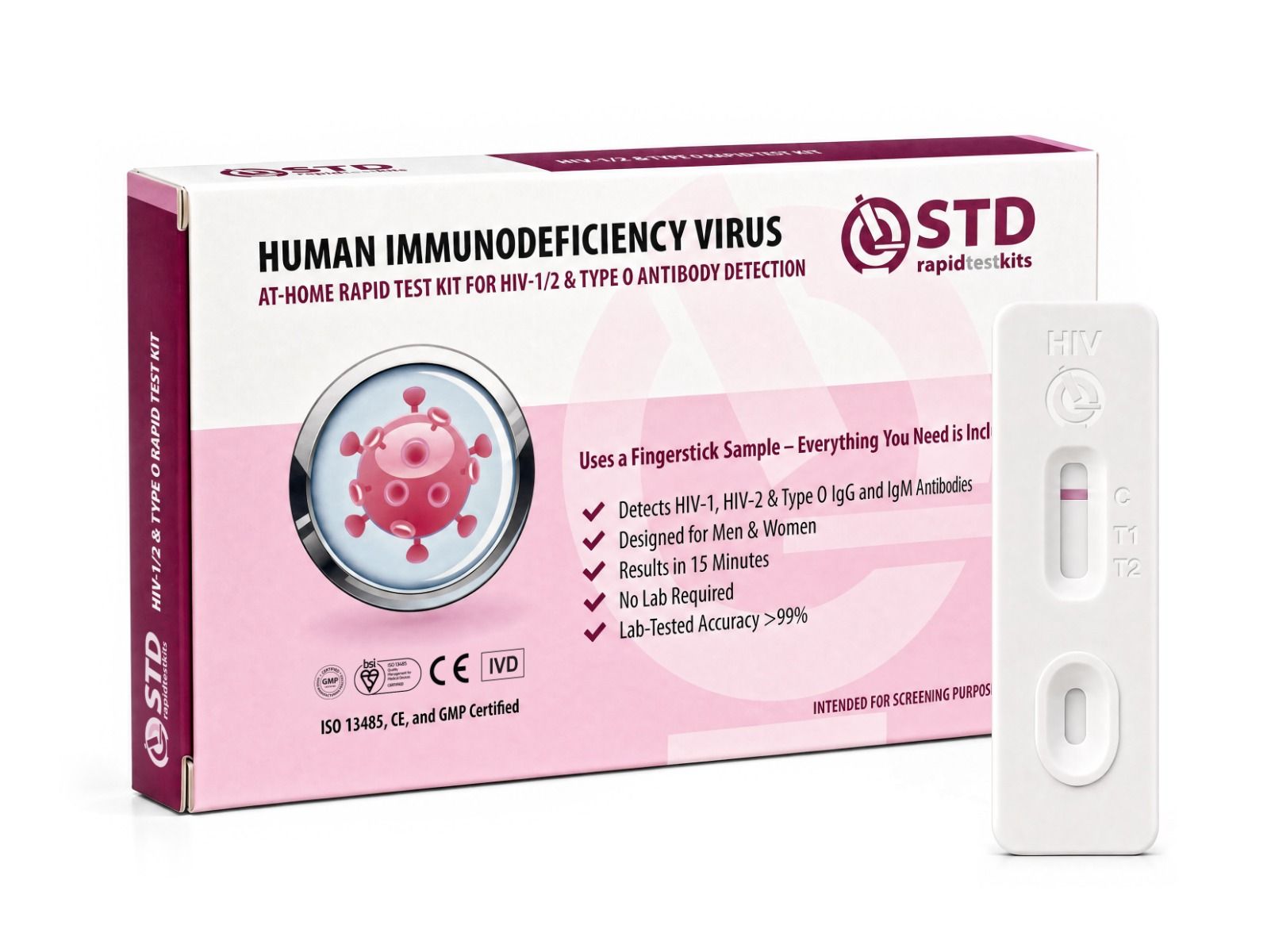
For some readers, the question is narrower: was that single exposure a possible HIV transmission event? A standalone HIV blood test is the right tool when HIV is the specific concern and other infections are less likely or already excluded. Modern fourth-generation HIV antigen-antibody tests detect HIV by about 45 days post-exposure in the large majority of cases, and earlier in many cases. Earlier testing remains useful as a baseline, with retesting recommended at 6 weeks and 3 months for full confidence (CDC HIV testing).
For higher-risk exposures, the medical decision point is post-exposure prophylaxis (PEP). PEP is a 28-day course of antiretroviral medication that must be started within 72 hours of the exposure. If a recent exposure raised that concern, the right next step is an urgent clinic or emergency-department visit for PEP evaluation, not a wait-for-results at-home test.
When to see a clinic instead of testing at home
At-home testing is private, fast, and accurate for the infections it covers. It is also a complement to clinic care, not a complete substitute in every scenario. A clinic visit is the right choice when:
- The exposure was specifically oral or anal, and pharyngeal or rectal swabs are needed. At-home kits on this site do not include those swabs.
- A visible lesion (sore, ulcer, vesicle, wart) is present and needs evaluation. A clinician can perform a visual exam, take a swab from the lesion for PCR or culture, and order targeted treatment.
- Symptoms suggest pelvic inflammatory disease, epididymitis, or another complication that needs in-person evaluation.
- Post-exposure prophylaxis for HIV is on the table. PEP starts within 72 hours of exposure and is a clinic-administered course of antiretrovirals.
- Treatment is needed. Positive at-home results require a follow-up clinic visit to confirm, prescribe, and counsel on partner notification.
For everything else (routine genital and bloodborne screening, low-risk-exposure peace-of-mind testing, periodic screening between clinic visits), at-home rapid kits handle the workload well. Home and clinic testing cover different ground, and for many exposures both have a role.
Screening for Chlamydia trachomatis and Neisseria gonorrhoeae should occur at anatomic sites of exposure based on the patient's sexual history.
FAQs
- Do I really need a throat or rectal swab if I have had oral or anal sex?
- Yes if you want a complete answer. Gonorrhea and chlamydia colonize the specific tissue they touch, and a urine NAAT or a blood test cannot detect them at a different site. CDC guidance specifically recommends extragenital (throat and rectal) screening based on reported sexual history. At-home rapid kits on this site do not include throat or rectal swabs, so for those samples, a clinic visit is the right route.
- What if I have no symptoms at all?
- Most STDs are asymptomatic for most of their course. That is precisely why routine screening exists. Asymptomatic infections can still cause downstream complications (pelvic inflammatory disease, infertility, increased HIV transmission risk) and remain contagious. Feeling fine is not the same as being uninfected.
- Will I get a urethral swab during a clinic visit?
- Almost never for routine screening. A urine sample has replaced urethral swabs for asymptomatic chlamydia and gonorrhea testing in penile anatomy. Urethral swabs are reserved for cases with active symptoms (discharge, pain on urination) where the clinician needs a sample from the site of inflammation.
- Does STD testing hurt?
- For most samples, no. A pharyngeal swab feels like a brief throat tickle. A vaginal self-swab feels like a tampon insertion at most. A rectal swab is brief and feels strange more than painful. A fingerstick is a quick pinch. A urine cup is a urine cup. Procedures vary by site, but none are typically described as painful.
- Why can a blood test not just screen for everything at once?
- Bloodborne infections (HIV, syphilis, hepatitis B and C) are detectable in blood. Tissue-resident infections (chlamydia, gonorrhea, trichomoniasis, HPV) generally are not, because the pathogens do not enter circulation in screening-relevant amounts. Full coverage of both categories needs a blood sample plus the appropriate genital or extragenital swabs or urine sample.
- If I only did a urine test, was that visit useless?
- Not useless. A urine NAAT is a strong test for urethral chlamydia and gonorrhea. It is incomplete if the relevant exposure was at a different site. A clean urine result says nothing about the throat, the rectum, or bloodborne infections like HIV or syphilis. Matching the test to the exposure is the way to read the result with confidence.
- Can an at-home kit cover everything I need?
- Sometimes yes, sometimes no. At-home kits on this site cover the most common genital infections (via self-swab) and bloodborne infections (via fingerstick). They do not include pharyngeal or rectal swabs. If a sexual history involves oral or anal contact and full screening matters, a clinic visit for those swabs is the right addition. At-home bloodwork can still be ordered in parallel.
- How long after a possible exposure should I wait to test?
- Testing the day after an exposure is almost always too early. For chlamydia and gonorrhea, wait at least one to two weeks. For HIV with a fourth-generation antigen-antibody test, most cases show by 45 days, and retesting at 6 weeks and 3 months closes the window. Syphilis antibodies may take up to three months to appear. A baseline test plus retesting is the conservative protocol for a single high-risk exposure.
- U.S. Centers for Disease Control and Prevention. STI overview - patient-facing landing page for sexually transmitted infections.
- U.S. Centers for Disease Control and Prevention. Sexually Transmitted Infections Treatment Guidelines, Screening Recommendations - authoritative reference for anatomic-site-specific screening of chlamydia and gonorrhea, including pharyngeal and rectal sites.
- U.S. Centers for Disease Control and Prevention. HIV Testing - reference for HIV window periods and fourth-generation antigen-antibody test timing.
- U.S. Centers for Disease Control and Prevention. Chlamydia overview - reference for asymptomatic chlamydia infection.
- World Health Organization. Sexually transmitted infections (STIs) fact sheet - global context for STI prevalence and screening rationale.
- National Health Service (UK). Sexually transmitted infections (STIs) - patient-facing reference for STI testing routes.
- MedlinePlus (U.S. National Library of Medicine). Sexually Transmitted Infection (STI) Tests - plain-language NIH reference for sample types and the testing process.
