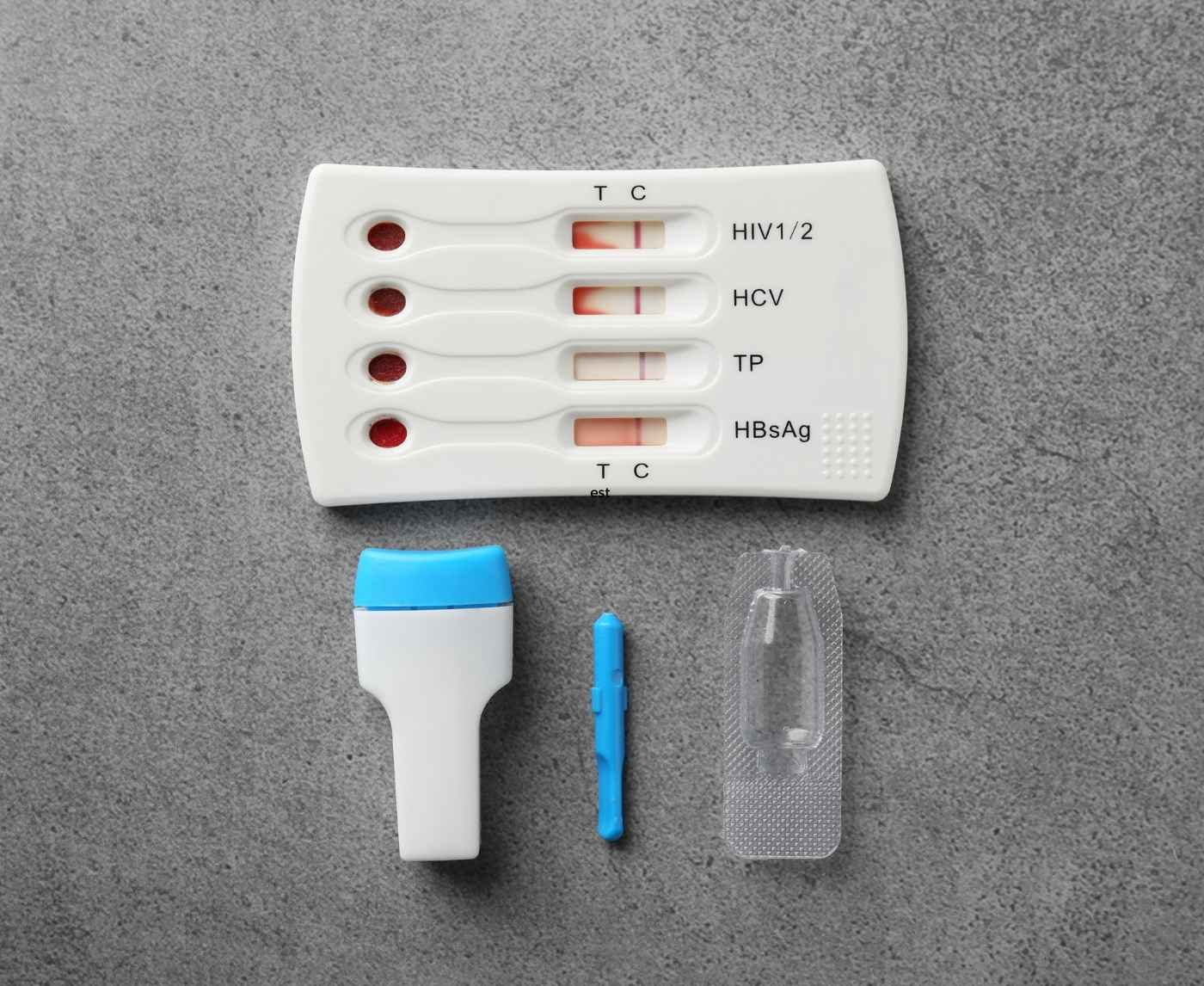

Published: December 2025 | Last updated: April 2026 | Editorial review and quality control: Martina N.
Most people who buy a home STI kit have a single, specific question on their mind: did the thing I'm worried about actually happen, and if so, what is it. The honest answer is that home rapid tests can resolve that question for several common infections, but only if you understand what each kit is built to detect, what sample it needs, and when after exposure the result becomes reliable. Stock the wrong information into your decision and you can end up testing too early, screening for the wrong site of infection, or trusting a negative that the kit was never designed to deliver.
This guide is the calmer version of every product page you have seen this morning. It covers the eight common infections that are screen-able with at-home rapid lateral-flow technology, the four that are not (and where to go for those), the timing window for each test type, and how to read sensitivity and specificity numbers without being misled by them.
Which STIs can you actually test for at home?
Eight, grouped by sample type. Self-collected swab tests cover chlamydia, gonorrhea, trichomoniasis, and HPV. Fingerstick blood tests cover HIV, syphilis, hepatitis B, hepatitis C, and herpes (HSV-1 and HSV-2 are sold as separate panels). Rapid lateral-flow kits typically report sensitivity in the mid-to-high 90s and specificity above 99% when used after the correct window period (see Accuracy section below for sourced figures). Throat (pharyngeal), rectal, and urine-only tests are not available as at-home rapid products; those require a clinic-collected sample sent to a lab.
Key Takeaways
- Eight common STIs are screen-able with at-home rapid lateral-flow kits: four via self-swab (chlamydia, gonorrhea, trichomoniasis, HPV) and four core infections via fingerstick blood (HIV, syphilis, hepatitis B, hepatitis C), plus separate HSV-1 and HSV-2 panels.
- Timing matters more than kit brand. Each infection has its own window between exposure and the earliest reliable result, ranging from about 7 days for gonorrhea to 12 weeks or longer for herpes antibody seroconversion.
What you can test for at home: the eight infections
The catalog of at-home rapid STI tests is narrower than what a clinic can run, but it covers the conditions that account for most consumer concern. The first thing to notice is that there are two distinct sample types, and they are not interchangeable. A blood test will not detect a localized swab infection, and a swab will not pick up systemic seroconversion. Choose by the infection, not by what feels easier to collect.
Self-collected swab tests (4)
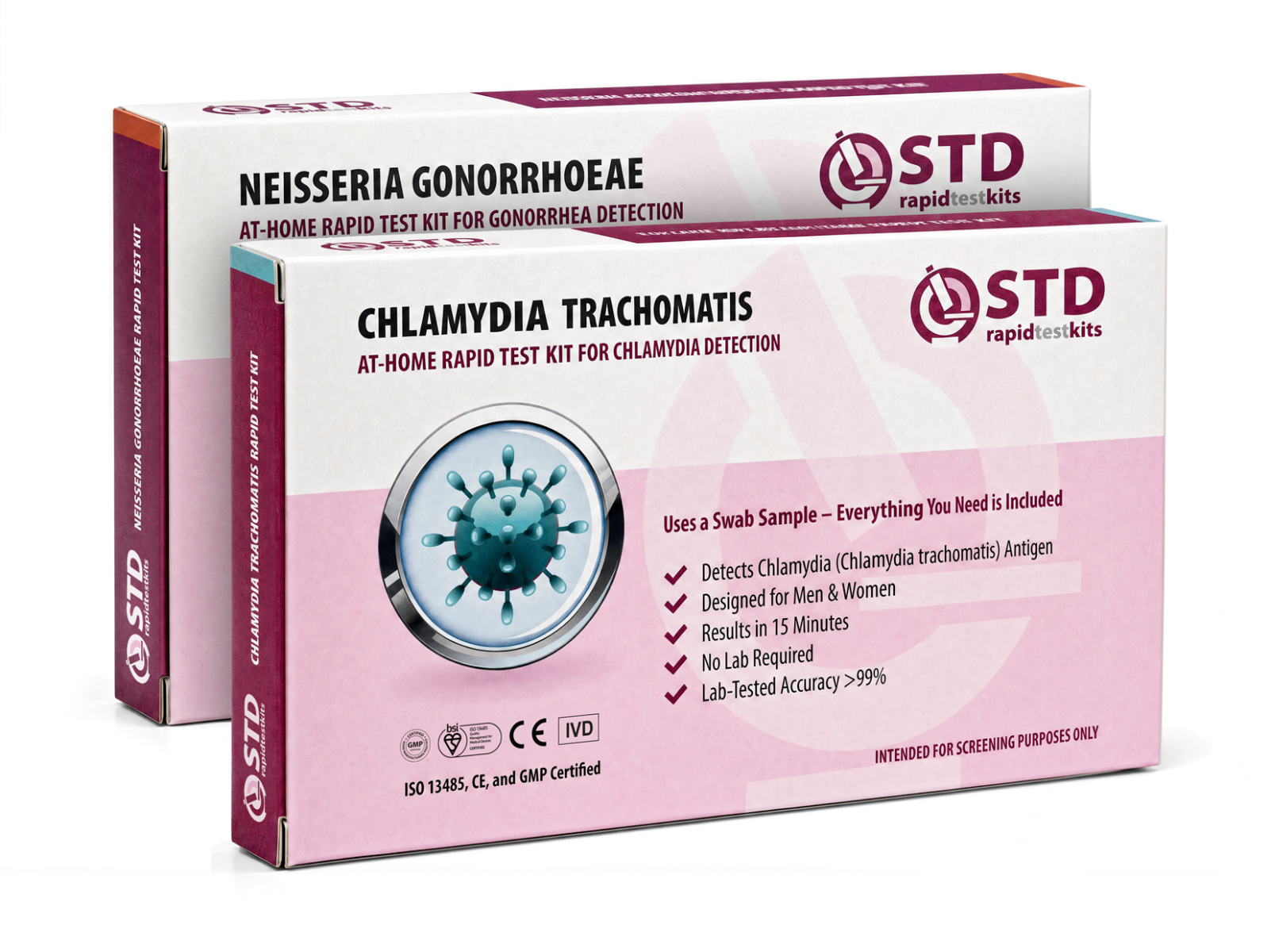
Swab tests are rapid lateral-flow cassettes that detect antigens directly in genital tissue secretions. The reader collects a vaginal or penile swab at home, applies it to the cassette, and reads a control and test line within roughly 15 minutes.
- Chlamydia. The most commonly reported bacterial STI worldwide, often asymptomatic, especially in women. Untreated, it can cause pelvic inflammatory disease and tubal-factor infertility, which is why the CDC recommends annual screening for sexually active women under 25 (CDC STI overview).
- Gonorrhea. A bacterial infection that frequently co-occurs with chlamydia. Most genital infections in women are silent. In men, urethral gonorrhea typically causes obvious discharge within a week or two.
- Trichomoniasis. A protozoal infection. Our at-home rapid swab is validated for vaginal self-collection only. Male readers needing a trich test should see a clinic; we do not sell a male-compatible home kit.
- HPV. Specifically the high-risk strains associated with cervical cancer. The at-home self-swab is also validated for vaginal collection only. Routine cervical screening at a clinic is still the gold standard for cytology and follow-up; the home test is a screen, not a replacement for a Pap.
Fingerstick blood tests (6 panels: HIV, syphilis, Hep B, Hep C, HSV-1, HSV-2)
Blood-based rapid tests detect antibodies (and in some cases antigens) that the immune system produces in response to a systemic infection. The reader pricks a fingertip, transfers a small drop to the cassette, and reads the result in 15 to 20 minutes. Four core infections plus two herpes panels are covered; the herpes panels are sold separately because antibody seroconversion takes longer than the other windows.
- HIV. Home rapid kits detect HIV antibodies. Because the body takes time to mount an antibody response, the window period for antibody-only rapid tests is roughly 23 to 90 days after exposure, with most people seroconverting by 3 months (CDC HIV testing).
- Syphilis. Detects treponemal antibodies. Useful from roughly 3 to 6 weeks post-exposure, with reliable detection by 90 days. A positive antibody result requires lab confirmation to distinguish current from previously treated infection.
- Hepatitis B. Detects hepatitis B surface antigen (HBsAg) or antibodies, depending on the kit configuration. Surface antigen typically becomes detectable 4 to 8 weeks after exposure.
- Hepatitis C. Detects HCV antibodies. The seroconversion window is roughly 8 to 11 weeks for most people, with some taking up to 6 months.
- Herpes (HSV-1 and HSV-2). Sold as two separate panels, each detecting type-specific antibodies. Antibody seroconversion can take 12 weeks or longer after a primary infection. Note that antibody tests cannot localize the infection (they will not tell you whether HSV-2 antibodies came from a genital or oral infection), and they detect past exposure rather than active lesions.
Combination kits
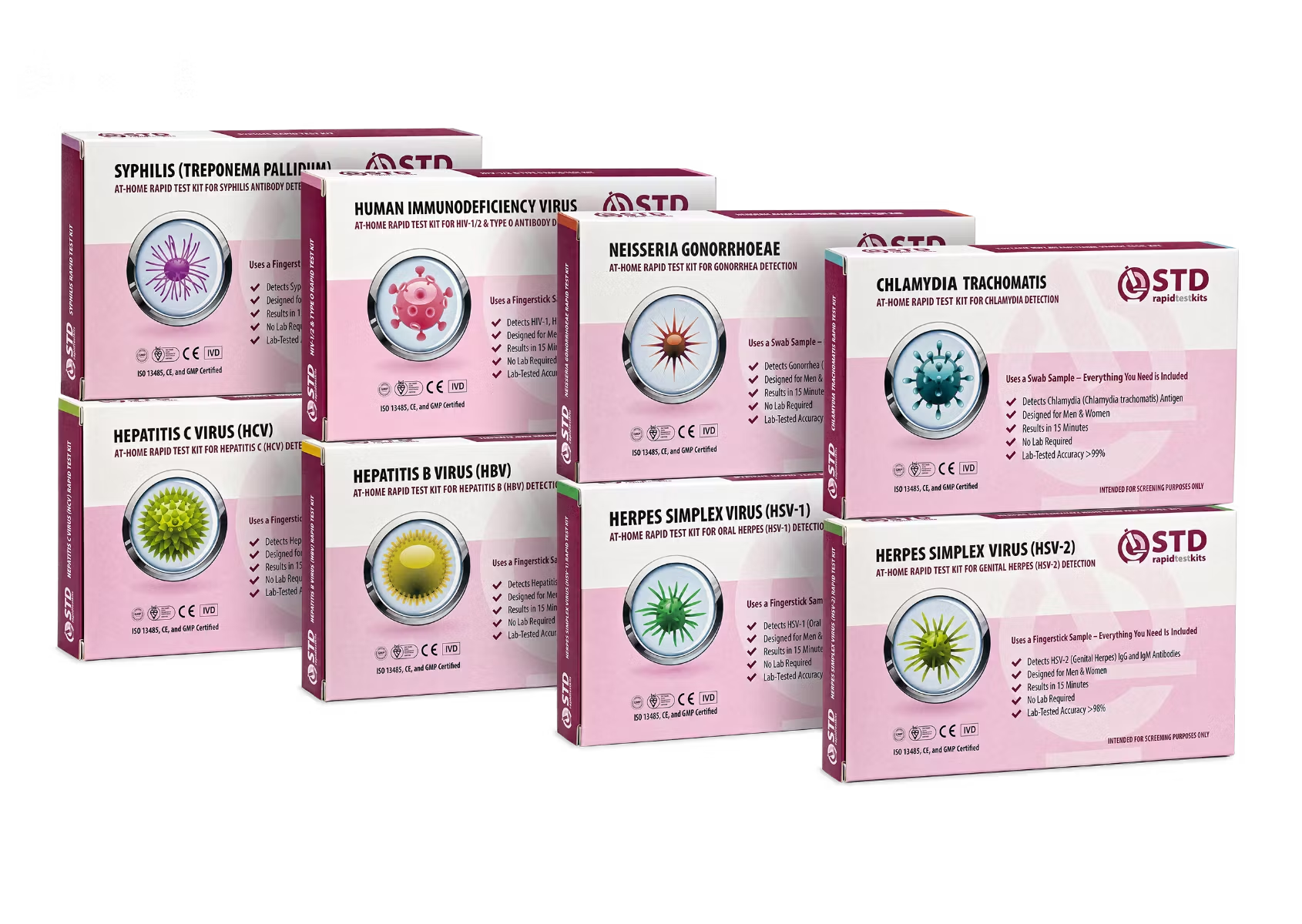
Combination kits bundle several single-infection tests into one box, usually pairing the swab tests with the blood tests for fuller coverage in a single sitting. Common combinations include 2-in-1 (chlamydia and gonorrhea), 3-in-1 (chlamydia, gonorrhea, syphilis), 6-in-1, 7-in-1, 8-in-1, and a women-only 10-in-1 that adds the trichomoniasis and HPV swabs. The cost per infection drops substantially with combos, which is the main reason most readers buying for the first time pick a 6-in-1 or 7-in-1 over a stack of singles.
This article is published by stdrapidtestkits.com, which sells at-home STI testing kits. Our recommendations describe what each kit can and cannot do based on its sample type and validated indication, not on commercial benefit. If your situation calls for a clinic visit, we say so plainly.
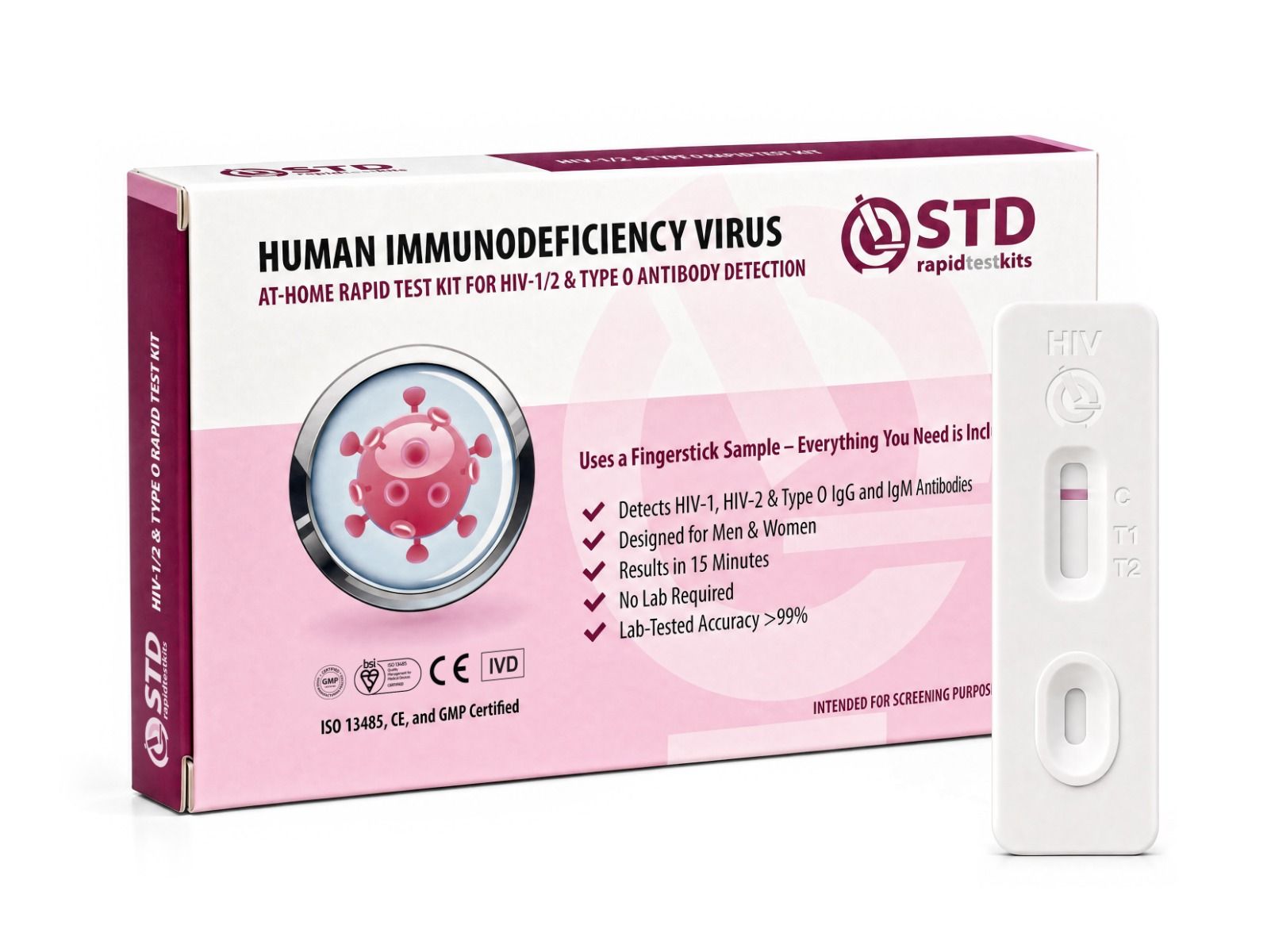
How at-home rapid tests actually work
Almost every at-home STI kit on the market today uses the same underlying chemistry: lateral-flow immunoassay. The same chemistry that powers a home pregnancy test, a COVID-19 antigen test, and a flu rapid test also powers the cassette in your STI kit. Understanding it helps you read the result honestly.
Inside the cassette is a strip of nitrocellulose with two zones: a test line containing antibodies (or antigens) specific to the infection you are screening for, and a control line that confirms the test ran correctly. When you apply your sample, the liquid wicks across both zones. If the target molecule is present, it binds at the test line and a colored band appears within roughly 15 minutes. The control line should always appear; if it does not, the test is invalid and you need to redo it with a fresh cassette.
The strength of lateral-flow chemistry is speed, privacy, and the absence of laboratory infrastructure. The trade-off is analytical sensitivity. A laboratory NAAT (nucleic acid amplification test) or PCR amplifies the pathogen's genetic material and can detect infections at very low concentrations. The CDC's chlamydia treatment guidance identifies NAATs as the most sensitive tests and the recommended standard for detecting chlamydial infection across genital, rectal, and oropharyngeal specimens (CDC STI treatment guidelines: chlamydia). A home rapid test cannot match that analytical floor, but it does not need to in order to be useful: lateral-flow kits are calibrated to detect concentrations that correspond to clinically relevant active infection, which is what the home reader is trying to answer.
Accuracy: what 99% really means
Product pages love big numbers, and the temptation is to read "99% accurate" as "this kit cannot be wrong." That phrasing collapses two very different measurements into a single misleading figure. Sensitivity and specificity are what you want to look at separately.
Sensitivity is the fraction of infected people that the test correctly identifies as positive. A 95% sensitivity rate means that out of 100 truly infected samples, the test will catch 95 and miss 5 (false negatives). Specificity is the fraction of uninfected people that the test correctly identifies as negative. A 99% specificity rate means that out of 100 truly negative samples, the test will correctly clear 99 and incorrectly flag 1 as positive (false positive).
For at-home rapid lateral-flow STI tests, sensitivity typically falls somewhere in the mid-to-high 90s and specificity is usually above 99% when the test is used inside its validated window period. Figures vary by infection and kit. The HIV home test product page publishes manufacturer-validation sensitivity and specificity values, and each individual kit page on this site does the same. Lab-based NAAT or PCR tests run higher on both metrics, particularly in early or low-load infections. The two technologies are complementary, not equivalent: the home rapid test screens at home and gives you a fast answer; a positive result is worth confirming with a lab NAAT, especially if you are planning treatment decisions or need to inform partners.
Two patterns are worth knowing about. First, false negatives become much more likely if you test before the window period closes. A negative HIV result on day 10 after a high-risk exposure is not reassuring, because the antibodies the test looks for take longer than that to appear. Second, the rare false positive is one of the reasons clinical guidelines call for confirmatory testing on any reactive screen, especially for HIV and syphilis, where a positive carries weight.
A test with mid-to-high 90s sensitivity will catch most active infections inside its validated window, but roughly 1 in 20 truly infected samples may still produce a false negative result. Above 99% specificity means false positives are rare but not zero. The practical takeaway: confirm any reactive result with a lab test before acting on it, and trust a negative only when you tested after the window for that specific infection has closed.
Window periods: when each test gets reliable
The window period is the time between exposure and the earliest point at which a test can reliably detect the infection. Before the window opens, even an actively infected person can produce a negative result on a perfectly functioning test. This is the single most common reason home tests get blamed for being "wrong" when in fact they were used too early.
The table below summarizes the practical window for each infection covered by at-home rapid kits. These ranges align with general public-health guidance from the CDC, WHO, and NHS (WHO STI fact sheet; NHS STIs). They are general windows for screening, not guarantees for any individual case.
| Infection | Sample type | Earliest reliable detection | Window closure |
|---|---|---|---|
| Chlamydia | Swab | Around 14 days | Reliable from 2 weeks |
| Gonorrhea | Swab | 7 to 14 days | Reliable from 2 weeks |
| Trichomoniasis | Swab (women only) | 5 to 28 days | Reliable from 1 month |
| HPV | Swab (women only) | Variable; persistent infection | Best as routine screen, not post-exposure |
| HIV (antibody rapid) | Blood | 23 days | Full closure at 3 months (90 days) |
| Syphilis (treponemal antibody) | Blood | 3 to 6 weeks | Reliable by 90 days |
| Hepatitis B (HBsAg) | Blood | 4 to 8 weeks | Reliable by 12 weeks |
| Hepatitis C (antibody) | Blood | 8 to 11 weeks | Reliable by 6 months |
| HSV-1 / HSV-2 (antibody) | Blood | 12 weeks | Some seroconvert later, up to 16 weeks |
If you tested before the window closed
If you test inside the window, the negative result has limited meaning. The kit is functioning correctly; the immune response (or, for swab tests, the bacterial load) just has not built up enough yet to be detectable. Either retest after the window closes for the specific infection you are concerned about, or, for a known high-risk exposure, consult a clinician about post-exposure prophylaxis options that have their own time-sensitive clocks. For HIV specifically, the window for post-exposure prophylaxis (PEP) closes at 72 hours, which is a separate and more urgent clock than the antibody-detection window. For lower-risk exposures and routine screening, the practical move is to mark the calendar and time the retest to the right side of the window for that infection.
If you had a high-risk HIV exposure within the last 72 hours, contact a clinician about post-exposure prophylaxis (PEP) before waiting to retest. PEP is a 28-day course of antiretroviral medication that can substantially reduce the chance of seroconversion when started promptly. The PEP window closes at 72 hours from exposure and is a separate, more urgent clock than the antibody-detection window covered in the table above.
What at-home rapid tests do not cover
Home testing has limits, and being honest about them is more useful than pretending it does everything. Three categories of test are unavailable as at-home rapid products on this site or anywhere else in the consumer market.
Throat (pharyngeal) swabs
Pharyngeal gonorrhea and chlamydia happen, particularly after oral exposure, and they are often asymptomatic. The CDC recommends pharyngeal screening for people whose sexual practices include receptive oral sex with a partner of unknown status. The catch is that an at-home rapid kit is not validated for a throat swab. Pharyngeal screening requires a clinic-collected swab sent to a lab for NAAT analysis. If your concern is throat-based, see a clinic.
Rectal swabs
Rectal chlamydia and gonorrhea similarly require a clinic-collected swab and lab NAAT. No at-home rapid kit is validated for rectal sample collection.
Urine-based tests
Some lab-processed mail-in panels use a urine sample for chlamydia and gonorrhea NAAT. We do not sell urine-collection kits; our product line is rapid lateral-flow only. If you prefer urine over a self-swab, a clinic visit or a lab-based mail-in service is the right route.
Lab-grade NAAT or PCR panels
If you specifically need NAAT or PCR-grade analytical sensitivity (for example, to confirm a previous positive, to screen during pregnancy, or to satisfy a clinical referral requirement), home rapid tests are not the right tool. Home kits are calibrated for clinically relevant active infection screening, not for the lower detection limits that NAAT delivers. Lab-equivalent at-home NAAT options have begun entering the consumer market in recent years, but they remain a small minority of available products, and most home kits, including everything sold on this site, are still rapid lateral-flow chemistry.
None of this is a reason to skip home testing. It is a reason to match the test to the question. For genital exposures, where you can collect the right sample yourself and time the test to the right side of the window, at-home rapid kits resolve the question well. For exposures involving the throat, rectum, or that need lab-grade analytical sensitivity, the right route is a clinic visit where a clinician collects the appropriate sample and a lab runs the NAAT.
Many people who have a sexually transmitted infection (STI) have no signs or symptoms. Talking openly with your healthcare provider, knowing your sexual history, and getting tested are the first steps toward staying healthy.
Reading a positive result
A reactive result on an at-home rapid test is not a final diagnosis. It is a strong signal worth acting on. The next steps depend on which infection is involved.
For bacterial STIs (chlamydia, gonorrhea, trichomoniasis, syphilis), the standard of care is a clinical visit for confirmation and treatment. Most uncomplicated bacterial STIs are curable with a short course of antibiotics, and the sooner you start, the lower the risk of complications and onward transmission.
For HIV, a reactive screen warrants confirmatory testing immediately. Modern HIV care is highly effective when started early; antiretroviral therapy can suppress the virus to undetectable levels, which also eliminates the risk of sexual transmission to a partner (the U=U principle).
For viral hepatitis (B and C), positive results trigger further blood work to assess viral load, liver function, and treatment need. Both conditions have effective management or curative therapy options today.
For HSV-1 and HSV-2 antibodies, a positive result indicates past exposure, not necessarily a current outbreak. The clinical implications depend on symptoms and partner-disclosure context; a healthcare provider can help you interpret the result.
Whatever the infection, partner notification matters. Most public-health systems offer anonymous contact services if you are uncomfortable doing it directly. Skipping this step is the single most common driver of reinfection and continued community transmission.
A reactive rapid result is a screening signal, not a final diagnosis. Bacterial STIs (chlamydia, gonorrhea, trichomoniasis, syphilis): see a clinician for confirmation and antibiotic treatment. HIV: confirmatory testing is urgent, ideally same-day. Hepatitis B and C: follow-up blood work assesses viral load, liver function, and treatment need. HSV-1 / HSV-2: a positive antibody result reflects past exposure; a clinician can help interpret it in context.
Picking the right kit for your situation
The right kit depends on what you are screening for and why. The table below distills the five most common scenarios; each is unpacked in the sub-sections that follow.
Routine annual screening, sexually active and asymptomatic
Most readers in this situation benefit from a multi-infection combo kit covering the bacterial and bloodborne basics: chlamydia, gonorrhea, syphilis, HIV, and hepatitis B and C. A 6-in-1 or 7-in-1 covers this efficiently. If you are also concerned about herpes, a separate HSV panel can be added; combo kits do not always include herpes by default because antibody seroconversion takes longer than other windows.
Specific exposure event, single concern
If you know what you are worried about (a recent unprotected encounter where the partner later told you they had chlamydia, for example), a single-infection rapid test is faster and cheaper than a combo. Pay particular attention to the window period for that specific infection; testing too early is the most common mistake here.
Multiple potential exposures, want comprehensive coverage
An 8-in-1 or 10-in-1 (women only) combo gives the broadest screen in one sitting. Run it after the longest applicable window period (HSV antibodies at 12 weeks is typically the gating factor) for the most complete result.
You suspect a non-genital site infection
If your concern is throat or rectal, see a clinic. The home kit cannot answer the question.
You want lab-grade NAAT confirmation
Either visit a clinic or use a lab-processed mail-in service that runs NAAT on your collected sample, rather than a rapid lateral-flow strip.
Quick decision guide
- Routine annual screening: a 6-in-1 or 7-in-1 combo covers chlamydia, gonorrhea, syphilis, HIV, and hepatitis B and C in one sitting.
- Known specific exposure: a single-infection rapid test is fastest. Time it to the window for that specific infection.
- Multiple exposures, comprehensive coverage: an 8-in-1 (or women-only 10-in-1) gives the broadest screen. Run it after the longest applicable window (usually the 12-week HSV antibody window).
- Throat or rectal concern: home kits cannot answer this. See a clinic for a pharyngeal or rectal swab and lab NAAT.
- Need lab-grade NAAT confirmation: visit a clinic or use a lab-processed mail-in NAAT service.
Product: STD-7KIT-ATH-2024
Frequently asked questions
- Are at-home STI tests as accurate as lab tests?
- For the same infection at the same time point, lab NAAT or PCR is generally more analytically sensitive than at-home rapid lateral-flow tests, particularly for chlamydia and gonorrhea where NAAT is the diagnostic standard. At-home rapid kits typically report sensitivity in the mid-to-high 90s and specificity above 99% within their validated window (the sensitivity range noted in the Accuracy section above). The two technologies are complementary; a positive home result is worth confirming with a lab test before treatment decisions.
- How long after sex should I wait to test at home?
- It depends on the infection. Chlamydia and gonorrhea swabs become reliable around 14 days after exposure. HIV antibody rapid tests need 23 to 90 days to close the window. Syphilis sits around 3 to 6 weeks. Hepatitis C can take up to 11 weeks. HSV antibody tests need 12 weeks or longer. Testing before the window closes risks a false negative on an active infection.
- Can I test for throat or rectal STIs at home?
- No. Pharyngeal (throat) and rectal STI testing requires a clinic-collected swab sent to a lab for NAAT analysis. No at-home rapid kit is validated for those sample sites. If your exposure was oral or anal, a clinic visit is the right route.
- What should I do if my home test is positive?
- Treat a reactive result as a strong screening signal, not a final diagnosis. For bacterial STIs, see a clinician for confirmation and antibiotic treatment. For HIV, get confirmatory testing immediately and start the conversation about treatment options; modern therapy is highly effective. For hepatitis, follow-up blood work assesses viral load and treatment need. Partner notification matters in every case.
- Is a combination kit better than buying single tests?
- Combination kits drop the per-infection cost and reduce the number of separate samples you need to collect. They make sense when you want broad coverage in one sitting (annual screening, multiple potential exposures, or peace-of-mind testing). Single tests make sense when you have a specific exposure to a known infection and want a fast targeted answer.
- Do at-home tests work during pregnancy?
- The chemistry of a rapid test does not change in pregnancy, so the kits will produce a valid result. That said, prenatal STI screening is part of standard antenatal care and your healthcare provider will routinely test for HIV, syphilis, chlamydia, gonorrhea, and hepatitis B as part of the workup. If you are already in care, the home test is supplementary at most. If you are not yet in care and want a private screening result, the home test is reasonable as a starting point, but you should still book a prenatal appointment.
- Can men use the trichomoniasis or HPV home kits?
- No. The trichomoniasis and HPV rapid swabs sold here are validated for vaginal self-collection only. There is no equivalent male-compatible at-home rapid kit for either infection. Male readers needing trich or HPV screening should see a clinic, where the test technology and sample collection differ.
- How often should I test if I'm sexually active?
- CDC screening guidance recommends at least annual chlamydia and gonorrhea screening for sexually active women under 25 and for older women with risk factors, annual HIV testing for everyone aged 13 to 64 (at least once), and more frequent screening (every 3 to 6 months) for people with multiple partners or other risk factors. After a known exposure or when starting a new relationship, a fresh screen is sensible regardless of the calendar.
- U.S. Centers for Disease Control and Prevention. Sexually transmitted infections overview, prevalence, and screening recommendations.
- U.S. Centers for Disease Control and Prevention. STI treatment guidelines: chlamydial infections, including NAAT as the recommended diagnostic standard.
- U.S. Centers for Disease Control and Prevention. HIV testing methods and window-period guidance.
- World Health Organization. Sexually transmitted infections fact sheet, including global prevalence and screening guidance.
- U.K. National Health Service. Sexually transmitted infections (STIs): symptoms, testing options, and clinical pathways.
- U.S. National Library of Medicine, MedlinePlus. Sexually transmitted diseases: testing, prevention, and treatment basics.
