
Published: September 2025 | Last updated: May 2026 | Editorial review and quality control: Martina N.
A sudden change in vaginal discharge can shift a normal evening into a search-engine spiral within minutes. Watery, clear, odorless. No itch. No pain. Just more fluid than usual. That gap between “something feels off” and “nothing obvious is wrong” is exactly where most people land when they start looking for answers.
Watery discharge without smell is most often a normal effect of hormonal cycling, stress, or birth-control changes. It can also be the quietest signal of a bacterial sexually transmitted infection, especially after a recent unprotected exposure. Both can be true at once. The way to tell them apart is timing, context, and, when the math points that way, a properly timed test.
Key Takeaways
- Clear, watery, odorless discharge is most often hormonal: estrogen peaks around ovulation, stress shifts cycles, and starting or stopping birth control can all produce it with no infection involved.
- When watery discharge follows a new sexual exposure and lingers, chlamydia and gonorrhea can both present this quietly. Reliable home testing starts about 7 days after exposure and improves around 14 days, per CDC guidance.
This Might Be Completely Normal, Here is Why
Vaginal discharge is the body’s self-cleaning system, not a sign of poor hygiene or imbalance. Throughout the menstrual cycle, estrogen levels rise and fall, and cervical mucus changes with them. Around ovulation, near day 13 of a typical 28-day cycle, many people notice a clear, slippery, sometimes watery fluid that feels heavier than usual.
That fluid has a job. Around ovulation the cervix produces mucus that helps sperm travel toward an egg. It can feel surprisingly wet without indicating any infection. There is no smell, no irritation, no pain. Volume varies cycle to cycle and from one person to the next.
Hormonal shifts outside ovulation can also change discharge. Starting or stopping hormonal birth control changes consistency and amount. Emergency contraception triggers a temporary hormonal swing. Stress, poor sleep, dehydration, illness, and travel all influence cervical mucus. The absence of odor is usually reassuring; a strong, fishy smell points more toward bacterial vaginosis than a sexually transmitted infection (CDC, Bacterial Vaginosis).
Around day 13 of a typical 28-day cycle, peak estrogen produces clear, slippery, sometimes watery cervical fluid. It is the body working normally, not a sign of imbalance, and usually resolves within two to three days as estrogen drops and progesterone rises.
When the Pattern Suddenly Shifts
The word that matters most here is sudden. Watery discharge that appears overnight, especially when it does not line up with the cycle, can understandably trigger anxiety. Bodies are creatures of pattern. When the pattern shifts, paying attention is reasonable.
Consider someone who had unprotected sex with a new partner three days ago. There were no symptoms in the days right after. About a week later the discharge feels thinner than usual. There is no odor and no itching. But it is persistent. Timing matters here, because the early window of most bacterial sexually transmitted infections produces exactly this kind of subtle shift.
Some sexually transmitted infections do not announce themselves. The CDC describes chlamydia as a frequently asymptomatic infection: most people who have it experience minimal or no symptoms (CDC, Chlamydia). Discharge changes can be the only quiet clue: slightly more watery, slightly more frequent, nothing dramatic.
How Watery Discharge Compares Across Causes
Different causes leave different fingerprints. Texture, odor, timing, and accompanying sensations create a pattern that is hard to read alone but easier side by side. The table below maps the most common reasons people search for “watery discharge but no smell” against what each one usually looks and feels like.
Watery discharge without smell aligns most closely with two patterns: normal hormonal fluid, or early-stage chlamydia or gonorrhea. That overlap is exactly why testing becomes a useful decision tool when the timing fits.
| Condition | Discharge Texture | Odor | Other Symptoms | Timing Clues |
|---|---|---|---|---|
| Normal Ovulation | Clear, watery, or egg-white | None | No pain, no irritation | Mid-cycle, predictable |
| Bacterial Vaginosis (BV) | Thin, grayish or watery | Fishy smell, often after sex | Mild irritation possible | Often after a new partner |
| Yeast Infection | Thick, white, clumpy | Usually none | Intense itching, redness | Can follow antibiotic use |
| Trichomoniasis | Thin, greenish or yellowish | Strong odor common | Burning, irritation | After sexual exposure |
| Chlamydia / Gonorrhea | Watery or slightly cloudy | Usually none | Often none; possible pelvic pain | Days to weeks after exposure |
When to Test After Watery Discharge Appears
Testing too early creates false reassurance. Testing at the right time creates clarity. Most bacterial sexually transmitted infections have a window period: a short delay between exposure and the moment a test can detect infection reliably. Tests run inside that window can return a negative result even when the infection exists.
The CDC’s chlamydia guidance notes that symptoms, when they appear at all, may not show up until several weeks after sex with an infected partner. Gonorrhea symptoms, when present, typically appear earlier, often within 1 to 14 days. Lateral-flow rapid tests sold for at-home use track that same biology: roughly 7 days after exposure for an early read, and around 14 days for a more confident read. Trichomoniasis takes somewhat longer to detect reliably; home-kit labeling generally recommends waiting at least 1 to 2 weeks after possible exposure, so check the specific kit instructions for the validated window.
If watery discharge started three days after sex, testing immediately probably will not catch anything yet. If two weeks have passed, accuracy is meaningfully better. The waiting period can feel unbearable when the mind keeps replaying the timeline.
| Infection | Earliest Reasonable Test | Better Accuracy | Common Symptoms (when present) |
|---|---|---|---|
| Chlamydia | 7 days post-exposure | 14 days+ | Watery discharge, mild pelvic discomfort |
| Gonorrhea | 7 days post-exposure | 14 days+ | Increased discharge, occasional burning |
| Trichomoniasis | About 1 to 2 weeks post-exposure | Check kit instructions for the validated window | Thin discharge, irritation |
What If There Is No Itching, Pain, or Smell?
This is where most people get stuck. If something hurt, the next step would be obvious. If it smelled, bacterial vaginosis would be the working theory. If it itched, a yeast infection would be the first guess. Watery discharge with none of those signals lives in the gray zone that fuels late-night searching.
Many cases of chlamydia and gonorrhea cause minimal or no symptoms at all, which is why the CDC recommends annual screening for all sexually active women under 25 and for older women with risk factors regardless of symptoms. Discharge can be the only subtle clue, with no burning during urination and no pelvic cramps. Just a shift that feels off compared with the usual pattern.
When obvious symptoms are missing, the decision often comes down to data. Tracking the cycle in a period app and checking whether the discharge falls inside or outside the expected ovulation window provides the first piece of context. If it does not line up and there was a recent unprotected exposure, testing replaces guesswork.

Watery Discharge After Sex: Normal Fluid or Infection?
Discharge after sex is confusing because not all fluid present is discharge. Semen, arousal fluid, and condom or finger lubricant can mix and leak hours later. The combination can feel watery and unexpected without indicating anything beyond typical sexual fluids.
Timing changes the interpretation. Normal post-sex fluid usually resolves within a day. If watery discharge continues for several days and feels persistent rather than fading, other possibilities deserve consideration. Trichomoniasis can cause thin discharge that may or may not have a strong odor early on. Chlamydia and gonorrhea can both cause mild discharge changes without dramatic warning signs in their early phase.
The cleanest signal is duration. Fluid that resolves in 24 hours is almost always not infection-related. Fluid that lingers, gradually increases, or appears days after sex without other plausible explanations is the pattern that warrants testing.
When It Is Bacterial Vaginosis Instead
Bacterial vaginosis is not a sexually transmitted infection in the strict sense, but it is connected to sexual activity, douching, and shifts in the vaginal microbiome. The CDC’s BV factsheet lists thin white or gray discharge with a fishy smell, especially after sex, as the most common signs. Early BV can present with thin or watery discharge before the odor becomes obvious.
A common trajectory looks like this: a new sexual partner, more frequent sex, exposure to a different microbiome. A few days later discharge increases and becomes thinner. At first there is no smell. Within another few days the smell becomes faint, then unmistakable. That sequence leans toward BV rather than a sexually transmitted infection.
BV usually does not cause pelvic pain or fever and is treatable with prescription antibiotics. Untreated BV can also raise the risk of acquiring some sexually transmitted infections if exposed (CDC), which is one reason testing after a new exposure remains worthwhile even when BV seems most likely.
This site sells rapid at-home STI test kits. Relevant products are linked in this article when they fit the symptom pattern being discussed.
Hormones: The Quiet Drivers Behind Watery Discharge
Before blaming bacteria, estrogen deserves attention. Estrogen thickens the uterine lining, primes ovulation, and changes cervical mucus across the month. When estrogen rises, discharge often becomes clear, slippery, or watery. When estrogen drops, discharge thickens or dries up. The same person can produce noticeably different discharge in week one of the cycle versus week two.
Cycles are not metronomes. A stressful week can shift ovulation by a few days. Long-haul travel can do the same. Starting hormonal birth control adjusts the baseline. Stopping it can produce a few months of unpredictable swings before the cycle settles. The watery discharge that shows up “off schedule” often turns out to be the schedule itself adjusting.
The body responds to sleep, illness, new exercise routines, and emotional upheaval. Hormones are adaptive. That adaptability can produce watery discharge with no infection behind it (NHS, Vaginal Discharge).
| Cycle Phase | Hormone Pattern | Typical Discharge | What It Usually Means |
|---|---|---|---|
| After period (days 1 to 7) | Low estrogen | Minimal or slightly sticky | Low fertility window |
| Pre-ovulation (days 8 to 12) | Rising estrogen | Increasingly watery or slippery | Fertility approaching |
| Ovulation (days 13 to 15) | Peak estrogen | Clear, stretchy, sometimes watery | Highest fertility |
| Post-ovulation (days 16 to 28) | Rising progesterone | Thicker or creamier | Cycle stabilizing |
Watery Discharge in Early Pregnancy
Clear, watery discharge can increase in early pregnancy because of rising estrogen and increased blood flow to the cervix. Per NHS guidance, normal vaginal discharge, including during pregnancy, is typically clear or white and odorless, usually starting in the first weeks after conception and continuing throughout pregnancy.
For someone who had unprotected sex three weeks ago and now notices watery discharge with no odor and no itching, anxiety often swings between “sexually transmitted infection” and “pregnant.” The body can produce similar discharge patterns in both situations, which is why testing for both, when timing allows, is more useful than picking a single explanation.
The clarifying signs are the surrounding ones. A missed period, breast tenderness, fatigue, light spotting around when a period was expected: those point toward pregnancy. Severe abdominal pain, fever, or strong odor are different conversations entirely and warrant prompt medical care, not at-home testing alone.
Watery, odorless discharge that follows unprotected sex three weeks earlier may point to early pregnancy as much as infection. A pregnancy test runs in parallel with an STI test; both are home tests, both deserve their own answer.
Cervical Irritation: The In-Between Zone
Sometimes watery discharge is not hormonal and not a full-blown infection. The cervix produces mucus, and when it becomes mildly inflamed from prolonged or rough intercourse, a new lubricant, or a different condom material, mucus production can increase. The fluid may look clear or slightly cloudy. There is no odor and no dramatic symptom. Just more moisture.
This pattern often follows a change in sexual products: switching condom brands, using a new lube, starting a new spermicide. Within a few days of the change, discharge increases. There is no pain, but something feels different. It does not always mean infection. The body may be reacting to friction or material sensitivity.
Context protects against overdiagnosing. A change that started after a product switch and resolves within a week or two of stopping that product fits irritation, not infection.
Watery Discharge in People with Penises: A Different Conversation
Penile discharge is uncommon in general, so any clear or watery fluid that is not tied to arousal tends to raise alarms more quickly. Per the CDC’s gonorrhea factsheet, urethral discharge is one of the most common symptoms in symptomatic men, and it can start as a clear or whitish drip before becoming thicker or more pus-like as infection progresses. Chlamydia in men is often quieter and may produce a small amount of clear discharge with little or no burning early on.
Some people describe it as a light morning drip. Others notice occasional staining in underwear. The amount can be subtle enough to ignore, especially when there is no pain. Both gonorrhea and chlamydia can produce clear or mild urethral discharge with little or no odor in early phases.
For people with penises, lateral-flow rapid testing typically becomes reliable about 7 days after exposure, with higher confidence at 14 days. Both timing windows track CDC general guidance for chlamydia and gonorrhea screening.
Chlamydia is often called a “silent” infection because most infected people have no symptoms. If symptoms do appear, they may not show up until several weeks after sex with an infected partner.
When Watery Discharge Is the Only Sign
A lack of smell does not equal a lack of infection. That myth delays testing more than almost any other belief about discharge. Many bacterial sexually transmitted infections produce no obvious symptoms at all in their early phase, and the ones that do produce symptoms often start with changes too quiet to feel like a clear signal.
Chlamydia in particular can cause subtle discharge changes: slightly milky or watery fluid, a small increase in volume, or a shift that feels slightly different from the usual pattern. Many people describe it as “just not my normal.” Without itching, burning, or odor to anchor the suspicion, the change is easy to attribute to stress or hormones.
In people with cervixes, untreated chlamydia can ascend to the upper reproductive tract and cause pelvic inflammatory disease, which the CDC links to long-term complications including chronic pelvic pain, ectopic pregnancy, and infertility. That is why early detection matters even when symptoms feel mild.
Untreated chlamydia in people with cervixes can ascend the reproductive tract and cause pelvic inflammatory disease. The CDC links PID to chronic pelvic pain, ectopic pregnancy, and reduced fertility. Most cases are caught through routine screening rather than dramatic symptoms.
If a Test Comes Back Negative but Discharge Continues
This scenario happens often enough to deserve its own section. The test is negative, relief sets in, and the discharge is still there.
Two main possibilities exist. The first is that testing happened too early in the window period and the infection was not yet detectable. The second is that the discharge is not related to a sexually transmitted infection at all. Hormonal fluctuations, mild bacterial vaginosis, cervical irritation, dehydration, and stress can all influence fluid production independently.
If testing happened before day 7 after exposure, retesting at day 14 is a reasonable next step. If timing was right and results stayed negative, the next stop is a clinician who can evaluate non-STI causes including yeast overgrowth, BV, cervicitis, or hormonal imbalance.
Tested before day 7 post-exposure: retest at day 14. Tested at the right time and still negative: see a clinician for non-STI causes. Persistent symptoms with no infection found are still real, and BV, yeast, cervicitis, or hormonal shifts are common explanations.
How to Decide What to Do Next
Decision-making feels heavier when shame is involved. Watery discharge with no smell is a biological event, not a moral one. The next step depends on three factors: timing within the menstrual cycle, recent sexual exposure, and whether other symptoms appeared.
| Scenario | Most Likely Cause | Recommended Action |
|---|---|---|
| Mid-cycle, predictable timing, no new partners | Ovulation-related fluid | Monitor; no immediate testing needed |
| New partner within 2 weeks, persistent discharge | Possible chlamydia or gonorrhea | Test at 14 days post-exposure |
| Watery discharge that develops a fishy smell | Bacterial vaginosis | Clinical evaluation or BV treatment |
| Penile watery discharge unrelated to arousal | Possible chlamydia or gonorrhea | Test 7 to 14 days post-exposure |
| Three weeks post unprotected sex, missed period | Possible early pregnancy | Pregnancy test plus STI test |
At-Home Testing vs Clinic Testing
For many people the barrier is not willingness to test. It is privacy. Clinic visits can feel exposed, and waiting rooms can amplify shame. At-home testing offers a quieter alternative for the bacterial sexually transmitted infections that drive most discharge questions.
The rapid at-home kits sold on this site detect chlamydia and gonorrhea using a self-collected vaginal or penile swab, with lateral-flow chemistry that returns a result in roughly 15 minutes. They are screening tools, not a substitute for laboratory NAAT testing in symptomatic or high-risk cases. A positive home result is worth confirming with a clinician who can prescribe treatment and recommend follow-up. A negative result, taken at the right point in the testing window, is meaningful reassurance.
Clinic testing, including laboratory NAAT, has higher analytical sensitivity and broader panel options than at-home rapid tests. The two are complementary. For someone weighing the decision, at-home testing answers “should I act now?” quickly and privately. Clinic testing handles complex cases, broader panels, and immediate treatment access.
You Deserve Answers, Not Assumptions
Watery discharge without smell is most often normal. It can be ovulation, stress, or the body adjusting to its own rhythm. When timing or context raises questions, testing replaces guesswork with information. Most bacterial sexually transmitted infections that cause this kind of subtle shift are treatable, often with a single course of antibiotics.
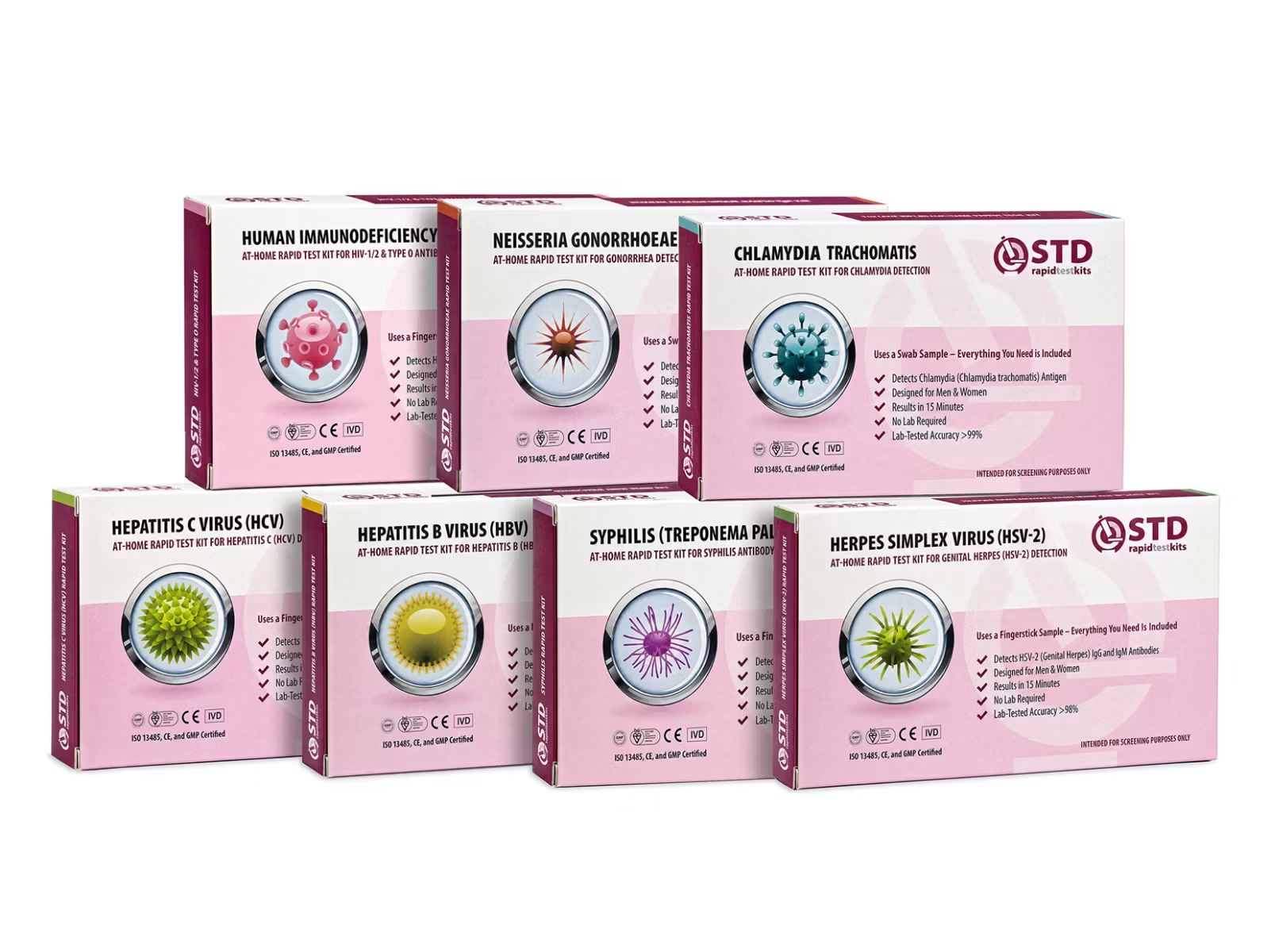
If a discreet at-home option fits the situation better than a clinic visit, the combo STD home test kits cover the most common bacterial infections behind this symptom pattern. The result is yours, the timing is yours, and the next step, whatever it is, is yours to choose.
Frequently Asked Questions
- Is watery discharge but no smell usually normal?
- Most of the time, yes, especially when it appears around ovulation and resolves within a few days. The body produces more cervical fluid mid-cycle, and that fluid can feel surprisingly wet. Without odor, itching, pain, or recent unprotected exposure, hormonal cycling explains it.
- Can chlamydia cause watery discharge with no odor?
- Yes. Chlamydia is one of the most often-asymptomatic sexually transmitted infections, and when symptoms do appear, they can be as quiet as a slight shift in discharge. If recent sex was unprotected and discharge feels different from the usual pattern, testing around 7 to 14 days after exposure is a reasonable response.
- How soon after sex would STI-related discharge appear?
- For chlamydia and gonorrhea, when symptoms appear at all, they usually show up within days to a few weeks. Many people never notice obvious symptoms. CDC guidance is that timing matters more than symptom intensity, which is why annual screening is recommended for sexually active women under 25 and for older women with risk factors.
- If there is no itching, can yeast be ruled out?
- Mostly. Yeast infections almost always come with intense itching plus thick, white, clumpy discharge. Clear, watery fluid with no irritation is unlikely to be yeast.
- What if discharge only appears after sex?
- First check whether it is actually discharge. Semen, arousal fluid, and lubricant can leak for hours and feel like discharge. If it resolves within a day, it is almost always residual sexual fluid. If it lasts several days or keeps increasing, the case for testing strengthens.
- The test came back negative but the discharge has not changed. What now?
- A negative result at the right time is meaningful. If you tested before day 7 post-exposure, retesting at day 14 is reasonable. If timing was right and results stayed negative, a clinician can evaluate other causes such as BV, cervicitis, yeast, or hormonal fluctuation. None of those show up on a standard STI lateral-flow strip.
- Can stress really change discharge?
- Yes. Stress shifts hormone levels, and hormones drive cervical mucus. People going through breakups, work pressure, travel, or sleep disruption often notice temporary discharge changes. The pattern usually settles as life settles.
- Is watery discharge in people with penises always an STI?
- Not always, but it is worth investigating. Penile discharge unrelated to arousal is uncommon enough that any persistent clear or cloudy fluid warrants testing for chlamydia and gonorrhea. Testing becomes reliable around 7 days after exposure with better accuracy at 14 days.
- U.S. Centers for Disease Control and Prevention. Chlamydia: basic and detailed fact sheet covering symptoms, the asymptomatic majority of cases, screening recommendations for women under 25, and complications including pelvic inflammatory disease.
- U.S. Centers for Disease Control and Prevention. Gonorrhea: basic fact sheet covering urethral and vaginal discharge symptoms, screening, and treatment.
- U.S. Centers for Disease Control and Prevention. Bacterial vaginosis: symptoms (thin discharge with fishy odor), treatment, and connection to elevated STI susceptibility.
- U.S. Centers for Disease Control and Prevention. Trichomoniasis: symptoms and clinical context.
- World Health Organization. Sexually transmitted infections: global prevalence and symptom data fact sheet, including frothy discharge as a recognised trichomoniasis sign.
- U.K. National Health Service. Vaginal discharge: clinical guidance on normal discharge across the cycle and pregnancy, and red-flag patterns.
