
Published: November 2025 | Last updated: April 2026 | Editorial review and quality control: Martina N.
Putting off a sexual-health test because the clinic feels impossible is a real, common reason people stay in the dark. Cost, judgment, the fear of being recognized in a small-town waiting room, work schedules that don't bend, dorm life, a partner who would notice if you went, none of these are excuses. They are the reason at-home rapid testing exists at all. This guide walks through what at-home tests can answer for chlamydia, gonorrhea, HIV, syphilis, hepatitis B, hepatitis C, and herpes; how the technology works; when each test is reliable; and what to do with the result, whatever it shows.
The short version: rapid lateral-flow kits are screening tools you run at home in about 15 minutes. They are different chemistry from the lab nucleic acid amplification test (NAAT) a clinician would order, and they are not the right tool for every kind of exposure. Knowing which test fits your situation is the difference between a useful answer and a misleading one.
Can I really test for STDs at home?
Yes. At-home rapid kits use a self-collected genital swab (for chlamydia and gonorrhea) or a fingerstick drop of blood (for HIV, syphilis, hepatitis B, hepatitis C, and herpes), with results visible on a lateral-flow cassette in about 15 minutes. The most reliable timing is 14 days after exposure for chlamydia and gonorrhea, 18 to 90 days for HIV rapid antigen/antibody tests, 3 to 6 weeks for syphilis, and 12 weeks for herpes antibodies. A positive at-home result is a screening signal; confirmation at a clinic NAAT is the next step before treatment.
Key takeaways
- At-home rapid tests are FDA-cleared lateral-flow screening tools, not the lab NAAT or PCR your doctor's office runs. Any positive result should be confirmed with a clinic NAAT before treatment is started.
- Test timing matters more than test brand. Chlamydia and gonorrhea need 14 days after exposure; HIV needs up to 90 days for a rapid antigen/antibody test; herpes needs 12 weeks. Testing too soon is the most common reason a home kit gives a false negative.
Why home testing exists in the first place
Millions of new sexually transmitted infections are diagnosed in the United States every year, according to the CDC's STI overview. The people most at risk are also the people least likely to walk into a sexual-health clinic. The reason is rarely apathy. It is the gap between knowing you should test and being able to test on a Tuesday morning without explaining yourself to a receptionist, an insurer, or a roommate.
At-home kits exist to close that gap. They run the same 15-minute lateral-flow chemistry that walk-in clinics use for rapid screening, in plain packaging, on your schedule, in your bathroom. They are not the deepest test available. The CDC's gold standard for chlamydia and gonorrhea remains a laboratory nucleic acid amplification test processed by a CLIA-certified lab, and a positive at-home result is something you confirm at a clinic before starting treatment. For the question "do I need to act on this exposure today," rapid screening is faster than any lab.
Most readers who land on this page do not, statistically, have an STI. The largest single use of at-home testing is reassurance after a single new partner, a slipped condom, or a worrying symptom that turns out to be something else. Most readers leave with a clear negative and an answer to the anxiety. The smaller share who do test positive get a head start on treatment days or weeks earlier than they otherwise would.
Delayed testing is rarely about not caring. It is about being unable to take half a day off work, sit in a clinic waiting room, and explain a recent partner to a stranger. At-home rapid kits remove that scheduling friction without sacrificing the reliability of a screening result, provided you respect each infection's window period.
What home rapid tests actually screen for
Every kit on this site uses lateral-flow immunoassay technology, the same chemistry as a home pregnancy test or a rapid COVID antigen test. A small sample, either a self-collected genital swab or a fingerstick drop of blood, is applied to a cassette. Antibodies or antigens in the sample bind to capture lines on a strip, and a colored band appears within 15 minutes if the target is present.
Lateral flow is fast and accessible. It is also a different chemistry from the polymerase chain reaction (PCR) and NAAT methods labs use. NAAT amplifies bacterial or viral DNA and is more analytically sensitive, especially for low-load asymptomatic infections. Rapid lateral-flow kits are screening tools that complement, rather than replace, lab testing. A positive at-home result should always be confirmed with a clinic NAAT before treatment is started, and a negative result close to the edge of a window period is worth retesting later.
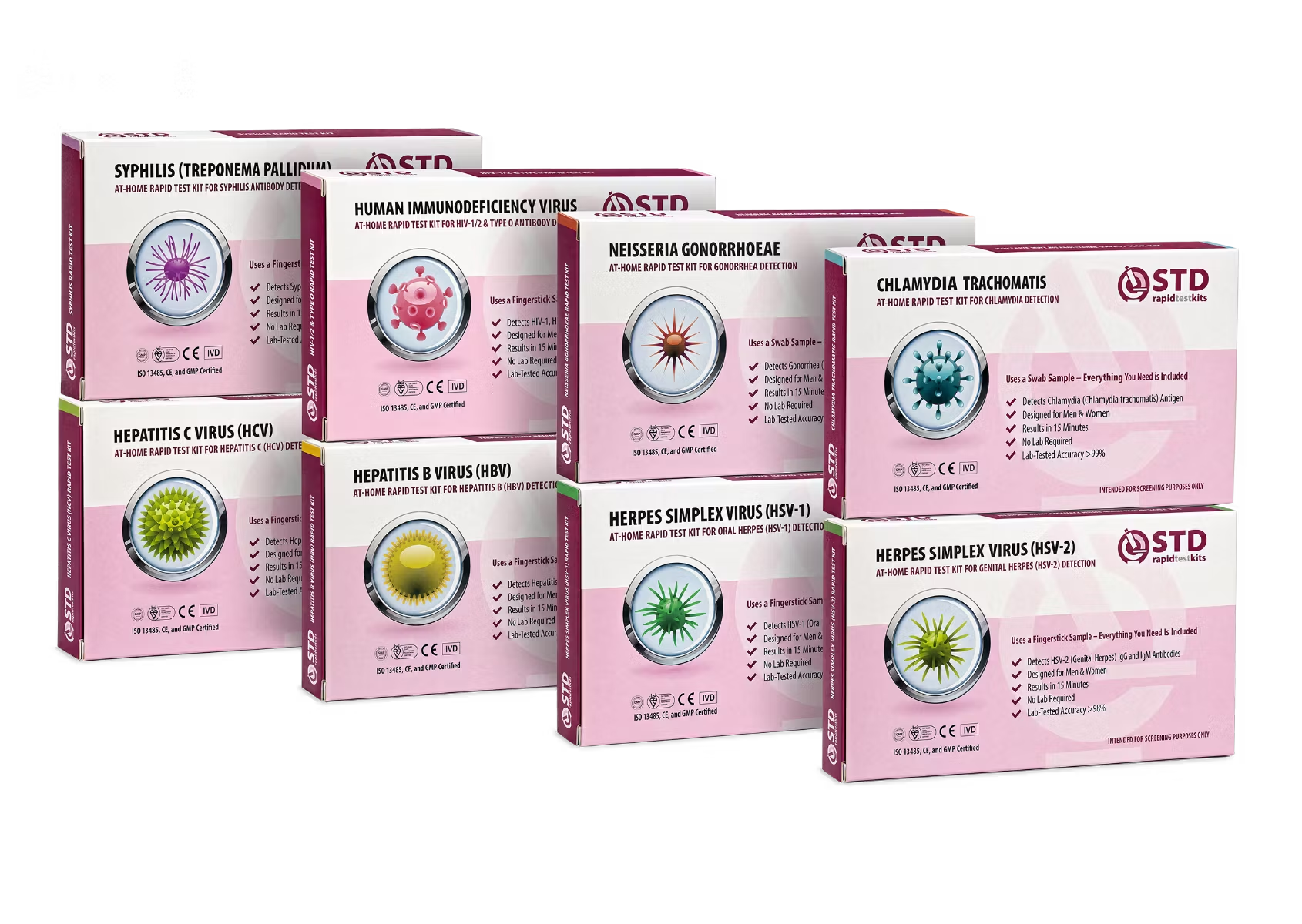
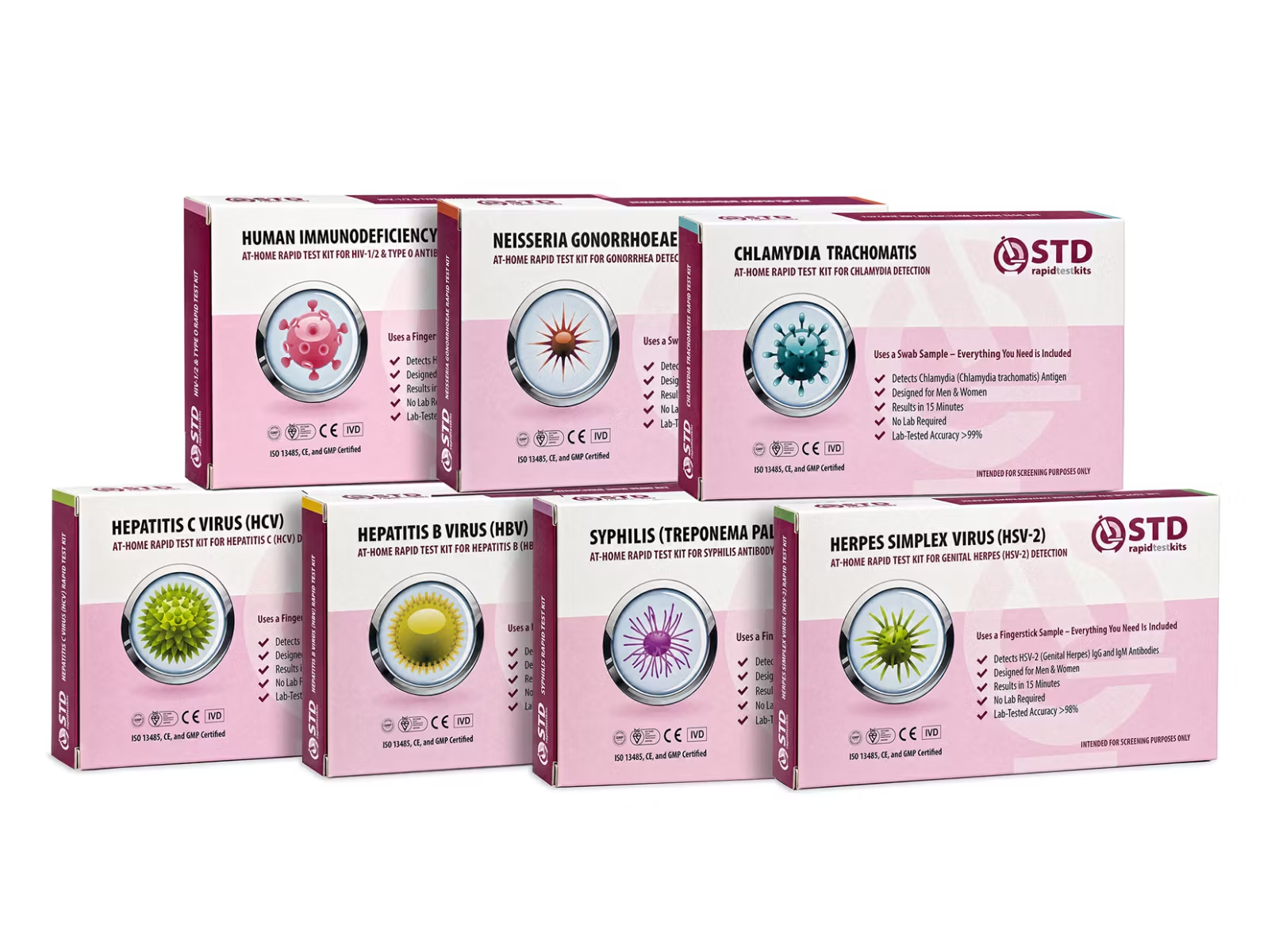
Our catalog covers the seven most common at-home-testable infections: chlamydia, gonorrhea, HIV, syphilis, hepatitis B, hepatitis C, and herpes (with HSV-1 and HSV-2 sold as separate kits or as a combined panel). What at-home rapid kits do not cover, and where you should head straight to a clinic, is throat-swab gonorrhea, rectal-swab chlamydia or gonorrhea, urine-sample testing, and any lab-processed mail-in panel. If your exposure was strictly oral or anal, the right test is at the clinic, not in the box.
This article is published by stdrapidtestkits.com, which sells at-home STI testing kits. We recommend products based on fit-for-purpose for the reader's concern, not commercial benefit. If a clinic test is the right tool for your specific exposure, we say so plainly.
When to test after exposure
The single most common reason a home test gives a false negative is being run too early. Each infection has a window period, the lag between exposure and the moment the test can reliably detect it. Test inside that window and the result is unreliable, regardless of which kit you use.
Chlamydia and gonorrhea need about 14 days after exposure to reach detectable levels. The CDC's STI treatment guidelines note that bacterial loads can be detectable from around day 5 in some people, but day 14 is the conservative window for high reliability. HIV rapid antigen/antibody tests reach reliability between 18 and 90 days post-exposure, per the CDC's HIV testing guidance; the lower end of that range applies to the most sensitive lab-based fourth-generation assays, while at-home rapid antibody/antigen kits should be retested at 90 days for high confidence. Syphilis takes 3 to 6 weeks for antibody seroconversion. Hepatitis B surface antigen is detectable from about 4 weeks. Hepatitis C antibodies usually appear by 8 to 11 weeks. Herpes (HSV-1 and HSV-2) antibody tests need 12 weeks for reliable seroconversion.
Testing too soon is the single most common reason a home kit gives a false negative. If panic is driving the timing, run a test now for the peace of mind it gives, then schedule a confirmatory retest at the conservative window listed above. The retest is the one that determines whether treatment is needed.
| Infection | Sample type at home | Earliest detection | Reliable window |
|---|---|---|---|
| Chlamydia | Genital swab | 5 to 7 days | 14 days |
| Gonorrhea | Genital swab | 5 to 7 days | 14 days |
| HIV (rapid antigen/antibody) | Fingerstick blood | 18 days | 90 days for high confidence |
| Syphilis | Fingerstick blood | 21 days | 6 weeks |
| Hepatitis B (surface antigen) | Fingerstick blood | 4 weeks | 8 weeks |
| Hepatitis C (antibody) | Fingerstick blood | 8 weeks | 11 weeks |
| Herpes (HSV-1, HSV-2) | Fingerstick blood | 6 weeks | 12 weeks |
Swab versus blood: which sample type your kit uses
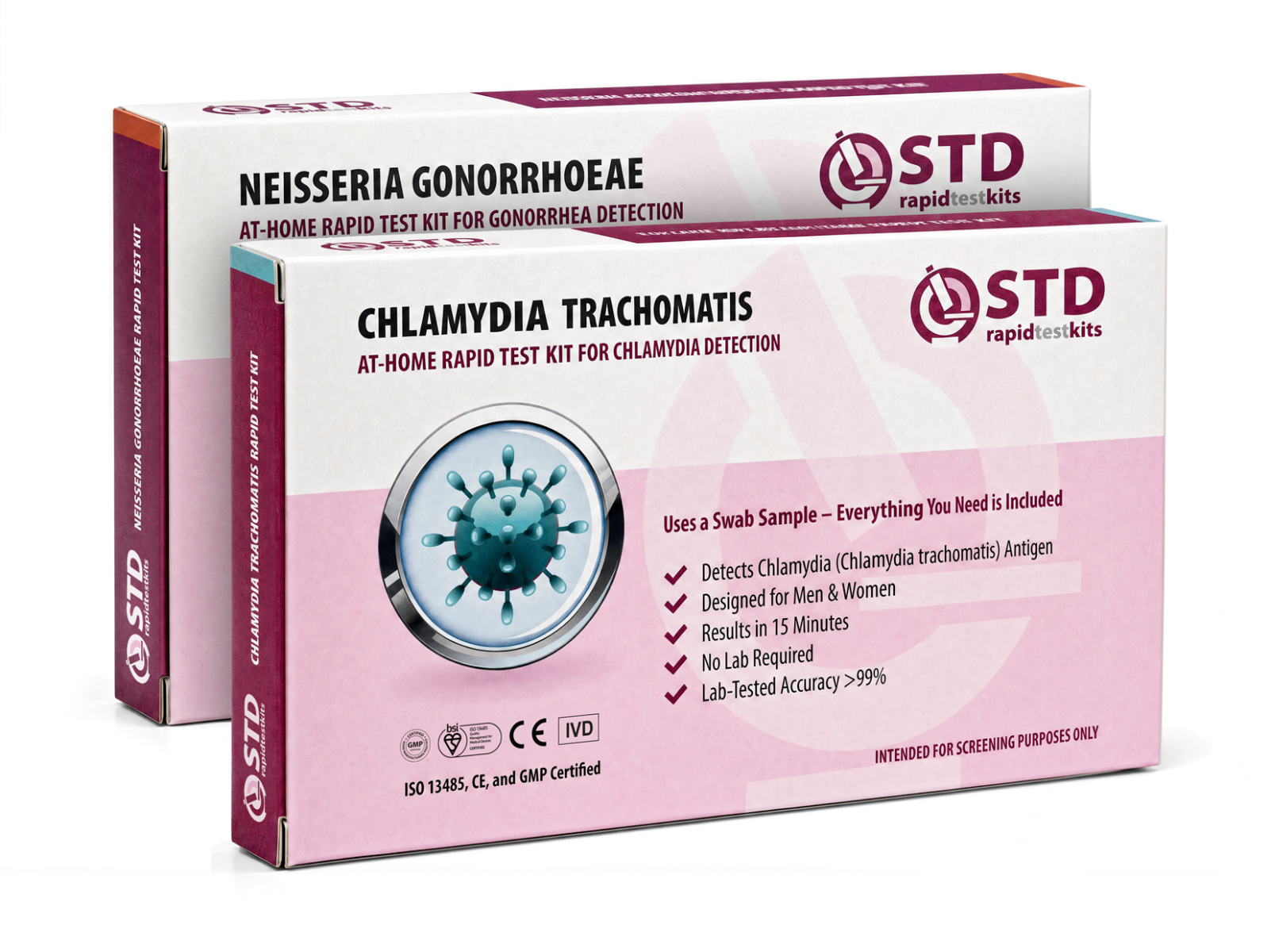
The right sample type is determined by the infection, not by your preference. Bacterial infections that live on the genital mucosa (chlamydia, gonorrhea, trichomoniasis, HPV) are detected by a self-collected genital swab. Bloodborne or systemic infections (HIV, syphilis, hepatitis B, hepatitis C, herpes) are detected by a fingerstick drop of blood.
Genital swabs are self-collected. For people with vaginas, that means a 2 to 3 inch insertion of the supplied swab and rotation against the vaginal wall for about 15 seconds. For people with penises, a smaller swab is rotated inside the urethral opening or rolled along the head. The swab is then placed into a buffer solution and applied to the cassette. The collection sounds awkward and is briefly uncomfortable, though not painful.
Fingerstick blood tests come with a single-use lancet that produces a small bead of blood from a clean fingertip. The blood is collected with a dropper or capillary tube, mixed with the supplied buffer, and applied to the cassette. Most people describe it as less painful than a standard blood draw at a clinic.
You will not see at-home options for urine samples, throat swabs, or rectal swabs in our catalog. Those collections require a different chemistry or a different sample-handling protocol that does not exist in a consumer rapid kit, and a clinic is the right setting for them.
| Collection method | Target infections | Discomfort level | Sample volume |
|---|---|---|---|
| Self-collected genital swab | Chlamydia, gonorrhea (also trichomoniasis and HPV in dedicated kits) | Brief, awkward, not painful | Tissue scraping into buffer tube |
| Fingerstick blood drop | HIV, syphilis, hepatitis B, hepatitis C, HSV-1, HSV-2 | Brief pinprick, similar to a glucose test | Single drop into buffer |
Step by step: doing an at-home test correctly
Read the instructions before opening anything. Each kit has slightly different drop counts, timing windows, and reading thresholds, and skipping the instructions is the most common cause of an invalid result.
Wash and dry your hands. Lay out the cassette, the collection materials, and the buffer on a clean surface in good light. Do not collect the sample on a wet bathroom counter where stray water can run into the cassette window.
For a swab kit, follow the supplied technique guide for your anatomy. Rotate the swab against the target tissue for the full duration the instructions specify. Place the swab into the buffer tube, swirl, and squeeze excess liquid out as directed. Apply the specified number of drops to the sample well on the cassette.
For a fingerstick kit, prick the side of a clean fingertip with the supplied lancet, then collect blood with the dropper or capillary tube into the buffer. Apply the resulting mixture to the sample well.
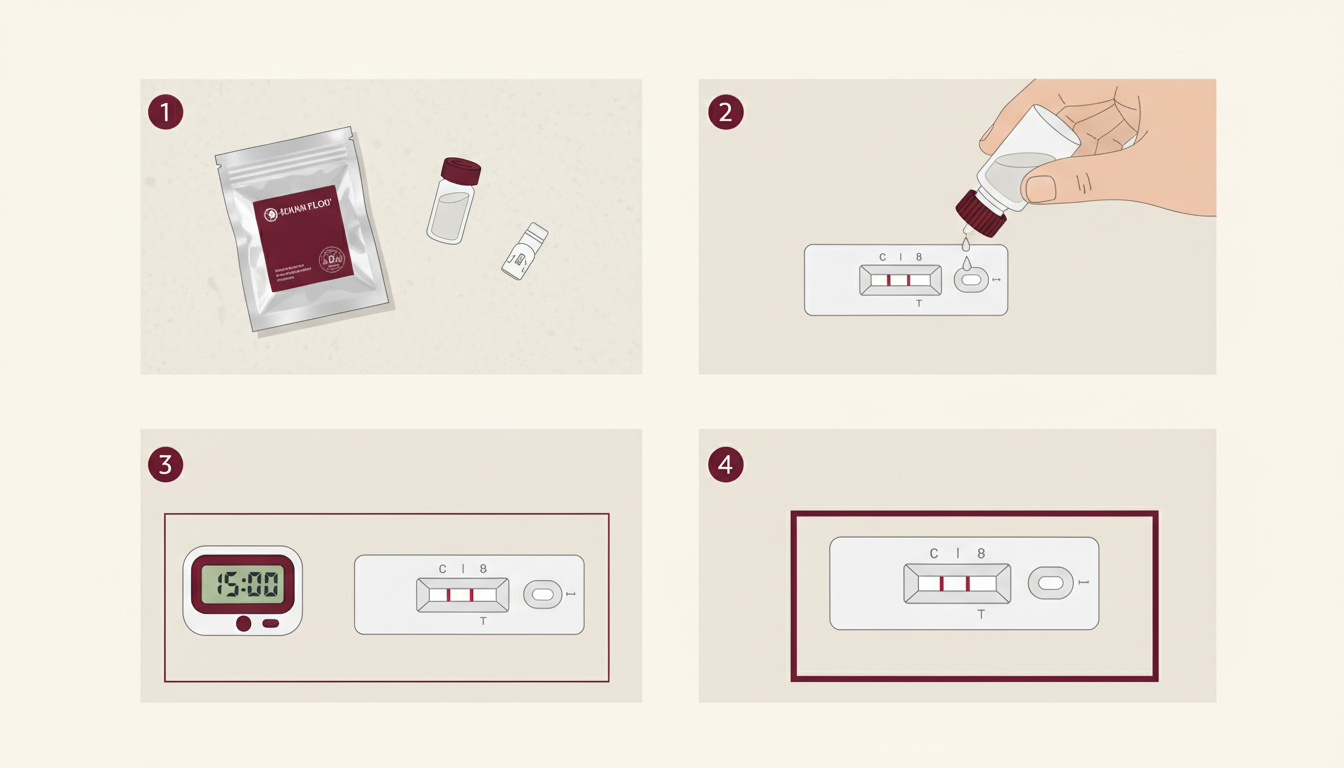
Set a timer for the read window listed in your kit (most are 10 to 15 minutes). Do not read the cassette before that window or after the maximum read time, which is usually 30 minutes. A control line must always appear; without it, the test is invalid and you should run a fresh cassette.
Reading the result, including faint lines
A lateral-flow cassette has two reading positions: a control line (C) and a test line (T). The control line confirms the test ran correctly. If the control band does not appear within the read window, the test is invalid; throw it out and run another cassette.
If only the control band appears, the result is negative for the target infection (within the limits of the window period). If both the control and test bands appear, the result is positive, even if the test band is faint. A faint test band is still a positive result; the intensity of the band reflects how much antigen or antibody is present in your sample, not how confident the result is.
The exception to that rule is a band that appears outside the labeled read window (most commonly an evaporation artifact appearing 30 to 60 minutes after the test was run). Bands that develop late, after the read window has closed, do not count. Reading the cassette at the correct time is part of the test, not optional.
A faint band that appears within the labeled read window is a positive result. A band that develops after the read window has closed (usually 30 minutes plus) does not count and may be an evaporation artifact. When in doubt, run a fresh cassette and confirm any positive with a clinic NAAT before any treatment decision.
What to do if your test is positive
A positive at-home rapid result is a screening signal, not a final diagnosis. The right next move is a clinic NAAT (for bacterial infections) or a confirmatory blood test (for HIV, syphilis, hepatitis, herpes) before antibiotics or antivirals are started. This matters because lateral-flow tests have a non-zero false-positive rate, and a single course of antibiotics aimed at the wrong target wastes the medicine without helping.
For bacterial STIs (chlamydia, gonorrhea, syphilis), confirmation and treatment are usually fast. Most urgent care clinics, Planned Parenthood centers, and primary care offices can run a confirmatory NAAT and prescribe a course of antibiotics in a single visit. The treatments themselves are well-tolerated: chlamydia is a 7-day doxycycline course, gonorrhea is a single ceftriaxone injection, syphilis is one or more penicillin injections depending on stage.
For viral infections (HIV, hepatitis B, hepatitis C, herpes), a confirmed positive triggers a referral to a specialist for ongoing management. Modern antiretroviral therapy for HIV, direct-acting antivirals for hepatitis C, and suppressive therapy for herpes have transformed each of these from a life-altering diagnosis into a chronic condition you live with. The earlier you start, the better the outcomes.
Partner notification is the other piece. Most jurisdictions offer anonymous notification services through the local health department, which means you do not have to be the one delivering the news. A simple message that says "I tested positive and you should get checked" is enough. You do not owe anyone an explanation of your sex life beyond that.
What about throat, rectal, or urine-based exposure?
Three gaps in the at-home rapid catalog are worth knowing about before you order.
Pharyngeal (throat) gonorrhea and chlamydia exist and are common, especially after oral sex with a new partner. The right test for them is a throat swab processed on a lab NAAT. We do not sell that kit, and a home rapid swab on a tongue or tonsil is not validated. If you are testing because of an oral exposure, see a sexual-health clinic for a pharyngeal NAAT.
Rectal chlamydia and gonorrhea are also common, especially in receptive partners. Like pharyngeal infections, these need a rectal swab on a lab NAAT, which is a clinic test. A genital swab kit will not detect rectal infection.
Urine-sample testing for chlamydia and gonorrhea is the standard for people with penises in clinic settings; it is not currently a sample type in a consumer rapid kit. Our catalog covers urethral and vaginal swabs, which give comparable sensitivity for genital infection at home.
The genital swab and fingerstick blood kits we sell still do useful work for the bloodwork side of any exposure event (HIV, syphilis, hepatitis, herpes seroconversion). If your exposure was multi-route, run the home tests for the bloodwork markers and book a clinic visit for the swab markers you cannot do at home.
Pharyngeal gonorrhea or chlamydia (oral exposure) and rectal gonorrhea or chlamydia (receptive anal exposure) need a clinician-collected swab processed on a lab NAAT. Book a sexual-health clinic, urgent care, or Planned Parenthood appointment specifically for those swabs. Our at-home blood tests still cover the systemic side of the same exposure event (HIV, syphilis, hepatitis B, hepatitis C, herpes seroconversion) while you wait for the clinic visit.
Privacy and discretion: what the box looks like
Shipping arrives in plain corrugated cardboard with no medical labeling on the outside. The return address is the warehouse, not a clinic name. Bank statements and credit card descriptors use a generic merchant code, not the product name. Nothing about the package, the charge, or the delivery notification announces what is inside.
Your name does not enter any public health database unless you pursue clinic confirmation and treatment, and even then you are protected by the same medical-record privacy that applies to any other diagnosis. Roommate visibility, employer visibility, and family-plan-insurance visibility are non-issues for the at-home kit itself.
Self-collected vaginal swabs are an effective method to screen for chlamydia and gonorrhea infections. Self-collection has been shown to be acceptable, comparable in sensitivity to clinician-collected samples, and to expand access to testing.
Coverage at a glance: each infection in one paragraph
The seven infections our at-home rapid kits cover, with the essentials for each: cause, sample type, window period, and whether it is curable or managed long-term.
Chlamydia. Caused by Chlamydia trachomatis. The most reported bacterial STI in the United States, often asymptomatic. Genital swab at home, 14-day window. Curable with a 7-day course of doxycycline. Untreated infection can lead to pelvic inflammatory disease and tubal-factor infertility, which is why screening matters even without symptoms (see the NHS chlamydia overview).
Gonorrhea. Caused by Neisseria gonorrhoeae. Often asymptomatic in women, sometimes presents as a burning sensation or discharge in men. Genital swab at home, 14-day window. Curable with a single ceftriaxone injection, though antibiotic resistance is a growing concern per the CDC's antimicrobial resistance surveillance.
Syphilis. Caused by Treponema pallidum. Stages from a painless chancre through systemic and neurological involvement. Fingerstick blood at home, 3 to 6 week window for antibody detection. Curable with one or more penicillin injections depending on stage; early detection prevents the late-stage complications.
HIV. Human immunodeficiency virus. Lifelong but well-managed condition with modern antiretroviral therapy. Fingerstick blood at home, window depends on assay generation (18 to 90 days for rapid antigen/antibody tests, per the CDC's HIV testing guidance). Not curable; daily ART suppresses the virus to undetectable levels and stops sexual transmission.
| Infection | Curable or manageable | Sample type at home | Reliable window |
|---|---|---|---|
| Chlamydia | Curable (7-day doxycycline) | Genital swab | 14 days |
| Gonorrhea | Curable (single ceftriaxone injection) | Genital swab | 14 days |
| Syphilis | Curable (penicillin) | Fingerstick blood | 6 weeks |
| HIV | Manageable (daily ART) | Fingerstick blood | 90 days for rapid kit |
| Hepatitis B | Vaccine-preventable; chronic form managed with antivirals | Fingerstick blood | 8 weeks |
| Hepatitis C | Curable in most cases (8 to 12 week DAAs) | Fingerstick blood | 11 weeks |
| Herpes (HSV-1, HSV-2) | Manageable (suppressive antivirals) | Fingerstick blood | 12 weeks |
Coverage at a glance, continued: the hepatitis viruses and herpes
Hepatitis B. A viral liver infection that can be acute or chronic. Fingerstick blood at home, 4 to 8 week window for surface antigen detection. Vaccine-preventable; chronic infection is managed with antivirals.
Hepatitis C. A viral liver infection transmitted primarily through blood-to-blood contact (including sexual contact involving blood). Fingerstick blood at home, 8 to 11 week window for antibody detection. Curable in most cases with an 8 to 12 week course of direct-acting antivirals.
Herpes (HSV-1 and HSV-2). Lifelong viral infections, with most transmission happening during asymptomatic shedding. Fingerstick blood antibody test at home, 12-week window. Not curable; suppressive antiviral therapy reduces outbreaks and transmission risk.
A short note before you order
Pick the kit that matches the exposure, not the cheapest panel and not the broadest one by default. If your concern is a single new partner with a slipped condom, the chlamydia plus gonorrhea 2-in-1 swab covers the highest-probability bacterial markers, and a separate fingerstick HIV or syphilis kit covers the bloodwork side. The 7-in-1 and 8-in-1 panels cover every bloodwork marker and both bacterial swabs in a single order, which is the practical choice when the exposure crossed routes and you want one cassette session to settle the question. The most expensive panel is not the right answer for everyone, and the cheapest single-infection kit is not the right answer when your exposure was multi-route.
Frequently asked questions
- Are at-home rapid STI tests as accurate as clinic lab tests?
- They are reliable screening tools, not the same chemistry as a clinic NAAT. Lateral-flow rapid kits typically report sensitivity in the mid-to-high 90s for symptomatic infections within the correct window period and specificity above 99 percent. Lab NAATs are more analytically sensitive for low-load asymptomatic infections, which is why a positive at-home result should be confirmed with a clinic NAAT before treatment is started.
- Can I really test for chlamydia and gonorrhea at home without a doctor?
- Yes. The at-home rapid kit uses a self-collected genital swab and gives a 15-minute result. The CDC's STI screening guidance accepts self-collected vaginal swabs as comparable in sensitivity to clinician-collected swabs. The kit ships in plain packaging, with no clinic visit, prescription, or insurance involvement required.
- How soon after a possible exposure should I test?
- For chlamydia and gonorrhea, wait 14 days. For HIV, 18 to 90 days for an at-home rapid antigen/antibody test, with 90 days giving high confidence. For syphilis, 3 to 6 weeks. For hepatitis B, 4 to 8 weeks. For hepatitis C, 8 to 11 weeks. For herpes (HSV-1 and HSV-2), 12 weeks. Testing earlier can produce a false negative because your body has not yet built up enough of the target marker for the cassette to detect.
- What if I have no symptoms? Should I still test?
- Yes. The majority of chlamydia, gonorrhea, and HIV infections cause no symptoms in their early stages. The CDC recommends annual screening for sexually active people under 25 and after each new partner regardless of symptoms. Most of these infections spread precisely because the person carrying them feels fine, which is why symptom-free testing matters.
- What if the test line is faint? Is that positive?
- Any visible line in the test position within the labeled read window, even a very faint one, is a positive result. Line intensity reflects how much antigen or antibody was in your sample, not whether the result is reliable. Photograph the cassette before the read window closes, then book a clinic NAAT to confirm before any treatment decision.
- Can I get tested for throat or rectal gonorrhea at home?
- No. Throat and rectal samples require lab-processed NAAT, which means a clinic visit. If the same exposure also put you at risk for HIV, syphilis, hepatitis B, hepatitis C, or herpes, our at-home blood tests cover the systemic side of the event while you wait for that appointment.
- Will the package be obvious to my roommate or partner?
- The shipping box is plain corrugated cardboard with no medical labeling. The return address is the warehouse, not a clinic. Bank and credit card statements use a generic merchant code rather than the product name. The package looks like any other small parcel from any other online retailer.
- If I tested positive and got treated, do I need to test again?
- Yes, three months after treatment for bacterial STIs (chlamydia, gonorrhea, syphilis). The CDC recommends this not because treatment usually fails, but because reinfection from an untreated partner is the most common reason an infection comes back. The same applies if you have new partners after treatment. Testing within the first 3 weeks post-treatment can produce a false positive from residual bacterial DNA.
- U.S. Centers for Disease Control and Prevention. About STIs. General population overview cited for the introduction's framing on the burden of STIs in the United States.
- U.S. Centers for Disease Control and Prevention. Sexually Transmitted Infections Treatment Guidelines, 2021. Window periods, treatment regimens, and screening recommendations referenced throughout.
- U.S. Centers for Disease Control and Prevention. Getting tested for STIs. Sample types, self-collection guidance, and testing-frequency recommendations.
- U.S. Centers for Disease Control and Prevention. HIV testing overview. Window periods for rapid antigen/antibody tests (18 to 90 days) and lab-based fourth-generation assays cited throughout.
- U.K. National Health Service. Chlamydia symptoms, transmission, and self-collection guidance.
- World Health Organization. Sexually transmitted infections fact sheet. Global incidence figures and treatment access.
