
Published: October 2025 | Last updated: April 2026 | Editorial review and quality control: Martina N.
You typed it into the search bar at two in the morning. "STD test near me." Then you closed the tab. Maybe the closest clinic is forty minutes away. Maybe the receptionist there knows your mother. Maybe you have not come out to anyone in town, and a paper trail at a sexual-health clinic feels like a fuse waiting to be lit. Whatever the reason, stepping back from the in-person visit is more common than the public-health posters let on. At-home rapid testing exists to fill exactly that gap.
This guide walks through what an at-home kit can actually screen for, when to test for results that mean something, how the discreet shipping really works, and what to do if a result comes back positive. No moralizing, no scare tactics. Just specifics you can use today.
Can I really test for STDs without going to a clinic?
Yes. Rapid lateral-flow at-home tests can screen for the most common sexually transmitted infections, including HIV, syphilis, chlamydia, gonorrhea, hepatitis B, hepatitis C, and herpes. They typically deliver a result in 10 to 20 minutes from a fingerprick blood drop or a self-collected swab, and they ship in plain unmarked packaging. A positive screening result is worth confirming with a laboratory NAAT, especially for HIV and syphilis. A negative result is only meaningful inside the correct window period for that infection.
Key Takeaways
- At-home rapid kits screen for HIV, syphilis, chlamydia, gonorrhea, hepatitis B and C, and herpes using a self-collected swab or fingerprick blood drop, with a result in 15 minutes.
- Timing matters. Most infections need 7 to 14 days (chlamydia, gonorrhea), 3 to 6 weeks (syphilis), or 23 to 90 days (HIV antibody) before a test reliably picks them up.
What at-home STD tests actually cover
Most consumer at-home kits sold in the United States use rapid lateral-flow chemistry. The format is similar to a home pregnancy test or a COVID-19 antigen strip: a small sample (a fingerprick blood drop or a self-collected swab) is loaded onto a paper cassette, and antibodies or antigens fixed to the membrane bind to anything in the sample, producing a colored line in 10 to 20 minutes.
This is not the same chemistry that a hospital lab uses. Labs typically run nucleic acid amplification tests (NAATs) for bacterial infections like chlamydia and gonorrhea, which detect DNA or RNA fragments and have higher analytical sensitivity than any home format. Lateral-flow at-home tests are screening tools. A positive result is worth confirming with a lab NAAT or a clinician, especially for HIV and syphilis. A negative result during the wrong window period can miss an infection that is genuinely there. The two test types complement each other and are not interchangeable.
At-home formats offer a genuine upside. The U.S. Centers for Disease Control and Prevention supports HIV self-testing as one of the strategies for reaching people who avoid clinic-based screening, and similar logic applies across the broader STI panel. The kits sold by reputable retailers in the United States typically cover the infections in the table below.
| Infection | Sample Type | Result Time | Notes |
|---|---|---|---|
| Chlamydia | Self-collected genital swab | 15 minutes | Any-gender kit. Reliable from day 7 to 14 post-exposure. |
| Gonorrhea | Self-collected genital swab | 15 minutes | Any-gender kit. Reliable from day 7 to 14 post-exposure. |
| HIV (1 and 2) | Fingerprick blood drop | 15 minutes | Antibody screen. Confirm any positive with a lab antigen/antibody test. |
| Syphilis | Fingerprick blood drop | 15 minutes | Treponemal antibody screen. Reliable after 3 to 6 weeks. |
| Hepatitis B | Fingerprick blood drop | 15 minutes | HBsAg detection. Confirm positives with viral-load testing. |
| Hepatitis C | Fingerprick blood drop | 15 minutes | Anti-HCV antibody screen. Reliable from week 8 to 11 post-exposure. |
| Herpes (HSV-2) | Fingerprick blood drop | 15 minutes | Type-specific IgG. Most blood panels do not type-specifically include HSV-1. |
| Trichomoniasis | Self-collected vaginal swab | 15 minutes | Female anatomy only. We do not sell a male-compatible trichomoniasis kit. |
| HPV | Self-collected vaginal swab | 15 minutes | Female anatomy only. Cervical screening adjunct, not a replacement for a Pap test. |
Why timing changes everything (even when you are panicking)
The first instinct after a possible exposure is to test as soon as the package arrives. Your body needs time first. Each infection has a window period, the gap between exposure and the moment a test can reliably detect either the pathogen or your antibody response to it. Test before that window closes and you can get a falsely reassuring negative result.
The window period is also separate from the incubation period, which is when symptoms might appear. You can be infectious and asymptomatic, or have early symptoms while a test still reads negative because antibodies have not built up yet. Per the CDC's HIV testing overview, a rapid antibody self-test can take from 23 days to 90 days post-exposure to register reliably. The numbers below summarize the working windows that public-health bodies use as practical guidance.
| Infection | Earliest Reliable Test | Recommended Test Date | Retest If Negative |
|---|---|---|---|
| Chlamydia | 7 days | 14 days post-exposure | At 14 to 21 days if symptoms persist |
| Gonorrhea | 7 days | 14 days post-exposure | At 14 to 21 days if symptoms persist |
| Syphilis | 3 weeks | 6 weeks post-exposure | At 12 weeks for high-risk exposures |
| HIV (rapid antibody) | 23 days | 90 days for definitive negative | At 90 days for full assurance |
| Hepatitis B | 3 to 6 weeks | 6 to 12 weeks post-exposure | At 12 weeks |
| Hepatitis C | 8 to 11 weeks | 11 weeks post-exposure | At 6 months for definitive |
| Herpes (HSV-2 IgG) | 3 weeks | 12 weeks for most; up to 16 weeks in slow-seroconverters | If new symptoms develop later |
| Trichomoniasis | 5 days | 1 to 4 weeks | If symptoms develop |
Privacy and what discreet shipping really looks like
The most repeated worry in customer-service inboxes is some version of "what does the box look like?" The realistic answer: like an unbranded health-supplies parcel. Reputable retailers ship at-home STI kits in plain corrugated cardboard with no STI-specific branding, no health-jargon labeling, and a generic return address. Card statements typically read as the parent company's neutral name, not the product name. The carrier driver does not see what is inside.
Inside the box are sterile collection materials, written instructions, and either a rapid-read cassette (for tests you process at home) or a prepaid envelope (for kits that require a lab). Most kits do not need refrigeration and stay shelf-stable for several months unopened. If a roommate, partner, or family member opening a package would be a problem, options include shipping to your workplace, to a trusted friend's address, to a parcel locker, or to a PO box.
The deeper privacy guarantee is that no insurance card needs to swipe and no photo identification needs to be presented. That matters for abuse survivors, undocumented residents, people on a parent's insurance, anyone living in conservative communities, and digital nomads with no fixed address. Reasons not to want a clinical paper trail are not always reasons of convenience. Some of those reasons are reasons of safety.
Plain unmarked packaging. Generic return address. No insurance card or photo ID required at checkout. Card statements read as a neutral company name, not the product. Most kits ship in 2 to 4 business days within the United States, with options for workplace, friend's-address, parcel-locker, or PO box delivery.
At-home vs clinic testing: what you trade off
At-home rapid kits are not a clinic replacement. They are a different tool for a different best-use case. The honest comparison below is what to weigh when picking the format that fits your situation.
Consider the in-person clinic visit when persistent symptoms warrant a physical exam, when an infection like throat or rectal gonorrhea may require a swab type that home kits do not currently sell (we want to be explicit: at-home kits in our catalog are genital and bloodwork tests, not pharyngeal or rectal swabs), or when you need confirmation testing on a positive home result. Use the at-home rapid screen for routine privacy-preserving screening, for low-friction repeat testing in established sexual partnerships, and for situations where the clinic visit itself is the barrier to getting any answer at all.
| Format | Privacy | Time to Result | Sensitivity Profile | Best For |
|---|---|---|---|---|
| At-home rapid (lateral-flow) | Very high | 15 to 20 minutes | High when used in window | Routine screening, anxiety-driven testing, when the clinic itself is the barrier |
| Mail-in lab kit (NAAT) | High | 2 to 5 days plus shipping | Lab-grade NAAT | Detailed multi-infection panels, confirmatory follow-up, off-grid living |
| Clinic visit | Low to moderate | Same day to 1 week | Lab-grade NAAT plus exam | Persistent symptoms, exam-required diagnosis, throat or rectal swabs |
When (and why) to retest
Retesting fits naturally into a sexual-health routine. The two most common reasons to retest are: a first test fell outside the reliable window period, or a treatment course just finished and you want to confirm clearance.
For the early-window scenario, the playbook is simple. If you tested 5 days after a possible chlamydia or gonorrhea exposure and the result was negative, the result might be real or might be premature. Retest at the 14-day mark. For HIV, a negative rapid antibody test before day 23 is unreliable; the 90-day mark is when public-health bodies treat a negative result as a definitive negative for that exposure. For syphilis, retest at 6 weeks if the early test was negative and the exposure risk was real.
For the post-treatment scenario, the rule is the opposite of urgent. After antibiotic treatment for chlamydia or gonorrhea, residual bacterial DNA can still be detected by very sensitive tests for several weeks, even though the live infection is already cleared. The CDC's screening guidance recommends a re-screen at three months because reinfection from an untreated partner is common. Testing 3 days after a course of azithromycin is too soon and can falsely register positive on a sensitive assay.
If symptoms persist or worsen after a negative test, follow up with a clinician or a telehealth provider. A negative screening result does not override what your body is telling you.
Two retest triggers worth knowing
- Tested before day 14 for chlamydia or gonorrhea? Retest at the 14-day mark before treating the negative as final.
- Post-treatment re-screen: wait 3 months, not 3 days. Residual bacterial DNA can produce a false positive on a sensitive assay run too soon after antibiotics.
If your result comes back positive
Take a slow breath before reading further. A positive screening result means information you didn't have ten minutes ago. It does not mean your life is over. Most infections in the at-home test panel are either curable (chlamydia, gonorrhea, syphilis, trichomoniasis) or manageable with antiviral medication and routine follow-up (HIV, herpes, hepatitis B). The World Health Organization reports that direct-acting antivirals now cure more than 95% of hepatitis C infections.
The next step depends on which infection registered. For HIV, syphilis, and hepatitis: confirmatory laboratory testing is the standard recommendation before any major treatment decision, because rapid screens can occasionally produce false positives. Many telehealth services can order this for you remotely; you walk into a draw station, give a tube of blood, and get a definitive answer in 1 to 3 days. For chlamydia and gonorrhea: most clinicians will treat presumptively with antibiotics on the basis of a positive at-home result plus reported symptoms, especially when an in-person clinic visit is impractical.
Partner notification is a separate question. You do not have to phone a recent partner crying. A short factual message works: "Hey, I tested positive for [infection]. You may want to test too." Many local health departments offer anonymous partner-notification services that send the message on your behalf, removing your name entirely. The CDC's STI testing page can help you find confidential local testing and counseling options.
Talking to a partner about testing without making it weird
The conversation gets easier when the framing flips. Instead of asking "have you been tested?", which can land as an accusation, try "I just ordered an at-home kit. Want me to grab one for you too?" That positions testing as something both people are doing together, not a vetting interrogation of one person by another.
If a partner reacts with offense, defensiveness, or a "why don't you trust me?" response: that reaction is information about the partner, not evidence that suggesting a screen was unreasonable. People in healthy relationships test routinely. Treating screening as a sign of suspicion is a position from twenty years ago, and it has not aged well. The cultural shift in the last decade is toward treating regular STI testing the way regular dental cleanings are treated.
Opening: "I just ordered an at-home STI kit for myself. Want me to grab one for you too so we can do them at the same time?"
If they ask why now: "No specific reason. Both of us testing at the start of seeing each other makes it easier to leave the question alone for the next year."
If they react defensively: "This isn't an accusation. It's the same reason we'd both go to the dentist, just less inconvenient."
Myths that keep people from testing
The persistent ideas below are still talking people out of testing. Each one has a public-health body or a peer-reviewed study disagreeing with it.
- "If I had something I would feel it." Most chlamydia and gonorrhea infections in women, and a substantial share in men, produce no obvious symptoms. The CDC's screening recommendations exist precisely because asymptomatic infection is so common.
- "I am in a monogamous relationship so I am safe." Possibly. The careful version is: you are safe from new exposures during the period you have both been monogamous. Pre-existing infections from before the relationship are still on the table until both partners have screened.
- "At-home rapid kits are not real tests." Reputable lateral-flow products use the same antibody and antigen detection chemistries that clinic-based rapid tests use. The difference is the location, not the underlying science. Lab NAATs are still more analytically sensitive, which is why a positive home result for HIV or syphilis is worth confirming.
- "Suggesting testing means I do not trust my partner." Routine screening is a practice, not an accusation. Two people who test together at the start of a sexual relationship build trust faster than two people who avoid the topic.
- "I would know who gave it to me." Often you would not. Many infections sit asymptomatically for months, sometimes years. Tracing back to a single exposure is rarely possible without lab work and timing data, and it usually does not change the treatment plan.
The CDC's STI screening recommendations exist because the majority of chlamydia infections in women and a large share in men cause no symptoms at all. Waiting until symptoms appear means waiting through months of unknowing transmission and, for chlamydia and gonorrhea specifically, the window in which untreated infection can progress to pelvic inflammatory disease and downstream fertility complications.
Frequently asked questions
- Do at-home STD tests really work?
- When used inside the correct window period, yes, with accuracy on a par with clinic-based rapid tests. The single biggest cause of a wrong result is testing before the window closes, not a flaw in the kit itself. For HIV and syphilis, confirm any positive with a lab NAAT before treatment decisions.
- Will the package give me away to a roommate or partner?
- No. The outer box is plain corrugated cardboard with no health branding of any kind. Your card statement shows the parent company name. If home delivery poses a risk, redirect shipping to a workplace, parcel locker, friend's address, or PO box at checkout.
- Should I test if I have no symptoms?
- Yes if you are sexually active outside of mutual long-term monogamy. The CDC explicitly recommends routine screening for chlamydia and gonorrhea in sexually active women under 25 and in men who have sex with men, in part because asymptomatic infection is so common that waiting for symptoms misses most cases.
- How soon after exposure can I test?
- It depends on the infection. Chlamydia and gonorrhea: 14 days for reliable results. HIV antibody self-test: 23 days at the earliest, 90 days for a definitive negative. Syphilis: 3 to 6 weeks. Earlier testing can produce a falsely reassuring negative because antibody response or pathogen load has not built up yet.
- Can I test during my period?
- For blood-based fingerprick tests (HIV, syphilis, hepatitis B and C, HSV-2 IgG), yes. For self-collected vaginal swab kits (chlamydia, gonorrhea, trichomoniasis, HPV), the manufacturer instructions usually recommend waiting 2 to 3 days after the period ends to avoid sample contamination. Always check the leaflet before collecting.
- What if I mess up the sample collection?
- Most reputable kit suppliers will replace a botched kit. Re-read the instructions before starting, work over a clean dry surface, and do not skip the hand-washing step. Fingerprick lancets are forgiving, and swabs are designed for self-collection without medical training.
- What happens if I test positive?
- Confirmatory laboratory testing for HIV, syphilis, and hepatitis is the standard next step. Antibiotic treatment is straightforward for chlamydia, gonorrhea, syphilis, and trichomoniasis once confirmed. Partner notification can be done anonymously through public-health services. None of this requires walking into a clinic if telehealth is available in your state.
- How often should I test if I am sexually active?
- For people with new or multiple partners: every 3 to 6 months is the practical interval. For people in established mutually-monogamous relationships after both have screened: annually as a maintenance check. The CDC publishes detailed screening intervals by population group on its STI screening recommendations page.
You deserve answers, not assumptions
The clinic visit will not always be the right tool for the job. A local provider might be a forty-minute drive plus a receptionist who knows your family. A clinic visit assumes you have four unscheduled hours, which many shift workers and parents do not. The exam-room setting itself can be a trauma trigger for survivors of past medical harm. None of those barriers should translate into going without testing, and the at-home format exists to fill that gap.
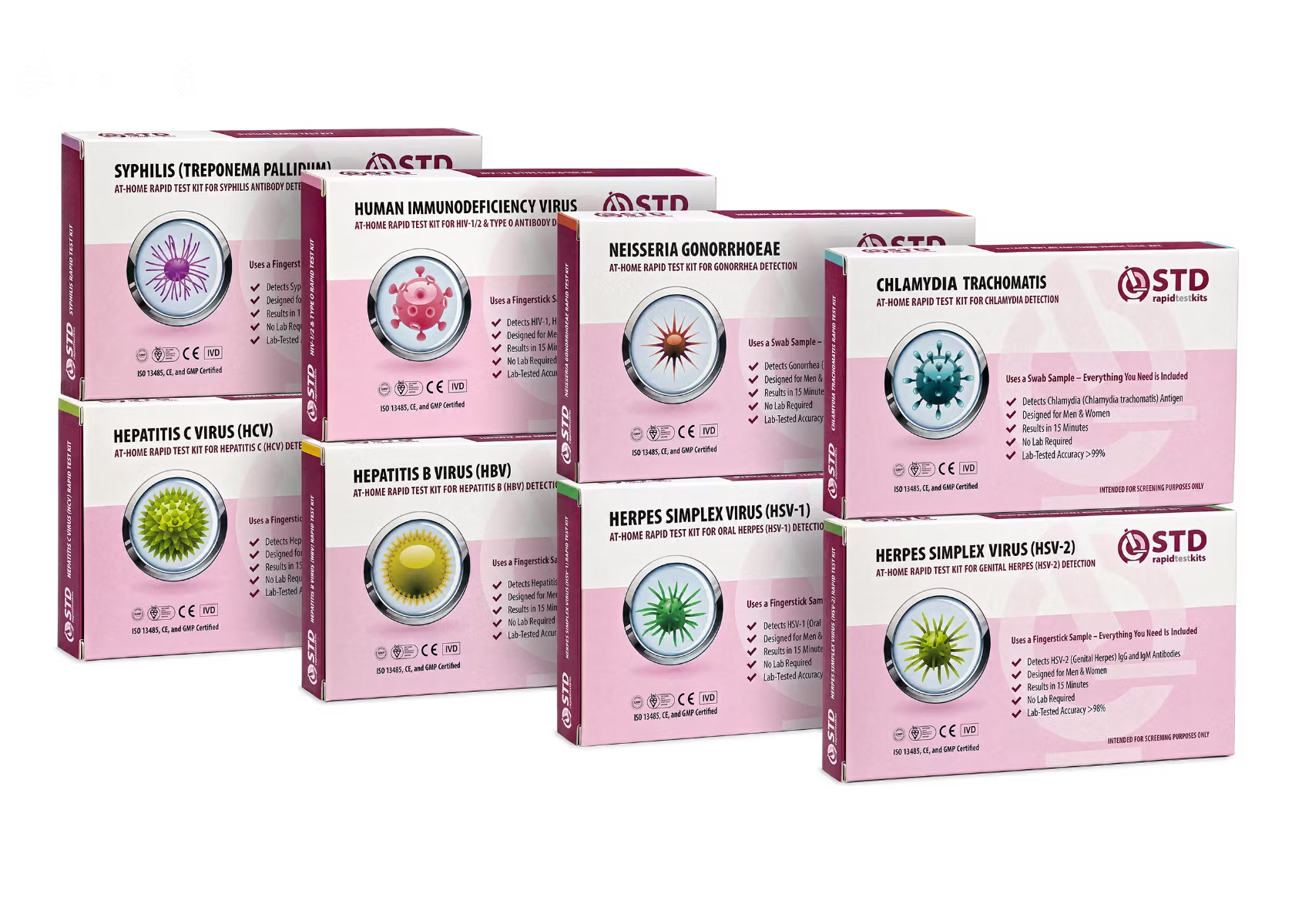
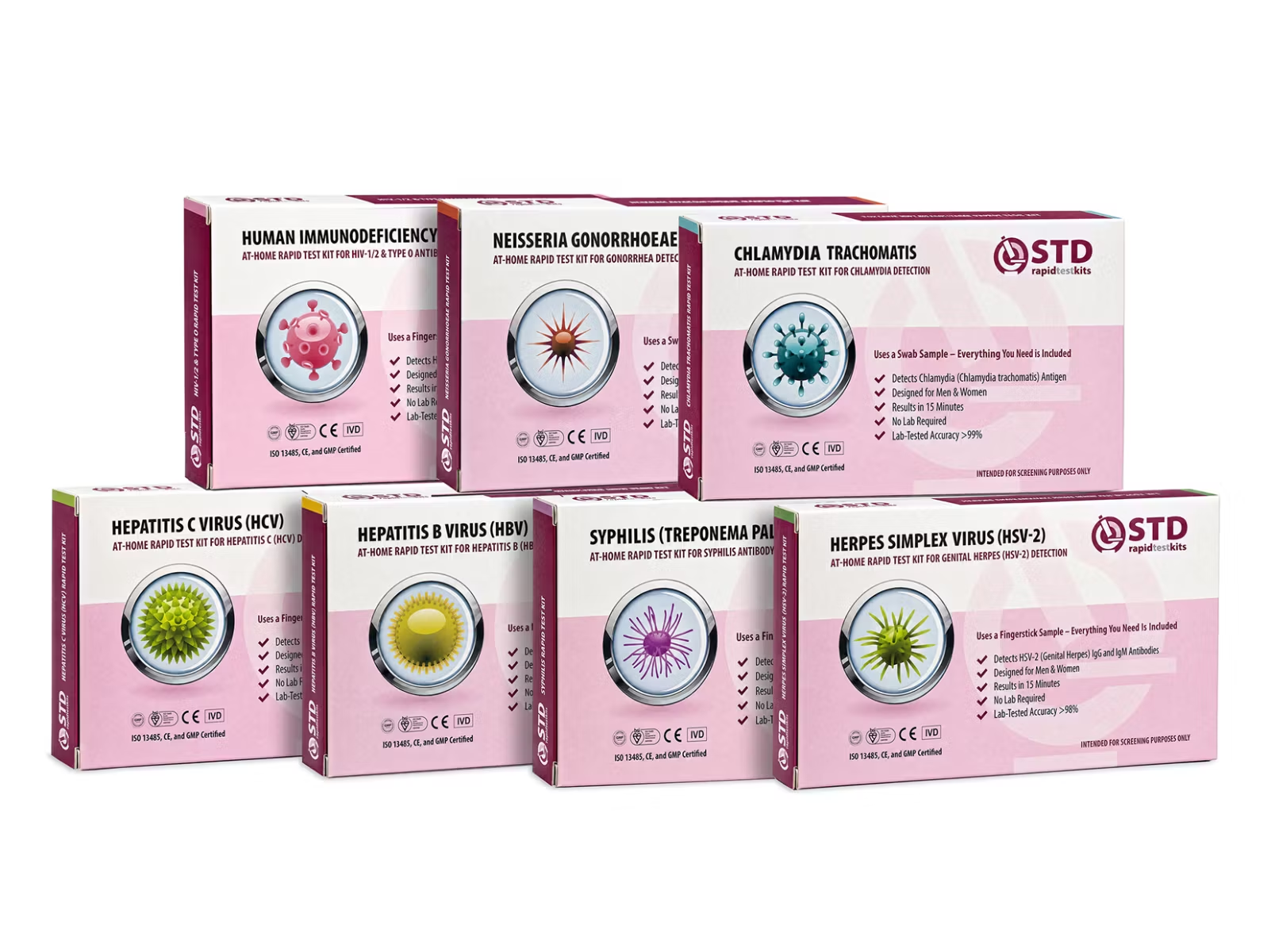
The kits below are sold by stdrapidtestkits.com, the publisher of this article. Whichever one fits your situation, the next step is the same: order, test inside the correct window, and read the result. Once you have an answer, the next decision is in your hands.
Order the kit that matches your situation. Test inside the correct window for that infection. Read the result, then follow up with confirmatory laboratory testing or treatment if the result is positive.
- U.S. Centers for Disease Control and Prevention. Getting Tested for STIs, including confidential resources and recommended frequencies.
- U.S. Centers for Disease Control and Prevention. STI Screening Recommendations covering who should be screened and how often by population group.
- U.S. Centers for Disease Control and Prevention. HIV Testing overview, including window periods for rapid antibody and antigen/antibody self-tests.
- World Health Organization. Sexually transmitted infections (STIs) fact sheet, with global incidence and screening guidance.
- World Health Organization. Hepatitis C fact sheet, including direct-acting antiviral cure-rate figures.
- United Kingdom National Health Service. Sexually transmitted infections (STIs) overview, with public-health screening pathways and home-testing guidance.
- Mayo Clinic. STD testing: What's right for you? Patient-facing review of test types, sample types, and clinical follow-up.
