
Published: December 2025 | Last updated: April 2026 | Editorial review and quality control: Martina N.
A repeat positive test after a course of antibiotics for chlamydia is one of the most common, and most quietly distressing, scenarios in sexual health. The fear that hits first is usually about the medication: did the antibiotics fail? In almost every case, the answer is no. The U.S. Centers for Disease Control and Prevention is direct that repeat infection is common after treatment, and the cause is reinfection, not antibiotic resistance. The medication does its job. The problem is what happens after the prescription is filled.
This article walks through what reinfection actually means, why retesting at three months is the standard rule even when you feel completely fine, and what a realistic prevention plan looks like if a positive test has come back a second time.
Can you get chlamydia again after treatment?
Yes. A standard antibiotic course (usually doxycycline 100 mg twice daily for 7 days, or a single dose of azithromycin in some cases) clears the current infection in the large majority of people, but it does not create immunity. If a partner was not treated, if either of you resumed sex before the full seven-day waiting window ended, or if a new exposure happened, the bacteria can come right back. Reinfection in the months after treatment is common enough that the CDC recommends a follow-up test at three months for everyone treated, even with no symptoms.
Key Takeaways
- A repeat positive test after antibiotics almost always means reinfection (often from an untreated partner or sex too soon), not antibiotic failure. True drug resistance in uncomplicated chlamydia is rare.
- Both partners must complete treatment and wait at least seven full days, including no oral, vaginal, or anal sex, before resuming contact. The CDC recommends retesting about three months later, regardless of symptoms.
This Isn't Antibiotic Failure (Most of the Time)
The fear that the medication did not work is the loudest one in the room after a second positive test. It is also, statistically, the least likely explanation. For uncomplicated genital chlamydia, the recommended regimens are highly effective when taken correctly. The CDC's 2021 STI treatment guidelines still list doxycycline 100 mg twice daily for 7 days as the preferred regimen, with azithromycin 1 g as a single oral dose as the alternative. Both have decades of clinical evidence behind them.
What the CDC also says, plainly: most post-treatment positives are caused by exposure to an untreated partner, not by resistant bacteria. The medication clears the infection in the body it treated. It does not vaccinate that body, and it does nothing for a partner who was never given a prescription.
A useful way to picture it: the antibiotics clear the house. They do not lock the doors afterward. If the bacteria are reintroduced, even a single time, the infection can restart from scratch.
Genuine antibiotic failure for uncomplicated genital chlamydia is uncommon, but a few specific scenarios raise the risk: vomiting within an hour or two of taking azithromycin, an incorrect regimen or dose, missed doses partway through a doxycycline course, or pharyngeal (throat) infection treated with single-dose azithromycin. If any of these apply and symptoms persist after strict abstinence and confirmed partner treatment, ask a clinician about repeat testing or an alternative regimen.
The Seven-Day Rule Most People Break Without Meaning To
After starting antibiotics for chlamydia, the CDC and most clinical guidelines recommend waiting at least seven full days before any sexual contact. That includes vaginal, anal, and oral sex. The rule is the full seven days, not just until symptoms clear and not until you simply start to feel better, and the seven-day clock applies to both partners.
That last part is where the rule quietly fails in practice. One person finishes their course on a Friday. Their partner started two days later because the prescription took longer to fill. They count from the wrong start date, or they don't count at all, and the bacteria pass back and forth in the gap. A common pattern reported in clinic intake notes is something like, “We only did it once, we thought since I'd started antibiotics it was fine.” Two weeks later, a retest comes back positive, and the cause is almost always timing rather than failed medication.
This is why the question “How soon can you get reinfected with chlamydia?” has a sharper answer than people expect. Immediately, if exposure happens before both partners are fully treated and through the full seven-day window.
The full seven days starts from the day each partner takes their first dose, not from whichever person started first. If you started on Monday and your partner started on Wednesday, the earliest safe day for sex is the following Wednesday at the earliest, after both of you complete the wait.
Why Reinfection Happens More Than People Realize
Reinfection has very little to do with promiscuity or being “bad at condoms.” It is almost always a timing, communication, or assumption problem. Sometimes a partner says they took the medication and they did not. Sometimes they took it but had sex during the seven-day wait. Sometimes both people assumed the other was clear. Sometimes a new partner showed up before the three-month retest was due.
Repeat infection is common enough after treatment that the CDC's retesting guidance recommends a follow-up test at about three months for everyone treated for chlamydia, regardless of symptoms. Adolescents and young adults under 25 are at higher risk than older adults, which is part of why annual screening is recommended for that age group on top of any post-treatment retest.
| Cause of repeat positive | What actually happened | How common |
|---|---|---|
| Untreated partner | Partner never filled the prescription, never finished it, or never told their other partners | Very common |
| Sex too soon | Sex resumed before the full seven-day post-treatment window for both partners | Common |
| New exposure | Sex with a new partner who was unknowingly infected, often asymptomatic | Common |
| Testing too early | A nucleic acid test repeated within a few weeks picks up residual bacterial DNA, not a live infection | Less common but possible |
| True treatment failure | Vomiting shortly after the dose, incorrect regimen, or rare resistance pattern | Rare in uncomplicated cases |
Reinfection vs. Residual Positives: Timing of the Retest Matters
Another source of confusion shows up when someone retests within a few weeks of finishing antibiotics. Modern chlamydia tests (nucleic acid amplification tests, or NAATs) detect bacterial genetic material, and small fragments can linger in the urogenital tract for several weeks after the live infection is gone. A retest done too early can therefore pick up residual DNA from an infection that has already cleared, not a live, replicating bacterial population.
This is exactly why the CDC does not routinely recommend a “test of cure” for uncomplicated chlamydia in non-pregnant adults. The recommended retest is at about three months, not three weeks. Pregnancy is the main exception, where a test of cure roughly four weeks after treatment is advised because of the risk to the pregnancy.
If you tested negative a few weeks after treatment and then positive again at the three-month mark, that strongly suggests a fresh reinfection rather than leftover DNA. The timeline tells the story.
A NAAT done in the first three weeks after finishing antibiotics can return a positive driven by leftover bacterial DNA from the infection that already cleared, not a new live infection. Unless symptoms persist or worsen, or you are pregnant, wait until the three-month retest window. Earlier testing tends to create confusion rather than clarity.
Do Both Partners Really Need Treatment? Yes, Always
If even one partner skips antibiotics, takes them inconsistently, or has sex with someone else who is untreated, the cycle continues. This is why the most common search behind a repeat positive (“reinfected with chlamydia by the same partner”) is not a mystery. It is biological feedback.
Most U.S. states, plus the District of Columbia, allow a clinical practice called expedited partner therapy (EPT): a person diagnosed with chlamydia can be given prescriptions or medication to take directly to their partner, without that partner needing a separate clinic appointment. The CDC endorses EPT for chlamydia and gonorrhea as a useful partner-management option, and clinical studies have shown it meaningfully reduces repeat infections compared with standard partner referral.
If you are in a region where EPT is allowed, ask your provider directly. The takeaway is simple: treatment must be mutual, the wait must be mutual, and protection going forward needs to be mutual too.
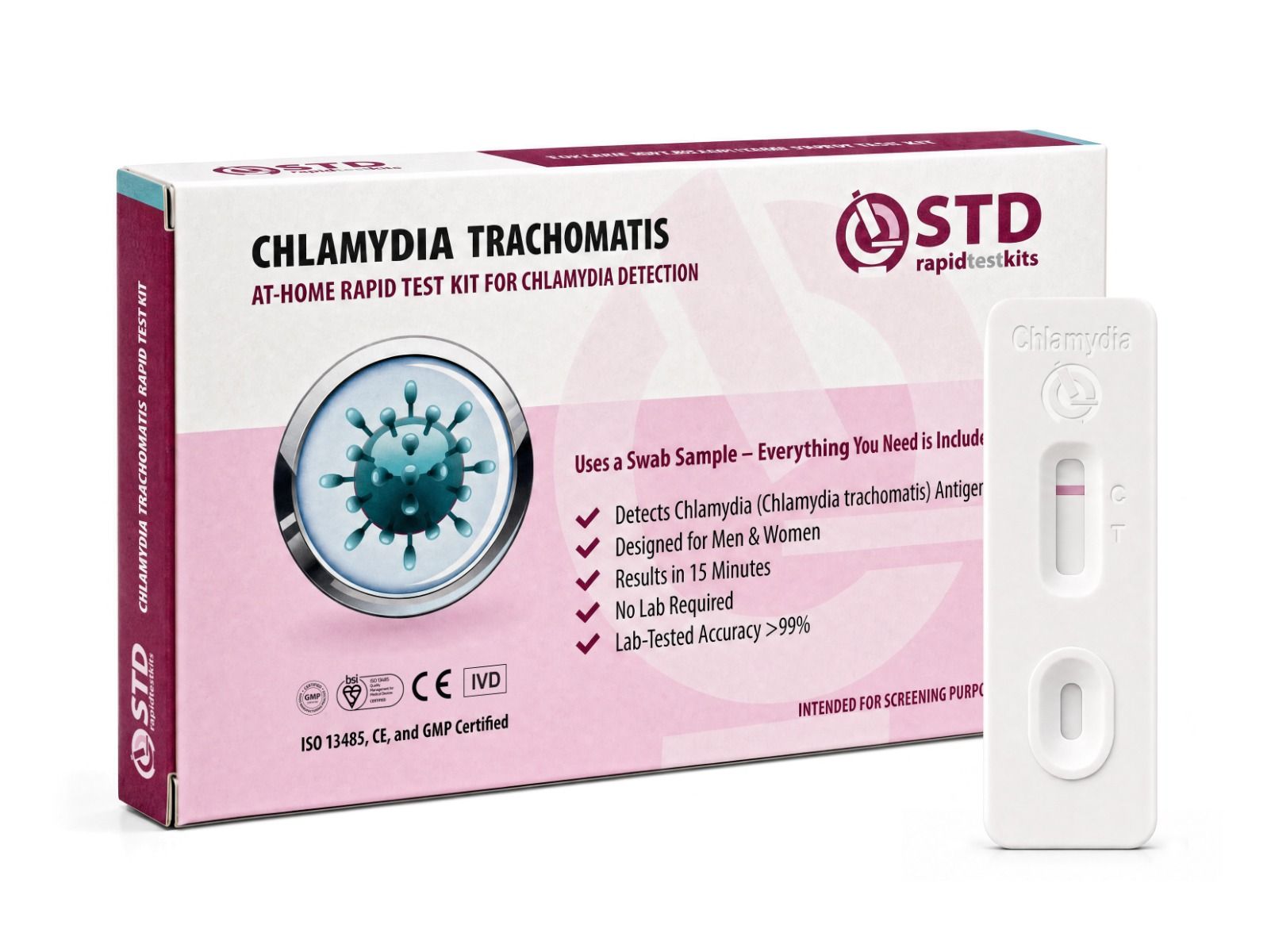
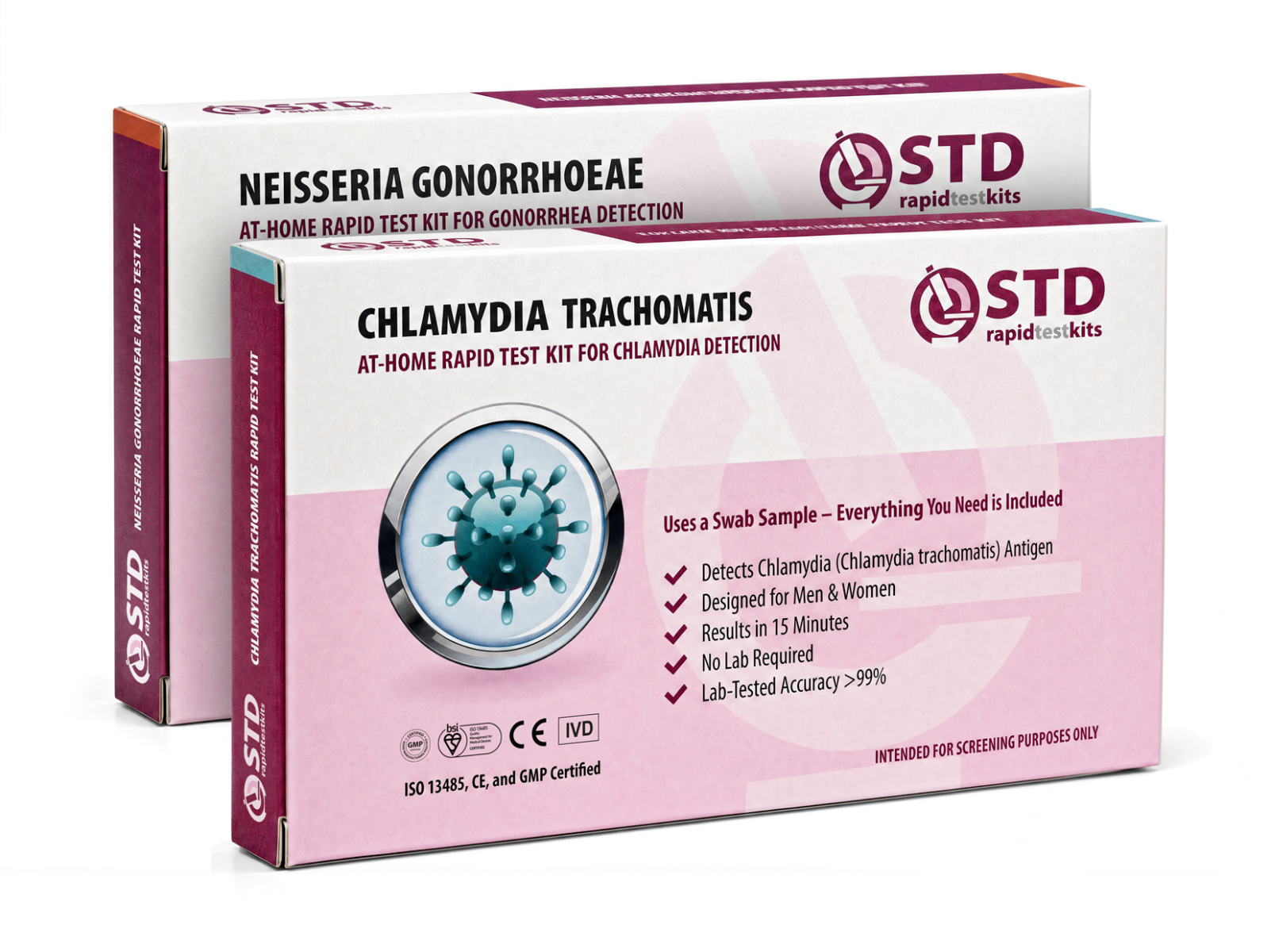
A note on the at-home test options below: this article is published by stdrapidtestkits.com, which sells rapid at-home STI tests. The kits below are from our catalog and are recommended where they fit the reader's situation, not as a substitute for clinical care when symptoms persist.
How Long After Chlamydia Treatment Can You Have Sex?
This question accounts for an enormous share of post-diagnosis searches, and the answer is short: wait at least seven days after a single-dose treatment, or until completing a full seven-day antibiotic course, and confirm the same for every partner before any sexual contact resumes. That is the published CDC rule, and there is no clinical version of it that involves shortcuts.
Real life complicates the rule. Maybe you live together and the abstinence feels awkward to enforce. Maybe you reconciled after a breakup and the timing felt off to bring up. Maybe neither of you had symptoms in the first place, so the urgency felt abstract. The bacteria does not interpret emotional context. If exposure happens before both partners are fully treated and cleared, reinfection becomes possible from the first instance of contact.
The practical move is to have the prevention conversation before sex resumes, not after. That includes the seven-day rule, the three-month retest plan, and condom use during the first few months when reinfection rates are highest.
| Time after treatment | What to do | Why it matters |
|---|---|---|
| Days 0 to 7 | No oral, vaginal, or anal sex, with anyone | Allows full bacterial clearance for both partners during the antibiotic window |
| Weeks 1 to 3 | Avoid retesting unless symptoms persist or worsen | Residual bacterial DNA can produce a misleading positive on early NAAT testing |
| 3 months | Retest, even with no symptoms | CDC-recommended rescreen window. Catches the silent reinfections that drive most repeat cases |
| Any new partner | Test based on the new exposure timing | Each new sexual partner resets the reinfection clock independently |
Is It Ever Treatment Failure?
True antibiotic failure for uncomplicated genital chlamydia is uncommon. It can happen, mostly in well-defined situations: vomiting within an hour or two of taking azithromycin, an incorrect regimen or dose, or in rare instances heterotypic resistance. Pharyngeal (throat) infections also clear less reliably than genital infections, especially with single-dose azithromycin, which is part of why doxycycline became the preferred CDC regimen.
If symptoms persist after treatment despite strict abstinence and confirmed partner treatment, a clinician may recommend repeat testing or an alternative antibiotic. Statistically, though, reinfection remains far more common than drug resistance. Before assuming the medication failed, the more useful step is to look honestly at exposure history during the post-treatment window. That examination usually produces the answer.
Negative After Treatment, Then Positive Again: What That Usually Means
Testing negative after treatment and then positive weeks or months later almost always indicates a new infection rather than a resurfacing of the old one. The first negative confirms the original infection cleared. A later positive points to a fresh exposure that happened after that clearance.
Emotionally, this can feel devastating, particularly when exclusivity was assumed. Emotional assumptions about exclusivity, however, do not prevent bacterial transmission, and a second positive calls for the same practical reset as the first: confirm both partners are treated again, re-establish the seven-day waiting period from each partner's first dose, set a calendar reminder for the three-month retest, and reassess prevention going forward, including condom use during the highest-risk first few months and a more explicit conversation about other partners.
A clean negative result a few weeks after treatment is good evidence the original infection cleared. A positive result that follows weeks or months later, in that order, almost always points to a fresh exposure rather than the first infection lingering or hiding. The timeline is the diagnostic detail: which test came when, and what happened sexually in between.
Oral Sex, “Low Risk,” and the Half-Truths That Drive Reinfection
Chlamydia can infect the throat (pharyngeal chlamydia) and the rectum, not only the genitals. Pharyngeal and rectal infections are usually asymptomatic, which is exactly why they slip under the radar. Someone can unknowingly reintroduce bacteria through oral or anal contact even if their genital symptoms cleared completely.
If oral or anal sex is part of your sex life, comprehensive testing matters more than people are typically told. Many primary-care clinics test only the genital site by default. Asking specifically for extragenital (throat and rectal) testing, where appropriate to your exposures, can be the difference between catching a silent reinfection and missing it.
Our at-home rapid kit covers genital chlamydia via a self-collected vaginal or penile swab. For throat-swab or rectal-swab testing, the right venue is a sexual-health clinic or primary-care provider who can collect those samples directly, since we do not currently offer pharyngeal or rectal swab tests. If your most recent exposure was oral or anal, plan a clinic visit for that anatomical site even if you also use a home kit for the genital test.
Retesting at Three Months Is Standard Care, Not Paranoia
Many people assume that once antibiotics are finished, the story ends. Clinically, it does not. CDC guidance is to retest about three months after treatment, regardless of symptoms, because reinfection rates are high enough during that window to justify routine follow-up. In practice, follow-through on that retest tends to be poor, often because no one explicitly tells the patient to schedule one before they leave the clinic.
If three months feels distant, putting a calendar reminder in immediately is the simplest fix. If clinic access is complicated, or privacy is a concern, an at-home retest can remove most of the friction by skipping waiting rooms and insurance forms. Either route works; the only wrong move is skipping the retest entirely.
When Reinfection Becomes a Pattern
If a positive test has come back more than twice in a year, it is worth zooming out. Are sexual partners rotating without testing in between? Is exclusivity assumed but never explicitly discussed? Is condom use inconsistent? Are symptoms being used as a screening signal instead of routine testing?
Repeated chlamydia infections carry real downstream risk, particularly in people with female reproductive anatomy. The CDC's chlamydia page notes that untreated or repeatedly recurrent infection raises the risk of pelvic inflammatory disease (PID), which in turn is linked to longer-term complications including chronic pelvic pain, ectopic pregnancy, and infertility. That is not framed here to scare. It is framed to motivate the structural change that breaks the cycle: scheduled quarterly testing during higher-risk periods, mutual testing before condom-free sex with a new partner, and explicit conversations about exclusivity rather than implicit ones.
Why repeated infections deserve extra attention
- Untreated or repeatedly recurrent chlamydia raises the risk of pelvic inflammatory disease (PID), per the CDC's chlamydia overview.
- PID is in turn linked to chronic pelvic pain, ectopic pregnancy, and tubal-factor infertility.
- Risk accumulates with each untreated or unnoticed episode, which is the central argument for quarterly testing during higher-risk periods.
- Asymptomatic infections account for a meaningful share of recurrences, so screening cannot rely on symptoms alone.
What Prevention Actually Looks Like in Practice
Avoiding reinfection is not about perfection. It is about closing the specific gaps where bacteria slip back in. In real life, those gaps are almost always assumptions: assuming the partner took the medication, assuming exclusivity, assuming that no symptoms means no infection. Prevention works by replacing those assumptions with steps that take place at known times. The framework below is what that looks like done methodically.
| Prevention layer | What it means in practice | Why it works |
|---|---|---|
| Mutual treatment | Both partners complete the full antibiotic course before any sexual contact resumes | Eliminates the untreated bacterial reservoir that drives most reinfections |
| Seven-day abstinence | No vaginal, anal, or oral sex until both partners' seven-day windows have ended | Prevents bacterial transfer during the antibiotic clearance period |
| Three-month retest | Scheduled follow-up testing regardless of symptoms | Catches asymptomatic reinfections in the highest-risk window |
| Barrier use during weeks 1 to 12 | Consistent condoms during the first few months post-treatment, especially with newer partners | Reduces reinfection probability during the period when it is statistically most likely |
| Pre-sex testing as a norm | Both partners test before exclusivity or before stopping condoms | Replaces an unverified assumption with a documented baseline |
Men and women who have been treated for chlamydia should be retested approximately 3 months after treatment, regardless of whether they believe their sex partners were treated.
Starting Over, Smarter
If a second or third positive has just landed, treat it as a chance to reset the protocol cleanly rather than as a verdict on anyone's character. That usually means scheduling testing together before resuming sex, using condoms consistently for the first three months, having the explicit conversation about other partners that may have been skipped the first time, and putting the three-month retest on a calendar the day treatment ends.
If the next sexual decision is hanging on whether the infection has actually cleared, a discreet at-home test removes the guesswork. When uncertainty is fueling anxiety, verification restores control.
Frequently asked questions
- Can you really get chlamydia again right after treatment?
- Yes. Antibiotics cure the current infection, but they do not create immunity. If exposure happens again, even with the same partner, reinfection can begin from the first contact. The body does not retain a defense against the bacteria once treatment ends.
- We only had sex once during the seven-day window. Does that actually matter?
- Yes. The bacteria does not respond to intent or frequency. A single contact during the seven-day post-treatment window is enough to reintroduce infection in either direction, even if both partners feel fine.
- What if my partner says they took their antibiotics but I'm not sure?
- Sometimes people miss doses, vomit shortly after taking them, or never start the prescription. Asking directly about treatment completion is reasonable and clinically appropriate. If the answer is uncertain, treating that as the answer (and waiting longer or confirming with a retest) is the safer move.
- How common is chlamydia reinfection, really?
- Common enough that the CDC recommends retesting all treated patients at about three months, regardless of symptoms. Adolescents and adults under 25 are at higher risk than older adults, which is why annual screening is also recommended for that group on top of any post-treatment retest.
- Does a repeat positive test mean the antibiotics failed?
- Almost never in uncomplicated cases. True drug resistance is rare for genital chlamydia. The CDC and most clinical guidelines attribute the large majority of post-treatment positives to reinfection from an untreated partner or new exposure, not to antibiotic failure.
- I tested negative after treatment, and now I'm positive again. What does that mean?
- That pattern points strongly to a new infection rather than the original infection lingering. A clean negative confirms the first round cleared. A subsequent positive almost always indicates a fresh exposure that occurred after that clearance.
- Can I get reinfected with chlamydia from oral sex?
- Yes. Pharyngeal (throat) chlamydia is usually asymptomatic and can be transmitted through oral sex. If oral contact is part of your exposures, a complete picture requires testing the appropriate sites, which for throat-specific testing means a clinic visit since throat-swab tests are not part of our at-home catalog.
- What is the simplest plan to stop reinfection from happening again?
- Three steps cover the majority of reinfection risk: both partners complete treatment in full, both partners wait the full seven days from their own first dose, and both partners retest at three months. Adding consistent condom use during the first few months, particularly with any new partner, lowers the residual risk further.
- U.S. Centers for Disease Control and Prevention. STI Treatment Guidelines, Chlamydial Infections. Source for the recommended doxycycline and azithromycin regimens, the seven-day post-treatment abstinence rule, and the recommendation to rescreen all treated patients at about three months.
- U.S. Centers for Disease Control and Prevention. Retesting After Treatment to Detect Repeat Infections. Source for the three-month retest recommendation and the published rationale that repeat infection drives the large majority of post-treatment positives.
- U.S. Centers for Disease Control and Prevention. Expedited Partner Therapy: Clinical Guidance. Source for the legal status of EPT, the conditions for which it is recommended (chlamydia and gonorrhea), and the framing of EPT as a useful partner-management option.
- U.S. Centers for Disease Control and Prevention. About Chlamydia (basic facts page). Source for general epidemiology and the published links between untreated or repeatedly recurrent chlamydia infection and pelvic inflammatory disease, ectopic pregnancy risk, and infertility.
- World Health Organization. Sexually Transmitted Infections (STIs) Fact Sheet. Source for global STI epidemiology context and the broader public-health framing of repeat infection.
- Mayo Clinic. Chlamydia Trachomatis: Symptoms and Causes. Source for plain-language clinical overview and complication context referenced in this article.
