
Published: November 2025 | Last updated: May 2026 | Editorial review and quality control: Martina N.
You finished your antibiotics. Your partner said they did too. A few weeks pass, you take another test, and the result comes back positive again. The first reaction is often suspicion. The second is exhaustion. The third, eventually, is the realization that something in the chain of follow-through broke down somewhere along the way.
Repeat positives after chlamydia treatment are documented well enough that the U.S. Centers for Disease Control and Prevention recommends clinicians retest every patient diagnosed with chlamydia roughly three months after treatment, regardless of relationship status (CDC 2021 STI Treatment Guidelines). The reason is straightforward. Reinfection is one of the most common outcomes after a positive diagnosis, and it usually traces back to one of three logistical gaps that have nothing to do with infidelity.
Key Takeaways
- Reinfection from the same partner is so common that the CDC recommends retesting at three months post-treatment for every chlamydia diagnosis, regardless of relationship structure.
- Most reinfections trace back to one of three logistical gaps: incomplete partner treatment, sex resumed before the seven-day overlap window ended, or an early-window test that returned a false negative.
What "Coming Back" Actually Means
When chlamydia tests positive a second time after treatment, the bacterium itself has not done anything mysterious. Azithromycin and doxycycline, the two first-line treatments recommended in the CDC's 2021 STI treatment guidelines, clear chlamydia in the vast majority of cases when taken as prescribed. The issue is almost never antibiotic failure.
What usually happens is one of three things. The infection was never cleared from one partner because they did not finish their course. One of you tested too early after exposure to detect the bacterium, and got a falsely reassuring negative. Or sex resumed before both partners had completed treatment, which set the cycle running again.
Repeat infection is common enough that the CDC's 2021 STI treatment guidelines call for routine retesting at three months for every person treated, regardless of relationship status. That recommendation exists because the same partner pair often completes the loop incompletely, not because most people change partners.
When chlamydia comes back, it is almost always one of these:
- One partner did not finish the antibiotic course as prescribed.
- A test was taken too early after exposure to detect the bacterium and produced a false negative.
- Sex resumed before both partners had completed treatment, restarting the transmission loop.
Why Monogamy Does Not Equal Immunity
The most common late-night Google search on this topic is some version of "how could I get chlamydia from my partner if we are both monogamous." The assumption underneath the question is that monogamy creates a closed system. In practice, it does not.
Several scenarios explain reinfection inside a committed relationship without anyone stepping outside. A partner may have carried chlamydia from a prior relationship without ever testing, then transmitted it months into the new partnership. According to the CDC's chlamydia fact sheet, chlamydia often has no symptoms at all, so a long-time partner can carry and transmit it without ever feeling sick. A previous round of treatment may have failed because one partner skipped doses. Or one partner finished antibiotics earlier than the other, then re-exposed the still-finishing partner.
None of these require infidelity. They require math, timing, and follow-through, three things relationships rarely budget for explicitly.
A partner who tested negative two years ago and has had no symptoms since can still be carrying chlamydia from a prior relationship. Asymptomatic infections are quiet enough to outlast the previous breakup, the gap between partners, and even a clean-feeling first year together.
Asymptomatic Carriers Are the Quiet Engine
The biology of chlamydia transmission is unfair. The infection is mostly silent. The CDC notes that chlamydia frequently produces no symptoms at all. The Mayo Clinic chlamydia overview notes that even when symptoms appear, they often emerge weeks after exposure and resemble urinary tract infections, vaginitis, or proctitis, conditions that get blamed on other causes first.
For couples, the silent-carrier problem creates a specific trap. One partner gets diagnosed because they happen to test for an unrelated reason. The other partner feels fine, sees no urgency, and skips testing or treatment. Weeks later the diagnosed partner tests positive again, having been re-exposed during sex that everyone assumed was safe because nobody felt sick.
Nothing. Feeling fine is not evidence of being uninfected. The only reliable way to know your chlamydia status is a test taken at least two weeks after the most recent possible exposure.
Testing Windows: When "Negative" Is Just Early
Chlamydia testing is most often done with nucleic acid amplification tests (NAATs), which are the gold standard recommended by the CDC for both diagnosis and screening. NAATs detect bacterial DNA directly. They are highly sensitive, but only after enough bacterial replication has happened in the patient's tissue to push the signal above the test's detection threshold.
That replication takes time. Most NAATs reliably detect chlamydia by about two weeks after exposure. Tests taken inside the first five to seven days after a possible exposure can return false negatives, especially in newly acquired infections where the bacterial load is still climbing. A negative result inside that window is not wrong, just early.
This is how reinfection cycles get missed. One partner tests at day five, gets a negative, assumes they are clear, and stops thinking about it. The infection clears its detection threshold a week later, but no one retests because the first result said negative. Meanwhile sex has resumed, and the other partner gets re-exposed.
| Days After Possible Exposure | What a Test Result Means | Recommended Next Step |
|---|---|---|
| 0 to 5 days | Too early. False negatives are common. | Wait. Retest at day 14. |
| 5 to 14 days | Some assays detect, others miss it. | Retest if symptoms appear or partner is positive. |
| 14+ days | Peak detection accuracy. | Reliable result. Treat if positive. |
| Less than 3 weeks after treatment | Avoid testing here. | Residual bacterial DNA can read positive even after cure. |
| 3 months after treatment | CDC retest recommendation. | Standard reinfection screening point. |
Can you get chlamydia again from the same partner?
Yes. Reinfection from the same partner is documented well enough that the CDC recommends retesting roughly three months after treatment for everyone diagnosed, regardless of relationship status. The most common causes are incomplete partner treatment, resuming sex before the seven-day overlap window ends, or testing inside the first one to two weeks after exposure when even sensitive lab assays can return a false negative. None of those require infidelity.
The Seven-Day Overlap Rule and Why It Matters
The standard treatment instruction after a chlamydia diagnosis is straightforward in theory. Take the prescribed antibiotics. Avoid sex for seven days after a single-dose azithromycin regimen, or until both partners finish a seven-day doxycycline course, whichever applies. Wait until your partner has also completed treatment before resuming sex.
The trap is in the word "both." Most reinfection within couples happens because the seven-day windows do not overlap. One partner picks up their prescription Monday and finishes Friday. The other partner does not pick theirs up until Friday and finishes the following Friday. If the couple has sex anywhere in that gap, the partner who finished first gets re-exposed by the partner who is still mid-course.
The cleanest version of this rule is therefore: both partners abstain from sexual contact, including oral, until seven days after whichever antibiotic course finishes later. The first partner's finish date does not end the window, and neither does the moment symptoms feel resolved or the midpoint of the antibiotic course.
For couples whose partner cannot easily get to a clinic, many U.S. states allow expedited partner therapy (EPT), where the diagnosed patient's clinician can prescribe antibiotics for the partner without requiring them to be seen in person (CDC EPT guidance). It removes one of the most common reasons partner treatment falls behind schedule. The CDC's 2021 STI Treatment Guidelines cite the high incidence of reinfection as the reason for the three-month retest recommendation, which is why coordinated overlap and follow-up testing matter as a single sequence rather than two separate decisions.
| Scenario | Reinfection Risk | Why It Happens |
|---|---|---|
| Only one partner is treated | Very high | The untreated partner still carries the infection. |
| Partners treated on different days | Moderate to high | Sex during the timing gap re-exposes the partner who finished first. |
| Sex resumed before 7-day window ends | High | Antibiotics may still be clearing residual bacteria. |
| Both complete treatment + abstain through later finish | Low | Properly synced courses break the transmission loop. |
What If You Have Been Treated Twice and Still Test Positive?
Persistent positive tests after two complete courses of antibiotics raise three possible explanations, in roughly descending order of likelihood.
The most common explanation is residual bacterial DNA from the prior infection. NAATs are sensitive enough to pick up dead bacterial fragments for several weeks after a successful course. The CDC and Mayo Clinic both recommend waiting at least three to four weeks after finishing antibiotics before retesting for cure, specifically to give residual DNA time to clear. A test taken inside that window can read positive even though the patient is biologically cured.
The second explanation is a new exposure from a partner who was not treated, was treated incorrectly, or was re-exposed themselves. This is the same loop described above and is more common than people expect.
The third, less common explanation is true antibiotic failure. Documented antibiotic resistance in Chlamydia trachomatis remains rare in the United States, but persistent infection from incorrect dosing, malabsorption from vomiting or other GI issues, or rare treatment-resistant strains does happen. A clinician may switch antibiotic classes, run a culture-based test, or refer for specialist evaluation in these cases. Self-managed retreatment without a clinical workup at this stage usually delays the right diagnosis.
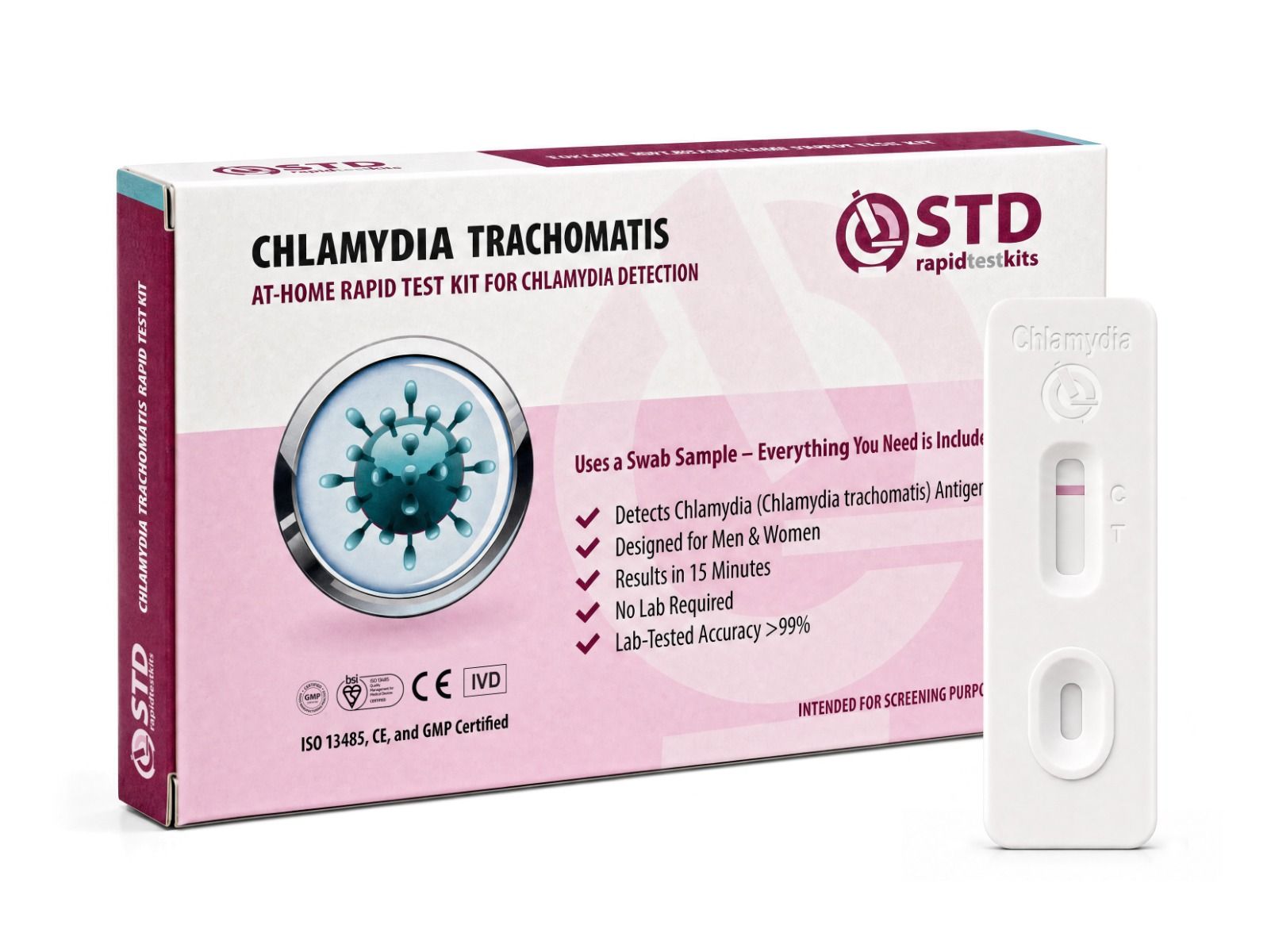
This site sells at-home rapid chlamydia tests; the recommendation below is based on CDC guidance and fit for a confirmation-of-cure use case, not on commercial preference.
How to Talk to a Partner About Retesting
Bringing up a second positive result is harder than the first. The first time felt accidental. The second time can feel like evidence. The instinct to investigate or accuse is human, but it rarely produces the outcome the conversation is supposed to produce, which is breaking the cycle.
The most useful framing leans on logistics rather than motive. Something like: "My retest came back positive. Before we figure out what happened, can we walk through what we both did with the antibiotics, when we finished, and when we resumed sex." Most reinfection histories collapse into a clear logistical gap once the timeline is laid out. A partner who skipped two doses or finished four days late is typically not lying about being treated. They are reporting a process failure they may not even have realized was a failure.
If the timeline review uncovers a gap that explains the positive, the fix is straightforward. Both partners take a fresh round of antibiotics simultaneously, both abstain from sex until seven days past the later finish, and both retest at three months. If the timeline review does not produce an obvious gap, that is the moment to involve a clinician rather than to escalate the conversation.
- Review the timeline together. Who started antibiotics when, who finished when, and when did sex resume.
- Identify the gap. Skipped doses, mismatched finish dates, or sex resumed before the later finish are the usual culprits.
- Re-treat simultaneously and retest at three months. Both partners take a fresh course at the same time and put a calendar reminder for the CDC's three-month retest window.
Building a Prevention Plan That Holds
Once a couple has cleared a reinfection cycle, the question becomes how to keep it from happening again. The CDC's screening guidance gives a clear baseline. Sexually active women under 25 should screen for chlamydia annually. Anyone with a previous chlamydia diagnosis should be retested at three months after treatment and screened more frequently going forward.
Beyond screening cadence, a few habits move the needle. Schedule retesting on the calendar rather than relying on "we will get to it." Test together when possible so both timelines stay aligned. Treat at the same time when both partners are positive. Use the full seven-day overlap rule on every reinfection cycle, not just the first one. And make screening a routine maintenance task on the same footing as a dental cleaning, predictable, scheduled, and not crisis-driven.
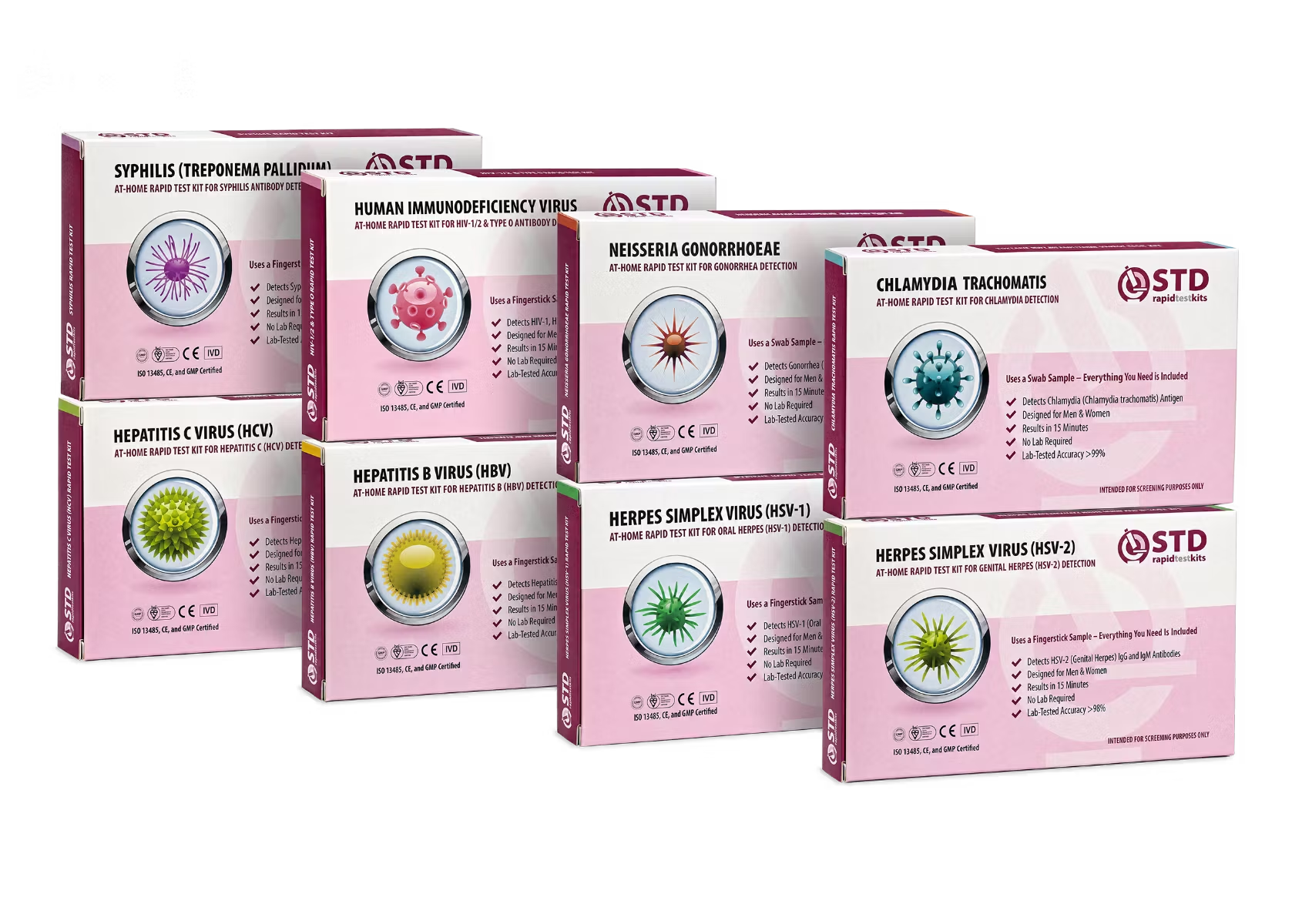
For couples whose risk profile includes more than one STI, a combination at-home rapid kit can replace the bookkeeping of three or four separate tests with a single sample. The CDC's screening guidance treats co-infections, particularly chlamydia and gonorrhea, as common enough to warrant routine dual screening, which is the use case combination kits are designed for.
What About Open Relationships and Multiple Partners?
The mechanics of reinfection inside an open or polyamorous relationship are not fundamentally different from a closed dyad. They are just harder to coordinate. Every additional partner adds another set of testing windows, treatment timelines, and seven-day abstinence overlaps that need to align.
For people in non-monogamous arrangements, the practical guidance from clinicians is to bring testing onto a fixed calendar rather than letting it float. Many relationship structures already use a quarterly testing rhythm, partly because that aligns naturally with the CDC's three-month retest recommendation. Verbal check-ins about partner testing are useful for trust, but actual screening results are what break reinfection cycles. Combination testing kits that screen for several STIs from a single sample can shorten the bookkeeping considerably for anyone managing multiple concurrent partners.

When to See a Clinician
Most chlamydia reinfection can be handled with another round of antibiotics and tighter coordination. Some situations warrant a clinical visit rather than a self-managed retreatment. See a clinician if you have completed two full courses of antibiotics with both partners and still test positive after a clean three-week wait. See one if symptoms persist despite multiple negative retests, which can suggest a different infection or a complication. See one if you are unsure whether the antibiotics were absorbed correctly because of vomiting or interactions with other medications. And see one if a clinician suspects another STI is co-infecting with the chlamydia, since chlamydia and gonorrhea co-infection in particular is common enough to warrant routine dual testing.
Telehealth services have made the visit itself easier. Many providers now offer chlamydia consults and prescriptions through video, including expedited partner therapy where state law allows. Privacy concerns and rural geography no longer have to mean going without follow-up care. The NHS chlamydia guidance takes a similar position for UK readers, with most local sexual health clinics offering remote consultations and home-test kits as a routine option.
- Two full antibiotic courses, still positive. Both partners completed treatment and you still test positive after a clean three-week wait.
- Symptoms persist despite negative retests. A different infection or a complication may be in play.
- Uncertain antibiotic absorption. Vomiting, malabsorption, or interactions with other medications may have undercut the dose.
- Suspected co-infection. Gonorrhea co-infection with chlamydia is common enough to warrant routine dual testing.
Reinfection Is a Process Problem
The most useful frame for chlamydia reinfection is to treat it as a process problem rather than a personal one. The bacteria do not care about relationship structure or moral character. They respond to antibiotic dosing, sexual abstinence windows, and testing timing. When all three line up, the cycle breaks. When any one of them slips, the cycle continues.
That framing also takes pressure off the conversations the diagnosis forces. "Did you finish your antibiotics on time" is a different conversation from "are you cheating on me." The first one is solvable in an afternoon. The second one is rarely the actual problem, and treating it as the actual problem usually delays the fix.
Two things to do this week
- Both partners treat simultaneously and abstain from sexual contact through seven days past the later antibiotic finish date.
- Put the CDC's three-month retest window on the calendar now, before you forget. Treat it as routine maintenance, not a crisis check-in.
FAQs
- Can I get chlamydia again if my partner and I are only sleeping with each other?
- Yes. Reinfection inside monogamous relationships is one of the most common outcomes after a chlamydia diagnosis. The CDC recommends retesting at three months after treatment for everyone, regardless of relationship structure, because incomplete partner treatment, missed seven-day abstinence windows, and early-window false negatives create reinfection cycles that have nothing to do with infidelity.
- How long after treatment should we wait to have sex?
- Seven days after the later of the two partners finishes their antibiotic course. If you finish on a Friday and your partner finishes the following Tuesday, abstain from all sexual contact, including oral, until the Tuesday after that. The most common reinfection scenario inside couples is sex resumed before both seven-day windows fully overlap.
- We both tested negative once and the infection still came back. How?
- Most NAAT tests reliably detect chlamydia by about two weeks after exposure. A test inside the first five to seven days can return a false negative because the bacterium has not replicated to detectable levels yet. If that early negative gets treated as a clean bill of health, the infection has time to establish before the next test catches it.
- Do I need to retreat if I tested positive again after a full antibiotic course?
- If you took the antibiotics as prescribed, abstained for seven days, and your partner did the same, retreatment is usually warranted because a positive retest most likely reflects either residual DNA from the prior infection or a new exposure. Talk to a clinician about timing. Retesting before three weeks have passed since the prior treatment can produce a misleading positive from dead bacterial fragments.
- Can my partner have chlamydia without any symptoms?
- Frequently. Chlamydia is mostly silent, and feeling fine is not evidence of a clean test result. The asymptomatic rate is higher in women than in men, but a long-time partner of any gender can carry and transmit chlamydia for months without ever feeling sick. The only reliable way to know is a test taken at least two weeks after the most recent possible exposure.
- Is chlamydia developing antibiotic resistance?
- Documented antibiotic resistance in Chlamydia trachomatis remains rare in the United States. Most apparent treatment failures trace back to incomplete dosing, missed doses, vomiting that affected absorption, or new exposure rather than true resistance. Persistent infection after two correctly taken courses warrants a clinician evaluation, which may include a culture-based test or a switch in antibiotic class.
- Can I confirm a cure with an at-home test?
- Yes, with one timing caveat. Wait at least three weeks, ideally four, after finishing antibiotics before testing for cure. Earlier than that and a sensitive test can pick up residual bacterial DNA from the cleared infection and read positive even though the bacterium is no longer viable. After the three-to-four-week mark, an at-home rapid test gives reliable confirmation.
- U.S. Centers for Disease Control and Prevention. Chlamydia: detailed fact sheet, screening recommendations, and asymptomatic infection guidance.
- U.S. Centers for Disease Control and Prevention. 2021 Sexually Transmitted Infections Treatment Guidelines: chlamydia treatment regimens, the seven-day abstinence rule, and the three-month retest recommendation.
- U.S. Centers for Disease Control and Prevention. Expedited Partner Therapy: legal status by state and clinical guidance for prescribing partner antibiotics without a separate visit.
- Mayo Clinic. Chlamydia: symptoms, diagnosis, NAAT-based testing, and post-treatment retesting timing.
- U.K. National Health Service. Chlamydia: symptoms, treatment timing, and partner notification guidance for the U.K. context.
- World Health Organization. Sexually transmitted infections fact sheet: global epidemiology and screening considerations.
- Planned Parenthood. Chlamydia: patient-facing reference on transmission, testing, and treatment.
