

Published: November 2025 | Last updated: April 2026 | Editorial review and quality control: Martina N.
A second positive chlamydia test lands like a punch. Your first thought is suspicion. Before you light the fuse on your relationship, slow down. Repeat chlamydia infections are common enough that the CDC recommends retesting every treated patient three months after diagnosis, regardless of whether they believe their partner was treated (CDC clinical retesting guidance). Most of those second positives have nothing to do with cheating. They come from missed treatment timing, an early-window false negative, or a partner who never knew they were carrying the infection in the first place.
This guide walks through what reinfection actually looks like, where the testing math trips couples up, and how to tell biology from betrayal before you decide what comes next.
Does a second positive chlamydia test mean my partner cheated?
Not necessarily. Repeat positives most often come from one of three things: a partner who didn’t get treated at the same time you did, sex resumed too soon after the antibiotics, or a missed infection from an early-window false negative. Cheating is possible, but it is rarely the most likely explanation. Confirm with retesting, treat both partners on the same timeline, and gather facts before drawing conclusions.
Key Takeaways
- The CDC recommends retesting roughly three months after any chlamydia diagnosis, because repeat positives are common and most of them come from an undertreated partner rather than infidelity.
- Treating both partners on the same timeline and abstaining for the full seven days after antibiotics are the two strongest defenses against the reinfection ping-pong cycle.
A Second Positive Is More Common Than People Realize
The CDC’s repeat-testing guidance exists for a reason. After treatment for chlamydia, a meaningful share of patients test positive again within three months, even when they took every pill on schedule. That is why the agency recommends retesting at the three-month mark for everyone treated for chlamydia, regardless of whether they believe their partners were treated (CDC clinical retesting guidance).
The reasons cluster into a short list. The partner who passed the infection on never got treated at the same time, often because their test came back negative or because they never tested at all. One or both partners resumed sex before the antibiotics had fully cleared the infection. Or a previous test landed inside the window period and missed an infection that was already there. None of those scenarios require infidelity. They all require what public health calls concurrent partner treatment, which most people have never heard of.
The clinical pattern is so consistent that the CDC, the NHS, and the Cleveland Clinic all converge on the same advice: when one partner tests positive, both partners get treated, both abstain for the full window after the antibiotics, and both retest at three months.
Skip any one of these three steps and the infection often comes right back. Public-health guidance from the CDC, NHS, and Cleveland Clinic all converge on the same loop:
- Concurrent partner treatment. Both partners start antibiotics on the same day, even if only one tested positive.
- Full abstinence window. No sexual contact for seven days after the antibiotics finish, with no exceptions.
- Three-month retest. A confirmation test at roughly 90 days, regardless of symptoms or what either partner believes about the other’s status.
Three Ways You Can Catch Chlamydia Twice
Chlamydia does not give you immunity. Once it clears, your body is just as susceptible to the next exposure as it was before the first one (Cleveland Clinic, Chlamydia overview). The most common reinfection pathways look like this:
| Reinfection Scenario | What Actually Happened |
|---|---|
| Partner was never properly treated | You finished your antibiotics, but they never started theirs, stopped early, or took someone else’s leftover pills. The bacteria stays alive in their body and transmits back during the next sexual contact. |
| Sex resumed too soon after treatment | One or both of you had unprotected contact before the seven-day post-treatment window closed, while live bacteria were still being shed. |
| Earlier test fell inside the window period | Their test came back negative, but it was taken too soon after exposure for the assay to detect the infection. They were positive the whole time. |
| Asymptomatic carrier from before the relationship | One partner has been carrying chlamydia silently for weeks or months from a prior exposure. Neither of you knew, because most cases produce no symptoms. |
The Testing Window That Trips Couples Up
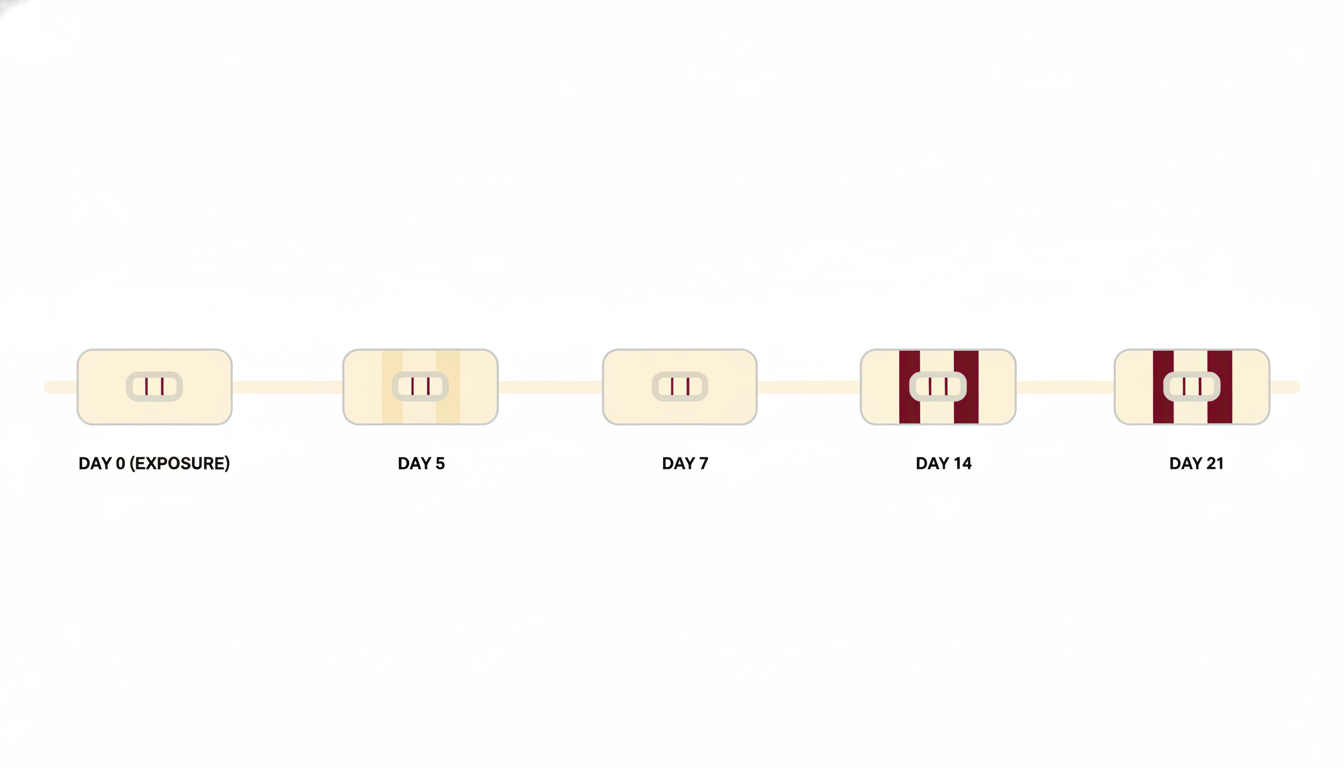
Here is the cruel twist that breaks more relationships than the infection itself: chlamydia tests are not perfect, and the timing of the test matters more than most people realize. The window period is the gap between exposure and when a test can reliably detect the infection. Test too early and a true positive can come back negative. That single false negative is enough to convince a couple that one partner is clean and the other must have cheated, when in reality both were infected the whole time.
Most clinical guidance places the reliable detection window for laboratory NAAT testing at roughly one to two weeks after exposure, with peak accuracy from day 14 onward. Rapid lateral-flow tests, including the at-home swab tests we sell, follow a similar window because the bacteria need time to multiply enough for any test platform to pick them up. Testing on day three after a risky encounter is unreliable. Testing at day seven is better but still produces false negatives. Testing at day 14 or later is the sweet spot for either lab or rapid testing.
If you or your partner tested during the first week after a possible exposure, that result might have come back negative even when an infection was already there.
| Days Since Exposure | What a Negative Result Means |
|---|---|
| 0 to 5 days | Too early to trust. Most tests cannot detect infection reliably. A negative here is not informative. |
| 6 to 13 days | Detection is possible, but false negatives are still common. A negative result should be confirmed with a repeat test. |
| 14+ days | Ideal window. A negative test from this point onward has high reliability for chlamydia detection. |
| 3 months post-treatment | CDC-recommended retest after a previous positive, regardless of symptoms or partner status. |
Why Asymptomatic Carriers Drive the Reinfection Cycle
Monogamy does not protect either partner if one of you is an asymptomatic carrier. Chlamydia can sit quietly in the body for weeks or months without producing any noticeable signs. Most people with chlamydia have no symptoms at all and never know they are infected, according to NHS guidance. A couple can pass the infection back and forth indefinitely without either person realizing anything is wrong.
This is the part of the picture that gets lost when a second positive arrives. The brain reaches for the simplest story first, and the simplest story is betrayal. Biology is messier than the accusation reflex. One partner may have been carrying chlamydia from a relationship that ended a year before the current one, with no symptoms, no idea, no fault. The infection can lie low for that long. The first treatment cleared the infection in one partner but never reached the other. The first sexual contact after antibiotics passed it back. Both partners stare at a positive result and start looking for someone to blame.
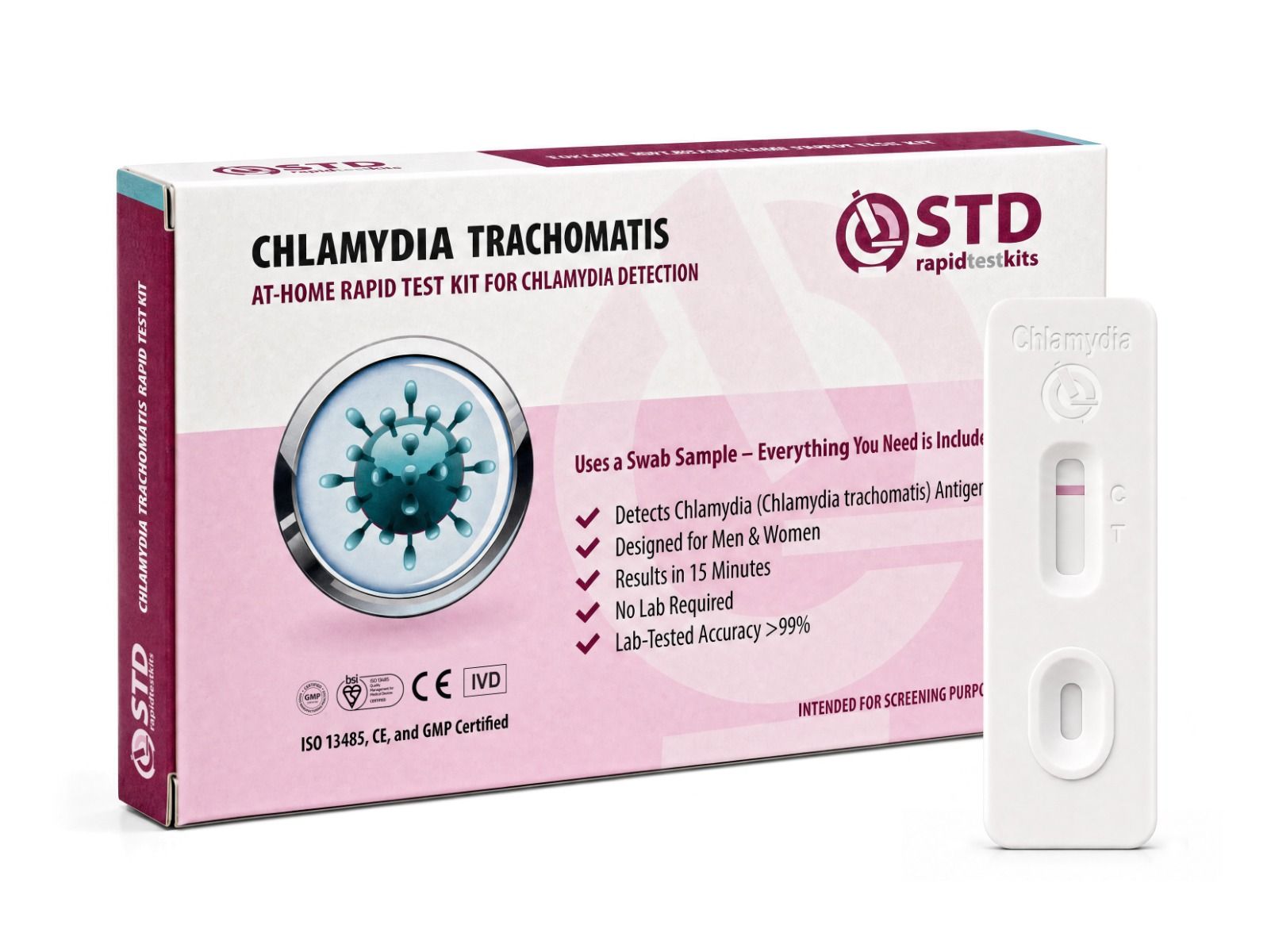
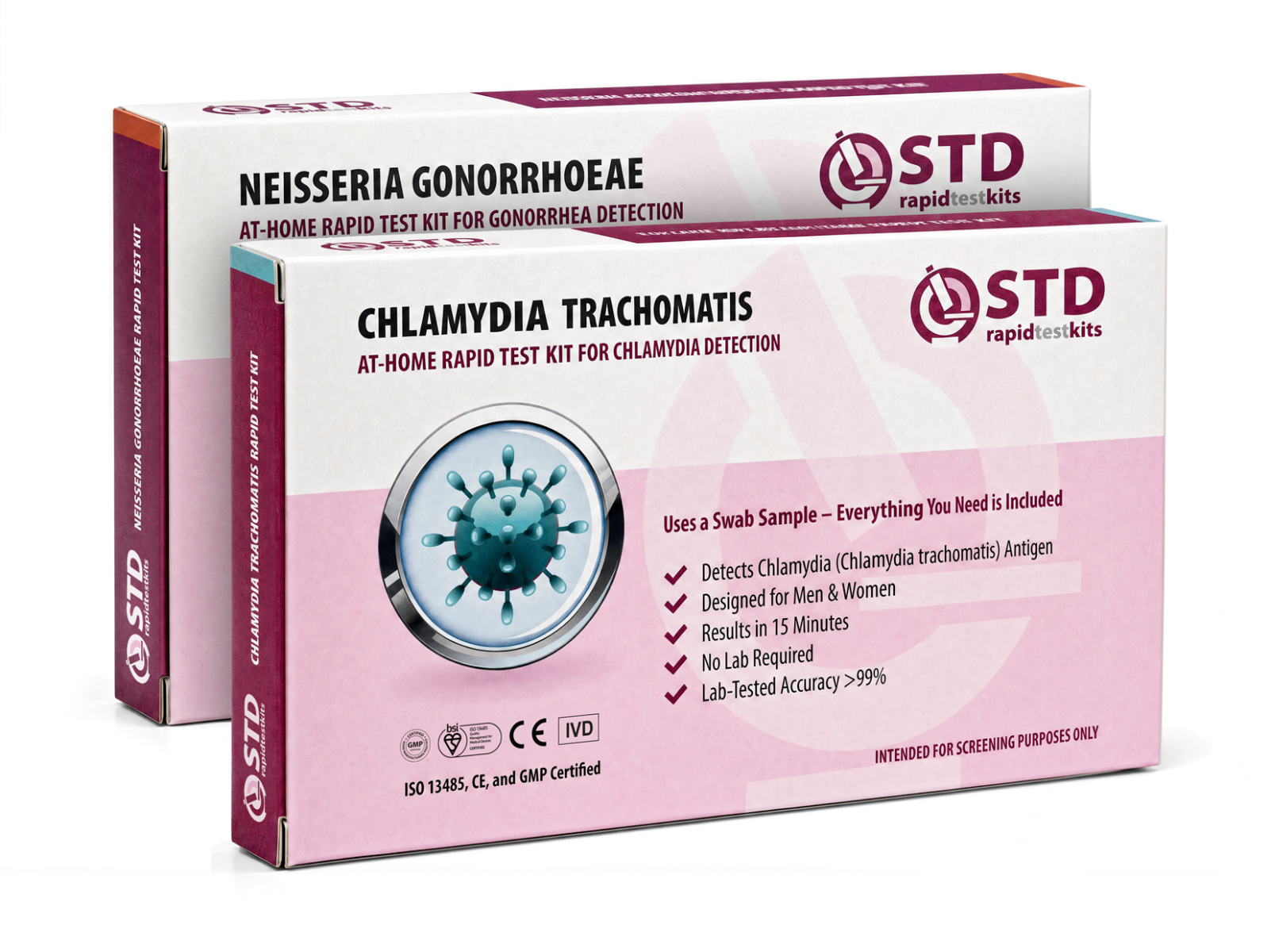
This article is published by stdrapidtestkits.com, which sells at-home rapid chlamydia, gonorrhea, and combination test kits. We recommend products based on whether they fit a reader’s situation, not on commercial benefit. Our chlamydia kit is a self-collected swab with a rapid lateral-flow result. Laboratory NAAT testing is the diagnostic gold standard at clinics, and the two are complementary rather than identical. A positive at-home result is worth confirming through a clinic NAAT when possible.
When to Suspect Treatment Failure
Treatment failure is rare, but it happens. The standard regimen for uncomplicated chlamydia is a seven-day course of doxycycline (100 mg twice daily) per current CDC guidance, with azithromycin as an alternative in specific cases (CDC chlamydia treatment guidelines). When treatment appears to fail, the most common explanations are not antibiotic resistance. They are missed doses, partial courses, taking the medication outside the prescribed timing, or sex during the seven-day post-treatment window before the bacteria fully clear.
If both partners genuinely completed the full course, abstained for the recommended seven days, and a follow-up test still comes back positive, that is the point at which a clinical conversation about resistance, reinfection from outside the relationship, or pharyngeal or rectal infection (which require different sample sites) becomes worth having.
How to Talk About a Second Positive Without Starting a War
This is where the medicine stops mattering and the relationship dynamics take over. One positive STD test in a monogamous relationship is hard. A second is harder. Leading with accusation shuts the conversation before it starts, because once accusation is on the table, the conversation stops being about facts and becomes about defending dignity.
Opening with curiosity works better. "My test came back positive again, and I’m trying to figure out why. Can we walk through the timeline together, when each of us tested, when we restarted sex, what dosing schedule each of us followed?" That single sentence opens the door to the science instead of the shame. It puts the two of you on the same side of the problem rather than across from each other.
Most of those questions have answers that explain the second positive without anyone lying. The last one in the list below is the one that has to be asked, but the answer becomes more meaningful when it arrives in a conversation that already trusts the rest of the timeline. If a partner refuses to engage, deflects, or treats the conversation as an attack, that response is its own data point. So is genuine cooperation.
- What date did each of you test, and how many days after the suspected exposure was that test taken?
- What was the dosing regimen prescribed (single-dose azithromycin or seven-day doxycycline), and was the full course actually completed?
- How many days after the antibiotics finished did sex resume?
- Did either of you have any sexual contact, including oral sex, with anyone outside the relationship between the first positive and the current one?
Your Reinfection-Prevention Protocol
If you are reading this in the middle of a second positive, here is the practical protocol that closes the door on a third one. It draws directly from CDC partner-management guidance, in which the Expedited Partner Therapy framework is embedded, and from the way clinics actually run these cases when they have the time and resources to do it well.
- Retest to confirm the result. A repeat test from the right window, ideally at least 14 days from any new exposure, separates a true positive from a fluke. At-home testing makes this faster and more private than a clinic visit.
- Both partners get treated on the same day. Even if one partner tests negative. Public health calls this expedited partner therapy, and many U.S. states allow a clinician to prescribe for a partner without a separate visit (CDC chlamydia treatment guidelines, partner-management section).
- Abstain for the full seven days after the antibiotics. No exceptions, no "just this once." That window is when reinfection happens most reliably.
- Retest at three months. The CDC explicitly recommends this for anyone with a recent chlamydia diagnosis, even if symptoms are gone and even if the partner was treated (CDC clinical retesting).
- Use condoms consistently until both partners are confirmed clear. Not perfect, but meaningfully protective.
- Document the timeline. Test dates, treatment dates, sex dates. Sounds clinical, but it is the single tool that ends "he said, she said" arguments fastest.
Persons who receive a diagnosis of chlamydia should be retested approximately 3 months after treatment, regardless of whether they believe that their sex partners were treated.
When It Actually Might Be Cheating
None of this is a guarantee that a second positive cannot be evidence of infidelity. It can be. The signal worth paying attention to is not a single test result. It is a pattern of facts that does not fit the reinfection scenarios above.
The pattern that suggests a new exposure rather than an unfinished old one looks like this. Both partners tested at appropriate windows after the original exposure, both completed the full antibiotic course, both abstained the full seven days after treatment, and both came back negative on a confirmatory test at six to eight weeks. Months later, with no missed steps, one partner tests positive again. That sequence is genuinely difficult to explain through reinfection from the original episode, because the original episode was, by every measurable standard, fully resolved.
Even then, the right next step is calm conversation rather than confrontation. New exposure can come from sources other than infidelity in the conventional sense, including a previously undisclosed partner before the relationship was understood to be exclusive, or different definitions of monogamy that were never explicitly aligned. The conversation worth having is about timeline and honesty.
If a partner refuses to engage in any version of that conversation, refuses retesting, or refuses partner-treatment, those refusals tell you what the test result alone cannot.
FAQs
- Does a second positive chlamydia test automatically mean my partner cheated?
- Rarely. Three causes are far more common than infidelity: same-day partner treatment was skipped, sex resumed inside the seven-day post-antibiotic window, or your partner’s earlier test fell inside the detection window and produced a false negative. Map your own timeline against those three patterns before any accusation. If every step was completed correctly and a confirmatory negative test came back at six to eight weeks, only then does new exposure become the leading explanation.
- Can I really get chlamydia from the same person twice?
- Yes. Treatment clears the infection from your body but does not give you immunity. If your partner was not treated at the same time as you, or if they were and the timing slipped, the bacteria can transmit back during the next sexual contact. This is why concurrent partner treatment is the public-health standard.
- How long should I wait before retesting after treatment?
- The CDC recommends retesting approximately three months after treatment for anyone diagnosed with chlamydia, regardless of whether you believe your partner was treated. If you have new symptoms before then, retest immediately rather than waiting.
- What if my partner’s test came back negative but mine is positive?
- The most common cause is timing. If their test was taken inside the window period (under two weeks from possible exposure), a true infection can read as negative. They should retest at day 14 or later. Less commonly, infection can sit at a body site that was not swabbed, such as the throat or rectum.
- Can chlamydia stay in my body without symptoms for months?
- Yes. Most people with chlamydia have no symptoms at all and never know they are infected, according to NHS guidance. The infection can persist this way for weeks or months, which is why screening is recommended even when nothing feels wrong.
- How long should we abstain after starting antibiotics?
- Abstain from sexual activity for seven days after a single-dose regimen, or until the full seven-day course is complete for doxycycline. Both partners should follow the same timing, even if only one tested positive. Sex inside this window is one of the most common causes of reinfection.
- Does chlamydia treatment ever fail?
- Outright treatment failure is uncommon. When a follow-up test is positive, the most likely causes are missed doses, an incomplete course, sex during the seven-day window, or reinfection from an untreated partner. Antibiotic resistance does occur but is rare. Talk to a clinician if both partners completed treatment correctly and a follow-up test is still positive.
- Where can I get a private retest without going to a clinic?
- An at-home self-swab rapid kit gives a private result in about 15 minutes. It is well-suited to confirming a suspected second infection, screening at three months as the CDC recommends, or testing both partners discreetly on the same timeline. A positive at-home result is worth confirming through a clinic lab NAAT when possible.
- U.S. Centers for Disease Control and Prevention. Sexually Transmitted Infections Treatment Guidelines, chlamydial infections section, including first-line antibiotic regimens, partner-management standards, and Expedited Partner Therapy guidance.
- U.S. Centers for Disease Control and Prevention. STI Treatment Guidelines, clinical retesting after treatment, including the three-month retest recommendation cited throughout this article.
- Cleveland Clinic. Chlamydia: causes, symptoms, treatment, and prevention. Patient-facing overview supporting the no-immunity and reinfection-cycle framing.
- NHS. Chlamydia overview, with patient-facing guidance on testing windows, partner notification, asymptomatic-rate framing, and treatment.
