
Published: October 2025 | Last updated: May 2026 | Editorial review and quality control: Martina N.
Noticing blood after sex when you weren't expecting it can be unsettling. Sometimes the cause is mechanical: friction, dryness, a deep angle. Other times it's a quiet sign that something inside the cervix is inflamed. One of the most common silent causes is chlamydia, a bacterial infection that often shows no other symptoms but leaves the cervical surface fragile enough to bleed during ordinary sex.
This guide explains what postcoital bleeding is, how chlamydia (and a few other infections) cause it, when to test, and what happens after a positive result. The aim is to help you separate everyday explanations from the ones worth testing for, without overreacting to a small symptom.
Key Takeaways
- Light pink spotting after vaginal sex is one of the few visible signs of chlamydia in people with a cervix, and it can show up without any pain, discharge, or itching.
- If you've had unprotected sex in the last few weeks, a swab-based test about 14 days after exposure is the simplest way to rule chlamydia in or out before deciding next steps.
What "postcoital bleeding" actually means
The clinical term for bleeding after vaginal penetration is "postcoital bleeding." Mayo Clinic notes that it can come from cervical irritation, infections, dryness, polyps, or hormonal shifts, and that recurrent episodes are worth investigating even when each one looks small. It's a fairly common symptom and not always serious, but worth taking seriously when it shows up.
What sets infection-related bleeding apart is its quiet pattern. There's often no cramping, no smell, no obvious discharge. The first thing you notice might be a streak of pink on toilet paper or a small mark on the sheets. That subtlety is part of why chlamydia gets missed; the body doesn't sound an alarm, so the symptom gets blamed on dryness or a rough night.
If the bleeding happens once after a particularly vigorous session and never repeats, friction is usually the cause. If it happens more than once, especially after gentler sex, or pairs with a recent unprotected encounter, the infection question deserves an answer from a swab rather than a guess. The cervix is one of the few internal surfaces you can't see, and the bleeding is sometimes the only message it sends.
One episode after rough or poorly-lubricated sex that does not repeat: friction is the likely cause. Two or more episodes, especially after gentler sex or paired with a recent unprotected encounter: worth a swab test before attributing it to mechanics.
The most common causes, side by side
Not every drop of blood means infection. The pattern of when the bleeding happens, what comes with it, and whether it repeats usually points toward the cause. Hormonal spotting follows the cycle. Friction-related bleeding clears in a day. Infectious bleeding tends to repeat. The table below lays out the most common explanations side by side.
| Cause | Typical Clues | STI Risk? |
|---|---|---|
| Chlamydia | No pain, often no discharge; spotting after sex or between periods | Yes, very high |
| Gonorrhea | Spotting often paired with thicker discharge or pelvic ache | Yes, moderate to high |
| Trichomoniasis | Frothy discharge, fishy smell, redness, occasional bleeding | Yes, moderate |
| Cervical irritation (non-STI) | Recent speculum exam, IUD insertion, douching, or spermicide | Possible, not usually infectious |
| Friction or deep penetration | One-off bleed after intense sex; doesn't repeat | Low unless other symptoms appear |
| Polyps or fibroids | Spotting with cycle irregularity; sometimes pelvic fullness | No, benign cause |
| Hormonal shifts (pill, perimenopause) | Spotting throughout the cycle, not just after sex | No, not STI-related |
How chlamydia inflames the cervix
Chlamydia is caused by the bacterium Chlamydia trachomatis, which infects the lining of the cervix, urethra, rectum, or throat. According to the CDC's overview of chlamydia, the infection often produces no symptoms at all. When it does cause symptoms in people with a cervix, the signs tend to be subtle: unusual discharge, bleeding between periods, or bleeding after sex.
The mechanism behind that bleeding is cervicitis, an inflammation of the cervical lining. The CDC's treatment guidelines for urethritis and cervicitis describe how both chlamydia and gonorrhea irritate cervical tissue, leaving the surface engorged and easy to bruise. Think of how a chapped lip splits open with the smallest tug; the inflamed cervix behaves the same way under the pressure of sex. Small surface vessels rupture and release a few drops of pink or red.
The same inflammation can cause bleeding between periods, with no sex involved at all. If the bacteria move up into the uterus and fallopian tubes, the infection becomes pelvic inflammatory disease (PID). The CDC's PID page links untreated chlamydia to chronic pelvic pain, ectopic pregnancy, and infertility, and notes that the upper-tract damage can occur silently. PID isn't the only path to bleeding, though, and you don't need to wait for serious abdominal pain to take a quiet bleed seriously.
Even untreated, the bleeding can come and go for weeks. The infection itself doesn't clear on its own. A short course of antibiotics is usually enough to settle the inflammation and stop the spotting once the bacteria are gone.

Why chlamydia is so often silent
Most chlamydia infections don't announce themselves. The CDC's chlamydia overview notes that the infection often has no symptoms at all, which is part of why annual screening exists for sexually active people under 25 in the first place. Asymptomatic carriers can pass the bacterium to partners for months without realizing anything is wrong.
The bacterium replicates inside the cells of the cervical or urethral lining without triggering the kind of immune response that produces fever or burning. There's no swelling to feel, no rash to see, no consistent smell. The first hint often arrives indirectly: a partner's positive test result, a routine screening flag, or the small streak of pink that brought you to this article.
Clinicians commonly see patients who only learn they have chlamydia when an unrelated check-up turns up cervicitis on a speculum exam. The cervix looks irritated, a swab is sent, and the lab confirms the cause. None of this requires the person to feel sick. The infection has been quietly there for weeks or months.
This is why screening guidelines aren't built only around symptoms. The CDC recommends annual chlamydia screening for all sexually active people with a cervix under 25, and for older people with new or multiple partners. The point isn't paranoia; the point is that you genuinely can't feel it. A swab is the only reliable way to know.
Chlamydia often has no symptoms, but it can cause serious health problems, even without symptoms. If symptoms occur, they may not appear until several weeks after having sex with a partner who has chlamydia.
When does spotting start after exposure?
If you're trying to trace the bleeding back to a specific encounter, the timing can be confusing. Chlamydia's incubation period and its testing window don't quite line up. Some people develop symptoms within a week. Others stay symptom-free for months and only notice bleeding once the cervical inflammation has built up.
The bacterium typically becomes detectable on a swab around 5 to 14 days after exposure. Testing too early, especially within the first five days, can produce a false negative because there's not yet enough bacterial material on the cervix or in the urine to register. Most clinics recommend waiting at least seven days, and ideally 10 to 14 days, before the first test. If symptoms continue after a negative early test, retest two to three weeks after the suspect encounter.
If you have a known positive partner, don't wait for symptoms. Most providers will start treatment empirically while the test is being processed, because reinfection from an untreated partner is one of the main reasons people end up testing positive a second time. The bleeding itself usually starts in the first three weeks after exposure, but it can show up later, especially if the infection has had time to spread up into the upper genital tract.
The table below maps the rough timeline. Use it as a reference for when to test, not a guarantee.
Editorial disclosure: this site, stdrapidtestkits.com, sells the at-home chlamydia swab test referenced below. We recommend products based on fit for the reader's specific concern, not commercial benefit.
| Event | Timeframe | What Might Be Happening |
|---|---|---|
| Unprotected sex or exposure | Day 0 | First contact with Chlamydia trachomatis |
| Silent infection takes hold | Day 1 to 10 | Bacteria colonize the cervix, urethra, or rectum |
| Earliest reliable test window | Day 5 to 14 | Most home and lab tests can detect the infection |
| First spotting often appears | Day 7 to 21 | Cervical inflammation produces post-sex bleeding |
| Best window for confirmation | Day 14 plus | Highest accuracy, especially for asymptomatic infections |
Testing at home, in a clinic, or by mail
Testing for chlamydia doesn't have to mean a clinic visit. Three routes exist, and each fits a different situation.
A clinic test is the gold standard when you have severe symptoms (intense pelvic pain, fever, heavy abnormal bleeding), when you're pregnant, when you want a full STI screen alongside chlamydia, or when you may need same-day antibiotics. A clinician collects a swab or urine sample, sends it for nucleic acid amplification testing (NAAT) at the lab, and prescribes treatment if the result is positive. Laboratory NAAT is the most analytically sensitive method for detecting Chlamydia trachomatis, especially in very early or low-bacteria infections.
Mail-in lab kits sit in the middle. You collect a sample at home, ship it to a partner lab, and get a NAAT result back in a few days. Privacy is good. Turnaround is slower than a clinic, but the underlying lab method is the same.
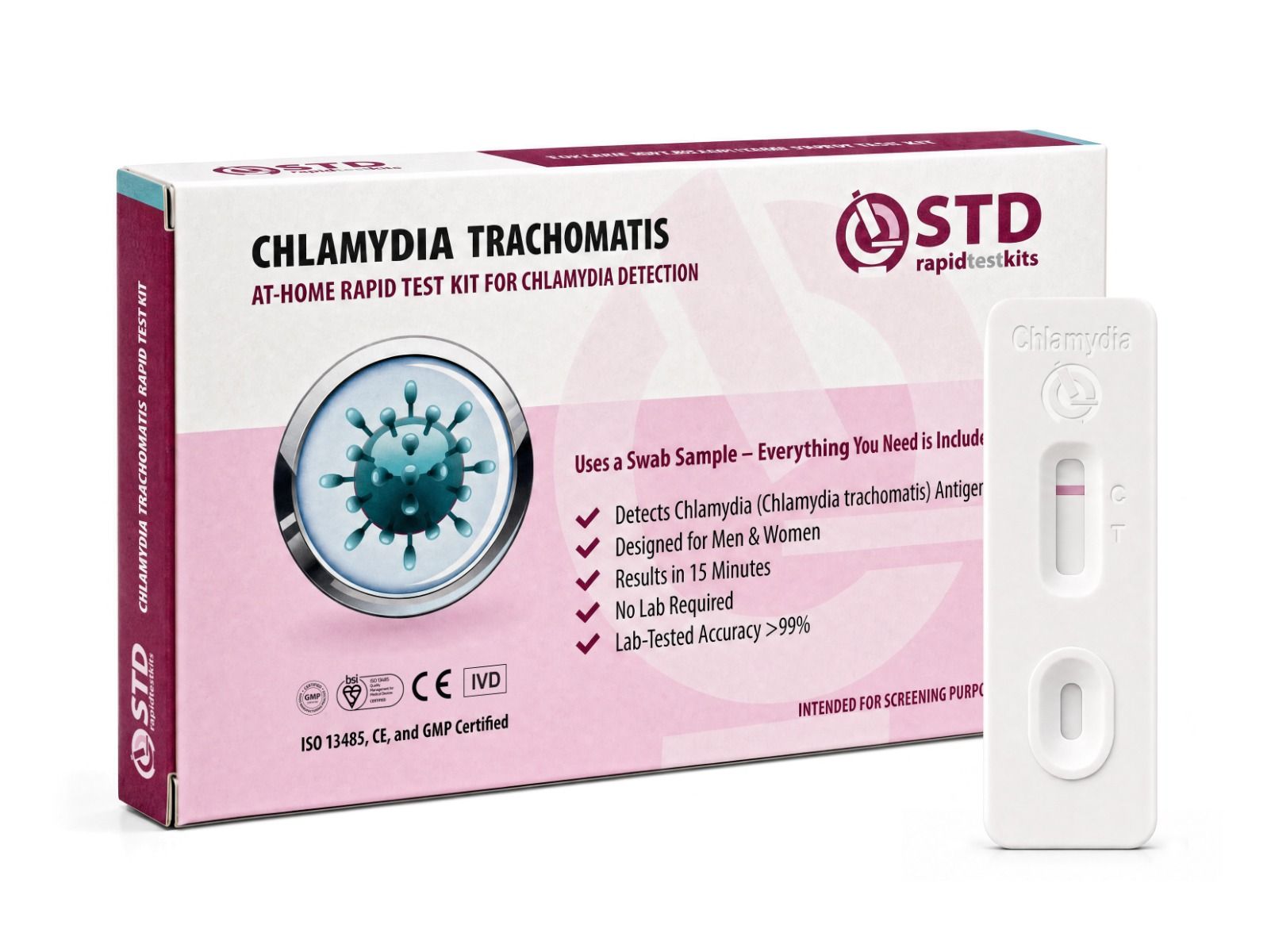
At-home rapid tests are the fastest. Our chlamydia home test uses a self-collected vaginal or penile swab and a lateral-flow cassette, with a result in roughly 15 minutes. Lateral-flow chemistry isn't identical to a lab NAAT (lab NAAT catches a small additional fraction of low-bacteria infections), but it's a useful screening step when you want fast clarity at home and don't have easy access to a clinic. A positive at-home result is worth confirming with a clinician, who can then prescribe treatment.
Whichever route you choose, time the test correctly. A test in the first five days after exposure can miss an active infection. If symptoms continue after a negative early test, repeat at the 14 day mark.
If your bleeding comes with severe pelvic pain, fever, heavy bleeding outside your normal cycle, pain during urination, or pregnancy, go to a clinic rather than testing at home. These can be signs of pelvic inflammatory disease (PID) or another upper-tract infection that needs in-person evaluation and prompt antibiotics. PID is treatable but easier to treat early.
If you test positive: what happens next
Chlamydia is a common, curable bacterial infection. The standard treatment is a 7-day course of doxycycline, with single-dose azithromycin reserved for situations like pregnancy where doxycycline isn't appropriate. The CDC's 2021 STI treatment guidelines outline the full protocol, and most clinics will prescribe one of these regimens immediately on a positive result.
A few things to know about the days right after a positive test:
- Avoid sex (including oral and anal) for at least seven days after starting treatment, and only resume after symptoms have cleared.
- Tell every partner from the past 60 days. The CDC recommends partner notification, and many states allow expedited partner therapy, where the same prescription can be picked up by your partner without a separate clinic visit.
- Retest in three months. Reinfection from an untreated partner is the most common reason for a second positive, and the CDC recommends a follow-up test for everyone, regardless of whether symptoms cleared.
- The bleeding usually settles within a few weeks of treatment as the cervical inflammation calms. If spotting continues after the antibiotic course finishes, see a clinician to rule out a separate cause: bacterial vaginosis, a cervical polyp, a yeast infection, or a hormonal contributor like a recent change in birth control.
A positive result isn't a verdict on you as a person. Chlamydia is among the most commonly reported bacterial infections in the United States, according to CDC surveillance data, and the true number is higher because so many cases stay silent. Treatment is straightforward; the harder parts are usually the conversation with partners and the wait for the three-month retest.
"It was just rough sex," or was it?
There's a familiar pattern: the bleeding showed up after a long session, a new position, not enough lubrication. Friction is a real cause of post-sex bleeding, and it can absolutely produce a small amount of spotting that resolves in a day or two. The trouble is that "rough sex" is also a very convenient explanation, and it can keep someone from testing for an infection that genuinely needs treatment.
A useful rule of thumb: friction-related bleeding is a one-off. The next time, with adequate lubrication and a less intense session, it doesn't repeat. Infection-related bleeding does the opposite. It comes back, often after gentler sex, sometimes between periods entirely. If you've had bleeding more than once, or if it pairs with any unprotected sex in the previous month, friction alone is unlikely to be the full story.
Being in a long-term, monogamous relationship doesn't rule chlamydia out either. The infection can sit asymptomatic for months. It can have arrived from a previous partner, gone undetected through a routine screening that didn't include chlamydia, or surfaced now because the cervical tissue has finally inflamed enough to bleed during sex. Testing in that situation is a sensible diagnostic check given the symptom, not an accusation.
The cleanest way to settle the question is a swab. If it comes back negative and the bleeding stops with better lubrication or a gentler approach, friction was probably the cause. If it stays positive or the bleeding returns, you have an answer to act on.
Reducing the chance of the next surprise
There's no way to drop the risk to zero, but a few habits change the odds.
- Use barrier protection with new or recent partners. Condoms substantially lower chlamydia transmission, especially when used consistently from the start of sex.
- Screen on a schedule. Annually if you're under 25 or have new or multiple partners. Every three to six months in a higher-risk situation. The screening interval is what catches the silent cases before they cause damage.
- Treat new partners as an unknown. A negative test from six months ago doesn't tell you anything about this week. People can pick up chlamydia between tests without knowing.
- Don't wait for dramatic symptoms. Mild spotting, a slightly different discharge, a vague pelvic ache, any of these is enough reason to test, especially after a recent unprotected encounter.
The mindset shift that matters most is treating testing as routine maintenance rather than a confession. Sexually active adults pick up infections; that's the population biology. Catching them early keeps treatment simple and prevents the upper-tract damage that turns a curable infection into a chronic problem.
If you've noticed bleeding after sex and you're not sure where to start, a swab is the simplest first step. A negative result lets you focus on the mechanical causes (lubrication, position, hormonal shifts). A positive result hands you a clear treatment path and a short list of next steps.
FAQs
- Can chlamydia cause bleeding after sex even if nothing else hurts?
- Yes. Chlamydia inflames the cervical lining (a condition called cervicitis), which leaves the surface fragile enough to bleed during ordinary sex even when there's no pain, no smell, and no obvious discharge. Light spotting can be the only symptom for weeks or months, which is why a swab is the only reliable way to confirm or rule out the infection when bleeding shows up unexpectedly.
- How soon after exposure does spotting actually start?
- There's no strict clock. Most people who develop symptoms notice them within one to three weeks, but some carry the infection for months without bleeding at all. Testing too early can miss it; the bacterium typically becomes detectable around 5 to 14 days after exposure, with the most reliable window starting around day 14. If you tested negative within the first week and symptoms continue, retest at the two-week mark.
- What if I only spotted once after a vigorous session?
- One-off spotting after a particularly intense or poorly-lubricated session is usually friction-related and clears within a day. The thing to watch for is repeat episodes. If bleeding shows up again after gentler sex, or pairs with any unprotected sex in the previous month, that pattern points away from friction and toward something worth testing for.
- Can I get chlamydia from oral sex or just touching?
- Oral sex can transmit chlamydia. The bacterium can colonize the throat and the urethra, and infections move in either direction during oral contact. Hand-to-genital contact rarely spreads it, but shared sex toys that aren't cleaned between users can. Throat infections are usually asymptomatic and aren't always caught by a standard genital swab, so mention oral exposure to your clinician if you're getting a full screen.
- Will the bleeding stop after antibiotics?
- In most cases yes. Once the bacteria are cleared, the cervical inflammation calms over a few weeks and the spotting resolves. If spotting continues two to three weeks after finishing the antibiotic course, see a clinician to rule out a separate cause: bacterial vaginosis, a cervical polyp, a yeast infection, or a hormonal contributor like a recent change in birth control.
- Could I test negative and still have chlamydia?
- Yes, if you tested too early. Within the first 5 days after exposure, a swab may not pick up enough bacterial material to register a positive. The CDC recommends a repeat test at 14 days if symptoms continue after a negative early test. A laboratory NAAT is the most analytically sensitive option; rapid lateral-flow tests at home are useful for screening, while the lab method catches a small additional fraction of low-bacteria infections.
- Could my partner have given me chlamydia without symptoms themselves?
- Almost certainly possible, and this is the most common transmission pathway. Because chlamydia rarely causes obvious symptoms, your partner may be entirely unaware they're carrying it. This is why the CDC recommends notifying every partner from the past 60 days regardless of how they feel, so they can test and, if positive, break the reinfection cycle that's the single biggest reason people retest positive after finishing treatment.
- How do I bring this up with my partner?
- Lead with facts and skip the dramatics. Something like: "I've had some bleeding after sex, I tested, and the result came back positive for chlamydia. I wanted you to know so you can get tested too." Most people respond well to a calm, factual conversation. Many states also allow expedited partner therapy, which lets a clinician write a prescription your partner can pick up without their own appointment.
How we sourced this article: Our article was constructed based on current advice from the most prominent public health and medical organizations, and then molded into simple language based on the situations that people actually experience. We cite the CDC, Mayo Clinic, NHS, and Planned Parenthood for clinical guidance; we describe how at-home screening kits fit into the broader testing landscape; and we keep the focus on practical action rather than fear.
- U.S. Centers for Disease Control and Prevention. About Chlamydia, public health overview, symptoms in people with a cervix, screening recommendations.
- U.S. Centers for Disease Control and Prevention. STI Treatment Guidelines, Urethritis and Cervicitis chapter, on cervicitis pathology and chlamydia treatment regimens.
- U.S. Centers for Disease Control and Prevention. About Pelvic Inflammatory Disease (PID), upper-tract complications of untreated chlamydia.
- Mayo Clinic. Bleeding after vaginal sex, list of common causes including infections, irritation, polyps, and hormonal shifts.
- Planned Parenthood. Chlamydia overview, including the high rate of asymptomatic infections in people with a cervix.
- National Health Service (UK). Chlamydia, symptoms, testing windows, and treatment.
