
Published: November 2025 | Last updated: May 2026 | Editorial review and quality control: Martina N.
There is a moment after casual sex when the body goes quiet but the mind starts running. No symptoms yet. Just a wait. For most people who type "burning after sex" or "STD symptoms" into a search bar at 2 a.m., the question is not really about a single sensation. It is about whether one night with someone who said "I am clean" could have changed something.
This guide is the calm version of the answer. Most post-hookup worries do not turn into a positive test. Some do. The difference comes down to timing: when symptoms can appear, when a test can reliably detect what you might have, and what to do when "I tested negative last week" does not quite mean what you hoped. None of what follows is a moral verdict on a one-night stand. It is a practical map of what your body can and cannot tell you in the days and weeks after.
Key Takeaways
- Symptoms of common STIs like chlamydia and gonorrhea often appear 3 to 14 days after exposure, but most chlamydia infections produce no symptoms at all.
- Testing too soon can produce a false negative. Reliable detection windows range from about 5 days for bacterial infections to 12 weeks for some viral ones.
Why Most People Miss the Earliest Signs
STIs rarely look like they do in textbooks. The most contagious infections are often the quietest ones. The CDC reports that most people with chlamydia have no symptoms, and gonorrhea is similarly silent in many infected people, especially in women. When symptoms do appear, they tend to look like ordinary irritations: a mild burn during urination, a tiny sore that could pass for a shaving nick, an extra-thick discharge that might pass for a yeast infection.
Oral exposure adds another layer of confusion. Many readers describe brushing off a sore throat or a raw feeling at the back of the mouth as a cold or post-drinking dryness. Pharyngeal gonorrhea, the clinical name for gonorrhea in the throat, is one common reason oral STIs get passed forward without anyone noticing. The Mayo Clinic notes that STI symptoms can be mild enough to ignore for weeks or months, which is why most public-health bodies recommend routine screening for sexually active people regardless of how they feel.
Two things follow from this. First, symptom-free does not mean infection-free. Second, a single bothersome symptom does not automatically mean catastrophe. Both directions are common, and the only way to close the gap between "I think I might" and "I know" is a properly timed test that does not just rely on how you feel.
The most contagious STIs are often the quietest ones. Routine screening, not symptom-watching, is what catches them in time.
Window Periods: Why Testing Right Away Can Backfire
Every STI has a window period: the time between exposure and the point at which a test can reliably detect the infection. Test before that window closes and you can get a clean result while the infection is still building up in your body. The most common scenario behind a "false negative" story is not test failure. It is testing too soon.
The numbers vary by infection and by sample type. Bacterial infections like chlamydia and gonorrhea become detectable within days because the bacteria themselves can be picked up directly. Viral infections like HIV and herpes are usually measured by antibody response, which takes weeks to build. Syphilis sits in the middle. The CDC's screening recommendations reflect these timing differences, which is why most clinics will tell you to come back later if you test within a few days of an exposure.
The table below summarizes the typical detection windows reported by the CDC and major laboratories. They are not absolute: some people seroconvert sooner, others later. Use them as a defensible plan for when to test and when to retest. If you test inside the early-detection range and the result is negative, plan a retest at the longer window for confirmation.
| Infection | Earliest Detectable | Most Reliable Test Time |
|---|---|---|
| Chlamydia | 5 to 7 days | About 14 days after exposure |
| Gonorrhea | 3 to 5 days | 7 to 14 days after exposure |
| Syphilis | About 3 weeks | 6 weeks or more |
| HIV (antigen/antibody) | 2 to 4 weeks | 4 to 6 weeks after exposure |
| Herpes (blood antibody) | 3 to 6 weeks | 8 to 12 weeks after exposure |
When "I'm Clean" Isn't a Guarantee
"I got tested and everything was negative" is one of the most common reassurances exchanged before unprotected sex. It feels like a fact, but it is a snapshot. A test result describes what was true on the day of the test. If your partner had a new contact between then and now, or tested inside their own window period, the result is already out of date by the time it is being repeated to you.
This is one of the more frustrating realities of post-hookup anxiety. Most people who say "I am clean" are not lying maliciously. They genuinely believe a months-old test still applies. They assume that because they have no symptoms, they cannot be contagious. The CDC notes that most chlamydia infections produce no noticeable symptoms, which is exactly why "I feel fine" is not the same as "I am not infected." The same applies to gonorrhea in many people and to early-stage syphilis, which can hide for weeks behind a single painless sore most people never notice.
Practical translation: if you have had unprotected sex with a new partner, plan to test on your own schedule regardless of what they say about their last result. Their honesty is not the same as your evidence. The reverse is also true. If a partner asks you to confirm a recent test, share the date and the panel, not just the word "negative." Treating testing as a shared logistical fact, rather than a moral statement, is what keeps this from becoming a trust crisis later.
How long after sex can an STI actually be detected?
For most common STIs, the earliest reliable testing window is between 5 days and 4 weeks after exposure. Chlamydia and gonorrhea: about 14 days. HIV antigen/antibody tests: 4 to 6 weeks. Syphilis: 6 weeks or more. Herpes blood antibody tests: 8 to 12 weeks. Testing inside these windows can produce a false negative, so a single early test is rarely the end of the story.
Burning After Sex: STI or Something Else?
Burning during urination is the symptom that drives most after-hours searches. It is also one of the symptoms with the longest list of possible causes. Friction, dehydration, lubricant or condom irritation, soap residue, and an ordinary urinary tract infection (UTI) can all produce burning that has nothing to do with a sexually transmitted infection. Most of these resolve in a day or two with hydration and time.
The trouble is that chlamydia, gonorrhea, and trichomoniasis can produce nearly identical sensations. Cleveland Clinic notes that burning during urination is a common chlamydia symptom in both men and women, and the same is true for gonorrhea. Telling them apart from a UTI at home is often impossible, which is why clinicians who see burning-with-urination after a recent sexual exposure usually test for both UTI bacteria and STIs at the same visit.
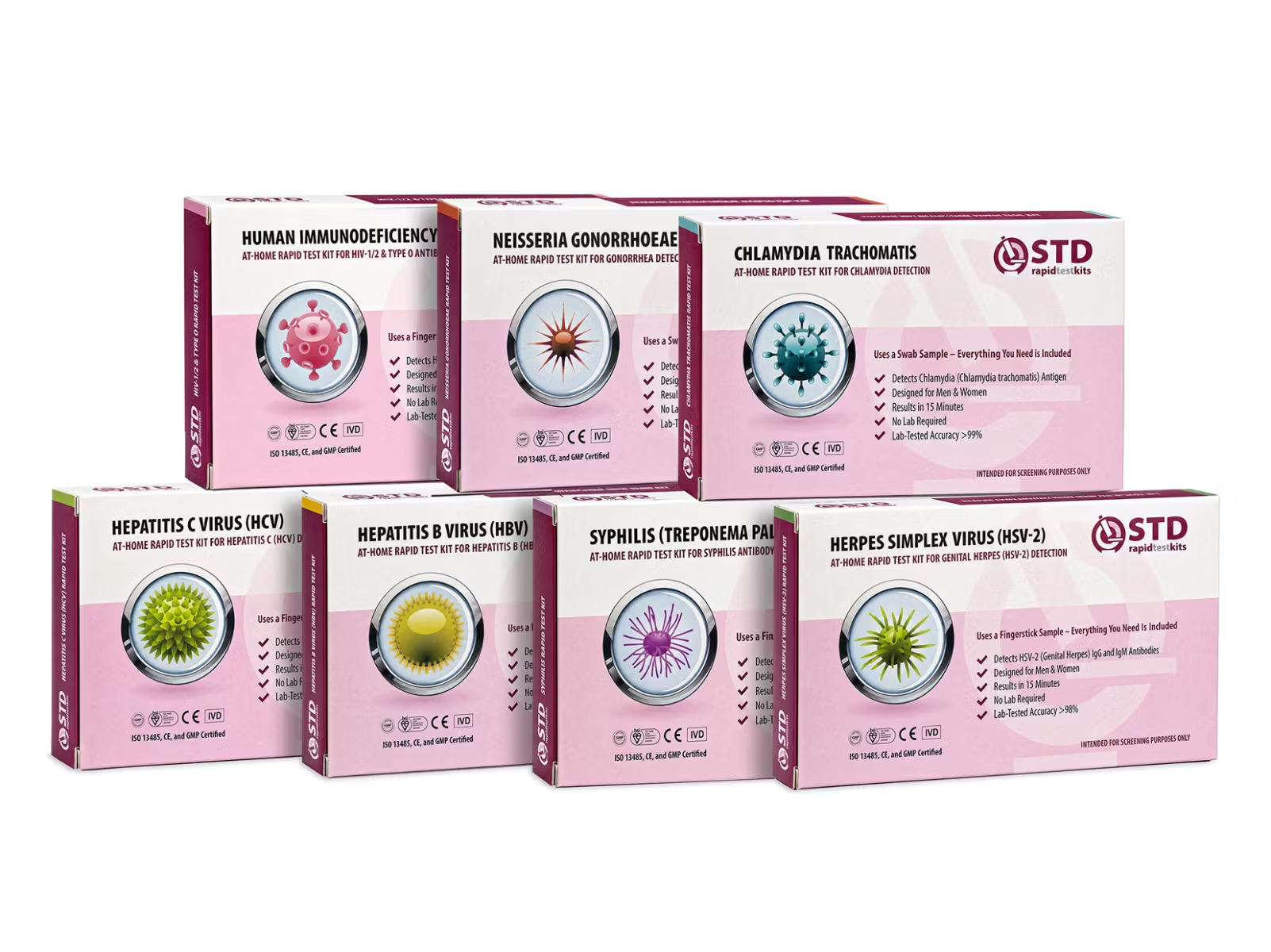
The table below shows where UTIs and STIs overlap and where they tend to diverge. Use it as a starting point, not a diagnosis. The two patterns most worth paying attention to: an unusual discharge alongside burning is much more typical of an STI, and a UTI that does not respond to standard treatment within a few days is a common signal to test for chlamydia or trichomoniasis. (Disclosure: stdrapidtestkits.com sells rapid at-home STI test kits, including the panel referenced below; we recommend products based on fit for the reader's concern, not on commercial benefit.)
| Symptom | Typical of UTI | Typical of STI |
|---|---|---|
| Burning with urination | Yes | Yes |
| Cloudy or bloody urine | Common | Less common |
| Unusual discharge | No | Yes (chlamydia, gonorrhea, trich) |
| Pain during sex | Sometimes | Yes |
| Lower back or pelvic pain | Yes | Yes |
| Symptoms that persist after standard UTI treatment | Uncommon | Common |
How One Missed Test Becomes a Ripple
Public-health researchers use the term "asymptomatic carrier" for someone who is infected and contagious without knowing it. The phrase is clinical, but the consequences are not. One untested case can travel through a relationship, a friend group, or a hookup chain over the course of weeks. Most STIs spread quietly through people who feel fine, not through reckless behavior.
The CDC's STI surveillance data shows millions of new chlamydia, gonorrhea, and syphilis cases reported in the United States each year, and the agency notes that the true number is meaningfully higher because so many infections are never tested. The takeaway is not fear. It is pattern recognition. If you have had a recent unprotected exposure, the absence of symptoms is not evidence of absence. Routine screening at the right interval is the thing that breaks the chain.
HIV deserves a brief note here, since it drives a lot of post-hookup anxiety. Per-act transmission risk for unprotected vaginal or receptive anal sex is generally low (the CDC publishes per-exposure risk estimates in the low fractions of a percent for most contacts), but several conditions raise it substantially: an undiagnosed acute HIV infection in the partner, a detectable viral load, and the presence of another untreated STI like syphilis or gonorrhea, which inflames tissue and increases transmission. None of this changes the testing plan; it just clarifies why HIV testing is worth doing on the recommended schedule even if a single contact felt low-risk.
This is also why testing is rarely a one-and-done event for sexually active people. Public-health bodies recommend at least an annual screen for chlamydia and gonorrhea in sexually active women under 25 and in men who have sex with men, and more frequent testing for people with multiple recent partners.

The Emotional Weight of a Post-Hookup Diagnosis
The physical symptoms of most common STIs are usually treatable. The emotional ones often last longer. A positive result can stir up guilt about choices, doubts about a partner's honesty, and a shaken sense of control over your own body. The shame people feel is often disproportionate to the actual medical reality, which for most bacterial STIs is a single course of antibiotics and a retest a few weeks later.
Sexual-health counselors often recommend reframing the diagnosis as information rather than identity. You are not "a chlamydia person." You had an infection, the same way you might have had strep throat. The infection is treatable; what changes is what you now know about your body and your last partner. The NHS's overview of STIs reinforces this framing: STIs are common, treatable, and not a moral statement.
If you find yourself spiraling, talking to a clinician (in person or by telehealth) is usually more useful than another late-night search session. They can confirm the medical picture, explain what your specific result does and does not mean, and answer questions that feel too embarrassing to ask elsewhere. The thoughts that feel catastrophic at 2 a.m. tend to look much smaller after a five-minute conversation with someone who treats this every week.
For most bacterial STIs, a positive result means a single course of antibiotics and a follow-up test a few weeks later. It is a treatable infection, and a follow-up test confirms the antibiotic worked.
Telling a Partner Without the Shame Spiral
Telling a current or recent partner that you tested positive for an STI is one of the harder conversations in adult life. It is also one of the most useful things a person can do for the people in their orbit. Many partners are surprised by how matter-of-fact the conversation can be when it starts with information rather than blame.
The basic script is short. "I just tested positive for [infection]. I wanted you to know so you can get tested too." That is enough. You do not owe an exposure timeline or an explanation of how it happened. If a direct conversation feels impossible, free anonymous partner-notification services let you send a text or email that names the infection and the recommended testing window without identifying you. Most local health departments offer this service or can refer you to one.
What matters is that the message gets through. Partners who do not know they are at risk pass the infection forward, and many bacterial STIs become harder to treat the longer they go untreated. Untreated chlamydia in women, for example, can progress to pelvic inflammatory disease and affect long-term fertility. The conversation is not about confession. It is about closing a loop that protects everyone in it, including you, since reinfection from an untreated partner is one of the most common reasons people end up back at the clinic three months later.
Many people who have a sexually transmitted infection do not have any symptoms. The only way to know for sure if you have an STI is to get tested.
Treatment, Retesting, and What Happens After
Most common bacterial STIs are curable with a single course of antibiotics. Chlamydia, gonorrhea, and trichomoniasis fall into this category. Syphilis is also bacterial and curable, though early-stage treatment is more straightforward than late-stage. Viral infections like herpes, HIV, and hepatitis B and C are not curable in the same sense, but modern medications keep them manageable, suppress symptoms, and (with HIV) reduce transmission risk to effectively zero when viral load is undetectable.
Retesting matters more than people expect. The CDC recommends retesting about three months after treatment for chlamydia, gonorrhea, and trichomoniasis, mainly because reinfection from an untreated partner is so common. A retest confirms that treatment worked and that you have not picked the infection back up from someone in your circle who was never told. Skipping the retest is one of the most common ways an "I treated it" story turns into a "wait, why is this back?" story two months later.
For viral infections, the early conversation is usually about long-term care: HSV-2 outbreak management, HIV treatment plans, hepatitis B vaccination follow-up. Your clinician or a telehealth provider is the right place for that conversation, not a search bar. The goal of the first appointment is not to make a permanent identity decision. It is to understand what is being treated, what the treatment changes, and what the next testing milestone looks like.

Your Next Steps
If you are somewhere in the middle of this article because something happened, the practical sequence is short. Note the date of the exposure. Pick the right window period for the infection you are worried about. Test once at that window, and retest at the longer window if anything was outside the early-detection range. If symptoms appear before then, test sooner anyway and plan to retest. The window period applies to the test result, not to your symptoms.
If you tested negative at three days and your symptoms started yesterday, that result is not your final answer. Test again. If you have already tested positive, follow your treatment plan, tell any partners who could have been exposed, and put the retest on your calendar three months out.
None of this is a referendum on who you are. It is a sequence of small, specific actions that move you from "I do not know what is happening" to "I have a plan" you can follow tonight or first thing tomorrow.
Action checklist
- Note the date of the exposure so you can match it to the window period for each infection.
- Use the window-period table above to pick the earliest reliable test date for the infection you are worried about.
- Test once at that window. Retest at the longer window if your first test was inside the early-detection range.
- If you test positive, tell any recent partners and book a retest three months after treatment.
FAQs
- Can you really catch an STI from one night?
- Yes. Most STIs do not need repeated exposure. A single unprotected sexual contact is enough for chlamydia, gonorrhea, herpes, syphilis, and HIV to transmit if one person is infected. The likelihood per contact varies by infection, but "it was just one time" is not a protective factor.
- I tested negative, but I still feel something. What's going on?
- The most likely explanation is window period. Tests taken within a few days of exposure can miss an active infection because the bacterial load or antibody response has not yet reached detectable levels. Retest at the longer window for the infection you are concerned about. If symptoms persist, see a clinician sooner; symptoms can also point to non-STI causes like a UTI or a yeast infection.
- What does burning after sex usually mean?
- It can mean ordinary irritation (friction, lubricant or condom sensitivity, soap residue), a UTI, or an STI like chlamydia, gonorrhea, or trichomoniasis. If burning persists beyond a day or two, gets worse, or comes with discharge or pelvic pain, it is worth testing for both UTI bacteria and common STIs.
- How long do STI symptoms take to show up?
- Gonorrhea symptoms can appear within 2 to 5 days. Chlamydia symptoms, when they appear at all, usually show up within 1 to 3 weeks. Herpes outbreaks typically appear 2 to 12 days after exposure. Syphilis can hide behind a single painless sore for weeks. Many infections, particularly chlamydia, never produce symptoms in the infected person.
- Can a partner who 'tested clean' still pass an STI?
- Yes. A negative result describes a single moment in time. If your partner had any contact with someone else after their test, or tested within their own window period, the result no longer reflects current status. Treat "I tested negative" as helpful information, not as a guarantee.
- What's the difference between a UTI and an STI?
- Both can cause burning, urgency, and pelvic discomfort. STIs are more likely to also cause unusual discharge, pain during sex, or visible sores. A UTI that does not improve with standard treatment within a few days is a common signal to test for chlamydia, gonorrhea, or trichomoniasis.
- Do I really need to retest after treatment?
- Three months post-treatment is the CDC-recommended checkpoint for chlamydia, gonorrhea, and trichomoniasis. The reason is practical: if your partner was not tested and treated at the same time, picking the infection back up is common. The retest is what confirms the antibiotic worked.
- Is at-home STI testing reliable?
- At-home rapid lateral-flow tests are reliable when used inside the correct window period and the instructions are followed. They are screening tools rather than laboratory NAATs, which means a positive result is worth confirming with a clinician, and a negative result inside the window period should be retested. Used at the right time, they answer most post-hookup questions accurately.
How we sourced this article: Our article was constructed based on current advice from the most prominent public health and medical organizations, including the U.S. Centers for Disease Control and Prevention, the U.K. National Health Service, the World Health Organization, the Mayo Clinic, and the Cleveland Clinic. We then translated the guidance into plain-English context for the situations real readers actually describe in their late-night searches. Where specific numbers (window periods, transmission likelihoods, retest intervals) are cited, the figure links directly to the source page that publishes it.
- U.S. Centers for Disease Control and Prevention. STI screening recommendations, including retest intervals after treatment for chlamydia, gonorrhea, and trichomoniasis.
- U.S. Centers for Disease Control and Prevention. Chlamydia overview, including the proportion of infections that are asymptomatic and typical symptom timing.
- U.S. Centers for Disease Control and Prevention. STI Statistics landing page, including the most recent national surveillance data for chlamydia, gonorrhea, and syphilis (2024 provisional report).
- Mayo Clinic. Sexually transmitted diseases (STDs) symptoms and causes overview, including how mild and easy-to-miss many common STI presentations can be.
- Cleveland Clinic. Chlamydia overview, including burning during urination as a common symptom in both men and women.
- U.K. National Health Service. Sexually transmitted infections (STIs) overview, including general framing that STIs are common and treatable.
