






Quick Answer: Oral gonorrhea often causes no symptoms, but it can still be passed to partners. Throat swab STD tests, especially NAAT-based kits, are the most accurate way to detect it from home.
Why You Might Have Gonorrhea Without Feeling a Thing
Let’s be blunt: gonorrhea in the throat rarely causes symptoms. That’s part of what makes it so dangerous. According to the CDC, pharyngeal gonorrhea (the medical term for it) is usually asymptomatic in both men and women. You won’t necessarily feel pain, burning, or irritation. Many people never know they’re infected until a partner tests positive or a routine screen catches it.
It’s not just about discomfort. It’s about transmission. Oral gonorrhea can be passed through giving oral sex, deep kissing, or rimming, even if the person carrying it feels 100% fine. And if left untreated, it can act as a silent reservoir, increasing the risk of transmission to others during both oral and genital contact.
What does this mean for you? If you’ve had oral sex, especially unprotected, you could have throat gonorrhea without knowing it. And if you’re relying on symptoms to tell you when to test, you might already be too late.
People are also reading: Where They Swab and Why: A No-BS Guide to STD Testing by Body Part
What Oral Gonorrhea Looks (and Feels) Like, When It Shows Up
Most cases are completely silent. But when oral gonorrhea does cause symptoms, they’re often mistaken for something else. Think strep throat, seasonal allergies, or post-nasal drip.
| Possible Symptom | How It’s Misread |
|---|---|
| Sore or scratchy throat | Allergies or dry air |
| Redness in throat | Viral infection or irritation |
| Swollen lymph nodes | Common cold or mono |
| Bad breath or taste | Poor dental hygiene |
| White patches or pus | Strep throat |
Figure 1. Oral gonorrhea symptoms are easily confused with common, non-STD issues, making testing essential even in the absence of signs.
In most clinical data, even when people are swab-positive for throat gonorrhea, fewer than 10% report symptoms at all. That means up to 9 in 10 cases go completely unnoticed, unless tested intentionally.
Can You Really Get Gonorrhea From Oral Sex?
Yes. And it’s more common than most people think. According to peer-reviewed studies, oral sex can transmit gonorrhea even without ejaculation or visible symptoms. It’s possible to catch it from a partner who didn’t even know they had it, especially if the infection is localized in the genitals or throat and hasn’t caused discomfort.
The risk is higher if:
- There was no barrier used (e.g., condom, dental dam)
- You or your partner have multiple partners
- You’ve had gonorrhea before
Throat exposure isn’t just a one-way risk. Once it’s in your throat, you can transmit it to someone else’s genitals during oral sex, or even back to yourself if you switch between giving and receiving during the same session.
This isn’t about shame. It’s about biology. The bacteria that cause gonorrhea can survive in mucosal tissue, especially in warm, moist environments like the throat. And without proper testing, it’s easy to spread it unintentionally.
The Problem With Most STD Tests (And Why They Miss the Throat)
Here’s where things get tricky. Many standard STD panels, especially the ones used for home testing or rapid testing, don’t automatically include throat swabs. They focus on urine, vaginal, or rectal samples. So even if you think you’re doing “a full panel,” you might be missing the very spot where the infection lives.
To catch oral gonorrhea, you need one of two things:
- A throat swab sent to a lab using NAAT (nucleic acid amplification testing)
- A combo kit that explicitly includes or allows oral sample collection
Unfortunately, not all at-home kits offer this. And even in some clinics, you have to specifically request a throat swab. That’s why choosing the right test matters, especially if your exposure was oral or your symptoms are vague.
What Kind of Test Catches Gonorrhea in the Throat?
Not all STD tests are created equal, especially when it comes to oral infections. Throat gonorrhea isn’t usually detectable through urine or genital swabs, which means even a “clean” test could give you a false sense of security. The gold standard for detecting it is a NAAT throat swab.
NAAT (nucleic acid amplification testing) works by detecting the actual genetic material of Neisseria gonorrhoeae, the bacteria that causes gonorrhea. It's highly sensitive, widely used in labs, and FDA-recommended for screening the throat and rectum in high-risk populations.
Here’s how the top test options compare:
| Test Type | Can It Detect Oral Gonorrhea? | Requires Throat Swab? | Common Use Case |
|---|---|---|---|
| Urine-based Rapid Test | No | No | Genital exposure only |
| Combo STD Test Kit (with oral swab) | Yes | Yes | Multi-site exposure (oral, genital, rectal) |
| Mail-in NAAT Throat Swab Kit | Yes | Yes | Focused oral exposure |
| Clinic-based NAAT Panel | Yes | Usually | Routine screening with provider |
Figure 2. Only throat-specific swabs using NAAT will detect gonorrhea in the mouth. Make sure your kit includes this.
If you’ve recently given or received oral sex and want to be thorough, opt for a multi-site test that includes oral collection. The Combo STD Test Kit lets you collect swabs for the throat, rectum, and genitals at once, no clinic, no awkward questions.
Timing Matters: When to Test for Oral Gonorrhea
Even the best test won’t catch gonorrhea if you take it too early. Like all STDs, oral gonorrhea has a window period, the time between exposure and when it can reliably show up on a test.
According to CDC-backed guidelines and lab data, the window period for throat gonorrhea is typically:
- Earliest detection: ~5 days after exposure
- Most accurate timing: 7–14 days post-exposure
Testing too early may result in a false negative. Here’s how to think about it in real life:
Let’s say you gave oral sex to a new partner last weekend. It’s been four days. You’re anxious and want answers now. While you can test early, it’s smart to follow up again in a week or two if your first result is negative. Especially if your partner hasn’t tested, or if you’ve noticed any strange taste or mild irritation in your throat.
This isn’t overkill. It’s just reality: false negatives are more common when testing before the 7-day mark, even with high-sensitivity kits. Retesting later doesn’t mean you were careless, it means you’re being smart with your timeline.
Can You Spread Gonorrhea Without Symptoms?
Absolutely. This is the core problem with throat infections. Just because you don’t have pain, discharge, or any “typical” STD signs doesn’t mean you’re in the clear. In fact, asymptomatic spread is the #1 driver of oral STD transmission, according to research published in the journal Sexually Transmitted Diseases.
Here’s how it works:
Scenario: You give oral sex to a partner who has undiagnosed genital gonorrhea. You don’t feel anything afterward. No sore throat, no burn. But you’ve now got bacteria living in your pharynx. A few days later, you hook up with someone else, maybe giving oral again, maybe even kissing deeply. Now they’re exposed. They might not feel symptoms either. And so the chain continues.
This is why testing isn’t just about symptoms, it’s about protection. For you, your partners, and anyone else in the loop.
Check Your STD Status in Minutes
Test at Home with Remedium3-in-1 STD Test Kit
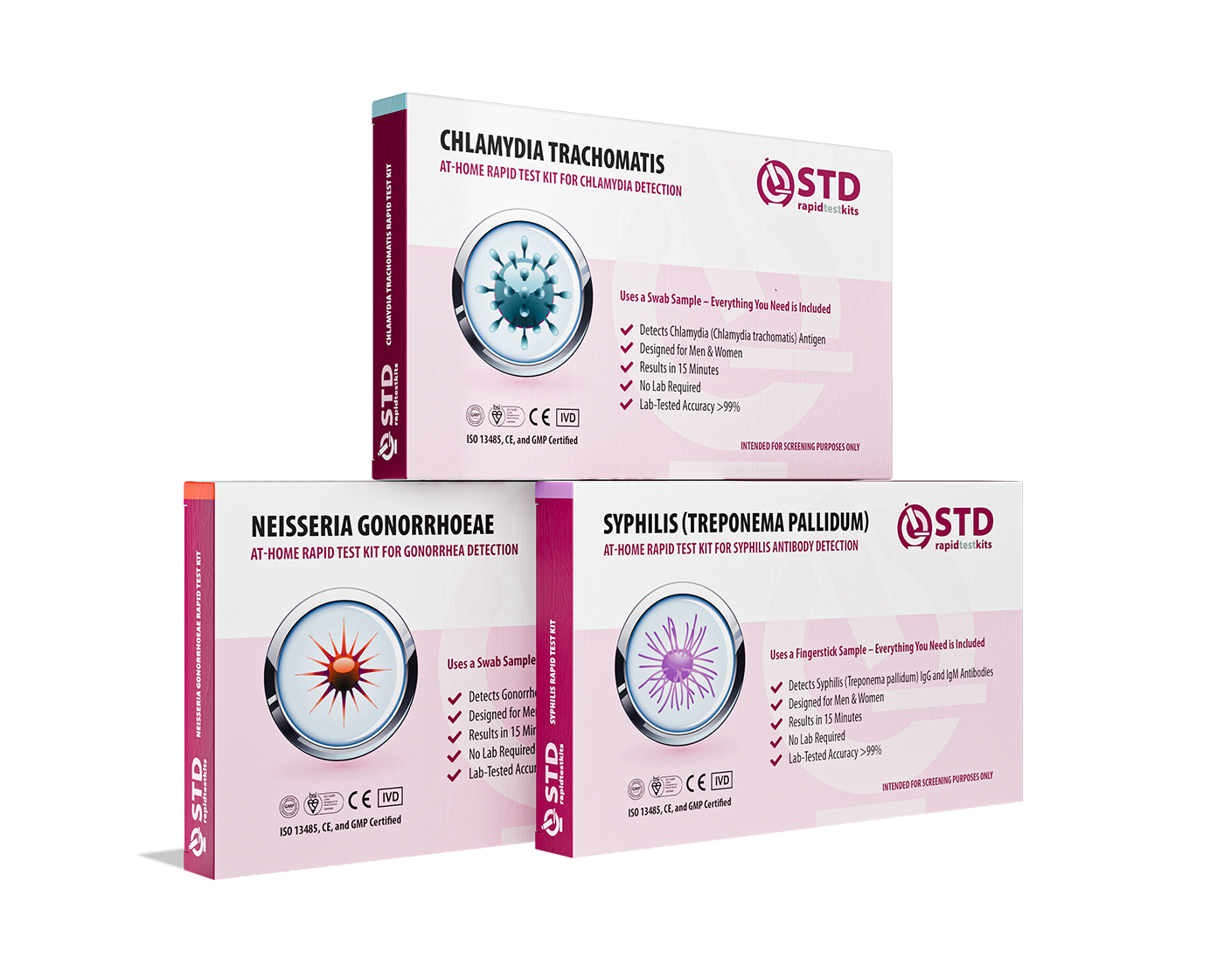
 For Men & Women
 Results in Minutes
 No Lab Needed
 Private & Discreet
Order Now $69.00 $147.00
For all 3 tests
No Symptoms, But Still Positive
Chris, 26, got tested because his ex reached out after a positive chlamydia diagnosis. “I hadn’t noticed anything, no discharge, no burning, not even a sore throat,” he said. He ordered a full panel with oral and rectal swabs included, just to be safe. To his shock, the genital and rectal swabs were negative, but his throat came back positive for gonorrhea.
“It really messed with my head because I felt fine. If I hadn’t tested my throat, I never would’ve known.”
Chris followed up with treatment, notified partners, and now includes oral swabs in all future tests. “It made me realize that just feeling okay doesn’t mean you’re clear,” he said.
Stories like Chris’s aren’t rare. In fact, public health experts are urging providers and patients alike to include extragenital testing in routine screens, especially among sexually active adults who engage in oral or anal sex.
If you're unsure whether your last test covered this, now’s the time to double-check.
What to Do If You Test Positive for Oral Gonorrhea
First: breathe. Gonorrhea is treatable, even when it’s in your throat. Testing positive doesn’t mean you’re “dirty” or dangerous, it means you’ve got answers, and now you can act.
The next step is to confirm your result and begin treatment. Oral gonorrhea is typically treated with antibiotics, often a single dose of ceftriaxone. But some strains are developing resistance, so it's essential to follow your provider’s instructions carefully and complete the full treatment course.
If you used a home test and tested positive, many services will connect you to a telehealth provider for a prescription. If not, take your result to a local clinic. Don’t wait. The longer you delay, the more chance the infection has to spread, to others, or to other parts of your own body.
And yes, you’ll need to tell your recent partners. But don’t panic. Many people test positive for STDs in their lifetime, and there are compassionate, anonymous ways to notify partners that don’t involve confrontation or shame. Some clinics offer anonymous text/email notifications, and there are websites like Don't Spread It that let you alert partners discreetly.
Here’s the truth: You’re not alone. You’re not broken. You’re someone who took charge of your health, and that’s something to be proud of.
Do You Need to Retest After Treatment?
In most cases, yes. Especially if your infection was in the throat. According to the latest studies, oral gonorrhea may clear more slowly or less completely than genital infections, even with standard antibiotics. That’s why many providers recommend a follow-up test about 14 to 21 days after treatment.
This isn’t because the meds don’t work. It’s because the throat’s environment can make it harder to fully eradicate the bacteria in one round. Retesting helps confirm that treatment was successful, and that you’re no longer contagious.
If you had multiple exposure sites (genital, rectal, oral), or if you’re in a relationship with an untreated partner, retesting is even more important. Reinfection is common when both partners don’t get treated simultaneously.
Use this guide to decide when a retest might be wise:
- 2–3 weeks post-treatment: To confirm clearance if throat was involved
- 4–6 weeks post-exposure: If initial test was early or uncertain
- After each new partner or unprotected encounter: As part of routine screening
Need a discreet way to retest? STD Rapid Test Kits offers home kits with fast shipping, easy instructions, and no awkward pharmacy visits.
Let’s Talk About Privacy: No One Needs to Know Unless You Say So
One of the biggest barriers to testing, especially for oral STDs, is fear. Fear of being judged. Fear of being seen. Fear of someone finding the test box in the trash.
But privacy has come a long way. Today’s at-home kits are packaged discreetly, shipped in plain envelopes, and don’t show up on your credit card statement with anything sexual or medical. Most kits let you collect the sample privately and either get instant results or mail it to a lab under a secure barcode system.
If you’re living with roommates, family, or just don’t want to explain, you’re not alone. Most users of at-home tests cite discretion as their top priority. That’s why STD Rapid Test Kits focuses on low-profile shipping and fast turnaround, so you stay in control of who knows, when they know, and what you do next.
Remember: testing isn’t a public act. It’s a private decision with powerful ripple effects for your health, your relationships, and your peace of mind.

People are also reading: How to Tell Someone You Have HSV-1 (Without Losing the Relationship)
You Can’t Rely on Symptoms
Oral gonorrhea is one of the fastest-rising hidden STDs, not because it’s especially deadly, but because it spreads silently. Without pain. Without pus. Without a signal. And the fewer symptoms we feel, the more chances we have to unknowingly pass it to someone else.
The good news? You don’t need a sore throat to take action. You just need the right information, and the right test. Whether you’re in a new relationship, had unprotected oral sex, or just want to be thorough, adding a throat swab to your next STD screen could be the difference between catching it early or spreading it silently.
Think your throat is fine? Maybe it is. But if there’s even a question mark in your gut, don’t wait.
Testing is care. Testing is protection. Testing is clarity, especially when the symptoms stay quiet.
FAQs
1. Can you really get gonorrhea just from oral sex?
Yep. You don’t need to go “all the way” to catch gonorrhea. Oral sex, especially without protection, can transfer it directly to your throat. It doesn’t matter if it’s a quick hookup or your long-term partner. If they’re carrying the bacteria, your mouth becomes the new host.
2. How would I even know if it’s in my throat?
That’s the thing, you probably wouldn’t. Most people feel totally fine. Maybe a mild tickle, maybe a sore throat that comes and goes. But nothing screams “STD!” That’s why so many people walk around with it unknowingly, especially after a weekend fling or a new situationship.
3. Do those rapid at-home kits test for this?
Some do, but you’ve gotta read the fine print. If the kit doesn’t include a throat swab or mention “extragenital” testing, it likely won’t catch it. The 7-in-1 STD At-Home Rapid Test Kit is one of the few that checks your throat, not just your downstairs.
4. What if I tested last month and everything came back negative?
Did that test include a throat swab? If not, oral gonorrhea could’ve flown under the radar. Also, timing matters. If it was too soon after exposure, like within 3–5 days, it might’ve missed the infection completely. This is one of those cases where a retest might actually bring peace of mind.
5. If I don’t have symptoms, am I still contagious?
Absolutely. That’s the kicker. You can feel 100% healthy and still pass gonorrhea to someone during oral sex. You might even pass it to yourself, say, from your throat to your genitals, if there’s contact between the two during the same encounter.
6. Will antibiotics wipe it out completely?
Usually, yes. But treatment’s not a magic wand. Some newer strains are fighting back, antibiotic-resistant gonorrhea is very real. That’s why follow-up testing is important, especially for oral infections, which can be stubborn little jerks.
7. How soon after exposure can I take a throat test?
Your best window is around 7 to 14 days post-exposure. Earlier than that, and you might get a false negative. If you're antsy and test early, just make a plan to retest later. No shame, just smart strategy.
8. Does kissing spread it too?
It’s rare, but not impossible. Deep kissing, especially with tongue and prolonged contact, can sometimes transmit gonorrhea if there are open sores or inflamed gums involved. Still, oral sex is by far the more common route.
9. What if my partner tests positive and I don’t?
Get retested. Sometimes infections settle in different places, maybe theirs is genital, and yours is pharyngeal. Or maybe you tested too early. Either way, don’t assume you’re safe just because your results came back clear once.
Do I have to tell people I hooked up with?
10. Legally, no. Ethically? It’s complicated. But here’s the thing: letting partners know gives them a chance to get treated before they pass it to someone else, or back to you. If a text or in-person convo feels impossible, you can use anonymous notification tools online. No confrontation necessary.
You Deserve Answers, Not Assumptions
You don’t need to feel sick to be responsible. Oral gonorrhea is one of the most common silent infections, passed between people who often feel totally fine. It doesn’t make you reckless. It doesn’t make you “dirty.” It makes you part of a bigger story: one where symptoms don’t tell the whole truth.
If you’ve had oral sex, even with protection, and especially with new or multiple partners, it’s worth checking. You can do it from home, in private, without waiting for a clinic. Because your health should never be a guessing game.
Don’t wait and wonder, get the clarity you deserve.
Check Your STD Status in Minutes
Test at Home with Remedium7-in-1 STD Test Kit
 For Men & WomenResults in MinutesNo Lab NeededPrivate & Discreet
Order Now $129.00 $343.00
For all 7 tests
How We Sourced This Article: We combined current guidance from leading medical organizations with peer-reviewed research and lived-experience reporting to make this guide practical, compassionate, and accurate. In total, around fifteen references informed the writing; below, we’ve highlighted some of the most relevant and reader-friendly sources.
Sources
1. About STI Risk and Oral Sex | CDC
3. Gonococcal Infections Among Adolescents and Adults – Treatment Guidelines | CDC
4. How to Identify, Treat, and Prevent Oral Gonorrhea | Healthline
5. Gonorrhea – Diagnosis & Treatment | Mayo Clinic
6. The Staying Power of Pharyngeal Gonorrhea: Implications for Public Health Practice | NCBI PMC
About the Author
Dr. F. David, MD is a board-certified infectious disease specialist focused on STI prevention, diagnosis, and treatment. He blends clinical precision with a no-nonsense, sex-positive approach and is committed to expanding access for readers in both urban and off-grid settings.
Reviewed by: T. Kelley, MSN, NP-C | Last medically reviewed: October 2025
This article is for informational purposes and does not replace medical advice.


