
Published: October 2025 | Last updated: May 2026 | Editorial review and quality control: Martina N.
Most early STD symptoms in men do not shout. They whisper. A faint sting during urination that fades by lunchtime. A patch of irritation that feels like friction. A small bump that could be an ingrown hair, or something else. The signals are quiet enough to dismiss, and that is exactly why so many infections pass unnoticed through the first few weeks. This guide walks through what the early signs actually look like in men, why they are easy to miss, and how to tell when a vague or faint discomfort is worth checking with a test.
Key Takeaways
- Many early STIs in men produce only mild burning, faint discharge, or no symptoms at all, which is why infections like chlamydia and gonorrhea regularly spread before anyone notices.
- When something feels off after a new exposure, a single at-home rapid screen gives a private result in about 15 minutes and removes most of the guesswork.
How a Quiet Infection Actually Starts
Clinicians describe a familiar pattern. After a new partner, often a few days later, something feels slightly different. It is not painful or alarming, just different enough to register before being dismissed. By the time the feeling is clearly real, the infection has often been spreading for weeks.
Early chlamydia and gonorrhea infections are biologically suited to flying under the radar. The CDC describes chlamydia bluntly: it often has no symptoms (CDC chlamydia fact sheet). Gonorrhea is more likely to cause symptoms in men than chlamydia is, but in many cases the first signs are mild enough that men attribute them to dehydration, friction, or a one-off irritation.
Herpes is a different category of subtle. Early genital herpes can start as a faint tingling in the skin, a single irritated spot that resembles an ingrown hair, or a quick sting that resolves before any visible blister forms. Some men have a first episode so mild they never seek care, and only learn about the infection years later when a partner gets tested.
The longer the early window is misread, the more time the infection has to spread to partners and to progress in the body. Early treatment is also easiest treatment, particularly for bacterial STIs that respond to a short antibiotic course.
The CDC's own language on chlamydia is that it 'often has no symptoms,' and the same caveat applies to a meaningful share of gonorrhea cases in men. Standard public-health guidance treats 'no symptoms' as compatible with a positive result, not as evidence against one. That is why annual screening and post-exposure testing exist as default recommendations rather than symptom-triggered ones.
The Symptoms That Feel Too Small to Matter
The symptoms most men dismiss are also the ones most likely to be early signs of something treatable. They tend to fall into five recognizable patterns.
A slight burning sensation during urination is the most common early signal of urethral chlamydia or gonorrhea. The discomfort is often described as a momentary sting or a brief warmth, sometimes only at the start of the urine stream. It can come and go depending on hydration and time of day, which is why many men attribute it to needing more water before considering an infection.
Discharge is the second pattern, and it is often subtler than illustrations suggest. Many men picture a thick, obvious flow. In reality, early discharge from chlamydia can be a small amount of clear or cloudy fluid that only shows up first thing in the morning, or as a faint dampness inside underwear. Gonorrhea discharge is more likely to be visible and yellow or green, but early cases can still be minor.
Tingling and skin sensitivity in the genital area can precede a herpes outbreak by hours or days, and sometimes appear without producing a visible sore at all. The sensation is often described as a strange awareness, like a low-grade nerve buzz, that was not there before.
A single bump or small sore can be syphilis, a herpes lesion, or HPV. Syphilis chancres are particularly easy to miss because they are typically painless, often heal on their own within a few weeks, and can sit on the shaft, scrotum, or anal area where men do not routinely check.
A sore throat that lingers after oral sex is the fifth pattern, and it points to pharyngeal gonorrhea or chlamydia. The symptom feels like a mild cold that never quite progresses: no fever, no body aches, just a low-grade rawness in the throat that persists past the usual common-cold window.
| Symptom | How It Feels | Common Misinterpretation |
|---|---|---|
| Mild burning when urinating | Brief, inconsistent sting or warmth | Dehydration or general irritation |
| Minimal discharge | Small, clear or cloudy fluid | Normal bodily variation |
| Tingling or skin sensitivity | Low-grade nerve buzz in the genital area | Friction or clothing irritation |
| Single bump or sore | Small, painless or mildly painful | Ingrown hair or pimple |
| Sore throat after oral sex | Mild rawness, no fever or congestion | Common cold |
When Silence Is the Symptom
The part most readers find unsettling is that many early STIs produce no symptoms at all, not faint ones, not subtle ones, just no signal from the outside. The CDC estimates that most people with chlamydia have no symptoms, and a meaningful share of men with gonorrhea, trichomoniasis, and early HIV are similarly silent in the first weeks (CDC STI overview). Syphilis, HPV, and herpes can also pass through long stretches with nothing visible. That asymptomatic period is when transmission is most likely to happen unknowingly.
The mental model many men carry into this is that the body sends clear distress signals when something is wrong. For most acute illnesses, that is roughly true. For most sexually transmitted infections, it is not. The biology of these pathogens favors quiet persistence over loud symptoms, because quieter pathogens get passed on more often.
This is why partner notification, routine annual screening for sexually active adults, and a low threshold for testing after any new exposure all exist as public-health recommendations. Standard NHS guidance and CDC screening recommendations both treat 'no symptoms' as compatible with a positive result, not as evidence against one (NHS STI overview).

Not All STDs Show Up the Same Way
One of the reasons early STD symptoms in men get missed is that there is no single textbook presentation that applies across infections. What feels like nothing in one case might be the only clue in another, and what looks like one condition can be caused by several different pathogens.
Some STIs stay localized. Chlamydia in the urethra usually presents only with mild urinary symptoms and minor discharge. Others move through the system more broadly: early HIV can cause a flu-like illness 2 to 4 weeks after exposure that is easily mistaken for any seasonal viral infection. Some STIs alternate between subtle sensations and more obvious outbreaks, with herpes the clearest example of periods of complete silence punctuated by recurrent episodes.
The variation makes self-diagnosis unreliable. Comparing a single symptom to a photo or fact sheet often produces false reassurance. Early symptoms rarely match textbook descriptions because the textbook describes the average presentation, and real bodies vary widely around that average.
The table below summarizes how the five most common STIs tend to introduce themselves in men, and the reasons each one is so commonly missed.
| STI | Early Symptom Pattern | Why It Is Often Missed |
|---|---|---|
| Chlamydia | Mild burning, slight discharge, or no symptoms | Frequently produces no symptoms at all in men |
| Gonorrhea | Burning, discharge, or pharyngeal soreness after oral exposure | Mistaken for a urinary tract infection or a mild cold |
| Herpes | Tingling, itching, or a single irritated spot | Easily confused with friction or an ingrown hair |
| Syphilis | Single painless ulcer that heals on its own | Painless lesion is assumed harmless and forgotten |
| HPV | Small skin-colored bumps or no visible changes | Looks like normal skin variation or sebaceous bumps |
The Symptoms Don't Always Stay
A common and misleading pattern is when symptoms show up briefly, then vanish. A few days of urethral burning. A bump that fades. A weird sensation that resolves on its own. Once the symptom is gone, it is human nature to assume the problem went with it.
For several STIs, that assumption is dangerous. The immune system can suppress visible symptoms while the bacteria or virus continues to multiply in deeper tissue. Chlamydia in men can cause early symptoms that subside as the infection ascends from the urethra toward the epididymis and testicles, where it can cause inflammation and contribute to fertility problems later.
Syphilis is the cleanest example of this trap. The first stage produces a single painless ulcer that heals on its own in 3 to 6 weeks, even without treatment. The disappearance of the sore feels like recovery. In reality, the bacterium is moving into the secondary and latent stages, where untreated infection can cause systemic damage over months and years (CDC syphilis stages and statistics).
Herpes follows a different but equally confusing pattern: symptoms appear, resolve, and reappear later, sometimes triggered by stress or illness, sometimes for no clear reason.
Most people who have chlamydia have no symptoms. If you do have symptoms, they may not appear until several weeks after you have sex with an infected partner.
Why Men Wait Even When Something Feels Off
The other half of the missed-symptom story is psychological. Even when men do notice a faint signal, the decision to test is rarely driven by the symptom itself. It is driven by how that symptom is interpreted.
Many men are socially trained to minimize discomfort. If it is not painful enough to interrupt the day, it gets filed under 'probably nothing.' That heuristic works fine for most everyday aches. It works poorly for sexually transmitted infections, where the most common early signal genuinely is something easy to ignore.
There is also a confirmation-avoidance loop. Knowing that a result might come back positive forces a sequence of follow-ups: telling partners, getting treated, sitting with the result. The brain, which is good at downplaying inputs that lead to uncomfortable outputs, tends to filter the signal accordingly. Several behavioral-health studies of STI testing decisions in men identify this avoidance as a stronger driver of delay than lack of access to testing.
Protection use can also create a false sense of safety. Condoms substantially reduce the risk of bacterial STIs and HIV, though they do not eliminate it: skin-to-skin transmission of herpes, syphilis, and HPV can happen from contact with skin the condom does not cover. Imperfect use, breakage, and oral exposure further close the gap between 'protected' and 'risk-free.'
Behavioral-health research on sexual-health screening identifies confirmation avoidance, not lack of access, as the most consistent driver of testing delay in men. The brain downplays signals that lead to uncomfortable next steps, which is why a symptom can register for days or weeks before turning into action. Treating the test as a routine check rather than a verdict tends to short-circuit the avoidance loop.
When Should You Actually Get Tested?
Two kinds of situations justify testing. The first is symptom-driven: any of the subtle signs above is reason enough on its own. Waiting for a more dramatic symptom often means waiting past the window when treatment is simplest.
The second is risk-driven, and it applies even when nothing feels wrong:
- A new sexual partner whose recent testing history you do not know.
- Unprotected vaginal, oral, or anal sex, including one-off exposures.
- A partner who has reported symptoms or a positive result.
- Annual routine screening for sexually active adults, which most major guidelines recommend.
Timing matters because tests have window periods. Chlamydia and gonorrhea typically become detectable on most assays within 1 to 2 weeks of exposure. HIV antibody tests can take 3 to 12 weeks to turn positive depending on the assay generation. Syphilis blood tests are most accurate after 3 to 6 weeks. Herpes blood tests measure antibodies and can take 12 weeks or longer to seroconvert, so an early test does not rule out a recent exposure.
What Happens If You Ignore It
Early-stage infections that go untreated can advance into tissue, organs, and the bloodstream in ways that are harder to reverse than the original infection would have been to treat.
Untreated chlamydia and gonorrhea can ascend from the urethra into the epididymis, causing painful epididymitis and, less commonly, contributing to infertility. They can also spread to other parts of the reproductive system and, rarely, into the bloodstream where they cause disseminated infection.
Syphilis, if left to run, progresses through stages over months and years. The bacterium can affect the cardiovascular system, the nervous system, and internal organs in the tertiary stage, with consequences that are hard to reverse even with later treatment. Because the early sore heals without treatment, many cases are not caught until secondary or latent stages.
HIV progresses through acute and chronic phases that are far easier to manage with early antiretroviral treatment. The earlier treatment starts, the better the immune-system outcomes, and the lower the risk of transmission to partners. Untreated HIV eventually causes severe immune deficiency.
Even for STIs that are not curable, such as herpes and HIV, early diagnosis offers concrete benefits: antiviral suppression to reduce outbreaks and transmission, partner notification, and the ability to make informed decisions about pregnancy and sexual activity.
- Chlamydia and gonorrhea: ascend to the epididymis, cause painful epididymitis, and contribute to fertility problems.
- Syphilis: progresses through latent and tertiary stages affecting the cardiovascular and nervous systems.
- HIV: early antiretroviral therapy substantially improves immune outcomes and reduces transmission risk; untreated infection progresses to severe immune deficiency.
- HPV: certain strains contribute to anal, penile, and oropharyngeal cancers years after the initial infection.
Why Real Symptoms Rarely Match Google Images
A common trap in self-diagnosis is the comparison search. A man notices a symptom, searches for images of what it 'should' look like, finds that his version does not match, and concludes he is in the clear. The problem is that the images online overwhelmingly show advanced or textbook-typical presentations, not early or atypical ones.
An early herpes outbreak might be a single irritated spot, not a cluster of blisters. A syphilis chancre is often a small, painless, well-defined ulcer that looks more like a healing cut than the dramatic open sores in stock medical photos. Early gonorrhea discharge can be barely visible. Genital warts from HPV can be skin-colored, flat, and easily confused with normal skin tags or sebaceous bumps.
The mismatch between expectation and reality is one of the biggest reasons men delay testing. They are looking for certainty in an image-based comparison when what they have is a clinical pattern that only a test can resolve.
- Herpes: an early outbreak can be one tingling spot, not a cluster of blisters.
- Syphilis: the chancre is usually painless and well-defined, more like a healing cut than a dramatic open sore.
- Gonorrhea/chlamydia: early discharge can be a small clear-to-cloudy trace, not a visible flow.
- HPV: warts can be flat, skin-colored, and easily mistaken for normal skin tags.
What Early Testing Gives You Besides Peace of Mind
Testing is not only about confirming the worst case. In most cases it rules things out. For symptoms that turn out to be irritation, allergy, or a urinary tract infection unrelated to an STI, a clean test result is genuine clarity.
When a test does turn up something, catching it early generally means simpler treatment, fewer downstream complications, and a lower chance of transmission. Chlamydia, gonorrhea, and syphilis are bacterial infections that respond to short antibiotic courses when caught early. Trichomoniasis treats with a brief oral course. HIV and herpes are manageable with long-term antiviral therapy that works better the sooner it starts.
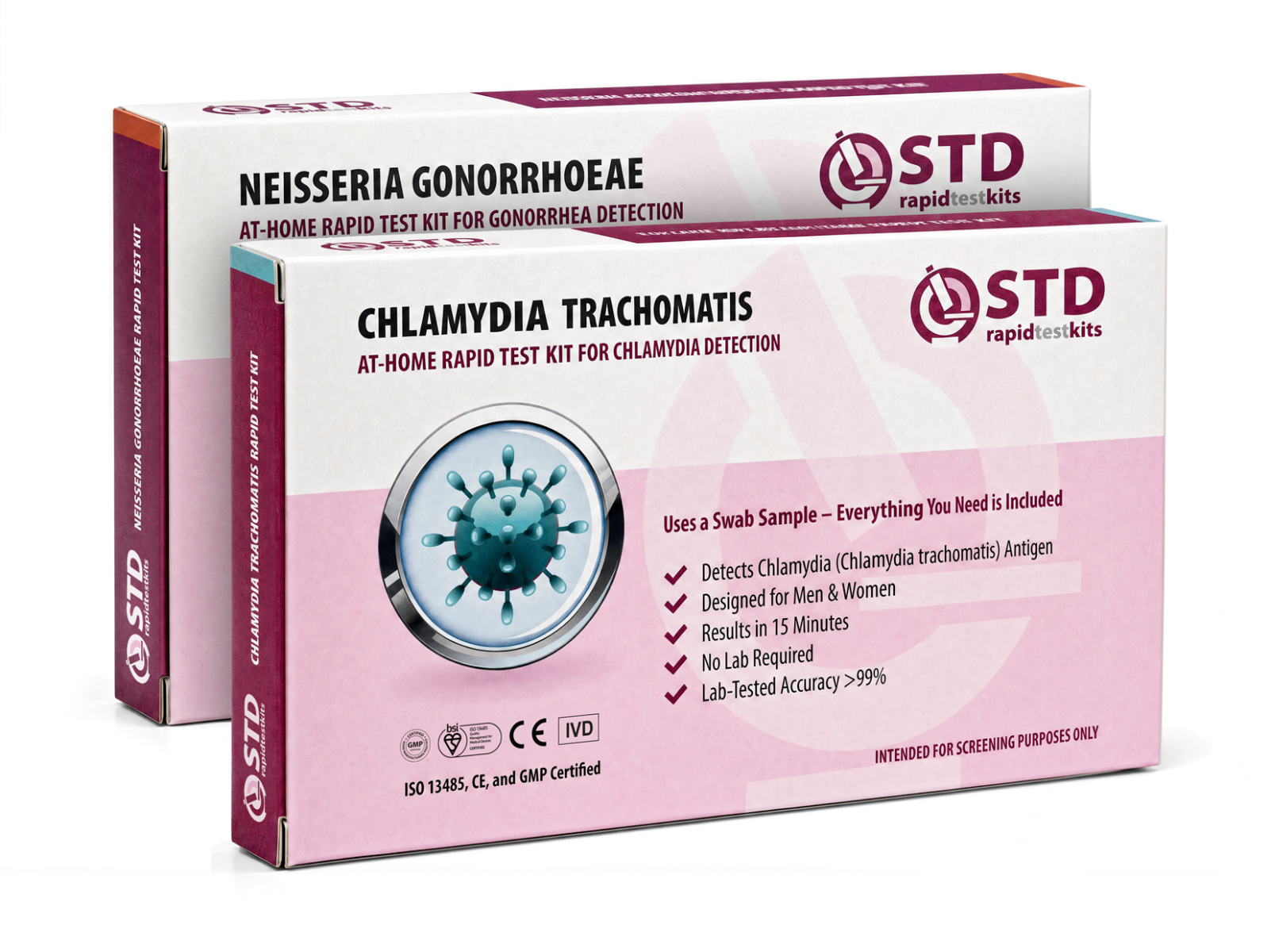
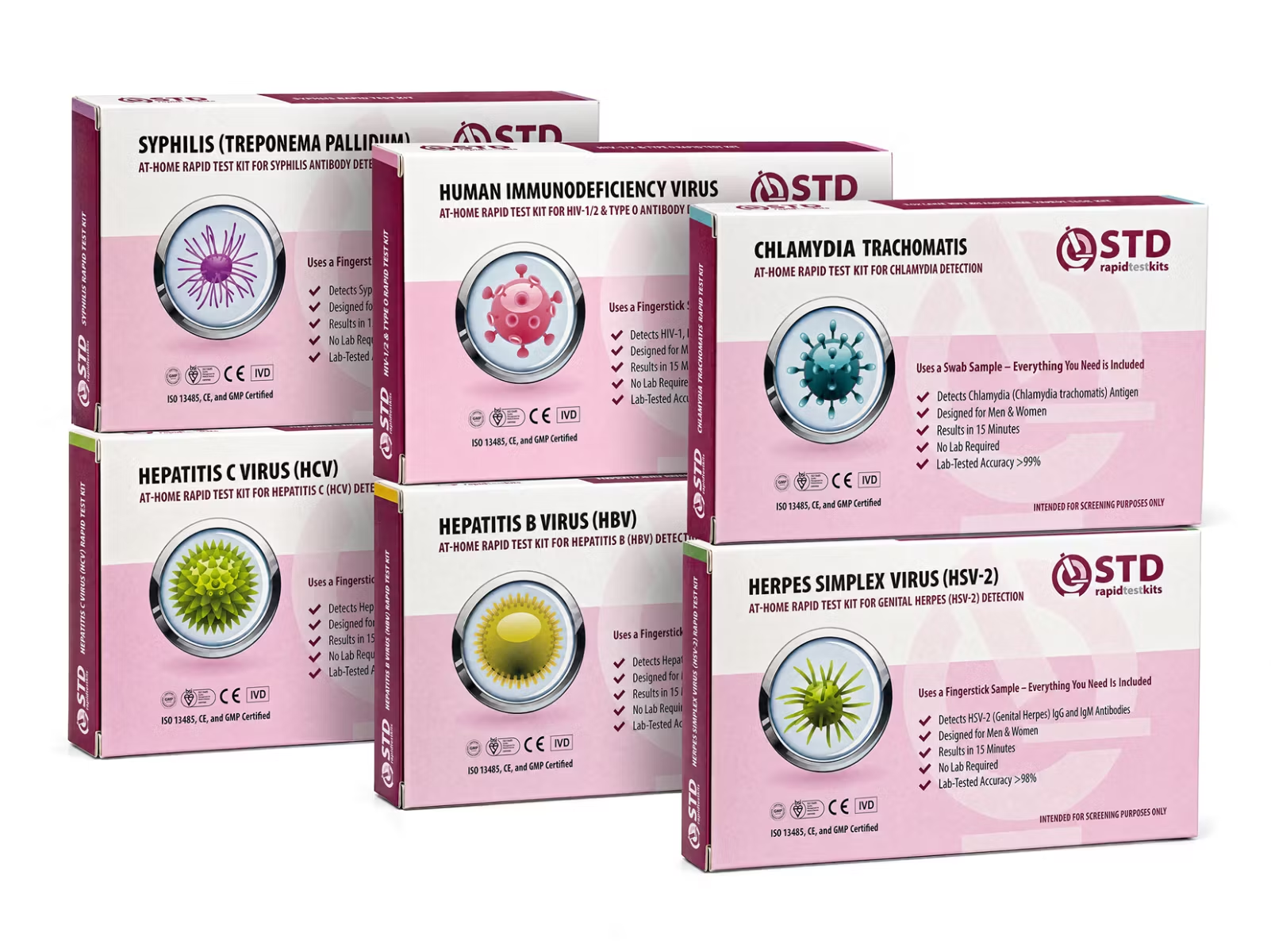
At-home rapid lateral-flow tests have made the practical barrier to testing much lower. There is no clinic visit, no waiting room, no in-person conversation about what brought you in. The kit ships to your home, the sample is self-collected, and the result appears on the cassette in about 15 minutes. For men in particular, the privacy of the home setup removes one of the most cited reasons for skipping the test entirely.
A confirmed positive result on a home rapid test should still be followed up with a clinician for confirmatory testing (typically a laboratory NAAT for bacterial STIs) and a treatment plan. The rapid test is a screening tool, not a final diagnosis.
What to Do If Something Feels Off
The decision pattern that works in practice is simple. You do not need to be certain something is wrong to take the next step. A vague signal plus a recent exposure is enough information to test once.
Severe pain, fever, testicular swelling, or rapidly progressing skin changes are reasons to see a clinician directly rather than wait on a home result. Most early STI symptoms in men are not in that category, but rule-out for non-STI conditions like a urinary tract infection or epididymitis from another cause is part of a clinician's job and is worth the appointment when symptoms escalate.
A negative result gives you closure. A positive result gives you a treatment path and a defined next step. Either way, you have something concrete to act on rather than a symptom to keep second-guessing.
Next Steps
- Vague signal plus a recent exposure: test once at the appropriate window for the exposure.
- Severe pain, fever, or testicular swelling: see a clinician directly rather than wait on a home result.
- Negative result but the symptom persists or recurs: retest after the full window for the suspected infection has passed.
- Positive result on a home rapid test: book a clinician visit for confirmatory testing and a treatment plan.
FAQs
- Can you have an STD and feel completely normal?
- Yes, and it is common. Most chlamydia infections, a large share of gonorrhea cases in men, and many early HIV and syphilis infections produce no symptoms at all in the first weeks. Routine annual screening and testing after any new exposure exist precisely because 'no symptoms' is compatible with a positive result, not evidence against one.
- What is the kind of symptom most men brush off first?
- It tends to be the tiny stuff. A faint burning during urination that comes and goes through the day. A barely-visible bit of discharge on waking. A spot that looks like an ingrown hair. An itch that is gone by tomorrow. The gray-zone signals are exactly where early STIs live, because they are mild enough to rationalize.
- If it does not hurt, is it still worth testing?
- In most cases, yes. Pain is not a reliable signal for sexually transmitted infections. Chlamydia, syphilis, and HPV can all present without significant pain in early stages. Waiting for something painful before testing typically means waiting past the simplest treatment window.
- A symptom showed up and went away. Am I in the clear?
- Not necessarily. The disappearance of a visible symptom does not always mean the infection has cleared. Syphilis chancres, herpes outbreaks, and early chlamydia symptoms can all resolve on their own while the underlying infection continues. A symptom that came and went is still grounds to test once.
- How do I tell the difference between irritation and an STD?
- Often you cannot, just by looking or feeling. Razor burn, friction, contact dermatitis, and ingrown hairs can all mimic STD symptoms. The practical difference is that irritation usually resolves cleanly within a few days and does not return. Anything that lingers, recurs, or feels persistently off is worth a test.
- Is a sore throat after oral sex worth checking?
- It can be, especially if it lasts longer than a normal cold and is not accompanied by fever or congestion. Pharyngeal gonorrhea and chlamydia present as low-grade throat discomfort without the broader cold symptoms. These infections need a throat swab, which our home genital-swab kits do not collect, so a clinic visit or lab order is the appropriate next step.
- What if symptoms only appear in the morning?
- That pattern is common and not reassuring on its own. Urethral discharge and burning often present most clearly in the first urination of the day, when urine has had time to concentrate and any pooled discharge has not yet been flushed. Time-of-day variation does not mean the underlying infection is mild.
- What is the simplest way to check without making it a whole thing?
- At-home rapid testing. The kit ships discreetly, the sample is self-collected, and the lateral-flow result appears on the cassette in about 15 minutes. For ambiguous symptoms, a multi-infection combo kit is usually the most practical first move because it covers several possibilities in a single round.
How we sourced this article: This guide synthesizes current public-health guidance from the U.S. Centers for Disease Control and Prevention, the UK National Health Service, and the World Health Organization, alongside peer-reviewed research on asymptomatic STI transmission and behavioral patterns around delayed testing in men. It is editorial summary, not a substitute for clinical advice; readers with significant symptoms or known exposure should see a licensed provider in addition to using any home test.
- U.S. Centers for Disease Control and Prevention overview of sexually transmitted infections, screening guidance, and asymptomatic-transmission context.
- CDC chlamydia fact sheet, including the agency's 'often has no symptoms' language, urethral presentation, and recommended testing windows.
- CDC gonorrhea fact sheet, including urethral, pharyngeal, and rectal presentations and treatment guidance.
- CDC syphilis information page, covering primary chancre presentation, stage progression, and the self-resolving nature of early ulcers.
- UK National Health Service overview of STIs, including patient-education symptom descriptions and screening guidance.
- World Health Organization fact sheet on sexually transmitted infections, with global prevalence and transmission-route data.
