
Published: October 2025 | Last updated: May 2026 | Editorial review and quality control: Martina N.
The last text goes unanswered. The dating app match disappears. A few days later something starts feeling off: a faint burn while peeing, a discharge that wasn't there before, or a low-grade itch that turns the next forty-eight hours into a Google spiral. Gonorrhea is one of the most common bacterial reasons for that exact spiral, and for anyone who has been ghosted after unprotected sex and is now noticing symptoms, the link between those two events deserves to be taken seriously. It is, more often than people realize, the same story.
This piece walks through how gonorrhea actually shows up in the first two weeks after exposure, why so many people who pass it on simply vanish, how to test at home in fifteen minutes, what current CDC-recommended treatment looks like, and how to handle partner notification without spiraling. The goal is not to alarm. It is to give a clear, calm sequence to follow, so the ghosting becomes the smaller part of the story.
Key Takeaways
- Gonorrhea symptoms usually appear 2 to 14 days after exposure, but the majority of cervical infections in women cause no symptoms at all, which is why a missed partner conversation often means a missed diagnosis.
- A positive at-home rapid test should be followed by the CDC-recommended single 500 mg intramuscular ceftriaxone shot and a seven-day pause on sex while you and any recent partners get treated.
When Silence After Sex Becomes Its Own Signal
Ghosting after a hookup gets framed as a dating problem. When symptoms follow within two weeks, it is also a public-health problem. The reason someone disappears the morning after isn't always personal. Sometimes it is because they already knew, or strongly suspected, something was wrong, and they did not want the conversation that disclosure would have started.
Two things are true at once. Most ghosting has nothing to do with STIs. And a meaningful subset of ghosting does. Reported case totals make the scale of the underlying transmission picture clearer.
If burning, unusual discharge, pelvic ache, or genital itch started inside two weeks of a sexual encounter, the right next step is not to message the ghost. It is to test. Diagnostic certainty matters more than social closure, and waiting for the silent partner to come around delays the only thing that fixes the problem.
543,409 reported gonorrhea cases in the United States in 2024. That is the third consecutive year of declining totals, but the volume is still large enough that contact tracing routinely breaks down when partners become unreachable (<a href="https://www.cdc.gov/sti-statistics/annual/" target="_blank" rel="noopener">CDC STI Surveillance, 2024 provisional</a>).
What Gonorrhea Actually Feels Like in the First Two Weeks
The "you'd know if you had an STI" myth is one of the most stubborn pieces of bad sex education in circulation. Gonorrhea, especially in its first week, can be subtle enough that people write the early signs off as a tight pair of jeans, a new soap, or the tail end of a urinary tract infection. That ambiguity is exactly what allows transmission to keep happening. People genuinely don't know.
The snapshot below describes how symptoms most commonly present in the first two weeks after exposure. Timing is approximate, not diagnostic, and the absence of symptoms does not mean the absence of infection. Per the CDC's gonorrhea overview, most women with cervical infection experience no symptoms at all, and a smaller share of men with urethral infection are also asymptomatic (CDC, About Gonorrhea).
| Symptom | How it usually shows up | Typical timing post-exposure |
|---|---|---|
| Urethral burning | A sharp sting while peeing, often described as citrus on a paper cut | 3 to 7 days |
| Discharge | Thick, yellowish or greenish from the urethra; clearer but heavier from the vagina | 2 to 10 days |
| Genital itch | Low-grade irritation, easy to mistake for a yeast issue or new laundry detergent | 3 to 7 days |
| Pelvic or lower abdominal ache | Dull pressure that feels like mild cramps or bloating | 5 to 14 days |
| No symptoms at all | Especially common with cervical, pharyngeal, or rectal infection | Any time, including never |
Why Gonorrhea Gets Mistaken for Yeast Infections and UTIs
Early gonorrhea and a yeast infection can look almost identical from the outside: itch, mild discomfort, a change in discharge. A urinary tract infection adds burning while peeing, which overlaps with the urethral symptoms of gonorrhea. People who have never had a confirmed yeast infection or UTI before will sometimes self-diagnose with one, buy an antifungal cream or push fluids, feel slightly better for a day, and convince themselves the issue has passed.
The pattern is consistent across patient surveys. People who eventually test positive for gonorrhea routinely report two or three weeks of trying home remedies first. The infection does not respond to antifungals. It does not flush out with cranberry juice. Symptoms may temporarily quiet down on their own, which feels reassuring, but the bacteria are settling deeper into the tissue.
The differentiator is exposure history. A yeast infection or UTI does not require recent sexual contact. New-onset symptoms within two weeks of unprotected sex deserve a test, regardless of how the discomfort compares to a past yeast infection.

Why So Many People Ghost After Passing an STI
Three patterns repeat in the public-health literature on partner notification. Knowing them makes the experience feel less personal and more recognizable.
The first is genuine ignorance. Because most cervical gonorrhea is asymptomatic and a smaller but real share of urethral cases produce no symptoms either, someone can pass the infection on without ever feeling sick. They are not lying about being clean. They have no information that contradicts what they're saying. The result is the same; the intent is different.
The second is suspicion plus avoidance. The person noticed something off (a brief burn, an unusual discharge, a vague pelvic ache) and chose to disappear rather than have a conversation that felt impossible. Shame is the main driver here. Public-health research on STI disclosure consistently identifies fear of stigma as a leading barrier to telling partners (CDC, Sexually Transmitted Infections).
The third is more deliberate avoidance. The person knew, did not disclose, and did not want to be held accountable for the consequences. This category is the rarest of the three, but it does happen, and it is the version of the story that drives most online warnings about the dangers of casual hookups.
None of those three patterns is the responsibility of the ghosted person to figure out. What is solvable on this side of the silence is the diagnostic question. Test on the timeline that matches when gonorrhea actually shows up, and the rest stops being a guessing game.
Gonorrhea often has no symptoms, but it can cause serious health problems, even without symptoms.
What an At-Home Gonorrhea Test Actually Involves
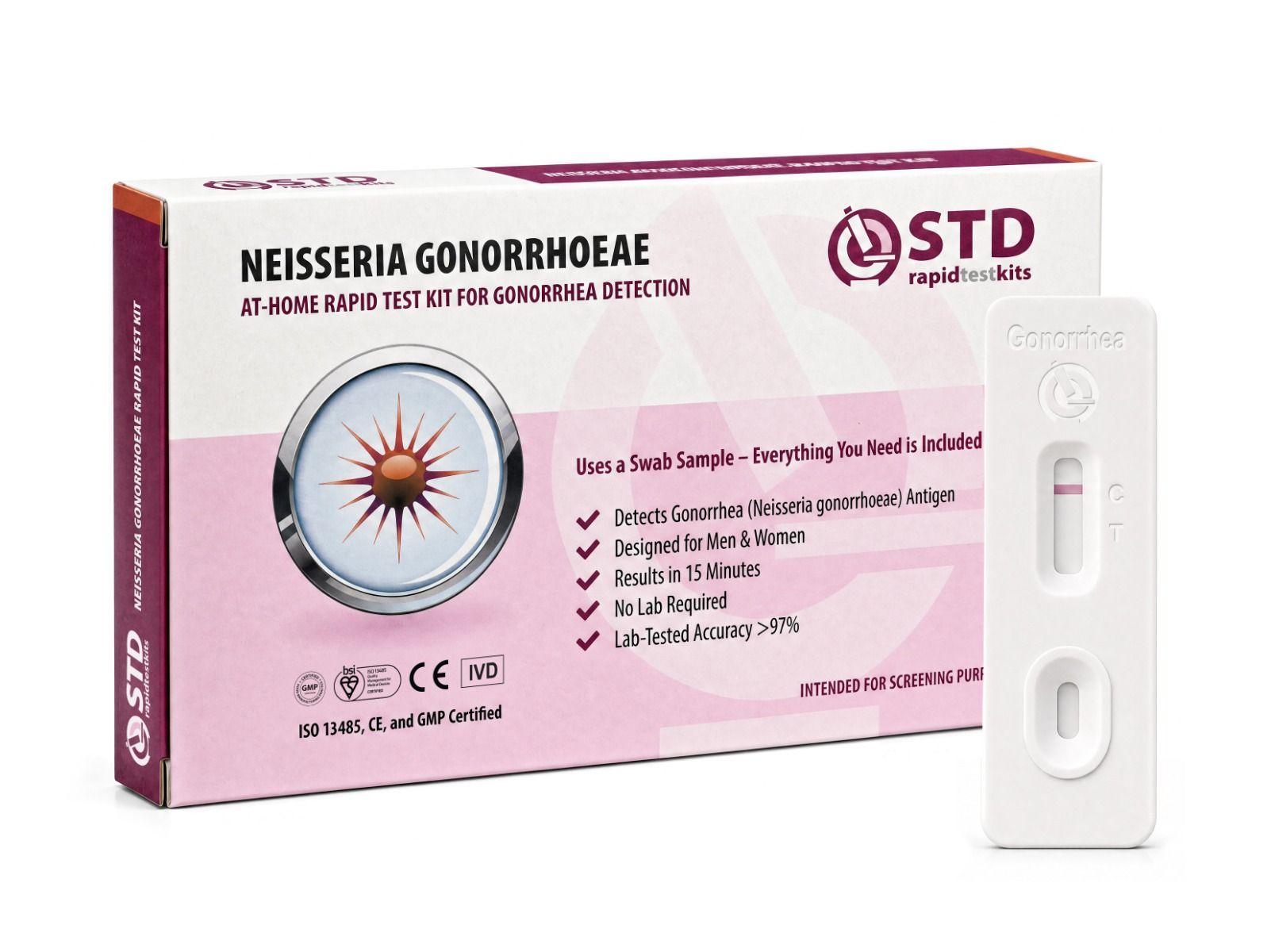
Rapid gonorrhea tests have changed what the first 24 hours after a suspected exposure look like. A kit ships in plain packaging, contains a sterile self-collection swab, a buffer solution, and a lateral-flow cassette, and produces a visible line result in roughly fifteen minutes. No clinic, no waiting-room small talk, no asking a receptionist to repeat the reason for the visit out loud.
The sample is collected at home. For someone with a vagina, that means inserting the swab a few centimeters and rotating it gently for about ten seconds. For someone with a penis, the swab enters a short distance into the urethra. Both feel briefly uncomfortable. Neither is painful. The swab then mixes with the included buffer, and a few drops go into the cassette.
The chemistry is worth understanding. The home cassette uses antibody-based lateral-flow detection of gonococcal antigens. That is a different technology than the molecular NAAT test used in clinic laboratories, which amplifies bacterial DNA. Lateral-flow rapid tests are designed for fast, accessible screening. They are useful for moving quickly past the question "am I infected," and a positive result is worth confirming at a clinic when access allows. A negative result paired with persistent symptoms should be retested or followed up with a clinic NAAT.
Timing matters. Testing in the first 48 hours after exposure can produce a false negative because the bacterial load is not yet high enough to detect. The most reliable window for swab-based testing is roughly day 5 through day 14 post-exposure. If symptoms appeared earlier than that, test immediately and retest a week later if the first result was negative.
Disclosure: stdrapidtestkits.com sells the at-home gonorrhea rapid test linked below. The testing-window guidance and clinical detail above draw on CDC sources, independent of the product recommendation.
1. Insert the swab a short distance and rotate gently for about 10 seconds.
2. Mix the swab tip into the buffer solution provided.
3. Apply a few drops to the cassette window.
4. Read the result at 15 minutes.
A control line confirms the test ran correctly. If a second line appears, that is a positive result.
Why Untreated Gonorrhea Is the Real Problem
The immediate symptoms are uncomfortable. The long-term consequences are what justify treating gonorrhea quickly, even when the surface experience feels manageable. Untreated gonorrhea does not burn out on its own. Acute symptoms can fade while the bacterial infection continues to do quiet damage.
Complications differ slightly by anatomy. In women, untreated infection can ascend from the cervix through the uterus into the fallopian tubes and cause pelvic inflammatory disease. PID is the bridge between an acute STI and lifelong reproductive consequences. According to the CDC, one in eight women with a history of PID later experiences difficulty getting pregnant, and the risk of ectopic pregnancy rises with each repeat episode (CDC, About Pelvic Inflammatory Disease). In men, untreated urethral gonorrhea can progress to epididymitis. Rarely, it leads to infertility. In both groups, untreated gonorrhea raises the risk of acquiring or transmitting HIV during future exposures.
| If treatment is delayed or skipped | What can happen | Why it matters |
|---|---|---|
| No treatment in women | Cervical infection ascends to uterus and fallopian tubes (PID) | 1 in 8 women with PID later experience infertility per the CDC; risk of ectopic pregnancy also rises |
| No treatment in men | Urethritis can progress to epididymitis | Painful testicular swelling; rare progression to infertility |
| Acute symptoms fade without treatment | Infection is still active in the body | Tissue damage continues silently; transmission to new partners continues |
| Repeated infections, treated inconsistently | Drug-resistant strains can emerge | Antibiotic-resistant gonorrhea is on CDC's urgent-threat list |
| No partner notification | Untreated partners reinfect each other | Community-level transmission persists and reproductive damage compounds |
If the Result Is Positive: The Next Forty-Eight Hours
A positive rapid result rearranges the next two days into a clear sequence: get treatment, pause sex, notify recent partners. Each step blocks a different harm, which is why the order matters.
Treatment is straightforward and brief. Current CDC guidance for uncomplicated gonococcal infection is a single 500 mg intramuscular dose of ceftriaxone (1 g for patients weighing 150 kg or more). The previous dual-therapy regimen that paired ceftriaxone with azithromycin was retired in 2020 because azithromycin resistance had grown more than sevenfold over five years. If chlamydia has not been ruled out, doxycycline 100 mg twice daily for seven days is added (CDC, Gonococcal Infections Treatment Guidelines; CDC MMWR 2020 update).
Sex pauses for seven days after the injection. The bacteria need time to clear, and the body needs time to stop being infectious. Resuming sex earlier means restarting the cycle, including the risk of passing the infection back to a partner who already finished treatment. This is the most common reason people end up with a second positive test a few weeks later. It is re-exposure during the waiting window, not antibiotic failure.
Partner notification is the part that feels worst and matters most. The next section walks through how to handle it without spiraling.

How to Tell Recent Partners Without Spiraling
Partner notification is uncomfortable for everyone, every time. Health departments do it routinely because the alternative is ongoing community transmission, and they have learned a few things about what makes the conversation easier. The most useful is that the message can be short. It does not need to be apologetic. It does not need a backstory. A workable script lives in the callout below; copy it, adjust the channel, send.
For a partner who has already disappeared, the ethical question gets murkier. If they are reachable at all, sending the message once is generally the right call. It is not their reward for ghosting; it is harm reduction for whoever they sleep with next. If they have blocked you or vanished entirely, the responsibility moves on. Many health departments offer anonymous third-party notification services that will contact a partner on your behalf without naming you. Local STI clinics and Planned Parenthood often facilitate this; ask when you call.
What partner notification does not require: a long conversation, an explanation of how, or a debate about whose fault it is. The bacteria do not care.
"I tested positive for gonorrhea and you may have been exposed. It is treatable with one antibiotic shot. You should get tested or just go straight to treatment, since exposure counts even without symptoms."
Send by whatever channel they actually answer on. No backstory required.
Returning to Sex Without Carrying the Shame Forward
Gonorrhea is treatable, and a treated infection rarely shapes a person's future dating life in any meaningful way. A diagnosis is not evidence that someone is reckless or broken. It is evidence that they had sex, which is what STIs do: they spread among sexually active people, and the only way to avoid every possible exposure is to never have sex at all. Most adults choose otherwise, which is why testing exists.
The post-treatment recovery is mostly emotional. Untangling the assumption that a positive test means something about a person's character. Realizing that asking a future partner about their last test is the bare minimum of adult intimacy, not a vibe-killer. Internalizing that the appropriate frequency of STI testing for sexually active adults under 25 is at least annually, and more often with new partners. Treating an infection and building the habit of regular testing is the standard upkeep of a healthy sex life.
What also helps: a follow-up test of cure roughly three months after treatment, especially if the infection was at a pharyngeal or rectal site. Reinfection rates within a year of treatment are higher than most patients expect, so the three-month retest is worth booking now rather than waiting until symptoms return.
Frequently Asked Questions
- Can someone really pass on gonorrhea without knowing they have it?
- Yes, routinely. Per the CDC, most women with cervical gonorrhea have no symptoms at all, and a smaller share of men with urethral infection are also asymptomatic. Pharyngeal and rectal infections are even more likely to be silent. The person who ghosted you may genuinely not have known, even if the timing makes it look intentional.
- How long after sex do gonorrhea symptoms usually show up?
- Most often between 2 and 14 days after exposure, with a peak around days 4 to 7. Some people never develop symptoms at all, which is part of why screening matters. If symptoms appear within two weeks of a new sexual encounter, test.
- I got ghosted. Should I still tell them I tested positive?
- If you have any way to reach them, one short message is enough. You don't owe an explanation, just the fact and the note that it's treatable with one injection. If they've blocked you or vanished, the responsibility ends there. Health departments can send anonymous notifications on your behalf if you want to try without direct contact.
- Can gonorrhea go away on its own?
- No. Acute symptoms can fade, which feels like resolution but isn't. The bacteria continue to live in the tissue and can cause pelvic inflammatory disease, epididymitis, or systemic spread. Treatment with a single antibiotic injection is required to actually clear the infection.
- Could the at-home rapid test be wrong?
- False positives are rare but possible with any lateral-flow test. A positive result should be acted on (treatment is brief and the cost of waiting is high) and ideally confirmed at a clinic with a NAAT lab test if access allows. False negatives are more common when the test is taken too early; the most reliable window is roughly day 5 through day 14 after exposure.
- Do condoms prevent gonorrhea completely?
- Condoms substantially reduce the risk of transmission but they are not perfect. Any area not covered by the barrier (the base of the penis, the vulva, the throat or rectum during oral or anal sex) can still transmit the infection. Use condoms consistently and test regularly. Both matter.
- Should I tell future partners I have had gonorrhea?
- A treated and cleared gonorrhea infection doesn't need to come up at every new encounter. What does matter is sharing your last test date. "Tested negative in [month]" gives a future partner the information that actually affects them.
- When is it safe to have sex again after treatment?
- Seven full days after the injection, minimum. Wait longer if any recent partners haven't yet been treated. Most repeat positives a few weeks later trace back to resuming sex before the other person cleared the infection, not to the antibiotic failing.
This article synthesizes current U.S. Centers for Disease Control and Prevention treatment and surveillance guidance, peer-reviewed STI epidemiology, and published research on partner notification and STI-related stigma. Where specific figures appear (treatment doses, infection windows, complication rates), they are cited inline to the CDC source that publishes them. The piece does not provide individual clinical advice. Anyone with a positive at-home test or persistent symptoms should follow up with a licensed clinician for confirmatory testing and treatment.
- U.S. Centers for Disease Control and Prevention. About Gonorrhea. Symptoms, transmission, complications, and the high proportion of asymptomatic cases in women.
- U.S. Centers for Disease Control and Prevention. Gonococcal Infections Among Adolescents and Adults, STI Treatment Guidelines. Current recommended ceftriaxone 500 mg IM regimen and chlamydia co-treatment guidance.
- U.S. Centers for Disease Control and Prevention. Update to CDC's Treatment Guidelines for Gonococcal Infection, 2020 (MMWR, Vol. 69, No. 50). Rationale for the 2020 shift from dual therapy to monotherapy and the dose increase to 500 mg.
- U.S. Centers for Disease Control and Prevention. About Pelvic Inflammatory Disease. PID as a complication of untreated gonorrhea and chlamydia, including the 1-in-8 long-term infertility figure.
- U.S. Centers for Disease Control and Prevention. Sexually Transmitted Infections Surveillance, 2024 (Provisional). National gonorrhea case totals and year-over-year trends.
- U.S. Centers for Disease Control and Prevention. Sexually Transmitted Infections (STI) homepage. General CDC hub for STI prevention, screening, partner-notification context, and disease-specific guidance.
