
Published: October 2025 | Last updated: May 2026 | Editorial review and quality control: Martina N.
You pricked your finger, dripped the blood into the buffer, and watched the strip pull color across the cassette window. Now there is a line. Or two lines. Or maybe a streak so faint you cannot tell if it is real. This guide walks through what each pattern means on a hepatitis C antibody rapid test, when to trust the result, and what to do next.
The short version: any visible line at the test position is reactive, even when it is whisper-faint. A line at the control position alone, after the full read window, is non-reactive. No control line at all means the test failed and the result is invalid. The rest of this article explains why these rules exist, when they hold, and where rapid tests are most likely to mislead you.
Key Takeaways
- A faint line at the T position counts as reactive. Lateral-flow strips detect antibody binding through capillary action, and the test cannot distinguish weak signal from strong.
- A non-reactive result is only reliable when you tested at least 8 to 11 weeks past the exposure you are worried about. Earlier than that, your antibodies may not have developed enough to register.
How the Cassette Actually Works
A rapid hepatitis C test cassette is a small plastic shell holding a strip of treated paper. The strip uses lateral-flow immunoassay chemistry, the same technique behind home pregnancy tests and rapid COVID antigen tests. Inside the strip, immobilized HCV antigens sit at the test region, and a separate antibody-binding reagent sits at the control region.
When you place a few drops of fingerstick blood into the sample well and add the buffer, capillary action pulls the liquid across the strip. If your blood contains antibodies to hepatitis C, those antibodies bind to a colored marker and then stick at the test “T” region, producing a visible line. Whether or not antibodies were present, the buffer continues across the strip and a separate reaction at the control “C” region produces a second line, confirming the chemistry ran end to end.
That is why the C line matters more than the T line for reading the test. The C line is the kit telling you it worked. No C line means the buffer did not reach the end, the strip was bad, or the chemistry failed for some other reason. Without C, the result is invalid; the T line, if any, cannot be trusted in either direction.
| Zone | What You Should See | What It Means |
|---|---|---|
| C (Control) | A solid line, any color | Confirms the test ran correctly |
| T (Test) | Any visible line, even very faint | Reactive: HCV antibodies detected |
| T (Test) | No line at all, with C present | Non-reactive, if read after the full time window and you tested past the antibody seroconversion period |
| No C line | Nothing visible at the control zone | Invalid: discard and retest with a new kit |
Reading Your Hepatitis C Rapid Test: What Each Line Pattern Means
Open the cassette, look at the result window, and walk through three checks in order. First, is there a line at the C position? If not, stop. The result is invalid and the kit needs to be repeated with a new device. Second, is there any visible line at the T position, including a faint pink shadow? If yes, the result is reactive. Third, if C is present and T is completely blank after the full read time, the result is non-reactive, with caveats about when you tested.
The intensity of the T line does not measure how strong, recent, or severe the infection is. A bold line and a barely-there line carry the same diagnostic meaning at this stage: your immune system has produced antibodies that bind HCV antigens. The home rapid test cannot distinguish between a current active infection, a past infection that resolved on its own, and a past infection that was treated and cured. That distinction comes from a follow-up HCV RNA test, which detects whether the virus itself is still present in your blood.
If you are unsure whether you are seeing a real line or a smudge, hold the cassette under direct, even light and look at the strip from straight on. Do not tilt to find a line that is not there, and do not squint hard to dismiss one that is. If a co-reader is available, ask them to look without telling them what you saw.
What does a faint second line mean on my Hep C rapid test?
If the control “C” line appeared and there is any visible line at the test “T” position, even one so faint you have to tilt the cassette under good light to see it, the result is reactive. The intensity of the T line does not indicate how recent or severe the infection is. A reactive result is a screening signal that needs confirmation with a lab HCV RNA test through your healthcare provider. Do not retake the home antibody test to “check”; an antibody test will read positive once you have antibodies, regardless of whether the virus is currently active.
Why Even a Faint Line Counts
Lateral-flow strips work on capillary movement and antibody binding. The colored marker that produces the visible T line is bound to a small amount of conjugate; even a low titer of HCV antibodies in your blood can capture enough conjugate to render a thin, pale line at the test region. That is by design. Manufacturers set the strip’s sensitivity threshold so that a small but real signal still counts.
The CDC and major laboratory associations are explicit on this point. Per CDC clinical diagnosis guidance and APHL laboratory interpretation guidance, any visible line at T, regardless of color intensity, should be read as reactive. A faint line is the strip telling you it found antibodies at the lower end of the detection range. Reasons your line might be faint include early seroconversion (antibody titer is climbing), a low overall antibody response, or a sample volume at the lower edge of what the kit needs.
A faint line carries the same clinical weight as a bold one; it is not a borderline result, not a wait-and-see signal, and retesting the same kit will not change what it shows. Treat any visible T line as reactive and move to confirmation.
| Cassette Result | What It Means | Next Step |
|---|---|---|
| Line at C only (no T line) | Non-reactive (negative screen) | If you tested past the antibody window, a follow-up is usually unnecessary. Retest at 12 weeks if your exposure was recent. |
| Line at C plus any line at T | Reactive (positive screen) | Book a confirmatory HCV RNA test with your healthcare provider or a clinic. |
| No C line, regardless of T | Invalid result | Discard the device and retest with a new kit. Check the kit’s expiration date. |
The Window Period: Why Timing of the Test Matters
Hepatitis C is a viral infection that takes time to leave a detectable trail of antibodies in your blood. After exposure, the virus replicates first; your immune system gradually produces antibodies that the rapid test is designed to find. CDC clinical guidance notes that detectable antibodies typically develop within 8 to 11 weeks after exposure for most people, with longer windows in some cases.
This delay is the core reason a non-reactive home test is not always a clean bill of health. If you tested at three weeks after a possible exposure, you may simply be too early in the antibody curve for the strip to register. The test is technically working; your body has not produced enough antibody yet for the strip to bind.
What this means in practice: if your test is non-reactive but the exposure you are worried about happened in the last two months, plan to retest at the 12 week mark. If you cannot wait, ask your healthcare provider about an HCV RNA (PCR) test, which detects the virus directly and can confirm or rule out infection earlier, often within two to three weeks of exposure.
People with weakened immune systems, including those on immunosuppressive medication, dialysis patients, and people with untreated HIV co-infection, may take longer than 11 weeks to seroconvert. In these situations, lean on RNA testing rather than antibody screens.
Antibodies to hepatitis C virus develop in most people within 8 to 11 weeks after infection, though seroconversion can take longer in people with weakened immune systems.
If Your Test Is Reactive, Here Is What Comes Next
A reactive home test means antibodies were detected. It does not, on its own, confirm active infection. The CDC describes a reactive antibody result as consistent with current HCV infection, past HCV infection that resolved without treatment, past infection that was successfully treated, or, less commonly, a biological false positive. Confirmatory testing tells you which.
The standard next step is an HCV RNA (PCR) test ordered through a healthcare provider or a sexual-health clinic. RNA testing detects the virus itself, not the antibody response. If RNA is detected, you have a current infection and are eligible for treatment. If RNA is not detected, you had HCV at some point and your body cleared it, either on its own (which the WHO hepatitis C fact sheet reports happens in roughly 15 to 45 percent of acute infections within six months) or because you completed treatment in the past.
Modern hepatitis C treatment uses direct-acting antiviral (DAA) medication taken orally for 8 to 12 weeks. The same WHO fact sheet reports cure rates above 95 percent in clinical use, with cure defined as sustained virological response 12 weeks after the end of treatment. Side effects are limited compared with the older interferon-based regimens, and access has expanded substantially in the United States and most high-income countries.
If your reactive home test turns out to be a past, cleared infection, no treatment is needed. You will keep testing antibody-positive on future rapid tests because the antibodies persist; this is a normal residual signal, not a sign of active illness. You can be reinfected through new exposure, however, because antibody response to HCV does not produce lasting immunity and there is no vaccine.
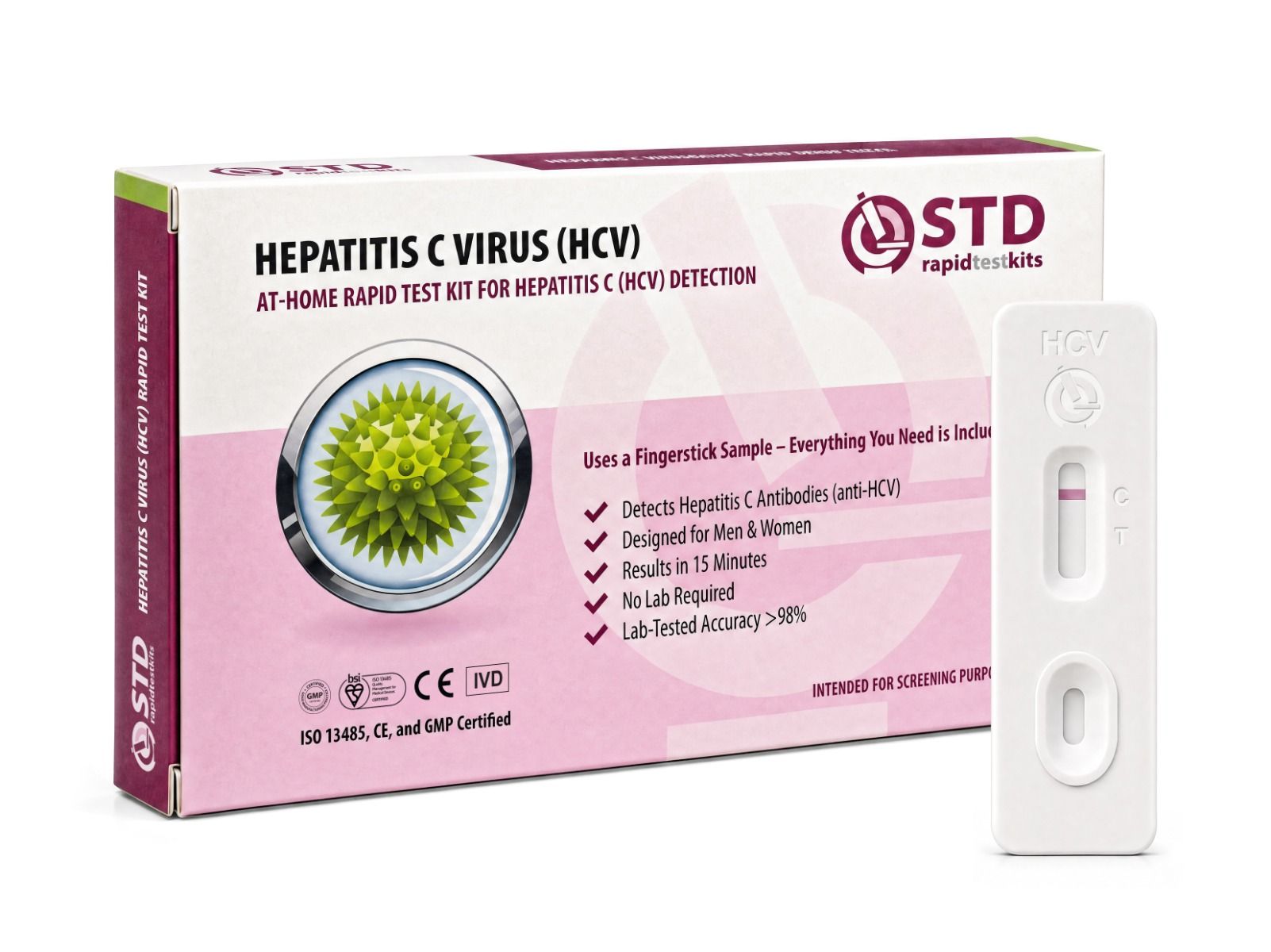
This site sells at-home rapid test kits; what follows is a product recommendation for a screening kit, not a substitute for the lab RNA confirmation described above.
Why a Non-Reactive Result Can Still Be Wrong
Most non-reactive results are real and reliable. Reputable manufacturers report sensitivity figures in the high 90s when the test is used after the antibody window. The two situations where a non-reactive home test can mislead you are window-period testing and immune compromise.
Window-period testing is the most common source of false reassurance. If your exposure was recent (less than about 8 weeks ago) and your test came back negative, you have not ruled out infection. Your antibody titer may not yet be high enough for the strip to detect. The fix is simple: retest at the 12 week mark, or ask your provider for an RNA test sooner if waiting is not workable.
Immune compromise is the less common but more serious blind spot. People on immunosuppressive medication after an organ transplant, people on chemotherapy, dialysis patients, and people with untreated HIV may take longer than 11 weeks to develop antibody levels detectable by a rapid strip. If you fall into one of these groups and your exposure history is concerning, do not rely on a home antibody test alone. Ask your provider for HCV RNA testing.
One other situation worth mentioning: chronic hepatitis C in people who already know they have it. Antibody tests detect prior exposure and stay reactive even after the virus is cured. If you have a known history of HCV and want to confirm cure or check for reinfection, the antibody test will keep showing reactive. Use an RNA test instead.

Common Mistakes That Produce Invalid or Confusing Results
Most home rapid test failures trace back to a small set of avoidable errors. Here is what to watch for, in rough order of how often they occur:
- Sample volume too low. Each kit specifies how many drops of blood it needs. Below that volume, the buffer cannot push the sample fully across the strip and the C line may never form.
- Reading outside the time window. Reading the cassette before the kit’s read time can miss a slow T line. Reading hours after can produce evaporation lines that look like positives but carry no diagnostic meaning.
- Expired or improperly stored kits. Heat, humidity, and time degrade the antibody-binding chemistry. An expired kit can produce a false negative or an invalid no-C-line result.
- Buffer not added or wrong volume. The buffer is the medium that drives capillary flow. Without it, or with the wrong volume, the strip will not run.
- Touching or splashing the result window. Liquid splashed onto the strip from outside can produce streaks or false lines that have nothing to do with antibody binding.
- Reading the wrong test. If you tested for multiple infections in one session, the cassettes can look similar. Read the brand label and the labeled C and T positions carefully.
If anything about the result looks ambiguous, treat it as inconclusive and retest. Most reputable kits cost less than the time and worry of misreading a single one.
| Test Outcome | What It Means |
|---|---|
| HCV Antibody Positive plus HCV RNA Positive | Current active infection. You are eligible for direct-acting antiviral treatment, with cure rates above 95 percent in 8 to 12 weeks. |
| HCV Antibody Positive plus HCV RNA Negative | Past infection that was cleared, naturally or after treatment. No current infection. You will keep testing antibody-positive on future rapid tests. |
| HCV Antibody Negative (after the full window) | No evidence of current or past infection, assuming you tested at least 8 to 12 weeks past any concerning exposure. |
What If You Are Immunocompromised or on Long-Term Medication?
If you are on immunosuppressive medication after an organ transplant, on chemotherapy, on dialysis, or living with HIV without effective treatment, your antibody response may be slower or weaker than the general population, and the typical 8 to 11 week window may not apply to you.
The practical guidance for this situation is to lean on RNA testing rather than antibody screens. If your provider knows your medication history and the exposure you are concerned about, they can order an HCV RNA test directly. RNA testing detects the virus itself within roughly two to three weeks of exposure and does not depend on your antibody response.
Common medications and conditions that slow antibody response include cyclosporine, tacrolimus, mycophenolate, rituximab, high-dose steroids, anti-TNF biologics, and active untreated HIV. If any of these apply to you, mention it when you book follow-up testing so the right test is ordered.
What to Expect Emotionally After Testing
The clinical interpretation is the easier part of this guide. The harder part, and the one most people do not plan for, is the gap between reading the result and doing something with it. Sitting with a reactive result before you have called a clinic is uncomfortable in a way the kit instructions do not address.
A reactive antibody test is a screening signal, not a diagnosis. It tells you the immune system has met hepatitis C at some point. It does not tell you whether the virus is still in your body, whether you need treatment, or whether you can spread it to anyone. All of those questions have answers, and the answers come from one follow-up RNA test ordered by a provider. The earlier you book that follow-up, the shorter the uncertainty period.
If the result is non-reactive but you are still worried, that worry usually has one of two roots: a recent exposure inside the antibody window, or general health anxiety. The first deserves a retest at 12 weeks or an RNA test sooner. The second deserves a conversation with a provider, not another rapid test the same week. Repeated home antibody testing in a short period rarely produces useful new information.
FAQs
- Does a faint line at T really count as positive?
- Yes, with no threshold attached. Even a line you have to hold under a lamp to see is a reactive result per APHL laboratory interpretation guidance and CDC clinical guidance. Lateral-flow tests detect antibody binding through capillary action, and even small amounts of antibody can produce a visible line. The strength of the line does not indicate how recent or severe the infection is. Treat any visible T line as a reactive screen and book a confirmatory HCV RNA test.
- What if there is no control line at all?
- That makes the test invalid. The control line is the kit’s way of confirming the chemistry ran. No C line means the buffer did not reach the end of the strip, the kit was bad, or something interrupted the reaction. Discard the device, check the expiration date on a fresh kit, and retest.
- Can I trust a negative result if I tested two weeks after exposure?
- Not fully. CDC clinical guidance puts the typical antibody window at 8 to 11 weeks after exposure. Two weeks is well inside that window. Retest at 12 weeks for a definitive antibody result, or ask your provider about an HCV RNA test, which can detect the virus within two to three weeks of exposure.
- Does a reactive home test mean I am contagious?
- Not necessarily. A reactive antibody test confirms exposure to HCV at some point. It does not confirm whether the virus is currently replicating. Per the WHO fact sheet, roughly 15 to 45 percent of acute HCV infections clear without treatment, and the antibody response stays for life. You need an HCV RNA test to know whether you are actively infected and contagious.
- My antibody test is reactive but my RNA is negative. What does that mean?
- You were exposed to hepatitis C in the past, but the virus is no longer in your blood. Either your immune system cleared it on its own, or you completed treatment at some point. You are not currently infectious. You will keep testing antibody-positive on future rapid tests because the antibodies persist; this is normal. You can be reinfected through new exposure, however, because there is no HCV vaccine and prior infection does not confer immunity.
- Can I be reinfected with hepatitis C after I have cleared it?
- Yes. Hepatitis C does not work like chickenpox; clearing the virus once does not protect you from a future exposure. Reinfection is documented in people who shared injection equipment after a prior cure, and in some sexual-transmission contexts. There is no HCV vaccine. Avoiding shared injection equipment, using sterile tattoo and piercing equipment, and following safer-sex practices reduce risk.
- Can I read the cassette long after the time window?
- Evaporation lines are the risk. A strip left for hours past the read window can develop faint marks that mimic a true T line but carry no diagnostic meaning, because the chemistry that produced the original color signal has stopped. Read the cassette once, at the kit’s specified time, and trust that read. A line that appears later is not a delayed positive; it is drift.
- Should I tell my partner if I test reactive at home?
- Disclosure is a personal call, but it is the right call in most cases. If you share injection equipment or have been in a sexual relationship, your partner has direct reason to know. Open conversation lets them get tested too, and reduces the chance of either of you being surprised later. Anonymous notification services exist if a direct conversation feels too hard at first; many sexual-health clinics can help facilitate.
Your Next Step
If your home test was reactive, book a confirmatory HCV RNA test through a healthcare provider or a sexual-health clinic. Direct-acting antiviral treatment cures more than 95 percent of active infections in 8 to 12 weeks, and the earlier you start, the more straightforward the treatment course tends to be.
If your home test was non-reactive and you tested at least 12 weeks past your last possible exposure, you can take that as a reliable screen. If your exposure was more recent, plan to retest at the 12 week mark or ask about an RNA test sooner.
If your test came back invalid (no control line), retest with a new kit. Do not try to interpret the result; the strip cannot tell you anything diagnostic if the C line did not appear. Order a Hepatitis C rapid test kit here if you need a replacement or a follow-up screen at the 12 week mark.
Reactive (any visible T line): book a lab HCV RNA test through a healthcare provider to confirm whether the virus is currently active.
Non-reactive (C line only) at 12+ weeks past exposure: a reliable negative screen. No follow-up needed unless new exposure occurs.
Non-reactive but tested under 8 weeks past exposure: retest at the 12 week mark, or ask your provider about an RNA test sooner.
Invalid (no C line): discard the device, check the kit’s expiration date, and retest with a fresh kit.
How We Sourced This Article: Our article was constructed based on current advice from the most prominent public health and medical organizations, including the U.S. Centers for Disease Control and Prevention, the World Health Organization, and the Association of Public Health Laboratories, then molded into plain language based on the situations that people actually experience when reading a home rapid test cassette. Below we have highlighted the most reader-relevant references that informed this guide.
- U.S. Centers for Disease Control and Prevention. Testing for Hepatitis C, including how rapid antibody screens fit into the diagnostic flow and confirmatory RNA testing.
- U.S. Centers for Disease Control and Prevention. Clinical Screening and Diagnosis for Hepatitis C, the source for the 8 to 11 week antibody window guidance.
- World Health Organization. Hepatitis C fact sheet, including the 15 to 45 percent spontaneous-clearance range, direct-acting antiviral cure rates above 95 percent, and global epidemiology.
- World Health Organization. Recommendations and guidance on hepatitis C virus self-testing, including the role of rapid antibody assays in screening.
- Association of Public Health Laboratories. Laboratory interpretation guidance for hepatitis C test results, including the rule that any visible T line is reactive regardless of intensity.
- Smith DB, Bukh J. A review of the OraQuick Hepatitis C Virus Rapid Antibody Test. PMC peer-reviewed review covering sensitivity and specificity of an FDA-approved rapid HCV antibody assay.
