Published: November 2025 | Last updated: May 2026 | Editorial review and quality control: Martina N.
What is MG-B, and how do I get tested for it?
MG-B is informal shorthand for macrolide-resistant Mycoplasma genitalium, a sexually transmitted bacterium that mimics recurrent BV in women and urethritis in men. No rapid at-home kit or standard clinic panel detects it. You need a lab nucleic acid amplification test (NAAT) ordered specifically for M. genitalium, ideally with resistance testing.
You have had three rounds of antibiotics for what your provider called bacterial vaginosis. The symptoms ease for a couple of weeks, then return. The discharge, the faint fishy odor, the irritation that does not quite quit. Or you finished a course of azithromycin for a positive chlamydia result and the burning and discharge stayed. A clean follow-up STI panel says you are fine. Your body keeps saying otherwise.
For one of the more common bacterial sexually transmitted infections in the United States, that pattern often points to the same culprit, and most standard panels do not test for it. Mycoplasma genitalium, usually shortened to Mgen or M. genitalium, is rarely included in routine screening. Recent consumer reporting has used the label MG-B for its newer macrolide-resistant variants. It can sit silently in the urinary and reproductive tracts for months, cause urethritis or pelvic pain that gets misread as a UTI or recurrent bacterial vaginosis, and pass between partners without anyone noticing.
This article walks through what current CDC and WHO guidance says about Mgen, why standard panels miss it, what testing looks like, what MG-B means in clinical terms, and what the rapid lateral-flow kits sold on this site can and cannot tell you about your situation.
Key Takeaways
- Mycoplasma genitalium is not part of most routine U.S. STI panels and is not detected by any current rapid at-home STI kit. If your provider did not specifically order an Mgen NAAT, you have not been tested for it.
- Mgen is among the first widely antibiotic-resistant STIs: the CDC reports macrolide-resistance markers (the MG-B pattern) in 44 to 90 percent of cases across the U.S., Canada, Western Europe, and Australia.
What Mycoplasma genitalium actually is
Mycoplasma genitalium is a tiny bacterium first identified in 1981 in samples from men with non-gonococcal urethritis (American Sexual Health Association). It is one of the smallest known free-living organisms. Unlike most bacteria, it has no cell wall, which matters clinically because many common antibiotics (penicillins, cephalosporins) work by attacking the bacterial cell wall and so do nothing to Mgen.
It spreads almost exclusively through unprotected sex: vaginal and anal contact most efficiently, with oral transmission considered possible but less well established. Both men and women carry it. In men, Mgen lives in the urethra. In women, it colonizes the cervix and can ascend into the upper genital tract. Surveillance summarized by the American Sexual Health Association places Mgen as more common than gonorrhea, though less common than chlamydia, among sexually active adults. Once it takes hold the infection can persist for months or longer, often without producing symptoms a person would recognize as an STI rather than ordinary irritation, a urinary tract issue, or another round of bacterial vaginosis.
The U.S. Centers for Disease Control and Prevention recognizes Mgen as a confirmed cause of urethritis in men and a probable cause of cervicitis and pelvic inflammatory disease (PID) in women, with possible links to ectopic pregnancy and infertility (CDC: About Mycoplasma genitalium; CDC 2021 STI Treatment Guidelines). The World Health Organization includes Mgen in its STI surveillance and flags it as an emerging antimicrobial-resistance concern, noting that resistance in Mgen is not yet systematically monitored (WHO: Sexually transmitted infections fact sheet).
Mycoplasma genitalium is a common sexually transmitted infection that can be treated. People with Mgen often have no symptoms.
Why standard STI panels miss it
A typical "full panel" at a U.S. clinic or urgent care covers chlamydia, gonorrhea, HIV, and syphilis. Trichomoniasis and hepatitis are sometimes added, especially for women or for higher-risk presentations. Mycoplasma genitalium is rarely included, and the reasons are partly historical and partly economic.
The historical reason: Mgen grows extremely slowly in culture, sometimes taking weeks to produce a result, so the bacterium was effectively invisible to clinicians for decades. Reliable molecular tests (NAATs) for Mgen only became commercially available in the United States in recent years, and they are still not stocked in many primary-care or urgent-care labs.
The economic reason: NAATs are more expensive than the antigen and antibody tests that dominate routine panels, and insurers do not always cover Mgen testing without documented persistent symptoms. Until reimbursement caught up, most labs simply did not stock the assay.
The CDC's 2021 STI Treatment Guidelines state that screening of asymptomatic people for Mgen is not recommended, but testing is recommended for men with recurrent non-gonococcal urethritis (NGU) and women with recurrent cervicitis, and should be considered in cases of pelvic inflammatory disease (CDC STI Treatment Guidelines: Mycoplasma genitalium). In practice, many clinicians still do not order it unless a patient specifically asks.
Symptoms (and the bigger problem of no symptoms)
The complicating fact about Mycoplasma genitalium is that most people who carry it have no symptoms at all. The CDC notes that people with Mgen often have no symptoms, and sexual-health clinic studies suggest a substantial share of infections are silent. Those patterns explain why Mgen surfaces so often only after a partner reports a diagnosis or after symptoms outlast a completed course of antibiotics for something else.
When symptoms do appear, they tend to mirror chlamydia, a stubborn urinary tract infection, or, in women especially, recurrent bacterial vaginosis. In men, most cases of non-gonococcal urethritis that test negative for chlamydia and gonorrhea and do not clear with doxycycline are now attributed to Mgen, with Ureaplasma and Trichomonas accounting for a smaller share. The checklist below groups the signs worth noticing.
None of these signs is unique to Mgen. They overlap heavily with chlamydia, gonorrhea, trichomoniasis, UTIs, and bacterial vaginosis, which is why a stepwise approach matters: rule out the common bacterial STIs first with a rapid swab, then specifically request Mgen testing if symptoms remain. In women, the BV resemblance is the single most common reason Mgen gets missed. Standard BV diagnostics (pH strip, microscopy, Amsel criteria, Nugent score) do not detect M. genitalium, so cycling through three or four rounds of metronidazole for recurrent BV is a familiar story in clinic notes that eventually end with a positive Mgen NAAT.
Symptoms That Can Point to Mycoplasma genitalium
Most people with Mgen have no symptoms, and none of these signs is unique to it. Having one or more does not confirm infection; only a NAAT can do that.
- Burning or stinging during urination, in men or women Common
- Clear or cloudy discharge from the penis Common
- Thin gray or off-white vaginal discharge, sometimes with a faint fishy odor that worsens after sex Common
- Persistent urethral irritation that does not clear after standard non-gonococcal urethritis treatment Common
- Pain during or after sex, or spotting between periods or after sex, in women Less common
- Persistent or recurrent cervicitis a clinician notes on exam, sometimes with friable cervical tissue Less common
- Lower abdominal or pelvic pain that can signal ascending pelvic inflammatory disease Less common
- Testicular pain or epididymitis in men Rare
Window periods: when to test, when to retest
The window period is the gap between exposure and the point at which a test can reliably detect the infection. It is not the same as the incubation period (how long until symptoms appear, if they appear at all). Many STIs cause no symptoms early on, and testing too soon can produce a false negative even when the infection is already established (NHS: STI overview). For most bacterial STIs the window is short, two to three weeks at the outside. For HIV, depending on the test generation, it can stretch to several weeks. For Mycoplasma genitalium specifically, the reliable window is typically about two to three weeks, depending on the assay; confirm the exact timing with your test's package insert.
If you are testing because of symptoms rather than a known exposure, the calculation is different. Symptoms mean something is happening now, and waiting can delay treatment. Test on the day you can, then retest two to three weeks later if the first result is negative and symptoms persist. The table below summarizes the standard windows; confirm specifics with the test manufacturer's package insert or your clinician, because individual assay performance varies.
| Infection | Common test type | Sample | Typical window period | When accuracy peaks |
|---|---|---|---|---|
| Chlamydia | NAAT / PCR | Urine or swab | 7 to 14 days | 14+ days |
| Gonorrhea | NAAT / PCR | Urine or swab | 7 to 14 days | 14+ days |
| Syphilis | Treponemal / non-treponemal antibody | Blood | 3 to 6 weeks | 6 to 12 weeks |
| HIV | Ag/Ab combo or NAAT | Blood or oral fluid | 2 to 6 weeks (Ag/Ab); 10 to 33 days (NAAT) | 6 to 12 weeks |
| Trichomoniasis | NAAT / rapid antigen | Swab or urine | 5 to 28 days | 2 to 4 weeks |
| Mycoplasma genitalium | NAAT (not routine) | Urine or self-collected swab | About 2 to 3 weeks | 3+ weeks |
The antibiotic resistance angle and what MG-B means
Mycoplasma genitalium has become one of the first sexually transmitted infections with widespread, well-documented antibiotic resistance. The CDC's 2021 STI Treatment Guidelines report that molecular markers for macrolide resistance (the resistance pattern that defeats azithromycin, the older first-line drug) are present in 44 to 90 percent of Mgen cases sampled across the U.S., Canada, Western Europe, and Australia. Resistance to second-line fluoroquinolones such as moxifloxacin is lower but rising, with the S83I mutation seen in 0 to 15 percent of U.S. cases (CDC STI Treatment Guidelines: Mycoplasma genitalium).
The label MG-B has entered consumer-health vocabulary through reporting on European and Australian surveillance studies that identified distinct genetic clusters of resistant M. genitalium. In the published research, these clusters are usually described by their underlying resistance markers (the 23S rRNA mutations A2058G and A2059G, which knock out macrolide binding, and parC mutations that reduce moxifloxacin response) rather than by a single letter. MG-B is not a formal taxonomic name and you will not see it on a lab report. What you will see, if your provider orders the right test, is a result that flags Mycoplasma genitalium as positive with macrolide-resistance markers detected. The headlines are describing this same clinical pattern.
For someone reading symptoms on a health blog, the strain letter is less important than two facts. First, a single dose of azithromycin (the historical go-to for chlamydia and presumed Mgen) increasingly fails to clear Mgen and may even drive further resistance. Current CDC guidance therefore recommends a two-stage regimen: a course of doxycycline first, followed by either azithromycin (only if resistance testing confirms a macrolide-sensitive strain) or moxifloxacin (if the strain is macrolide-resistant or resistance status is unknown). The CDC reports cure rates above 90 percent when this resistance-guided approach is used.
Second, the WHO has formally flagged Mgen as part of its global antimicrobial-resistance concern for STIs, alongside drug-resistant gonorrhea, while noting that Mgen resistance is not yet systematically monitored. That gap means real-world figures may be worse than the published ones. If you are treated for a presumed STI and your symptoms come back within weeks, do not assume you reinfected yourself; assume the bug was not cleared and ask what was used to treat it.
| Drug class | Example | Role in Mgen treatment | Reported resistance |
|---|---|---|---|
| Macrolide | Azithromycin | Older first-line; now used only for confirmed macrolide-sensitive strains | 44 to 90 percent of Mgen cases carry macrolide-resistance markers (CDC 2021) |
| Tetracycline | Doxycycline | First stage of CDC two-step regimen; lowers bacterial load before second drug | Limited as monotherapy; used to set up the next-stage drug |
| Fluoroquinolone | Moxifloxacin | Second-stage drug when resistance is unknown or macrolide-resistant | 0 to 15 percent of U.S. cases carry the S83I resistance mutation (CDC 2021) |
| Penicillin / cephalosporin | Amoxicillin, ceftriaxone | Not effective; Mgen has no cell wall for these drugs to attack | Intrinsic (organism-level) resistance |
How Mgen is diagnosed
Mgen is diagnosed using a NAAT, the same general test technology labs use for chlamydia and gonorrhea. The sample is either a urine specimen (collected at the start of the urine stream, called a first-catch sample), a clinician-collected vaginal or cervical swab, or a self-collected vaginal swab. Two NAAT assays are FDA-cleared in the United States as of 2026: the Aptima Mycoplasma genitalium assay and the Cobas TV/MG assay. Some specialty labs additionally bundle 23S rRNA macrolide-resistance testing into the NAAT, which is what lets a clinician choose the right second-stage antibiotic.
Each testing route has a use case. The table below summarizes what to expect from the three common paths.
| Method | Privacy | Speed | Detects Mgen? | Best fit when |
|---|---|---|---|---|
| At-home rapid lateral-flow | Very high | Minutes | No (chlamydia, gonorrhea, HIV, syphilis, hepatitis, HSV, trich, HPV only) | You need fast reassurance and privacy on the common bacterial and bloodborne STIs |
| Mail-in lab kit (CLIA lab NAAT) | High | 1 to 5 business days | Sometimes, as a paid add-on; verify on the panel before ordering | You want lab-grade accuracy without a clinic visit and may want Mgen on the panel |
| Clinic visit (provider-ordered NAAT) | Low to moderate | Same-day to several days | Yes when ordered by name | You have symptoms, need Mgen plus resistance testing, or expect follow-up care |
What at-home rapid kits can (and cannot) detect
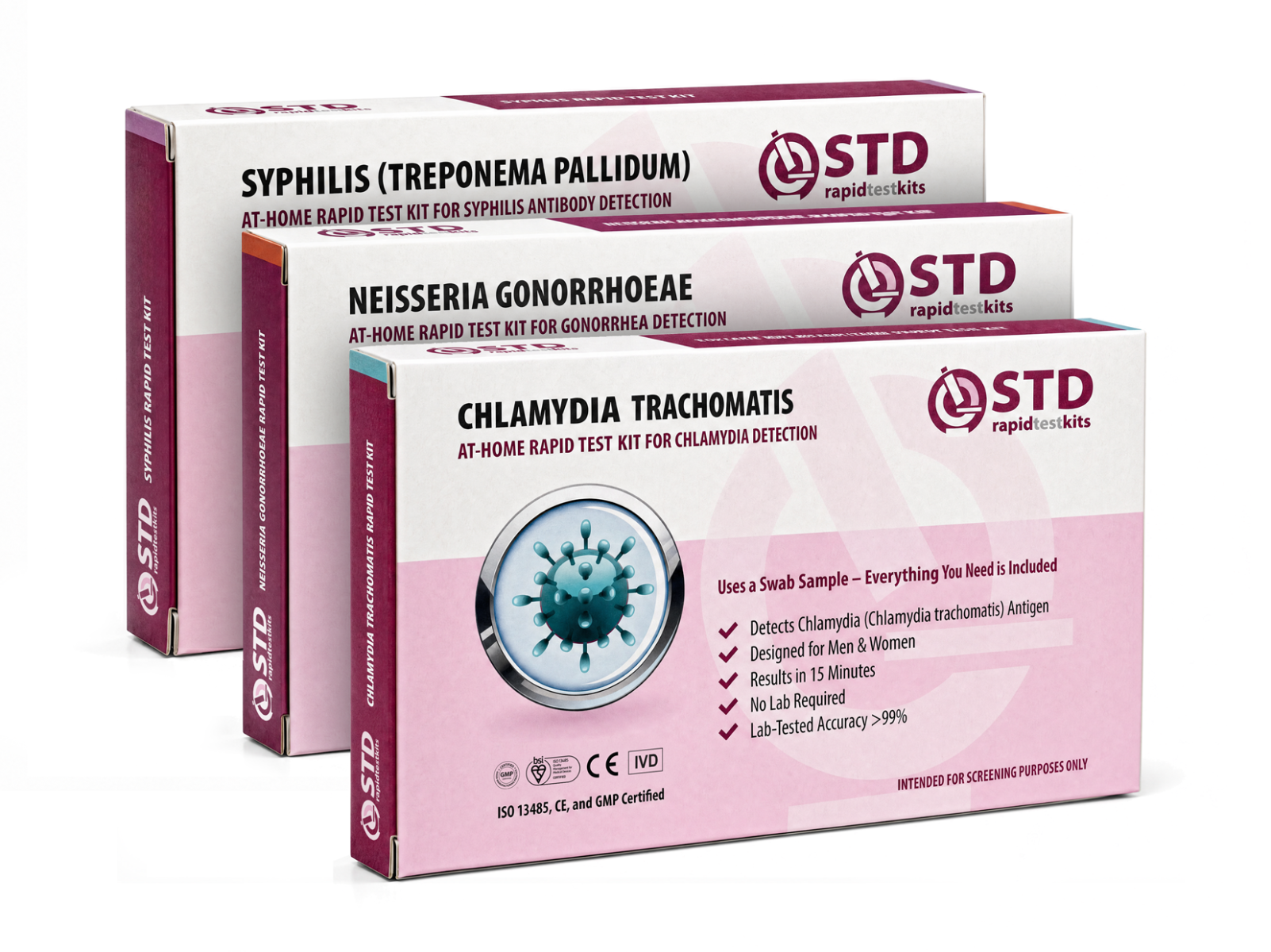
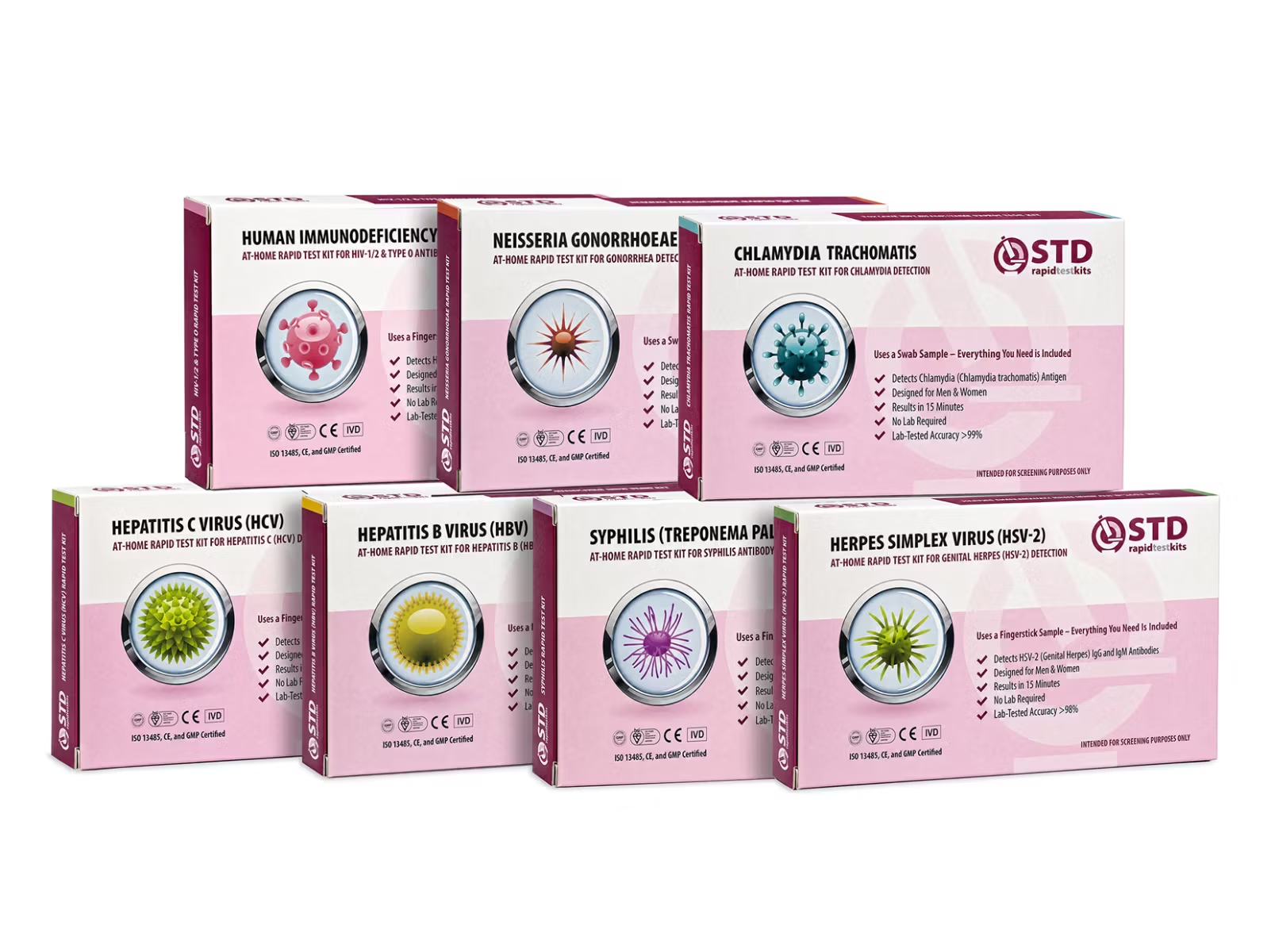
The rapid at-home STI tests sold on stdrapidtestkits.com cover chlamydia, gonorrhea, syphilis, HIV, hepatitis B, hepatitis C, HSV-1, HSV-2, trichomoniasis (women only), and HPV (women only), individually or in combination panels. None of them detect Mycoplasma genitalium. Mgen requires NAAT-grade molecular detection, which is not the same chemistry as a lateral-flow strip, so a rapid at-home test is not the right tool for it. For Mgen specifically, you need either a mail-in lab kit whose panel explicitly lists M. genitalium NAAT, or a clinic visit where you can ask the provider to order the test by name.
Where a rapid at-home kit still helps in a conversation about MG-B is at the front end of the workup. Mgen frequently coexists with chlamydia, and untreated chlamydia and gonorrhea cause the same urethritis, cervicitis, and downstream PID people worry about with Mgen. Ruling out the common bacterial STIs at home with an at-home STI test kit, fast and privately, narrows the differential. If your rapid result is clean and your symptoms persist, that is the moment to ask a clinician for an Mgen NAAT, with a much clearer story about what has already been ruled out.
For Mgen, a lab NAAT is the only definitive route currently available, so we will not sell you a chlamydia or gonorrhea swab and pretend it tests for Mgen. This site sells at-home STI kits, and we recommend them by fit for your concern, not commercial benefit.
How Mgen is treated
Treatment for Mycoplasma genitalium has changed sharply because of resistance. The CDC's current recommended approach has two stages.
Stage one: doxycycline
A seven-day course of doxycycline (100 mg twice daily) is given first. On its own, doxycycline does not reliably clear Mgen. The CDC includes it as Stage 1 specifically because it lowers the bacterial load and improves the effectiveness of the second-stage drug (CDC 2021 STI Treatment Guidelines).
Stage two: a macrolide or a fluoroquinolone, guided by resistance testing
If the strain has been confirmed macrolide-sensitive by resistance testing, a longer course of azithromycin follows the doxycycline. If the strain is macrolide-resistant (the MG-B pattern) or its resistance status is unknown, the second-stage drug is moxifloxacin, a fluoroquinolone, for seven days. The CDC reports cure rates above 90 percent when this resistance-guided approach is used. Without resistance testing, cure rates drop, but a doxycycline-plus-moxifloxacin regimen is still considerably more effective than a single dose of azithromycin alone.
Test of cure
Because resistance is common, the CDC recommends a follow-up NAAT about three to four weeks after treatment for symptomatic patients and for anyone treated with the alternative doxycycline-then-azithromycin regimen. For asymptomatic patients who completed a full recommended regimen, a test of cure is not required, though some providers still order one given current resistance patterns. Take the full course (do not stop when symptoms ease), and abstain from sexual contact during treatment and for seven days after completion.
A single old prescription of azithromycin from a pharmacy abroad, a friend's leftover antibiotics, or a one-dose chlamydia regimen will not reliably clear Mgen and is a major driver of further resistance. The CDC's two-stage doxycycline-then-targeted-drug regimen needs to be prescribed and monitored by a clinician.
Partner treatment and why it matters more than most people realize
The single largest predictor of Mgen recurrence is an untreated partner. Sexual-health research is consistent on this: when only the symptomatic person is treated, a substantial share of cases recur within twelve months. When current sexual partners, generally those from roughly the last 60 days, are treated alongside the index case, recurrence drops sharply. The CDC recommends that recent sexual partners be tested and, if positive, treated with the same resistance-guided regimen (CDC: Mycoplasma genitalium).
Many U.S. states allow expedited partner therapy (EPT), where the index patient receives an extra prescription to give to the partner without that partner needing their own clinic visit. EPT is most commonly authorized for chlamydia and gonorrhea, with state-by-state variation for other infections (CDC: Expedited Partner Therapy). For Mgen specifically, ask the clinic whether EPT is permitted in your state and whether it is being used for your diagnosis. If it is not, the partner may need to schedule their own visit.
The conversation with a partner does not have to be dramatic. A short, factual script tends to work: "My test came back positive for Mycoplasma genitalium. It does not always cause symptoms, so you may feel fine and still have it. The clinic recommended that anyone I have been recently intimate with get tested and, if exposed, treated. Here is the lab name; you can self-refer, or I can give them your number."
If a course of metronidazole works for two to three weeks and the same BV-like symptoms return, ask your provider three specific questions: (1) Can we run a NAAT panel that includes Mycoplasma genitalium and Trichomonas vaginalis? (2) Has my current partner been tested and, if appropriate, treated? (3) Does the antibiotic regimen need to change given current resistance patterns? Standard BV testing alone will not answer any of these.
When to push for Mgen testing (and when it is not necessary)
Most asymptomatic adults do not need Mgen screening. The CDC explicitly does not recommend it for general screening. Where the test earns its place is in specific clinical patterns the standard panel has not explained. Recurrent urethritis after a clean chlamydia and gonorrhea result is the single most common reason clinicians order an Mgen NAAT; persistent cervicitis, treatment-failed PID, and recurrent BV that bounces back after each metronidazole course are the others.
Strongest reasons to ask for an Mgen NAAT
- Recurrent or persistent non-gonococcal urethritis in men, especially after treatment for chlamydia
- Cervicitis or pelvic inflammatory disease that has not resolved after standard treatment
- Urethral, cervical, or BV-like symptoms that came back within weeks of finishing antibiotics
- Three or more rounds of metronidazole for recurrent BV in twelve months without lasting resolution
- A current sexual partner has been diagnosed with Mgen
- UTI-like symptoms in someone who tests negative for a urinary tract infection on urinalysis and culture
Reasons that are not strong enough on their own
- A single past sexual partner with no symptoms in either of you
- Anxiety after seeing social-media posts about MG-B, with no symptoms of your own
- Wanting a more thorough panel purely for general peace of mind
If your situation falls into the first list, ask directly: "Can you order a Mycoplasma genitalium NAAT, and if it is positive, can we do resistance-guided treatment based on macrolide-resistance markers?" If your provider does not offer it, sexual health clinics, Planned Parenthood, and direct-to-consumer mail-in lab services with Mgen on the panel are reasonable alternatives.
Prevention: same playbook, with one caveat
Mgen behaves like other bacterial STIs in terms of how to lower risk. Condoms substantially reduce transmission during vaginal and anal sex but do not eliminate it entirely, particularly where there is skin contact or fluid exchange outside the area a condom covers. Reducing concurrent partners and disclosing test results before condomless sex both lower risk meaningfully. Regular STI testing matters, with the caveat that "regular STI testing" usually means a standard panel that does not include Mgen.
The single Mgen-specific prevention point worth knowing: do not assume that a clear chlamydia or gonorrhea result clears you of bacterial urethritis as a category. If a partner reports persistent urethritis or pelvic symptoms after their own treatment, treat that as a flag for asking about Mgen specifically rather than dismissing it. For women considering testing more broadly, a multi-STI panel can rule out trichomoniasis, HPV, and the common bloodborne STIs at the same time as the bacterial swab tests. That combination still does not include Mgen, but it does take most of the differential off the table so the remaining diagnostic question becomes much narrower.
The takeaway
Mycoplasma genitalium has been hiding in plain sight for decades: common, undertested, and increasingly hard to treat because of resistance. The clinical picture (persistent urethritis, recurrent cervicitis, or recurring BV-like symptoms after a clean panel) is the single clearest signal that Mgen might be the missing piece. The treatment exists, and it works when matched to a strain's resistance profile. The action item for most readers is simple: if a routine STI test came back negative but your symptoms have not, ask your clinician specifically about Mycoplasma genitalium, and ask them to treat your current partner alongside you.
Three next steps if Mgen is on your radar
- Ask for a Mycoplasma genitalium NAAT by name at your next clinic visit; do not assume the standard panel includes it.
- If positive, request resistance-guided treatment using the CDC two-stage regimen (doxycycline followed by moxifloxacin or, only if macrolide-sensitive, azithromycin).
- Make sure your current partner is tested and, if positive, treated alongside you to prevent ping-pong reinfection.
Should You Ask for a Mycoplasma genitalium NAAT?
Do you have urethral, cervical, or BV-like symptoms that returned within weeks of finishing antibiotics, or three or more rounds of metronidazole for recurrent BV without lasting relief?
Yes: Ask your provider for a Mycoplasma genitalium NAAT by name, ideally with 23S rRNA macrolide-resistance testing bundled in.
Has a current or recent sexual partner been diagnosed with Mycoplasma genitalium?
Yes: Get tested even if you feel well. Mgen is often symptomless but still transmissible, so request the NAAT.
Are you symptom-free, with a negative routine panel and no known Mgen exposure?
Yes: Routine Mgen screening is not recommended for you; the CDC does not advise screening asymptomatic people.
No: If symptoms persist after a clean routine panel, bring those results to a clinic and ask for an expanded NAAT that includes Mgen and Trichomonas vaginalis.
Guidance only. Your clinician can advise based on your full history and exam.
FAQs
- What exactly is MG-B?
- MG-B is informal consumer-health shorthand for macrolide-resistant variants of Mycoplasma genitalium, a sexually transmitted bacterium recognized as an STI by the CDC and the WHO. The label is not used by the CDC or WHO and will not appear on a lab report; what you would see is "Mycoplasma genitalium positive, macrolide resistance detected." The practical concern is the same: these strains are hard to treat with first-line azithromycin and are rarely caught by standard STI panels.
- Was I tested for Mgen during my last STI screen?
- Almost certainly not, unless your provider specifically ordered a Mycoplasma genitalium NAAT. Standard panels in the U.S. cover chlamydia, gonorrhea, HIV, and syphilis, sometimes with trichomoniasis or hepatitis added. Mgen is a separate add-on test that has to be requested by name.
- Can I have Mgen without any symptoms?
- Yes. The CDC notes that people with Mgen often have no symptoms, and surveillance cohorts find that a large share of women and a meaningful fraction of men who test positive feel nothing at the time of testing. They can still transmit the bacterium to partners and can still develop reproductive complications over time, which is why partner testing is recommended regardless of symptom status.
- Why does Mgen get confused with bacterial vaginosis?
- Standard BV diagnostic methods (pH strip, microscopy, Amsel criteria, Nugent score) do not detect Mgen. Because the two conditions produce near-identical discharge and odor, many women complete several metronidazole courses for "recurrent BV" before a provider orders the NAAT that would identify the real underlying organism.
- If I was treated for chlamydia with azithromycin, did that also clear Mgen?
- Probably not. The single-dose azithromycin regimen long used for chlamydia is no longer reliable against Mgen because most strains carry macrolide-resistance markers. If your chlamydia treatment did not resolve your symptoms, that mismatch is one of the strongest signals to specifically ask for a Mycoplasma genitalium NAAT and resistance-guided treatment.
- Can Mgen be cured?
- Yes, but treatment has become more complicated because of antibiotic resistance. Current CDC guidance is a two-stage regimen of doxycycline followed by either azithromycin (if a strain is confirmed macrolide-sensitive) or moxifloxacin. Resistance-guided treatment achieves cure rates above 90 percent.
- Does treating my partner really make a difference?
- Yes, and this is one of the most consistent findings in the Mgen literature. When only the symptomatic patient is treated, recurrence rates within twelve months are substantial. When current sexual partners are treated alongside the index case, recurrence drops. Ask your clinic about expedited partner therapy (EPT) in your state.
- My home rapid STI test was negative but I still have symptoms. What now?
- A clean rapid panel rules out the infections that were on the panel; it does not rule out everything. If symptoms persist after a negative rapid result, the next step is a clinic visit with a request for an expanded NAAT panel that includes Mycoplasma genitalium and Trichomonas vaginalis, plus a clinical exam for cervicitis, urethritis, or pelvic findings that a home test cannot evaluate.
- U.S. Centers for Disease Control and Prevention. About Mycoplasma genitalium. Plain-language overview of symptoms, transmission, and complications; source for the asymptomatic-carriage and urethritis/cervicitis/PID statements.
- U.S. Centers for Disease Control and Prevention. Mycoplasma genitalium. 2021 Sexually Transmitted Infections Treatment Guidelines. Source for the confirmed/probable-cause clinical characterization, the 44 to 90 percent macrolide-resistance figure, the 0 to 15 percent S83I moxifloxacin-resistance figure, the two-stage doxycycline-plus-targeted-drug regimen, the above-90-percent resistance-guided cure rate, and the test-of-cure rules.
- U.S. Centers for Disease Control and Prevention. Expedited Partner Therapy (EPT) clinical guidance. Source for state-by-state variation in EPT authorization and the partner-treatment recommendations referenced in this article.
- World Health Organization. Sexually transmitted infections (STIs) fact sheet. Source for global STI surveillance context and the WHO's note that antimicrobial resistance in Mycoplasma genitalium is not yet systematically monitored.
- NHS. Sexually transmitted infections (STIs) overview. Source for general patient-facing guidance that many STIs are asymptomatic and that tests have window periods before they reliably detect infection.
- American Sexual Health Association. Mycoplasma genitalium: the STI you've (probably) never heard of. Patient-education overview; source for the 1981 first-identification date and the comparison-with-gonorrhea prevalence statement.
